Natto: Nutrient Profile
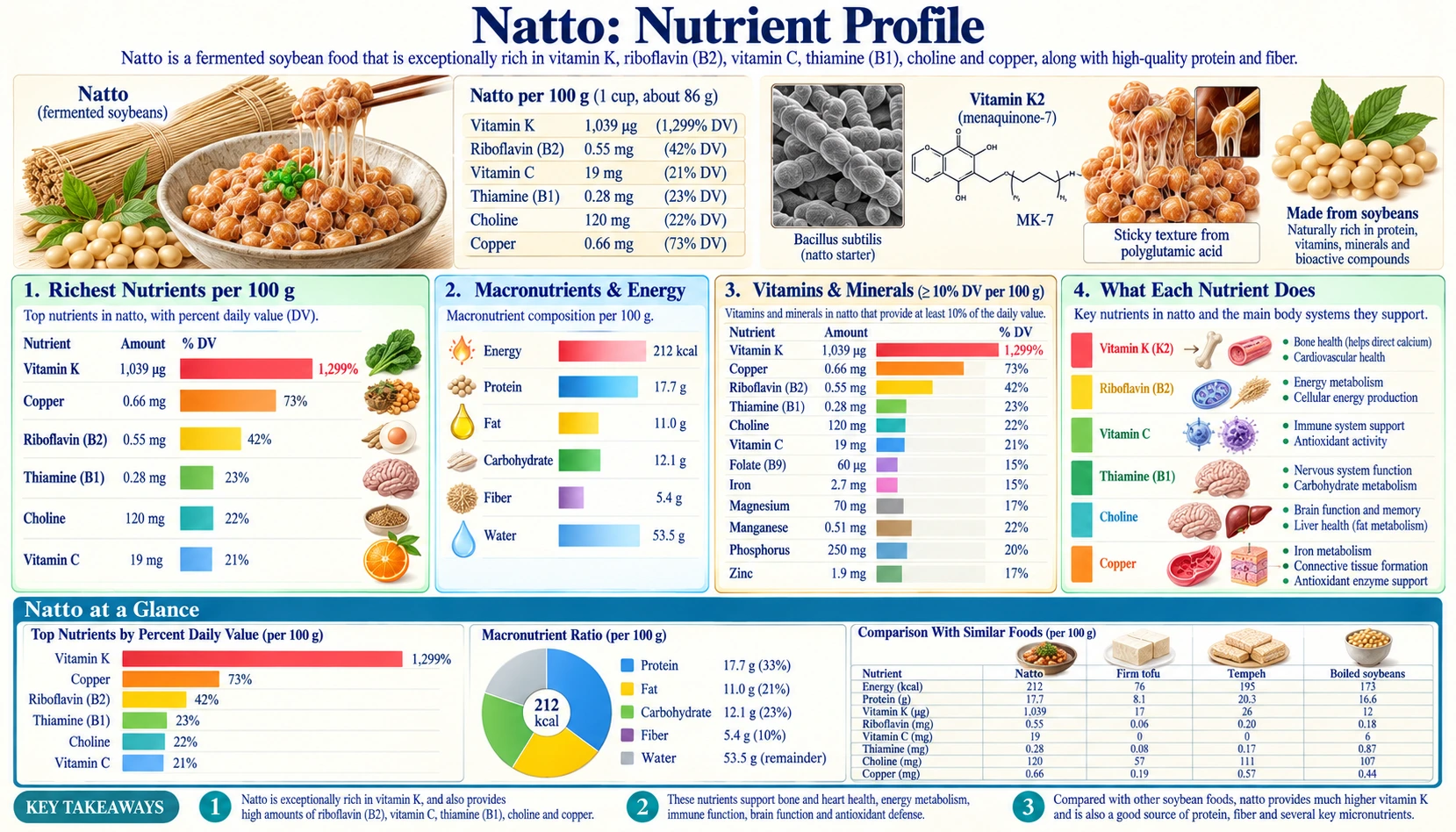
What is Natto richest in? Below are the vitamins, minerals and amino acids that 100 g of Natto delivers in the highest amounts. Each one links to that nutrient’s own page listing the best foods to get it from.
| Natto: Richest Nutrients (per 100 g) | ||||
|---|---|---|---|---|
| Rank | Nutrient | Per 100 g | %DV / 100g | Purpose |
| Vitamins | ||||
| 1 | Vitamin K | 23 mcg | 🟡 19% | Blood clotting & bone |
| 2 | Vitamin B2 (Riboflavin) | 0.2 mg | 🟡 15% | Energy & cell health |
| 3 | Vitamin C | 13 mg | 🟡 14% | Antioxidant; builds collagen |
| 4 | Vitamin B1 (Thiamine) | 0.2 mg | 🟡 13% | Turns carbs into energy |
| 5 | Choline | 57 mg | 🟡 10% | Brain & liver |
| Minerals | ||||
| 1 | Copper | 0.7 mg | 🟢 74% | Iron use; connective tissue |
| 2 | Manganese | 1.5 mg | 🟢 67% | Bone & metabolism |
| 3 | Iron | 8.6 mg | 🟡 48% | Carries oxygen in blood |
| 4 | Zinc | 3.0 mg | 🟡 28% | Immunity & healing |
| 5 | Magnesium | 115 mg | 🟡 27% | Muscle, nerves & energy |
| 6 | Calcium | 217 mg | 🟡 17% | Bones & teeth |
| 7 | Selenium | 8.8 mcg | 🟡 16% | Antioxidant & thyroid |
| 8 | Potassium | 729 mg | 🟡 16% | Blood pressure & fluid balance |
| 9 | Phosphorus | 174 mg | 🟡 14% | Bones & cellular energy |
| Amino Acids — ranked by amount (no Daily Value) | ||||
| 1 | Glutamic acid | 3.3 g | 🟢 | Brain signaling (glutamate) |
| 2 | Aspartic acid | 2.0 g | 🟢 | Cellular energy & detox |
| 3 | Leucine | 1.5 g | 🟡 | Builds muscle (branched-chain amino acid, BCAA) |
| 4 | Proline | 1.4 g | 🟡 | Collagen & joints |
| 5 | Lysine | 1.1 g | 🟡 | Collagen & immunity |
| 6 | Serine | 1.1 g | 🟡 | Cell membranes & brain |
| 7 | Valine | 1.0 g | 🟡 | Muscle & energy (branched-chain amino acid) |
| 8 | Phenylalanine | 0.9 g | 🟡 | Dopamine & focus |
| 9 | Isoleucine | 0.9 g | 🟡 | Muscle & energy (branched-chain amino acid) |
| 10 | Arginine | 0.9 g | 🟡 | Blood flow (nitric oxide) |
| 11 | Threonine | 0.8 g | 🟡 | Collagen & gut lining |
| 12 | Alanine | 0.8 g | 🟡 | Energy (glucose cycle) |
| 13 | Glycine | 0.6 g | 🟡 | Collagen, calm & sleep |
| 14 | Tyrosine | 0.6 g | 🟡 | Dopamine & thyroid |
Values are per 100 g of the U.S. Department of Agriculture (USDA) FoodData Central record FDC 172443, “Natto” (SR Legacy). %DV is the amount per 100 g divided by the adult Daily Value in 21 CFR 101.9.
About the vitamin K row: U.S. Department of Agriculture FoodData Central lists only phylloquinone (vitamin K1) for natto — the 23 mcg above. It does not count natto's vitamin K2 (menaquinone-7, MK-7), which is far larger: a laboratory analysis of Japanese foods measured 939 µg of menaquinone-7 per 100 g of natto (Kamao et al. 2007, J Nutr Sci Vitaminol — PubMed PMID: 18202532), in line with the roughly 1,000 µg per 100 g found in an earlier Dutch analysis (Schurgers & Vermeer 2000, Haemostasis — PubMed PMID: 11356998). See the Vitamin K2 (menaquinone-7) deep dive.
Natto and Warfarin
A Japanese report found that patients taking the blood thinner warfarin after heart-valve replacement had significantly raised Thrombotest values (a blood-clotting test) after eating natto, and further tests in people and rabbits showed natto to be strongly antagonistic to warfarin. The author suspected that the natto bacterium (Bacillus natto) makes large amounts of vitamin K in the gut, and measured a rise in blood vitamin K in healthy people after they ate natto. The author concluded that people taking warfarin need special food instructions (Kudo 1990, Artery — PubMed PMID: 2360879).
Natto Intake Linked to Less Bone Loss After Menopause
In a Japanese population study that measured bone mineral density in 944 women aged 20 to 79 and again 3 years later, postmenopausal women who habitually ate more natto lost less bone at the hip (femoral neck), and this link held after adjusting for age, body size, lifestyle, calcium intake and other soy foods. No such link was seen for tofu or other soybean products. The authors suggest the menaquinone-7 or the isoflavones in natto may explain it. This was an observational study, not a trial (Ikeda et al. 2006, J Nutr — PubMed PMID: 16614424).