Vitamin C: Food Sources & Daily Intake
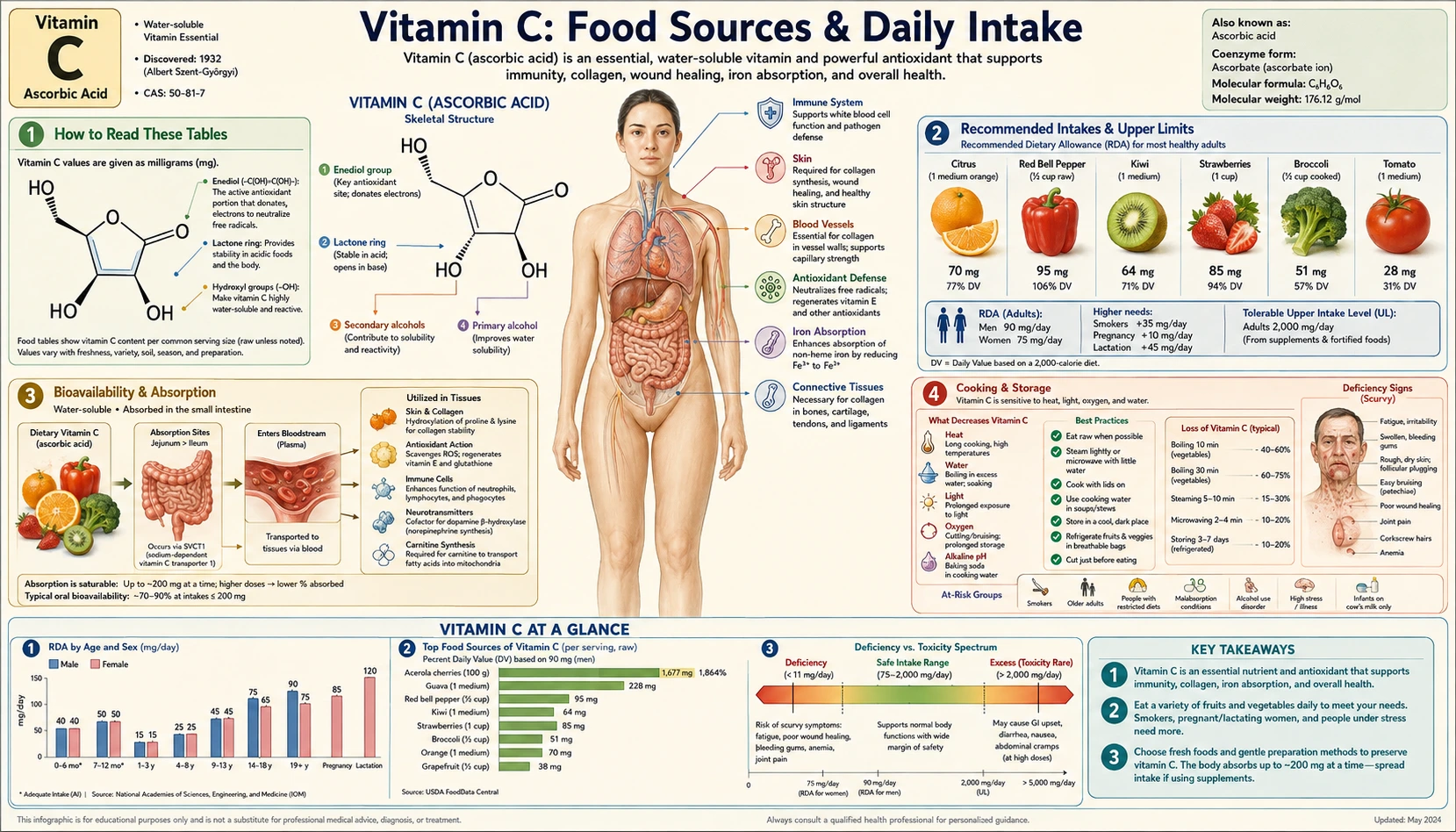
Vitamin C (ascorbic acid) is water-soluble and not stored in any quantity, so the body needs a fresh supply most days. Humans are among the few mammals that cannot make their own — we lost the enzyme — which is why diet matters so much. It is overwhelmingly a plant nutrient: peppers, citrus, berries, kiwi and cruciferous vegetables dominate, while meat and dairy contribute almost none.
| Vitamin C: Food Sources & Daily Intake | ||||||
|---|---|---|---|---|---|---|
| Rank | Food (serving) | Per 100 g | %DV / 100g | Glucose | Fructose | Notes |
| 1 | Guava 1 cup / 165 g | 228 mg | 🟢 253% | — | — | One of the richest whole-food C sources. |
| 2 | Red Bell Pepper, Raw 1 medium / 119 g | 128 mg | 🟢 142% | 1.9 | 2.3 | |
| 3 | Kale, Raw 1 cup / 21 g | 93 mg | 🟢 104% | 0.4 | 0.4 | |
| 4 | Kiwifruit 1 cup / 180 g | 93 mg | 🟢 103% | 4.1 | 4.3 | |
| 5 | Green Bell Pepper, Raw 1 medium / 119 g | 80 mg | 🟢 89% | 1.2 | 1.1 | |
| 6 | Broccoli ½ cup / 78 g | 65 mg | 🟢 72% | 0.5 | 0.7 | Steam rather than boil to keep more C. |
| 7 | Brussels Sprouts ½ cup / 78 g | 62 mg | 🟢 69% | — | — | |
| 8 | Papaya 1 cup / 145 g | 61 mg | 🟢 68% | 4.1 | 3.7 | |
| 9 | Strawberries 1 cup / 152 g | 59 mg | 🟢 65% | 2.0 | 2.4 | |
| 10 | Cauliflower, Raw 1 cup / 107 g | 48 mg | 🟢 54% | 0.9 | 1.0 | |
| 11 | Pineapple 1 cup / 165 g | 48 mg | 🟢 53% | 1.7 | 2.1 | |
| 12 | Orange 1 medium / 131 g | 45 mg | 🟢 50% | — | — | |
| 13 | Grapefruit (Pink/Red) ½ fruit / 123 g | 37 mg | 🟡 41% | — | — | |
| 14 | Cantaloupe (Melon), Raw 1 cup / 160 g | 37 mg | 🟡 41% | 1.5 | 1.9 | |
| 15 | Cabbage, Raw 1 cup / 89 g | 37 mg | 🟡 41% | 1.7 | 1.4 | |
| 16 | Mango 1 cup / 165 g | 36 mg | 🟡 40% | 2.0 | 4.7 | |
| 17 | Pork Organ Meats 3 oz / 85 g | 11 mg | 🟡 12% | — | — | Nutrient-dense organ meat. |
| 18 | Chicken Organ Meats 3 oz / 85 g | 12 mg | 🟡 14% | 0 | 0 | Nutrient-dense organ meat (giblets). |
Interactive Visualization Vitamin C, Collagen & Why Sailors Fell Apart Zip three protein chains into the strongest rope in biology — then take the vitamin C away and watch the helix unravel, and old healed scars split back open. Launch →
Table of Contents
How to Read These Tables
- Water-soluble — little is stored. Unlike the fat-soluble vitamins, excess vitamin C is excreted in urine within hours, so a steady daily intake matters more than any single large dose.
- %DV vs Recommended Dietary Allowance (RDA). The %DV column compares a serving against the U.S. Food and Drug Administration (FDA) Daily Value of 90 mg. Your personal target (the Recommended Dietary Allowance) is 90 mg for men and 75 mg for women, higher in pregnancy and for smokers — see the second table.
- Per 100 g vs per serving. Per-100 g lets you compare foods fairly; the serving size shown beside each food is what you actually eat. A single red pepper or a cup of strawberries clears a whole day’s need.
Recommended Intakes & Upper Limits
Your personal target depends on age, sex and pregnancy. The Daily Value used for the %DV column above is a single label figure; the table below is the age-specific guidance.
| Life stage | Recommended Dietary Allowance / Adequate Intake (mg/day) | Upper limit (mg/day) |
|---|---|---|
| Infants 0–6 mo | 40* (Adequate Intake) | Not set |
| Infants 7–12 mo | 50* (Adequate Intake) | Not set |
| Children 1–3 y | 15 | 400 |
| Children 4–8 y | 25 | 650 |
| Children 9–13 y | 45 | 1,200 |
| Males 14–18 y | 75 | 1,800 |
| Males 19+ y | 90 | 2,000 |
| Females 14–18 y | 65 | 1,800 |
| Females 19+ y | 75 | 2,000 |
| Pregnancy | 80–85 | 1,800–2,000 |
| Lactation | 115–120 | 1,800–2,000 |
Bioavailability & Absorption
At ordinary dietary intakes the gut absorbs vitamin C very efficiently (around 70–90%), but the fraction absorbed falls as the dose climbs — the body has a ceiling and simply excretes the surplus. Two practical points: vitamin C dramatically increases the absorption of non-heme (plant) iron when eaten in the same meal, so a squeeze of citrus on beans or greens is genuinely useful; and because it is water-soluble it is not affected by dietary fat the way the fat-soluble vitamins are.
Cooking & Storage
Vitamin C is the most fragile of the vitamins. It is degraded by heat, light, oxygen and especially water — boiling can leach away half or more because the vitamin dissolves into the cooking water. More of it is kept when C-rich produce is eaten raw, steamed or microwaved rather than boiled, cut just before cooking, and stored cold and covered once cut. Long storage and reheating also take a steady toll.
Vegetarian & Vegan Sources
This is the easiest vitamin for plant-based eaters. Every top source is a plant — peppers, citrus, kiwi, berries, broccoli, Brussels sprouts — while meat, fish, eggs and dairy supply almost none. Anyone eating a normal variety of fruit and vegetables comfortably exceeds the Recommended Dietary Allowance, and there is no animal-source gap to plan around.
Who Needs to Pay Attention
Groups with higher needs or a higher chance of running low: smokers (and heavy second-hand smoke exposure), who need an extra 35 mg/day; people who eat very little fresh fruit or veg; and those with malabsorption, dialysis, or heavy alcohol use. True deficiency causes scurvy — bleeding gums, easy bruising, poor wound healing, fatigue — which is now uncommon but still seen with very restricted diets. Because excess is excreted, toxicity is rare; very large supplemental doses mainly cause diarrhea and may raise kidney-stone risk in susceptible people.
Key Research Papers
- NIH Office of Dietary Supplements — Vitamin C Fact Sheet (DV, RDA, UL)
- Linus Pauling Institute — Vitamin C Micronutrient Information Center
- PubMed — vitamin C absorption, bioavailability and requirements. — Search PubMed