Corn - Beneficial Foods
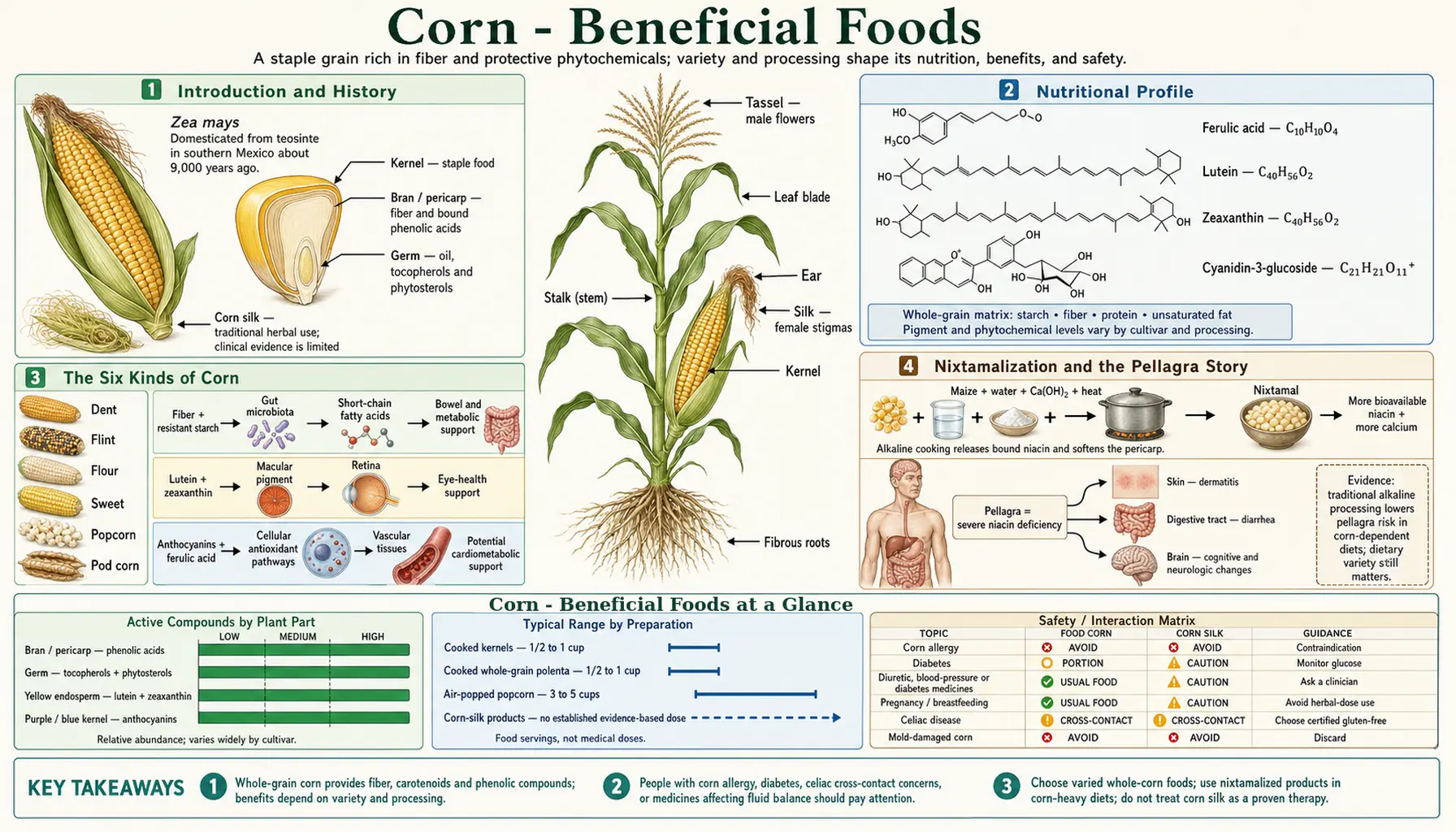
Corn is the food that most people think they already understand and mostly do not. It is at once a vegetable eaten fresh off the cob in high summer, one of the three grains that feed the world, and the raw material behind a long list of industrial ingredients that bear almost no resemblance to the plant. Those three identities have very different nutritional consequences, and confusing them is why corn gets praised and condemned in the same breath. This page keeps them separate: sweet corn as a vegetable, whole dried maize as a grain, and corn derivatives as something else entirely.
Table of Contents
- Introduction and History
- Nutritional Profile
- The Six Kinds of Corn
- Nixtamalization and the Pellagra Story
- Resistant Starch and the Gut
- Whole Corn Versus Corn Derivatives
- Lutein, Zeaxanthin and the Eye
- Fiber, Cholesterol and Blood Sugar
- Ferulic Acid and Bound Antioxidants
- How to Buy and Store Corn
- How to Prepare and Cook It
- How Much to Eat
- Who Should Be Careful
- Connections
- References & Research
- Featured Videos
Introduction and History
Corn is Zea mays, a giant annual grass in the same family as wheat, rice, barley and sugarcane. In most of the world outside the United States it is called maize, which is the more useful name because it avoids the old English sense of "corn" meaning whatever grain was locally dominant. The plant that feeds a fifth of humanity descends from a scrubby Mexican grass called teosinte, whose seed head holds five to twelve hard little kernels in two ranks and shatters at maturity to scatter them. A modern ear holds five hundred to a thousand kernels on a cob that does not shatter at all. The distance between those two objects is the single most dramatic transformation in the history of plant domestication.
Genetic work on maize landraces across the Americas points to one domestication event, not several, from the teosinte subspecies Zea mays ssp. parviglumis in the seasonally dry tropical forest of the Balsas River valley in southwestern Mexico. Starch grains and phytoliths recovered from grinding stones in that valley push the earliest evidence for domesticated maize back to roughly 8,700 years ago. Physical cobs, tiny ones about the length of a thumb, survive from Guilá Naquitz cave in Oaxaca at around 6,200 years old. So people have been eating corn for somewhere between eight and nine millennia, which makes it older in the human diet than written language.
From Mexico it moved fast: lowland South America by about 6,700 years ago, the American Southwest by roughly 4,100 years ago, and the Eastern Woodlands later still, where it joined beans and squash in the intercropped triad often called the three sisters. Columbus carried kernels back to Spain in 1493, and within a century maize was growing in West Africa, the Balkans, Italy and southern China. It succeeded because it is astonishingly productive per acre and per hour of labor, tolerates a wide range of climates, and stores well when dried.
What did not travel with the seed was the knowledge of how to cook it — an omission that caused a century of disease in Europe, the American South and southern Africa, and the subject of the nixtamalization section below.
Today maize is the largest cereal crop on earth by tonnage, at well over a billion tonnes a year. Very little of that is what a shopper would recognize as food. In the United States, sweet corn accounts for well under one percent of the corn acreage; the overwhelming majority is field corn destined for animal feed, ethanol, and the wet- and dry-milling streams that produce starch, syrup, oil, and alcohol. When a nutrition argument about "corn" is really an argument about sweeteners or feedlots, it is not an argument about the food on your plate.
Nutritional Profile
Because corn is eaten in three quite different states, one nutrient table cannot describe it. Here are three, all per 100 grams, from United States Department of Agriculture composition data. One medium ear of sweet corn yields about 90 grams of kernels, so the first list is close to a single ear.
Sweet corn, yellow, raw — per 100 g
- Energy: 86 kcal
- Water: 76.0 g
- Protein: 3.27 g
- Total fat: 1.35 g
- Carbohydrate: 18.7 g, of which sugars 6.26 g
- Dietary fiber: 2.0 g
- Potassium: 270 mg
- Phosphorus: 89 mg
- Magnesium: 37 mg
- Sodium: 15 mg
- Iron: 0.52 mg
- Zinc: 0.46 mg
- Manganese: 0.163 mg
- Copper: 0.054 mg
- Vitamin C: 6.8 mg
- Thiamin (B1): 0.155 mg
- Riboflavin (B2): 0.055 mg
- Niacin (B3): 1.77 mg
- Vitamin B6: 0.093 mg
- Folate: 42 mcg
- Vitamin K: 0.3 mcg
- Lutein plus zeaxanthin: 644 mcg
- Beta-carotene: 22 mcg
Whole dried yellow maize (field corn, grain) — per 100 g
- Energy: 365 kcal
- Water: 10.4 g
- Protein: 9.42 g
- Total fat: 4.74 g
- Carbohydrate: 74.3 g, of which sugars 0.64 g
- Dietary fiber: 7.3 g
- Potassium: 287 mg
- Phosphorus: 210 mg
- Magnesium: 127 mg
- Iron: 2.71 mg
- Zinc: 2.21 mg
- Manganese: 0.485 mg
- Copper: 0.314 mg
- Selenium: 15.5 mcg
- Thiamin (B1): 0.385 mg
- Riboflavin (B2): 0.201 mg
- Niacin (B3): 3.63 mg
- Vitamin B6: 0.622 mg
- Folate: 19 mcg
- Vitamin E: 0.49 mg
- Lutein plus zeaxanthin: about 1,355 mcg
Popcorn, air-popped — per 100 g
- Energy: 387 kcal
- Protein: 12.9 g
- Total fat: 4.54 g
- Carbohydrate: 77.8 g
- Dietary fiber: 14.5 g
- Potassium: 329 mg
- Magnesium: 144 mg
- Phosphorus: 358 mg
- Iron: 3.19 mg
- Zinc: 3.08 mg
Three things stand out. First, the fiber number moves enormously with water content: sweet corn is three-quarters water, so its 2 grams per 100 grams becomes 7.3 grams once the same kernel is dried, and 14.5 grams in popcorn. A 28-gram bowl of popcorn, which is a generous snack, delivers about 4 grams of fiber — more than most people get from any other snack food. Second, whole maize is a genuinely respectable source of magnesium, phosphorus, manganese and zinc, and yellow maize carries far more lutein and zeaxanthin than almost any other grain. Third, the niacin number on both lists is a lie unless the corn was treated with alkali, for reasons explained below.
Corn protein is real but incomplete. It is dominated by zein, a prolamin storage protein poor in lysine and tryptophan. This is why every traditional maize cuisine on earth pairs it with a legume — beans in Mesoamerica, cowpeas in West Africa, lentils where they grow. Beans supply the lysine that maize lacks; maize supplies the sulfur amino acids that beans are short of. The combination is not folklore, it is complementary amino acid chemistry, and it was worked out empirically thousands of years before anybody could name an amino acid.
The Six Kinds of Corn
Six endosperm types cover essentially all of the corn people grow, and knowing which one is in your hand tells you how to cook it.
- Dent corn — the workhorse. Soft starch in the kernel crown shrinks as it dries and leaves a dimple, hence the name. Ground into cornmeal, grits and masa; also the main feed and industrial corn.
- Flint corn — hard and glassy, low in soft starch, resistant to insects and rot in humid storage. Northern Italian polenta corn and ornamental multicolored "Indian corn" are flints; it grinds to a coarser meal.
- Flour corn — nearly all soft starch, so it grinds easily by hand. The corn of the American Southwest and the Andes, and the reason a stone metate works at all.
- Popcorn — a small-kernelled flint with a moisture-tight pericarp. Heat turns its roughly 14 percent internal water to steam until the hull ruptures near 180 °C and the starch inflates. No other corn does this properly.
- Sweet corn — a mutant that cannot convert sugar to starch efficiently in the endosperm, so it stays sweet and tender at the immature milk stage when we pick it. This is corn as a vegetable.
- Waxy corn — nearly pure amylopectin, grown for industrial thickeners rather than the table.
Sweet corn comes in three genetic classes worth knowing at the market. Standard sugary (su1) types have the classic corn flavor but convert sugar to starch within hours of picking. Sugary enhanced (se) types are sweeter and hold longer. Shrunken-2 (sh2) "supersweet" types hold sugar for days, which is why supermarket corn in February is still sweet and also why it tastes less like corn: sweetness and corn flavor are not the same thing.
Color matters nutritionally. Yellow and orange kernels carry the xanthophyll carotenoids. White corn has almost none. Blue, red and purple maizes carry anthocyanins in the aleurone layer at concentrations comparable to dark berries, and the pigmented landraces of Mexico and Peru are the most antioxidant-rich corns available. If you can buy blue corn masa or purple Peruvian maize, you are getting a meaningfully different food, not a novelty.
Nixtamalization and the Pellagra Story
This is the part of corn's story that everyone should know, because it is the clearest example in nutrition of traditional food processing solving a biochemical problem that science needed until 1937 to describe.
Maize contains a respectable amount of niacin, vitamin B3, on paper. The problem is that most of it is bound — esterified to hemicellulose and small peptides in a complex historically called niacytin — and the human gut cannot free it. Eat corn as plain porridge or plain bread and you absorb only a small fraction of the niacin the composition table promises. Compounding this, corn protein is unusually poor in tryptophan, the amino acid the body can convert into niacin at roughly a 60-to-1 ratio. So a maize monodiet fails twice on the same vitamin: the niacin present is locked up, and the backup pathway is starved of raw material.
The result is pellagra, once described by the four Ds: dermatitis in a symmetrical, sun-exposed, sharply bordered rash; diarrhea; dementia; and death. Gaspar Casal described it in Spain in 1735 as mal de la rosa. It swept northern Italy, Romania, Egypt, and southern Africa wherever maize became the dominant calorie without the accompanying technique. In the American South between about 1906 and 1940 there were an estimated three million cases and one hundred thousand deaths. Joseph Goldberger proved through the 1910s and 1920s that it was dietary rather than infectious — famously by inducing it in volunteers with a maize-heavy diet and failing to transmit it by injecting himself and his wife with patients' blood and secretions. Conrad Elvehjem identified nicotinic acid as the missing factor in 1937 by curing canine black tongue with it.
Meanwhile, in Mexico and Guatemala, people had eaten maize as their principal food for thousands of years and pellagra was essentially unknown. The reason is nixtamalization, from the Nahuatl nextli (ashes) and tamalli (dough). Dried kernels are simmered and then steeped, typically overnight, in water made alkaline with calcium hydroxide — slaked lime, called cal — or with wood ash. The kernels are then rinsed, rubbed to slip off the softened outer pericarp, and ground into masa. Cooking pots bearing lime residues push the technique back to at least 1500–1200 BC in the Guatemalan highlands.
What the alkali does, in order of importance:
- It frees the niacin. Alkaline hydrolysis cleaves the ester bonds holding niacin to the grain's carbohydrate matrix, converting bound niacin into the free, absorbable form. This single chemical step is the difference between a maize staple that sustains a civilization and one that produces pellagra.
- It adds calcium, a lot of it. Untreated maize holds roughly 7 to 10 mg of calcium per 100 g. Lime-treated masa and tortillas typically run well over 100 mg per 100 g, and often 150 to 200 mg, because calcium from the cooking liquor diffuses into the kernel. In a diet where maize supplies most of the calories, that turns the staple into the main calcium source.
- It improves the amino acid balance. Alkali degrades some of the zein and improves the relative availability of lysine and tryptophan, raising the protein quality of the resulting dough above that of the raw grain.
- It reduces mycotoxins. Alkaline cooking substantially lowers fumonisin content, and much of what remains is washed away with the steep liquor and the pericarp. Aflatoxin is also partly degraded. This is a food safety benefit that matters a great deal in humid maize-growing regions.
- It makes the dough work. Partial starch gelatinization and pericarp removal are what let masa hold together as a tortilla or tamal without any gluten. The culinary motive was probably the original one; the nutrition came along for free.
The practical takeaway for a modern kitchen: if you eat corn as a staple rather than an occasional vegetable, prefer the nixtamalized forms. Corn tortillas and tamales made from masa or masa harina, hominy, posole and menudo are all nixtamalized. Ordinary cornmeal, corn grits, polenta, cornbread from plain cornmeal, and cornstarch are not. Check a masa harina bag for "corn treated with lime" or "calcium hydroxide" in the ingredients — that phrase is the whole point. Note also that this is not the same thing as the alkali-free "corn flour" sold for baking.
Resistant Starch and the Gut
Corn starch is about 75 percent amylopectin and 25 percent amylose in ordinary dent varieties, and amylose is the fraction that resists digestion. Starch that escapes digestion in the small intestine reaches the colon intact and behaves like fiber: resident bacteria ferment it into short-chain fatty acids, principally butyrate, which is the preferred fuel of the cells lining the colon. Corn is one of the more useful everyday sources of this material, for two separate reasons.
The first is retrogradation, formally type 3 resistant starch. When cooked starch cools, amylose chains that gelatinized and unwound during heating re-associate into tight crystalline structures that digestive amylase struggles to attack. Cook polenta or grits and eat them hot and you get mostly rapidly digestible starch. Let the same polenta set overnight in the refrigerator, then slice and reheat it, and a measurable share of that starch has become resistant. The same holds for corn tortillas, which are cooked, cooled, and often reheated — a sequence that is essentially a resistant-starch factory. Reheating does not undo it; the recrystallized fraction is thermally stable at normal kitchen temperatures.
The second is high-amylose maize, formally type 2. Specialty lines bred to 60 to 70 percent amylose are the standard experimental source of resistant starch in human research, which is why most of what is known about resistant starch at all was learned with corn. In controlled feeding studies roughly 30 grams a day improved insulin sensitivity in healthy adults over four weeks. That is a supplement dose of an isolated ingredient rather than anything you get from an ear of corn — read it as mechanism, not as a recommendation — but the effect is real.
What you can reasonably expect from whole corn in a normal diet: a moderate contribution of fermentable substrate that feeds butyrate-producing bacteria, softer and more regular stools from the insoluble bran, and a lower glycemic response from cooked-and-cooled preparations than from freshly cooked ones. For a fuller treatment of the category, see Resistant Starches, and compare the beta-glucan route taken by oats and barley, which is soluble-fiber chemistry rather than starch crystallography.
Whole Corn Versus Corn Derivatives
A corn kernel has three parts. The pericarp or bran is the outer skin, almost pure insoluble fiber, and the part that sticks in your teeth. The germ is the embryo, about 11 percent of the kernel, and it holds nearly all the oil, the vitamin E, most of the B vitamins and much of the magnesium, iron and zinc. The endosperm is the rest, roughly 82 percent, and it is starch plus zein protein.
Every industrial corn product is defined by which of those three it keeps.
- Whole-grain cornmeal, whole hominy, whole-grain masa, popcorn, and fresh sweet corn keep all three parts. These are whole foods and belong in a normal diet.
- Degerminated cornmeal and grits — the standard supermarket kind — have the germ and most of the bran removed so the product does not go rancid on the shelf. That trade costs most of the magnesium, vitamin E and fiber. The label reads "degerminated" or "enriched"; whole-grain cornmeal says so explicitly and lives in the refrigerated or frozen case for a reason.
- Cornstarch is endosperm starch alone: no fiber, no fat, no micronutrients. A thickener, not a food.
- Corn oil is germ oil, extracted and refined. Predominantly linoleic acid, so it is a concentrated source of omega-6 fat with none of the grain's fiber or minerals. If a household wants a cooking fat, olive oil is a better default.
- Glucose syrup, high-fructose corn syrup, dextrose, maltodextrin, and crystalline fructose are enzymatic breakdown products of cornstarch. They are sugars, and the fact that the carbon atoms came from a grain does not make them anything else. High-fructose corn syrup rose from essentially nothing in 1970 to a major share of American added sweetener by the 1990s, and that shift is one of the reasons corn's reputation as a food is so poor. The criticism is fair; it simply is not a criticism of corn on the cob.
Modified starches, citric acid, xanthan gum and the rest of the ingredients manufactured from corn feedstock are not corn in any nutritional sense, and carry neither its benefits nor, for most people, its problems. The exception is people with true corn allergy, who sometimes react to trace protein in poorly refined derivatives.
Lutein, Zeaxanthin and the Eye
Yellow corn is one of the richest common sources of zeaxanthin and a solid source of lutein. These two xanthophylls are the only dietary carotenoids concentrated in the macula of the human retina, where they form the yellow macular pigment. That pigment absorbs high-energy short-wavelength blue light before it reaches the photoreceptors, and quenches the singlet oxygen and peroxyl radicals generated in the most metabolically active and most light-exposed tissue in the body.
Raw yellow sweet corn supplies roughly 644 micrograms of lutein plus zeaxanthin per 100 grams; whole yellow maize runs about twice that. What distinguishes corn is the ratio: most vegetables deliver lutein with only traces of zeaxanthin, while corn is unusually zeaxanthin-rich. Since zeaxanthin dominates the very center of the macula, corn fills a slot leafy greens do not.
The strongest clinical evidence comes from the Age-Related Eye Disease Study 2, which tested 10 mg of lutein and 2 mg of zeaxanthin in older adults with age-related macular degeneration. Adding them to the original formula did not further reduce progression in the primary analysis, but in secondary analyses they outperformed beta-carotene and helped participants whose baseline dietary intake was lowest. Stated honestly: these carotenoids look most useful for people who are not getting them, which is an argument for food rather than pills. Observational data consistently link higher dietary intake to lower risk of both macular degeneration and cataracts.
Two practical points. Carotenoids are fat-soluble, so corn eaten with butter, cream, cheese, avocado or a good oil delivers substantially more of them into your bloodstream than corn eaten dry. And cooking helps: heat disrupts the cell walls and the protein-carotenoid complexes, so cooked corn releases its xanthophylls more readily than raw, even though a little vitamin C is lost in the process. Egg yolk is the other standout zeaxanthin source and, like corn, benefits from being eaten with its own fat intact — see eggs.
Fiber, Cholesterol and Blood Sugar
Corn's fiber is mostly insoluble — cellulose, hemicellulose and lignin in the pericarp — which makes it a bulking, transit-accelerating fiber rather than a cholesterol-binding one. It does not lower LDL cholesterol the way the beta-glucan in oats and barley does, and it is honest to say so. What insoluble fiber does well is add stool bulk, shorten transit time, and dilute the concentration of irritants in the colon. Higher intakes of cereal fiber in particular track with lower rates of diverticular disease and colorectal cancer in prospective cohorts, and corn bran is a legitimate contributor to that intake.
On blood sugar, corn behaves better than its starch content suggests, and the form matters more than the amount:
- Sweet corn has a glycemic index around 52 on the glucose scale — low. Its intact cell walls, water content and modest 18.7 g of carbohydrate per 100 g keep the glucose curve shallow.
- Corn tortillas come in near 50, helped by nixtamalization, the retrograded starch from cooling, and the small portion size of a single tortilla.
- Popcorn lands around 65 — medium — but the portion is tiny by weight, so the glycemic load of a realistic serving is small.
- Cornmeal porridge and polenta run around 68 and higher, because grinding destroys the cell-wall barrier and hot, freshly gelatinized starch is maximally accessible to amylase. Cooling and reheating pulls this number down.
- Cornstarch and corn syrup sit at the top of the scale. Nothing about the parent grain protects them.
The pattern is completely general: the more intact the kernel structure, the gentler the metabolic response. A whole boiled ear, a bowl of hominy and a stack of corn tortillas are reasonable food for someone managing type 2 diabetes or metabolic syndrome, particularly eaten alongside protein and fat. Cornstarch-thickened sauces, corn syrup and finely milled instant grits are not, and neither is a large bowl of hot polenta on its own.
Corn also earns a share of the general whole-grain benefit. Dose-response meta-analysis of prospective cohorts puts each additional 90 grams of whole grains per day at roughly a 17 percent lower risk of all-cause mortality, with reductions in cardiovascular disease and colorectal cancer as well. Whole maize counts as a whole grain; degerminated cornmeal and cornstarch do not.
Ferulic Acid and Bound Antioxidants
When the total antioxidant activity of the major cereal grains was measured systematically, corn came out on top — roughly double wheat and oats and several times rice. The interesting part is where that activity lives. In corn, over 85 percent of the phenolic content is bound, cross-linked into the cell walls of the bran rather than floating free in the cytoplasm. The dominant compound is ferulic acid, esterified to arabinoxylan, and corn is one of the densest dietary sources of it.
Bound phenolics behave quite differently from free ones. They survive stomach acid and small-intestinal digestion largely intact, then travel to the colon where bacterial esterases release them. Corn's antioxidant capacity is therefore delivered where the fermentation happens rather than absorbed in the upper gut, which is a plausible part of why cereal bran looks protective for the colon specifically. It also means a standard laboratory antioxidant assay run on an extract badly underestimates corn, because the solvent never releases the bound fraction.
Pigmented maize adds a second layer: anthocyanins, chiefly cyanidin-3-glucoside and its malonylated derivatives, concentrated in the aleurone of blue and purple varieties. A tortilla made from blue corn masa is, compound for compound, one of the more phytochemically interesting starchy foods in an ordinary grocery store.
How to Buy and Store Corn
Fresh sweet corn. Freshness dominates everything else, because a picked ear is a living organ that keeps respiring and burns its own sugar for fuel. Standard sugary varieties can lose a substantial share of their sugar within a day at room temperature; the loss is dramatically slower at refrigerator temperature. That single fact explains every piece of traditional corn advice, including the old exaggeration about having the pot boiling before you walk to the field.
What to look for:
- Husks bright green, tightly wrapped and slightly damp — not dry, yellowed or loose.
- Silks at the tip brown and slightly sticky. Black, dry or slimy silk means old or spoiling.
- An ear that feels heavy for its size, with plump kernels you can feel in rows through the husk right to the tip.
- A cut stem end that looks moist and pale rather than dark and dried out.
- Please do not peel back the husk in the store. It dries out the ear you reject and every shopper after you pays for it. Feel through the husk instead.
Take it home and refrigerate it in the husk, unwashed, in the coldest part of the refrigerator, ideally in a loose plastic bag. Use within one to two days; three at a push for supersweet types. Do not trim or shuck until you are ready to cook.
Freezing. Corn freezes better than almost any vegetable, but only if you blanch first — unblanched kernels keep their enzymes active and turn starchy and off-flavored within weeks. Shuck, then blanch whole ears in boiling water about 7 minutes for small, 9 for medium, 11 for large; ice-bath for the same time, drain, cut the kernels off and pack with the air pressed out. Quality holds about a year. Kernels cut before blanching need only 4 minutes.
Dried corn, cornmeal and masa harina. Whole-grain cornmeal contains the oil-rich germ, so it goes rancid: expect two to three months at cool room temperature, six months to a year sealed in the freezer. Smell it first — rancid cornmeal has a sharp crayon-like odor and will ruin whatever you bake. Degerminated cornmeal keeps far longer precisely because the perishable part is gone. Masa harina holds six months or more sealed and cool. Whole dried kernels keep a year or two in an airtight jar; popcorn dried below about 13 percent moisture pops poorly, and a teaspoon of water shaken into the jar for a couple of days often revives it.
Canned and frozen. Both are legitimate. Frozen kernels are processed within hours of picking and are often better than tired fresh corn out of season. Canned corn loses some vitamin C and thiamin to the retort but keeps its carotenoids, fiber and minerals; choose versions without added sugar, and drain, since the sodium sits in the packing liquid.
How to Prepare and Cook It
Fresh ears, in water. Bring a wide pot of unsalted water to a rolling boil, drop the shucked ears in, and give them 3 to 5 minutes once the water returns to the boil. Modern sweet corn needs far less time than old recipes suggest; the goal is to heat it through, not cook the sugar out. Salt lightly or not at all — heavily salted water toughens the kernel skins — and salt at the table. A knob of butter or a splash of whole milk in the pot helps carry the carotenoids.
On the grill. The best method for flavor. Leave the husk on, pull off the loose outer leaves, soak the ears 15 minutes in cold water, and grill over medium heat 15 to 20 minutes, turning every 5; the husk steams the kernels and chars enough to perfume them. For direct-fire char, shuck completely and grill 8 to 10 minutes with frequent turning until the kernels blister and spot brown — that Maillard browning is where elote gets its character. Finish with butter or crema, cheese, chile and lime.
In the oven. Whole ears in the husk, 200 °C for 25 to 30 minutes, is the least attended method. To cut kernels off, stand the ear upright in a wide bowl, cut downward, then scrape the cob with the back of the blade for the milky liquid. Keep the cobs: simmered 30 minutes they make a sweet stock for chowder.
Polenta and grits. Whisk 1 part coarse whole-grain cornmeal into 4 parts of simmering water or stock in a steady stream, then cook at the barest simmer for 30 to 45 minutes, stirring often, until the grains have lost their raw bite. Coarse meal needs the long version; there is no shortcut that produces the same texture. Finish with butter and cheese. To capture the resistant-starch benefit, pour the finished polenta into a shallow pan, refrigerate overnight, then slice and pan-fry or grill it the next day.
Nixtamalizing at home. Easier than it sounds, and worth doing once for the education. Rinse 1 kg of whole dried field corn; combine with about 2 litres of water and 10 grams of food-grade calcium hydroxide (cal), 1 percent of the corn's weight — buy it where masa ingredients are sold and do not substitute another alkali. Simmer 20 to 40 minutes until a kernel's pericarp slips off when rubbed between your fingers, then take it off the heat and steep 8 to 12 hours or overnight. Drain, discard the yellow liquor, and rinse and rub the kernels until the water runs clear and most of the skins are gone. What you have is nixtamal, which is hominy: cook it in soup as posole, or grind it wet for fresh masa. Handle the lime carefully — it is caustic dry and in solution, so keep it off skin and out of eyes, and this is not a job with small children helping.
Tortillas from masa harina. Mix roughly 2 parts masa harina to 1.3 parts warm water with a pinch of salt, knead 2 minutes, rest 20 minutes covered, then press walnut-sized balls between plastic sheets and cook on a dry hot griddle: 30 seconds, flip, 45 seconds, flip again and it should puff. Ten minutes of practice and homemade tortillas are permanently better than the packaged kind.
Popcorn on the stove. Two tablespoons of butter, ghee or coconut oil in a heavy pot over medium heat, add 60 grams of kernels, cover with the lid slightly ajar so steam escapes, and shake occasionally until the popping slows. Salt while hot. Three ingredients, pennies a bowl, and a whole grain — one of the best value-for-nutrition snacks in any kitchen.
Pairing. Put a legume on the plate. Corn with beans is the oldest complete-protein combination in the Americas, and the same logic applies to chickpeas or lentils. Add fat for the carotenoids and something acidic and green for contrast, and corn stops being a starch side and becomes a meal.
How Much to Eat
Corn sits in the starchy vegetable group when it is fresh and in the whole-grain group when it is dried, and it is worth counting it honestly in whichever slot applies.
- Fresh sweet corn: one medium ear yields about 90 grams of kernels, roughly 77 kcal, 17 g of carbohydrate and 2 g of fiber. One to two ears is a normal portion. Two to four ears a week in season is an easy, sensible amount.
- As a starchy vegetable: a 2,000-calorie eating pattern has room for about 5 cups of starchy vegetables a week in total, shared with potatoes, sweet potatoes, pumpkin and winter squash. Corn should take a slice of that, not all of it.
- Corn tortillas: two to three small tortillas, about 75 to 100 grams, is a standard meal's worth and provides meaningful calcium from the lime treatment.
- Polenta, grits or hominy: about 60 grams of dry meal, or a cup of the cooked dish, per serving.
- Popcorn: 25 to 30 grams of unpopped kernels makes a large bowl and delivers around 4 grams of fiber. This is a genuinely good snack.
The important boundary is not a gram figure, it is a substitution rule. Corn should displace refined starch, not vegetables. Corn instead of white bread, crackers or a sugary snack is a clear gain. Corn instead of leafy greens, crucifers or berries is a loss, because corn is mediocre at what those foods do well — little vitamin C after cooking, almost no vitamin K, modest calcium unless nixtamalized, no vitamin B12. Keep it in rotation with barley, oats and the legumes rather than making it the grain you eat every day.
Anyone eating maize as an actual staple — most of the calories, most days — needs the nixtamalized forms and a daily legume, for the reasons in the pellagra section. Pellagra still appears where maize-dominant diets lack both.
Who Should Be Careful
Corn is a benign food for the large majority of people. The genuine cautions are these.
Corn allergy
True IgE-mediated corn allergy is uncommon but well documented. The principal culprit is Zea m 14, a nonspecific lipid transfer protein in the kernel that is heat- and digestion-stable and can therefore cause systemic reactions rather than only oral itching; reported reactions run from urticaria to anaphylaxis. Because lipid transfer proteins are structurally similar across plant families, some corn-allergic people react to peach, rice or wheat as well. They are also the one group for whom highly processed derivatives matter, since trace protein can carry through into inadequately refined starches and syrups — a real problem given how many packaged foods contain something corn-derived. Suspected corn allergy warrants proper testing rather than guesswork; a corn-free diet is genuinely hard to maintain.
Celiac disease and gluten
Corn contains no gluten and is a mainstay of the gluten-free diet. Its prolamin is zein, not the wheat, rye or barley protein that drives celiac disease. Isolated case reports describe zein reactivity in people whose symptoms persist on an otherwise strict diet, but this is rare and no reason to avoid corn preemptively. The practical risk is cross-contamination: cornmeal and masa milled on shared equipment can carry wheat, so buy certified gluten-free products.
Phytate and mineral absorption
Whole maize contains roughly 0.6 to 1.0 grams of phytic acid per 100 grams, concentrated in the germ and aleurone. Phytate chelates zinc and iron in the gut lumen and reduces their absorption; maize-based diets are a recognized contributor to zinc deficiency where they dominate. On a varied diet this is unimportant, and the same phytate has antioxidant activity, so the trade is a net wash. Where maize is the staple it matters, and the mitigations are traditional: soaking, fermentation (ogi, kenkey and sourdough approaches all reduce phytate substantially via the grain's own phytase and microbial phytases), sprouting, and a source of vitamin C or animal protein at the same meal to improve iron uptake. Nixtamalization is excellent for niacin and calcium but only modestly reduces phytate.
Mycotoxins in poorly stored corn
Maize is the crop most associated with two fungal toxins. Aspergillus flavus produces aflatoxins, potent liver carcinogens; Fusarium verticillioides produces fumonisins, associated with esophageal cancer and with neural tube defects in maize-dependent populations. Regulated commercial supplies are tested and generally safe; the risk concentrates in home-stored, humid, damaged or visibly moldy grain. Practical rules: never eat corn or cornmeal that smells musty or shows mold, discard rather than trim moldy kernels, store dried corn cool and sealed — and note that nixtamalization substantially reduces fumonisin and partly degrades aflatoxin, one more argument for the traditional technique.
Digestion, FODMAPs and the intact hull
The pericarp is cellulose and lignin and human enzymes cannot touch it, which is why recognizable corn appears in the stool. That is normal, not malabsorption — the kernel's interior was digested and only the skin passed through. Chewing thoroughly, or eating corn as masa with the pericarp removed, reduces the effect. Sweet corn also contains sorbitol and some fructans and is classed as high-FODMAP above about half a cob; people with irritable bowel syndrome often tolerate a small portion and not a large one. Popcorn hulls irritate some people with diverticular disease, though the old blanket advice to avoid all nuts, seeds and popcorn after diverticulitis has not held up in prospective data.
Interactions and specific conditions
- Kidney disease: corn is moderate in potassium (270 mg per 100 g fresh) and moderate in phosphorus. Anyone on a potassium- or phosphorus-restricted diet for chronic kidney disease should fit it into their allowance rather than treating it as a free food.
- Warfarin: corn is very low in vitamin K, about 0.3 micrograms per 100 grams, so it does not interfere with anticoagulation the way leafy greens can. This is one of the rare cases where a food's nutritional weakness is a clinical convenience.
- Corn silk: the dried stigmas are a traditional diuretic taken as a tea, and unlike the kernel they do have plausible drug interactions — additive effects with prescription diuretics, possible additive glucose lowering with diabetes medication, and a theoretical risk of raising lithium levels through altered clearance. Corn silk tea is a herbal preparation and should be treated as one; eating corn is not.
- Infants: whole kernels are a choking hazard under about four years of age. Serve corn cut off the cob and lightly crushed, or as polenta or masa.
None of this is medical advice, and none of it replaces a conversation with your own clinician about your own situation.
Connections
- All Food
- Resistant Starches
- Beans
- Lentils
- Barley
- Oats
- Vitamin B3 (Niacin)
- Lutein
- Zeaxanthin
- Ferulic Acid
- Macular Degeneration
- Celiac Disease
References & Research
- Matsuoka Y, Vigouroux Y, Goodman MM, Sanchez GJ, Buckler E, Doebley J. A single domestication for maize shown by multilocus microsatellite genotyping. Proceedings of the National Academy of Sciences, 2002. Search PubMed
- Piperno DR, Ranere AJ, Holst I, Iriarte J, Dickau R. Starch grain and phytolith evidence for early ninth millennium B.P. maize from the Central Balsas River Valley, Mexico. Proceedings of the National Academy of Sciences, 2009. Search PubMed
- Carpenter KJ, Lewin WJ. A reexamination of the composition of diets associated with pellagra. Journal of Nutrition, 1985. Search PubMed
- Sefa-Dedeh S, Cornelius B, Sakyi-Dawson E, Afoakwa EO. Effect of nixtamalization on the chemical and functional properties of maize. Food Chemistry, 2004. Search PubMed
- Voss KA, Ryu D, Jackson LS, Riley RT, Gelineau-van Waes J. Reduction of fumonisin toxicity by extrusion and nixtamalization (alkaline cooking). Journal of Agricultural and Food Chemistry, 2017. Search PubMed
- Adom KK, Liu RH. Antioxidant activity of grains. Journal of Agricultural and Food Chemistry, 2002. Search PubMed
- Robertson MD, Bickerton AS, Dennis AL, Vidal H, Frayn KN. Insulin-sensitizing effects of dietary resistant starch and effects on skeletal muscle and adipose tissue metabolism. American Journal of Clinical Nutrition, 2005. Search PubMed
- Age-Related Eye Disease Study 2 Research Group. Lutein + zeaxanthin and omega-3 fatty acids for age-related macular degeneration: the Age-Related Eye Disease Study 2 randomized clinical trial. JAMA, 2013. Search PubMed
- Aune D, Keum N, Giovannucci E, et al. Whole grain consumption and risk of cardiovascular disease, cancer, and all cause and cause specific mortality: systematic review and dose-response meta-analysis of prospective studies. BMJ, 2016. Search PubMed
- Pastorello EA, Farioli L, Pravettoni V, et al. The maize major allergen, which is responsible for food-induced allergic reactions, is a lipid transfer protein. Journal of Allergy and Clinical Immunology, 2000. Search PubMed