Almonds: History and Origins
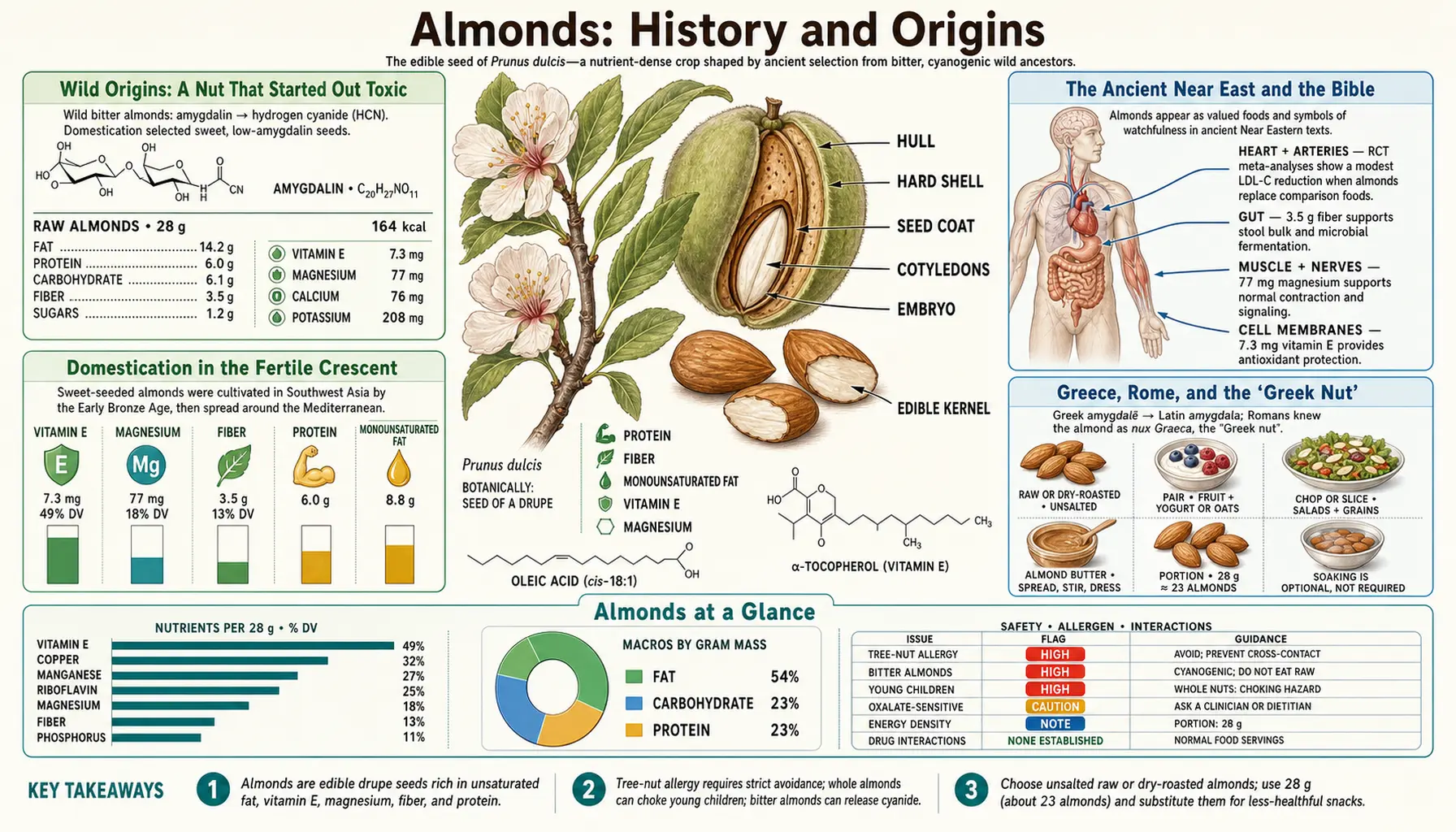
The almond began as a poison. Its wild ancestors carried seeds laced with a bitter compound that releases cyanide when the kernel is chewed — a fierce defence that should, by rights, have kept the almond out of the human diet forever. That it became one of the oldest and most beloved tree nuts in the world is the result of a single quiet stroke of luck: somewhere in the dry hills of western Asia, ancient gatherers found rare trees whose kernels were sweet rather than bitter, and chose to plant them. This article follows the almond's real, documented story — from that act of selection in the Fertile Crescent, through the orchards of Egypt, Greece, and Rome, along the trade routes that carried it east and west, into the kitchens and fasting traditions of medieval Europe, across the ocean to California, and finally into a modern laboratory where, in 2019, scientists identified the exact genetic change that made the almond edible at all. Where the record is firm we say so; where a story is legend or tradition, we name it as such.
Table of Contents
- Wild Origins: A Nut That Started Out Toxic
- Domestication in the Fertile Crescent
- The Ancient Near East and the Bible
- Greece, Rome, and the "Greek Nut"
- Medieval Almond Milk and the Spread Across Europe
- Crossing the Atlantic: Spain to California
- The Sweet-Almond Mystery, Solved in 2019
- Research Papers and References
- Connections
- Featured Videos
Wild Origins: A Nut That Started Out Toxic
The almond is the seed of a small tree, Prunus dulcis, that belongs to the rose family and sits in the same genus as the peach, plum, cherry, and apricot. What we call the "nut" is botanically the kernel inside the stony pit of a fruit — a drupe — much like the pit of its cousin the peach, only with a soft, leathery husk instead of juicy flesh. The tree is native to a broad band of warm, dry country across western and central Asia and the eastern Mediterranean, where several closely related wild almond species still grow in stony, sun-baked ground.
The crucial fact about wild almonds is that most of them are bitter and toxic. Their kernels accumulate a cyanogenic compound called amygdalin, which breaks down into hydrogen cyanide when the seed is crushed or chewed. A handful of wild bitter almonds can deliver a dangerous dose of cyanide; this is the plant's defence against animals that would otherwise eat its seeds. Any history of the almond therefore has to begin with a puzzle: how did a seed evolved specifically to poison whoever ate it become a staple food across three continents?
The answer is that not every wild almond is bitter. Within wild populations, occasional trees bear sweet kernels that do not accumulate the toxic compound, and it was these rare sweet individuals that early people could safely gather and, eventually, deliberately plant. The bitterness trait, as later genetics would confirm, is genetically simple — which made the sweet almond unusually easy to fix in cultivation once humans started choosing which trees to grow. The story of the almond's domestication is, at heart, the story of people learning to favour the rare safe tree over the common poisonous one.
Domestication in the Fertile Crescent
The almond is one of the earliest fruit and nut trees that humans brought into cultivation. In their standard reference work Domestication of Plants in the Old World, the archaeobotanists Daniel Zohary and Maria Hopf place the almond among the first tree crops of the Old World, domesticated in the warm, dry lands of western Asia and the eastern Mediterranean — broadly, the Fertile Crescent and its margins, spanning parts of the modern Levant, Anatolia, and Iran. The key step in that domestication was simple to describe and momentous in effect: the selection of sweet-kernelled trees out of predominantly bitter wild populations.
Carbonised almond remains turn up at archaeological sites across the region from deep antiquity, and by the Early Bronze Age — roughly the third millennium BCE — the almond appears as an established cultivated tree, grown alongside the other founding fruit crops of the region such as the olive, grape, fig, and date. Almonds were well suited to early orchard farming: like the olive and the fig, the almond can be propagated by grafting or from cuttings of a chosen tree, which means a grower could clone a particularly good sweet tree directly, rather than gambling on its seeds. This ease of propagation is one reason the almond joined the orchard so early.
It is worth being precise about what "origin" means here. The almond was not invented, and it had no single discoverer; it is a wild plant that was gradually tamed by many people over many generations. What the archaeological and botanical record supports is a region and an era — western Asia and the eastern Mediterranean, with cultivation firmly established by the Early Bronze Age — rather than a precise date or a founding individual. From that cradle, the cultivated almond began the long journey outward that the rest of this article traces.
The Ancient Near East and the Bible
By the time written records and durable art appear, the almond is already a familiar and valued food across the ancient Near East. One of the most often-cited material traces is from Egypt: almonds were among the foods placed in the tomb of the pharaoh Tutankhamun, who was buried in the fourteenth century BCE, a sign that the nut was prized enough to provision a king for the afterlife. Almonds and almond oil also feature in the broader food and cosmetic traditions of Egypt and Mesopotamia, though specific claims about exactly how they were used in each kitchen should be treated with the usual caution that surrounds ancient culinary detail.
The almond's deepest cultural mark in this era is in the Hebrew Bible, where it appears as a recurring and meaningful image. In the Book of Genesis, almonds are listed among the "choice fruits of the land" that the patriarch Jacob sends down to Egypt as a gift, showing that they were regarded as a prized commodity worth offering to a powerful host. In the Book of Numbers, the rod of Aaron miraculously buds, blossoms, and produces ripe almonds overnight as a sign confirming the priestly tribe of Levi — an episode that made the almond a lasting symbol of divine favour and watchfulness. The Hebrew word for almond is itself connected to the idea of "watching" or being awake, a pun the prophet Jeremiah draws on in a vision of an almond branch.
These biblical references are presented here as cultural and literary history, not as botanical dating evidence. What they reliably show is that, well over two thousand years ago, the almond was woven deeply enough into the life of the ancient Levant to carry symbolic weight — the kind of standing a food earns only after long familiarity. The almond was not merely eaten; it meant something.
Greece, Rome, and the "Greek Nut"
From the eastern Mediterranean the cultivated almond moved west into the Greek and then the Roman world, where it became a familiar orchard tree and a documented part of agriculture and medicine. The classical Greeks grew and ate almonds, and the nut features in their cooking and their materia medica. So thoroughly did the Greeks adopt it that, when the almond reached Rome, the Romans called it the nux graeca — the "Greek nut" — a name that neatly records the almond's route into Italy by way of Greece.
Roman writers on farming and natural history give the almond solid documentary footing. The encyclopaedist Pliny the Elder, writing his Natural History in the first century CE, describes almonds among the nuts known to Rome and records varieties and uses, including medicinal ones. (Pliny also passes on folk beliefs about the tree — such as a method of "curing" bitterness by treating the trunk — which are best read as ancient lore rather than reliable horticulture.) Roman agricultural authors before him had already treated the almond as a cultivated orchard crop. Across the classical Mediterranean the almond was valued on several fronts at once: as food eaten fresh or dried, as a pressed oil used in cooking and cosmetics, and as an ingredient in traditional remedies.
That last role — the almond in ancient medicine — should be framed carefully. Mediterranean physicians and writers ascribed various virtues to almonds and almond oil, and a scholarly review of Mediterranean nuts by Casas-Agustench and colleagues surveys these inherited beliefs and symbolic associations. Such uses tell us how ancient cultures thought about the almond; they are history, not medical guidance, and a traditional remedy is not the same as a proven treatment. What is firmly documented is the almond's standing as an everyday Mediterranean crop with a name — the "Greek nut" — that still carries its history in it.
Medieval Almond Milk and the Spread Across Europe
As almond cultivation spread around the Mediterranean rim, the trade and movements of the medieval world carried the nut and its products far beyond the orchard. Almonds travelled the long-distance routes linking Asia and the Mediterranean — the network often loosely called the Silk Road — as a durable, portable, high-energy food, and almond growing took firm hold in the warm parts of southern Europe, above all in Spain and Italy, which remain major producers today. Arab agriculture in medieval Spain (al-Andalus) was particularly important in establishing almonds, along with other orchard and irrigation crops, on the Iberian Peninsula.
In medieval Europe the almond found a special role that says a great deal about how it was used: almond milk. Ground almonds steeped in water yield a rich, creamy liquid that, unlike dairy milk, does not spoil quickly and contains no animal product. Both facts mattered enormously to medieval cooks. In an age before refrigeration, a "milk" that kept was a practical treasure; and because the Christian calendar imposed many fast days and the long fast of Lent, during which dairy and meat were forbidden, almond milk became the standard stand-in for cow's milk in countless fasting-day dishes. Medieval cookbooks lean on it heavily, using almond milk and ground almonds to thicken sauces, enrich porridges, and make creamy dishes that complied with religious rules.
Almonds also became central to a whole family of sweets that are still with us. Ground almonds and sugar form marzipan, a confection with deep roots in medieval and early-modern Europe and the wider Mediterranean and Middle East, and the same pairing underlies nougat, macaroons, and a long list of festive pastries. By the close of the Middle Ages the almond was firmly established in European kitchens at every level — a luxury for the rich, a fasting staple for the devout, and the foundation of the continent's sweet tooth.
Crossing the Atlantic: Spain to California
The almond is an Old World plant, so its arrival in the Americas is a matter of recorded history rather than guesswork. Spanish Franciscan missionaries carried almonds to California in the 1700s, planting them at the chain of missions along the Pacific coast as part of their effort to build self-sustaining farms. Those first coastal plantings, however, largely failed to thrive: the cool, damp, foggy coastal climate was poorly suited to a tree that wants hot, dry summers, and the almond never really took hold by the sea.
Commercial almond growing in California is a creation of the mid-nineteenth century, after statehood and the Gold Rush brought a flood of settlers. Growers found that the hot, dry interior — the great Central Valley, in the Sacramento and San Joaquin basins — offered exactly the Mediterranean-style climate the almond craved, and it was here, not on the coast, that orchards finally flourished. Over the following decades, plant breeders and nurserymen selected and propagated improved varieties suited to the region, and almond acreage steadily expanded.
That shift inland set the stage for a striking modern fact: California now grows the large majority of the world's almonds, with the other leading producers including Spain, Australia, and several Mediterranean and Middle Eastern countries from the almond's ancestral range. The scale of California's almond industry has also made it a focus of debate over water use in a drought-prone region, since almond orchards are thirsty and permanent. That tension — an ancient dry-land tree grown at vast scale in an irrigated valley — is the almond's newest historical chapter, and it is still being written. The detailed nutrition, growing, and consumption story is taken up on the main Almonds page.
The Sweet-Almond Mystery, Solved in 2019
For almost the whole of its history, no one knew why some almonds are sweet and edible while their wild relatives are bitter and poisonous. People knew that it was so, and that the sweet trees bred more or less true, but the underlying cause stayed hidden until very recently. Here the almond's story includes a genuine, datable scientific discovery, achieved by named scientists.
In 2019, a research team led by Raquel Sánchez-Pérez, working with colleagues including the biochemist Birger Lindberg Møller and an international group of geneticists, published the answer in the journal Science. By mapping the gene that controls kernel taste, they showed that the difference between a bitter, toxic almond and a sweet, edible one comes down to a single transcription factor — a gene called bHLH2 that switches on the machinery for making the bitter cyanogenic compound amygdalin. A single small mutation in that gene shuts the amygdalin pathway off, and the kernel comes out sweet. In other words, the entire history above — every orchard, every fasting-day dish of almond milk, every Californian acre — ultimately traces back to one tiny genetic change that turned a poison off.
The finding is a tidy bookend to the almond's long history. The ancient gatherers who first chose sweet trees over bitter ones had no idea they were selecting for a broken transcription factor; they simply tasted, survived, and planted what was safe. What the 2019 study did was give that prehistoric act of selection its molecular explanation, naming the exact switch the early almond growers were unknowingly flipping when they tamed one of the world's oldest tree crops. Tradition supplied the sweet almond; modern genetics finally explained how it came to be.
Research Papers and References
The list below combines key peer-reviewed and reference sources on the almond's domestication, botany, and cultural history with curated PubMed topic-search links. Historical primary sources (the Hebrew Bible, and the ancient writings of authors such as Pliny the Elder) are named in the article as historical sources rather than as modern citations. Author names, titles, and journals are given as plain text; only the stable DOI, PMID, or archive link is hyperlinked, and each opens in a new tab.
- Sánchez-Pérez R, Pavan S, Mazzeo R, Moldovan C, Aiese Cigliano R, Del Cueto J, Ricciardi F, Lotti C, Ricciardi L, Dicenta F, López-Marqués RL, Møller BL. Mutation of a bHLH transcription factor allowed almond domestication. Science. 2019;364(6445):1095-1098. — doi:10.1126/science.aav8197 Search PubMed
- Casas-Agustench P, Salas-Huetos A, Salas-Salvadó J. Mediterranean nuts: origins, ancient medicinal benefits and symbolism. Public Health Nutrition. 2011;14(12A):2296-2301. — doi:10.1017/S1368980011002540
- Zohary D, Hopf M, Weiss E. Domestication of Plants in the Old World: The Origin and Spread of Domesticated Plants in Southwest Asia, Europe, and the Mediterranean Basin. 4th ed. Oxford University Press; 2012. — named in this article as the standard reference on Old World crop domestication, including the almond.
- Almond domestication, origin, and the sweet-versus-bitter kernel trait PubMed: almond domestication and kernel bitterness
- Almonds in history, ethnobotany, and Mediterranean food culture PubMed: almond history and ethnobotany
External Authoritative Resources
- Wikipedia — Almond (botany, history, and cultivation)
- Science — Mutation of a bHLH transcription factor allowed almond domestication
- PubMed — All research on Prunus dulcis (almond)