Pinworm Treatment: Pyrantel, Mebendazole, and Albendazole
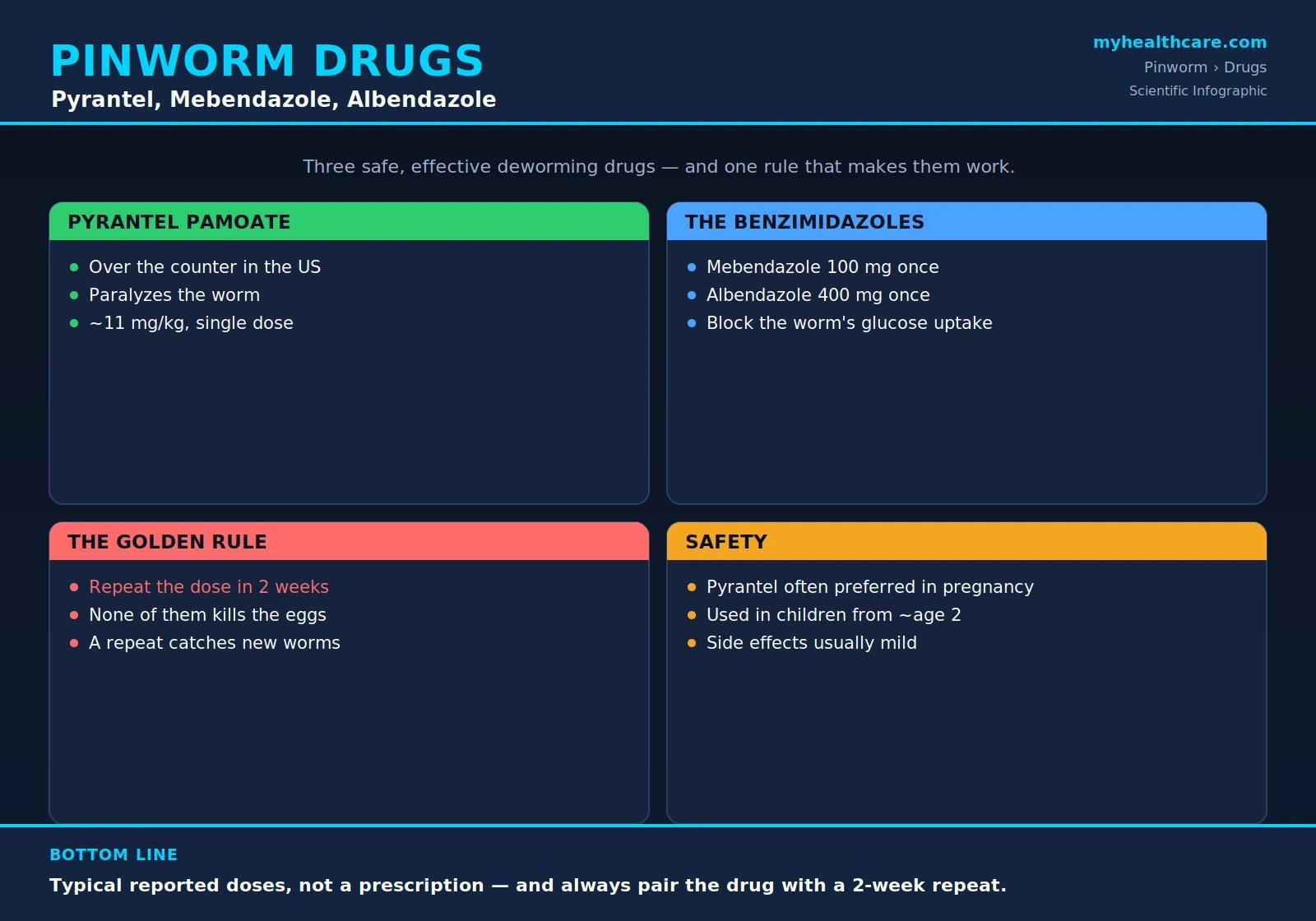
Pinworm (caused by the small white roundworm Enterobius vermicularis) generally responds well to medicine. CDC lists three drugs: pyrantel pamoate, which is sold without a prescription in the United States, and two closely related prescription drugs from the benzimidazole family, mebendazole and albendazole. A single dose of any one of them clears most of the adult worms living in the bowel at that moment. CDC's regimen for all three is two doses, the second given two weeks after the first, because, in CDC's words, the medications "kill worms but cannot kill eggs" — and in pinworm, swallowed eggs are how the infection comes straight back. This page describes how each drug works, what reviews and trials report about how well they work, why regimens repeat the dose, why CDC and the US over-the-counter label extend treatment to the whole household, and what drug labels and health agencies state about pregnancy and young children. The doses on this page are those reported by CDC, US drug labels and trials, not a prescription; decisions about treatment belong with a clinician or pharmacist.
Table of Contents
- Pyrantel Pamoate — The Over-the-Counter Option
- Mebendazole — A Benzimidazole
- Albendazole — A Benzimidazole
- How the Benzimidazoles Work
- How Effective Are They?
- Why Regimens Repeat the Dose at Two Weeks
- Why Guidance Covers the Whole Household
- Safety: Pregnancy and Young Children
- Why Hygiene Measures Accompany the Medicines
- Key Research Papers
- Featured Videos
1. Pyrantel Pamoate — The Over-the-Counter Option
Pyrantel pamoate is the pinworm medicine sold over the counter, without a prescription, in the United States (CDC clinical overview). The FDA's over-the-counter rules require its label to identify it as a "pinworm treatment" (21 CFR 357.150), and CDC lists oral suspension, capsules and chewable tablets as its forms.
Pyrantel works in a very different way from the benzimidazoles. It acts on the nicotinic acetylcholine receptors of nematode muscle (Martin 1997) as a depolarizing neuromuscular blocker — it floods the worm's nerve-muscle junctions with a steady "on" signal, much as the parasite's own messenger acetylcholine would, but without letting up. In laboratory studies on nematode muscle the result is a spastic contraction and sustained paralysis (Atchison 1992): the worm's muscles seize up, it can no longer hold its place in the gut, and it is swept along and passed out of the body in the stool. Reviews describe drugs of this type as acting rapidly on the worm's neuromuscular transmission (Martin 1997), unlike the benzimidazoles, which act on its energy supply. Pyrantel pamoate is also poorly absorbed from the human gut: in healthy volunteers given 750 mg, mean peak blood levels were only about 36–38 ng/mL (Fasanmade 1994), so most of the dose stays in the bowel where the worms are.
CDC lists 11 mg/kg by mouth (maximum 1 gram) for adults and children, repeated in two weeks. The US over-the-counter labeling rules set the same single dose — 11 mg of pyrantel base per kilogram (5 mg per pound) of body weight, not to exceed 1 gram — but their directions say it is taken one time as a single dose and not repeated unless directed by a doctor, and that it is not to be used in children under 2 years or weighing less than 25 pounds unless directed by a doctor (see the repeat-dose section). The same label lists abdominal cramps, nausea, vomiting, diarrhea, headache or dizziness as effects that sometimes occur.
2. Mebendazole — A Benzimidazole
Mebendazole is one of the two benzimidazole drugs used against pinworm and has been used for it for decades. In the United States it is a prescription medicine (CDC); in the United Kingdom it is sold in pharmacies (NHS). It belongs to the same chemical family as albendazole and shares the same fundamental way of attacking the worm, described in the mechanism section below.
CDC lists a 100 mg dose by mouth for adults and children, repeated in two weeks. The US label for the 100 mg chewable tablet, approved for patients two years of age and older, gives one tablet once for pinworm, advises a second course if the patient is not cured three weeks after treatment, and states that the tablet may be chewed, swallowed, or crushed and mixed with food.
Only about 2–10% of an oral dose of mebendazole is absorbed (CDC); the label states that most of the dose remains in the gastrointestinal tract, where it acts locally. The label lists loss of appetite, stomach pain, diarrhea, gas, nausea, vomiting and rash as the most common side effects.
3. Albendazole — A Benzimidazole
Albendazole is the other benzimidazole, a close chemical cousin of mebendazole and one of the most widely used drugs in community deworming programmes; a 2000 review counted more than several hundred million patient exposures over 20 years (Horton 2000). Like mebendazole it is a prescription medicine in the United States, where its label covers two infections with tapeworm larvae (neurocysticercosis and cystic hydatid disease) and CDC lists it among pinworm treatments. It works by the same mechanism — binding the worm's structural protein and shutting down its ability to feed.
CDC lists a single 400 mg dose by mouth for adults and children, repeated in two weeks, taken on an empty stomach. CDC also notes that WHO mass-deworming campaigns have treated many children under six with albendazole at a reduced dose (see the safety section).
Albendazole itself is poorly absorbed, and the absorbed portion is rapidly converted to its active metabolite, albendazole sulfoxide; taken with a fatty meal, blood levels of that metabolite are on average up to about five times higher than when fasting (US albendazole label). That systemic activity underlies its use against worm larvae that live in body tissues; pinworm, by contrast, is a purely intestinal infection. In a review of published albendazole studies, gastrointestinal side effects were the only ones reported at an overall frequency of just over 1% (Horton 2000).
4. How the Benzimidazoles Work
Mebendazole and albendazole are both benzimidazoles, and their shared mechanism helps explain both how they work and why they act more slowly than pyrantel.
Every cell — in a worm as in a person — relies on tiny internal scaffolding tubes called microtubules, which are built from a protein called tubulin. Microtubules are constantly being assembled and disassembled; they form the worm's internal skeleton, move materials around inside its cells, and are essential to how the lining of the worm's gut absorbs food. Benzimidazoles work by binding selectively to the worm's β-tubulin (beta-tubulin) and jamming this machinery (Martin 1997; Lacey 1988): they stop the tubulin building-blocks from snapping together into microtubules, so the scaffolding falls apart and cannot be rebuilt.
The critical consequence plays out in the cells lining the worm's intestine. With their microtubules disrupted, those cells lose much of their absorptive function, especially the uptake of glucose — the worm's sugar fuel. In effect, the benzimidazoles block the worm's glucose uptake. As the US albendazole and mebendazole labels describe it, the worm's glycogen stores are depleted, it runs short of energy, and it is gradually immobilized and dies. This is why benzimidazoles do not paralyze the worm the way pyrantel does — they kill it more slowly by cutting off its energy supply.
Reviews link their safety in people partly to selectivity: benzimidazoles bind the parasite's β-tubulin selectively (Martin 1997), and high-affinity binding sites have been demonstrated in worm tubulin (Lubega and Prichard 1990), although laboratory studies show they can also slow the assembly of mammalian tubulin in vitro (Lacey and Watson 1985). Together with poor absorption from the gut, this is one explanation offered for the safety record of single-dose use (Horton 2000).
5. How Effective Are They?
For the adult worms present in the gut at the time of treatment, reported cure rates are high. A 2000 review of albendazole studies reported an overall cure rate of 98% across 27 studies of the single 400 mg dose for pinworm (Horton 2000), and a 2019 review reported success rates of up to more than 90% for the approved pinworm drugs, while noting that no large-scale randomized controlled trials of pinworm treatment are available (Wendt 2019).
Head-to-head data are limited. In a 2026 open-label randomized trial in India, 126 children aged 2–12 received albendazole (400 mg), mebendazole (100 mg) or pyrantel pamoate (11 mg/kg), each repeated after two weeks, with hygiene instruction for parents. The share reaching the trial's best remission score did not differ significantly (albendazole 70.5%, mebendazole 59.5%, pyrantel pamoate 67.5%; P = 0.483), while the best no-recurrence score was reached by 97.6% with mebendazole, 82.1% with pyrantel pamoate and 69% with albendazole (P = 0.010); the trial used a new symptom-based scoring system (Renuka Devi 2026). Other factors that differ between the drugs are availability without a prescription (pyrantel, in the US), the age limits on their labels, their status in pregnancy, and cost. On resistance, the US mebendazole label notes a potential for resistance through changes in the worm's β-tubulin and states that its clinical significance is not known.
The crucial caveat is built into that phrase — "the adult worms present at the time of treatment." High cure rates describe the drug's effect on existing adult worms in a single round. They say nothing about the eggs, and in pinworm the eggs drive reinfection, which is the subject of the next section.
6. Why Regimens Repeat the Dose at Two Weeks
CDC's regimen for all three drugs is two doses, the second given two weeks after the first, and CDC describes the second dose as important (CDC clinical overview). The US labels are worded differently, as described below.
CDC gives the reason: "The medications kill worms but cannot kill eggs. The second dose is important to prevent infection by newly hatched adult worms that were not killed by the first treatment because they were still eggs." Eggs laid on the skin around the anus become infective two to three hours later and are easily carried to the mouth on fingers, or from diapers, clothes, bedding and other items (CDC). After an egg is swallowed, the larva hatches in the small intestine, and about one month passes from swallowing an egg to an adult female laying eggs of her own (CDC DPDx). One 2025 review describes mebendazole and albendazole as acting on eggs as well as adult worms and pyrantel as acting on adults only (Leung 2025); CDC's two-dose schedule applies to all three.
The second dose, two weeks after the first, falls inside that roughly one-month window: worms that hatched from eggs swallowed around the time of the first treatment have grown to a stage the drug can kill, but have not yet matured enough to lay a new batch of eggs and restart the cycle. The stage of the worm matters too: in a 1981 Korean study of 131 children in three orphanages, the worms expelled after a single dose indicated that mebendazole removed worms at early stages of development satisfactorily, while pyrantel was less effective against early-stage worms (Cho 1981).
Reviews report that recurrence is common even after effective treatment, and attribute it mainly to repeated cycles of reinfection, particularly autoinfection, given the short life span of adult pinworms (Leung 2025). The US labels differ from CDC's schedule: the over-the-counter pyrantel directions say the medicine is taken one time as a single dose and not repeated unless directed by a doctor (21 CFR 357.150), and the mebendazole label advises a second course if the patient is not cured three weeks after treatment. CDC's clinical regimen, the 2026 randomized trial and the 2025 review all use the same dose again at two weeks.
7. Why Guidance Covers the Whole Household
Pinworm infections often occur in more than one person in a household (CDC). The eggs spread easily — from scratching to fingers, and from bedding, clothing, towels and other objects to the mouth — and many infections cause no symptoms: CDC's clinical overview states that most people with the infection have none, and a 2025 review puts the share without symptoms at about 30–40% (Leung 2025). By the time one family member is diagnosed, others may be infected without knowing it.
CDC's patient page states: "Treat everyone in the same household and caregivers of the person diagnosed with pinworms at the same time," with the same two-dose treatment, and its prevention page gives the purpose as preventing repeat infections. The US over-the-counter pyrantel directions likewise call for treating the entire household when one member has pinworms, unless otherwise advised, and the NHS describes treating everyone aged 2 years and over in the household, even those without symptoms. A 2025 review frames whole-household treatment as something to consider, especially when there are multiple or repeated symptomatic infections (Leung 2025), and a 2019 review describes involving everyone living in the household, including sexual partners, as a prerequisite to lasting success (Wendt 2019). In a 1994–95 school study in Korea covering 738 children, treating whole classes together with the family members of positive cases gave better control than the other schemes tested (Yang 1997). For childcare centers and other institutions, CDC states that mass and simultaneous treatment, repeated in two weeks, can be effective. The topic has its own page: Recurrent Pinworm and Whole-Household Treatment.
8. Safety: Pregnancy and Young Children
Single-dose use of these drugs has a long safety record (Horton 2000), but labels and health agencies treat two groups differently: pregnant women and very young children. What follows is what CDC, US drug labels, the NHS and published studies state; decisions for any individual belong with a clinician or pharmacist.
In pregnancy. CDC states that the safety of the drugs used to treat pinworm has not been studied in pregnant women, and that if the infection is compromising the pregnancy (for example through weight loss or sleeplessness), treatment can be considered but is to be withheld until the third trimester, when the risk to the fetus, if any, is likely to be reduced. CDC lists all three drugs as pregnancy category C and notes that WHO allows each of them in the second and third trimesters in mass-deworming campaigns. The US over-the-counter pyrantel label carries a warning against its use during pregnancy or liver disease unless directed by a doctor. A 2025 review states that pyrantel is preferred to mebendazole and albendazole for pregnant women (Leung 2025). For people who cannot take medicine, the NHS describes hygiene measures alone, kept up for 6 weeks, and asks pregnant or breastfeeding women to speak to a pharmacist, as treatment might not be suitable.
For the benzimidazoles, the labels separate animal and human findings. The US albendazole label states that, based on animal studies (embryotoxicity and skeletal malformations in rats and rabbits), albendazole may cause fetal harm, and recommends a pregnancy test before treatment in women who could become pregnant; it adds that the limited human data have not identified a drug-associated risk of major birth defects or miscarriage. The mebendazole label reports embryotoxic and teratogenic effects in pregnant rats, while stating that the published human literature has not reported a clear association with major birth defects or miscarriage. Two cohort studies are consistent with that: an Israeli study of 192 mebendazole-exposed pregnancies, 71.5% of them exposed in the first trimester, found no increase in major malformations (3.3% vs 1.7% in unexposed controls; P = 0.478) (Diav-Citrin 2003), and a Danish nationwide registry study of 2,567 exposed pregnancies found no association with major congenital malformations (odds ratio 0.7, 95% CI 0.5–1.1) and no increased risk after exposure in any trimester (Torp-Pedersen 2016).
In young children. CDC states that the health risks and benefits of these drugs are for health practitioners and parents to weigh in patients under two years of age. The US over-the-counter pyrantel directions cover adults and children from 2 years of age and say it is not to be used in children under 2 or weighing less than 25 pounds unless directed by a doctor; CDC adds that the WHO Model List of Essential Medicines for Children lists pyrantel for children one year of age and older. The US mebendazole 100 mg label is approved for patients two years of age and older and reports convulsions in infants below the age of 1 year in post-marketing experience; CDC notes limited data in children under 2. For albendazole, CDC states that its safety in children under 6 is not certain, that studies in children as young as one year suggest it is safe, and that WHO mass-deworming campaigns give it to children from one year of age (able to swallow tablets safely), at a reduced dose for many children under six.
9. Why Hygiene Measures Accompany the Medicines
CDC presents medication, handwashing and good hygiene together as the ways to stop the spread of pinworm, and describes strict hand hygiene, in addition to treatment, as the most effective way to prevent infection and spread. A 2019 review concludes that drug treatment along with attention to hygiene can eradicate the infection and prevent recurrence and autoinfection in nearly all cases (Wendt 2019).
The reason goes back to the eggs. The medicines clear adult worms, but the surroundings of an infected person carry eggs — on the skin and under the fingernails, and on diapers, clothes, bedding, food and other items. If not properly washed or cleaned, pinworm eggs can survive 2 to 3 weeks on objects (CDC); the NHS gives up to 2 weeks outside the body. Swallowing them starts a new infection, so a person can re-infect themselves while the worms are being treated. In the 2026 randomized trial, 102 of the 113 children who kept to the hygiene measures recorded in a family diary (90.3%) had no recurrence of worms (P = 0.001) (Renuka Devi 2026).
CDC's prevention page lists the measures: frequent handwashing with soap and warm water (especially after using the toilet or changing diapers, after touching an infected person or the items they have used, and before handling food); no scratching around the anus and no nail-biting; fingernails kept clean and short; bathing every morning and changing underwear to remove eggs laid overnight, with showers rather than tub baths and no shared or reused washcloths; and frequent changing of nightclothes, underwear, washcloths, towels and bedding, handled without shaking, washed in hot water (at least 130°F) and dried in a hot dryer. CDC states that it is especially important for everyone in the household to follow these steps for two weeks after the last treatment dose; the NHS gives 2 weeks of hygiene measures when medicine is taken and 6 weeks without medicine. The drugs kill the worms; the hygiene measures target the eggs. The full set of measures is covered on the Hygiene and Preventing Reinfection page.
Key Research Papers
Peer-reviewed reviews, mechanistic studies, clinical trials, and safety analyses on the drugs used to treat pinworm and related intestinal worms. Journal names appear as plain text; the DOI or PubMed link at the end of each entry opens the paper. Agency and label sources (CDC, the FDA's over-the-counter labeling rules, DailyMed labels, NHS) are linked in the text where they are cited.
- Georgiev VS. Chemotherapy of Enterobiasis (Oxyuriasis). Expert Opinion on Pharmacotherapy. 2001;2(2):267–275. — doi:10.1517/14656566.2.2.267
- Keiser J, Utzinger J. Efficacy of Current Drugs Against Soil-Transmitted Helminth Infections: Systematic Review and Meta-analysis. JAMA. 2008;299(16):1937–1948. — doi:10.1001/jama.299.16.1937
- Selvaraj V. Comparison of Efficacy of Albendazole, Mebendazole and Pyrantel Pamoate in Achieving Remission and Preventing Recurrence of Enterobius vermicularis Infestation in Children [letter]. Indian Pediatrics. 2026;63(6):455–456. — doi:10.1007/s13312-026-00338-z
- Atchison WD, Geary TG, Manning B, VandeWaa EA, Thompson DP. Comparative Neuromuscular Blocking Actions of Levamisole and Pyrantel-type Anthelmintics on Rat and Gastrointestinal Nematode Somatic Muscle. Toxicology and Applied Pharmacology. 1992;112(1):133–143. — doi:10.1016/0041-008x(92)90289-5
- Martin RJ. Modes of Action of Anthelmintic Drugs. The Veterinary Journal. 1997;154(1):11–34. — doi:10.1016/s1090-0233(05)80005-x
- Lacey E. The Role of the Cytoskeletal Protein, Tubulin, in the Mode of Action and Mechanism of Drug Resistance to Benzimidazoles. International Journal for Parasitology. 1988;18(7):885–936. — doi:10.1016/0020-7519(88)90175-0
- Lacey E, Watson TR. Structure-Activity Relationships of Benzimidazole Carbamates as Inhibitors of Mammalian Tubulin, In Vitro. Biochemical Pharmacology. 1985;34(7):1073–1077. — doi:10.1016/0006-2952(85)90611-2
- Lubega GW, Prichard RK. Specific Interaction of Benzimidazole Anthelmintics with Tubulin: High-Affinity Binding and Benzimidazole Resistance in Haemonchus contortus. Molecular and Biochemical Parasitology. 1990;38(2):221–232. — doi:10.1016/0166-6851(90)90025-h
- McKellar QA, Scott EW. The Benzimidazole Anthelmintic Agents — a Review. Journal of Veterinary Pharmacology and Therapeutics. 1990;13(3):223–247. — doi:10.1111/j.1365-2885.1990.tb00773.x
- Dayan AD. Albendazole, Mebendazole and Praziquantel. Review of Non-clinical Toxicity and Pharmacokinetics. Acta Tropica. 2003;86(2–3):141–159. — doi:10.1016/s0001-706x(03)00031-7
- Diav-Citrin O, Shechtman S, Arnon J, Lubart I, Ornoy A. Pregnancy Outcome after Gestational Exposure to Mebendazole: A Prospective Controlled Cohort Study. American Journal of Obstetrics and Gynecology. 2003;188(1):282–285. — doi:10.1067/mob.2003.79
- Prichard RK. Benzimidazole Binding to Haemonchus contortus Tubulin: A Question of Structure [author reply to correspondence]. Trends in Parasitology. 2002;18(4):154. — doi:10.1016/s1471-4922(01)02226-7
- Renuka Devi AV, Selvaraj V, Venkat BS, Kandasamy V. Comparison of Efficacy of Albendazole, Mebendazole and Pyrantel Pamoate in Achieving Remission and Preventing Recurrence of Enterobius vermicularis Infestation in Children: A Randomised Controlled Trial. Indian Pediatrics. 2026;63(7):501–506. — PubMed PMID: 41811423
- Horton J. Albendazole: A Review of Anthelmintic Efficacy and Safety in Humans. Parasitology. 2000;121(Suppl):S113–S132. — PubMed PMID: 11386684
- Wendt S, Trawinski H, Schubert S, Rodloff AC, Mössner J, Lübbert C. The Diagnosis and Treatment of Pinworm Infection. Deutsches Ärzteblatt International. 2019;116(13):213–219. — PubMed PMID: 31064642
- Leung AKC, Lam JM, Barankin B, Wong AHC, Leong KF, Hon KL. Pinworm (Enterobius vermicularis) Infestation: An Updated Review. Current Pediatric Reviews. 2025;21(4):333–347. — PubMed PMID: 38288810
- Torp-Pedersen A, Jimenez-Solem E, Cejvanovic V, Poulsen HE, Andersen JT. Birth Outcomes after Exposure to Mebendazole and Pyrvinium during Pregnancy — A Danish Nationwide Cohort Study. Journal of Obstetrics and Gynaecology. 2016;36(8):1020–1025. — PubMed PMID: 27189319
- Fasanmade AA, Akanni AO, Olaniyi AA, Fasanmade AA, Tayo F. Bioequivalence of Pyrantel Pamoate Dosage Forms in Healthy Human Subjects. Biopharmaceutics & Drug Disposition. 1994;15(6):527–534. — PubMed PMID: 7993990
- Cho SY, Hong ST, Kang SY, Song CY. Morphological Observation of Enterobius vermicularis Expelled by Various Anthelmintics. Korean Journal of Parasitology. 1981;19(1):18–26. — PubMed PMID: 12902715
- Yang YS, Kim SW, Jung SH, Huh S, Lee JH. Chemotherapeutic Trial to Control Enterobiasis in Schoolchildren. Korean Journal of Parasitology. 1997;35(4):265–269. — PubMed PMID: 9446908
PubMed Topic Searches
Each link opens a live PubMed query so results stay current as new papers are indexed.
- PubMed: Enterobius vermicularis treatment
- PubMed: Pyrantel pamoate for pinworm
- PubMed: Mebendazole for enterobiasis
- PubMed: Albendazole single dose pinworm
- PubMed: Benzimidazole tubulin mechanism
- PubMed: Pyrantel neuromuscular mechanism
- PubMed: Mebendazole safety in pregnancy
- PubMed: Pinworm reinfection and household treatment
Connections
- All Parasites
- Symptoms & Diagnosis
- Anal Itching & Sleep Disturbance
- Pinworm in Children & Households
- Complications & Unusual Sites
- Treatment & Prevention
- Hygiene & Preventing Reinfection
- Recurrent Pinworm & Whole-Household Treatment
- Pinworm Overview
- Gastroenterology
- Infectious Disease
- All Conditions
- Dr. Bryan Ardis: Nicotine and Parasites