Low-Histamine Diet for MCAS
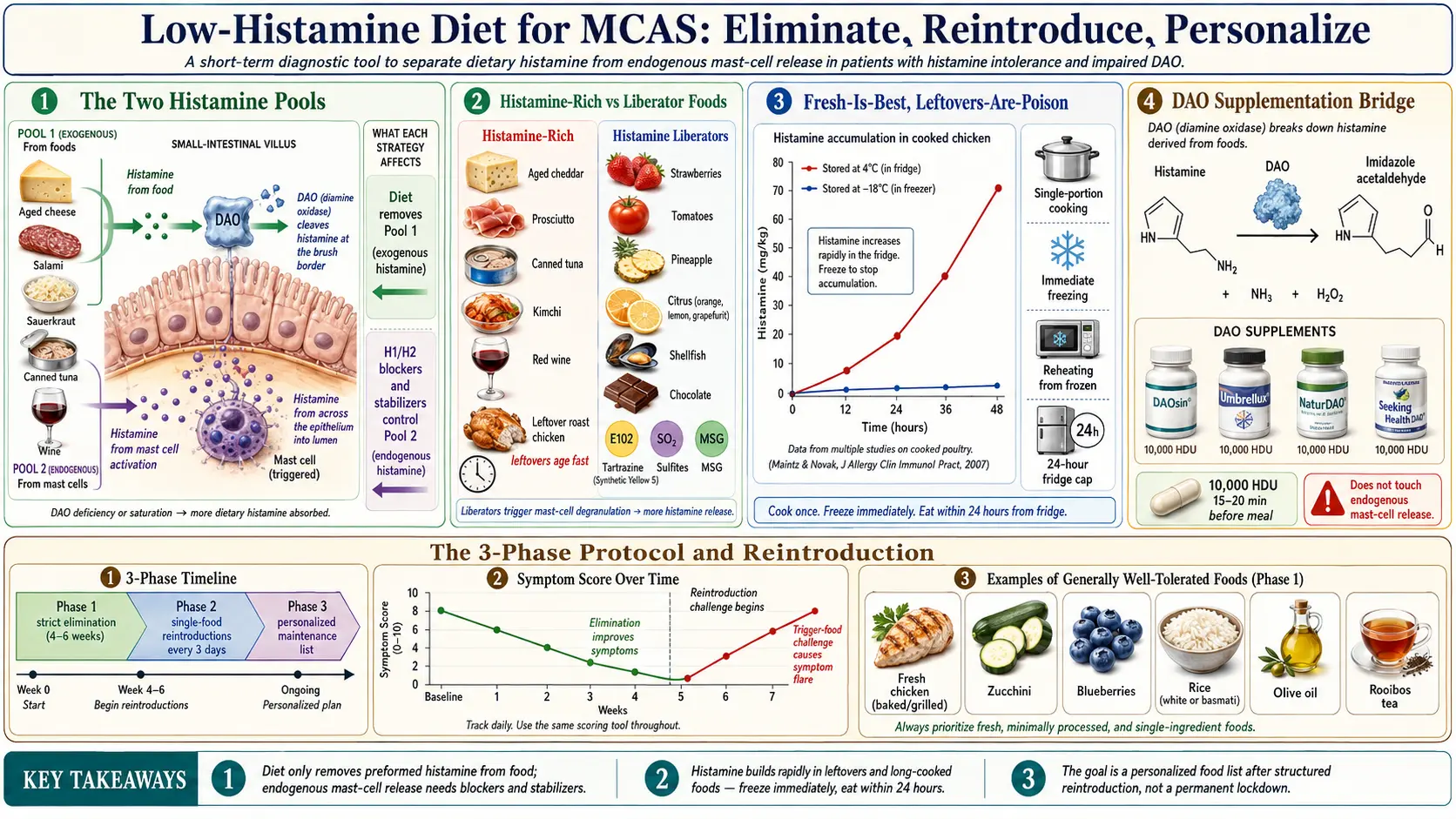
Lists of foods for a low-histamine diet often disagree with one another. A 2021 review of ten published low-histamine diets found that the foods they excluded differed from diet to diet: only fermented foods were excluded by all of them, and the exclusion of 32% of the listed foods could be explained by a high histamine content (Sánchez-Pérez 2021). Part of the disagreement comes from two different ideas being mixed together — the histamine already present in food, and the claim that some foods make the body’s own cells release histamine.
Clinical reviews describe the diet as a diagnostic tool as much as a treatment. A 2021 review calls a low-histamine diet the gold standard among treatments for histamine intolerance and states that a good response to it is considered confirmation of the condition (Hrubisko 2021). A 2021 German-language allergy guideline describes people with suspected histamine intolerance who follow extensive elimination diets for years and restrict their diet unnecessarily, and sets out a stepwise approach intended to move them from blanket restrictions to personalized ones (Reese 2021). Most of the research behind the diet comes from histamine intolerance and chronic urticaria rather than from MCAS (see section 2).
Table of Contents
- What Histamine Intolerance Is
- MCAS Criteria and the Strength of the Diet Evidence
- Histamine-Rich Foods and “Liberators”: Two Different Claims
- Foods Measured or Listed as High in Histamine
- “Histamine Liberators”: Foods Said to Release Histamine
- Foods Usually Listed as Low in Histamine
- Storage, Leftovers and Histamine Formation
- DAO Enzyme Supplements: The Trials
- The Three-Phase Approach in the German-Language Guideline
- The Costs of Long-Term Restriction
- What a Low-Histamine Day Can Look Like
- Shopping and Cooking: What Studies Report
- Eating Out
- How the Diet Fits With Other MCAS Treatments
- Food Lists, Apps and Other Resources
- The Role of Nutrition Counseling
- Key Research Papers
- Connections
- Featured Videos
1. What Histamine Intolerance Is
Histamine intolerance is described as an imbalance between the histamine that accumulates in the body and the body’s capacity to break it down (Maintz 2007). It is not an IgE-mediated allergy. Reviews describe three parts to the picture:
- Histamine in food. Histamine is a biogenic amine that occurs to various degrees in many foods (Maintz 2007). Bacteria make it, so the foods most likely to accumulate it are those altered by spoilage bacteria and fermented foods made with histamine-producing bacteria (Sánchez-Pérez 2021). This is the histamine a low-histamine diet aims to reduce.
- Histamine released by the body’s own mast cells. In MCAS, histamine and other mediators are released by mast cells themselves (Valent 2020). H1 and H2 blockers and mast cell stabilizers are the drug classes used against this release; a low-histamine diet is aimed at the histamine in food, not at this pool.
- DAO (diamine oxidase). DAO is the main enzyme that breaks down ingested histamine; histamine N-methyltransferase, the other major enzyme, works only inside cells (Maintz 2007). DAO activity depends on variants of its gene (AOC1), the body’s physiological state, alcohol, other biogenic amines and some medicines (Hrubisko 2021). People with low amine oxidase activity are described as at risk of histamine toxicity from dietary histamine (Maintz 2007). The 2021 German-language guideline, however, states that prospective, controlled studies showing that DAO deficiency causes reactions to ingested histamine are still lacking (Reese 2021).
Whether histamine intolerance can be confirmed in a given person is disputed. In a placebo-controlled histamine challenge of 59 patients with suspected histamine intolerance, 37 (62.7%) had symptoms after placebo, and the diagnosis was excluded in 50 (84.7%); three-quarters had reported improvement, but never resolution, of symptoms on a histamine-low diet (Bent 2023). In an earlier double-blind trial, 39 patients who had reacted to an open challenge with 75 mg of histamine did not reproduce their main or secondary symptoms under blinded conditions (Komericki 2011).
2. MCAS Criteria and the Strength of the Diet Evidence
The Consensus Criteria
The consensus criteria first proposed in 2012 by an international group led by Valent, and restated by the group in 2019 and 2020, require all three of the following before a condition is called MCAS (Valent 2012; Valent 2019; Valent 2020):
- Typical symptoms: severe, recurrent episodes of systemic mast cell activation involving at least two organ systems.
- Laboratory evidence: preferably a rise in serum tryptase during an episode to more than the person’s own baseline plus 20%, plus 2 ng/mL (the “20% + 2” formula).
- Response to treatment: symptoms respond to mast-cell-stabilizing drugs or to drugs that block mast cell mediators.
A different proposal, called “consensus-2” by Afrin and colleagues, leads to substantial differences in how many patients qualify for the diagnosis (Afrin 2020). Response to a diet is not one of the consensus criteria. The criteria are covered in more detail on the cromolyn and ketotifen page.
What the Diet Studies Tested
None of the diet studies cited on this page enrolled people diagnosed with MCAS:
- Mastocytosis. A 2005 literature search found no double-blind, placebo-controlled food challenge studies of biogenic amines or “histamine-releasing foods” in mastocytosis. The authors concluded that the role of such diets in mastocytosis remains hypothetical but worthy of further investigation, and found some evidence of adverse reactions to alcohol (Vlieg-Boerstra 2005).
- Chronic spontaneous urticaria with gastrointestinal symptoms. In a study without a control group, patients followed a low-histamine diet for at least 3 weeks; 34 of 56 (61%) reached the primary endpoint (an improvement in urticaria activity score of 3 or more points), 75% had some benefit, and DAO activity remained stable (Wagner 2017).
- Histamine intolerance. In a randomized crossover study of 18 people, patients reported a significant reduction in gastrointestinal and skin symptoms during the low-histamine phase, while serum DAO did not change in a way linked to either diet (Rentzos 2024).
For MCAS more broadly, a 2024 review notes that interventional studies are lacking and calls for double-blind, placebo-controlled trials of the main drug treatments (Castells 2024). The German-language guideline states that controlled studies are still needed to show to what extent dietary changes achieve biological effects (Reese 2021).
3. Histamine-Rich Foods and “Liberators”: Two Different Claims
Food lists for the diet mix several different reasons for excluding a food:
- Histamine-rich foods. Foods that contain histamine made by bacteria, chiefly fermented foods and foods altered by spoilage bacteria (Sánchez-Pérez 2021). Measured examples are listed in section 4.
- “Histamine liberators.” Foods said to contain little or no histamine but to trigger the release of the body’s own histamine. The mechanism has not been worked out (Sánchez-Pérez 2021), and the German-language guideline states that there is no reliable evidence that histamine liberators in foods exist or that they matter clinically (Reese 2021).
- Other amines. Putrescine, another amine that may interfere with the breakdown of histamine by DAO in the gut, could partly explain why citrus fruits and bananas are often excluded (Sánchez-Pérez 2021).
Many lists put all of these in a single excluded column, which is one reason the lists disagree.
4. Foods Measured or Listed as High in Histamine
Measured Histamine Levels
The 2021 review of low-histamine diets compiled histamine measurements for foods on the Spanish market (Sánchez-Pérez 2021). Average values (and the highest sample, where reported) were:
- Soy-fermented products: 73.95 mg/kg on average (highest sample 730.06 mg/kg)
- Sauerkraut: 43.74 mg/kg
- Eggplant: 39.42 mg/kg
- Cured, semi-cured and grated cheese: 33.10 mg/kg (highest 389.86 mg/kg)
- Spinach: 31.77 mg/kg
- Dry-fermented sausages: 21.57 mg/kg (highest 474.82 mg/kg)
- Preserved and semi-preserved fish: 10.03 mg/kg (highest 657.05 mg/kg)
- Fresh oily fish: 3.27 mg/kg (highest 111.26 mg/kg); fresh white fish: 1.14 mg/kg (highest 36.55 mg/kg)
- Wine: 3.63 mg/L; beer: 1.23 mg/L
- Tomato: 2.51 mg/kg
Levels in fermented foods varied widely, even between samples from the same production batch, and histamine in wine and beer was much lower than in the other fermented foods (Sánchez-Pérez 2021). Fish such as mackerel, tuna, sardines and anchovy are described as susceptible to histamine accumulation because of their high free histidine content (Sánchez-Pérez 2021).
Foods Most Often Excluded
Every low-histamine diet in the 2021 review excluded fermented foods and beverages, such as dry-fermented sausages, cured cheese, wine and beer (Sánchez-Pérez 2021). Published diets and patient lists also commonly exclude other aged cheeses, cured and smoked meats, canned and preserved fish, fermented vegetables (sauerkraut, kimchi, brined pickles), fermented soy products and sauces, and vinegars.
Fish
Histamine in fish is made by bacteria that carry the enzyme histidine decarboxylase. Production is highest at 20 to 37 °C, and keeping fish chilled after harvest limits it by reducing both bacterial growth and enzyme activity (Visciano 2020). European law sets limits of 200 mg/kg of histamine in fresh fish and 400 mg/kg in fishery products treated by enzyme maturation in brine (Visciano 2014).
Alcohol
Alcohol may slow the breakdown of histamine because the same enzymes are involved in degrading both (Reese 2021); a 2021 review lists alcohol as blocking DAO and as able to release the body’s own histamine (Hrubisko 2021). The 2005 mastocytosis review found some evidence of adverse reactions to alcohol in mastocytosis, including one severe case confirmed by an open challenge (Vlieg-Boerstra 2005).
Cooking Method
In a study that measured histamine in commonly eaten foods, grilled seafood had higher levels than raw or boiled seafood, grilling raised and boiling lowered levels in meat, fried vegetables had higher levels than raw ones, and boiling made little difference to fermented foods (Chung 2017).
5. “Histamine Liberators”: Foods Said to Release Histamine
Foods labelled as histamine liberators are said to make the body’s own mast cells release histamine rather than to contain it. Lists of these foods in scientific articles include citrus fruits, seafood, papaya, tomato, nuts, pineapple, spinach, chocolate and strawberries (Sánchez-Pérez 2021). Some lists also name egg white, alcohol and food additives such as tartrazine, benzoates, sulfites and glutamate.
The evidence for the category is weak:
- The mechanism by which these foods would release histamine has not been worked out (Sánchez-Pérez 2021).
- The German-language guideline finds no reliable evidence that histamine liberators in foods exist or that they play a role in adverse reactions to food (Reese 2021).
- The 2005 mastocytosis review found only in vitro studies in other diseases, animal studies and studies in which histamine-releasing agents were applied directly to duodenal tissue (Vlieg-Boerstra 2005).
6. Foods Usually Listed as Low in Histamine
In the Spanish-market measurements, no histamine was detected in samples of fresh meat, eggs, milk, yogurt, pumpkin, apricot, avocado, banana, citrus fruits, cherry, grapes, kiwi, papaya, pineapple, plums, red fruits, strawberries, olives, nuts, chocolate or tea (Sánchez-Pérez 2021). Several of these are still excluded by low-histamine diets for other reasons, such as their putrescine content or the “liberator” label (see section 3).
Patient lists commonly name the following as low in histamine:
Proteins
- Fresh chicken and turkey, freshly cooked
- Fresh beef and lamb, freshly cooked (not aged or dry-aged)
- Fresh or frozen white fish such as cod, sole and haddock, and fresh salmon
- Fresh eggs
Dairy
- Fresh butter and cream
- Fresh, short-ripened cheeses such as mozzarella, ricotta, cottage cheese and cream cheese
Vegetables
- Zucchini, cucumber, summer squash
- Carrots, parsnips, beets
- Bell peppers, broccoli, cauliflower, brussels sprouts
- Kale, lettuces, arugula, bok choy, cabbage
- Sweet potato, white potato, pumpkin, winter squash
- Onions, leeks, garlic
- Asparagus, green beans, snow peas
Fruits
- Apples, pears, blueberries
- Mangoes, watermelon, cantaloupe, honeydew
- Cherries, peaches, apricots, nectarines
- Fresh grapes
Grains
- Rice (white, brown, basmati, jasmine)
- Oats
- Quinoa, amaranth, millet, buckwheat, teff
Fats
- Extra-virgin olive oil
- Coconut oil
- Ghee, fresh butter
Herbs & Spices
- Basil, oregano, thyme, rosemary, sage
- Parsley, cilantro, chives, dill
- Ginger, turmeric, cumin, coriander
Beverages
- Water, sparkling water
- Freshly pressed non-citrus juices (apple, pear, watermelon)
- Herbal teas such as rooibos, chamomile, peppermint and ginger
7. Storage, Leftovers and Histamine Formation
Most of the measured evidence on storage comes from fish. Once bacteria have produced the enzyme histidine decarboxylase, it can keep making histamine at or near refrigeration temperature; the enzyme remains stable in frozen fish and can be reactivated after thawing. Freezing at −18 °C or below stops bacterial growth and prevents the enzyme already formed from producing histamine. Cooking, canning and freezing do not lower histamine that has already formed, because it is heat-stable (Visciano 2014). Outside fish, a study cited in the 2021 review found a significant increase in histamine in spinach during 15 days of refrigerated storage (Sánchez-Pérez 2021).
Patient diet guides apply these findings to cooked food at home: cooking single portions, freezing food that will not be eaten soon, reheating from frozen, and setting time limits for refrigerated leftovers, commonly 24 to 48 hours. These hour limits are not taken from the studies cited on this page, none of which measured histamine in refrigerated home leftovers.
8. DAO Enzyme Supplements: The Trials
DAO supplements contain the enzyme, usually extracted from pig kidney, and are taken before meals with the aim of breaking down histamine in the gut before it is absorbed. A 2021 review describes them as a possible subsidiary treatment, alongside the diet, for people with intestinal DAO deficiency, notes that studies of them are scarce, and calls for more robust, well-designed trials; it also reports research on legume sprouts as a possible future DAO source (Hrubisko 2021). The German-language guideline states that the effectiveness of DAO supplementation has not been scientifically proven and does not recommend it (Reese 2021).
- Suspected histamine intolerance (Komericki 2011). A randomized, double-blind, placebo-controlled crossover study in 39 patients who had reacted to an open histamine challenge. Single symptoms were not reproducible, but total symptom scores were lower with DAO capsules than with placebo (P = 0.014). The guideline notes that the study’s primary endpoint was not met and that it was supported by the capsules’ manufacturer (Reese 2021).
- Histamine intolerance (Schnedl 2019). An open-label pilot study without a control group in 28 patients, who took capsules containing 4.2 mg of pig-kidney protein extract with 0.3 mg of DAO before meals, up to three times a day, for 4 weeks. All symptoms improved during supplementation, and symptom scores rose again during a 4-week follow-up without it. The capsules were supplied free by the manufacturer, which also paid for study monitoring and employed one author (Schnedl 2019).
- Episodic migraine with low DAO (Izquierdo-Casas 2019). A randomized double-blind trial in 100 patients with serum DAO below 80 HDU/mL, given DAO or placebo for one month. Attack duration in the DAO group fell from 6.14 to 4.76 hours (p = 0.0217); in the placebo group it fell from 7.53 to 6.68 hours, which was not significant. The number of attacks and pain intensity fell similarly in both groups, no adverse effects were recorded with DAO, and the authors called for longer studies.
- Chronic spontaneous urticaria (Yacoub 2018). A double-blind, placebo-controlled crossover study in 22 patients (20 completed) whose urticaria was incompletely controlled by antihistamines, using 1 capsule twice a day, 15 minutes before a meal, for 30 days. In patients with low serum DAO at the start, the weekly urticaria activity score fell by 3.8 ± 1.2 points (p = 0.041 compared with placebo), and patients were able to slightly reduce their daily antihistamine dose.
None of these trials enrolled people diagnosed with MCAS.
9. The Three-Phase Approach in the German-Language Guideline
The 2021 guideline of the German, Swiss and Austrian allergy societies describes a three-step change of diet (Reese 2021):
Phase 1 — Restriction (10 to 14 days)
- A vegetable-based mixed diet with restricted intake of biogenic amines, especially histamine
- The main measure is described as optimizing digestion through nutrient optimization and meal composition, on the principles of a balanced, light whole-food diet
Phase 2 — Test Phase (up to 6 weeks)
- Targeted reintroduction of suspected foods and softening of the restrictions
- Determination of the person’s individual histamine tolerance, taking into account factors such as stress, menstruation and medicines
Phase 3 — Permanent Nutrition
- Individual dietary recommendations based on the person’s histamine tolerance
- The stated aim is a diet that covers nutrient needs with a high quality of life
The guideline states that experience with personalized nutritional therapy suggests tolerance of histamine and other biogenic amines can be increased in this way, but that controlled studies are needed (Reese 2021). A 2021 review describes a similar sequence, with reintroduction lasting up to 6 weeks (Hrubisko 2021).
10. The Costs of Long-Term Restriction
The German-language guideline describes people with perceived adverse reactions to food who follow extensive elimination diets for years and restrict their diet unnecessarily, as in suspected histamine intolerance. Its stated primary goal is to prevent patients, through expert nutritional counseling, from following diets that lead to unnecessary restrictions and a reduced quality of life (Reese 2021).
The guideline offers its three-step approach to people who restrict their diet considerably and whose quality of life is impaired, especially in social settings, and it prefers personalized nutritional therapy focused on nutrient optimization over generalized, restrictive diets (Reese 2021). Specific nutrient shortfalls from long-term low-histamine diets were not measured in the studies cited on this page.
11. What a Low-Histamine Day Can Look Like
The day below is an illustration assembled from foods that commonly appear on low-histamine lists. It is not taken from a study and has not been tested in one.
- Breakfast: freshly cooked steel-cut oats with fresh blueberries, coconut milk and cinnamon
- Snack: a fresh apple and a handful of pistachios
- Lunch: freshly cooked chicken breast, white rice, steamed broccoli, olive oil and fresh basil
- Snack: cucumber slices, carrot sticks, and fresh ricotta or rice crackers
- Dinner: a salmon fillet frozen at purchase and cooked from frozen; roasted sweet potato; kale sauteed in olive oil and garlic
- Beverage: water or rooibos tea; a fresh peach for dessert
12. Shopping and Cooking: What Studies Report
- Temperature. In fish, histamine production is highest at 20 to 37 °C, and keeping the cold chain after harvest limits it; European rules require frozen fishery products to be kept at no more than −18 °C (Visciano 2020).
- Refrigeration has limits. Some microorganisms can grow at low temperatures and produce the enzymes that form amines (Visciano 2020).
- Freezing does not undo histamine already formed, nor does cooking or canning (Visciano 2014).
- Cooking method. Frying and grilling raised histamine levels in the foods tested, while boiling had little influence or lowered them (Chung 2017).
- Practices described in patient guides include buying fresh rather than pre-sliced or cured meats, freezing meat and fish in single portions soon after purchase, labelling frozen portions with the date, and cooking most meals at home.
13. Eating Out
Patient guides describe choosing simply prepared, freshly cooked dishes when eating out — grilled or boiled fish or meat, plain rice or potatoes, fresh vegetables and olive oil — and leaving out fermented, aged, cured, smoked or marinated items, long-cooked sauces and stocks, and bread that has been sitting out. Some people take DAO capsules before restaurant meals; the trials above gave them 15 minutes before a meal (Yacoub 2018) or before meals up to three times a day (Schnedl 2019).
14. How the Diet Fits With Other MCAS Treatments
The diet addresses one source of histamine. Other approaches are covered on their own pages:
- Medications: a low-histamine diet reduces the histamine taken in with food, while H1 and H2 blocker stacks block histamine at its receptors. Whether combining the two works better than either alone has not been tested in controlled MCAS trials, which a 2024 review describes as lacking (Castells 2024).
- Stabilizers: cromolyn and ketotifen are described as acting on the release of mediators from mast cells; their trials in mast cell disease were small and were done in mastocytosis.
- Natural adjuncts: quercetin, luteolin, vitamin C, and DAO support are covered, with their evidence, on the natural mast cell stabilizers page.
- Non-food triggers: heat, stress, hormones, infections, mold — a diet does not address these.
15. Food Lists, Apps and Other Resources
- Food compatibility lists. A Swiss patient association publishes a free, color-coded food compatibility list that is widely circulated; it is one organisation’s list. The 2021 review of published low-histamine diets found that such lists differ widely and that only fermented foods are excluded by all of them (Sánchez-Pérez 2021).
- Phone apps rate foods for histamine and related compounds such as tyramine, salicylates and sulfites.
- Books and blogs. Books by dietitians and patient-run recipe blogs cover the diet; they are not peer-reviewed sources.
16. The Role of Nutrition Counseling
The German-language guideline places expert nutritional counseling at the center of management, with the aim of moving people from blanket and often unnecessary restrictions to personalized diets (Reese 2021). Its test phase takes individual factors such as stress, menstruation and medicines into account when judging reactions to reintroduced foods (Reese 2021).
Professional dietetic associations maintain directories of registered dietitians, whose experience with histamine intolerance and MCAS varies. Decisions about diets and supplements belong with a clinician.
Key Research Papers
- Maintz L, Novak N. Histamine and histamine intolerance. Am J Clin Nutr. 2007;85(5):1185-1196. — doi:10.1093/ajcn/85.5.1185
- Comas-Basté O, Sánchez-Pérez S, Veciana-Nogués MT, et al. Histamine intolerance: the current state of the art. Biomolecules. 2020;10(8):1181. — doi:10.3390/biom10081181
- Schnedl WJ, Schenk M, Lackner S, et al. Diamine oxidase supplementation improves symptoms in patients with histamine intolerance. Food Sci Biotechnol. 2019;28(6):1779–1784. — doi:10.1007/s10068-019-00627-3
- Afrin LB, Ackerley MB, Bluestein LS, et al. Diagnosis of mast cell activation syndrome: a global "consensus-2". Diagnosis (Berl). 2020;8(2):137–152. — doi:10.1515/dx-2020-0005
- Sánchez-Pérez S, Comas-Basté O, Veciana-Nogués MT, et al. Low-histamine diets: is the exclusion of foods justified by their histamine content? Nutrients. 2021;13(5):1395. — PubMed PMID: 33919293
- Hrubisko M, Danis R, Huorka M, et al. Histamine intolerance — the more we know the less we know. A review. Nutrients. 2021;13(7):2228. — PubMed PMID: 34209583
- Reese I, Ballmer-Weber B, Beyer K, et al. Guideline on management of suspected adverse reactions to ingested histamine: Guideline of the German Society for Allergology and Clinical Immunology (DGAKI), the Society for Pediatric Allergology and Environmental Medicine (GPA), the Medical Association of German Allergologists (AeDA) as well as the Swiss Society for Allergology and Immunology (SGAI) and the Austrian Society for Allergology and Immunology (ÖGAI). Allergol Select. 2021;5:305–314. — PubMed PMID: 34651098
- Wagner N, Dirk D, Peveling-Oberhag A, et al. A popular myth — low-histamine diet improves chronic spontaneous urticaria — fact or fiction? J Eur Acad Dermatol Venereol. 2017;31(4):650–655. — PubMed PMID: 27624921
- Rentzos G, Weisheit A, Ekerljung L, et al. Measurement of diamine oxidase (DAO) during low-histamine or ordinary diet in patients with histamine intolerance. Eur J Clin Nutr. 2024;78(8):726–731. — PubMed PMID: 38769188
- Bent RK, Kugler C, Faihs V, et al. Placebo-controlled histamine challenge disproves suspicion of histamine intolerance. J Allergy Clin Immunol Pract. 2023;11(12):3724–3731.e11. — PubMed PMID: 37648152
- Komericki P, Klein G, Reider N, et al. Histamine intolerance: lack of reproducibility of single symptoms by oral provocation with histamine: a randomised, double-blind, placebo-controlled cross-over study. Wien Klin Wochenschr. 2011;123(1-2):15–20. — PubMed PMID: 21165702
- Izquierdo-Casas J, Comas-Basté O, Latorre-Moratalla ML, et al. Diamine oxidase (DAO) supplement reduces headache in episodic migraine patients with DAO deficiency: a randomized double-blind trial. Clin Nutr. 2019;38(1):152–158. — PubMed PMID: 29475774
- Yacoub MR, Ramirez GA, Berti A, et al. Diamine oxidase supplementation in chronic spontaneous urticaria: a randomized, double-blind placebo-controlled study. Int Arch Allergy Immunol. 2018;176(3-4):268–271. — PubMed PMID: 29698966
- Vlieg-Boerstra BJ, van der Heide S, Oude Elberink JN, et al. Mastocytosis and adverse reactions to biogenic amines and histamine-releasing foods: what is the evidence? Neth J Med. 2005;63(7):244–249. — PubMed PMID: 16093574
- Chung BY, Park SY, Byun YS, et al. Effect of different cooking methods on histamine levels in selected foods. Ann Dermatol. 2017;29(6):706–714. — PubMed PMID: 29200758
- Visciano P, Schirone M, Tofalo R, et al. Histamine poisoning and control measures in fish and fishery products. Front Microbiol. 2014;5:500. — PubMed PMID: 25295035
- Visciano P, Schirone M, Paparella A. An overview of histamine and other biogenic amines in fish and fish products. Foods. 2020;9(12):1795. — PubMed PMID: 33287193
- Valent P, Akin C, Arock M, et al. Definitions, criteria and global classification of mast cell disorders with special reference to mast cell activation syndromes: a consensus proposal. Int Arch Allergy Immunol. 2012;157(3):215–225. — PubMed PMID: 22041891
- Valent P, Akin C, Bonadonna P, et al. Proposed diagnostic algorithm for patients with suspected mast cell activation syndrome. J Allergy Clin Immunol Pract. 2019;7(4):1125–1133. — PubMed PMID: 30737190
- Valent P, Akin C, Nedoszytko B, et al. Diagnosis, classification and management of mast cell activation syndromes (MCAS) in the era of personalized medicine. Int J Mol Sci. 2020;21(23):9030. — PubMed PMID: 33261124
- Castells M, Giannetti MP, Hamilton MJ, et al. Mast cell activation syndrome: current understanding and research needs. J Allergy Clin Immunol. 2024;154(2):255–263. — PubMed PMID: 38851398
PubMed Topic Searches
Curated PubMed topic searches of peer-reviewed literature on histamine intolerance, DAO, and MCAS diet. Each link opens a live PubMed query so you always see the most current studies.
- PubMed: Histamine intolerance diet
- PubMed: Diamine oxidase deficiency
- PubMed: Mast cell diet and histamine
- PubMed: Histamine liberator foods
- PubMed: Low-histamine diet and MCAS
- PubMed: Fermented foods and histamine content
- PubMed: DAO supplementation trials
- PubMed: SIGHI and histamine intolerance classification
Connections
- Neurology
- MCAS Overview
- H1/H2 Blocker Stacks
- Natural Mast Cell Stabilizers
- Triggers & Flare Management
- Cromolyn & Ketotifen
- Testing Guide
- Mediators & Symptom Map
- Hereditary Alpha-Tryptasemia
- POTS
- SIBO
- Alpha-Gal Syndrome
- Food Intolerance
- Elimination Diet
- Gut Healing
- Quercetin
- Low FODMAP Diet for IBS
- Diet Triggers and Elimination Protocol
- Hashimoto POTS MCAS Overlap