Cromolyn and Ketotifen Protocols for MCAS
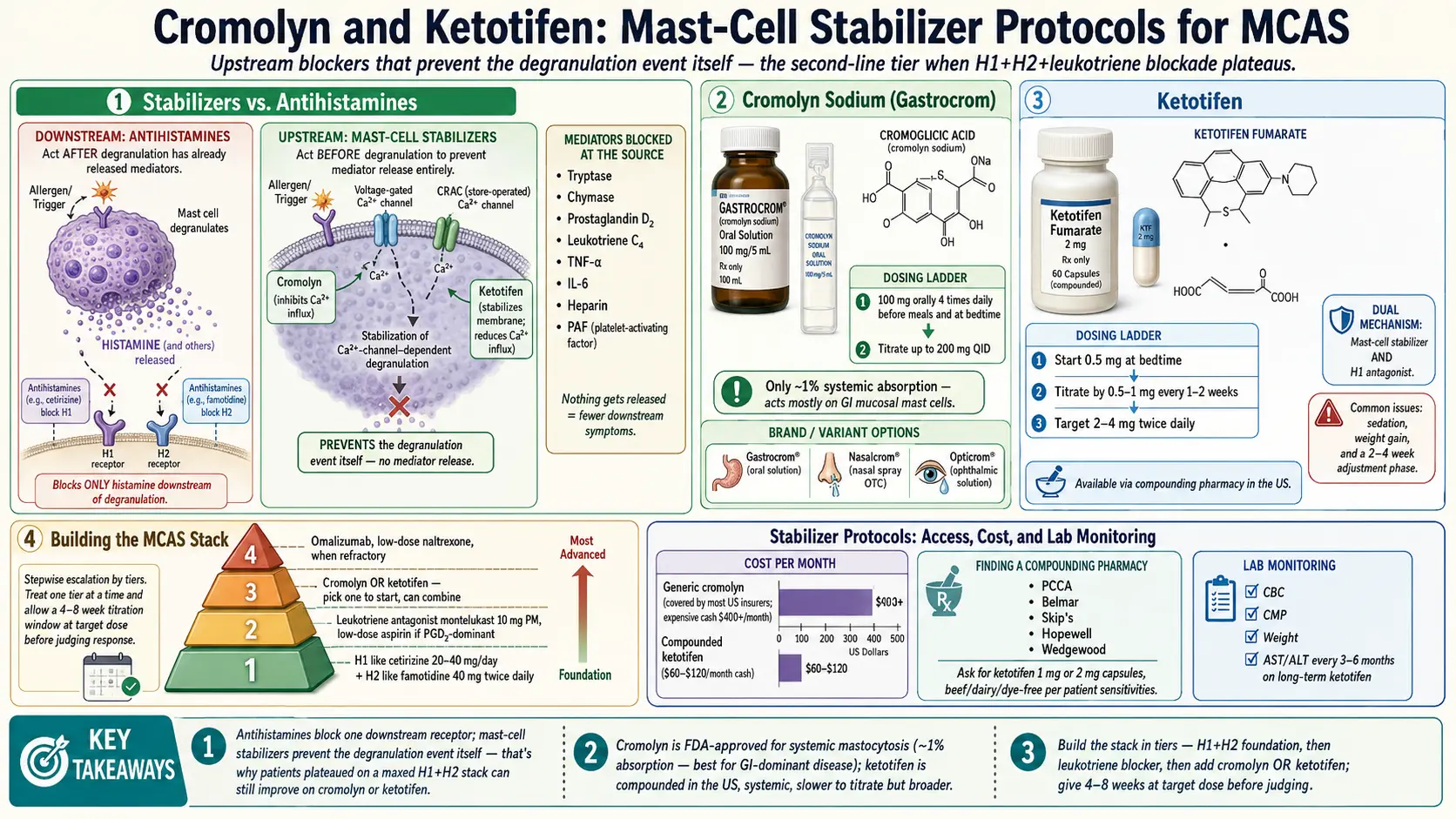
Table of Contents
- Why Stabilizers Are Different from Antihistamines
- MCAS Criteria and the Strength of the Evidence
- Cromolyn Sodium: Forms and US Labeling
- Cromolyn Doses on the US Label
- Cromolyn Side Effects
- Cromolyn: Prescription Status and Access
- Ketotifen
- Ketotifen Doses Reported in Studies
- Ketotifen Side Effects
- Ketotifen: Access in the US
- Compounded Preparations and Excipients
- Cromolyn vs Ketotifen — How They Differ
- Combining with the H1/H2 Stack
- When Stabilizers Aren’t Enough
- Lab Monitoring
- Stopping Stabilizers
- Key Research Papers
- Connections
- Featured Videos
1. Why Stabilizers Are Different from Antihistamines
Antihistamines — cetirizine, loratadine and diphenhydramine at the H1 receptor, famotidine at the H2 receptor — act after the mast cell has released histamine. They block the histamine signal at its receptor; they do not stop the release itself.
Mast cell stabilizers are described as acting a step earlier, on release. The US label for oral cromolyn states that in laboratory and animal studies cromolyn inhibits the release of mediators from sensitized mast cells, including histamine and leukotrienes, and that it has no antihistamine activity of its own. How it does this is not settled; a 2016 review lists the GPR35 receptor and chloride currents among its proposed targets (Molderings 2016). Activated mast cells release many mediators besides histamine, among them tryptase, chymase, prostaglandin D2, leukotriene C4, TNF-alpha, IL-6, heparin and platelet-activating factor. Some, such as histamine and heparin, are stored in the cell’s granules; others, such as prostaglandins and leukotrienes, are made at the moment of activation rather than stored (Valent 2020).
The human data on mediator levels are mixed, however. In two mastocytosis trials of oral cromolyn, histamine levels were not consistently changed by the drug — in one of them even though symptoms improved markedly (Soter 1979; Frieri 1985) — and in an irritable bowel syndrome trial, ketotifen eased symptoms without changing tryptase or histamine release from rectal biopsies (Klooker 2010). Whether adding a stabilizer helps people already taking antihistamines has not been tested in controlled MCAS trials (Castells 2024).
2. MCAS Criteria and the Strength of the Evidence
The Consensus Criteria and the “20% + 2” Tryptase Rule
The consensus criteria first proposed in 2012 by an international group led by Valent, and restated by the group in 2019 and 2020, require all three of the following before a condition is called MCAS (Valent 2012; Valent 2019; Valent 2020):
- Typical symptoms: severe, recurrent episodes of systemic mast cell activation involving at least two organ systems, often in the form of anaphylaxis.
- Laboratory evidence: preferably a rise in serum tryptase during an episode to more than the person’s own baseline plus 20%, plus 2 ng/mL (the “20% + 2” formula, written as baseline × 1.2 + 2). A clear rise in another mast cell mediator, such as urinary histamine or prostaglandin D2 metabolites, is accepted as an alternative, though these are considered less specific than tryptase.
- Response to treatment: symptoms respond to mast-cell-stabilizing drugs or to drugs that block mast cell mediators.
A 2024 review adds that the tryptase rise can be captured within 4 to 6 hours of an episode, peaking 30 to 60 minutes after symptoms begin, with the baseline measured at least 24 hours after symptoms have fully resolved (Castells 2024). Response to treatment is itself one of the criteria: in the 2019 diagnostic algorithm, the response of symptoms to stabilizing or anti-mediator drugs is the step that confirms MCAS (Valent 2019).
Not everyone uses these criteria. A different proposal, called “consensus-2” by Afrin and colleagues, leads to substantial differences in how many patients qualify for the diagnosis. Its authors describe MCAS as common (up to 17% of the general population, in their estimate), accept that overdiagnosis under their criteria could be a problem, and argue that underdiagnosis under the 2012 criteria is the far larger one (Afrin 2020). The consensus-criteria group, by contrast, describes overt MCAS as unusual and reports that many patients referred with suspected MCAS turn out to have other conditions (Valent 2019). The 2019 work group report of the American Academy of Allergy, Asthma & Immunology (AAAAI) sets out criteria intended to diagnose most cases without overdiagnosing patients who likely have other conditions (Weiler 2019).
Where the Treatment Evidence Comes From
The trials of oral cromolyn and oral ketotifen in mast cell disease cited on this page were all done in mastocytosis, a related but different disease in which mast cells accumulate in tissues, and all were small:
- Oral cromolyn: the US label summarizes four randomized controlled trials in cutaneous or systemic mastocytosis that together enrolled 36 patients, 32 of them evaluable — too few for formal statistical analysis. Published examples include a 5-patient crossover trial (Soter 1979), an 8-patient comparison with antihistamines (Frieri 1985) and an 11-patient withdrawal trial (Horan 1990). In a separate 4-patient report, neither cromolyn nor ketotifen improved symptoms (Mallet 1989).
- Oral ketotifen: a 10-patient crossover trial in urticaria pigmentosa, a skin form of mastocytosis (Czarnetzki 1983), and an 8-child crossover trial in pediatric mastocytosis (Kettelhut 1989).
For MCAS and related mast cell disorders, reviews describe the evidence as expert opinion, observational studies and case reports. A 2017 review states that current recommendations “are exclusively based on expert opinions due to the lack of controlled clinical trials” (Gülen 2017); a 2016 review states that treatment options for refractory disease “are based mainly on observational studies and case reports” (Molderings 2016); and a 2024 review notes that interventional studies are lacking and calls for double-blind, placebo-controlled trials of antihistamines, mast cell stabilizers and leukotriene blockers (Castells 2024).
3. Cromolyn Sodium: Forms and US Labeling
Cromolyn sodium (also called cromoglicic acid or disodium cromoglycate) is described in the National Library of Medicine’s MeSH vocabulary as a chromone that acts by inhibiting the release of chemical mediators from sensitized mast cells, used to prevent allergic and exercise-induced asthma. In the US it is sold in these forms, as listed in the FDA’s Drugs@FDA database:
- Oral concentrate (prescription) — 100 mg in each 5 mL ampule; labeled for the management of mastocytosis
- Nasal spray (over the counter) — labeled to prevent and relieve nasal symptoms of hay fever and other nasal allergies
- Eye drops, 4% (prescription) — labeled for vernal keratoconjunctivitis, vernal conjunctivitis and vernal keratitis
- Nebulizer solution (prescription) — labeled as a preventive treatment for bronchial asthma; the metered-dose inhaler and inhaled-capsule forms are listed as discontinued
US Labeling for the Oral Form
The US label for oral cromolyn sodium concentrate lists one indication, the management of patients with mastocytosis, and states that its use “has been associated with improvement in diarrhea, flushing, headaches, vomiting, urticaria, abdominal pain, nausea, and itching in some patients.” MCAS is not a labeled indication, so prescribing it for MCAS is off-label.
How It Works — and Where It Acts
The label states that no more than 1% of an oral dose is absorbed, the remainder being excreted in the feces. Even so, the label and the trials report effects beyond the gut: in the mastocytosis trials summarized on the label, gastrointestinal symptoms (diarrhea, abdominal pain) improved in the majority of patients, with some improvement also in skin symptoms (urticaria, itching, flushing) and cognitive function. In the 11-patient withdrawal trial, the benefit over placebo was statistically significant for gastrointestinal symptoms but not for other symptoms (Horan 1990).
4. Cromolyn Doses on the US Label
Adults and Adolescents
- Adults and adolescents 13 years and older: two ampules (200 mg) four times daily, taken one-half hour before meals and at bedtime — the label’s usual starting dose
- The label directs that the ampule contents be squeezed into a glass of water, stirred, and all of the liquid drunk
- If symptoms are not satisfactorily controlled within two to three weeks, the label allows the dose to be increased, to no more than 40 mg/kg/day
- Once a response is achieved, the label allows the dose to be reduced to the minimum that maintains control
Lower Starting Doses
The label gives no step-up schedule for adults. For older adults it notes that dose selection is usually cautious, starting at the low end of the dosing range. A 2016 review of mast cell disease treatment describes testing each new drug for tolerance with a low single dose before regular use, when tolerance is not already known (Molderings 2016).
Children
Children 2–12 years: one ampule (100 mg) four times daily, one-half hour before meals and at bedtime. For children under 2 the label does not recommend it, reserving use for severe disease in which the potential benefits clearly outweigh the risks, and notes that in term infants up to six months available data suggest a dose not exceeding 20 mg/kg/day.
Time to Effect
In the label’s mastocytosis trials, clinical improvement occurred within 2–6 weeks of starting treatment. The label states that the effect depends on taking the drug at regular intervals.
Withdrawal
In the same trials, improvement persisted for 2–3 weeks after the drug was withdrawn. What is reported about stopping is collected under Stopping Stabilizers.
5. Cromolyn Side Effects
- In the mastocytosis studies. The most frequently reported adverse events were headache and diarrhea (each in 4 of 87 patients), then itching, nausea and muscle aches (3 patients each) and abdominal pain, rash and irritability (2 patients each). The label notes that most were transient and could represent symptoms of the disease itself.
- Initial flare. A 2016 review notes that cromolyn sometimes causes an initial flare of symptoms that usually soon abates (Molderings 2016).
- Taste. The label describes a slightly bitter aftertaste; unpleasant taste also appears among the events reported from other studies and post-marketing experience.
- Allergic reactions. The label warns that severe anaphylactic reactions may occur rarely, and cromolyn is contraindicated in people who have shown hypersensitivity to it.
- Kidney and liver function. Because cromolyn is excreted through the bile and the kidneys, the label calls for a lower dose in people with decreased renal or hepatic function.
6. Cromolyn: Prescription Status and Access
- Oral concentrate: prescription only. Besides the original brand, several FDA-approved generic versions are listed in Drugs@FDA. The labels call for storage at room temperature, protected from light, and state that a solution that contains a precipitate or has become discolored is not to be used.
- Nasal spray: sold over the counter.
- Eye drops (4%): prescription only in the US.
Prices and insurance coverage vary by pharmacy, plan and country and are not covered here. In the ICD-10-CM diagnosis codes, systemic mastocytosis is D47.02 and congenital cutaneous mastocytosis is Q82.2; mast cell activation disorders have their own codes, D89.40–D89.49, which include D89.44 for hereditary alpha-tryptasemia.
7. Ketotifen
Ketotifen fumarate is described in MeSH as a cycloheptathiophene drug that blocks histamine H1 receptors and the release of inflammatory mediators. A 1990 review describes oral ketotifen as a preventive treatment for bronchial asthma and allergic disorders (Grant 1990), and a 1997 trial report describes it as marketed throughout the world as an antiallergy drug (Hoshino 1997).
US Status
In the US, oral ketotifen is not FDA-approved: Drugs@FDA lists no oral ketotifen product. The FDA-approved ketotifen products are 0.025% eye drops, first approved in 1999 and now sold over the counter, labeled to temporarily relieve itchy eyes due to pollen, ragweed, grass, animal hair and dander. Oral ketotifen used in the US is therefore a compounded preparation (see Ketotifen: Access in the US), and its use in MCAS is not covered by any US label.
How It Works
Ketotifen is credited with two actions:
- H1 antihistamine — it blocks the histamine-1 receptor; a 1990 review describes pronounced antihistaminic properties (Grant 1990)
- Mast cell stabilizer — MeSH describes it as also blocking the release of inflammatory mediators
Unlike oral cromolyn, ketotifen is absorbed after an oral dose: in 40 healthy men given 2 mg, it was rapidly absorbed, peaking in the blood within 2 to 4 hours, with an average elimination half-life of about 12 hours (Grahnén 1992). Which action explains its effects in people is not settled: in a randomized trial in 60 patients with irritable bowel syndrome, 8 weeks of ketotifen reduced abdominal pain and other symptoms compared with placebo without changing tryptase or histamine release from rectal biopsies, and the authors left open whether mast cell stabilization or H1 blockade was responsible (Klooker 2010).
8. Ketotifen Doses Reported in Studies
There is no US label for oral ketotifen, and no controlled MCAS trial has set a dose (Castells 2024). Doses used in published trials include:
- 2 mg daily by mouth — a double-blind crossover trial in 10 adults with urticaria pigmentosa (Czarnetzki 1983)
- 1 mg twice daily — an 8-week double-blind, placebo-controlled trial involving 25 patients with atopic asthma (Hoshino 1997)
Any titration schedule used for MCAS rests on expert opinion rather than trial data; a 2017 review states that recommendations for mast cell disorders are based exclusively on expert opinion because controlled trials are lacking (Gülen 2017).
Time to Effect
In asthma, the 1990 review describes benefit after 6 to 12 weeks and notes that a lengthy run-in period is needed (Grant 1990). How quickly ketotifen works in MCAS has not been established in controlled trials.
9. Ketotifen Side Effects
- Sedation. The 1990 review notes that sedation can be troublesome in older children and adults during the first 2 weeks of treatment (Grant 1990); in the 10-patient urticaria pigmentosa trial, tiredness was the only side effect, noted in 40% of patients (Czarnetzki 1983).
- Weight gain. Described as a notable effect in a small percentage of patients (Grant 1990).
- Symptoms after stopping. In the urticaria pigmentosa trial, a transient worsening of symptoms was noted after the drug was discontinued (Czarnetzki 1983).
10. Ketotifen: Access in the US
Because no oral ketotifen product is FDA-approved, oral ketotifen in the US is a compounded preparation made to a prescription. The FDA states that compounded drugs are not FDA-approved, which means FDA does not verify their safety, effectiveness or quality before they are marketed. Prices and insurance coverage vary and are not covered here.
11. Compounded Preparations and Excipients
A 2016 review of mast cell disease treatment, drawing partly on its authors’ unpublished observations, reports that some patients react to medication excipients — fillers, binders, dyes and preservatives — even more readily than to the active drug, and that a formulation with different excipients, or a custom-compounded one, sometimes makes a drug tolerable. The same review notes geographic and financial barriers to reaching compounding pharmacies (Molderings 2016).
A 2024 review describes patient groups, including online ones, as a possible source of support and shared information for people with mast cell disease (Castells 2024).
12. Cromolyn vs Ketotifen — How They Differ
- Absorption: no more than 1% of oral cromolyn is absorbed (US label); oral ketotifen is rapidly absorbed (Grahnén 1992).
- Antihistamine action: cromolyn has none of its own (US label); ketotifen blocks H1 receptors (MeSH).
- Sedation: not among the most frequently reported events in the oral cromolyn studies; a recognized effect of ketotifen in the first 2 weeks (Grant 1990).
- US status: oral cromolyn is FDA-approved, with mastocytosis as its labeled indication; oral ketotifen is not FDA-approved and is compounded.
- Trials in mast cell disease: small trials in mastocytosis for both. In an 8-child crossover trial in pediatric mastocytosis, 7 of the 8 children had a greater reduction in symptoms on hydroxyzine, and the authors concluded that ketotifen offered no advantage over hydroxyzine (Kettelhut 1989).
Using Both
Reviews of mast cell disease treatment describe combining drugs: a 2016 review states that, as a rule, its first-line drugs are used in combination, and that effective therapy often consists of antihistamines and mast-cell-stabilizing compounds plus medications aimed at specific symptoms (Molderings 2016).
13. Combining with the H1/H2 Stack
A 2016 treatment review describes mast cell stabilizers being combined with H1 and H2 antihistamines (Molderings 2016). The same review lists leukotriene blockers such as montelukast as possible additions, and describes aspirin for prostaglandin-driven flushing as an option used only with extreme caution, because aspirin can itself trigger mast cell degranulation (Molderings 2016).
See H1 and H2 Blocker Stacks for the antihistamine layer. The stabilizer acts on a different step in the cascade (release) than the antihistamines (receptor blockade), but whether their benefits add up has not been tested in controlled MCAS trials (Castells 2024). In an 8-patient mastocytosis trial (6 completed), oral cromolyn alone and the antihistamine pair chlorpheniramine plus cimetidine were indistinguishable for symptom relief, and neither changed plasma or urine histamine levels consistently (Frieri 1985).
14. When Stabilizers Aren’t Enough
Reviews describe further options for symptoms that antihistamines and stabilizers do not control; the evidence behind them is limited:
- Omalizumab (an anti-IgE antibody given by injection under the skin). MCAS is not among its US labeled indications. A 2025 systematic review found nine published studies describing 28 patients with refractory MCAS treated with it: most had a partial response (61%) and five a complete response, at doses ranging from 150 mg every 4 weeks to 300 mg every 3 weeks (Matheny 2025). A 2024 review describes the supporting data in mastocytosis and hereditary alpha-tryptasemia as case reports, small uncontrolled case series and retrospective analyses (Castells 2024).
- Imatinib (a tyrosine kinase inhibitor). Its US label covers adults with aggressive systemic mastocytosis without the KIT D816V mutation or with mutational status unknown; MCAS is not a labeled indication.
- Avapritinib (a tyrosine kinase inhibitor that targets KIT D816V). FDA-approved for adults with advanced systemic mastocytosis and for adults with indolent systemic mastocytosis; MCAS is not a labeled indication. A 2024 review reports that D816V-targeting inhibitors reduce bone marrow and skin mast cells, serum tryptase and symptoms of mast cell activation (Castells 2024).
- Intravenous immunoglobulin (IVIG). A 2024 review describes reports of benefit from low-dose naltrexone with and without IVIG as anecdotal, uncontrolled and controversial (Castells 2024); a 2016 review raises immunoglobulin only as an open question for patients whose drug-intolerance reactions may be IgG-mediated (Molderings 2016).
These drugs are prescribed by specialists, usually in allergy/immunology or hematology.
15. Lab Monitoring
The US label for oral cromolyn does not call for routine laboratory monitoring. It does call for a lower dose in people with decreased kidney or liver function, and abnormal liver function tests appear among the less common events reported from other studies and post-marketing experience, where attribution to the drug often cannot be determined. Oral ketotifen has no US label.
16. Stopping Stabilizers
Published data on stopping are limited. For oral cromolyn, the label reports that improvement persisted for 2–3 weeks after treatment was withdrawn, and states that the dose is maintained to prevent relapses; in the 11-patient randomized withdrawal trial, symptom scores and physician-rated disease severity worsened significantly in patients switched to placebo compared with those who stayed on cromolyn (Horan 1990). For ketotifen, the 10-patient urticaria pigmentosa trial noted a transient worsening of symptoms after the drug was stopped (Czarnetzki 1983).
Neither the label nor these trials sets out a tapering schedule. Decisions about starting, changing or stopping these medicines belong with a clinician.
Key Research Papers
- Valent P, et al. Proposed diagnostic algorithm for patients with suspected mast cell activation syndrome. J Allergy Clin Immunol Pract. 2019;7(4):1125–1133. — doi:10.1016/j.jaip.2019.01.006
- Molderings GJ, Haenisch B, Brettner S, et al. Pharmacological treatment options for mast cell activation disease. Naunyn-Schmiedeberg’s Archives of Pharmacology. 2016;389(7):671–694. — doi:10.1007/s00210-016-1247-1
- Gülen T, Akin C. Pharmacotherapy of mast cell disorders. Current Opinion in Allergy and Clinical Immunology. 2017;17(4):295–303. — doi:10.1097/ACI.0000000000000377
- Afrin LB, Ackerley MB, Bluestein LS, et al. Diagnosis of mast cell activation syndrome: a global “consensus-2.” Diagnosis (Berl). 2020;8(2):137–152. — doi:10.1515/dx-2020-0005
- Valent P, Akin C, Arock M, et al. Definitions, criteria and global classification of mast cell disorders with special reference to mast cell activation syndromes: a consensus proposal. Int Arch Allergy Immunol. 2012;157(3):215–225. — PubMed PMID: 22041891
- Valent P, Akin C, Nedoszytko B, et al. Diagnosis, classification and management of mast cell activation syndromes (MCAS) in the era of personalized medicine. Int J Mol Sci. 2020;21(23):9030. — PubMed PMID: 33261124
- Weiler CR, Austen KF, Akin C, et al. AAAAI Mast Cell Disorders Committee Work Group Report: Mast cell activation syndrome (MCAS) diagnosis and management. J Allergy Clin Immunol. 2019;144(4):883–896. — PubMed PMID: 31476322
- Castells M, Giannetti MP, Hamilton MJ, et al. Mast cell activation syndrome: current understanding and research needs. J Allergy Clin Immunol. 2024;154(2):255–263. — PubMed PMID: 38851398
- Soter NA, Austen KF, Wasserman SI. Oral disodium cromoglycate in the treatment of systemic mastocytosis. N Engl J Med. 1979;301(9):465–469. — PubMed PMID: 111124
- Frieri M, Alling DW, Metcalfe DD. Comparison of the therapeutic efficacy of cromolyn sodium with that of combined chlorpheniramine and cimetidine in systemic mastocytosis. Results of a double-blind clinical trial. Am J Med. 1985;78(1):9–14. — PubMed PMID: 3917606
- Horan RF, Sheffer AL, Austen KF. Cromolyn sodium in the management of systemic mastocytosis. J Allergy Clin Immunol. 1990;85(5):852–855. — PubMed PMID: 2110198
- Mallet AI, Norris P, Rendell NB, Wong E, Greaves MW. The effect of disodium cromoglycate and ketotifen on the excretion of histamine and N tau-methylimidazole acetic acid in urine of patients with mastocytosis. Br J Clin Pharmacol. 1989;27(1):88–91. — PubMed PMID: 2495814
- Czarnetzki BM. A double-blind cross-over study of the effect of ketotifen in urticaria pigmentosa. Dermatologica. 1983;166(1):44–47. — PubMed PMID: 6341102
- Kettelhut BV, Berkebile C, Bradley D, Metcalfe DD. A double-blind, placebo-controlled, crossover trial of ketotifen versus hydroxyzine in the treatment of pediatric mastocytosis. J Allergy Clin Immunol. 1989;83(5):866–870. — PubMed PMID: 2654254
- Grant SM, Goa KL, Fitton A, Sorkin EM. Ketotifen. A review of its pharmacodynamic and pharmacokinetic properties, and therapeutic use in asthma and allergic disorders. Drugs. 1990;40(3):412–448. — PubMed PMID: 2226222
- Grahnén A, Lönnebo A, Beck O, et al. Pharmacokinetics of ketotifen after oral administration to healthy male subjects. Biopharm Drug Dispos. 1992;13(4):255–262. — PubMed PMID: 1600111
- Hoshino M, Nakamura Y, Shin Z, Fukushima Y. Effects of ketotifen on symptoms and on bronchial mucosa in patients with atopic asthma. Allergy. 1997;52(8):814–820. — PubMed PMID: 9284980
- Klooker TK, Braak B, Koopman KE, et al. The mast cell stabiliser ketotifen decreases visceral hypersensitivity and improves intestinal symptoms in patients with irritable bowel syndrome. Gut. 2010;59(9):1213–1221. — PubMed PMID: 20650926
- Matheny MV, Craig T, Al-Shaikhly T. Systematic review of omalizumab for refractory clonal and non-clonal mast cell activation syndrome. Allergy Asthma Proc. 2025;46(1):11–18. — PubMed PMID: 39741373
PubMed Topic Searches
Curated PubMed topic searches — each link opens a live query so you always see the most recent literature.
Connections
- Neurology
- MCAS Overview
- H1 and H2 Blocker Stacks
- Mediators and Symptom Map
- MCAS Testing Guide
- Low-Histamine Diet
- Triggers and Flare Management
- Natural Mast Cell Stabilizers
- Hereditary Alpha-Tryptasemia
- Hormone Sensitivity and Menstrual Flares
- POTS
- Allergies
- Alpha-Gal Syndrome
- SIBO
- Asthma
- Quercetin
- Bloating
- Brain Fog