Epilepsy: History and Discovery
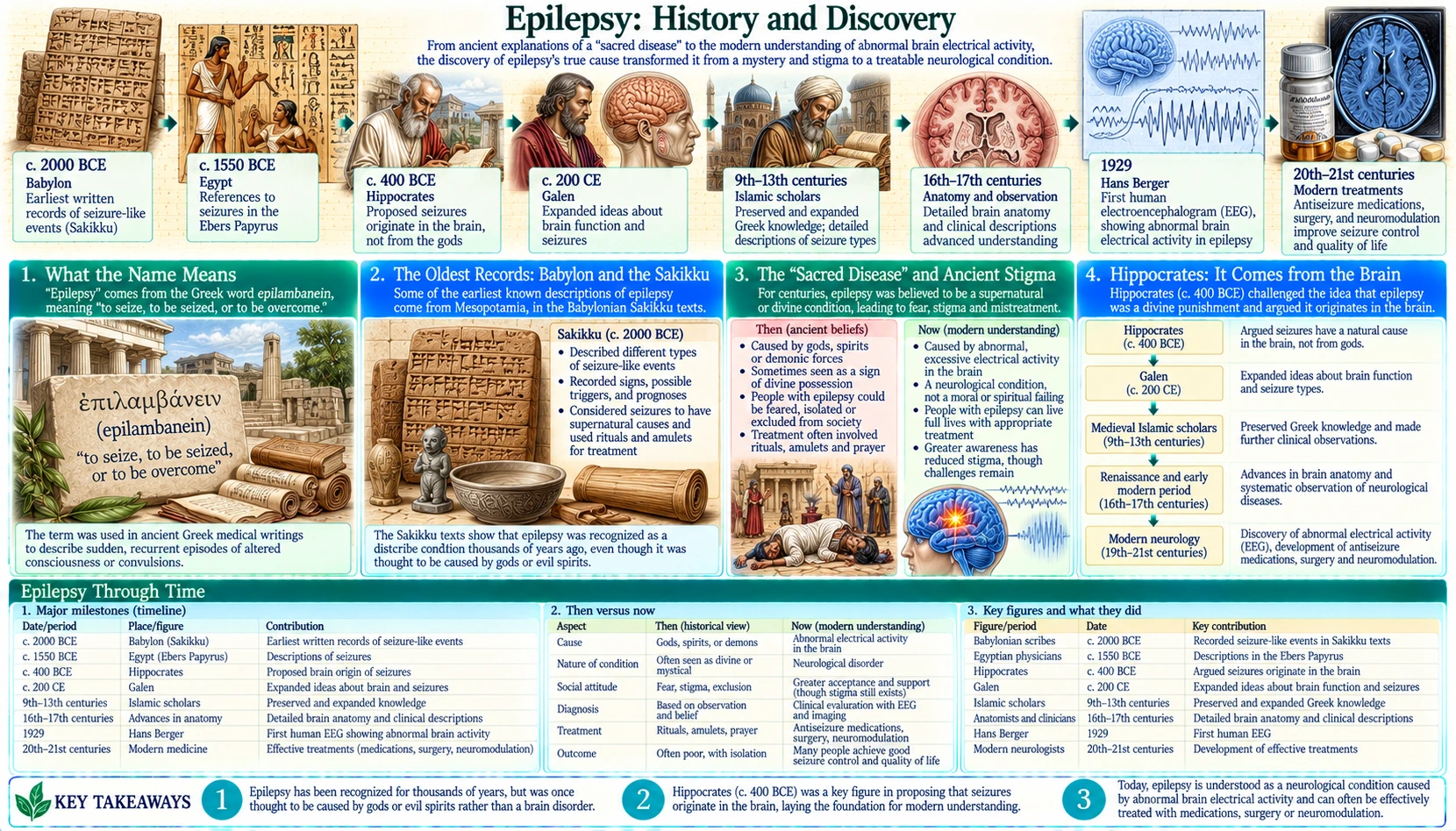
Few diseases have been watched, feared, and misunderstood for as long as epilepsy. For thousands of years a seizure looked to onlookers like possession — the body seized by a god, a demon, or the moon — and the condition was called the “sacred disease.” Yet epilepsy also holds a special place in the history of medicine, because it was one of the very first illnesses that thinkers dared to pull out of the supernatural realm and explain as something physical: a disorder of the brain. This page traces that long journey, from the cuneiform seizure-records of ancient Babylon and the radical Hippocratic argument that epilepsy comes from the brain “like any other disease,” through John Hughlings Jackson’s definition of the seizure as an electrical storm in the brain, Hans Berger’s first recording of human brain waves, and the first medicines that could actually quiet a seizure. Throughout, the people who lived with epilepsy deserve dignity: much of this history is also a history of stigma, and naming that honestly is part of telling the story truthfully.
Table of Contents
- What the Name Means
- The Oldest Records: Babylon and the Sakikku
- The “Sacred Disease” and Ancient Stigma
- Hippocrates: It Comes from the Brain
- The Middle Ages and the Long Persistence of Superstition
- John Hughlings Jackson and the Electrical Storm
- Hans Berger and the First Human Electroencephalogram
- The First Medicines: Bromide and Phenobarbital
- The Modern Era: From Stigma to Science
- Key Research Papers
- Connections
- Featured Videos
What the Name Means
The word epilepsy comes straight from the experience of watching a seizure. It descends from the ancient Greek verb epilambanein (επιλαμβανειν), built from epi- (“upon”) and lambanein (“to take” or “to grasp”), so that the whole word means roughly “to seize upon,” “to lay hold of,” or “to attack.” To an observer, that is exactly what a convulsion looks like: something invisible reaches out and takes hold of a person, throwing them down and shaking them. The Greek noun epilepsis meant simply “a seizure,” and that idea — of the person being grabbed by an outside force — is baked into the very name we still use today.
That etymology carried a heavy implication. If a seizure is a force taking hold of someone, the natural ancient question was: who, or what, is doing the seizing? For most of human history the assumed answer was supernatural — a spirit, a god, the moon. The English word reached us in the sixteenth century by way of the French épilepsie and the Latin epilepsia, but its emotional charge is far older. Understanding that the name itself encodes a misunderstanding helps explain why it was such an intellectual achievement for medicine to relocate the cause of the “seizing” from the heavens to the brain.
The Oldest Records: Babylon and the Sakikku
Epilepsy is genuinely ancient, and we have written descriptions of it that are roughly three thousand years old. The most important early source is a Babylonian cuneiform text known as the Sakikku (Sumerian Sa-gig), a large diagnostic handbook whose title is often rendered as “all diseases” or “symptoms.” It was compiled on clay tablets in Mesopotamia, and a revised edition is dated to the reign of the Babylonian king Adad-apla-iddina, between about 1067 and 1046 BCE. Tablet 26 of this series is devoted to seizures, which makes it one of the oldest detailed medical accounts of epilepsy anywhere in the world. The text was studied and translated in the modern era by the scholars J. V. Kinnier Wilson and the neurologist Edward H. Reynolds, working from a tablet in the British Museum in London together with a duplicate held in Ankara, Turkey.
What is remarkable about the Sakikku is how careful and clinical its observations are. The Babylonian physicians were close watchers of their patients, and the tablet distinguishes between several kinds of seizure that modern neurologists still recognize: generalized convulsions with falling and shaking, brief blank spells, seizures that march across the body, and episodes with altered awareness and automatic behaviors. It records signs, symptoms, the course of an attack, treatments, and likely outcomes. In other words, more than a millennium before Hippocrates, someone sat down and tried to describe epilepsy systematically as a recognizable set of patterns rather than a single mysterious event.
And yet the Babylonians did not separate this careful description from the supernatural. Although they recognized natural causes for many ailments, seizures — like many disorders of mind and behavior — were generally attributed to gods, demons, ghosts, or evil spirits. This combination of precise clinical observation wrapped inside a supernatural explanation is the inheritance that would pass into the Greek idea of epilepsy as a “sacred” affliction.
The “Sacred Disease” and Ancient Stigma
By the time of classical Greece, epilepsy had acquired a reverent and frightening name: the sacred disease (Greek hiera nosos). The label reflected a widespread belief that a seizure was a moment of contact with the divine — that a god or spirit had literally entered and taken possession of the sufferer’s body. The dramatic, involuntary nature of a convulsion, with its sudden fall, fixed stare, shaking, foaming, and loss of awareness, seemed to demand a more-than-human explanation. To witnesses it did not look like ordinary sickness; it looked like the visible action of an unseen power, and so it was treated as holy, polluting, and dangerous all at once.
This sacred framing had real and often cruel consequences for the people who lived with epilepsy. Because seizures were read as signs of divine displeasure or impurity, sufferers could be feared, shunned, or blamed for their own condition. The healers who claimed authority over the “sacred disease” were frequently priests, purifiers, and magicians who prescribed incantations, ritual cleansings, and appeals to the gods rather than anything we would recognize as medicine. Other ancient traditions linked seizures to the moon — the root of the later word lunatic — reinforcing the sense that the cause lay in the heavens rather than in the body. It is important to state plainly that this was stigma, not science: the supernatural model made onlookers comfortable while too often leaving the patient isolated and blamed.
Hippocrates: It Comes from the Brain
Against this backdrop, one ancient text stands out as a genuine turning point in the history of human thought. Around 400 BCE, an author of the Hippocratic school — the tradition associated with Hippocrates of Kos — wrote a short treatise pointedly titled On the Sacred Disease. Its opening is one of the boldest statements in the whole of early medicine. The disease called sacred, the author declares, is “in my opinion no more divine or more sacred than other diseases, but has a natural cause, and its supposed divine origin is due to men’s inexperience and to their wonder at its peculiar character.” In a single sentence, the writer takes the most “divine” affliction known and insists it is an ordinary illness with an ordinary cause.
The treatise then makes a claim even more important than its rejection of the supernatural: it locates the cause of seizures in a specific organ — the brain. The author argues that the brain is the seat of our thoughts, feelings, and senses, and that epilepsy arises when something interferes with the brain’s normal workings. The mechanism he proposed — an excess of phlegm (one of the four humors) flowing from the brain and blocking the passages of the body — is, by modern standards, wrong in its details. But the structure of the argument is profoundly modern and correct in its essentials: seizures are a brain phenomenon, they follow natural laws, and they should be studied and treated like any other bodily disease rather than placated with ritual. It is worth keeping the humoral mechanism clearly labeled as the ancient hypothesis it was, while recognizing that the central insight — epilepsy comes from the brain — has stood for nearly twenty-four centuries.
The author also turned scorn on the “purifiers” and magicians who profited from the disease, accusing them of hiding their ignorance behind a cloak of holiness — and noting, shrewdly, that their incantations and purifications did not actually cure anyone. For all these reasons On the Sacred Disease is celebrated as one of the earliest surviving documents of rational, naturalistic medicine: a deliberate move from a magico-religious worldview toward the idea that disease has physical causes that can, in principle, be understood. That this breakthrough happened with epilepsy — the very illness most heavily wrapped in superstition — is part of what makes it so striking.
The Middle Ages and the Long Persistence of Superstition
The Hippocratic insight, sadly, did not win the day for a very long time. The careful naturalism of On the Sacred Disease was preserved and elaborated by later physicians — the Roman-era Greek physician Galen, among others, continued to discuss epilepsy as a disorder centered on the brain — but in the wider culture the older supernatural model proved extraordinarily durable. Through late antiquity and the medieval centuries, epilepsy was once again widely interpreted as possession, as a curse, or as a sign of sin, and people sought relief through prayer, pilgrimage, relics, exorcism, and the intercession of saints rather than through medicine. The condition acquired the name “the falling sickness” in many European languages, and in some periods sufferers were treated with suspicion bordering on accusation.
It is important to acknowledge how much harm this superstition caused: people with epilepsy were too often excluded from ordinary life, marriage, and work, and were sometimes feared as contagious or morally tainted. The persistence of these attitudes — long after a rational alternative had been articulated — is a sobering reminder that scientific understanding and social acceptance do not always advance together. A correct idea about the brain had existed since antiquity; what was missing for almost two thousand more years was the tools to prove it, the treatments to act on it, and the cultural willingness to abandon the language of possession.
Only with the gradual rise of clinical and anatomical medicine from the seventeenth century onward did epilepsy begin, slowly, to be reclaimed as a neurological condition. Physicians increasingly tied seizures to observable problems in the nervous system, setting the stage for the decisive nineteenth-century work that would finally turn the Hippocratic intuition into a precise, testable science.
John Hughlings Jackson and the Electrical Storm
The person most responsible for the modern understanding of seizures is the English neurologist John Hughlings Jackson (1835–1911), who worked in London at the National Hospital for the Paralysed and Epileptic in Queen Square. In a series of papers in the 1870s — most famously “A Study of Convulsions” in 1870 and a much-quoted statement in 1873 — Jackson defined epilepsy in terms that neurologists still use today. He described a seizure as the result of “an occasional, sudden, excessive, rapid, and local discharge of grey matter” in plain language, a brief, abnormal electrical storm in the cells of the brain. This was the crucial reframing: the seizure is not something that enters the person from outside, but something the brain itself does when its own neurons fire in a sudden, disorderly burst.
Jackson reached this conclusion largely by careful observation rather than by measuring electricity directly — the technology to record human brain waves did not yet exist. He paid close attention to a particular kind of seizure that begins in one small part of the body, say the thumb or the corner of the mouth, and then spreads in an orderly way up the limb and across the body as the abnormal discharge travels across the surface of the brain. This characteristic spread is now called the Jacksonian march, and the seizure type bears his name as Jacksonian epilepsy — a label coined by the French neurologist Jean-Martin Charcot in Jackson’s honor. By tracing such seizures, Jackson deduced in the 1870s that they arose from discharges in the motor region of the cerebral cortex, and that different parts of the body were represented in an orderly map across that region — an insight that helped found the modern understanding of how the brain is organized.
The importance of Jackson’s work is hard to overstate. He completed, in scientific terms, what the Hippocratic author had begun in philosophical ones: he placed epilepsy firmly and specifically in the brain, gave it a physical mechanism — abnormal electrical discharge of neurons — and described its patterns precisely enough to be tested. His definition was so accurate that it would later be confirmed almost word-for-word once brain electricity could actually be recorded, and it remains reflected in the way seizures are described a century and a half later.
Hans Berger and the First Human Electroencephalogram
Jackson had argued that seizures were electrical events, but proving it required a way to actually detect the electrical activity of a living human brain. That breakthrough came from a German psychiatrist named Hans Berger (1873–1941), working at the University of Jena. Building on the nineteenth-century discovery by the English physiologist Richard Caton that animal brains produce measurable electrical currents, Berger set out to record the same thing in people. He made his first successful recording of human brain electrical activity on 6 July 1924, and he gave the technique the name we still use: the electroencephalogram, or electroencephalogram (EEG) (originally Elektrenkephalogramm).
Berger was a cautious and famously self-doubting scientist. Worried that his results might be artifacts rather than genuine brain signals, he spent five years repeating and refining his work before he was willing to publish. His first paper finally appeared in 1929, the first in a long series all carrying the same title, Über das Elektrenkephalogramm des Menschen (“On the Electroencephalogram of Man”). In it he described the rhythmic waves of the resting human brain, including the prominent rhythm later named in his honor the Berger rhythm, now usually called the alpha rhythm, along with the faster beta activity. His findings were met at first with skepticism and were only widely accepted after other laboratories confirmed them in the 1930s.
For epilepsy, the electroencephalogram was transformative. Once the abnormal electrical discharges of the brain could be seen as tracings on paper, Jackson’s “sudden, excessive, rapid discharge” stopped being an inference and became something doctors could literally watch. The electroencephalogram made it possible to confirm a seizure disorder, to distinguish different seizure types by their electrical signatures, to localize where in the brain a seizure begins, and eventually to guide surgery. Nearly every aspect of modern seizure science — classification, diagnosis, and treatment — rests on the window that Berger’s recording first opened onto the living human brain.
The First Medicines: Bromide and Phenobarbital
Understanding epilepsy is one thing; being able to treat it is another, and for almost the whole of recorded history medicine had nothing that reliably stopped a seizure. The first real change came in the mid-nineteenth century. On 12 May 1857, at a meeting of the Royal Medical and Chirurgical Society in London, the obstetrician Sir Charles Locock — physician-accoucheur to Queen Victoria — remarked that he had used potassium bromide to stop seizures in a series of women with what was then called “hysterical” or menstrual-related epilepsy, reportedly succeeding in all but one. Locock’s own reasoning about why bromide worked was mistaken, but the observation itself was sound, and he is generally credited with introducing the first reasonably effective anti-seizure drug into medicine. Bromide had real drawbacks — sedation, skin eruptions, and toxicity with long use — but for the next half-century it was essentially the only medicine that could quiet seizures, and that alone made it a landmark.
The next major advance came in 1912, when the German psychiatrist Alfred Hauptmann discovered the anti-seizure power of phenobarbital. Phenobarbital had been introduced as a sedative and sleeping aid, and Hauptmann — by one account giving it to agitated seizure patients on his ward to help them sleep — noticed that their seizures markedly decreased. He pursued the observation and established phenobarbital as a genuine antiepileptic drug. It was dramatically more effective and better tolerated than bromide, and it rapidly became the mainstay of seizure treatment. Phenobarbital remains one of the oldest medicines still in regular use anywhere in medicine, and it is still listed by the World Health Organization as an essential treatment for epilepsy, especially where newer drugs are unavailable.
These two discoveries opened the modern pharmaceutical era of epilepsy care. The arrival of phenytoin in the late 1930s — identified through deliberate laboratory screening rather than chance — began the era of systematic drug development. But the line begins with Locock’s bromide and Hauptmann’s phenobarbital: the first proof that a seizure, long thought to be the work of gods or demons, could be calmed by a chemical acting on the brain.
The Modern Era: From Stigma to Science
The twentieth century turned epilepsy from a feared mystery into one of the better-understood neurological conditions. With the electroencephalogram to reveal seizures and a growing array of medications to control them, attention shifted toward classifying seizure types precisely, mapping where in the brain they originate, and, for some patients, removing the small region of cortex responsible. Pioneering epilepsy surgery in the mid-twentieth century — notably the work of Wilder Penfield in Montreal, who stimulated the exposed cortex of conscious patients and mapped its functions — built directly on Jackson’s idea of an orderly cortical map and Berger’s ability to record the brain’s electrical activity. Today many people with epilepsy become seizure-free on medication, and others benefit from surgery, dietary therapies, or implanted devices that interrupt abnormal electrical activity.
Just as important as the medical progress is the slow, still-unfinished work of undoing centuries of stigma. The supernatural framing that began in Babylon and Greece left a long shadow: well into modern times, people with epilepsy faced discrimination in marriage, employment, education, and even basic civil rights, and in many places they still encounter fear and misunderstanding rooted in the ancient idea that a seizure is something shameful or contagious. Patient advocacy, public education, and the plain facts of neuroscience have gradually replaced the language of possession with the language of medicine. Modern epilepsy organizations emphasize a simple, dignifying truth that the Hippocratic author grasped twenty-four centuries ago: epilepsy is a condition of the brain, it is no one’s fault, and the people who live with it deserve the same understanding and respect as anyone with any other medical condition.
Seen as a whole, the history of epilepsy is one of the great arcs in the story of medicine. It runs from clay tablets that carefully described seizures while blaming demons, through a single ancient treatise brave enough to say the cause was the brain, to a neurologist who defined the seizure as an electrical discharge, a psychiatrist who first recorded the brain’s own electricity, and the first medicines that could quiet the storm. The throughline is the gradual triumph of observation and reason over fear — and the recovery of the dignity of people who, for most of human history, were misunderstood.
Key Research Papers
The references below combine peer-reviewed historical scholarship with curated PubMed topic-search links into the literature on the history of epilepsy. Ancient primary sources — the Babylonian Sakikku and the Hippocratic treatise On the Sacred Disease — are named in the article as historical documents rather than as modern citations. Where a stable DOI or PMID is given it links directly to the record; topic-search links open at PubMed (National Library of Medicine) in a new tab.
- Iniesta I. John Hughlings Jackson and our understanding of the epilepsies 100 years on. Practical Neurology. 2011;11(1):37-41. — doi:10.1136/jnnp.2010.235192 (PubMed PMID: 21239653)
- Eadie MJ. Sir Charles Locock and potassium bromide. Journal of the Royal College of Physicians of Edinburgh. 2012;42(3):274-279. — doi:10.4997/JRCPE.2012.317
- Yasiry Z, Shorvon SD. How phenobarbital revolutionized epilepsy therapy: the story of phenobarbital therapy in epilepsy in the last 100 years. Epilepsia. 2012;53(Suppl 8):26-39. — doi:10.1111/epi.12026
- Reynolds EH, Kinnier Wilson JV. Psychoses of epilepsy in Babylon: the oldest account of the disorder. Epilepsia. 2008;49(9):1488-1490. — PubMed PMID: 18479392
- Kinnier Wilson JV, Reynolds EH. Translation and analysis of a cuneiform text forming part of a Babylonian treatise on epilepsy (the Sakikku). — PubMed: Babylonian treatise on epilepsy (Sakikku)
- Magiorkinis E, Sidiropoulou K, Diamantis A. Hallmarks in the history of epilepsy: epilepsy in antiquity. Epilepsy & Behavior. — PubMed: hallmarks in the history of epilepsy — antiquity. — Search PubMed
- The Hippocratic treatise On the Sacred Disease and the naturalistic origins of epilepsy — PubMed: Hippocrates, the Sacred Disease, and the brain
- Reynolds EH, Kinnier Wilson JV. Epilepsy — from the Sakikku to Hughlings Jackson. — PubMed: epilepsy from the Sakikku to Hughlings Jackson
- Hans Berger and the discovery of the human electroencephalogram (EEG) — PubMed: Hans Berger and the human EEG
- The contribution of J. H. Jackson to present-day epileptology — PubMed: Hughlings Jackson and present-day epileptology
- Antiepileptic drug therapy — the story so far (bromide, phenobarbital, phenytoin and beyond) — PubMed PMID: 21075011
- The history of epilepsy: stigma, superstition, and the long road to acceptance — PubMed: epilepsy history, stigma, and superstition
External Authoritative Resources
Connections
- Neurology
- Epilepsy (overview)
- Migraine
- Concussion
- Parkinson’s Disease
- Alzheimer’s Disease
- Multiple Sclerosis
- All Conditions