Anemia: History and Discovery
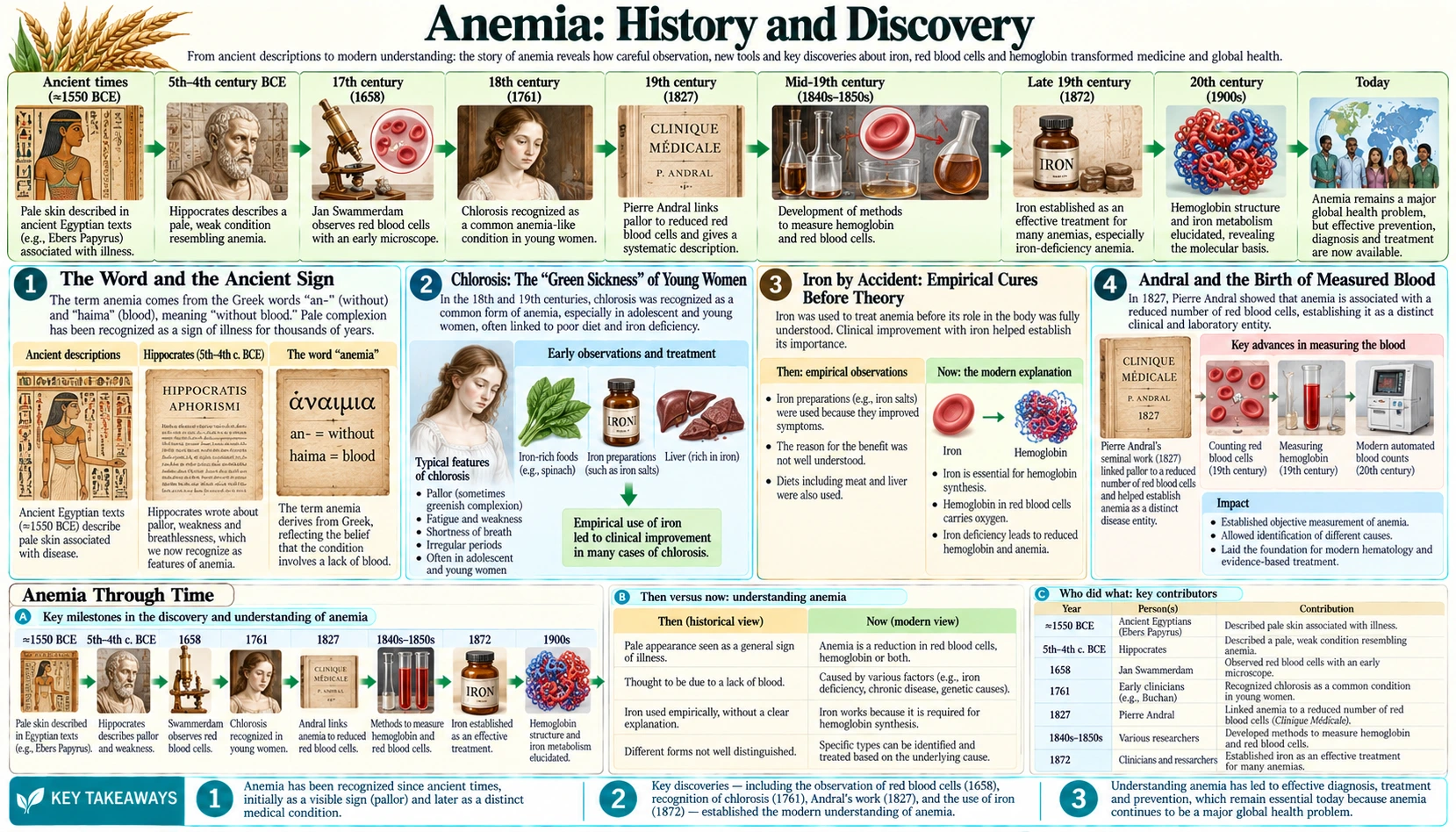
Anemia is not one disease but a shared end-point of many — a shortage of the red blood cells, or of the hemoglobin inside them, that carry oxygen through the body. Its visible signs, pallor and weakness, were noticed in antiquity, but it took until the nineteenth and twentieth centuries to separate the many distinct causes hiding behind that one pale face. This is the story of how an ancient symptom became a measured, classified, and in many forms curable condition — including one of medicine’s most dramatic victories, the conquest of the once-uniformly-fatal pernicious anemia. Throughout, this page is careful to distinguish what was described from what was explained and what was actually cured, and to flag old ideas that were guesses rather than facts.
Table of Contents
- The Word and the Ancient Sign
- Chlorosis: The “Green Sickness” of Young Women
- Iron by Accident: Empirical Cures Before Theory
- Andral and the Birth of Measured Blood
- Pernicious Anemia: Addison and Biermer Name a Killer
- The Liver Cure: Minot, Murphy, and Whipple
- Intrinsic Factor and Vitamin B12: The Mechanism Revealed
- One Pallor, Many Diseases: Sorting the Anemias
- From Symptom to Diagnosis: Anemia Today
- Key Research Papers
- Connections
- Featured Videos
The Word and the Ancient Sign
The word anemia is built from two Greek roots: the negating prefix an- (“without”) and haima (“blood”). Literally it means “bloodlessness” a fittingly plain description of a person who looks drained of color. The British spelling anaemia keeps the Greek diphthong; the American anemia simplifies it. Both name the same thing, and the term entered formal medicine only in the nineteenth century, even though the condition it describes is as old as humanity.
The sign, by contrast, was recognized in the earliest written medicine. Greek and Roman physicians, working in the tradition of Hippocrates and later Galen, noted pallor (paleness of the skin and the inner eyelids), breathlessness, palpitations, and a deep fatigue out of proportion to a person’s activity. They had no microscope, no way to count a red blood cell, and no concept of hemoglobin, so they could only describe the outward picture and fit it into the humoral theory of the day — an imbalance of the four humors. That framework was a hypothesis, not a discovery, and it would be wrong to read modern understanding back into it; what the ancients genuinely contributed was a careful, repeatable description of how an anemic person looks and feels.
For nearly two thousand years that is where matters stood: pallor and weakness were familiar, but the reason for them was unknown. That long gap between recognizing the sign and understanding the cause is the central theme of anemia’s history, and it explains why the real story is concentrated in the last two centuries, once tools existed to look inside the blood itself.
Chlorosis: The “Green Sickness” of Young Women
One particular pattern of anemia was singled out long before the others, because it struck a visible and sympathetic population: adolescent girls and young women. In 1554 the German physician Johannes Lange described it in a now-famous letter, De morbo virgineo (“On the disease of virgins”). He portrayed pale girls who tired easily, lost their appetite — especially for meat — suffered palpitations and breathlessness on climbing stairs or dancing, and whose ankles swelled. Lange did not know the cause and attributed it, in the language of his time, to the patient’s unmarried state; that explanation was a cultural guess and is now understood to be wrong.
The condition went on to acquire a vivid name. Because the skin of some sufferers took on a pale, faintly greenish cast, it became known as chlorosis — from the Greek chloros, “greenish” or, in plain English, the “green sickness.” Other period names included morbus virgineus (the virgin’s disease) and even febris amatoria (lover’s fever). From the seventeenth through the nineteenth centuries chlorosis was one of the most commonly diagnosed illnesses of young women across Europe and North America, wrapped in layers of moralizing folklore that, viewed now, reveal more about the era’s attitudes than about the disease.
The crucial modern point is one of reinterpretation, not fresh discovery: chlorosis is today understood to have been, in most cases, iron-deficiency anemia — the predictable result of menstrual blood loss, rapid adolescent growth, and meat-poor diets all draining the body’s iron. The diagnosis faded from medicine in the early twentieth century precisely as iron deficiency came to be measured and understood. The green sickness was real, and so was the anemia behind it; what was mistaken was every old explanation for why it happened.
Iron by Accident: Empirical Cures Before Theory
One of the most striking things in anemia’s history is that an effective treatment for iron-deficiency anemia was in use for centuries before anyone understood why it worked. Physicians noticed, empirically, that giving iron in some form often helped the pale and weak — not because they grasped that hemoglobin needs iron (hemoglobin would not be characterized until much later), but because trial and observation said it helped. This is empirical medicine at its purest: a remedy validated by results long before its mechanism was known.
The English physician Thomas Sydenham (1624–1689), often called the “English Hippocrates,” is widely cited as having recommended iron for chlorosis in the seventeenth century. By accounts from around 1681 he prescribed a preparation of steel filings steeped in wine — a so-called chalybeate remedy — taken over a course of weeks. Sydenham’s reasoning was tangled in the humoral and “animal spirits” theories of his day and was largely mistaken; his observation — that iron-bearing medicine strengthened these patients — was sound. It is a clean example of getting the right answer for the wrong reason.
The empirical thread runs forward to a much sharper result. In 1832 the French physician Pierre Blaud reported curing a series of chlorosis cases with pills combining ferrous sulfate and potassium carbonate — the famous “Blaud’s pills” with many patients recovering within weeks. Blaud still lacked the modern theory of iron-deficiency anemia, but his standardized iron pill was strikingly effective and remained in use for generations. Only later, once hemoglobin’s iron content and the mechanism of iron deficiency were established, did science finally explain what Sydenham and Blaud had been doing all along.
Andral and the Birth of Measured Blood
Describing a pale patient is one thing; measuring what is wrong with the blood is another, and that quantitative leap is what turned anemia from a vague impression into a defined condition. The pivotal figure is the French pathologist Gabriel Andral (1797–1876). In his Essai d’hématologie pathologique — published around 1843 — Andral set out to measure the constituents of blood (its red “globules,” fibrin, solids, and water) in health and in disease. He is credited with bringing the term “anaemia” into this new quantitative usage, defining it as a real diminution of the red cellular elements of the blood rather than merely an outward paleness.
This matters because it reframed anemia as something objective and potentially countable. Andral is regarded as one of the founders of hematology as a scientific discipline — the study of blood in measurable terms. His work arrived alongside the rise of microscopy and chemical analysis, and it set the stage for everything that followed: if blood could be measured, then a deficiency in it could be diagnosed, classified, and eventually traced to specific causes.
Over the following decades the toolkit grew: methods to estimate hemoglobin, to count red cells, and later to gauge cell size and color let physicians distinguish kinds of anemia — small pale cells versus large cells, for instance. The single word “anemia” was beginning to fracture into a family of distinct diagnoses, each with its own cause. Andral’s measured blood was the doorway through which that whole modern understanding entered.
Pernicious Anemia: Addison and Biermer Name a Killer
While most anemias were stubborn but survivable, one form stood apart as an unhurried death sentence. The English physician Thomas Addison, working at Guy’s Hospital in London, described it to the South London Medical Society in 1849 and laid it out fully in his celebrated 1855 monograph. He depicted patients — usually past middle age — who grew steadily paler and weaker over months, sliding toward death with no obvious cause of blood loss to explain it. Honest about his ignorance, Addison called it idiopathic anaemia — “idiopathic” meaning, frankly, “of unknown cause.” (This is a separate condition from the adrenal disease, Addison’s disease, that also bears his name.)
In 1872 the German-Swiss physician Anton Biermer, in Zurich, reported a series of cases of this severe progressive anemia and gave it the name that captured its dreadful reputation: perniciöse Anämie — pernicious anemia, that is, fatal or deadly anemia. Biermer drew attention to the strikingly abnormal, enlarged red cells seen under the microscope and to the relentless downhill course. In recognition of both men, the disorder is still sometimes called Addison–Biermer disease or, in German usage, Biermer’s anemia.
It is important to be precise about what had and had not been achieved. Addison and Biermer had described and named the disease with great clinical accuracy, and the name “pernicious” was earned: before the 1920s the diagnosis was essentially a slow death sentence. But its cause remained a complete mystery, and there was no treatment that altered the outcome. Description had outrun explanation, and a cure was nowhere in sight — which is exactly what made what came next so astonishing.
The Liver Cure: Minot, Murphy, and Whipple
The breakthrough began, improbably, with dogs. The American pathologist George Whipple, studying how to rebuild blood in animals made anemic by bleeding, found in work around 1920 that feeding liver was especially effective at speeding red-cell recovery. Whipple’s anemic dogs were not suffering from pernicious anemia — this is an honest and important caveat — but his results pointed a bright arrow at liver as something powerfully restorative to the blood, and that clue proved decisive.
Two Boston physicians followed the arrow into the human disease. George Minot and William Murphy reasoned that if liver rebuilt blood in dogs, it might help patients dying of pernicious anemia, and in 1926 they put it to the test by feeding sufferers large quantities of liver — up to roughly half a pound a day. The effect was nothing short of revolutionary: by May 1926 they had treated dozens of patients (about 45 in their landmark report), and in many, symptoms improved within roughly a week, with the bone marrow visibly springing back into red-cell production. A disease that had been uniformly fatal was suddenly, reliably, treatable — with food.
For this conquest of a once-hopeless illness, George Whipple, George Minot, and William Murphy shared the 1934 Nobel Prize in Physiology or Medicine, awarded for their discoveries concerning liver therapy in the anemias. The liver regimen was demanding — the daily quantities were large and unpalatable — and it treated the disease without yet explaining it; why liver worked was still unknown. But for the first time a death sentence had become a manageable condition, and the race was on to find the single active ingredient hidden in the liver.
Intrinsic Factor and Vitamin B12: The Mechanism Revealed
The liver cure worked, but it left two deep questions: why does the disease arise in the first place, and what exactly in the liver reverses it? The first question was largely answered by the American physician William Bosworth Castle. In 1929, in a series of carefully designed experiments, Castle proposed that normal absorption of an essential dietary factor required something made by the healthy stomach. He distinguished an extrinsic factor (present in food, such as liver and meat) from an “intrinsic factor” secreted by the stomach lining; only when the two combined could the nutrient be absorbed. In pernicious anemia, Castle showed, the failing stomach no longer made intrinsic factor — so the body starved of the dietary factor no matter how much was eaten. This elegantly explained both the disease and why eating large amounts of liver could overpower the absorption block.
The second question — the identity of the extrinsic factor — was settled in 1948, when the active anti-pernicious-anemia substance was finally isolated in pure, crystalline form from liver. Two teams reached it almost simultaneously: one led by Karl Folkers at Merck in the United States, and one led by Ernest Lester Smith at Glaxo in Britain. The red, cobalt-containing compound they isolated was vitamin B12 (cobalamin). With it, pernicious anemia could at last be treated with tiny, purified doses — ultimately by injection, bypassing the missing intrinsic factor entirely — instead of mountains of liver.
The full picture now made sense as a chain: pernicious anemia is an autoimmune-driven failure of the stomach to make intrinsic factor, which causes vitamin B12 deficiency, which starves the bone marrow of a nutrient essential for making healthy red cells. Each link was discovered separately — Castle’s intrinsic factor (1929), then B12 itself (1948) — and only together did they convert a once-fatal mystery into a fully understood, fully treatable vitamin deficiency. It remains one of the clearest illustrations in all of medicine of how treatment, cause, and cure can each be solved at different times by different hands.
One Pallor, Many Diseases: Sorting the Anemias
The great lesson woven through this history is that “anemia” is an umbrella, not a single illness. The same pale, tired patient can be anemic for utterly different reasons, and the nineteenth and twentieth centuries were largely spent learning to tell those reasons apart. As blood could be measured, stained, and examined under ever-better microscopes, the one word splintered into a whole classification of distinct conditions, each demanding its own treatment.
The major families that came to be distinguished include: iron-deficiency anemia (the old chlorosis, due to too little iron for hemoglobin — the world’s most common form); the megaloblastic anemias of vitamin B12 or folate deficiency (in which red cells grow large and misshapen, pernicious anemia being the classic B12 example); the hemolytic anemias, in which red cells are destroyed faster than they can be replaced; aplastic anemia, a failure of the bone marrow to produce enough cells at all; and the inherited anemias rooted in faulty hemoglobin or globin chains, such as sickle-cell disease and the thalassemias. Anemia can also accompany chronic disease, kidney failure, and blood loss.
Recognizing these as separate diseases was itself a discovery — arguably the central one in anemia’s history. It meant that the right treatment depended entirely on the right diagnosis: iron for iron deficiency, B12 for pernicious anemia, folate for folate deficiency, and quite different approaches for the inherited and marrow-failure forms. Giving iron to a patient whose problem is actually B12 deficiency does not help and may delay correct care. The modern insistence on finding which anemia a person has, before treating it, is the direct inheritance of this long sorting-out.
From Symptom to Diagnosis: Anemia Today
Today anemia is defined not by appearance but by measurement: a hemoglobin concentration (or red-cell count) below an established threshold, read off an automated complete blood count in seconds — the distant descendant of Andral’s painstaking manual reckonings. From that single number a clinician works backward, using red-cell size and color, iron studies, vitamin levels, and other tests to identify which anemia is present and therefore what to do about it. The historical journey from “the patient looks pale” to “the patient has iron-deficiency anemia from chronic blood loss” is exactly this shift from symptom to specific diagnosis.
That shift has had enormous human consequences. Iron-deficiency anemia, the most common form worldwide, is usually straightforward to treat once recognized — the modern, evidence-based fulfillment of what Sydenham and Blaud stumbled toward empirically. Pernicious anemia, the killer Addison and Biermer named, is now controlled for life with simple vitamin B12 replacement. Many other forms are managed or, in some inherited cases, increasingly addressed by advanced therapies. The arc is one of steady demystification: a sign known since antiquity, slowly resolved into a set of understood and largely manageable conditions.
What endures from this history is a habit of mind. Because anemia is a final common pathway for many different problems, finding the cause matters as much as noting the pallor — the very lesson it took medicine two thousand years to fully learn. This page is historical and educational and is not medical advice; anyone who is persistently pale, breathless, or unusually tired should be evaluated by a clinician, since the right treatment depends entirely on which kind of anemia is present.
Key Research Papers
The references below combine peer-reviewed historical reviews with curated PubMed topic-search links into the history of anemia, chlorosis, pernicious anemia, and the discovery of vitamin B12. Where a stable identifier is available it is given; otherwise a PubMed topic search opens the relevant literature. Classic primary sources — Lange’s De morbo virgineo (1554), Addison’s 1855 monograph, Biermer’s 1872 report, and Andral’s Essai d’hématologie pathologique (c. 1843) — are named in the text as historical documents rather than as modern citations. Each link opens at the National Library of Medicine in a new tab.
- Minot GR, Murphy WP. Treatment of pernicious anemia by a special diet. JAMA. 1926;87(7):470–476. — doi:10.1001/jama.1926.02680070016005 (The landmark liver-therapy report.)
- The Nobel Prize in Physiology or Medicine 1934 — Whipple, Minot & Murphy, “for their discoveries concerning liver therapy in cases of anaemia.” NobelPrize.org — 1934 Physiology or Medicine
- Haden RL, et al. Historical reviews of pernicious anemia (Addison–Biermer disease) — PubMed: pernicious anemia history (Addison, Biermer)
- Castle WB. Observations on the etiologic relationship of achylia gastrica to pernicious anemia (intrinsic factor) — PubMed: Castle intrinsic factor
- The discovery and isolation of vitamin B12 (cobalamin), 1948 — Folkers (Merck) and Smith (Glaxo) — PubMed: vitamin B12 discovery and isolation
- Chlorosis: the rise and disappearance of a nutritional (iron-deficiency) disease — Guggenheim, chlorosis (PubMed PMID: 7616296) — PubMed PMID: 7616296
- Chlorosis revisited — iron deficiency and the “green sickness” of young women — PubMed PMID: 7022533
- Gabriel Andral and the founding of pathological hematology — PubMed: Gabriel Andral and the history of hematology
- History of the diagnosis and classification of the anemias — PubMed: history and classification of anemia
- Iron-deficiency anemia — history, mechanism, and treatment — PubMed PMID: 42871463
- Megaloblastic anemia — vitamin B12 and folate deficiency — PubMed: megaloblastic anemia (B12, folate)
- George Whipple and liver therapy — the dog studies that preceded the human cure — PubMed PMID: 4876155
- Thomas Sydenham, Blaud’s pills, and the empirical use of iron for chlorosis — PubMed: Sydenham, Blaud, iron and chlorosis
External Authoritative Resources
Connections
- Hematology
- Anemia (main page)
- All Conditions
- Sickle-Cell Disease
- Thalassemia
- Hemochromatosis (Iron Overload)
- Vitamin B12 (Cobalamin)
- Vitamin B9 (Folate)
- Iron