Aortic Stenosis
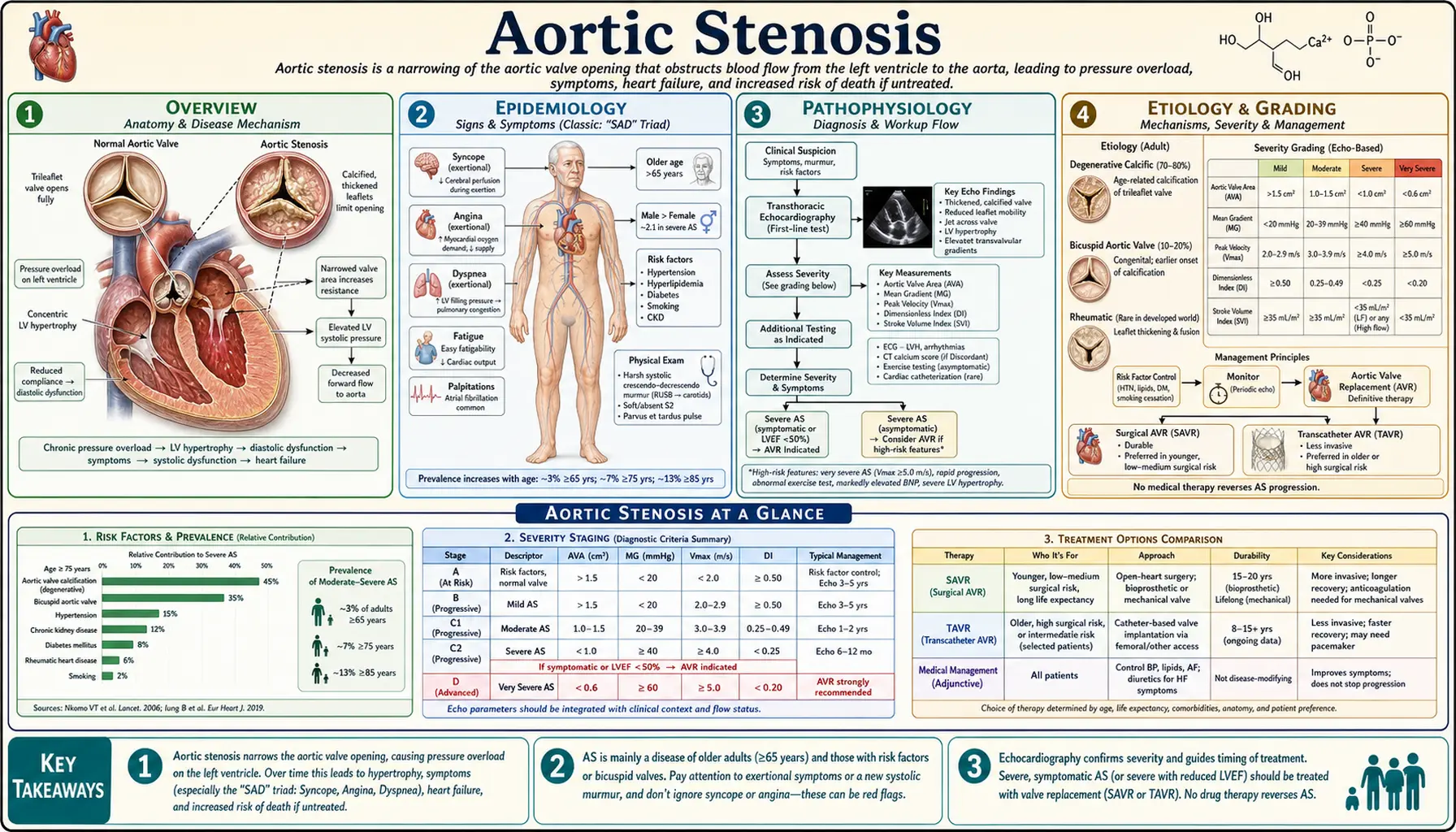
Table of Contents
- Overview
- Epidemiology
- Pathophysiology
- Etiology and Grading
- Classic Symptomatic Triad
- Diagnosis
- Medical Management
- TAVR (Transcatheter Aortic Valve Replacement)
- SAVR (Surgical Aortic Valve Replacement)
- Bicuspid Aortic Valve and Aortopathy
- Complications and Prognosis
- Key Research Papers
- Connections
- Featured Videos
1. Overview
Aortic stenosis (AS) is the predominant valve disease in the Western world (Banceu 2025). It is a progressive narrowing of the aortic valve opening that obstructs blood flow out of the left ventricle (LV). In Europe and North America the most common causes are calcific degeneration of a normal three-leaflet (tricuspid) valve and a bicuspid aortic valve (BAV) with calcium laid down on it; rheumatic valve disease and a congenital one-cusp (unicuspid) valve are less common causes (Laterra 2025).
The 2020 ACC/AHA guideline, as tabulated in a 2025 review, defines severe high-gradient AS as a mean gradient ≥40 mmHg, a peak jet velocity ≥4.0 m/s and a valve area ≤1.0 cm² (or ≤0.6 cm²/m² indexed to body size) (Laterra 2025). Once symptoms appear, survival falls steeply without valve replacement: the figure most often quoted, approximately 50% mortality at 2 years for symptomatic severe AS, comes from the 1968 synthesis by Ross and Braunwald (Demir 2026). Randomized trials have compared transcatheter aortic valve replacement (TAVR) with surgery across the range of surgical risk (section 8).
2. Epidemiology
- Severe AS affects approximately 5% of people over 65 years, according to a 2025 review (Laterra 2025); another 2025 review gives an estimated prevalence of AS ranging from 0.2% at ages 50–59 to nearly 10% at ages 80–89 (Banceu 2025)
- Global prevalence of AS rose from 46 cases per 100,000 in 1990 to approximately 116 per 100,000 in 2019 (figure quoted in Milojevic 2025)
- BAV is the most common congenital heart defect, affecting approximately 1–2% of the general population, and is more common in males (male-to-female ratio 3:1) (Bulut 2023; Burns 2022)
- In the US national TAVR registry, TAVR volumes rose every year and exceeded surgical aortic valve replacement (SAVR) in 2019 (72,991 vs. 57,626 procedures) (Carroll 2020)
- In a multicenter cohort of 330,940 adults with echocardiograms, 1.0% had severe AS; hypertension (53.1%), coronary disease (46.8%) and atrial fibrillation (34.8%) were common in those with severe AS (Playford 2023)
3. Pathophysiology
Calcific Aortic Stenosis
Calcific AS has many characteristics in common with atherosclerosis, including an association with high cholesterol (Cowell 2005). The valve cusps undergo progressive thickening, fibrosis and calcification through active inflammatory processes that involve biochemical, humoral and genetic factors; valve interstitial cells adopt a bone-forming (osteoblast-like) behaviour, and lipoprotein(a) has been shown to promote this change (Banceu 2025). Factors identified as predictors of faster progression include smoking, diabetes, hypertension, chronic kidney disease, dyslipidemia, coronary artery disease and male sex (Laterra 2025).
Leaflet stiffening and reduced valve opening area create an increasing transvalvular pressure gradient. The LV compensates with concentric hypertrophy (pressure overload pattern): sarcomeres added in parallel increase wall thickness while cavity dimensions remain relatively unchanged, normalizing wall stress per the Laplace law. Over time, this compensatory hypertrophy leads to diastolic dysfunction (a stiff, non-compliant LV), and eventually to systolic dysfunction when afterload exceeds the LV's compensatory capacity — a phenomenon called afterload mismatch.
Concentric hypertrophy also reduces coronary reserve: thickened walls compress intramural coronary vessels, and the hypertrophied myocardial mass demands more oxygen than the coronary circulation can supply during stress. This explains why angina is common in severe AS even in the absence of obstructive coronary artery disease. When ventricular output falls critically, systemic vascular resistance rises and cardiogenic shock can ensue.
Bicuspid Aortic Valve (BAV)
Most BAVs (90–95%) arise from fusion of two cusps; fusion of the right and left coronary cusps is the most common subtype, the other subtypes being right and non-coronary cusp fusion and the rare left and non-coronary fusion (Bulut 2023). In a CT study of adults with BAV, moderate-to-severe AS was more frequent with right- or left-noncoronary fusion (66.2%) than with right-left fusion (46.2%) (quoted in Burns 2022). Dilation of the aorta in BAV is attributed to accelerated degeneration of the aortic media, with increased matrix metalloproteinase activity, decreased fibrillin-1 expression and raised inflammatory cytokines, influenced by both genetic and hemodynamic factors (Bulut 2023).
4. Etiology and Grading
Etiology
- Calcific degeneration of a tricuspid valve: one of the two most common causes in Europe and North America (Laterra 2025)
- Bicuspid aortic valve (BAV, congenital) with superimposed calcification: the other most common cause; ascending aortic dilation (BAV aortopathy) is seen in up to 50% of patients with BAV (Laterra 2025)
- Rheumatic valve disease: a less common cause in Europe and North America (Laterra 2025); it differs from calcific AS in that the cusps fuse, rather than stiffening through calcification (Banceu 2025)
Grading
Severity categories used in a 2023 multicenter cohort study (Playford 2023) and the guideline definitions of severe AS tabulated in a 2025 review (Laterra 2025):
- Mild AS: mean gradient 10.0–19.9 mmHg / peak velocity 2.0–2.9 m/s, with valve area ≥1.0 cm² (Playford 2023)
- Moderate AS: mean gradient 20.0–39.9 mmHg / peak velocity 3.0–3.9 m/s, with valve area >1.0 cm² (Playford 2023)
- Severe high-gradient AS: mean gradient ≥40 mmHg, peak velocity ≥4.0 m/s, valve area ≤1.0 cm² or ≤0.6 cm²/m² (Laterra 2025)
- Very severe AS: mean gradient ≥60 mmHg or peak velocity >5.0 m/s, listed in current guidelines as a high-risk feature in patients without symptoms (Laterra 2025)
- Low-flow, low-gradient AS: valve area <1.0 cm² with mean gradient <40 mmHg and a stroke volume index <35 mL/m², either with preserved LV ejection fraction (>50%, "paradoxical") or reduced ejection fraction (<50%, "classical"). Dobutamine stress echocardiography assesses the change in gradient, velocity, valve area and flow reserve (a rise in stroke volume of more than 20%); with flow reserve and a valve area that rises above 1.0 cm², the stenosis is classed as pseudo-severe, and CT calcium scoring is used to confirm severity when there is no flow reserve (Laterra 2025)
5. Classic Symptomatic Triad
Heart failure, syncope and angina form the classic triad of symptoms of AS, resulting from the obstructed valve, LV pressure overload and LV hypertrophy (Banceu 2025). Ross and Braunwald's 1968 synthesis described an abrupt decline in survival once angina, syncope or heart failure appear, the source of the widely quoted figure of approximately 50% mortality at 2 years in symptomatic severe AS (Demir 2026). A 2023 cohort study questioned the idea that symptom onset is discrete and inexorably linked to AS severity: dyspnea was common in moderate as well as severe AS (Playford 2023).
- Angina: demand ischemia from concentric hypertrophy with reduced coronary flow reserve, independent of epicardial coronary artery disease (see section 3).
- Syncope (exertional): reduced cerebral blood flow from hypotension when cardiac output cannot rise with exercise (Playford 2023). Ventricular arrhythmias are a further concern; sudden cardiac death, often caused by ventricular arrhythmias, is a feared complication of severe AS (Martinek 2025).
- Dyspnea / heart failure: the stiff, hypertrophied ventricle relaxes and fills poorly during diastole, which can result in heart failure (Banceu 2025).
Physical Examination Findings
- Murmur: Harsh crescendo-decrescendo systolic ejection murmur, heard best at the right upper sternal border (2nd intercostal space), radiating to the carotids. Murmur intensity does not reliably correlate with severity — a soft or absent murmur in apparent AS may indicate severe stenosis with low cardiac output.
- Soft or absent A2: Calcified, immobile leaflets fail to produce a normal aortic closure sound; paradoxically split S2 can occur from prolonged LV ejection time.
- Pulsus parvus et tardus: Slow-rising, late-peaking, diminished amplitude carotid pulse — a classic bedside sign of severe AS.
- Sustained apical impulse: Reflects concentric LV hypertrophy.
- S4 gallop: Common from the stiff, hypertrophied LV; S3 is less common and suggests advanced LV dysfunction.
6. Diagnosis
Echocardiography (Primary Diagnostic Tool)
Transthoracic echocardiography with Doppler is the standard first-line investigation. Key measurements include:
- Peak jet velocity (Vmax) via continuous-wave Doppler through the aortic valve
- Mean transvalvular gradient (derived from the velocity-time integral)
- Aortic valve area (AVA) calculated by the continuity equation: AVA = LVOT area × LVOT VTI / AV VTI
- LV wall thickness, chamber dimensions, and ejection fraction
- Diastolic function parameters (E/A ratio, E/e' ratio, LA volume index)
- Aortic root and ascending aorta dimensions (relevant in BAV, where aortic dilation is common)
CT Calcium Scoring
CT aortic valve calcium scoring is used to confirm severity in low-gradient AS (Laterra 2025). A 2025 review describes it as highly reproducible and reports sex-specific thresholds for severe AS: >2000 Agatston units in men and >1200 in women (Laterra 2025). CT is also used to plan TAVR, including measurement of the coronary ostia height and the sinuses of Valsalva, which were lower and smaller in patients who had coronary obstruction after TAVR (Ribeiro 2013).
Cardiac Catheterization
Direct measurement of the transvalvular gradient via simultaneous aortic and LV pressure measurement is reserved for cases where echocardiography and CT are discordant, or for pre-SAVR coronary angiography.
Cardiac MRI (CMR)
CMR shows myocardial fibrosis by late gadolinium enhancement; in AS the fibrosis is diffusely distributed (Laterra 2025). In the EVOLVED trial, patients without symptoms who had severe AS and midwall fibrosis on CMR were randomized to early valve replacement or surveillance, and early replacement did not significantly change the combined primary endpoint of all-cause death or unplanned AS-related hospitalization (Laterra 2025).
Additional Studies
- Chest X-ray: May show cardiomegaly (late), pulmonary vascular congestion, or a calcified aortic valve on the lateral projection
- ECG: LV hypertrophy voltage criteria, ST-T changes in lateral leads, left bundle branch block in advanced disease
- Exercise testing: used in patients reported to have no symptoms, to unmask symptoms and to detect a fall in blood pressure during exertion; about 20% of such patients cannot perform a stress test, and a positive test carried a 7.6-fold higher risk of developing symptoms or sudden death during follow-up (Laterra 2025)
- Dobutamine stress echo: used in low-flow low-gradient AS to assess flow reserve and to separate true-severe from pseudo-severe stenosis (see section 4)
- BNP/NT-proBNP: predict symptom development; levels more than 3 times the age- and sex-adjusted normal value are listed as a high-risk feature in patients without symptoms (Laterra 2025). In a substudy of the EARLY TAVR trial, baseline NT-proBNP was associated with higher event rates but did not change the relative benefit of early TAVR (Laterra 2025)
7. Medical Management
Valve replacement remains the only strategy shown to improve survival; medical therapy neither corrects nor slows the progression of AS (Laterra 2025). Medicines for blood pressure, heart failure and atrial fibrillation in people with AS treat those conditions, not the valve obstruction; decisions about them belong with a clinician.
- Statins and lipid lowering: calcific AS shares features with atherosclerosis, which led to three randomized trials. In SALTIRE (155 patients), atorvastatin 80 mg daily lowered LDL cholesterol from 130 to 63 mg/dL but did not change the yearly rise in aortic-jet velocity or in valve calcification over a median of 25 months (Cowell 2005). In SEAS (1,873 patients with mild-to-moderate AS without symptoms), simvastatin plus ezetimibe did not reduce the composite of valve-related and ischemic events or the rate of valve replacement over a median 52.2 months, although it reduced ischemic cardiovascular events (Rossebø 2008). In ASTRONOMER (269 patients), rosuvastatin 40 mg daily did not reduce progression of mild-to-moderate AS over a median 3.5 years, and the authors concluded that statins should not be used for the sole purpose of slowing AS progression (Chan 2010).
- Investigational approaches: other drug strategies are being studied; for example, a 6-month trial of ataciguat slowed the progression of aortic valve calcification (Laterra 2025).
Surveillance of Severe AS Without Symptoms
For patients with severe AS, no symptoms and preserved LV ejection fraction, guidelines have recommended routine clinical surveillance every 6 to 12 months (Généreux 2025). Observational studies show that most such patients develop symptoms within 1–2 years of diagnosis, with an annual mortality risk of 1–2% (Laterra 2025). Four randomized trials have tested earlier valve replacement in this group:
- RECOVERY (2020): 145 patients with very severe AS (valve area ≤0.75 cm² with velocity ≥4.5 m/s or mean gradient ≥50 mmHg). Operative death or cardiovascular death occurred in 1% with early surgery vs. 15% with conservative care; death from any cause in 7% vs. 21%; in the conservative-care group, sudden death reached 4% at 4 years and 14% at 8 years (Kang 2020)
- AVATAR (2022): 157 patients with severe AS, normal LV function and a negative exercise test. Early surgery lowered the composite of death, myocardial infarction, stroke or unplanned heart-failure hospitalization (hazard ratio 0.46); all-cause death and other secondary endpoints did not differ significantly (Banovic 2022)
- EARLY TAVR (2025): 901 patients with severe AS and no symptoms, mean age 75.8 years. Death, stroke or unplanned cardiovascular hospitalization occurred in 26.8% with early TAVR vs. 45.3% with surveillance; deaths were 8.4% vs. 9.2%, and 87.0% of the surveillance group had valve replacement during a median 3.8 years (Généreux 2025)
- EVOLVED: early replacement in patients with myocardial fibrosis did not significantly change the primary endpoint (see section 6) (Laterra 2025)
8. TAVR (Transcatheter Aortic Valve Replacement)
TAVR delivers a bioprosthetic valve through a catheter and deploys it within the diseased native aortic valve, without open-heart surgery. The PARTNER (Placement of Aortic Transcatheter Valves) trials and a trial of a self-expanding valve compared it with standard therapy or surgery across surgical-risk groups:
- PARTNER 1B (2010, PubMed PMID: 20961243) — patients not suitable for surgery: among 358 patients, 1-year death from any cause was 30.7% with transfemoral TAVR vs. 50.7% with standard therapy (which included balloon valvuloplasty); TAVR also had more major strokes (5.0% vs. 1.1%, P=0.06) and major vascular complications (16.2% vs. 1.1%) at 30 days (Leon 2010).
- PARTNER 1A (2011) — high surgical risk: among 699 patients, 1-year death from any cause was 24.2% with TAVR vs. 26.8% with surgery, meeting the test for non-inferiority. Major vascular complications were more frequent with TAVR (11.0% vs. 3.2%); major bleeding (9.3% vs. 19.5%) and new atrial fibrillation (8.6% vs. 16.0%) were more frequent with surgery; major stroke was 5.1% vs. 2.4% at 1 year (P=0.07) (Smith 2011). At 2 years, death rates remained similar (33.9% vs. 35.0%) (Kodali 2012).
- PARTNER 2A (2016) — intermediate surgical risk: among 2,032 patients, death or disabling stroke at 2 years was 19.3% with TAVR vs. 21.1% with surgery (non-inferior). In the transfemoral-access cohort, TAVR had a lower rate of death or disabling stroke than surgery (hazard ratio 0.79, P=0.05) (Leon 2016).
- PARTNER 3 (2019) — low surgical risk: among 1,000 patients (mean age 73 years), death, stroke or rehospitalization at 1 year was 8.5% with a balloon-expandable valve vs. 15.1% with surgery (P=0.001 for superiority) (Mack 2019). At 5 years the difference was no longer significant (22.8% vs. 27.2%, P=0.07); death was 10.0% vs. 8.2% (Mack 2023).
- Low-risk self-expanding valve trial (2019): among 1,468 patients, death or disabling stroke at 24 months was 5.3% with TAVR vs. 6.7% with surgery (non-inferior). TAVR had less disabling stroke, bleeding, kidney injury and atrial fibrillation at 30 days, but more moderate or severe aortic regurgitation (3.5% vs. 0.5%) and pacemaker implantation (17.4% vs. 6.1%) (Popma 2019).
Guideline Positions on TAVR vs. SAVR
As summarized in a 2025 comparison of the two guidelines (Milojevic 2025):
- 2020 ACC/AHA: SAVR is recommended for patients younger than 65 years or with a life expectancy over 20 years; transfemoral TAVR is recommended for patients aged 80 or older, or younger patients with a life expectancy under 10 years; between 65 and 80 years either is recommended, chosen through shared decision-making (all Class I).
- 2021 ESC/EACTS: SAVR is recommended for patients younger than 75 years at low surgical risk; TAVR for patients aged 75 or older or at high surgical risk; for others, the choice rests on clinical, anatomical and procedural factors.
- Patients younger than 65 years are underrepresented in the low-risk trials (7% of PARTNER 3), while registry data showed that by 2021, 47.5% of patients younger than 65 underwent TAVR (Milojevic 2025).
- In the US registry in 2019, femoral access was used in 95.3% of TAVR procedures and the 30-day mortality rate had fallen from 7.2% in 2011 to 2.5% (Carroll 2020).
TAVR Complications
- Stroke: major stroke at 30 days was 3.8% with TAVR vs. 2.1% with surgery in PARTNER 1A (Smith 2011); in the low-risk PARTNER 3 trial, stroke at 30 days was lower with TAVR than with surgery (Mack 2019)
- Paravalvular leak (PVL): more frequent after TAVR than surgery in the PARTNER high-risk trial, and even mild paravalvular regurgitation was associated with increased late mortality (Kodali 2012)
- Permanent pacemaker implantation: rates after TAVR range from 6.5% to 25.9%, higher with self-expanding valves, compared with 3–5% after SAVR (Banceu 2025); in PARTNER 3 (balloon-expandable valve) new pacemaker rates did not differ significantly from surgery (Mack 2019)
- Vascular access complications: major vascular complications at 30 days were 16.2% with TAVR in PARTNER 1B (Leon 2010) and 11.0% in PARTNER 1A (Smith 2011); in the low-risk PARTNER 3 trial they did not differ significantly from surgery (Mack 2019)
- Coronary obstruction: in a registry of 6,688 TAVR patients, symptomatic coronary obstruction occurred in 0.66%; it was more frequent in women, with balloon-expandable valves and with a previous surgical bioprosthesis, was associated with lower-lying coronary ostia and shallower sinuses, and 30-day mortality was 40.9% (Ribeiro 2013)
- Leaflet thrombosis: CT showed reduced leaflet motion in 40% of 55 patients in a TAVR trial and 13% of 132 registry patients with transcatheter or surgical bioprostheses; it resolved with therapeutic anticoagulation, and its effect on clinical outcomes including stroke needed further study (Makkar 2015)
TAVR Durability
At 5 years in PARTNER 3, bioprosthetic-valve failure occurred in 3.3% of TAVR patients and 3.8% of surgery patients (Mack 2023). A 2025 review reports that midterm data suggest transcatheter valves have durability comparable to surgical bioprostheses (Laterra 2025). Because younger patients are underrepresented in the trials, durability over the longer life expectancy of younger patients remains an open question (Milojevic 2025; Banceu 2025).
9. SAVR (Surgical Aortic Valve Replacement)
Surgical aortic valve replacement via median sternotomy and cardiopulmonary bypass is the approach that guidelines and reviews describe for:
- Patients younger than 65 years or with a life expectancy over 20 years (2020 ACC/AHA) or younger than 75 years at low surgical risk (2021 ESC/EACTS) (Milojevic 2025)
- BAV with aortic dilation: SAVR is the primary recommendation for valve replacement in BAV, with TAVR an option for some patients (Bulut 2023); replacement of the ascending aorta and/or root is undertaken when its diameter reaches or exceeds 4.5 cm in BAV patients having SAVR (Banceu 2025)
- AS with complex coronary disease: guidelines advise SAVR with coronary artery bypass grafting, rather than TAVR with stenting, for left main bifurcation disease or multivessel disease with a SYNTAX score above 33 (Banceu 2025)
- Patients for whom transcatheter options are limited by anatomy: optimal valve-in-valve outcomes depend on patient anatomy and valve compatibility, so a later valve-in-valve TAVR may be inapplicable for a significant subset of patients (Banceu 2025)
Prosthesis Choice
- Guideline age thresholds: the 2020 ACC/AHA guideline suggests mechanical valves below 50 years, bioprosthetic valves above 65 years and an individual decision between 50 and 65; the 2021 ESC/EACTS guideline sets the mechanical-valve threshold at below 60 years, bioprosthetic above 65, and either between 60 and 65 (Milojevic 2025)
- Bioprosthetic (tissue) valves: resemble and function like natural valves but have limited longevity (Banceu 2025)
- Mechanical valves: durable with a low rate of reintervention, but thrombogenic, requiring lifelong anticoagulation with a risk of bleeding (Banceu 2025)
- Valve-in-valve TAVR: a transcatheter valve placed inside a failed surgical bioprosthesis. In a registry, around 30% of patients had a surgical prosthesis of 21 mm or smaller, and patient–prosthesis mismatch occurred in 31.8% after valve-in-valve procedures; evidence so far shows no superiority of valve-in-valve TAVR over redo surgery for mid-term mortality (Banceu 2025)
10. Bicuspid Aortic Valve and Aortopathy
BAV is the most common congenital heart defect, present in approximately 1–2% of the population (Bulut 2023; Burns 2022). Its clinical importance extends beyond valve disease to aortic dilation and dissection: ascending aortic dilation is seen in up to 50% of patients with BAV (Laterra 2025), and the risk of aortic dissection in BAV is eight times that of the general population, with dissections occurring at younger ages (Bulut 2023). Patients with BAV have a 25-year risk of aortic valve surgery of 25% (Burns 2022).
Aortic Surgery Thresholds
- Aortic replacement is a Class I recommendation when the aortic diameter reaches or exceeds 55 mm; the threshold may be lowered to 50 mm or 45 mm according to patient-specific factors (Bulut 2023)
- Prophylactic aortic surgery is recommended for patients with high-risk profiles such as aortic regurgitation, a family history of dissection, a root phenotype or a high rate of aortic growth (Bulut 2023)
- In BAV patients undergoing SAVR, the ascending aorta and/or root is replaced when the diameter reaches or exceeds 4.5 cm (Banceu 2025)
Genetics and Family Screening
Most BAV is sporadic, but the condition clusters in families; heritability has been estimated as high as 89%, with a 9% prevalence in first-degree relatives, and an autosomal dominant pattern with variable expressivity has been postulated (Burns 2022). Variants in genes including NOTCH1, FBN1, SMAD2, ACTA2 and TGFB2 have been described in BAV aortopathy (Burns 2022), and ROBO4 and GATA-family genes have been linked to BAV (Bulut 2023). American and European guidelines include echocardiographic screening of first-degree relatives, with Class IIa/IIb recommendations (Bulut 2023). Reviews describe TAVR in BAV as an option for selected patients, with valve sizing adapted to the elliptical, calcified orifice and planned by CT (Bulut 2023; Banceu 2025).
11. Complications and Prognosis
Natural History Without Intervention
Symptomatic severe AS carries approximately 50% mortality at 2 years, the figure from Ross and Braunwald's 1968 synthesis; in a national echocardiographic cohort of more than 240,000 adults, severe AS carried a 5-year mortality of approximately two-thirds (Demir 2026). In the PARTNER 1B trial, 1-year mortality among patients unsuitable for surgery who received standard therapy was 50.7% (Leon 2010). Approximately 70% of sudden deaths in patients with severe AS and no symptoms occur without preceding symptoms (Laterra 2025); in the conservative-care arm of RECOVERY, sudden death reached 14% at 8 years (Kang 2020).
Post-Intervention Prognosis
In the low-risk PARTNER 3 trial, 5-year death was 10.0% after TAVR and 8.2% after surgery, with no significant difference in the primary composite outcomes (Mack 2023). A 2025 review notes that a subset of patients, particularly those with peripheral artery disease or paravalvular leak, have persistently impaired quality of life after valve replacement (Laterra 2025).
Major Complications
- Heart failure: untreated severe AS can result in heart failure and arrhythmias (Banceu 2025)
- Atrial fibrillation: recorded in 34.8% of patients with severe AS and 29.6% with moderate AS in a large cohort (Playford 2023); about 20% of patients experience atrial fibrillation during mid- and long-term follow-up after valve replacement (Banceu 2025)
- Ventricular arrhythmias and sudden death: the hemodynamic and structural changes of AS create an arrhythmogenic substrate (Martinek 2025)
- Paravalvular regurgitation (TAVR > SAVR): even mild paravalvular regurgitation after TAVR was associated with increased late mortality (Kodali 2012)
- Bioprosthetic valve failure: a long-term concern for both surgical and transcatheter tissue valves; causes include structural valve deterioration, patient–prosthesis mismatch, paravalvular regurgitation, thrombosis and endocarditis (Laterra 2025)
- Anticoagulation-related bleeding: relevant to mechanical valves, which require lifelong anticoagulation (Banceu 2025)
- Conduction disease: high-degree heart block requiring a permanent pacemaker after TAVR, more often with self-expanding valves (Banceu 2025)
Key Research Papers
- Banceu CM, Cristutiu D, Gurzu S, et al. (2025). Aortic Stenosis: Diagnosis, Molecular Mechanisms and Therapeutic Strategies-A Comprehensive Review. Journal of Clinical Medicine — PubMed PMID: 40725641
- Laterra G, Agnello F, Strazzieri O, et al. (2025). Management of Asymptomatic Severe Aortic Stenosis: Current Evidence and Future Directions. Journal of Clinical Medicine — PubMed PMID: 41226944
- Demir OM, Latib A, Prendergast B (2026). Life-expectancy paradox and the selection of older patients with aortic stenosis for valve intervention. Open Heart — PubMed PMID: 42833700
- Milojevic M, Borger MA, Nikolic A, et al. (2025). Guidelines for the management of aortic stenosis: A methodologic review of American college of cardiology/American heart association (ACC/AHA) and the European society of cardiology/European association for cardio-thoracic surgery (ESC/EACTS) recommendations. JTCVS Open — PubMed PMID: 41466788
- Bulut HI, Arjomandi Rad A, Syrengela AA, et al. (2023). A Comprehensive Review of Management Strategies for Bicuspid Aortic Valve (BAV): Exploring Epidemiology, Aetiology, Aortopathy, and Interventions in Light of Recent Guidelines. Journal of Cardiovascular Development and Disease — PubMed PMID: 37754827
- Burns J, Lastovich L, Dhar A (2022). The genetic, molecular, and hemodynamic basis of bicuspid aortic valve aortopathy: A contemporary narrative review. International Journal of Cardiology Congenital Heart Disease — PubMed PMID: 39712055
- Carroll JD, Mack MJ, Vemulapalli S, et al. (2020). STS-ACC TVT Registry of Transcatheter Aortic Valve Replacement. Journal of the American College of Cardiology — PubMed PMID: 33213729
- Playford D, Schwarz N, Chowdhury E, et al. (2023). Comorbidities and Symptom Status in Moderate and Severe Aortic Stenosis: A Multicenter Clinical Cohort Study. JACC: Advances — PubMed PMID: 38938261
- Cowell SJ, Newby DE, Prescott RJ, et al. (2005). A randomized trial of intensive lipid-lowering therapy in calcific aortic stenosis. New England Journal of Medicine — PubMed PMID: 15944423
- Martinek M, Jiravsky O, Cesnakova Konecna A, et al. (2025). Ventricular Arrhythmias in Severe Aortic Stenosis Prior to Aortic Valve Replacement: A Literature Review. Medicina (Kaunas) — PubMed PMID: 40283012
- Ribeiro HB, Webb JG, Makkar RR, et al. (2013). Predictive factors, management, and clinical outcomes of coronary obstruction following transcatheter aortic valve implantation: insights from a large multicenter registry. Journal of the American College of Cardiology — PubMed PMID: 23954337
- Rossebø AB, Pedersen TR, Boman K, et al. (2008). Intensive lipid lowering with simvastatin and ezetimibe in aortic stenosis. New England Journal of Medicine — PubMed PMID: 18765433
- Chan KL, Teo K, Dumesnil JG, et al. (2010). Effect of Lipid lowering with rosuvastatin on progression of aortic stenosis: results of the aortic stenosis progression observation: measuring effects of rosuvastatin (ASTRONOMER) trial. Circulation — PubMed PMID: 20048204
- Généreux P, Schwartz A, Oldemeyer JB, et al. (2025). Transcatheter Aortic-Valve Replacement for Asymptomatic Severe Aortic Stenosis. New England Journal of Medicine — PubMed PMID: 39466903
- Kang DH, Park SJ, Lee SA, et al. (2020). Early Surgery or Conservative Care for Asymptomatic Aortic Stenosis. New England Journal of Medicine — PubMed PMID: 31733181
- Banovic M, Putnik S, Penicka M, et al. (2022). Aortic Valve Replacement Versus Conservative Treatment in Asymptomatic Severe Aortic Stenosis: The AVATAR Trial. Circulation — PubMed PMID: 34779220
- Leon MB, Smith CR, Mack M, et al. (2010). Transcatheter aortic-valve implantation for aortic stenosis in patients who cannot undergo surgery. New England Journal of Medicine — PubMed PMID: 20961243
- Smith CR, Leon MB, Mack MJ, et al. (2011). Transcatheter versus surgical aortic-valve replacement in high-risk patients. New England Journal of Medicine — PubMed PMID: 21639811
- Kodali SK, Williams MR, Smith CR, et al. (2012). Two-year outcomes after transcatheter or surgical aortic-valve replacement. New England Journal of Medicine — PubMed PMID: 22443479
- Leon MB, Smith CR, Mack MJ, et al. (2016). Transcatheter or Surgical Aortic-Valve Replacement in Intermediate-Risk Patients. New England Journal of Medicine — PubMed PMID: 27040324
- Mack MJ, Leon MB, Thourani VH, et al. (2019). Transcatheter Aortic-Valve Replacement with a Balloon-Expandable Valve in Low-Risk Patients. New England Journal of Medicine — PubMed PMID: 30883058
- Mack MJ, Leon MB, Thourani VH, et al. (2023). Transcatheter Aortic-Valve Replacement in Low-Risk Patients at Five Years. New England Journal of Medicine — PubMed PMID: 37874020
- Popma JJ, Deeb GM, Yakubov SJ, et al. (2019). Transcatheter Aortic-Valve Replacement with a Self-Expanding Valve in Low-Risk Patients. New England Journal of Medicine — PubMed PMID: 30883053
- Makkar RR, Fontana G, Jilaihawi H, et al. (2015). Possible Subclinical Leaflet Thrombosis in Bioprosthetic Aortic Valves. New England Journal of Medicine — PubMed PMID: 26436963
PubMed Topic Searches
- PubMed: Aortic stenosis treatment
- PubMed: TAVR PARTNER trial
- PubMed: Transcatheter aortic valve replacement outcomes
- PubMed: Aortic stenosis natural history
- PubMed: Calcific aortic valve disease
- PubMed: Bicuspid aortic valve
- PubMed: TAVR vs SAVR low risk
- PubMed: Aortic valve replacement complications
- PubMed: Aortic stenosis echocardiography
- PubMed: Aortic stenosis guidelines
- PubMed: Aortic stenosis pathophysiology
- PubMed: TAVR long-term durability