Vibrio cholerae: Cholera — Rice-Water Diarrhea, Dehydration, and Global Outbreaks
Symptoms & Diagnosis
Cholera can kill through dehydration within hours — understanding the crisis and how to respond.
Read the deep dive →Watery Diarrhea
The rice-water stool, rapid fluid loss, and the physiological crisis of severe cholera.
Read the deep dive →Children & Vulnerable Groups
Why children and malnourished individuals face higher mortality, and what that means for treatment.
Read the deep dive →Diagnosis Tests
Rapid dipstick tests for outbreak response, stool culture, and darkfield microscopy.
Read the deep dive →Treatment & Prevention
ORS is the life-saving intervention — accessible, cheap, and over 90% effective.
Read the deep dive →Oral Rehydration
The WHO ORS formula, how to make it at home, and when IV fluids are necessary.
Read the deep dive →Vaccines & Prevention
Oral cholera vaccines (OCV), water sanitation (WASH), and controlling outbreaks.
Read the deep dive →Antibiotics & Resistance
Doxycycline for severe cholera — and the growing problem of antibiotic resistance.
Read the deep dive →Cholera caused by Vibrio cholerae can kill a healthy adult within hours through extreme dehydration — profuse "rice-water" diarrhea that empties the body of fluids faster than most people can replace them. It is driven by contaminated water and poor sanitation; oral rehydration therapy (ORT) reduces death rates from roughly 50% to under 1%. Despite being preventable and treatable, cholera still sweeps through populations in crisis — Haiti, Yemen, Syria, and parts of Africa — wherever clean water disappears.
Table of Contents
What V. cholerae Is
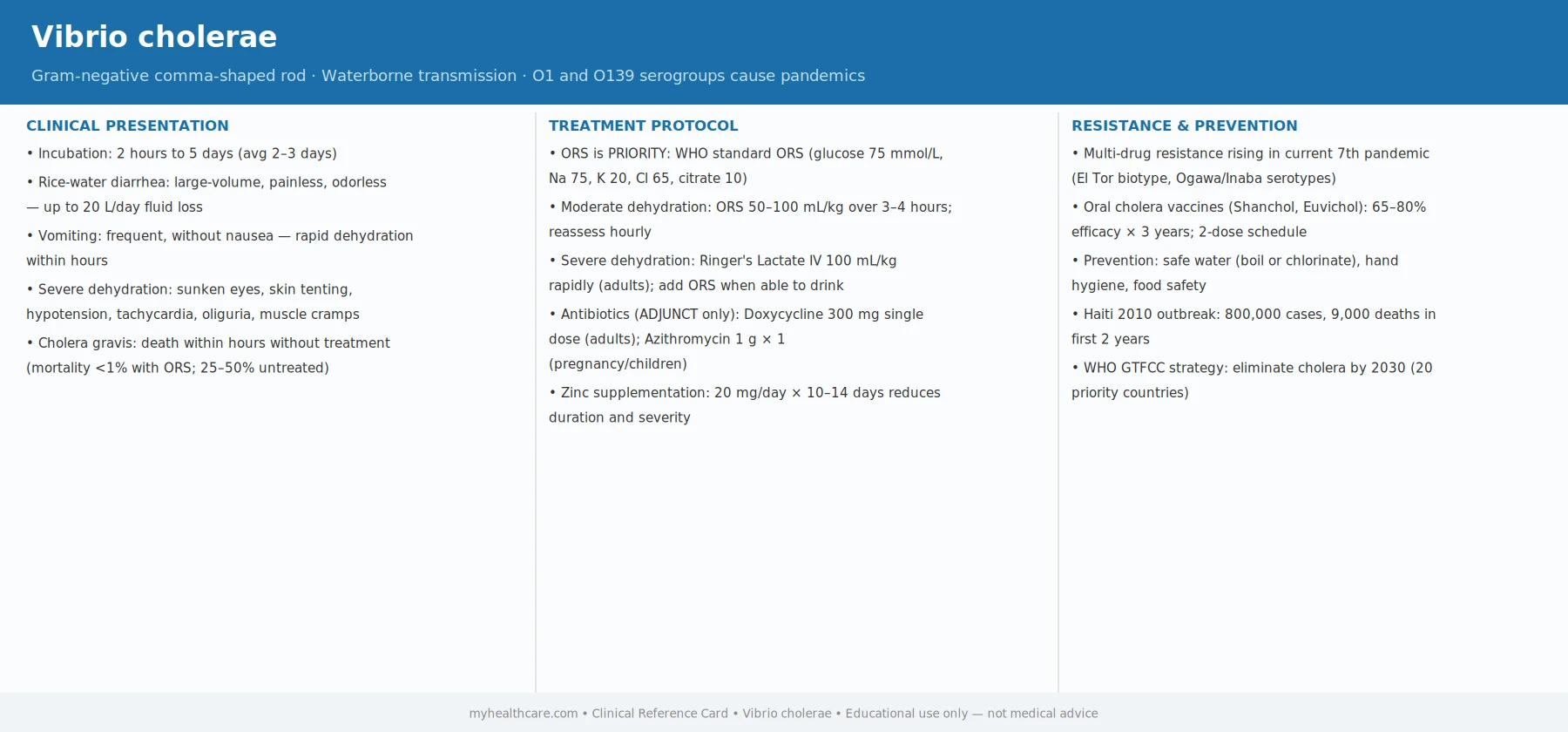
Vibrio cholerae is a comma-shaped, Gram-negative bacterium that lives in brackish coastal waters and estuaries worldwide. Of the roughly 200 known serogroups, only two — O1 and O139 — cause epidemic cholera. The O1 serogroup is responsible for all seven recorded cholera pandemics, including the current seventh pandemic that began in 1961 and continues today. The O1 serogroup is further divided into two biotypes: Classical (now largely displaced) and El Tor, which dominates globally.
The bacterium is strikingly adapted to the aquatic environment. It forms biofilms on the shells of zooplankton and copepods, which allows it to persist and cycle through coastal ecosystems independently of human hosts. This environmental reservoir means cholera can re-emerge in a community even after an apparent absence, particularly following flooding or storms that disturb coastal waters. Climate change is expanding the geographic range of suitable aquatic habitat, contributing to a slow northward and southward spread of the organism.
In humans, V. cholerae does not invade the bloodstream. It colonizes the small intestine, attaches to the lining, and releases a powerful toxin — without ever crossing into the body's tissues. This makes cholera a disease of the intestinal lumen rather than the tissues themselves, which is why the correct antibiotic, used alongside rehydration, can shorten illness considerably but rehydration alone is sufficient to prevent death.
The Rice-Water Diarrhea Mechanism
The defining pathology of cholera is caused by cholera toxin (CT), a protein the bacterium secretes once it has colonized the small intestine. The toxin is made of two components: the B subunit, which binds to a receptor (GM1 ganglioside) on the surface of intestinal cells, and the A subunit, which enters the cell and permanently activates a signaling protein called Gs-alpha.
This activation triggers an unrelenting surge of cyclic AMP (cAMP) inside intestinal epithelial cells. Normally, cAMP controls the opening and closing of ion channels — but with cholera toxin locking the signal permanently "on," chloride ions pour out of cells into the intestinal lumen. Water follows by osmosis, and sodium and other electrolytes follow along. The result is a massive, painless outpouring of fluid from the intestinal wall into the gut lumen that the body cannot stop or compensate for.
The stool is characteristically described as "rice-water" — a pale, slightly cloudy liquid containing flecks of mucus, resembling the water left over after washing rice. Unlike diarrhea from many other infections, cholera stool carries almost no blood, very little protein, and no fecal matter — just electrolytes and mucus. In severe cases, an adult can lose one liter of fluid per hour. Without replacement, blood pressure collapses, the kidneys shut down, and the heart — unable to pump fluid that no longer exists in the circulation — goes into arrest. The entire process from first symptom to death can take as little as a few hours.
The brilliant insight behind ORT is that a separate transport system in the intestine — the sodium-glucose cotransporter (SGLT1) — remains fully functional even when cholera toxin is active. This transporter absorbs sodium and glucose together, pulling water with them. By giving patients the right combination of glucose, sodium, and other electrolytes dissolved in clean water, the gut can absorb fluid fast enough to keep pace with — and eventually overcome — the toxin-driven loss.
How Cholera Spreads (WASH Factors)
Cholera is almost entirely a disease of contaminated water and food. The bacterium is transmitted by the fecal-oral route: infectious stool from a sick person contaminates a water source, and others who drink that water or eat food irrigated or washed with it become infected. Person-to-person transmission through casual contact is rare; the infective dose is high (typically tens of millions of organisms), so casual handling does not normally transmit the disease. The main exception is household contacts who handle the stool of very sick patients without hand hygiene.
The factors that drive outbreaks are captured by the acronym WASH: Water, Sanitation, and Hygiene. Everywhere cholera has been eliminated, the mechanism has been clean water supply and proper sewage treatment — not vaccination or treatment, which arrive after the water has already failed. Cholera virtually disappeared from Europe and North America in the late 19th and early 20th centuries before any cholera vaccine existed, driven entirely by investment in urban water and sewage infrastructure.
The specific risk environments include:
- Displaced populations and refugee camps — the highest-risk setting globally, where sanitation collapses rapidly and water sources are shared.
- Flooding — which contaminates wells and water supplies with human waste.
- Coastal and riverine communities in tropical and subtropical regions where V. cholerae circulates in the aquatic environment.
- Raw or undercooked seafood — particularly shellfish such as oysters, which filter-feed and concentrate the organism from seawater.
- Raw produce irrigated with contaminated water — a documented mechanism in field workers and their communities.
Symptoms and Severity
The majority of people infected with V. cholerae — roughly 75 to 80% — experience mild or no symptoms and recover without treatment. They may have a brief period of loose stools and some abdominal discomfort, but the illness resembles ordinary gastroenteritis and resolves on its own. These mild cases are still infectious and can silently sustain outbreaks.
In the 20 to 25% of cases that progress to more significant illness, the onset is sudden, with:
- Profuse, watery diarrhea — the characteristic rice-water appearance, typically painless and without blood or significant cramping.
- Vomiting — which adds to fluid loss and can make ORT difficult to tolerate early in the illness.
- Muscle cramps — particularly in the legs, caused by electrolyte depletion (especially low potassium and sodium).
- Rapid dehydration — sunken eyes, dry mouth and skin, decreased urine output, extreme thirst.
In severe cholera (about 5 to 10% of symptomatic cases), dehydration progresses to clinical shock: the skin becomes inelastic, the pulse is weak and rapid, blood pressure falls, and the patient becomes lethargic or unresponsive. Without prompt intravenous fluids, death follows within hours. The speed of this progression is what makes cholera one of the deadliest of the diarrheal diseases per episode of severe illness.
One clinical marker worth knowing: the characteristic "washerwoman's hands" — severely wrinkled skin on the fingers and palms from extreme fluid loss — is a sign of very advanced, life-threatening dehydration that requires immediate IV resuscitation.
Diagnosis
In an active outbreak with the classic rice-water diarrhea presentation, an experienced clinician can make a presumptive diagnosis on clinical grounds and begin treatment immediately. Waiting for laboratory confirmation before starting rehydration is never appropriate and costs lives.
Laboratory confirmation can be achieved by:
- Stool culture on thiosulfate-citrate-bile-sucrose (TCBS) agar, which is the gold standard for species identification and allows testing of antibiotic susceptibility. Cultures take 24 to 48 hours, so they are primarily useful for outbreak characterization and surveillance, not acute management.
- Rapid diagnostic tests (RDTs) — lateral-flow immunochromatographic strip tests that detect O1 or O139 antigens in stool within 15 minutes, without laboratory infrastructure. The WHO has approved several RDTs for field use in outbreak settings; they are highly sensitive and have transformed the speed of outbreak detection in resource-limited environments.
- Darkfield or phase-contrast microscopy of fresh stool can reveal the characteristic "shooting-star" motility of Vibrio organisms. This is a rapid bedside test available in some settings but requires skilled observers.
- PCR — highly sensitive and specific, used by reference laboratories for outbreak investigation and for distinguishing biotypes and drug-resistance profiles.
Treatment — ORT and IV Fluids
Rehydration is the treatment for cholera. Antibiotics help, but they are secondary. The priority in every case is replacing lost fluid and electrolytes, and the form this takes depends on how dehydrated the patient is.
For mild to moderate dehydration, oral rehydration solution (ORS) is the treatment of choice. The WHO/UNICEF standard ORS formulation contains specific amounts of glucose, sodium chloride, sodium citrate, and potassium chloride in one liter of clean water. This formulation exploits the SGLT1 cotransporter described above to drive active fluid absorption even in the face of ongoing cholera toxin activity. Patients are asked to drink ORS continuously, matching or exceeding their losses. In mild cases, this is straightforward. In vomiting patients, small, frequent sips — even 5 mL every minute — can accumulate to enough absorption to stay ahead of losses.
For severe dehydration (the patient is in shock, unable to drink, or losing fluid faster than they can absorb it), intravenous Ringer's lactate is the preferred fluid. Rapid infusion of large volumes — often 100 mL/kg over the first three to four hours in adults — is required. Normal saline is an acceptable alternative when Ringer's is unavailable, though it does not correct potassium and bicarbonate losses as well. Once the patient is out of shock and can swallow, transition to oral ORS.
Antibiotics shorten the duration of diarrhea and reduce stool volume, which eases the burden on caregivers and fluid supplies. The WHO recommends antibiotics only for severe cases. First-line agents depend on local resistance patterns:
- Doxycycline (single dose, adults) is the preferred agent where the local strain remains susceptible.
- Azithromycin is the preferred agent for children and pregnant women, and increasingly for adults where doxycycline resistance is common.
- Ciprofloxacin has been widely used but resistance is increasing in many outbreak strains, particularly in Asia and parts of Africa.
Zinc supplementation (10 mg/day for infants under 6 months, 20 mg/day for older children) reduces the duration and volume of diarrhea in children and is recommended by WHO as an adjunct to ORS in pediatric cases.
Cholera Vaccines
Three oral cholera vaccines (OCVs) are WHO-prequalified and included in the WHO stockpile used for outbreak response:
- Dukoral (killed whole-cell plus recombinant B subunit; requires a buffer liquid; two doses).
- Shanchol and Euvichol-Plus (killed whole-cell bivalent vaccines; no buffer needed; two doses at least two weeks apart).
The two-dose regimen provides roughly 65 to 80% protection for at least two to three years in endemic settings. A single dose provides shorter-duration protection (around 6 months) and is used for rapid deployment in the early phase of an outbreak where two-dose coverage cannot be achieved quickly.
Vaccination does not replace WASH improvements — it provides a temporary shield while the underlying infrastructure problem is addressed. In practice, vaccines are deployed reactively in outbreaks and proactively in high-risk endemic settings. The global OCV stockpile is chronically insufficient relative to demand, and allocation decisions — which outbreak to prioritize — are made centrally by the International Coordinating Group (ICG).
Global Burden and Active Outbreaks
Cholera is a disease of poverty and infrastructure failure. Its global distribution maps almost perfectly onto populations without reliable access to clean water and sanitation. WHO estimates that 1.3 to 4 million cholera cases and 21,000 to 143,000 deaths occur globally each year, with the wide range reflecting severe underreporting in resource-limited settings — most cases are never laboratory-confirmed or officially reported.
The seventh pandemic, caused by the El Tor biotype of O1 V. cholerae, began in Indonesia in 1961, reached Bangladesh and India in 1963, Africa in 1970, and Latin America in 1991 (where it caused over a million cases and 10,000 deaths in a region that had been cholera-free for a century). It continues uninterrupted today.
The largest outbreaks of the modern era illustrate how reliably cholera exploits the collapse of infrastructure:
- Haiti, 2010–2019: Introduced by UN peacekeepers following the earthquake, cholera caused over 800,000 cases and nearly 10,000 deaths in a country where cholera had been absent for decades. The outbreak was the largest in the modern era in a single country.
- Yemen, 2016–present: The civil war destroyed the water and sanitation infrastructure of one of the Arab world's poorest countries. The resulting outbreak has exceeded 2.5 million suspected cases and remains active, making it one of the largest cholera outbreaks in recorded history.
- Democratic Republic of Congo, Syria, Ethiopia, Cameroon, and Mozambique all carry persistent endemic cholera or recurrent outbreaks driven by conflict, displacement, or flooding.
A global roadmap — "Ending Cholera: A Global Roadmap to 2030" — targets a 90% reduction in cholera deaths and elimination of transmission in at least 20 currently endemic countries by 2030, through combined vaccination campaigns and WASH investment. Progress has been significant in some settings but is threatened by climate-related flooding, ongoing conflicts, and the strain on the global OCV stockpile from simultaneous outbreaks.
Key Research Papers
- Bhatt S, Bhatt DL, Baber U, et al. The manipulation of cell signaling and host cell biology by cholera toxin. Cell Signal. 2023;101:110489. — Detailed review of how cholera toxin permanently activates Gs-alpha and drives cAMP-mediated fluid secretion, explaining the rice-water diarrhea mechanism at the molecular level. — doi:10.1016/j.cellsig.2022.110489
- Clemens JD, Nair GB, Ahmed T, Qadri F, Holmgren J. Cholera. Lancet. 2017. Biswas AK, et al. Susceptibility to Vibrio cholerae infection in a cohort of household contacts. PLoS Negl Trop Dis. 2008;2(4):e221. — Landmark household contact study identifying blood group O and prior infection as key susceptibility determinants, helping explain why some people in the same household remain uninfected. — doi:10.1371/journal.pntd.0000221
- Zingl FG, Thapa HB, Scharf M, et al. Outer membrane vesicles of Vibrio cholerae protect and deliver active cholera toxin to host cells via GM1. mBio. 2021;12(3):e00534-21. — Showed that V. cholerae packages active cholera toxin in outer membrane vesicles that can cross the mucus layer and deliver toxin directly to intestinal epithelial cells, offering a new target for anti-virulence strategies. — doi:10.1128/mBio.00534-21
- Legros D. Updated global burden of cholera in endemic countries. J Infect Dis. 2019;219(suppl_1). Global Cholera Epidemiology: Opportunities to Reduce the Burden of Cholera by 2030. J Infect Dis. 2018;218(3):S137–S140. — Synthesizes country-level data to estimate 1.3 to 4 million cases and 21,000 to 143,000 deaths per year, and describes the roadmap targeting a 90% reduction in cholera mortality by 2030. — doi:10.1093/infdis/jiy486
- Wierzba TF. Oral cholera vaccines and their impact on the global burden of disease. Hum Vaccin Immunother. 2019;15(6):1294–1302. — Reviews the evidence for efficacy of the three WHO-prequalified oral cholera vaccines, their role in outbreak response, and the structural challenges of the global OCV stockpile. — doi:10.1080/21645515.2018.1504155
Connections
- All Bacteria
- Gastroenterology Conditions
- Infectious Disease
- Helicobacter pylori
- Inflammatory Bowel Disease
- Cryptosporidium
- Giardia
- All Conditions
- Cholera — the disease this bacterium causes, covered clinically.
- Robert Koch — the Nobel laureate who isolated the comma bacillus in 1883-84