Cholera Antibiotics: Doxycycline, Azithromycin, and Growing Resistance
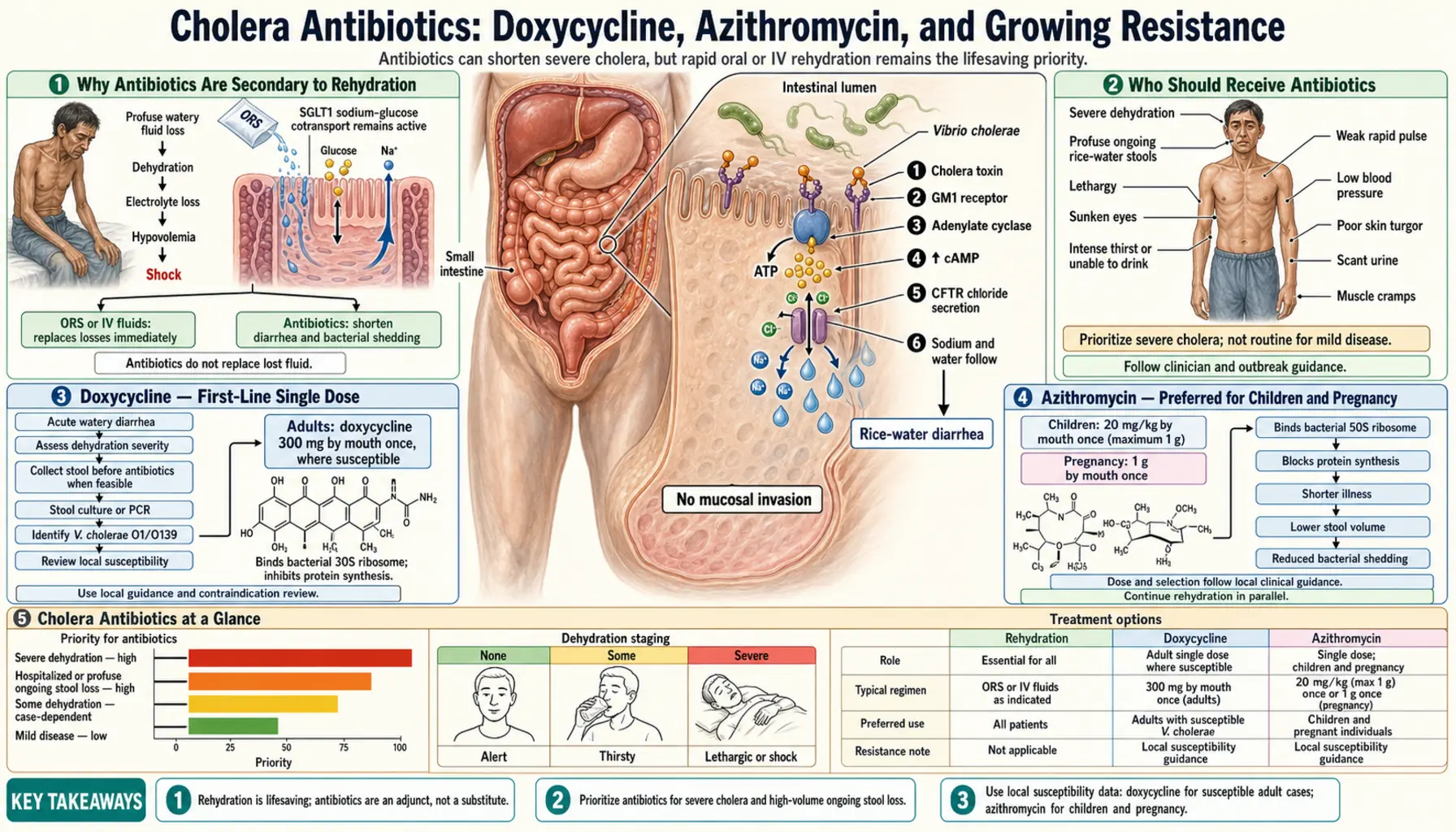
Antibiotics are a helpful — but secondary — tool in treating cholera. They can shorten illness and reduce the burden on patients and healthcare systems, but they cannot replace the fluids that are the true lifesaving intervention. As antibiotic-resistant strains spread across South Asia, Africa, and crisis zones like Yemen, understanding which drugs still work, who should receive them, and how resistance travels has become an essential part of cholera response for healthcare workers and patients alike.
Table of Contents
- Why Antibiotics Are Secondary to Rehydration
- Who Should Receive Antibiotics
- Doxycycline — First-Line Single Dose
- Azithromycin — Preferred for Children and Pregnancy
- Ciprofloxacin — An Alternative with Caveats
- How Resistance Spreads: SXT and Conjugative Plasmids
- Multidrug Resistance in the Yemen Outbreak
- Monitoring Resistance in Outbreak Settings
- Single-Dose vs Multi-Day Regimens
- Connections
- Featured Videos
Why Antibiotics Are Secondary to Rehydration
Without rehydration, cholera kills up to 50% of patients within hours. The bacterium Vibrio cholerae does not destroy tissue directly — it hijacks intestinal cells to pour out fluid at a rate the body cannot tolerate. Antibiotics that kill the bacteria cannot undo the dehydration that has already occurred, and a patient who is profoundly dehydrated needs fluid before anything else. With proper oral rehydration solution (ORS) or intravenous (IV) rehydration alone, the case fatality rate drops below 1% — even without a single antibiotic.
So what do antibiotics actually add? The evidence is consistent: when given to patients with moderate-to-severe disease alongside adequate rehydration, antibiotics reduce stool output by approximately 50%, shorten the duration of diarrhea by one to two days, reduce the total volume of ORS required, and shorten the period of V. cholerae shedding in stool — which matters for outbreak control. A Cochrane-style systematic review by Leibovici-Weissman Y et al. (PMID: 19888356) confirmed that antibiotics reduce the duration and volume of diarrhea and the length of hospital stay in patients with cholera.
For mild cholera — loose stools but no clinical signs of dehydration — the risk-benefit calculation shifts. Antibiotics offer modest benefit in patients who would recover quickly with ORS alone, while the indiscriminate use of antibiotics accelerates resistance. Sack DA et al., 2004 (PMID: 14738797) in their landmark Lancet cholera review made clear that the priority hierarchy is always: fluids first, antibiotics for moderate-to-severe disease, and antibiotic stewardship as a public health obligation. This principle guides all current WHO and CDC guidance.
Who Should Receive Antibiotics
Not every cholera patient needs antibiotics. Current WHO and most national cholera guidelines recommend antibiotic treatment for patients with moderate-to-severe dehydration. In practice, this means patients who need IV fluids because they cannot tolerate oral rehydration, or patients who are clinically assessed as having lost more than 10% of their body weight in fluid.
High-risk groups who benefit even with moderate disease include:
- Severely malnourished children — their immune response is compromised and their margin for error is smaller
- Pregnant women — volume loss can trigger preterm labor and fetal distress; reducing illness duration matters
- Elderly patients — less physiologic reserve, more vulnerable to cardiac complications of dehydration
- Immunocompromised individuals — HIV/AIDS, cancer chemotherapy, organ transplant recipients
Patients with mild cholera — those who are alert, tolerating fluids, and showing only minimal dehydration signs — generally do not need antibiotics. Seas C and Gotuzzo E, 2001 (PMID: 11440941) noted that for mild cases the natural resolution with ORS is rapid and the antibiotic benefit does not justify the population-level resistance risk. In outbreak settings with limited laboratory capacity, clinical severity is the practical guide. The critical point: when antibiotics are indicated, they should start alongside rehydration — never instead of it.
One more practical consideration: in the field during large outbreaks, the time to give antibiotics is when IV rehydration is initiated or within the first few hours of ORS treatment, not hours into care when the bacterial burden is already declining. Early administration maximizes the benefit in reducing total stool output and shortening illness.
Doxycycline — First-Line Single Dose
Doxycycline is the preferred first-line antibiotic for non-pregnant adults with moderate-to-severe cholera where the local strain is susceptible to tetracyclines. It belongs to the tetracycline class of antibiotics and works by inhibiting bacterial protein synthesis — binding to the 30S ribosomal subunit of V. cholerae and blocking the addition of amino acids to the growing protein chain. The effect is bacteriostatic at standard concentrations, meaning it slows bacterial growth rather than killing outright, but this is sufficient given that the immune system and fluid therapy handle the rest.
Dose: 300 mg as a single oral dose for adults. This single-dose regimen is clinically equivalent to three days of 100 mg twice daily, with the enormous practical advantage that compliance is guaranteed — a vomiting, disoriented patient takes one pill and the course is complete.
Bhattacharya SK, 2006 (PMID: 16645494) documented doxycycline's role as a cornerstone of cholera antibiotic management, noting its rapid oral absorption and high tissue concentrations in the gut wall — exactly where V. cholerae colonizes.
Who cannot take doxycycline:
- Children under 8 years — tetracyclines bind to developing tooth enamel and bone, causing permanent gray-brown staining of teeth and potential growth retardation. Azithromycin is the alternative.
- Pregnant women — fetal bone and tooth development risk in all three trimesters. Azithromycin is safe and preferred.
- Patients with tetracycline-class allergy — use azithromycin or ciprofloxacin depending on local susceptibility.
Resistance alert: Doxycycline resistance is mediated primarily by the SXT integrative conjugative element (ICE), which carries tetracycline resistance genes (typically tet(A) or tet(B)). In much of South Asia — Bangladesh, India, Pakistan — and in parts of Sub-Saharan Africa, tetracycline resistance is now documented in circulating V. cholerae O1 El Tor strains. Where local surveillance data show tetracycline resistance, azithromycin should replace doxycycline as the first-line agent. Using doxycycline against a resistant strain provides no clinical benefit and contributes to further resistance pressure.
Azithromycin — Preferred for Children and Pregnancy
Azithromycin is the first-line antibiotic of choice for children, pregnant women, and breastfeeding mothers with moderate-to-severe cholera. It is also a leading first-line alternative for adults where doxycycline resistance is confirmed or suspected. Azithromycin is a macrolide antibiotic that inhibits the 50S ribosomal subunit of V. cholerae, blocking protein elongation and reducing bacterial viability. In cholera specifically, it also appears to reduce cholera toxin gene expression, contributing to a faster reduction in stool output than one might expect from bacterial killing alone.
Adult dose: 1 g as a single oral dose.
Pediatric dose: 20 mg/kg body weight as a single dose, maximum 1 g. For infants under 6 months, azithromycin remains the drug of choice but dose must be calculated precisely by weight and administered under clinical supervision.
Pregnancy dose: 1 g single dose — same as adult, considered safe throughout pregnancy.
The head-to-head comparison between azithromycin and doxycycline was well established by Bhattacharya MK et al., 1999 (PMID: 10438064), who found single-dose azithromycin clinically equivalent to doxycycline for adult cholera, with comparable reductions in stool volume and illness duration. This study was pivotal in establishing azithromycin as a true alternative rather than merely a fallback.
Azithromycin's safety profile in pregnancy — FDA category B, with extensive obstetric use data for other indications — makes it the practical standard of care when a pregnant woman has severe cholera. The comparative trial evidence and Weil AA et al., 2013 (PMID: 24265554) have confirmed that single-dose azithromycin achieves microbiologic clearance and clinical cure rates comparable to multi-day regimens.
Resistance picture: Azithromycin resistance in V. cholerae O1 and O139 exists but remains less widespread than tetracycline resistance as of the mid-2020s. Sporadic reports of reduced azithromycin susceptibility have emerged from Bangladesh and India, typically mediated by mutations in the 23S rRNA gene or acquisition of macrolide efflux pumps. Monitoring azithromycin susceptibility in outbreak strains is a priority — it is currently the most reliable agent for children and pregnant women, and losing it to resistance would significantly narrow treatment options for the most vulnerable patients.
Ciprofloxacin — An Alternative with Caveats
Ciprofloxacin, a fluoroquinolone antibiotic, was widely used against cholera through the 1990s and early 2000s and remains an option when both doxycycline and azithromycin are contraindicated or unavailable. It acts by inhibiting bacterial DNA gyrase and topoisomerase IV — enzymes essential for V. cholerae DNA replication and repair. At therapeutic concentrations, ciprofloxacin is bactericidal against susceptible strains, achieving rapid bacterial killing.
Standard dose: 500 mg twice daily for three days, or 1 g as a single oral dose (some guidelines support the single-dose approach for uncomplicated moderate disease). The single-dose regimen is operationally simpler in field settings.
The growing problem with ciprofloxacin is resistance. Nelson EJ et al., 2009 (PMID: 20860987) documented the emergence and spread of El Tor variant V. cholerae strains with reduced fluoroquinolone susceptibility, driven by chromosomal mutations in the gyrA and parC genes — the same mechanism that undermines ciprofloxacin in many other bacteria. Some strains also carry plasmid-mediated quinolone resistance (PMQR) genes such as qnr determinants, which confer low-level but clinically significant protection against fluoroquinolones.
Strains with reduced ciprofloxacin susceptibility have been documented across South Asia — particularly in Bangladesh and India, where the O1 El Tor variant has dominated outbreaks since the early 2000s — and in parts of West and East Africa. The raised minimum inhibitory concentrations (MICs) in these strains mean that standard ciprofloxacin doses may not achieve sufficient gut concentrations to clear the infection, leading to treatment failure that can be misread as clinical worsening from dehydration.
Practical guidance: WHO explicitly recommends basing antibiotic selection on local susceptibility data. Do not default to ciprofloxacin without checking whether the current outbreak strain is still fully susceptible. In regions with known fluoroquinolone resistance, azithromycin is the preferred alternative and ciprofloxacin should be avoided unless susceptibility is confirmed by laboratory testing.
How Resistance Spreads: SXT and Conjugative Plasmids
Understanding how antibiotic resistance spreads in V. cholerae helps explain why resistance patterns change rapidly during outbreaks and why the same drug can work in one country and fail in another just a few years later. The main driver is a remarkable mobile genetic element called the SXT integrative conjugative element (ICE).
The SXT element is not a standard plasmid but an ICE — a piece of DNA that integrates into the bacterial chromosome and can excise and transfer itself to a new bacterium through direct bacterial contact (conjugation). The SXT element carries a modular resistance cassette that varies between strains but typically includes resistance genes for:
- Sulfonamides (sul2) — block bacterial folic acid synthesis
- Trimethoprim (dfrA1) — also blocks folate synthesis; combined as co-trimoxazole (SXT in common parlance, separate from the element name)
- Chloramphenicol (floR) — a florfenicol/chloramphenicol resistance gene
- Streptomycin (strA/strB or aadA variants)
Variant SXT elements — including the ICEVchInd family documented extensively by Faruque SM et al., 2003 (PMID: 12704411) — can also carry tetracycline resistance genes, explaining why tetracycline and co-trimoxazole resistance often appear together in clinical isolates. The epidemiology of the SXT element was further characterized by Faruque SM et al., 1998 (PMID: 9426255), who traced its emergence and geographic spread in the context of El Tor cholera pandemic waves.
Additional resistance genes arrive via conjugative plasmids — self-transmissible circular DNA molecules that exist independently of the chromosome. V. cholerae can acquire plasmids from other species of gut bacteria, not only from other Vibrio. This means that a cholera patient who receives broad-spectrum antibiotics — particularly if they are already colonized with resistant Enterobacteriaceae — can become a site where resistance genes transfer from commensal bacteria into V. cholerae. The practical implication: unnecessary antibiotic use in cholera patients with mild disease does not just promote resistance in V. cholerae already present — it may actively create new resistant strains by facilitating gene transfer in the gut environment.
Multidrug Resistance in the Yemen Outbreak
The cholera outbreak that began in Yemen in 2016 became the largest in recorded history within two years, eventually surpassing one million suspected cases. Beyond its sheer scale, the Yemen outbreak became a critical case study in how multidrug-resistant V. cholerae complicates clinical management in a collapsed healthcare system.
Camacho A et al., 2018 (PMID: 30602740) analyzed the epidemic dynamics of the Yemen outbreak, documenting its unprecedented spread through a population with severely degraded water and sanitation infrastructure — precisely the conditions under which cholera thrives and under which resistance surveillance collapses.
Molecular characterization of V. cholerae O1 El Tor isolates from Yemen showed patterns consistent with SXT-carrying strains, with resistance to:
- Ampicillin — beta-lactam resistance, common in SXT-carrying strains
- Co-trimoxazole (trimethoprim-sulfamethoxazole) — the SXT element's signature resistance
- Chloramphenicol — mediated by the floR gene on SXT
- Nalidixic acid — an older quinolone, used as a proxy marker for fluoroquinolone resistance trends
Some Yemen isolates also showed reduced susceptibility to ciprofloxacin — a critical finding given that ciprofloxacin had been one of the agents available in the field. This meant that for some patients, the antibiotic being administered was clinically ineffective even as rehydration was proceeding correctly.
The response adapted. Aid organizations and the Yemeni Ministry of Health, working with WHO technical guidance, shifted toward azithromycin as the preferred agent for severe cases requiring antibiotic therapy, reserving it for the highest-risk patients given limited drug supplies. The Yemen outbreak underscores a grim practical reality: in crisis settings, you cannot always perform susceptibility testing before choosing a drug. Building the evidence base and regional surveillance networks during inter-outbreak periods — when laboratories are functional — is the only way to make informed antibiotic choices when systems are under stress.
Monitoring Resistance in Outbreak Settings
Antibiotic susceptibility testing of V. cholerae isolates is not a luxury — it is a clinical and public health necessity. Even testing 10 to 20 isolates during the first weeks of an outbreak can reveal the dominant resistance profile and allow treatment protocols to be updated for thousands of patients who will receive antibiotics empirically. The difference between a susceptible strain and a multidrug-resistant one is invisible at the bedside — the bacteria look the same, the disease looks the same, and the patient looks the same. Laboratory testing is the only way to know.
WHO's Global Antimicrobial Resistance and Use Surveillance System (GLASS) includes V. cholerae as a priority pathogen. National cholera reference laboratories are expected to perform susceptibility testing on outbreak isolates and report results to WHO, contributing to the global picture of resistance trends. In field conditions where advanced microbiology is impossible, disk diffusion (Kirby-Bauer testing) is the most feasible method — it requires only standard laboratory materials, trained technicians, and a reliable supply of antibiotic disks.
Antibiotics to test in any cholera outbreak:
- Doxycycline and tetracycline (proxy for class resistance)
- Azithromycin
- Ciprofloxacin (and nalidixic acid as a screening marker)
- Ampicillin
- Trimethoprim-sulfamethoxazole (co-trimoxazole)
- Chloramphenicol
Isolates should be preserved (stored at -70°C or shipped to national or WHO reference laboratories on appropriate transport media) for full genotypic characterization — including PCR-based screening for the SXT element, specific resistance genes, and whole-genome sequencing when capacity allows. Genomic data is increasingly used to trace the phylogenetic spread of resistant strains between outbreak waves and countries.
When resistance to a first-line agent is confirmed in outbreak isolates, treatment protocols must be updated immediately — not after further confirmation, not after a committee review cycle. Healthcare workers treating patients empirically need real-time information. The protocol update should be communicated to all treatment centers in the affected area simultaneously, with a clear written recommendation signed by the relevant health authority. WHO 2017 cholera reference guidance (PMID: 28539432) reinforces that this surveillance-to-protocol loop is a core element of outbreak response.
Single-Dose vs Multi-Day Regimens
One of the clearest and most practically important findings in cholera antibiotic research is that single-dose regimens perform as well as multi-day courses for the primary antibiotics used in cholera treatment. This is not a compromise — it is a feature that makes antibiotic therapy dramatically more feasible in the conditions where cholera strikes.
Doxycycline: Single oral dose of 300 mg is clinically equivalent to three days of 100 mg twice daily in reducing stool output, shortening illness duration, and achieving microbiologic clearance. No meaningful difference in outcomes has been demonstrated in properly conducted trials.
Azithromycin: Single oral dose of 1 g (adults) or 20 mg/kg (children) achieves outcomes equivalent to three-day regimens. Weil AA et al., 2013 (PMID: 24265554) confirmed that single-dose azithromycin produces microbiologic clearance and clinical cure rates that are statistically non-inferior to multi-day courses, with the added advantage of guaranteed compliance.
Ciprofloxacin: A single 1 g oral dose shows comparable efficacy to three days of 500 mg twice daily in susceptible strains. Some clinicians use 500 mg twice daily for three days for severe disease, but the evidence base for this over single-dose therapy in cholera specifically is limited.
The compliance argument for single-dose therapy in cholera is overwhelming. A patient who arrives at a treatment center severely dehydrated, actively vomiting, and confused cannot reliably take pills twice a day for three days. A single pill given at admission — alongside IV rehydration — sidesteps the entire compliance problem. In large-scale outbreak responses, single-dose protocols also simplify drug distribution, reduce pharmacy burden, and lower the total antibiotic load distributed to the population, which has measurable resistance-reduction implications at the community level.
Guenther et al. (PMID: 22699834) examined the intersection of WASH (water, sanitation, and hygiene) interventions with antibiotic use in cholera contexts, noting that appropriate antibiotic stewardship — using single-dose regimens, restricting antibiotics to severe cases — is part of a broader resistance-mitigation strategy that complements clean water access. WHO guidelines for cholera universally favor single-dose regimens for all three primary agents and explicitly discourage multi-day courses except in cases where clinical complexity or treatment failure justifies extended therapy.
The bottom line for patients and caregivers: if you or a family member receives a single-pill antibiotic at a cholera treatment center, this is deliberate and evidence-based — not a shortcut. Take it as directed, continue your oral rehydration solution, and know that the combination of that single dose and adequate fluids is the best available treatment for moderate-to-severe cholera.
Connections
- All Bacteria
- Vibrio Cholerae — Overview
- Cholera Treatment and Prevention
- Oral Rehydration and IV Fluids
- Cholera Vaccines and Prevention
- Cholera Symptoms and Diagnosis
- Gastroenterology Diseases
- Cholera — disease overview these antibiotics are prescribed for.