Treponema pallidum: Syphilis — Stages, Symptoms, and the Return of a Forgotten Disease
Symptoms & Syphilis Stages
The four stages of syphilis — primary chancre, secondary rash, latent, and tertiary — and how each presents.
Read the deep dive →Primary & Secondary Syphilis
The painless sore, the spreading rash, and why this stage is often missed.
Read the deep dive →Neurosyphilis & Tertiary Syphilis
Brain, spinal cord, aorta, and gumma involvement — the devastating late-stage effects.
Read the deep dive →Diagnosis: Serologic Tests
RPR, VDRL, FTA-ABS, and TPPA — how syphilis is detected at each stage.
Read the deep dive →Treatment & Prevention
Benzathine penicillin G, alternative regimens, partner notification, and STI prevention.
Read the deep dive →Penicillin G Treatment
Why penicillin remains the only recommended drug, dosing by stage, and Jarisch-Herxheimer reaction.
Read the deep dive →Congenital Syphilis & Prevention
How syphilis crosses the placenta, effects on the newborn, and prenatal screening.
Read the deep dive →Syphilis Resurgence
Why syphilis rates are surging globally and what makes treatment challenging without a vaccine.
Read the deep dive →Syphilis, caused by Treponema pallidum, progresses through primary, secondary, latent, and tertiary stages over years or decades — starting as a painless sore, eventually attacking the brain, heart, and aorta if untreated. After near-elimination by penicillin, rates have surged to multi-decade highs across the US and Europe. A disease once thought conquered is back, and its return has been driven by changing sexual behavior, reduced condom use, and failures in public health contact tracing infrastructure.
Table of Contents
What T. pallidum Is and Why It Is Unusual
Treponema pallidum subsp. pallidum is a slender, tightly coiled, corkscrew-shaped bacterium belonging to the spirochete family — the same group that includes the Lyme disease bacterium (Borrelia burgdorferi) and the pathogen causing leptospirosis. It is extraordinarily thin (0.1–0.18 micrometers wide) and cannot be seen under an ordinary light microscope stained with standard dyes; visualizing it requires darkfield microscopy or special staining techniques.
Several features make T. pallidum deeply unusual among bacterial pathogens:
- It cannot be cultured in the laboratory on any artificial medium. It can only be maintained in living rabbits or in specialized tissue-culture systems that have never been successfully scaled for diagnostic use. This has made studying its biology and testing new antibiotics extraordinarily difficult.
- It has a minimal genome — one of the smallest of any pathogenic bacterium — and has outsourced almost all of its metabolic needs to its host. It cannot synthesize most amino acids, fatty acids, or nucleotides on its own. This extreme metabolic dependence is likely why it cannot be cultured outside of a living host.
- It is exquisitely sensitive to penicillin. Despite decades of widespread penicillin use since the 1940s, T. pallidum has never developed clinically significant resistance to penicillin. It is one of very few major bacterial pathogens for which the first-line treatment has never changed in 80 years.
- It evades the immune system remarkably well — so effectively that untreated syphilis can persist for decades, cycling through stages of activity and apparent quiescence, while the immune system fails to clear it.
Syphilis has been recorded in European populations since at least the late 15th century, though debate continues over whether it was present before or imported following Columbus's voyages. Before penicillin it was one of the leading causes of death and disability in the Western world, affecting the brain, heart, aorta, and multiple other organs when untreated.
The Four Stages of Syphilis
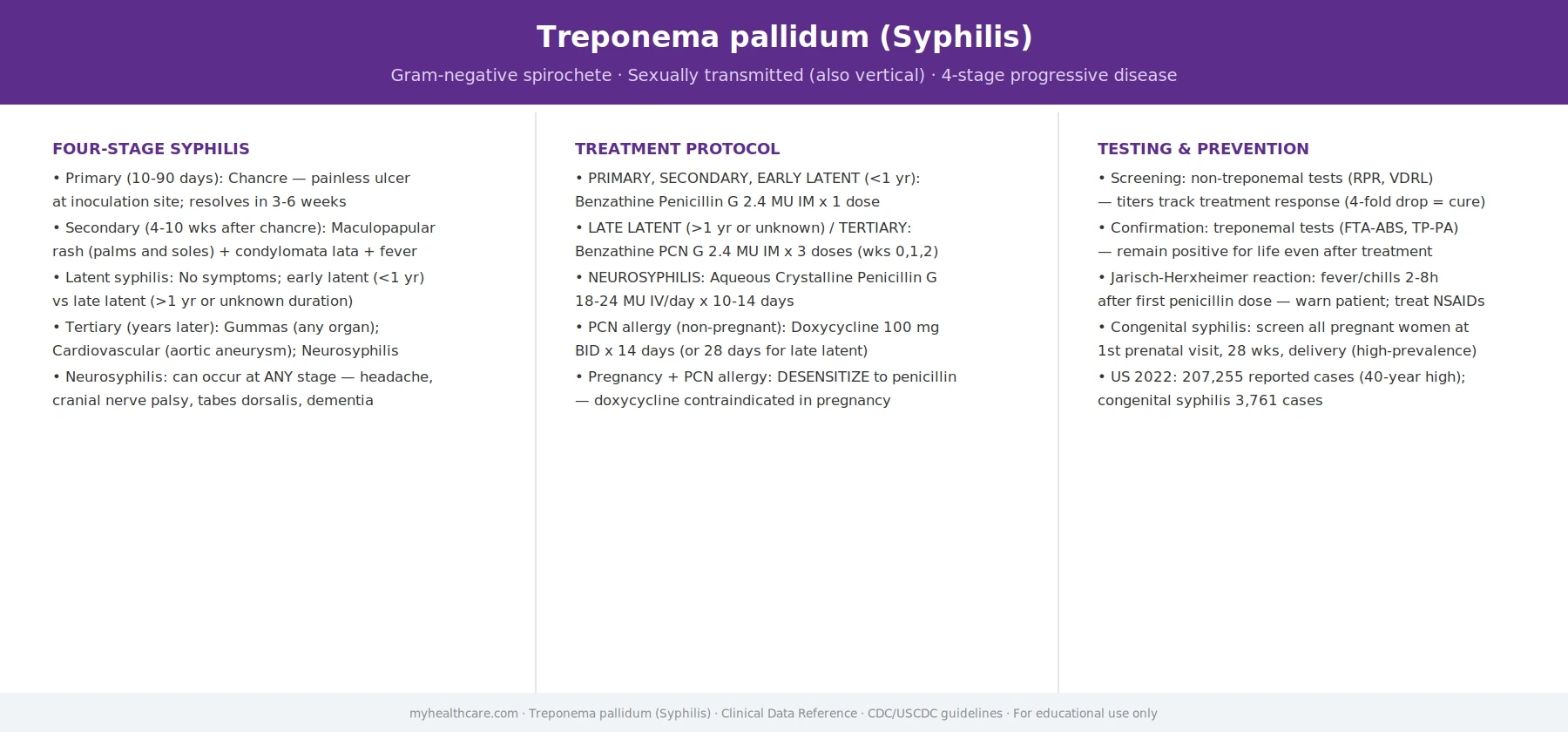
Syphilis is unique among common bacterial infections in progressing through clinically distinct stages separated by months or years. Understanding the stages is essential for recognizing the infection, because each stage has a completely different appearance.
Primary Syphilis
The hallmark is the chancre (pronounced "shanker") — a single, painless, indurated (firm-edged) ulcer at the site of inoculation. It appears 10 to 90 days after exposure (average 21 days). Chancres are most commonly found on the genitals, but can occur on the anus, rectum, lips, tongue, fingers, or any other site of sexual contact. The painlessness is diagnostically important: painful genital ulcers are more likely to be herpes simplex or chancroid.
The chancre heals on its own in three to six weeks without treatment — which is precisely what misleads patients into believing the infection has resolved. It has not. The bacterium has disseminated through the bloodstream to seed the entire body. Lymph nodes near the chancre enlarge but are typically non-tender.
Secondary Syphilis
Secondary syphilis begins two to eight weeks after the chancre appears (and may overlap with it) and represents the systemic dissemination of the organism. It is the most florid stage, and its manifestations are highly variable — giving syphilis its historical reputation as "the great imitator" because it can look like almost any other disease.
The defining feature is a rash that classically involves the palms and soles — a distribution that is unusual for most other skin conditions and should immediately raise suspicion for syphilis. The rash is typically copper-colored, macular or papular, and non-itchy, though it can be pustular or scaling in some cases. Other findings include:
- Condylomata lata — flat, moist, highly infectious gray-white lesions in warm intertriginous areas (groin, perianal area, axillae, under the breasts).
- Mucous patches — painless gray erosions on mucous membranes of the mouth, tongue, throat, or genitals; highly infectious.
- Patchy ("moth-eaten") alopecia of the scalp or eyebrows.
- Constitutional symptoms — fever, fatigue, headache, sore throat, weight loss, and generalized lymphadenopathy that can mimic mononucleosis or other viral illnesses.
- In a minority of cases, early neurologic (meningitis, cranial nerve palsies, uveitis), hepatic, renal, or bone involvement.
Secondary syphilis also resolves spontaneously without treatment, which again misleads patients. The infection enters a latent phase.
Latent Syphilis
Latent syphilis is defined as serologic evidence of infection (positive blood test) with no symptoms. Early latent syphilis covers the first year after infection; late latent syphilis is everything beyond one year (or of unknown duration). The distinction matters because early latent syphilis is still potentially infectious (secondary-stage relapses can occur), while late latent syphilis is not sexually transmissible (though a pregnant woman with late latent syphilis can still transmit to her fetus).
Many people remain in the latent stage permanently without progressing to tertiary disease, particularly in the antibiotic era. But without treatment, approximately one third will eventually develop tertiary syphilis.
Tertiary Syphilis
Tertiary syphilis develops years to decades after initial infection and represents the destructive late-stage disease. Three main forms are recognized:
- Gummatous syphilis: Inflammatory nodules called gummas that can form in any organ — skin, bone, liver, brain, testis — and cause local tissue destruction. In the pre-antibiotic era these were common; today they are rare in countries with functioning healthcare systems.
- Cardiovascular syphilis: Inflammation of the aorta (syphilitic aortitis) that weakens the vessel wall, causing aortic aneurysm (most often the ascending aorta), aortic valve regurgitation, or narrowing of the coronary artery ostia. This form typically develops 10 to 30 years after initial infection and was historically a leading cause of aortic aneurysm.
- Neurosyphilis: Invasion of the nervous system. Though technically possible at any stage (early neurosyphilis is a recognized entity), late neurosyphilis takes forms including meningovascular syphilis (strokes in young people), general paresis (progressive dementia, personality change, psychosis), and tabes dorsalis (degeneration of the dorsal spinal columns causing a characteristic wide-based "stamping" gait, lancinating leg pains, and loss of position sense). Neurosyphilis was a major cause of psychiatric institutionalization in the pre-penicillin era.
Congenital Syphilis
When a pregnant woman has untreated syphilis, T. pallidum can cross the placenta at any gestational age and infect the fetus. Congenital syphilis is the most preventable and most tragic consequence of the current resurgence: it is entirely avoidable by a single dose of penicillin during pregnancy.
Infection early in pregnancy causes miscarriage, stillbirth, or premature birth. In liveborn infants, congenital syphilis causes a wide range of manifestations:
- Early congenital syphilis (first two years of life): snuffles (a bloody, mucopurulent nasal discharge that is highly infectious), skin rashes similar to secondary syphilis, hepatosplenomegaly, jaundice, anemia, periostitis (bone inflammation causing extreme tenderness), and failure to thrive. Some infants appear well at birth and become ill over weeks.
- Late congenital syphilis (after two years): Hutchinson's teeth (notched, peg-shaped upper incisors), interstitial keratitis (corneal inflammation that can cause blindness), eighth nerve deafness, saddle-nose deformity, saber shins, and neurosyphilis.
The US saw its congenital syphilis rate reach a 30-year high in 2022 (3.3 cases per 100,000 live births), with over 3,700 cases and 231 congenital syphilis-attributable deaths reported to the CDC. This is a public health failure: syphilis testing in pregnancy is required by law in most US states, penicillin is inexpensive and curative, and congenital syphilis should be close to zero in a functioning healthcare system.
Syphilis and HIV Coinfection
Syphilis and HIV coinfection is common and clinically important. People with syphilis have a two- to fivefold increased risk of acquiring HIV if exposed, because the genital ulcer of primary syphilis provides a direct portal of entry for HIV. Conversely, people with HIV who acquire syphilis are at substantially higher risk of neurologic complications, atypical presentations, and treatment failure.
The immunosuppression of HIV can alter syphilis presentations significantly:
- Primary chancres may be multiple rather than solitary.
- Secondary and primary stages may overlap.
- Neurosyphilis may develop earlier and more aggressively.
- Standard serologic tests (RPR, VDRL) may give misleadingly high or low titers, and in severely immunocompromised individuals can occasionally be falsely negative.
In people living with HIV, the recommended treatment regimens are generally the same as for HIV-negative patients, but closer follow-up of serologic titers is essential, and a lower threshold exists for lumbar puncture to rule out neurosyphilis.
Diagnosis (RPR, VDRL, Treponemal Tests)
Because T. pallidum cannot be cultured, diagnosis relies on a combination of clinical presentation and serologic testing. Two types of blood tests are used together:
Non-Treponemal Tests (screening)
The RPR (Rapid Plasma Reagin) and VDRL (Venereal Disease Research Laboratory) tests detect antibodies to cardiolipin-cholesterol-lecithin, a lipid released by damaged cells during syphilis infection. They are not specific to T. pallidum but are:
- Inexpensive and quick.
- Quantifiable — the titer reflects disease activity and can be used to monitor treatment response. A fourfold fall in titer (e.g., from 1:32 to 1:8) within 6–12 months of treatment confirms adequate therapy.
- Subject to biological false positives in pregnancy, autoimmune diseases (especially lupus), other infections, and occasionally aging.
A positive RPR or VDRL must always be confirmed with a treponemal-specific test.
Treponemal Tests (confirmatory)
The FTA-ABS (Fluorescent Treponemal Antibody Absorbed), TP-PA (T. pallidum Particle Agglutination), and various EIA/CIA tests detect antibodies specifically to T. pallidum proteins. They are highly sensitive and specific for true syphilis infection but remain positive for life even after successful treatment. This means they cannot distinguish active infection from a past, treated infection — which is why non-treponemal titers are essential for monitoring.
Many labs now use a "reverse sequence algorithm": start with a treponemal-specific EIA (which can be automated), then confirm positives with RPR/VDRL. This is more sensitive for early primary syphilis (where the RPR can be negative in the first week or two) but can cause diagnostic confusion in patients with old treated infections and currently negative RPR.
Neurosyphilis Diagnosis
Neurosyphilis requires lumbar puncture with cerebrospinal fluid (CSF) analysis. CSF-VDRL is highly specific but relatively insensitive (a negative result does not rule out neurosyphilis). CSF protein elevation and pleocytosis (elevated white cell count) support the diagnosis. Neurosyphilis should be considered in any patient with syphilis who has neurologic symptoms, ophthalmologic or auditory abnormalities, or who fails standard treatment.
Rapid Tests
Point-of-care rapid treponemal tests are available and WHO-approved for use in low-resource settings and during pregnancy. They provide a result in 15–20 minutes from a finger-stick blood sample. These tests are qualitative (positive or negative) and remain positive lifelong, so they cannot distinguish treated from untreated infection, but they enable testing and same-day treatment in settings where laboratory testing would cause delays.
Treatment — Penicillin G and the Jarisch-Herxheimer Reaction
Benzathine penicillin G, given as an intramuscular injection, remains the treatment of choice for all stages of syphilis and has done so since the 1940s. This is a long-acting formulation that provides treponemicidal levels for two to three weeks from a single injection. The specific regimen depends on the stage:
- Primary, secondary, and early latent syphilis: Benzathine penicillin G 2.4 million units IM, single dose.
- Late latent or syphilis of unknown duration: Benzathine penicillin G 2.4 million units IM weekly for three weeks (three doses total).
- Neurosyphilis and ocular/otosyphilis: Aqueous crystalline penicillin G 18–24 million units daily by continuous IV infusion for 10–14 days. The IV route is required because benzathine penicillin does not achieve adequate CSF levels.
- Pregnancy: Penicillin G is the only treatment proven to prevent congenital syphilis. Penicillin-allergic pregnant women must be desensitized to penicillin and then treated — no alternative antibiotic has proven efficacy for preventing fetal transmission.
For penicillin-allergic (non-pregnant) patients, alternatives include doxycycline (100 mg twice daily for 14 days for early syphilis, 28 days for late latent) or ceftriaxone, though the evidence base for these alternatives is less robust and close follow-up is essential.
The Jarisch-Herxheimer Reaction
Within two to eight hours of the first dose of penicillin for syphilis, many patients experience the Jarisch-Herxheimer reaction (JHR) — a flu-like syndrome of fever (often reaching 39–40°C / 102–104°F), chills, headache, myalgia, and worsening of the existing syphilitic lesions. The mechanism involves a massive release of inflammatory cytokines (particularly TNF-alpha and IL-6) in response to the sudden killing of large numbers of spirochetes and release of their cell-wall components.
The JHR is not an allergic reaction to penicillin and should not be treated by stopping the antibiotic. It is managed with antipyretics (acetaminophen, NSAIDs) and supportive care. In most patients it resolves within 12 to 24 hours. However, it can be clinically important in specific groups:
- Pregnant women: The JHR can trigger uterine contractions and fetal distress. Women in the second or third trimester treated for syphilis should be monitored in a healthcare setting.
- Patients with cardiovascular syphilis: The inflammatory surge can transiently worsen aortic insufficiency.
- Patients with neurosyphilis: Transient worsening of neurologic symptoms is possible; the patient should be prepared for this.
Why Rates Are Surging
After falling dramatically following the introduction of penicillin in the 1940s and through aggressive public health programs in the 1990s, syphilis rates have been climbing steadily since approximately 2000 and have accelerated sharply since 2012. The CDC reported more than 207,000 syphilis cases in the US in 2022 — the highest number since 1950.
Multiple interlocking factors explain the resurgence:
- Decreased condom use in key populations, partly driven by the effectiveness of HIV pre-exposure prophylaxis (PrEP), which prevents HIV but not bacterial STIs. The removal of HIV fear as a motivator for condom use has had measurable downstream effects on syphilis and gonorrhea rates.
- Gay, bisexual, and men who have sex with men (MSM) account for a disproportionate share of syphilis cases (though the gender distribution has shifted — heterosexual transmission and cases in women have increased sharply since 2013, driving the congenital syphilis crisis).
- Methamphetamine and opioid use — associated with exchange of sex for drugs and reduced barrier contraception use.
- Erosion of STI clinic infrastructure — many local health departments lost syphilis surveillance staff and contact-tracing capacity during funding cuts in the 2000s and 2010s, and contact tracing was not substantially rebuilt before the surge began.
- Social media and dating apps that facilitate more rapid partner turnover in some networks, increasing exposure to infected individuals and reducing the reach of traditional partner notification.
- Healthcare access gaps — pregnant women who develop syphilis late in pregnancy or who have inadequate prenatal care are at highest risk of untreated infection leading to congenital syphilis. Racial disparities in syphilis rates directly mirror disparities in prenatal care access.
The public health response requires renewed investment in STI clinic capacity, contact tracing infrastructure, access to prenatal care, and community-level outreach — none of which are quick or inexpensive solutions.
Key Research Papers
- Espinoza JL, Trung LQ. Resurgent syphilis across the globe: a public health perspective on bridging surveillance and strategic interventions. Pathogens. 2025;14(11):1148. — Synthesizes global surveillance data explaining the multi-country resurgence of syphilis, the behavioral and structural drivers, and strategic priorities for public health response. — doi:10.3390/pathogens14111148
- Thompson LA, Gratrix J, Ives N, et al. Evaluating the impact of implementing and scaling-up the use of syphilis rapid/point-of-care tests. Clin Infect Dis. 2026;ciaf651. — Assesses real-world outcomes of deploying rapid syphilis point-of-care tests in multiple countries, with implications for scaling same-day testing and treatment programs. — doi:10.1093/cid/ciaf651
- Tripathy P, Lurie E, Narang V, et al. Antenatal syphilis treatment adequacy and neonatal outcomes: a retrospective cohort study. J Obstet Gynaecol Can. 2026;103423. — Documents the relationship between timing and adequacy of maternal syphilis treatment and neonatal outcomes, underscoring how gaps in prenatal care drive congenital syphilis. — doi:10.1016/j.jogc.2026.103423
- Joshi A, Joshi J, Sriram P. Congenital syphilis in neonates: persistent diagnostic and treatment challenges in resource-limited settings. Trop Doct. 2026;00494755261455658. — Reviews diagnostic barriers and treatment gaps for congenital syphilis in low-income settings, where inadequate testing infrastructure drives preventable neonatal morbidity and mortality. — doi:10.1177/00494755261455658
- Kewan T, River Y. A case of facial nerve palsy as the initial presentation of early neurosyphilis: a diagnostic challenge. Cureus. 2026;e100936. — Case report and literature review illustrating how neurosyphilis can present with isolated cranial nerve findings — exemplifying the "great imitator" problem in the current resurgence. — doi:10.7759/cureus.100936
Connections
- All Bacteria
- Infectious Disease
- Neurology Conditions
- Helicobacter pylori
- Meningitis
- Dementia
- Aortic Aneurysm
- All Conditions
- Syphilis — the disease this spirochete causes, covered from the infectious-disease side.
- Paul Ehrlich — Salvarsan, the first drug aimed at this microbe, and the birth of chemotherapy