Syphilis Treatment and Prevention
Benzathine Penicillin G: Dosing by Stage
The only first-line treatment, 80 years unchanged — doses for primary, latent, neurosyphilis, and pregnancy.
Read the deep dive →Congenital Syphilis and Prevention
How syphilis crosses the placenta, what it does to the newborn, and how prenatal screening prevents it.
Read the deep dive →Syphilis Resurgence and Challenges
Why cases are at multi-decade highs globally and what makes control so difficult without a vaccine.
Read the deep dive →Syphilis treatment is one of medicine's great success stories: a disease that devastated populations for centuries is reliably cured by a single intramuscular penicillin injection if caught in the early stages. The antibiotic itself has not changed in 80 years, which is remarkable. What has changed is the context — syphilis rates are surging globally after decades of decline, and prevention strategies have not kept pace.
Table of Contents
1. Principles of Syphilis Treatment
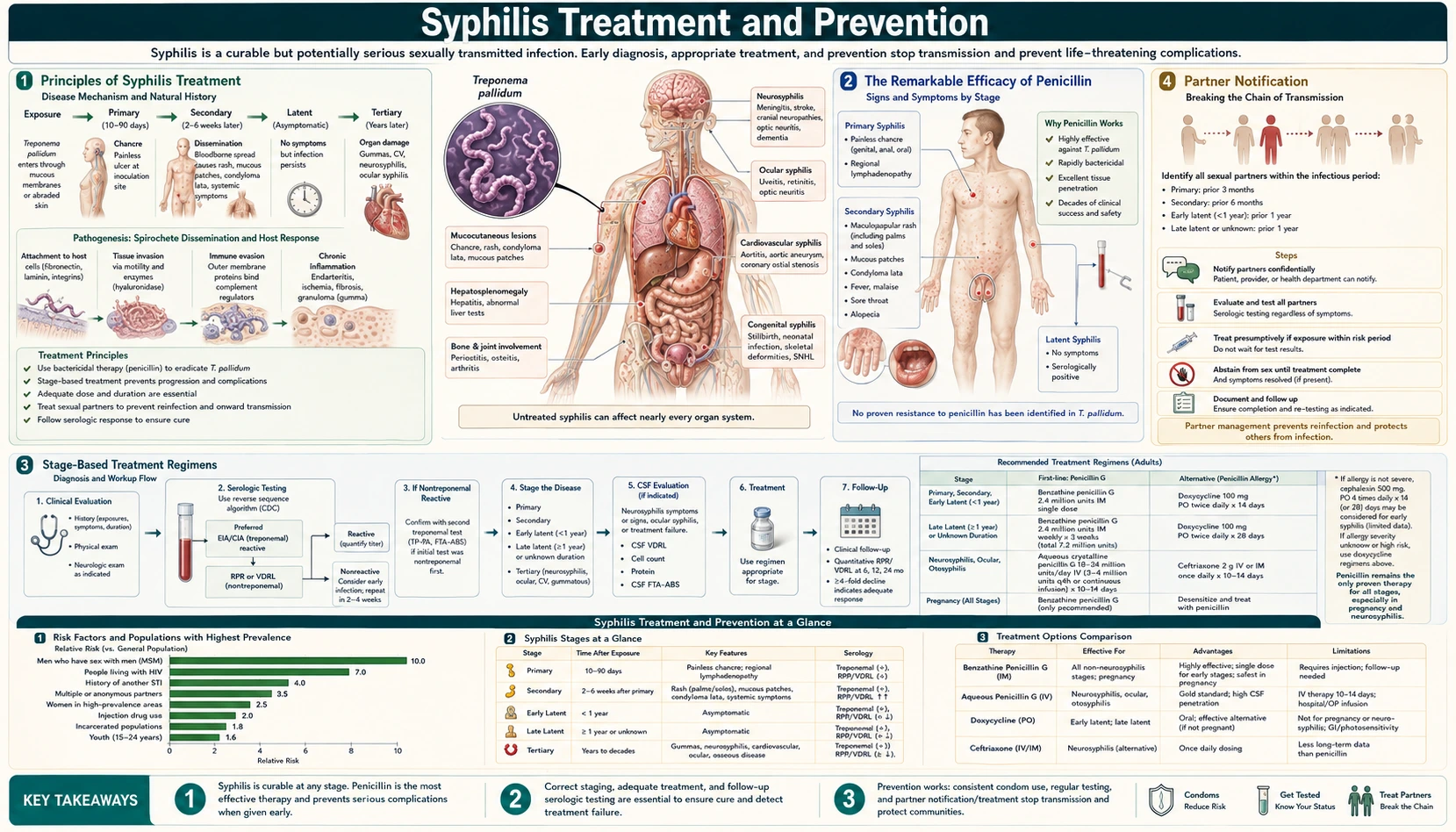
The goal of syphilis treatment is to kill all Treponema pallidum organisms in the body before they cause irreversible damage. Because T. pallidum cannot be cultured outside a living host, antibiotic susceptibility testing in the laboratory is not possible — treatment decisions are based on decades of clinical experience rather than individual susceptibility profiles.
Three principles guide treatment:
- Stage determines regimen. The stage of syphilis at diagnosis determines how much antibiotic is needed. Early-stage disease (primary, secondary, early latent) can be cured with a single injection. Late latent disease requires three weekly injections. Neurosyphilis requires 10 to 14 days of intravenous penicillin because the drug must reach the cerebrospinal fluid in sufficient concentration.
- Treatment is curative, not suppressive. Unlike HIV treatment (which suppresses but cannot eliminate the virus), effective antibiotic therapy genuinely eliminates T. pallidum from the body. A successfully treated person is cured. However, reinfection is possible — treatment confers no immunity.
- Monitor treatment response with serology. After treatment, RPR or VDRL titers should be followed at regular intervals. A fourfold fall in titer (e.g., 1:16 to 1:4) within 6 to 12 months confirms adequate treatment. Stable or rising titers suggest treatment failure or reinfection and require evaluation and retreatment.
2. The Remarkable Efficacy of Penicillin
Penicillin G, introduced into clinical use in the 1940s, has been the first-line treatment for syphilis without a single day of interruption for more than 80 years. This is unique in antimicrobial medicine. In an era when virtually every bacterial pathogen of significance has developed resistance to one or more antibiotics, T. pallidum remains universally susceptible to penicillin.
Why has resistance not emerged? Several factors may contribute:
- T. pallidum has an extremely small genome and has already shed most of its metabolic machinery. It may lack the genetic flexibility to acquire resistance through horizontal gene transfer.
- It cannot be cultured outside a living host, which limits the opportunities for laboratory selection of resistant mutants.
- Benzathine penicillin's long half-life means that organisms are exposed to adequate drug concentrations for two to three weeks after a single injection, preventing the underdosing that drives resistance in other organisms.
The result is that the first-line treatment for syphilis today is identical to the first-line treatment in 1945. No other major bacterial pathogen has maintained this record of sustained antibiotic susceptibility.
3. Stage-Based Treatment Regimens
The current CDC and WHO treatment guidelines specify regimens by stage:
- Primary, secondary, and early latent syphilis (<1 year duration): Benzathine penicillin G 2.4 million units IM as a single dose. This single injection cures the large majority of early-stage syphilis.
- Late latent syphilis (>1 year) or syphilis of unknown duration: Benzathine penicillin G 2.4 million units IM once weekly for 3 weeks (3 doses totaling 7.2 million units).
- Tertiary syphilis (non-neurosyphilitic): Same as late latent (weekly ×3), plus evaluation for neurosyphilis and cardiovascular disease.
- Neurosyphilis: Aqueous crystalline penicillin G 18–24 million units per day IV (3–4 million units every 4 hours) for 10–14 days. The IV route is mandatory because benzathine penicillin does not achieve treponemicidal concentrations in cerebrospinal fluid.
- Pregnancy: Penicillin G is the only antibiotic regimen proven to prevent congenital syphilis. Stage-appropriate penicillin regimens are used. Penicillin-allergic pregnant women must be desensitized to penicillin before treatment.
4. Partner Notification
Treating the infected person alone is not sufficient to control syphilis. T. pallidum spreads from person to person through sexual networks, and a treated person who returns to the same sexual network without partner notification is highly likely to be reinfected.
Partner notification (also called partner services or contact tracing) involves:
- Interviewing the newly diagnosed person to identify sexual partners during the relevant exposure window (primary: 3 months plus symptom duration; secondary: 6 months plus symptom duration; early latent: 12 months)
- Notifying these partners of their potential exposure and recommending testing and treatment
- Treating exposed partners presumptively (without waiting for test results) if they have had sexual contact with a confirmed primary, secondary, or early latent syphilis case within 90 days
Effective partner notification requires trained disease intervention specialists, sufficient staffing, and patient engagement. Erosion of these public health resources over the past two decades is one of the major structural drivers of the current syphilis resurgence.
5. Prevention: Condoms, PrEP, and Screening
No vaccine against syphilis exists. Prevention therefore relies on:
Barrier methods: Consistent and correct condom use significantly reduces but does not eliminate the risk of syphilis transmission. The chancre or other active lesions may be located outside the area covered by a condom (inner thigh, perineum, scrotum), limiting protection. A condom used consistently during penetrative sex reduces the probability of transmission per exposure by approximately 50 to 70%.
HIV PrEP does not prevent syphilis. Pre-exposure prophylaxis with antiretrovirals is highly effective for HIV prevention but has no effect on bacterial STIs. Studies consistently find higher rates of syphilis, gonorrhea, and chlamydia among PrEP users compared with HIV-negative non-users — not because PrEP causes STIs, but because PrEP users are selected from higher-risk populations, and in some studies, condom use declines among PrEP users who feel protected against HIV. The implication: PrEP programs should integrate routine STI screening.
Doxycycline post-exposure prophylaxis (doxy-PEP): Emerging evidence from clinical trials (IPERGAY, DOXYVAC, DoxyPEP trials) supports taking doxycycline 200 mg within 72 hours of condomless sex as an effective method to reduce syphilis (and chlamydia) acquisition in MSM at high risk. This is now included in CDC guidelines as an option for eligible individuals.
6. Screening Recommendations by Population
The US Preventive Services Task Force (USPSTF) and CDC recommend syphilis screening for:
- All pregnant women at the first prenatal visit; again at 28 weeks and at delivery for women in high-prevalence areas or at continued risk. This is a legal requirement in most US states.
- Sexually active MSM: At least annually; every 3 to 6 months for those with multiple partners.
- People with HIV: At least annually; more frequently based on behavior.
- Anyone newly diagnosed with another STI (gonorrhea, chlamydia, HIV).
- Any person requesting STI testing as part of sexual health care.
- People who use methamphetamine or inject drugs and are sexually active.
The simplicity of the test (a blood draw, results in 1 to 2 days, or same-day with rapid tests) and the simplicity of the cure (a single injection for early disease) make screening one of the highest-value interventions in preventive medicine. The challenge is getting people into testing.
7. Penicillin Allergy and Desensitization
Penicillin allergy, reported by approximately 10% of patients, creates a significant management challenge. The good news: in reality, only about 1% of people with reported penicillin allergy are truly allergic when formally tested, and most reactions described as "allergy" are side effects (nausea, diarrhea) or intolerance rather than true IgE-mediated hypersensitivity.
For non-pregnant adults with confirmed penicillin allergy, alternatives include:
- Doxycycline 100 mg orally twice daily for 14 days (early syphilis) or 28 days (late latent). Evidence for efficacy is less robust than for penicillin, and serologic follow-up is especially important.
- Ceftriaxone 1–2 g IM or IV daily for 10–14 days. Cross-reactivity with penicillin is less than 2%. Some evidence supports its efficacy, though clinical trial data are limited.
- Azithromycin 2 g single dose is no longer routinely recommended due to documented T. pallidum resistance to macrolides in many geographic areas.
For pregnant women with penicillin allergy: There is no acceptable alternative. Penicillin is the only agent proven to prevent congenital syphilis. These women must undergo penicillin desensitization — a procedure performed in a monitored medical setting where gradually increasing doses of penicillin are given over hours until tolerance is achieved — followed by standard penicillin treatment.
8. Global Health Burden
Syphilis remains a major global public health problem, with the WHO estimating approximately 7.1 million new infections per year among adults aged 15 to 49 worldwide. The global congenital syphilis burden is particularly troubling: the WHO estimates that untreated syphilis in pregnancy causes approximately 200,000 stillbirths and neonatal deaths annually, making it one of the leading infectious causes of stillbirth globally.
Regional disparities are pronounced. Sub-Saharan Africa, Latin America, and parts of Eastern Europe carry the highest burdens, driven by inadequate testing infrastructure, limited access to penicillin, and weak prenatal care systems. In contrast, Western Europe and North America have reversed decades of progress, with syphilis rates reaching multi-decade highs driven primarily by MSM and, increasingly, heterosexual transmission and drug-associated networks.
The WHO's Global Health Sector Strategy on STIs calls for a 90% reduction in syphilis incidence and elimination of congenital syphilis by 2030. Achieving these targets requires scaling up testing, strengthening antenatal care, maintaining penicillin supply chains (periodic shortages have occurred), and rebuilding contact-tracing capacity — goals that are technically achievable but politically and economically challenging.
Key Research Papers
- Workowski KA, Bachmann LH, Chan PA, et al. Sexually transmitted infections treatment guidelines, 2021. MMWR Recomm Rep. 2021;70(4):1–187. — PubMed PMID: 34292926
- Ghanem KG, Ram S, Rice PA. The modern epidemic of syphilis. N Engl J Med. 2020;382(9):845–854. — PubMed PMID: 32101666
- WHO. WHO guideline on syphilis screening and treatment for pregnant women. 2017. — Search PubMed
- Stamm LV. Syphilis: antibiotic treatment and resistance. Epidemiol Infect. 2015;143(8):1567–1574. — Search PubMed
- Luetkemeyer AF, Donnell D, Dombrowski JC, et al. Postexposure doxycycline to prevent bacterial sexually transmitted infections. N Engl J Med. 2023;388(14):1296–1306. — Search PubMed
- Rolfs RT, Joesoef MR, Hendershot EF, et al. A randomized trial of enhanced therapy for early syphilis in patients with and without human immunodeficiency virus infection. N Engl J Med. 1997;337(5):307–314. — PubMed PMID: 9235493
- Hollier LM, Cox SM. Syphilis. Semin Perinatol. 1998;22(4):323–331. — PubMed PMID: 9738997
- Sena AC, Bachmann LH, Hobbs MM. Persistent and recurrent nongonococcal urethritis. Sex Transm Infect. 2014;90(6):422–428. — Search PubMed
- Peeling RW, Mabey D, Kamb ML, et al. Syphilis. Nat Rev Dis Primers. 2017;3:17073. — Search PubMed
- Stoner BP. Current controversies in the management of adult syphilis. Clin Infect Dis. 2007;44 Suppl 3:S130–146. — PubMed PMID: 17342666
Connections
- All Bacteria
- Treponema pallidum (Syphilis) Hub
- Penicillin G Treatment by Stage
- Congenital Syphilis
- Syphilis Resurgence
- Syphilis Symptoms & Stages
- Syphilis Diagnosis: Serologic Tests
- Infectious Disease
- All Conditions
- Syphilis — overview of the infection these penicillin regimens cure.
- Primary & Secondary
- Neurosyphilis & Tertiary