Salmonella Prevention: Food Safety, Hygiene, and Vaccination
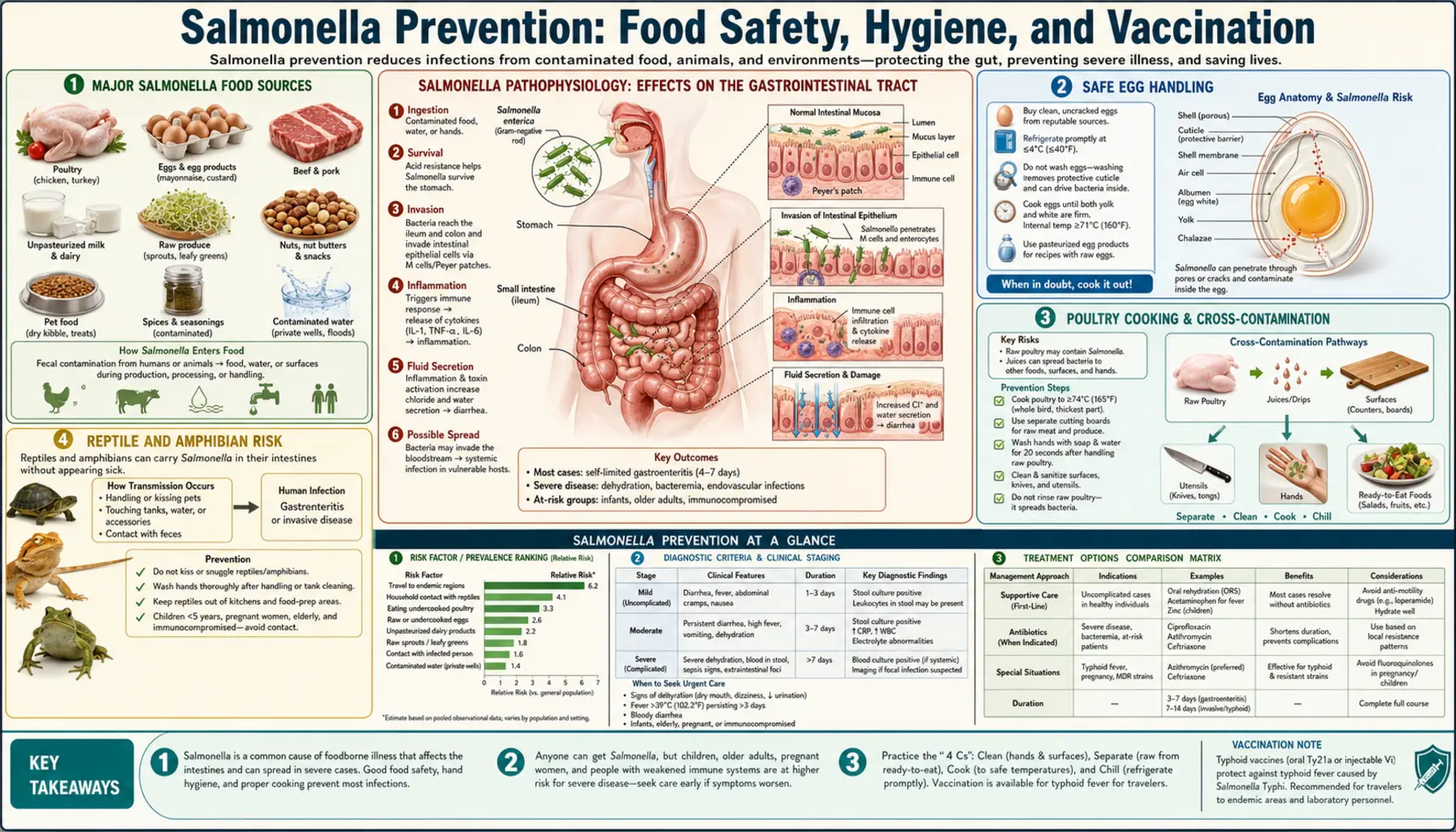
Salmonella infects roughly 1.35 million Americans every year and hospitalizes about 26,500 of them. Nearly all of those cases are preventable. Unlike many infections where exposure is unavoidable, Salmonella transmission follows predictable routes — contaminated animal products, unwashed hands, and unsafe food handling — that can be interrupted at every step. This page covers the practical strategies that actually work: what foods carry the highest risk, how to handle them safely, when to get vaccinated before travel, and why antibiotic use in farming matters to your health.
- Major Salmonella Food Sources
- Safe Egg Handling
- Poultry Cooking and Cross-Contamination
- Reptile and Amphibian Risk
- Hand Hygiene
- Typhoid Vaccination for Travel
- Food and Water Safety for Travelers
- Agricultural Antibiotic Use and MDR Salmonella
- Key Research Papers
- Connections
Major Salmonella Food Sources
Salmonella can colonize the gut of virtually any warm-blooded animal without making the animal visibly sick, which means the bacteria can be present in food long before it reaches your kitchen. Understanding the highest-risk categories helps you prioritize where to focus your caution.
Poultry
Salmonella Typhimurium and Salmonella Enteritidis together account for the majority of poultry-associated human cases in the United States. Commercial broiler chickens are frequently colonized in the gut; during slaughter and processing, fecal contamination can spread across the carcass surface. Even a single drop of raw chicken juices on a cutting board or countertop can contain tens of thousands of bacteria. Turkey carries similar risks. A 2011 USDA baseline survey found Salmonella on roughly 25 percent of whole broiler chickens at retail.
Eggs
Salmonella Enteritidis (SE) has a unique and unsettling ability: it can infect a hen's ovaries and reproductive tissues, meaning the bacterium can be present inside the egg before the shell is even formed. This is called transovarian transmission. A contaminated egg looks, smells, and tastes completely normal. SE became the dominant egg-associated Salmonella strain in the United States during the 1980s and 1990s, driving a major shift in food safety guidance.
Raw and Undercooked Beef
Ground beef carries higher risk than whole cuts because grinding distributes any surface contamination throughout the patty. Rare or medium-rare burgers that have not reached a safe internal temperature are a recognized source of Salmonella illness, as well as E. coli O157:H7. Beef tartare and carpaccio carry the same risks.
Raw Milk and Unpasteurized Dairy
Pasteurization kills Salmonella reliably. Raw milk, raw-milk cheeses, and unpasteurized dairy products bypass this safeguard entirely. The CDC estimates that raw milk is 840 times more likely to cause illness than pasteurized milk. Despite this, raw milk remains legal to sell in some US states, and outbreaks continue to occur.
Produce
Fresh fruits and vegetables can become contaminated through irrigation water containing animal feces, proximity to livestock operations, contaminated soil, or post-harvest handling. High-profile produce outbreaks have involved alfalfa sprouts (which are sprouted in warm, moist conditions that favor bacterial growth), tomatoes (Salmonella can enter through cracks, blossoms, or stem scars), cantaloupe (the rough rind surface is difficult to clean and can harbor bacteria), and pre-cut leafy greens. Washing produce under running water reduces but does not eliminate risk from internalized contamination.
Raw Seafood
Oysters and other bivalves filter large volumes of water and can concentrate Salmonella along with other pathogens. Raw or undercooked shrimp, especially imported shrimp, has been linked to Salmonella outbreaks. The risk is highest in tropical and subtropical growing regions where fecal contamination of coastal waters is more common.
Safe Egg Handling
Because Salmonella Enteritidis can be inside the egg rather than just on the surface, cooking is the primary defense — not washing or visual inspection.
The Key Rule: Cook Until Both Yolk and White Are Firm
SE is killed at 71°C (160°F). For whole eggs, this means cooking until both the white and the yolk are completely set — no runny yolk, no translucent white. Scrambled eggs should not look wet. Fried eggs should be cooked over hard. For baked goods containing eggs, an internal temperature of 74°C (165°F) is the target. Sous-vide egg preparations can be pasteurized at lower temperatures if held long enough (e.g., 57°C for 1.5 hours), but this requires precise temperature control.
Foods Made with Raw Eggs
Homemade mayonnaise, Caesar salad dressing with raw egg, hollandaise sauce, homemade eggnog, and traditional tiramisu all carry SE risk if made with raw eggs. Commercial versions of these products are typically made with pasteurized liquid eggs or are heat-treated during production. If you make these at home, use pasteurized shell eggs (sold in some grocery stores) or pasteurized liquid egg products instead.
Raw cookie dough and cake batter are a commonly overlooked risk — children are frequently exposed when licking bowls or beaters. Use pasteurized eggs in any batter you intend to eat raw.
Do Not Wash Shell Eggs Before Storing
This surprises many people, but washing eggs before refrigerating them is counterproductive. Eggshells have a natural protective coating called the bloom or cuticle that seals microscopic pores in the shell and slows bacterial entry. Washing removes this coating. In the United States, commercial eggs are washed and sanitized during processing (which is why US eggs must be refrigerated — the bloom is already gone), but if you have backyard chickens or purchase eggs at a farmers market that still have their bloom intact, do not wash them before storing. Refrigerate them unwashed and wash only immediately before use.
Refrigeration
Salmonella multiplies rapidly at room temperature. US commercial eggs should be refrigerated promptly at or below 4°C (40°F). Do not leave eggs at room temperature for more than 2 hours. The "danger zone" for bacterial growth is 4°C to 60°C (40°F to 140°F).
Poultry Cooking and Cross-Contamination
Cooking poultry to a safe temperature kills Salmonella, but cross-contamination before cooking is where most kitchen transmission happens. Raw poultry juices can contaminate any surface they touch, and Salmonella survives well on dry surfaces for hours.
Internal Temperature: 74°C (165°F)
Use a food thermometer — color and texture are not reliable indicators of doneness. Insert the thermometer into the thickest part of the meat, away from bone. For whole birds, check both the thickest part of the thigh and the breast. For stuffed poultry, the stuffing itself must reach 74°C. Let the thermometer read for 15 seconds to confirm stability. Ground turkey and ground chicken also require 74°C throughout.
Separate Cutting Boards
Designate one cutting board exclusively for raw poultry, meat, and seafood, and a separate board for ready-to-eat foods — vegetables, bread, fruit, cooked food. Color-coding boards (red for raw meat, green for produce) is a practical system used in commercial kitchens. Plastic boards are easier to sanitize in a dishwasher; wooden boards can harbor bacteria in deep cuts. Replace boards when they develop deep grooves that cannot be cleaned effectively.
Countertop and Utensil Contamination
After handling raw poultry, sanitize all surfaces the raw meat touched: countertops, sinks, faucet handles (you touched them with contaminated hands), knife handles, and any utensils. A solution of 1 tablespoon bleach per gallon of water is effective. The sink is particularly important — rinsing raw poultry in the sink (which the USDA does not recommend, because it splashes bacteria up to 3 feet) can contaminate the entire sink basin and surrounding area.
Marinating
Always marinate poultry in the refrigerator, never on the counter. If you want to use the marinade as a sauce, either reserve a separate portion before it contacts raw meat, or bring the used marinade to a full boil before serving. Marinating at room temperature creates ideal conditions for Salmonella to multiply.
Wash Hands After Handling Raw Poultry
Wash with soap and water for at least 20 seconds after handling raw poultry or any raw meat. This is the single most effective step. Do it before touching anything else in the kitchen — refrigerator handle, spice jars, your face.
Reptile and Amphibian Risk
Pet reptiles and amphibians are a significant and underappreciated source of Salmonella exposure, especially for young children. Unlike food-borne Salmonella, reptile-associated Salmonella does not require any cooking error — the bacteria are simply part of the animal's normal gut flora and are shed continuously in their feces.
Why Reptiles Always Carry Salmonella
Salmonella is part of the normal intestinal microbiome of virtually all reptiles and many amphibians. A healthy-looking, well-cared-for turtle, lizard, iguana, snake, or frog is almost certainly carrying Salmonella in its gut. The animal shows no signs of illness. You cannot tell by looking at the animal, and periodic veterinary testing does not make the animal permanently Salmonella-free — the bacteria will return.
The Small Turtle Ban
The CDC has banned the sale of small turtles (shell length less than 4 inches or 10 cm) in the United States since 1975 because they were causing tens of thousands of cases of pediatric Salmonella every year. Small turtles are irresistible to young children who handle them and then put their hands in their mouths. Despite the ban, small turtles are still sold illegally at flea markets, street fairs, and online. The ban exists for a compelling public health reason — do not purchase small turtles from any source.
High-Risk Behaviors
Outbreaks have been linked to: kissing or nuzzling reptiles; letting reptiles roam freely in kitchens or dining areas; bathing reptiles in kitchen sinks; allowing young children to handle reptiles without immediate hand washing; and keeping reptile enclosures in areas where food is prepared. Children under 5, pregnant women, adults over 65, and immunocompromised individuals should avoid all contact with reptiles and amphibians.
If You Have Reptile Pets
Wash hands thoroughly with soap and water immediately after any contact with the reptile, its enclosure, food/water dishes, or any surface the reptile has touched. Clean the enclosure in a bathroom, not a kitchen sink. Keep the reptile out of the kitchen and dining room at all times. Do not allow it on surfaces where food is prepared. Educate all household members, and do not allow young children to handle the pet without adult supervision and immediate hand washing.
Hand Hygiene
Hand washing is the single most cost-effective intervention in all of infectious disease prevention. For fecal-oral pathogens like Salmonella, clean hands break the transmission chain at its most vulnerable point — the moment before contamination reaches the mouth.
The Five Moments for Hand Washing in the Kitchen
- Before handling food — especially ready-to-eat foods that will not be cooked
- After handling raw meat, poultry, seafood, or eggs
- After touching reptiles, amphibians, or their environments
- After using the toilet or changing diapers
- After touching garbage, soil, or any obviously contaminated surface
Soap and Water vs. Hand Sanitizer
This is important: alcohol-based hand sanitizers are significantly less effective against Salmonella and other enteric (gut) bacteria compared to soap and water. Hand sanitizers work well against respiratory viruses and some other pathogens, but for fecal-oral transmission routes, the mechanical scrubbing action of soap and water physically removes bacteria from the skin surface in a way that a quick gel rub does not replicate. Use soap and water whenever possible for Salmonella prevention. Hand sanitizer is acceptable when soap and water are genuinely unavailable, but it is not a substitute at home or in food-service settings.
Proper Technique
Wet hands with clean running water (temperature does not matter — warm water is not more effective than cool). Apply soap. Scrub all surfaces — backs of hands, between fingers, under fingernails — for at least 20 seconds (about the time it takes to hum "Happy Birthday" twice). Rinse thoroughly. Dry with a clean towel or air dry. The friction of scrubbing and the rinsing are what remove the bacteria; the soap breaks up oils that trap them. Antibacterial soaps provide no additional benefit over regular soap for routine hand washing.
Children and Hand Hygiene
Young children are at higher risk of severe Salmonella illness and are also less reliable hand washers. Supervise children's hand washing after toilet use and after contact with animals. Schools and childcare settings with good hand hygiene practices consistently report lower rates of gastrointestinal illness outbreaks.
Typhoid Vaccination for Travel
Typhoid fever — caused by Salmonella Typhi — kills approximately 130,000 to 200,000 people annually worldwide and remains endemic in South Asia, sub-Saharan Africa, Southeast Asia, and parts of Latin America. Vaccination is the most reliable personal protection for travelers to endemic regions. Three vaccine options are currently available, each with a distinct profile.
Ty21a Oral Vaccine (Vivotif)
Ty21a is a live attenuated (weakened) bacterial vaccine taken by mouth. The regimen consists of 4 capsules taken on alternate days (Day 1, 3, 5, and 7), completing the series one week before potential exposure. The capsules must be refrigerated and taken on an empty stomach with cool water — heat and food can inactivate the live bacteria. Protection lasts approximately 3 years, after which revaccination is required. Ty21a is approved for individuals 6 years and older. Critically, Ty21a must not be taken concurrently with antibiotics or antimalarials (particularly mefloquine and atovaquone/proguanil), as these can kill the live bacterial vaccine and prevent an immune response from developing. Space the antibiotic course and the vaccine by at least 3 days.
Vi Capsular Polysaccharide Vaccine (Typhim Vi, Typherix)
The Vi CPS vaccine is a single intramuscular injection targeting the Vi capsular polysaccharide antigen of Salmonella Typhi. It is approved for adults and children 2 years and older. A single dose provides approximately 60 to 80 percent protection for 2 years. It can be administered at the same visit as most other travel vaccines. Unlike Ty21a, it is not affected by antibiotics and can be given to immunocompromised travelers (though effectiveness may be reduced). Revaccination is every 2 years for continued protection.
Typhoid Conjugate Vaccine (TCV — Typbar-TCV)
The TCV represents a significant advance over both older vaccines. It conjugates (chemically links) the Vi polysaccharide to a carrier protein (tetanus toxoid), producing a stronger, longer-lasting T-cell-mediated immune response rather than a purely antibody-based one. WHO-prequalified Typbar-TCV from Bharat Biotech (India) is a single intramuscular injection approved for use from 6 months of age — critically important because young children bear a disproportionate burden of typhoid in endemic countries. Efficacy in the STRATAA trial (Nepal, Bangladesh, Malawi) was 81.6 percent over 2 years, with immune responses likely persisting significantly longer than the 2-year window studied. The TCV is now the WHO-preferred vaccine for children in endemic settings. While Typbar-TCV is not currently FDA-approved in the United States, travelers can sometimes access it abroad, and it is central to WHO's typhoid elimination campaign.
What Typhoid Vaccines Do Not Cover
All typhoid vaccines target Salmonella Typhi only. They provide no protection against Salmonella Paratyphi A, B, or C (which cause enteric fever clinically indistinguishable from typhoid) or against the hundreds of non-typhoidal Salmonella serovars including Typhimurium and Enteritidis. Vaccine protection is also not 100 percent — even vaccinated travelers should follow food and water safety precautions in endemic areas.
When to Get Vaccinated
The CDC recommends typhoid vaccination for travelers to South Asia (India, Pakistan, Bangladesh, Nepal), sub-Saharan Africa, Southeast Asia, and other endemic regions. Complete the vaccine series at least 1 to 2 weeks before departure. If your travel is imminent (less than 2 weeks away), the injectable Vi CPS vaccine is preferable since it requires only a single dose. Consult a travel medicine clinic for destination-specific guidance — the vaccine recommendation strength varies by region, season, and trip itinerary.
Food and Water Safety for Travelers
Even after vaccination, travelers to endemic regions need to follow food and water precautions. The phrase taught in travel medicine — "boil it, cook it, peel it, or forget it" — captures the core principle: heat kills Salmonella, and foods with an intact peel you remove yourself are safe.
Water
Tap water in many parts of South Asia, sub-Saharan Africa, and Southeast Asia is not treated to eliminate Salmonella and other enteric pathogens. Use bottled water from sealed bottles (check the seal before opening), or water you have boiled yourself for at least 1 minute (3 minutes at altitude above 2,000 meters). Iodine or chlorine tablets are effective alternatives when boiling is not possible. Water purifiers with a 0.2-micron filter or UV-treatment pens (SteriPen) are reliable options for longer trips.
Ice
Ice in drinks is made from local water and is frequently contaminated. Decline ice in drinks unless you are certain it was made from purified water. Commercially produced sealed ice (bagged ice in sealed plastic) is generally safer but not guaranteed. This applies to ice in cocktails and non-alcoholic drinks equally — alcohol concentration in a diluted drink is not sufficient to kill Salmonella.
Street Food and Buffets
Street food cooked fresh in front of you and served piping hot is often safer than buffet food that has been sitting at lukewarm temperatures for hours. A bowl of noodle soup from a street vendor who cooks each serving to order is a lower risk than a hotel buffet where fried rice has sat in a warming tray for 3 hours. If you can watch the food being freshly cooked at high heat, it is generally safe. Avoid pre-made foods sitting at ambient temperature, cold salads, and sauces that may have been made with tap water.
Salad Bars and Raw Produce
Raw produce washed in local tap water carries transmission risk. Avoid salads, raw vegetable garnishes, and fruit salads that someone else has prepared. You can safely eat whole fruits that you wash with bottled water and peel yourself (bananas, oranges, mangoes) — the peeling process removes surface contamination and you do not eat the peel. Avoid fruits with thin skins that are eaten unpeeled (grapes, strawberries, tomatoes) unless you have washed them in safe water yourself.
Dairy Products
Unpasteurized dairy is common in many endemic regions. Ask whether milk and dairy products are pasteurized. In many rural areas, they are not. Boil milk before drinking if you are uncertain. Hard aged cheeses generally carry lower risk than soft fresh cheeses made from unpasteurized milk.
Seeking Medical Care Abroad
If you develop fever, severe diarrhea, or signs of dehydration while traveling, seek medical evaluation promptly. Typhoid fever in particular requires antibiotic treatment — it will not resolve on its own, and waiting to see a doctor increases the risk of serious complications including intestinal perforation and sepsis. Tell the doctor you have been traveling; typhoid fever may not be on their differential in non-endemic countries, but it should be high on yours.
Agricultural Antibiotic Use and MDR Salmonella
The antibiotics used to treat Salmonella infections in humans are the same classes — fluoroquinolones, third-generation cephalosporins, and azithromycin — that have been used extensively in livestock farming. This overlap has created a public health crisis: drug-resistant Salmonella strains are now circulating from farm animals to people through the food supply, limiting treatment options when Salmonella infections are severe enough to require antibiotics.
How Agricultural Antibiotic Use Drives Resistance
When antibiotics are administered to large groups of livestock — including at sub-therapeutic doses once used for growth promotion — any Salmonella bacteria present in the flock or herd are exposed. Most die, but any that carry resistance genes survive and reproduce, passing those genes to offspring and sometimes to other bacteria through horizontal gene transfer. These resistant strains then contaminate meat during processing and spread to humans through the food supply. The resistant strain does not need to cause illness in the animal to reach the human food chain.
Fluoroquinolone Resistance
Fluoroquinolones (ciprofloxacin is the prototypical agent) were once the first-line oral treatment for severe non-typhoidal Salmonella and for typhoid fever. Their use in commercial poultry in the United States was banned by the FDA in 2005 for this precise reason — fluoroquinolone use in poultry was generating ciprofloxacin-resistant Salmonella that was then infecting people who could no longer be treated with the drug. Despite the US ban, fluoroquinolone resistance in Salmonella remains a significant problem globally because poultry from other countries enters international supply chains, and travelers return from endemic regions carrying resistant strains.
Extended-Spectrum Beta-Lactamases (ESBLs) and Cephalosporin Resistance
Third-generation cephalosporins (like ceftriaxone) are used in livestock and have driven the emergence of ESBL-producing Salmonella strains. ACSSuT resistance (ampicillin, chloramphenicol, streptomycin, sulfonamides, tetracyclines) has been present in Salmonella Typhimurium for decades. The emergence of definitive phage type DT104 with ACSSuT resistance was an early signal of what was to come. More recently, the XDR (extensively drug-resistant) Salmonella Typhi strain H58 lineage spreading through South Asia has added fluoroquinolone resistance on top of older resistance patterns, reducing typhoid treatment to only a handful of options.
FDA's Veterinary Feed Directive (2017)
The FDA's Veterinary Feed Directive, fully implemented in January 2017, ended over-the-counter sales of medically important antibiotics for use in animal feed for growth promotion purposes. All such uses now require veterinary oversight and a prescription. This was a meaningful step but did not eliminate therapeutic use of these drugs in livestock — antibiotics can still be prescribed for disease prevention and treatment in animals, at the discretion of licensed veterinarians. Critics argue the rule did not go far enough; the WHO's 2017 list of critically important antimicrobials specifically calls for restricting fluoroquinolone and third-generation cephalosporin use in food animals.
What This Means for Patients
Most healthy adults with non-typhoidal Salmonella gastroenteritis do not need antibiotics — the infection resolves on its own. This is actually protective from a public health perspective, because unnecessary antibiotic use in humans also contributes to resistance. However, if you or a family member does need antibiotic treatment (you are immunocompromised, very young, elderly, have sickle cell disease, or have developed bacteremia), the treating physician should ideally have stool culture and sensitivity data before committing to an agent. Empiric treatment with ciprofloxacin for Salmonella may fail in areas with high resistance rates. Azithromycin and ceftriaxone have become increasingly important alternatives, though resistance to these is also rising. This is why cultures matter — and why antibiotic stewardship in both human medicine and agriculture matters to your personal treatment options.
Key Research Papers
- Braden CR. (2006). Salmonella enterica serotype Enteritidis and eggs: a national epidemic in the United States. Clinical Infectious Diseases. — Search PubMed
- Scallan E et al. (2011). Foodborne illness acquired in the United States — major pathogens. Emerging Infectious Diseases. — Search PubMed
- Pitzer VE et al. (2016). Mathematical modeling to assess the drivers of the recent emergence of typhoid fever in Blantyre, Malawi. Clinical Infectious Diseases. — Search PubMed
- Qamar FN et al. (2018). Outbreak investigation of ceftriaxone-resistant Salmonella enterica serotype Typhi and its risk factors among the general population in Hyderabad, Pakistan. PLOS ONE. — Search PubMed
- Voetsch AC et al. (2004). FoodNet estimate of the burden of illness caused by nontyphoidal Salmonella infections in the United States. Clinical Infectious Diseases. — Search PubMed
- Hohmann EL. (2001). Nontyphoidal salmonellosis. Clinical Infectious Diseases. — Search PubMed
- Parry CM et al. (2002). Typhoid fever. New England Journal of Medicine. — Search PubMed
- Acheson DW and Hohmann EL. (2001). Nontyphoidal salmonellosis — treatment and prevention. UpToDate Review. — Search PubMed
- Crump JA and Mintz ED. (2010). Global trends in typhoid and paratyphoid fever. Clinical Infectious Diseases. — Search PubMed
- Mohan VK et al. (2015). Use of Typbar Typhoid Conjugate Vaccine (TCV) — a Vi capsular polysaccharide conjugated to recombinant cross-reacting material 197 (CRM197) protein — in children. Vaccine. — Search PubMed
PubMed Topic Searches
- Salmonella food safety prevention
- Salmonella Enteritidis eggs contamination
- Typhoid fever vaccine efficacy
- Typhoid conjugate vaccine children
- Reptile-associated salmonellosis
- Salmonella antibiotic resistance livestock
- Fluoroquinolone resistance Salmonella poultry
- XDR Salmonella Typhi Pakistan
Connections
- All Bacteria
- Salmonella Typhimurium — Main Overview
- Salmonella Symptoms and Diagnosis
- Gastroenteritis and Food Poisoning
- Typhoid Fever and Bacteremia
- Diagnosis: Stool Culture and Serology
- Treatment and Prevention Overview
- Antibiotic Treatment and Rehydration
- Multidrug Resistance in Salmonella
- Sepsis
- Eggs — Nutrition and Health
- Beef — Nutrition and Health
- Pork — Nutrition and Health
- Garlic — Antimicrobial Properties