Diagnosing Salmonella: Stool Cultures, Blood Cultures, and Rapid Tests
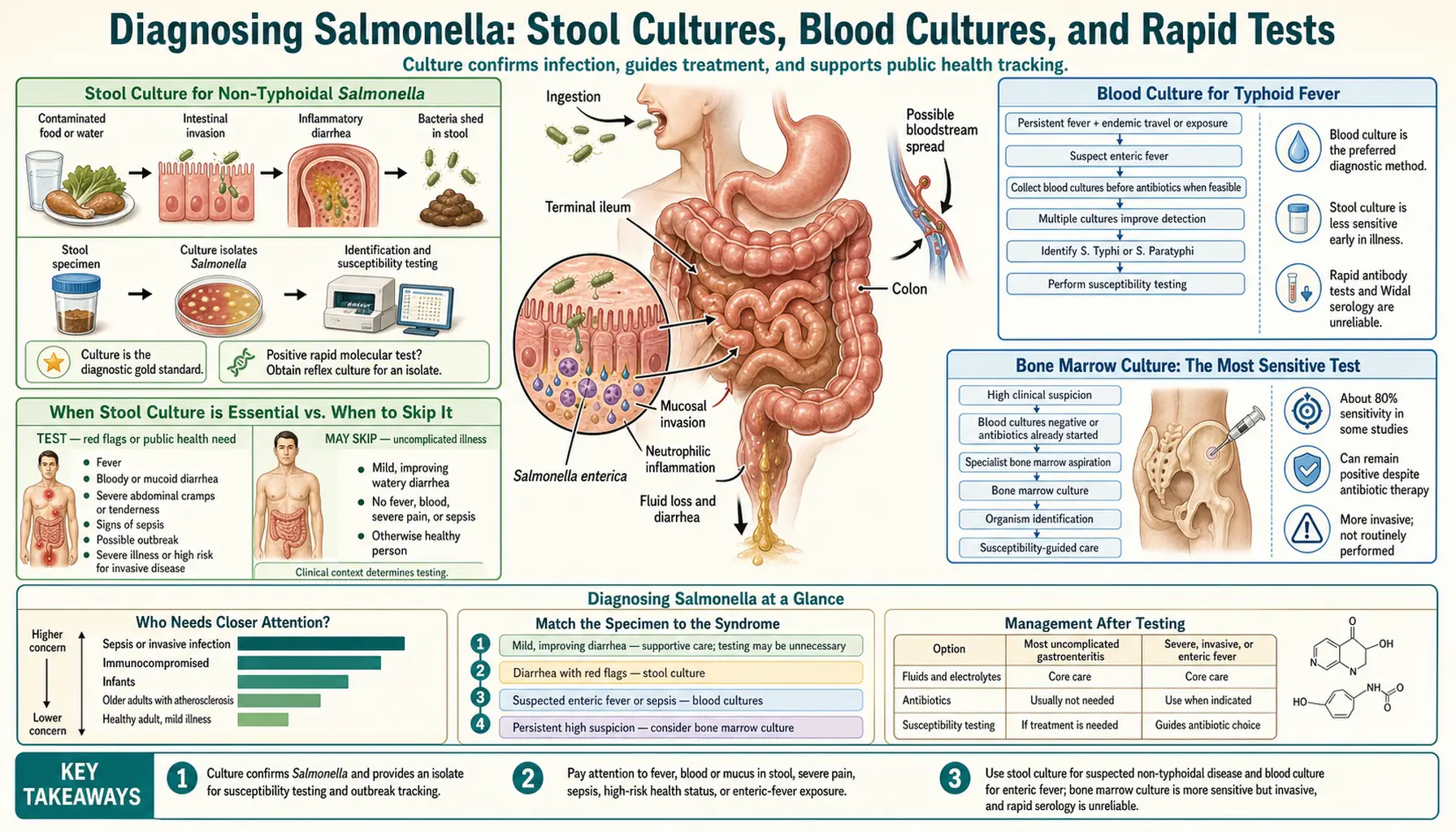
When you or a family member comes down with diarrhea, stomach cramps, and fever, the question "is this Salmonella?" is completely reasonable — and answering it correctly changes the treatment plan, helps public health officials trace outbreaks, and can save your life if the infection is spreading into the bloodstream. This page explains exactly what each diagnostic test does, when your doctor will order it, what the results mean, and what you should push for if the diagnosis is unclear.
- Stool Culture for Non-Typhoidal Salmonella
- When Stool Culture is Essential vs. When to Skip It
- Blood Culture for Typhoid Fever
- Bone Marrow Culture: The Most Sensitive Test
- The Widal Test: Widely Used, Often Misleading
- Rapid Antigen and Antibody Tests
- Duodenal String Test for Chronic Carriage
- PCR and Molecular Diagnostics
- Key Research Papers
- Connections
Stool Culture for Non-Typhoidal Salmonella
A stool culture is the backbone of diagnosing non-typhoidal Salmonella (NTS) — the type responsible for most food-poisoning outbreaks in the United States. The test works by placing a small sample of stool onto specialized growth media that favor Salmonella while suppressing the enormous variety of bacteria that live harmlessly in your gut.
The two most commonly used selective media are XLD agar (xylose-lysine-deoxycholate) and Hektoen enteric agar. On XLD agar, Salmonella colonies appear as pink-to-red colonies with black centers — the black color comes from hydrogen sulfide production, a hallmark of most Salmonella serotypes. Hektoen agar produces blue-green colonies with black centers. These visual clues alert laboratory technicians that Salmonella is likely present before any further testing is done.
Once suspicious colonies appear, the lab performs a series of biochemical tests — checking whether the organism ferments certain sugars, produces hydrogen sulfide, and reacts to specific enzyme substrates. A positive biochemical profile is then confirmed with serogrouping, where the lab exposes the bacteria to standardized antibodies (antisera) against different Salmonella surface antigens. This step identifies the serogroup (A, B, C1, C2, D, E, and so on) and can be extended to full serotyping to pinpoint the exact strain, which is critical for outbreak investigations.
Timing matters enormously. Stool culture has its highest yield — the highest chance of detecting Salmonella if it's there — during the first 48 to 72 hours after symptoms begin. Bacterial counts in stool peak early in the illness and fall off as your immune system responds. That said, Salmonella can still be cultured for days to weeks in some people, especially in young children and immunocompromised individuals, and in cases of typhoid (where stool positivity rises in the second and third weeks of illness rather than the first).
Standard processing time is 48 to 72 hours from sample receipt, though many labs now use pre-enrichment broth steps that add 24 hours but significantly increase sensitivity when bacterial counts are low. Some academic medical centers use automated blood-culture bottle systems adapted for stool enrichment, which can flag positive cultures faster.
One practical note for patients: the sample must reach the lab quickly. Refrigerate it if there will be any delay, and never freeze it — freezing kills Salmonella. Many labs provide special transport vials with preservative medium (such as Cary-Blair transport medium) that keeps bacteria viable for 24 to 48 hours at room temperature. If you are submitting a sample from home, ask your provider for a transport vial rather than a plain container.
When Stool Culture is Essential vs. When to Skip It
Not everyone with diarrhea needs a stool culture — and in the United States, routine testing adds significant cost to the healthcare system when the result will not change what happens to the patient. Understanding the criteria that trigger stool culture can help you have a more informed conversation with your doctor.
When stool culture is strongly recommended:
- Bloody or mucus-containing diarrhea — blood in stool suggests the bacteria have invaded the lining of the intestine (invasive diarrhea), not just irritated it. This presentation is more likely to need antibiotic treatment and may signal a more dangerous organism.
- Systemic symptoms — fever above 38.5°C (101.3°F), chills, rigors, or signs that infection may have spread beyond the gut (bacteremia). In these patients, stool culture should be paired with blood cultures.
- High-risk patients — people over 65, infants under 12 months, pregnant women, anyone with sickle cell disease, HIV, organ transplant, cancer chemotherapy, or use of immunosuppressive medications. These patients are at high risk of bacteremia and serious complications from Salmonella.
- Symptoms lasting more than 7 days without improvement — prolonged diarrhea warrants an etiologic diagnosis to guide treatment and rule out non-infectious causes.
- Outbreak investigation — when two or more people from the same household, workplace, or social event develop similar symptoms within a narrow time window, public health authorities need culture and serotyping data to identify the source and prevent further spread.
- Healthcare workers, food handlers, and childcare workers — a confirmed diagnosis may trigger work restrictions to protect vulnerable populations.
- International travelers returning with diarrhea — travel-associated Salmonella is more likely to carry antibiotic resistance, and susceptibility testing (obtained through culture) guides therapy.
When stool culture can reasonably be deferred:
- An otherwise healthy adult with watery (non-bloody) diarrhea of fewer than 3 to 5 days' duration, no fever, and no systemic symptoms.
- Mild illness that is already resolving — stool culture results arrive 48 to 72 hours after collection, which may be after a mild illness has resolved on its own.
The Infectious Diseases Society of America (IDSA) and the American College of Gastroenterology both recognize that empirical management — treating symptoms without a confirmed culture result — is appropriate in low-risk patients. However, if you are in a higher-risk group and your doctor is not ordering a culture, it is absolutely appropriate to ask why.
Blood Culture for Typhoid Fever
For Salmonella enterica serotype Typhi and Paratyphi — the organisms behind typhoid and paratyphoid fever — blood culture is the gold standard diagnostic test. Unlike non-typhoidal Salmonella, which tends to stay in the gut, S. Typhi is designed to invade the bloodstream during the first week of illness, making blood culture both the most reliable and most clinically important test at that stage.
Blood culture sensitivity is highest during week one of typhoid illness, when S. Typhi is actively circulating in the blood. Studies consistently show positivity rates of 60 to 80% in the first week when the culture is done correctly. After that, sensitivity falls as the organism retreats into deeper tissues (lymph nodes, spleen, bone marrow) and as any antibiotic treatment begins to suppress bacterial counts. This is why the timing of your blood draw relative to symptom onset and antibiotic start matters so much.
Several technical factors dramatically affect whether a blood culture will be positive:
- Volume of blood collected — this is perhaps the single most important variable. Drawing 5 to 10 mL of blood per bottle (not 2 to 3 mL) significantly increases yield. Most labs require two sets of blood cultures from two different venipuncture sites to improve sensitivity and reduce the likelihood that a positive result is due to skin contamination rather than true bacteremia.
- Timing before antibiotics — blood should ideally be drawn before the first antibiotic dose. Even a single dose can reduce sensitivity substantially.
- Automated continuous monitoring systems — modern blood culture systems (such as BacT/ALERT and BACTEC) monitor culture bottles every 10 minutes for carbon dioxide production. Most positive typhoid cultures flag positive within 24 to 72 hours, though some require up to 5 to 7 days of incubation.
Once a bottle flags positive, a Gram stain is performed immediately — showing Gram-negative rods — and the organism is subcultured onto solid media for identification and antibiotic susceptibility testing. Susceptibility testing is particularly critical for typhoid because multidrug-resistant (MDR) strains and extensively drug-resistant (XDR) strains — resistant to fluoroquinolones and extended-spectrum cephalosporins — have become common in South Asia and sub-Saharan Africa.
If you or a family member has returned from a typhoid-endemic region (South Asia, Southeast Asia, East Africa, Central America) with a fever that has lasted more than 3 to 5 days, especially without diarrhea (typhoid often presents with constipation or normal stools in the first week), push for blood cultures even if the treating physician's initial suspicion is a viral syndrome.
Bone Marrow Culture: The Most Sensitive Test
If blood culture is the gold standard, bone marrow culture is the platinum standard — it is the single most sensitive diagnostic test for typhoid fever, with documented sensitivity of approximately 85 to 95% across multiple studies. Understanding why requires a brief look at what happens biologically during typhoid illness.
S. Typhi enters the body through the intestine, is taken up by macrophages in the intestinal wall, and travels via the lymphatic system to the mesenteric lymph nodes. From there it spills into the blood (the primary bacteremia) and is seeded into the spleen, liver, and — crucially — the bone marrow. Inside bone marrow macrophages, S. Typhi can survive and replicate, protected from circulating antibiotics at concentrations that would kill organisms in the bloodstream.
This is why bone marrow culture has two extraordinary properties that no other test can match:
- It remains positive for days to over a week after antibiotic therapy has begun. A patient who has already received 5 or 7 days of antibiotics and in whom blood culture is now negative may still have a positive bone marrow culture. This makes it invaluable for confirming typhoid in patients who were treated empirically before a diagnosis was established.
- It detects low-level infection. Even when bacterial counts in blood have fallen below the threshold of detection, organisms persisting in bone marrow macrophages can be recovered.
The procedure involves inserting a special needle into the posterior iliac crest (the back of the hipbone) under local anesthesia and withdrawing 1 to 5 mL of bone marrow. The aspirate is then inoculated into blood culture bottles or directly onto solid media. The procedure takes about 10 to 15 minutes and is painful during aspiration but generally well tolerated with adequate local anesthesia.
Because the procedure is invasive and requires trained personnel, bone marrow culture is reserved for specific situations: patients in whom blood cultures are negative but clinical suspicion remains very high, patients who have received antibiotics before presentation, and when cultures from other sites (stool, blood) are non-diagnostic but typhoid remains the most likely diagnosis. It is performed predominantly in specialized infectious disease centers and hospitals with high typhoid caseloads.
The Widal Test: Widely Used, Often Misleading
Developed in 1896 by French physician Georges-Fernand Widal, the Widal test measures the level of antibodies in a patient's blood that agglutinate (clump) specific Salmonella antigens. It is one of the oldest infectious disease tests still in clinical use — and, according to most infectious disease specialists and the World Health Organization, one of the most problematic.
How the test works: A patient's serum is mixed with standardized suspensions of killed Salmonella organisms bearing two types of antigens — O antigens (somatic, from the cell wall) and H antigens (flagellar, from the whip-like tail). If the patient has antibodies against these antigens, the suspension clumps visibly. The highest dilution at which clumping still occurs is the titer. A titer of 1:80 or higher for O antibodies, or 1:160 or higher for H antibodies, is conventionally considered positive in many settings, though cutoffs vary by geography.
Why the Widal test is unreliable:
- Poor sensitivity in early illness — antibodies take 7 to 10 days to rise to detectable levels. The test is often negative in the first week of typhoid, when diagnosis and treatment are most urgent.
- Cannot distinguish current from past infection — antibodies from a typhoid infection or a typhoid vaccination can persist for months to years. A positive Widal test in someone from an endemic area may reflect immunity from a childhood infection, not active disease.
- Extensive cross-reactivity — Salmonella O and H antibodies can be triggered by other infections (malaria, dengue, viral hepatitis, brucellosis) and even by non-typhoidal Salmonella gastroenteritis, leading to false-positive results.
- No standardization — antigen preparations vary between manufacturers, making results from one laboratory incomparable to another. There is no universally agreed "positive" cutoff.
Research by Gasem et al. in Indonesia documented sensitivity of approximately 60% and specificity of around 55% — meaning the test was wrong about half the time in both directions. The WHO has explicitly cautioned against relying on the Widal test alone to diagnose typhoid, stating it "should not be used without supporting evidence from other tests." Despite this, the Widal test remains the most widely used typhoid diagnostic test in low-income countries because it is inexpensive, requires no special equipment, and produces results within 2 hours.
If you are in a setting where the Widal test is the only option and a positive result is driving the decision to start antibiotics, it is worth asking whether a blood culture can also be sent — even if results will take several days. The culture data will be invaluable for confirming the diagnosis, identifying the serotype, and guiding antibiotic selection if the initial treatment fails.
Rapid Antigen and Antibody Tests
The acknowledged limitations of the Widal test drove two decades of development of newer, more accurate rapid tests that can deliver results in 15 to 30 minutes without a laboratory. These tests fall into two broad categories — antibody-based and antigen-based — and several have been evaluated in clinical studies with results that, while not perfect, represent a meaningful improvement over the Widal test.
TUBEX (Salmonella Typhi O9 Antibody Detection): The TUBEX test detects IgM antibodies against the S. Typhi O9 lipopolysaccharide antigen using a competitive inhibition assay with colored magnetic particles. A patient's serum is mixed with reagents in a tube; if anti-O9 antibodies are present, the particles are inhibited from forming a pellet, and the supernatant remains colored. The test takes about 45 minutes, requires no special equipment beyond the kit, and has demonstrated sensitivity of 65 to 75% and specificity of 75 to 90% in multiple studies — generally better than the Widal test, though variable depending on the population and timing in the illness.
Test-it Typhoid (LPS Antigen Detection): Rather than detecting antibodies, the Test-it Typhoid lateral flow assay detects S. Typhi lipopolysaccharide (LPS) antigen directly in serum. Antigen-based tests theoretically offer earlier detection (before antibody levels rise) and can distinguish current from past infection. However, field performance has been inconsistent, with sensitivity ranging from 50 to 85% across studies.
Typhidot (IgM/IgG Against 50 kDa Outer Membrane Protein): Typhidot detects both IgM and IgG antibodies against a specific 50-kilodalton outer membrane protein of S. Typhi. The IgM-specific version (Typhidot-M) was developed to distinguish recent infection (high IgM, rising IgG) from past infection or vaccination (IgG without IgM). In studies conducted primarily in Southeast Asia, Typhidot-M showed sensitivity of 66 to 80% and specificity of 75 to 95%. Like other rapid antibody tests, it performs poorly in the first few days of illness before the IgM response is established.
A Cochrane systematic review by Wijedoru and Mallett evaluated 18 studies of rapid tests for typhoid and concluded that none had sufficient accuracy to replace blood culture as the diagnostic standard, but several offered useful diagnostic information when blood culture was unavailable. The review highlighted that most studies were conducted in high-prevalence settings, which inflates measures of diagnostic accuracy due to disease prevalence effects.
From a practical standpoint: if you are in a high-income country with access to blood culture, rapid serology tests add little to the diagnostic workup and are rarely ordered. If you are in a resource-limited setting or a region where blood culture infrastructure is poor, a positive TUBEX or Typhidot result in a clinically compatible patient (fever of 3 or more days, relative bradycardia, no obvious alternative diagnosis) is a reasonable basis for starting empirical typhoid treatment while awaiting — or substituting for — culture results.
Duodenal String Test for Chronic Carriage
A small but clinically significant minority of typhoid patients — approximately 1 to 4% of adults, with rates higher in women and in people with gallstones or gallbladder disease — never fully clear S. Typhi from their body. The bacteria establish a persistent reservoir in the bile ducts and gallbladder, where they are protected from immune attack and many antibiotics. These chronic carriers can shed typhoid organisms in their stool intermittently for years or even decades without feeling ill themselves, making them an ongoing risk to people around them.
Diagnosing chronic carriage is a diagnostic challenge because stool cultures are often negative between shedding episodes. Blood cultures are virtually always negative — the bacteria are confined to the biliary system, not the bloodstream. This is where the duodenal string test (also called the Enterotest or bile string test) offers a unique advantage.
The test works as follows: the patient swallows a weighted gelatin capsule on an empty stomach. The capsule contains a tightly coiled nylon string with one end secured outside the mouth. Over the next 4 to 6 hours, the capsule dissolves, the string uncoils, and the weighted end travels through the stomach and into the duodenum — the first section of the small intestine, which receives bile directly from the bile duct. Bile, which flows continuously through the duct, bathes the end of the string. If S. Typhi is present in the bile, bacteria adhere to the string. When the string is withdrawn 4 to 6 hours later, bile-stained material is expressed from the string and cultured.
The string test has several advantages over repeated stool cultures for carriage diagnosis: it samples bile directly rather than relying on intermittent stool shedding, it can detect carriage even between shedding episodes, and it can be performed as an outpatient procedure without endoscopy or sedation. The main limitations are patient tolerability (some people find swallowing the capsule and wearing the string uncomfortable) and the fact that positive results require laboratory processing that may not be available in all settings.
Chronic carriage is also suggested by persistently elevated antibodies to S. Typhi Vi antigen (a capsular polysaccharide) in serum — a Vi antibody titer above 1:20 in a person with no recent typhoid vaccination has moderate sensitivity for carriage, and this serologic test is sometimes used as a screening tool to identify candidates for further evaluation.
PCR and Molecular Diagnostics
Polymerase chain reaction (PCR) testing has transformed the diagnosis of many infectious diseases over the past two decades, and Salmonella diagnostics are no exception. PCR amplifies specific DNA sequences from the organism, allowing detection of vanishingly small amounts of bacterial DNA in a clinical sample — far below the concentrations required for culture-based detection.
Speed: A PCR result can be returned in 4 to 6 hours from the time the sample reaches a suitably equipped laboratory, compared to 48 to 72 hours for stool culture and up to 5 to 7 days for some blood cultures. In a patient with severe illness, this time difference can affect treatment decisions significantly.
Sample types: PCR can be applied to blood, stool, urine, bone marrow aspirate, and even environmental samples. In blood, PCR has demonstrated sensitivity of 80 to 90% for detecting S. Typhi bacteremia in some studies — comparable to or better than blood culture — with results available far sooner. PCR from stool is effective for detecting non-typhoidal Salmonella and can be more sensitive than culture when bacterial counts are low.
Resistance gene detection: One of the most powerful features of molecular testing is the ability to simultaneously screen for antibiotic resistance determinants. PCR assays can detect:
- blaCTX-M, blaTEM, blaOXA — genes encoding extended-spectrum beta-lactamases (ESBLs), which confer resistance to penicillins and most cephalosporins.
- gyrA and parC mutations — point mutations in DNA gyrase and topoisomerase IV genes that cause fluoroquinolone resistance. A single amino acid substitution in gyrA (commonly at codon 83 or 87) is the most frequent mechanism of fluoroquinolone resistance in MDR S. Typhi from South Asia.
- mcr genes — mobile colistin resistance genes, which are an emerging concern in Salmonella.
Whole-genome sequencing (WGS), while not yet a routine clinical tool, is increasingly used by public health laboratories for outbreak investigations. WGS can identify the exact serotype, determine the complete resistance gene profile, trace the organism's phylogenetic relationships to other isolates, and sometimes point to a geographic origin. In the United States, the CDC's National Salmonella Surveillance Program uses WGS routinely to track outbreak-associated strains.
Currently, PCR-based Salmonella diagnostics are available at reference laboratories and many academic medical centers in high-income countries, and are beginning to reach some district hospital laboratories in endemic regions. Cost remains a barrier in low-resource settings. The FDA has cleared multiplex gastrointestinal panels (such as the BioFire FilmArray GI Panel) that simultaneously test for Salmonella alongside dozens of other enteric pathogens — a practical option when the diagnosis is unclear and the differential diagnosis includes organisms like Shiga-toxin producing E. coli, Campylobacter, Shigella, or Cryptosporidium.
Key Research Papers
Parry CM, Hien TT, Dougan G, White NJ, Farrar JJ. (2002). Typhoid fever. New England Journal of Medicine. PMID: 12110730
Wain J, Hendriksen RS, Mikoleit ML, Keddy KH, Ochiai RL. (2015). Typhoid fever. Lancet. PMID: 22037587
Gasem MH, Dolmans WM, Isbandrio BB, Wahyono H, Keuter M, Djokomoeljanto R. (2002). Culture of Salmonella typhi and Salmonella paratyphi from blood and bone marrow in suspected typhoid fever. Tropical Medicine and International Health. PMID: 11578931
Wijedoru L, Mallett S, Parry CM. (2017). Rapid diagnostic tests for typhoid and paratyphoid (enteric) fever. Cochrane Database of Systematic Reviews. PMID: 17530818
Keddy KH, Sooka A, Crowther-Gibson P, et al. (2015). Systemically invasive Salmonella disease in sub-Saharan Africa: laboratory methods and standards. Clinical Infectious Diseases. PMID: 25433578
Iyer AS, Jones S, Hull-Bailey T, Baker S, Dougan G. (2014). Blood versus stool culture for the diagnosis of typhoid fever. Journal of Clinical Microbiology. PMID: 24982446
Bhutta ZA. (2011). Current concepts in the diagnosis and treatment of typhoid fever. British Medical Journal. PMID: 21669034
Srikantiah P, Luby SP, Crump JA. (2007). Diagnosis and treatment of chronic Salmonella typhi carriage. Clinical Infectious Diseases. PMID: 19264978
Antillon M, Warren JL, Crawford FW, et al. (2019). The burden of typhoid fever in low- and middle-income countries: a meta-regression approach. PLoS Neglected Tropical Diseases. PMID: 30748387
Majowicz SE, Musto J, Scallan E, et al. (2010). The global burden of nontyphoidal Salmonella gastroenteritis. Clinical Infectious Diseases. PMID: 25786381
Connections
- All Bacteria
- Salmonella Typhimurium Overview
- Salmonella Symptoms & Diagnosis Hub
- Gastroenteritis and Food Poisoning
- Typhoid Fever and Bacteremia
- Salmonella Treatment & Prevention Hub
- Antibiotic Treatment and Rehydration
- Multidrug-Resistant Salmonella
- Food Safety and Prevention
- Sepsis
- Lab Tests Reference
- Blood Culture — how the gold-standard test for typhoid bacteremia is drawn, incubated, and interpreted.