Mycobacterium tuberculosis: Causes of TB, Latent Infection, Symptoms, and Treatment
Symptoms & Diagnosis
The persistent cough, night sweats, weight loss, and how TB is detected.
Read the deep dive →Pulmonary TB
The classic chest disease — cough, hemoptysis, and cavitary lesions on X-ray.
Read the deep dive →Vulnerable Groups
TB in HIV-positive individuals, children, pregnant women, and the elderly.
Read the deep dive →Diagnosis Tests
Tuberculin skin test, IGRA, chest X-ray, sputum culture, and GeneXpert.
Read the deep dive →Treatment & Prevention
The 6-month HRZE regimen, adherence, and how TB is prevented.
Read the deep dive →HRZE Regimen
Isoniazid, rifampicin, pyrazinamide, ethambutol — the four-drug standard of care.
Read the deep dive →Prevention & BCG Vaccine
BCG efficacy, latent TB treatment, contact tracing, and respiratory precautions.
Read the deep dive →MDR-TB & Drug Resistance
MDR-TB, XDR-TB, bedaquiline, delamanid, and the global resistance crisis.
Read the deep dive →Tuberculosis (TB) kills over 1 million people per year globally, making Mycobacterium tuberculosis one of history’s deadliest infectious pathogens — responsible for more human deaths than almost any other single organism in recorded history. Yet the bacterium has a peculiar relationship with its human host: the vast majority of people who become infected never develop symptoms at all. Their immune systems contain the bacterium in a dormant state called latent TB, where it can persist for decades without causing disease. The danger comes when immunity weakens — through HIV infection, malnutrition, aging, or certain medications — allowing the bacteria to reactivate into active pulmonary TB, a contagious and potentially fatal lung disease. Understanding that distinction between latent and active TB is the key to understanding how this ancient disease is prevented, detected, and treated today.
Table of Contents
What M. tuberculosis Is
Mycobacterium tuberculosis is a slow-growing, rod-shaped bacterium with a thick, waxy outer coat made of unusual lipids called mycolic acids. That waxy coat is central to why TB is so hard to treat and why it behaves differently from most other bacterial infections. It makes the bacterium unusually resistant to drying out, allowing it to survive for hours in airborne droplets and even longer on surfaces. It also protects the bacterium from many disinfectants and from the acid found inside the immune cells that try to destroy it.
The genus Mycobacterium includes many species, but M. tuberculosis is by far the most important cause of TB in humans. A close relative, Mycobacterium bovis, infects cattle and can occasionally infect humans through unpasteurized dairy products. Other mycobacteria cause leprosy (M. leprae) and a range of opportunistic lung infections in people with compromised immune systems (M. avium complex and others).
M. tuberculosis most often infects the lungs, but it is not limited there. When it escapes the lungs and spreads through the bloodstream — a pattern called miliary TB or extrapulmonary TB — it can establish itself in almost any organ: the lymph nodes, spine (Pott’s disease), kidneys, brain (tuberculous meningitis), and even the skin. Extrapulmonary TB is more common in people with severely weakened immune systems.
The bacterium’s defining trick is its ability to survive inside macrophages — the very immune cells whose job is to engulf and destroy pathogens. Normally, a macrophage would fuse the compartment (phagosome) containing a bacterium with an acidic, enzyme-filled compartment (lysosome) to digest and kill it. M. tuberculosis blocks that fusion, allowing it to quietly persist inside the macrophage, walled off in a structure called a granuloma. In most people, granulomas keep the infection contained indefinitely. When granulomas break down — usually because of immune suppression — the bacteria escape and spread.
Latent vs Active TB
This distinction is perhaps the most practically important thing to understand about TB:
- Latent TB infection (LTBI) means the bacterium is present in the body, walled off inside granulomas, but is not actively multiplying or causing disease. The person feels well, has no symptoms, and is not contagious. Latent TB cannot be detected by a chest X-ray (which will look normal) or a sputum test. It is estimated that about 1.7 billion people — roughly one quarter of the world’s population — carry latent TB. The vast majority will never develop active disease.
- Active TB disease means the bacteria have broken free of immune containment, are actively multiplying, and are causing tissue damage. Active pulmonary TB produces the classic symptoms of cough, fever, and weight loss, and the person is contagious. Without treatment, active TB is fatal in about half of cases.
The lifetime risk of latent TB reactivating into active disease is estimated at roughly 5–10% for a healthy person with a normal immune system — meaning 90–95% of people with latent TB will carry it their whole lives without ever getting sick. But certain conditions dramatically raise that risk:
- HIV infection is the single biggest risk factor. A person co-infected with HIV and latent TB has a roughly 10% chance per year (not per lifetime) of developing active TB — making TB the leading cause of death in people with HIV worldwide.
- Immunosuppressive medications — particularly TNF-alpha inhibitors used for rheumatoid arthritis, Crohn’s disease, and psoriasis — significantly raise reactivation risk. TB screening before starting these drugs is now standard practice.
- Malnutrition, diabetes, chronic kidney disease, silicosis, smoking, and older age all impair the immune response enough to raise reactivation risk meaningfully.
- Recent infection carries the highest short-term risk — people newly infected (within the past two years) are at greatest risk of progression to active disease.
This is why doctors actively look for and treat latent TB in high-risk groups even when the person feels completely well. Treating latent TB prevents reactivation — and prevents transmission to others.
How TB Spreads
TB is spread almost exclusively through the air. When a person with active pulmonary TB (TB in the lungs or throat) coughs, sneezes, speaks, sings, or even breathes, they release tiny droplet nuclei — microscopic particles small enough to remain suspended in the air for hours. A person sharing a room, home, or vehicle with an infectious TB patient can inhale those particles and become infected.
Several features distinguish TB transmission from many other respiratory infections:
- TB requires prolonged, close contact. A brief encounter in passing is unlikely to transmit the bacterium. The people most at risk are those who share living spaces with an infectious patient — household members, coworkers, and close friends.
- It is not spread by touch, sharing dishes or cutlery, or kissing (unless there are open sores in the mouth).
- Only people with active pulmonary or laryngeal TB are contagious. People with latent TB, or with extrapulmonary TB in other organs, do not spread the disease.
- Effective treatment makes a patient non-contagious within a few weeks — even before the full course of antibiotics is complete. This is one of the most important practical facts about TB: treating the patient quickly protects the community.
- Certain settings strongly amplify transmission: crowded prisons, homeless shelters, healthcare settings with inadequate ventilation, and congregate housing. These are the environments where TB outbreaks occur even in low-incidence countries.
Symptoms of Active TB
Active pulmonary TB typically develops gradually over weeks to months rather than appearing suddenly, which unfortunately means many patients are contagious long before they realize they are sick. The classic symptom triad is:
- A persistent cough lasting three weeks or more, often producing phlegm. In advanced disease, the sputum may be blood-streaked or bloody (hemoptysis).
- Fever, often low-grade and occurring predictably in the afternoon or evening.
- Night sweats — drenching sweats that soak the bedclothes, a classic and often-overlooked symptom.
Other common symptoms include:
- Unexplained weight loss and loss of appetite — the old name for TB was “consumption” because patients seemed to be consumed from within.
- Fatigue and general weakness.
- Chest pain, particularly when breathing deeply or coughing.
- Shortness of breath, which tends to worsen as lung disease advances.
Extrapulmonary TB produces symptoms depending on the organ involved. TB meningitis causes severe headache, stiff neck, and confusion. Spinal TB (Pott’s disease) causes back pain that may be accompanied by neurological symptoms if the spine compresses. TB lymphadenitis (the most common extrapulmonary form) causes painless, enlarging lumps in the lymph nodes, most often in the neck.
The symptoms of TB overlap significantly with other lung conditions — pneumonia, lung cancer, and fungal infections can all present similarly. A persistent cough lasting more than three weeks, especially with fever or night sweats or weight loss, should always prompt a medical evaluation rather than watchful waiting.
Testing and Diagnosis
Because latent and active TB are distinct states that require different approaches, the tests are also different.
Tests for Latent TB Infection
- Tuberculin Skin Test (TST / Mantoux test). A small amount of tuberculin protein (purified protein derivative, PPD) is injected just under the skin of the forearm. After 48–72 hours, the area is checked for a raised, firm bump (induration). The size of the bump that counts as “positive” varies depending on the person’s risk factors (5, 10, or 15 mm depending on immune status and exposure history). A major limitation: people previously vaccinated with BCG (the TB vaccine widely used outside the United States) may have a false-positive TST.
- Interferon-Gamma Release Assay (IGRA). A blood test that measures how the immune system responds to M. tuberculosis proteins. The two main commercially available tests are QuantiFERON-TB Gold Plus and T-SPOT.TB. IGRAs are more specific than the TST — they are not affected by prior BCG vaccination — and require only a single visit (no need to return 48–72 hours later to read the result). IGRAs are now preferred in most settings in the United States and other high-income countries.
Both the TST and IGRA test for immune memory to TB proteins — not for active infection or live bacteria. A positive result means the immune system has encountered the bacterium at some point, but does not on its own indicate active disease.
Tests for Active TB Disease
- Chest X-ray. Active pulmonary TB produces characteristic patterns on X-ray: upper-lobe infiltrates, cavities (holes in the lung where tissue has been destroyed), and hilar lymph node enlargement. However, these findings are not unique to TB, and the X-ray alone cannot confirm the diagnosis. A normal X-ray does not rule out early or extrapulmonary TB.
- Sputum smear microscopy. Sputum (mucus coughed up from the lungs) is examined under a microscope using a special stain. Because of their waxy coat, mycobacteria retain red dye after treatment with acid — giving them the name “acid-fast bacilli” (AFB). Smear microscopy is fast and cheap, but misses many cases (it requires a high bacterial load to be positive) and cannot distinguish M. tuberculosis from other, non-TB mycobacteria.
- Sputum culture. Growing M. tuberculosis in the laboratory from a sputum sample is the definitive diagnostic standard. Because the bacterium grows very slowly, cultures can take 2–8 weeks. Culture also allows drug susceptibility testing — determining which antibiotics the strain is resistant to — which is essential for choosing the right treatment.
- Nucleic acid amplification tests (NAATs) / molecular tests. Tests like the Xpert MTB/RIF (GeneXpert) can detect M. tuberculosis DNA and simultaneously test for resistance to rifampicin (a key first-line drug and a marker for drug-resistant TB) within two hours. WHO now recommends NAATs as the first diagnostic test rather than smear microscopy. Molecular testing has transformed TB diagnosis, particularly in high-burden countries.
Treatment
TB is curable with antibiotics — but treatment is far more complex than a simple antibiotic course, for two reasons. First, because M. tuberculosis is slow-growing, antibiotics must be taken for a long time to catch every replication cycle. Second, using a single antibiotic reliably allows resistant mutants to survive and multiply. TB is always treated with multiple drugs simultaneously.
Standard (Drug-Sensitive) Active TB: RIPE Therapy
The backbone of TB treatment worldwide is a four-drug combination known by the acronym RIPE:
- Rifampicin (also called rifampin)
- Isoniazid
- Pyrazinamide
- Ethambutol
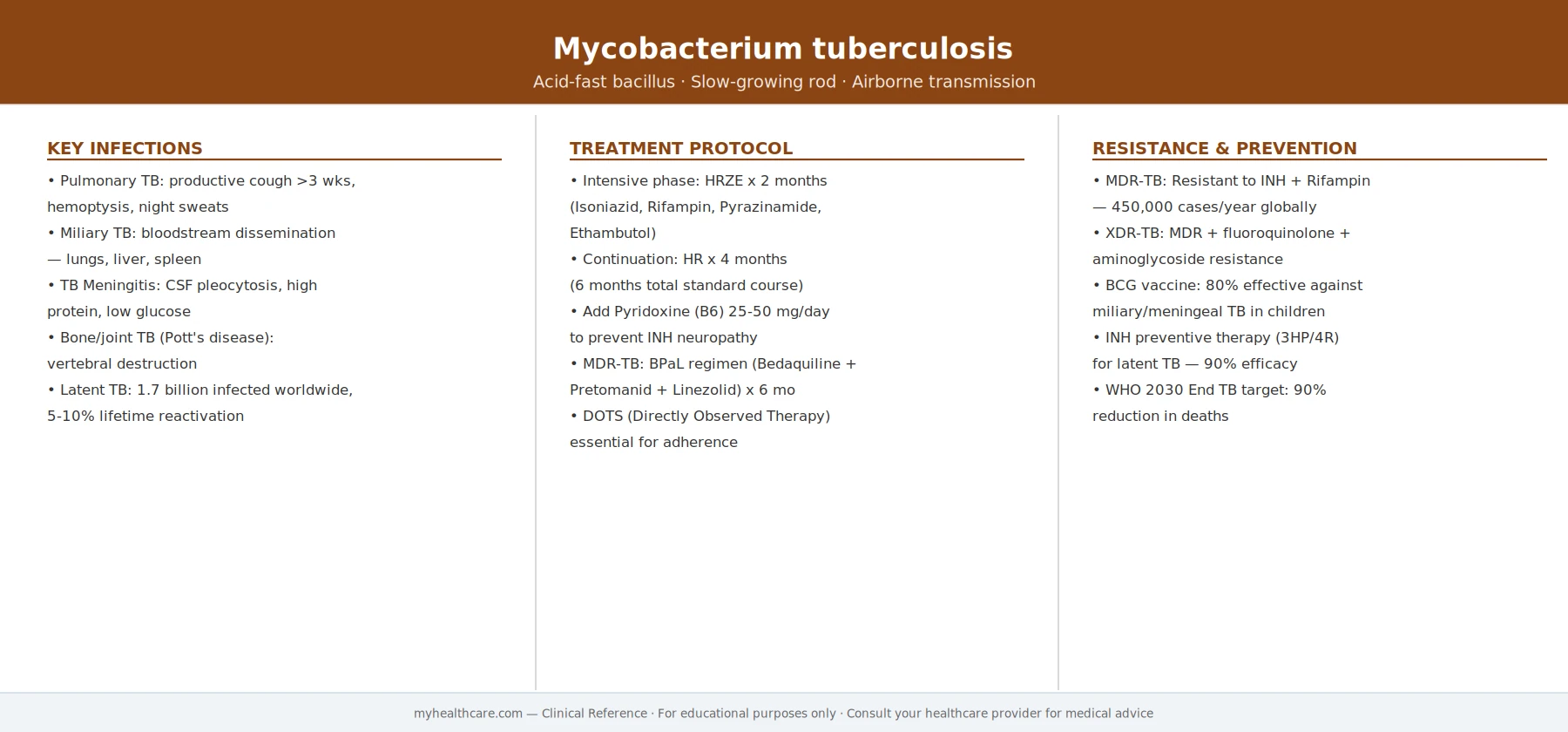
The standard regimen is two months of all four drugs, followed by four months of rifampicin and isoniazid — six months total for drug-sensitive pulmonary TB. This is the most widely used and well-studied TB treatment regimen in the world. Newer shorter regimens (4 months in some drug-sensitive cases) have been approved in recent years, based on clinical trial evidence.
Two things are critical for success:
- Never miss doses. Incomplete treatment is the leading driver of drug resistance. Many TB programs use directly observed therapy (DOT), where a health worker watches the patient swallow each dose, to ensure completion.
- Monitor for side effects. Isoniazid can cause nerve damage (peripheral neuropathy), prevented by vitamin B6 supplementation. Rifampicin turns body fluids (urine, tears, sweat) orange-red — harmless but startling. Pyrazinamide raises uric acid and can cause gout. Both rifampicin and isoniazid can cause drug-induced liver injury. Regular monitoring is standard during treatment.
Drug-Resistant TB
Drug resistance in M. tuberculosis arises from mutations and is entirely the result of inadequate treatment (wrong drugs, wrong doses, incomplete courses). It does not spread from person to person directly — resistant strains spread the same way sensitive strains do: through the air.
- Multidrug-resistant TB (MDR-TB) is defined as resistance to at least rifampicin and isoniazid, the two most potent first-line drugs. MDR-TB requires treatment with second-line drugs for 9–20 months, with more side effects and much higher cost. In 2022, WHO endorsed a new 6-month all-oral regimen (BPaL/M: bedaquiline, pretomanid, linezolid, with or without moxifloxacin) that has substantially improved outcomes.
- Extensively drug-resistant TB (XDR-TB) is MDR-TB plus resistance to key second-line drugs. It was historically associated with very poor outcomes, but newer regimens including bedaquiline and pretomanid have transformed treatment prospects.
Treatment of Latent TB Infection
People with latent TB who have risk factors for reactivation — particularly HIV-positive individuals, people starting immunosuppressive therapy, and those recently infected — are offered preventive therapy to reduce the risk that the latent infection will ever activate. Options include:
- Isoniazid for 6 or 9 months (the traditional regimen, highly effective but long).
- Rifampicin for 4 months — shorter and equally effective, now preferred in many settings.
- 3HP: isoniazid + rifapentine weekly for 12 weeks — a short regimen that can be administered by DOT or, increasingly, self-administered, with high completion rates.
BCG Vaccination
The Bacille Calmette-Guérin (BCG) vaccine has been in use since 1921 and is one of the world’s most widely administered vaccines. BCG is a live attenuated strain of Mycobacterium bovis. It provides strong protection against severe forms of childhood TB (tuberculous meningitis and miliary TB) — reducing mortality from these devastating forms by 60–80%. Its protection against pulmonary TB in adults is more variable and often limited in duration, which is why TB remains common in countries with high BCG coverage. Research on newer, more effective TB vaccines remains an active global health priority.
Global Burden and Progress
The World Health Organization’s 2023 Global TB Report estimated that in 2022:
- 10.6 million people developed active TB disease worldwide.
- TB caused approximately 1.3 million deaths, making it one of the top 10 causes of death globally from a single infectious agent.
- About two-thirds of cases occurred in just eight countries: India, Indonesia, China, the Philippines, Pakistan, Nigeria, Bangladesh, and the Democratic Republic of Congo.
- An estimated 187,000 deaths in 2022 were from drug-resistant TB, a growing and particularly challenging share of the burden.
TB incidence has been falling slowly for decades — by about 2–3% per year globally before the COVID-19 pandemic disrupted health services. The pandemic set back TB control significantly: in 2020 and 2021, TB case notifications and treatment success rates both declined as health systems were overwhelmed, and TB mortality increased for the first time in over a decade. Recovery has been partial.
The WHO’s End TB Strategy sets a target of reducing TB deaths by 95% and new cases by 90% between 2015 and 2035 — a very ambitious goal given current trajectories. Key challenges include inadequate funding, the silent reservoir of 1.7 billion people with latent TB, drug resistance, and the interaction with HIV. Bright spots include the pipeline of new drugs and drug combinations, advances in rapid molecular diagnostics, and promising new vaccine candidates in clinical trials.
In low-incidence countries like the United States, TB is no longer a common disease — the U.S. reports fewer than 10,000 active cases per year — but it has not been eliminated. Most U.S. cases occur in people born outside the country, people experiencing homelessness, people in congregate settings, and people living with HIV.
Key Research Papers
- Kim SH, Yoon YK, Kim MJ, Sohn JW. Risk factors of delayed isolation of patients with pulmonary tuberculosis. Clin Microbiol Infect. 2020;26(6):785–790. — Identifies the clinical and system factors that lead to delayed isolation of contagious TB patients, highlighting that symptom duration, cavitary disease, and AFB smear positivity all independently predicted delay. — doi:10.1016/j.cmi.2020.01.032
- Kizilbash SJ. Strategies for Successful Treatment of Active Tuberculosis in the Setting of Drug-Resistant Epilepsy. Open Forum Infect Dis. 2018;5(5):ofy062. — Reviews practical strategies for navigating TB treatment when significant drug interactions or resistance complicate standard RIPE regimen use. — doi:10.1093/ofid/ofy062
- Pai M, Denkinger CM, Kik SV, et al. Latent Mycobacterium tuberculosis Infection and Interferon-Gamma Release Assays. In: Donald PR, van Helden PD, eds. Tuberculosis and the Tubercle Bacillus. 2nd ed. ASM Press; 2020. — Comprehensive review of IGRA technology, performance, and clinical use for diagnosing latent TB infection compared with the tuberculin skin test. — doi:10.1128/9781555819569.ch17
- Colditz GA, Brewer TF, Berkey CS, et al. Efficacy of BCG Vaccine in the Prevention of Tuberculosis. JAMA. 1994;271(9):698–702. — Landmark meta-analysis of 14 randomized controlled trials and 12 case-control studies finding BCG reduced the risk of TB by 50% overall but with substantial variation by setting and latitude. — doi:10.1001/jama.1994.03510330076038
- Derrick SC, Lin PL, Yang A, et al. Enhanced efficacy of BCG vaccine formulated in adjuvant is dependent on IL-17A expression. Tuberculosis. 2024;148:102540. — Demonstrates that adjuvant-enhanced BCG formulations can improve vaccine-induced protection through IL-17A-dependent immune pathways, informing next-generation TB vaccine development. — doi:10.1016/j.tube.2024.102540
Connections
- All Bacteria
- Pulmonology Conditions
- Infectious Disease
- Helicobacter pylori
- HIV and AIDS
- All Conditions
- Robert Koch — the Nobel laureate who identified this bacillus on March 24, 1882
- Selman Waksman — streptomycin, the first drug that cured tuberculosis