Arginine
Table of Contents
- Overview
- Nitric Oxide Production and Vasodilation
- Cardiovascular Health and Blood Pressure
- The VINTAGE MI Trial: More Deaths After a Heart Attack
- Athletic Performance and Endurance
- Wound Healing and Tissue Repair
- Immune Function
- Growth Hormone Stimulation
- Erectile Function and Sexual Health
- Kidney Function
- Insulin Sensitivity
- Low Arginine States
- Food Sources
- Arginine and Herpes Simplex
- Supplement Forms and Doses Used in Studies
- Daily Intake and Upper Levels
- Key Research Papers
- Connections
- Featured Videos
Overview
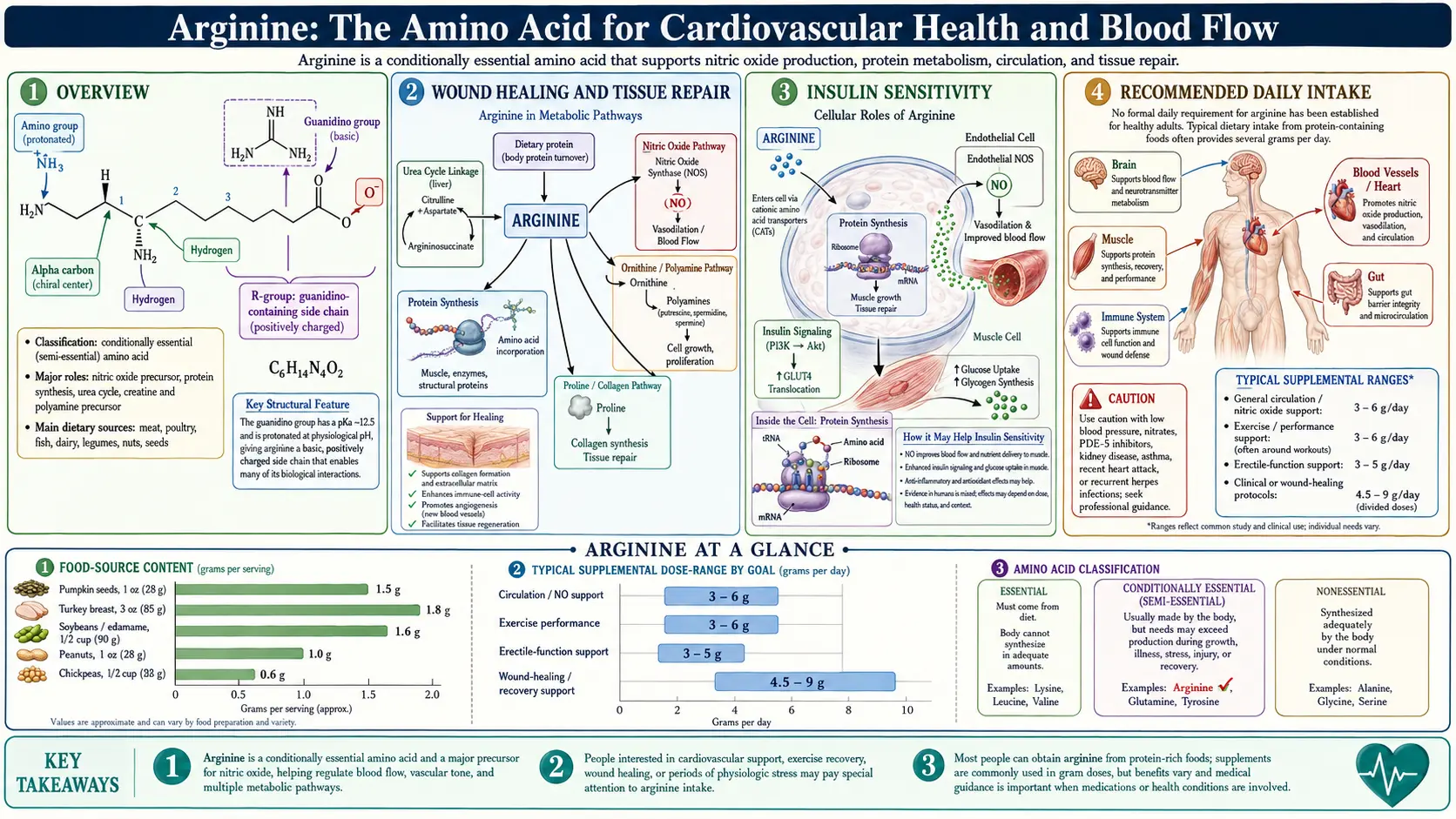
L-Arginine is a conditionally essential amino acid. Healthy adults make it themselves: in humans and most other mammals arginine is synthesised from glutamine, glutamate and proline through an intestinal–renal pathway, in which the small intestine releases citrulline and the kidneys convert citrulline to arginine (Wu 2009). Experimental and clinical studies indicate that arginine is nutritionally essential for spermatogenesis, embryonic survival, and fetal and neonatal growth (Wu 2009).
Arginine was first isolated in 1886 from lupin seedlings by the German-born chemist Ernst Schulze and his assistant Ernst Steiger, working in Zürich; the story is told on the Arginine History page. Besides being built into proteins, arginine is a precursor for nitric oxide, creatine, polyamines, agmatine and urea, and is interconvertible with proline and glutamate (Morris 2007). Arginine is also required for the detoxification of ammonia (Wu 2009).
Arginine supplements are studied mainly for blood pressure, blood flow and erectile function, for wound healing (usually inside nutrient mixtures), and for blood sugar. The trial results are mixed, and one trial in people who had just had a heart attack was closed early after more deaths in the arginine group (Schulman 2006, described below). This page sets out what the trials and reviews report.
Nitric Oxide Production and Vasodilation
Arginine is the substrate that nitric oxide synthase (NOS) uses to make nitric oxide (NO), with citrulline left over. Endothelial NOS (eNOS) in the lining of blood vessels uses it to make the NO that relaxes the vessel wall (Bode-Böger 2007). The NO diffuses into the smooth muscle underneath, activates guanylate cyclase, and the rise in cyclic GMP relaxes the muscle.
There are three isoforms of nitric oxide synthase that use arginine:
- Endothelial NOS (eNOS) produces NO in the vascular endothelium, where it regulates blood flow and vessel tone.
- Neuronal NOS (nNOS) generates NO in nerve tissue, including the nerves involved in gut motility and penile erection.
- Inducible NOS (iNOS) is expressed by immune cells such as macrophages during infection or inflammation, producing large amounts of NO that act against pathogens.
The “arginine paradox”
Plasma arginine is normally about 25 to 30 times higher than the concentration at which purified eNOS works at half its maximum rate in the test tube, so in theory extra arginine should not raise NO production — yet in living people it can improve NO-mediated vessel function. This is called the L-arginine paradox. A 2007 review proposes that the most likely explanation is that extra arginine counters asymmetric dimethylarginine (ADMA), the body's own NOS inhibitor, and suggests that the ratio of arginine to ADMA in plasma might identify the people most likely to benefit; it states that large randomised trials might be needed to find those people (Bode-Böger 2007). The same review reports that in most studies arginine improved endothelial function in animal models of high cholesterol and atherosclerosis.
Low oral bioavailability, and citrulline
Oral arginine is subject to extensive presystemic elimination by arginase in the intestine, while oral L-citrulline is readily absorbed and at least partly converted to arginine (Schwedhelm 2008). In a double-blind, randomised, placebo-controlled crossover study in 20 healthy volunteers, citrulline raised plasma arginine (peak concentration and area under the curve) more effectively than arginine, in a dose-dependent way. The highest citrulline dose, 3 g twice daily, raised the arginine/ADMA ratio from 186 to 278 and increased urinary nitrate and cyclic GMP. No regimen improved flow-mediated dilation over baseline, although in the pooled data a larger rise in the arginine/ADMA ratio went with a larger improvement in flow-mediated dilation (Schwedhelm 2008). Citrulline is covered on the Citrulline page.
Cardiovascular Health and Blood Pressure
The proposal behind arginine for the heart and blood vessels is that more substrate means more nitric oxide. The trial results are summarised below, including a trial in which arginine was associated with harm.
Blood pressure
A 2011 meta-analysis pooled 11 randomised, double-blind, placebo-controlled trials with 387 participants, using oral L-arginine at 4 to 24 g a day. Compared with placebo, arginine lowered systolic blood pressure by 5.39 mm Hg (95% CI 2.25 to 8.54) and diastolic blood pressure by 2.66 mm Hg (95% CI 1.54 to 3.77). Results were similar when the analysis was restricted to trials lasting 4 weeks or longer and to trials whose participants were not taking blood-pressure medicines. A meta-regression suggested a larger fall in people with higher starting systolic pressure, but this relation was not statistically significant (Dong 2011).
Pre-eclampsia
In a randomised, blinded, placebo-controlled trial at a public hospital in Mexico City, pregnant women at high risk of pre-eclampsia (a previous pre-eclamptic pregnancy, or pre-eclampsia in a first-degree relative) were studied from weeks 14–32 of pregnancy and followed until delivery. They received medical-food bars containing L-arginine plus antioxidant vitamins (228 women), antioxidant vitamins alone (222) or placebo bars (222). Pre-eclampsia was significantly less frequent with arginine plus vitamins than with placebo (absolute risk reduction 0.17, 95% CI 0.12 to 0.21) and than with vitamins alone; vitamins alone did not reach statistical significance against placebo. The authors state that the combination needs to be tested in low-risk women, and that the separate contributions of arginine and of the vitamins still need to be determined (Vadillo-Ortega 2011).
The heart-and-vessel evidence is described further on the Arginine for Cardiovascular Health and Nitric Oxide page.
The VINTAGE MI Trial: More Deaths After a Heart Attack
The VINTAGE MI trial was a single-centre, randomised, double-blind, placebo-controlled trial in 153 people after a first ST-elevation myocardial infarction (heart attack). Participants took L-arginine (goal dose 3 g three times a day) or a matching placebo, added to standard post-infarction treatment, for 6 months. Arginine did not improve the measures of vascular stiffness or left ventricular ejection fraction, in those aged 60 or older or in the whole group. Six participants (8.6%) in the arginine group died during the 6-month study, against none in the placebo group (P = .01), and because of these safety concerns the data and safety monitoring committee closed enrollment. The authors concluded that arginine added to standard treatment may be associated with higher post-infarction mortality and that it should not be recommended following acute myocardial infarction (Schulman 2006).
Athletic Performance and Endurance
Arginine is sold for exercise on the idea that more nitric oxide means more blood flow to working muscle. Arginine is also one of the building blocks of creatine, which the body makes from arginine, glycine and methionine (via S-adenosylmethionine), and it takes part in disposing of ammonia through the urea cycle (Wu 2009).
A 2020 systematic review and meta-analysis included 18 placebo-controlled studies, 15 of them pooled. It reported that arginine improved aerobic performance tests (standardised mean difference 0.84, 95% CI 0.12 to 1.56, with high heterogeneity, I² 89%) and anaerobic performance tests (standardised mean difference 0.24, 95% CI 0.05 to 0.43). Its authors described an acute dose of 0.15 g per kg of body weight taken 60–90 minutes before exercise, and longer-term doses of 1.5–2 g a day for 4–7 weeks (aerobic) and 10–12 g a day for 8 weeks (anaerobic) (Viribay 2020). A 2025 published comment on that meta-analysis argued that it contains errors common in sports-nutrition meta-analyses that distort its pooled effect estimates and their interpretation (Trexler 2025).
Wound Healing and Tissue Repair
Arginine can be converted, through ornithine, to proline — one of the main amino acids of collagen — and ornithine also feeds the polyamines that support cell division (Morris 2007; Albaugh 2017). Through inducible NOS, immune cells in a wound also make nitric oxide from arginine.
Human studies of arginine and wound repair fall into two groups: small studies that measured new collagen in a standardised test wound, and clinical trials of nutrient mixtures in which arginine was one of several ingredients:
- Arginine alone, test wounds. In 36 healthy volunteers, 30 g a day of arginine hydrochloride (24.8 g free arginine) or arginine aspartate (17 g free arginine) for 2 weeks increased the hydroxyproline (a marker of new collagen) collected in a small tube implanted under the skin, compared with placebo (Barbul 1990). In 45 healthy people over 65, 30 g a day of arginine aspartate (17 g free arginine) for 2 weeks increased hydroxyproline and total protein in the implanted tube, but did not change how fast a small skin wound re-epithelialised (Kirk 1993).
- Arginine with HMB and glutamine. In 35 healthy volunteers aged 70 or older, a daily mixture of 14 g arginine, 3 g HMB and 14 g glutamine increased collagen deposition (measured as hydroxyproline) in implanted test tubes compared with a non-essential amino acid control, with no effect on total protein deposition (Williams 2002).
- Pressure ulcers. In a multicentre randomised trial of 200 malnourished adults with stage II–IV pressure ulcers, an energy-dense, protein-rich oral formula enriched with arginine, zinc and antioxidants for 8 weeks reduced ulcer area by a mean 60.9%, against 45.2% with an isocaloric, isonitrogenous control formula (adjusted difference 18.7%, P = 0.017) (Cereda 2015).
- Diabetic foot ulcers. In a randomised trial of 270 people with diabetic foot ulcers, a twice-daily drink of arginine, glutamine and HMB for 16 weeks, added to standard care, did not change wound closure or time to healing overall; in a post-hoc analysis, more of those with low albumin or reduced limb blood flow healed (Armstrong 2014).
A critical review of amino acid supplementation for wound healing concluded that, although it may seem a reasonable strategy, a number of biochemical and physiological barriers limit what oral amino acids can achieve (Albaugh 2017). The same mixtures are described from the lysine side on the Lysine and Collagen Synthesis page, and in more detail on the Arginine for Wound Healing page.
Immune Function
Arginine is counted among the “immunonutrients”, nutrients studied for their effect on immune cells. The evidence comes from cell studies, small human studies and trials of enteral formulas that contain arginine with other ingredients:
- T cells (cell culture). In cultured human T cells (the Jurkat cell line), removing arginine from the medium rapidly lowered expression of the CD3-zeta chain, the main signalling part of the T-cell receptor, and reduced T-cell proliferation; adding arginine back, but not other amino acids, reversed this. The authors note that arginine can be depleted by arginase I in trauma, sepsis and after liver transplantation (Rodriguez 2002).
- Lymphocyte responses in volunteers. In the two small 2-week studies above, oral arginine increased the response of blood lymphocytes to mitogens in the laboratory (Barbul 1990; Kirk 1993).
- Surgery. A 2010 meta-analysis of 21 studies with 1,918 high-risk patients having elective surgery found that immune-modulating enteral diets reduced acquired infections, wound complications and length of hospital stay; mortality was 1% in both groups, and the authors report that the benefit required both arginine and fish oil (Marik 2010).
- Severe sepsis. In a planned interim analysis of a randomised multicentre trial in 33 Italian intensive care units, patients with severe sepsis or septic shock given an enteral formula with extra arginine, omega-3 fatty acids, vitamin E, beta carotene, zinc and selenium had higher intensive-care mortality than those given parenteral nutrition (44.4% vs 14.3%, P = 0.039, in 39 patients), and recruitment of patients with severe sepsis was stopped (Bertolini 2003).
These are described further on the Arginine for Immune Function page.
Growth Hormone Stimulation
Intravenous arginine raises growth hormone (GH). In six healthy men, a 30 g arginine infusion raised mean serum GH from 0.6 to 23.3 micrograms per litre at 60 minutes, and arginine with GHRH raised it further; arginine had no effect on rat pituitary cells in the dish, and the authors concluded that arginine acts by suppressing the body's own somatostatin (Alba-Roth 1988). Arginine-based stimulation is used in diagnosis: the 2007 consensus of the GH Research Society lists the combination of GHRH with arginine among the validated GH stimulation tests in adults (Ho 2007).
Oral arginine has smaller effects. In eight healthy young men tested after an overnight fast, single oral doses of 5 g and 9 g raised GH (area under the curve) compared with placebo; 13 g did not, and caused considerable gastrointestinal distress in most subjects. GH started to rise about 30 minutes after the dose and peaked at about 60 minutes (Collier 2005). In a second study, 7 g of oral arginine raised GH, resistance exercise alone raised it more, and taking arginine before the exercise attenuated the GH response compared with exercise alone (Collier 2006). No trial reviewed for this page showed that the GH rise after oral arginine changes muscle mass, body fat or bone.
Erectile Function and Sexual Health
Erection is a vascular event: nitric oxide released from nerve endings and endothelial cells in the corpus cavernosum raises cyclic GMP, which relaxes smooth muscle so the erectile tissue fills with blood. The drug class of PDE5 inhibitors acts further down the same pathway, by slowing the breakdown of cyclic GMP.
A 2019 systematic review and meta-analysis included 10 randomised controlled trials with 540 men with mild to moderate erectile dysfunction. Arginine supplements at 1,500 to 5,000 mg improved erectile dysfunction compared with placebo or no treatment (odds ratio 3.37, 95% CI 1.29 to 8.77), and improved the IIEF sub-scores for overall satisfaction, intercourse satisfaction, orgasmic function and erectile function, but not sexual desire. Adverse effects occurred in 8.3% of men taking arginine and 2.3% of those on placebo, none severe. The analysis covered arginine alone and arginine combined with other substances; the authors note that dosage and duration varied between studies (Rhim 2019).
One much-quoted figure comes from a 3-month study without a placebo group in 40 men aged 25–45 without confirmed organic erectile dysfunction. They took arginine as arginyl aspartate (equivalent to 1.7 g arginine a day) throughout, with French maritime pine bark extract added in the second and third months. After the first month, 2 men (5%) reported a normal erection; after the second, 80%; and after the third, 92.5% (Stanislavov 2003). Because every man received the same sequence and there was no control group, the study cannot separate the effect of the supplements from time or expectation.
Arginine is also required for spermatogenesis (Wu 2009). The male sexual health research is covered on the Arginine and Erectile Function page.
Kidney Function
The kidneys are the main site where the body makes arginine: they take up citrulline released by the small intestine and convert it to arginine, which they release into the blood (Wu 2009).
Because this synthesis happens in the kidney, loss of kidney tissue can change how much arginine the body makes. The studies of arginine supplements in kidney disease, in contrast-dye kidney injury and in kidney transplantation were not reviewed for this page, and no finding about them is stated here. Kidney tests are covered on the Kidney Function page.
Insulin Sensitivity
Whether long-term arginine supplements change the course of blood sugar was tested in the randomised trial below.
In a randomised, double-blind, placebo-controlled trial, 144 people with impaired glucose tolerance and metabolic syndrome took 6.4 g of L-arginine or placebo a day for 18 months, on top of a structured lifestyle programme, and were followed for a further 12 months after stopping. At 18 months arginine did not reduce the cumulative incidence of diabetes (21.4% vs 20.8%; hazard ratio 1.04, 95% CI 0.58 to 1.86), but more people returned to normal glucose tolerance (42.4% vs 22.1%; hazard ratio 2.60). At the end of the extended follow-up, the cumulative incidence of diabetes was lower in those who had taken arginine (27.2% vs 47.1%; hazard ratio 0.42). Arginine improved insulin sensitivity and beta-cell function during both periods (Monti 2012).
Low Arginine States
Because healthy adults make their own arginine, dietary arginine deficiency is not described as a disease in healthy adults, and no validated list of symptoms of low arginine was found for this page. Arginine is described as nutritionally essential during fetal and neonatal growth (Wu 2009).
Situations in which the research describes low arginine include:
- Trauma, sepsis and liver transplantation, in which arginase I produced by macrophages and liver cells can deplete arginine, with a fall in T-cell function (Rodriguez 2002).
- Low intake. In the US national NHANES III survey, a quarter of adults ate less than 2.6 g of arginine a day (King 2008); the health effect of that intake was not measured.
The opposite situation also exists. In the inherited disorder guanidinoacetate methyltransferase (GAMT) deficiency, in which the body cannot finish making creatine, treatment regimens in a 48-patient series included an arginine-restricted diet, together with creatine and high doses of ornithine, to lower guanidinoacetate (Stockler-Ipsiroglu 2014).
Food Sources
Arginine is found in most protein foods. The US Department of Agriculture's FoodData Central (SR Legacy) lists, per 100 g of food:
- Pumpkin and squash seed kernels, dried: 5.35 g arginine (FDC 170556)
- Peanuts, raw: 3.08 g (FDC 172430)
- Sesame seeds, whole, dried: 2.63 g (FDC 170150)
- Almonds: 2.46 g (FDC 170567)
- Sunflower seed kernels, dried: 2.4 g (FDC 170562)
- Walnuts, English: 2.28 g (FDC 170187)
- Beef, composite of retail cuts, cooked: 1.92 g (FDC 170609)
- Chicken breast, meat only, roasted: 1.87 g (FDC 171477)
- Salmon, sockeye, cooked, dry heat: 1.72 g (FDC 173692)
- Cheese, parmesan, hard: 1.32 g (FDC 170848)
- Natto (fermented soybeans): 0.909 g (FDC 172443)
- Chickpeas, cooked, boiled: 0.835 g (FDC 173799)
- Egg, whole, hard-boiled: 0.755 g (FDC 173424)
- Lentils, cooked, boiled: 0.697 g (FDC 175254)
- Quinoa, cooked: 0.34 g (FDC 168917)
- Brown rice, long-grain, cooked: 0.196 g (FDC 169704)
- Yogurt, plain, whole milk: 0.104 g (FDC 171284)
These are the same USDA values used on the Lysine to Arginine Ratio page, which also lists each food's lysine content. In the NHANES III survey, mean arginine intake for US adults was 4.40 g a day (King 2008).
Arginine and Herpes Simplex
The idea that arginine matters for herpes comes from cell culture. In 1964 Tankersley reported that in human cells in tissue culture, herpes simplex virus (HSV) produced neither cell damage nor new virus when arginine was withheld, and that infection followed promptly once arginine was replaced; lysine partially inhibited the virus (Tankersley 1964). In 1981 Griffith, DeLong and Nelson reported that arginine deficiency suppressed HSV growth in tissue culture and that lysine antagonised arginine's growth-promoting effect; they proposed that these in-vitro data may be the basis for the view that people prone to herpes lesions abstain from arginine excess (Griffith 1981). These are cell-culture findings, not human results.
No trial was found that tested a dietary lysine-to-arginine ratio, or arginine intake, against herpes recurrence. A 2015 Cochrane review of 32 randomised trials with 2,640 participants, covering 19 treatments for preventing cold sores, found no evidence of efficacy for lysine (Chi 2015). Whether arginine supplements make herpes outbreaks more frequent has not been tested in a trial found for this page. The evidence is set out on the Lysine to Arginine Ratio page.
Supplement Forms and Doses Used in Studies
Arginine is sold in several forms:
- L-Arginine free base, as powder or capsules
- L-Arginine hydrochloride, a salt form (used, for example, at 30 g a day in Barbul 1990)
- Arginine aspartate and arginyl aspartate, used in several of the trials above
- Arginine alpha-ketoglutarate (AAKG), a form sold for sports nutrition that combines arginine with alpha-ketoglutarate, an intermediate of the Krebs cycle
- L-Citrulline, not arginine itself, but readily absorbed and at least partly converted to arginine; it raised plasma arginine more effectively than arginine in a crossover study (Schwedhelm 2008)
Doses used in the trials described on this page:
- Blood pressure: 4 to 24 g a day of oral L-arginine across the 11 trials of the 2011 meta-analysis (Dong 2011)
- After a heart attack: goal dose 3 g three times a day for 6 months, the regimen associated with 6 deaths against none on placebo (Schulman 2006)
- Erectile function: 1,500 to 5,000 mg in the trials of the 2019 meta-analysis (Rhim 2019); 1.7 g a day as arginyl aspartate, with pine bark extract added, in an uncontrolled study (Stanislavov 2003)
- Exercise: the 0.15 g per kg acute dose and the longer-term doses described by Viribay 2020, whose analysis has been criticised (Trexler 2025)
- Test wounds: 17 g or 24.8 g of free arginine a day for 2 weeks (Barbul 1990; Kirk 1993); 14 g arginine with 3 g HMB and 14 g glutamine (Williams 2002)
- Growth hormone: single oral doses of 5 g and 9 g (Collier 2005)
- Blood sugar: 6.4 g a day for 18 months (Monti 2012)
- Pregnancy: medical-food bars with arginine and antioxidant vitamins in women at high risk of pre-eclampsia (Vadillo-Ortega 2011)
Side effects and cautions in the research
- After a heart attack: in the VINTAGE MI trial, 6 of the people taking arginine died during the 6-month study and none on placebo, and the trial's enrollment was closed for safety; the investigators concluded that arginine should not be recommended following acute myocardial infarction (Schulman 2006).
- Severe sepsis: an arginine-containing enteral immunonutrition formula was associated with higher intensive-care mortality than parenteral nutrition in an interim analysis (Bertolini 2003).
- Digestive effects: a single 13 g oral dose caused considerable gastrointestinal distress in most subjects (Collier 2005). In the erectile-function meta-analysis, adverse effects were reported in 8.3% on arginine and 2.3% on placebo, none severe (Rhim 2019).
- Blood-pressure medicines, nitrates and PDE5 inhibitors: arginine lowered blood pressure in the trials pooled by Dong 2011, and nitrate drugs and PDE5 inhibitors act on the same nitric oxide–cyclic GMP pathway. No trial of these combinations was reviewed for this page; the concern rests on the shared mechanism.
- GAMT deficiency: in this inherited disorder, treatment regimens include arginine restriction (Stockler-Ipsiroglu 2014).
- Pregnancy: apart from the pre-eclampsia trial of arginine with vitamins in high-risk women (Vadillo-Ortega 2011), no pregnancy safety data were reviewed for this page.
Decisions about supplements belong with a clinician.
Daily Intake and Upper Levels
No Recommended Dietary Allowance has been set for arginine, because healthy adults make it themselves.
- Typical intake: in the US NHANES III survey, mean arginine intake for adults was 4.40 g a day, and 25% of people consumed less than 2.6 g a day; intake varied with sex, ethnicity, smoking and other factors (King 2008).
- Upper level: no tolerable upper intake level has been set. A 2008 risk assessment, finding no systematic pattern of adverse effects in human trials, used the Observed Safe Level method and identified 20 g a day of supplemental arginine as the level up to which the evidence for the absence of adverse effects in healthy adults is strong; it states that higher intakes have been tested without adverse effects but that the data above that level are not sufficient for a confident conclusion of long-term safety (Shao 2008). That assessment covers healthy adults, not people after a heart attack or with severe sepsis (see above).
Factors that raise the body's use of arginine include trauma, sepsis and growth (Wu 2009; Rodriguez 2002).
Key Research Papers
- Schulman SP, Becker LC, Kass DA, Champion HC, Terrin ML, Forman S et al. (2006). L-arginine therapy in acute myocardial infarction: the Vascular Interaction With Age in Myocardial Infarction (VINTAGE MI) randomized clinical trial. JAMA 295(1):58-64. — PubMed PMID: 16391217
- Dong JY, Qin LQ, Zhang Z, Zhao Y, Wang J, Arigoni F et al. (2011). Effect of oral L-arginine supplementation on blood pressure: a meta-analysis of randomized, double-blind, placebo-controlled trials. American Heart Journal 162(6):959-65. — PubMed PMID: 22137067
- Bode-Böger SM, Scalera F, Ignarro LJ (2007). The L-arginine paradox: Importance of the L-arginine/asymmetrical dimethylarginine ratio. Pharmacology & Therapeutics 114(3):295-306. — PubMed PMID: 17482266
- Schwedhelm E, Maas R, Freese R, Jung D, Lukacs Z, Jambrecina A et al. (2008). Pharmacokinetic and pharmacodynamic properties of oral L-citrulline and L-arginine: impact on nitric oxide metabolism. British Journal of Clinical Pharmacology 65(1):51-9. — PubMed PMID: 17662090
- Vadillo-Ortega F, Perichart-Perera O, Espino S, Avila-Vergara MA, Ibarra I, Ahued R et al. (2011). Effect of supplementation during pregnancy with L-arginine and antioxidant vitamins in medical food on pre-eclampsia in high risk population: randomised controlled trial. BMJ 342:d2901. — PubMed PMID: 21596735
- Rhim HC, Kim MS, Park YJ, Choi WS, Park HK, Kim HG et al. (2019). The Potential Role of Arginine Supplements on Erectile Dysfunction: A Systemic Review and Meta-Analysis. The Journal of Sexual Medicine 16(2):223-234. — PubMed PMID: 30770070
- Stanislavov R, Nikolova V (2003). Treatment of erectile dysfunction with pycnogenol and L-arginine. Journal of Sex & Marital Therapy 29(3):207-13. — PubMed PMID: 12851125
- Collier SR, Casey DP, Kanaley JA (2005). Growth hormone responses to varying doses of oral arginine. Growth Hormone & IGF Research 15(2):136-9. — PubMed PMID: 15809017
- Collier SR, Collins E, Kanaley JA (2006). Oral arginine attenuates the growth hormone response to resistance exercise. Journal of Applied Physiology 101(3):848-52. — PubMed PMID: 16741262
- Alba-Roth J, Müller OA, Schopohl J, von Werder K (1988). Arginine stimulates growth hormone secretion by suppressing endogenous somatostatin secretion. The Journal of Clinical Endocrinology and Metabolism 67(6):1186-9. — PubMed PMID: 2903866
- Ho KK; 2007 GH Deficiency Consensus Workshop Participants (2007). Consensus guidelines for the diagnosis and treatment of adults with GH deficiency II: a statement of the GH Research Society in association with the European Society for Pediatric Endocrinology, Lawson Wilkins Society, European Society of Endocrinology, Japan Endocrine Society, and Endocrine Society of Australia. European Journal of Endocrinology 157(6):695-700. — PubMed PMID: 18057375
- Barbul A, Lazarou SA, Efron DT, Wasserkrug HL, Efron G (1990). Arginine enhances wound healing and lymphocyte immune responses in humans. Surgery 108(2):331-6; discussion 336-7. — PubMed PMID: 2382229
- Kirk SJ, Hurson M, Regan MC, Holt DR, Wasserkrug HL, Barbul A (1993). Arginine stimulates wound healing and immune function in elderly human beings. Surgery 114(2):155-9; discussion 160. — PubMed PMID: 8342121
- Williams JZ, Abumrad N, Barbul A (2002). Effect of a specialized amino acid mixture on human collagen deposition. Annals of Surgery 236(3):369-74; discussion 374-5. — PubMed PMID: 12192323
- Cereda E, Klersy C, Serioli M, Crespi A, D'Andrea F (2015). A nutritional formula enriched with arginine, zinc, and antioxidants for the healing of pressure ulcers: a randomized trial. Annals of Internal Medicine 162(3):167-74. — PubMed PMID: 25643304
- Armstrong DG, Hanft JR, Driver VR, Smith AP, Lazaro-Martinez JL, Reyzelman AM et al. (2014). Effect of oral nutritional supplementation on wound healing in diabetic foot ulcers: a prospective randomized controlled trial. Diabetic Medicine 31(9):1069-77. — PubMed PMID: 24867069
- Albaugh VL, Mukherjee K, Barbul A (2017). Proline Precursors and Collagen Synthesis: Biochemical Challenges of Nutrient Supplementation and Wound Healing. The Journal of Nutrition 147(11):2011-2017. — PubMed PMID: 28978679
- Rodriguez PC, Zea AH, Culotta KS, Zabaleta J, Ochoa JB, Ochoa AC (2002). Regulation of T cell receptor CD3zeta chain expression by L-arginine. The Journal of Biological Chemistry 277(24):21123-9. — PubMed PMID: 11950832
- Marik PE, Zaloga GP (2010). Immunonutrition in high-risk surgical patients: a systematic review and analysis of the literature. JPEN Journal of Parenteral and Enteral Nutrition 34(4):378-86. — PubMed PMID: 20631383
- Bertolini G, Iapichino G, Radrizzani D, Facchini R, Simini B, Bruzzone P et al. (2003). Early enteral immunonutrition in patients with severe sepsis: results of an interim analysis of a randomized multicentre clinical trial. Intensive Care Medicine 29(5):834-40. — PubMed PMID: 12684745
- Monti LD, Setola E, Lucotti PC, Marrocco-Trischitta MM, Comola M, Galluccio E et al. (2012). Effect of a long-term oral l-arginine supplementation on glucose metabolism: a randomized, double-blind, placebo-controlled trial. Diabetes, Obesity & Metabolism 14(10):893-900. — PubMed PMID: 22553931
- Viribay A, Burgos J, Fernández-Landa J, Seco-Calvo J, Mielgo-Ayuso J (2020). Effects of Arginine Supplementation on Athletic Performance Based on Energy Metabolism: A Systematic Review and Meta-Analysis. Nutrients 12(5):1300. — PubMed PMID: 32370176
- Trexler ET (2025). Common Errors in Sports Nutrition Meta-Analyses Lead to Distortion of Pooled Effect Estimates. Comment on Viribay et al. Effects of Arginine Supplementation on Athletic Performance Based on Energy Metabolism: A Systematic Review and Meta-Analysis. Nutrients 2020, 12, 1300. Nutrients 17(14):2375. — PubMed PMID: 40733000
- Griffith RS, DeLong DC, Nelson JD (1981). Relation of arginine-lysine antagonism to herpes simplex growth in tissue culture. Chemotherapy 27(3):209-13. — PubMed PMID: 6262023
- Tankersley RW Jr (1964). Amino acid requirements of herpes simplex virus in human cells. Journal of Bacteriology 87(3):609-13. — PubMed PMID: 14127578
- Chi CC, Wang SH, Delamere FM, Wojnarowska F, Peters MC, Kanjirath PP (2015). Interventions for prevention of herpes simplex labialis (cold sores on the lips). Cochrane Database of Systematic Reviews (8):CD010095. — PubMed PMID: 26252373
- King DE, Mainous AG 3rd, Geesey ME (2008). Variation in L-arginine intake follow demographics and lifestyle factors that may impact cardiovascular disease risk. Nutrition Research 28(1):21-4. — PubMed PMID: 19083383
- Shao A, Hathcock JN (2008). Risk assessment for the amino acids taurine, L-glutamine and L-arginine. Regulatory Toxicology and Pharmacology 50(3):376-99. — PubMed PMID: 18325648
- Stockler-Ipsiroglu S, van Karnebeek C, Longo N, Korenke GC, Mercimek-Mahmutoglu S, Marquart I et al. (2014). Guanidinoacetate methyltransferase (GAMT) deficiency: outcomes in 48 individuals and recommendations for diagnosis, treatment and monitoring. Molecular Genetics and Metabolism 111(1):16-25. — PubMed PMID: 24268530
- Wu G, Bazer FW, Davis TA, Kim SW, Li P, Rhoads JM et al. (2009). Arginine metabolism and nutrition in growth, health and disease. Amino Acids 37(1):153-68. — PubMed PMID: 19030957
- Morris SM Jr (2007). Arginine metabolism: boundaries of our knowledge. The Journal of Nutrition 137(6 Suppl 2):1602S-1609S. — PubMed PMID: 17513435
PubMed Topic Searches
- PubMed: Search — Arginine: Metabolism and biochemistry (review)
- PubMed: Search — Arginine: Dietary intake and requirements
- PubMed: Search — Arginine: Supplementation randomized controlled trials
- PubMed: Search — Arginine: Plasma levels and clinical outcomes
- PubMed: Search — Arginine: Muscle protein synthesis and exercise
- PubMed: Search — Arginine: Deficiency: signs and consequences
- PubMed: Search — Arginine: Cardiovascular effects
- PubMed: Search — Arginine: Neurological and cognitive effects
- PubMed: Search — Arginine: Immune function
- PubMed: Search — Arginine: Oxidative stress and antioxidant activity
- PubMed: Search — Arginine: Gastrointestinal and gut health
- PubMed: Search — Arginine: Safety, toxicity, and upper limit
For a broader literature review, see the full PubMed record for Arginine and the NIH Office of Dietary Supplements Fact Sheets.
This content is provided for informational purposes only and does not constitute medical advice. Decisions about supplements belong with a qualified healthcare provider.
Connections
- All Amino Acids
- How a Wound Heals: The Four Overlapping Phases — interactive animation
- Nitric Oxide & Vessel Dilation — interactive animation
- Ornithine
- Citrulline
- Arginine Benefits Deep Dive
- Proline
- Lysine
- Methionine
- Glycine
- Taurine
- Glutamine
- Blood Pressure
- Kidney Function
- Creatine
- Hypertension
- Erectile Dysfunction
- Diabetes
- Cardiovascular Disease
- Zinc
- Collagen
- Metabolic Syndrome
- L Lysine
- Isoleucine
- Furchgott, Ignarro & Murad — the nitric-oxide Nobel that explains arginine's claimed benefits
- Conditions on this site that reference this page: Angina (Angina Pectoris) · Diabetes Insipidus · MELAS Syndrome · Herpes Simplex
Featured Videos