Superoxide Dismutase (SOD)
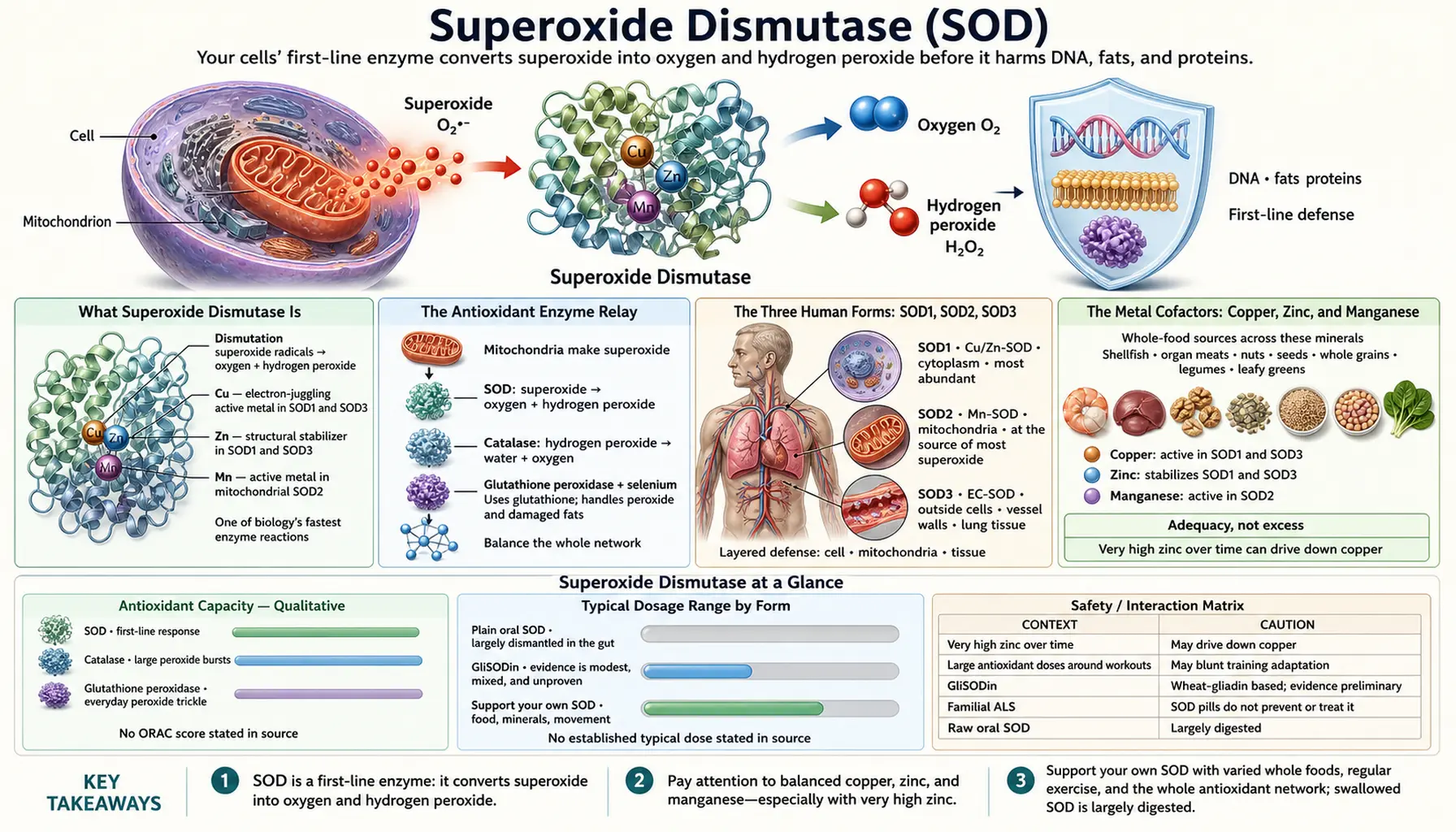
Superoxide dismutase — almost always shortened to SOD — is one of the most important antioxidants in your body, and yet most people have never heard of it. It is not a vitamin you eat or a supplement you have to remember to take. It is an enzyme: a tiny protein machine that your own cells build, and it works as the body's first line of defense against a specific troublemaker called the superoxide radical. Every time a cell burns fuel for energy, a small amount of oxygen leaks out in a damaged, reactive form. SOD grabs that reactive oxygen almost the instant it appears and defuses it, before it can start a chain reaction that harms your DNA, your fats, and your proteins.
This page explains, in plain language, what SOD actually does, the three different versions your body makes, the metal minerals it needs to function, and why it matters for aging and disease. It also tackles the honest and often-confusing question that brings many people here: can you take SOD as a pill? The short answer is "not really, at least not the way most people imagine" — and the longer answer, including what the melon-derived supplement GliSODin can and cannot do, is worth understanding. We will finish with the practical part: how to genuinely support your own SOD.
Interactive Visualization Free Radicals & Your Antioxidant Network Follow one superoxide radical down the whole relay — SOD, catalase, glutathione, vitamin E, vitamin C, NADPH — then release free iron and watch a membrane tear itself apart. Launch →
Table of Contents
- What Superoxide Dismutase Is
- The Antioxidant Enzyme Relay
- The Three Human Forms: SOD1, SOD2, SOD3
- The Metal Cofactors: Copper, Zinc, and Manganese
- Why SOD Matters: Mitochondria, Aging, and Disease
- SOD1 and Familial ALS: An Honest Note
- Can You Just Swallow SOD? The Digestion Problem
- GliSODin and SOD Supplements: What the Evidence Shows
- How to Actually Support Your Own SOD
- SOD in the Broader Antioxidant Network
- The Honest Bottom Line
- Research Papers
- Connections
- Featured Videos
What Superoxide Dismutase Is
To understand SOD you first need to meet its target: the superoxide radical, written by chemists as O2•− (an oxygen molecule carrying one extra, unpaired electron). Superoxide is a normal by-product of life. Inside your cells, the mitochondria — the little power plants that turn food and oxygen into usable energy — are not perfectly efficient. A few electrons routinely slip off the assembly line and land on oxygen, creating superoxide. It is not the most vicious of the reactive oxygen species, but it is the first one formed, and if it is left to accumulate it can go on to generate far nastier molecules.
SOD's job is to catch superoxide early and convert it into something the body can handle. It performs a reaction called dismutation, in which two superoxide radicals are turned into ordinary oxygen (O2) and hydrogen peroxide (H2O2). This is one of the fastest enzyme reactions known in all of biology — SOD works essentially as fast as superoxide molecules can bump into it. That speed is exactly why it counts as a first-line defense: it neutralizes the threat almost before the threat exists. SOD was discovered in 1969 by Joe McCord and Irwin Fridovich, who showed that a copper-and-zinc protein previously thought to just store metal was in fact a powerful enzyme — a finding that essentially launched the entire modern field of free-radical biology.
The Antioxidant Enzyme Relay
Here is a subtlety that surprises people: SOD does not finish the job on its own. When it converts superoxide into hydrogen peroxide, it has traded one reactive molecule for another. Hydrogen peroxide is less reactive than superoxide, but it is still dangerous — especially if it meets loose iron or copper, because it can then form the hydroxyl radical, the single most destructive oxidant in the body. So SOD is really the first runner in a relay, and it must hand the baton to enzymes that can safely destroy hydrogen peroxide.
Two teammates take over from there:
- Catalase — a fast enzyme that splits hydrogen peroxide into plain water and oxygen. It is concentrated in tiny cellular compartments called peroxisomes and handles large bursts of peroxide.
- Glutathione peroxidase — a selenium-dependent enzyme that neutralizes peroxide (and damaged fats) by spending glutathione, the cell's master antioxidant. It handles the steady, everyday trickle of peroxide.
This is the crucial mental model: SOD, catalase, and glutathione peroxidase form one coordinated system. SOD without its downstream partners would simply be flooding the cell with hydrogen peroxide. The trio has to stay in balance — which is one reason "just boosting SOD" is not automatically a good thing, and why supporting the whole network (including glutathione and its cofactor selenium) makes more biological sense than fixating on any single enzyme.
The Three Human Forms: SOD1, SOD2, SOD3
Humans do not make just one SOD. We make three, each encoded by its own gene and each stationed in a different location so that superoxide is neutralized wherever it happens to form. Think of them as three guards posted at three doors.
- SOD1 (Cu/Zn-SOD) — uses copper and zinc. It lives mainly in the cytoplasm, the general interior of the cell, and is the most abundant form. This is the enzyme McCord and Fridovich first identified.
- SOD2 (Mn-SOD) — uses manganese. It sits inside the mitochondria, right at the source of most superoxide production. Because mitochondria are where the radicals are actually born, many researchers consider SOD2 the most critical of the three for long-term health; animals that cannot make it do not survive.
- SOD3 (EC-SOD) — also copper-and-zinc based, but "extracellular," meaning it works outside the cells, in the spaces between them and along blood-vessel walls. It was discovered by Stefan Marklund in 1982 and is especially important for protecting blood vessels and lung tissue.
The three genes are ancient and closely related, and their structures have been compared in detail across species. The takeaway for a general reader is simple: your body has invested in a layered defense — inside the cell, inside the mitochondria, and out in the tissue — because superoxide can appear in all of those places.
The Metal Cofactors: Copper, Zinc, and Manganese
SOD is a beautiful example of why "trace" minerals are not optional. The enzyme cannot do its chemistry without a metal ion held at its active site to shuttle electrons. Take that metal away and the protein is just an inert scaffold.
- Copper is the working, electron-juggling metal in SOD1 and SOD3. It is the part that actually grabs and releases the electron during dismutation.
- Zinc sits alongside copper in those same enzymes, holding the structure stable and steady so the copper can do its job.
- Manganese is the active metal in the mitochondrial form, SOD2, where copper is not used.
The practical implication is important and honest: if your diet is genuinely short on copper, zinc, or manganese, your body may not be able to build fully functional SOD, and measured SOD activity can fall. This is one of the real, mechanism-based reasons that mineral status matters for antioxidant defense. It is also a two-way street — copper and zinc compete for absorption, so very high zinc supplementation over time can drive down copper and, indirectly, copper-dependent SOD. Balance, again, beats megadosing. For most people, the goal is simply adequacy from a varied whole-food diet, not loading up on any one mineral.
Why SOD Matters: Mitochondria, Aging, and Disease
Because superoxide is produced continuously by the mitochondria, and because unchecked oxidative damage accumulates over a lifetime, SOD sits close to the center of one of the leading biological stories about aging. The idea, laid out decades ago by Bruce Ames and others, is that a slow drip of oxidative damage to mitochondria, DNA, and proteins contributes to the degenerative diseases we associate with getting older. SOD is the enzyme most directly responsible for keeping that drip from becoming a flood at the very site — the mitochondrion — where it starts.
Low or overwhelmed SOD activity has been observed in the context of many conditions involving oxidative stress, from cardiovascular disease to inflammatory and neurological disorders. But it is worth being careful here, because the science has matured. Superoxide and hydrogen peroxide are not only villains — at low, controlled levels they also act as signaling molecules that cells use to sense their environment and adapt. Modern research frames SOD not as a simple "damage eraser" but as a manager that keeps reactive oxygen at the right level: low enough to avoid harm, but not so low that useful signaling is silenced. This nuance is exactly why blindly maximizing antioxidant activity is not the obvious win it once seemed.
SOD1 and Familial ALS: An Honest Note
There is one place where SOD appears prominently in serious human disease, and it deserves an honest, careful mention. In 1993, researchers discovered that certain inherited mutations in the SOD1 gene are a cause of some cases of familial ALS (amyotrophic lateral sclerosis, also known as Lou Gehrig's disease) — the roughly 5–10% of ALS that runs in families, of which SOD1 mutations account for a portion.
The important and somewhat counterintuitive point is how these mutations cause harm. For years people assumed a broken SOD1 must simply fail to clear superoxide, leaving cells defenseless. But the evidence points instead to a toxic "gain of function": the mutated protein misfolds and clumps together in motor neurons, and it is that toxic behavior — not merely a loss of antioxidant activity — that appears to drive the disease. This distinction matters, and it is a useful antidote to a tempting but false leap of logic. The existence of a rare, damaging SOD1 mutation does not mean that ordinary people are "low in SOD" or that swallowing SOD pills would prevent or treat ALS. It is a specific genetic disorder of one gene's protein behaving badly, and it should be understood on its own terms.
Can You Just Swallow SOD? The Digestion Problem
This is the question that sends most people searching, so let us be direct. SOD is a protein (an enzyme is a specialized protein). Your digestive system is superbly designed to take proteins apart: stomach acid unfolds them and enzymes chop them into individual amino acids and short fragments for absorption. That is what digestion is.
So when you swallow raw SOD — from a supplement, or naturally from a food like melon — the enzyme is largely dismantled in the gut and does not arrive in your bloodstream as an intact, working machine. It is broken down like any other dietary protein. This is the plain biochemical reason that the naive picture — "take an SOD pill, and that SOD goes to work in my cells" — does not hold up. You cannot meaningfully raise your body's functional SOD simply by eating more of the enzyme itself, any more than eating muscle meat directly transplants muscle onto your body.
This is not a fringe caveat; it is the central fact any honest discussion of SOD supplements has to start from. The supplement industry knows it too, which is precisely why the more serious SOD products are engineered to try to get around the digestion problem — with mixed success, as we will see next.
GliSODin and SOD Supplements: What the Evidence Shows
The best-studied attempt to make an oral SOD product actually do something is GliSODin. It starts with an SOD-rich extract of a specific French cantaloupe melon (Cucumis melo) and then binds that extract to gliadin, a wheat protein, which is meant to act like a protective wrapper that helps the material survive the harsh environment of the gut. The melon extract itself has genuine antioxidant and anti-inflammatory activity in laboratory studies, so the raw ingredient is real.
What does the human evidence show? It is best described as modest, mechanistically interesting, and mixed — not a slam dunk. Here is the honest version:
- The most credible proposed mechanism is not that GliSODin delivers intact melon SOD into your cells. It is that the gliadin-wrapped material, acting in and around the gut, appears to prod the body into making more of its own SOD and catalase — an indirect, "coax the factory" effect rather than a direct top-up. A small human study reported increased circulating SOD and catalase after oral supplementation.
- Some small trials suggest benefits on markers of oxidative stress and on specific outcomes — for example, reduced cell damage under an extreme oxidative challenge (high-pressure oxygen), or improvements in some cardiovascular and skin-related measures.
- But the studies are generally small, several were funded or conducted by parties with a commercial interest, outcomes vary, and large, independent, long-term trials showing meaningful health benefits in ordinary people are lacking.
A fair summary: GliSODin is more scientifically serious than a plain "SOD pill," and the idea of coaxing your own antioxidant enzymes upward is legitimate and intriguing. But the human evidence is preliminary. It is reasonable to be curious; it is not reasonable to treat it as a proven therapy, and it is certainly not a substitute for the basics of a good diet and lifestyle.
How to Actually Support Your Own SOD
If you cannot usefully swallow the enzyme, what can you do? Quite a lot, actually — and it is refreshingly ordinary. The goal is to give your body the raw materials and signals it needs to build and run its own SOD well.
Get enough of the cofactor minerals
Adequate (not excessive) copper, zinc, and manganese are the literal building blocks of functional SOD. Whole foods cover this well: shellfish, organ meats, nuts, seeds, whole grains, legumes, and leafy greens are all good sources across these three minerals. Because zinc and copper compete, aim for balance rather than a big solo dose of either.
Don't overwhelm the system in the first place
SOD is a defense; the smartest strategy is to reduce the attack. Not smoking, moderating alcohol, avoiding excess ultra-processed food, managing blood sugar, and limiting unnecessary oxidative burdens all mean your SOD has less to clean up.
Use the "hormesis" of exercise
Regular physical activity is one of the most reliable ways to upregulate your own antioxidant enzymes, including SOD. Exercise transiently raises reactive oxygen, and the body responds by building up its defenses — a "what doesn't overwhelm you makes you stronger" adaptation. Interestingly, this is also why hammering large antioxidant supplement doses around workouts can sometimes blunt the very training adaptations you are exercising to get.
Eat plants rich in "activator" compounds
Certain plant compounds appear to switch on the body's own antioxidant-enzyme genes through a cellular pathway called Nrf2. Sulforaphane from broccoli sprouts and cruciferous vegetables is the best-known example; curcumin from turmeric is another. Rather than being antioxidants you consume, these act more like signals that tell your cells to make more of their own SOD, catalase, and glutathione enzymes.
SOD in the Broader Antioxidant Network
Step back and the picture becomes clear: SOD is one player on a large, interconnected team, not a lone hero. Its immediate partners are catalase and glutathione-based enzymes. Behind them stands the wider antioxidant network — recyclable vitamins C and E, mitochondrial helpers like CoQ10, versatile molecules like alpha-lipoic acid, the master antioxidant glutathione (built partly from cysteine and available as NAC), and the mitochondria-focused hormone melatonin, which itself helps upregulate SOD.
These parts work best together and hand electrons back and forth to keep one another "recharged." That interconnectedness is the deepest reason to be skeptical of any product sold as a magic single antioxidant. Your body did not evolve one super-molecule; it evolved a resilient, self-recycling system, with SOD as its lightning-fast first responder. Supporting the system — through food, minerals, movement, and rest — will always beat trying to megadose one link in the chain.
The Honest Bottom Line
Superoxide dismutase is genuinely one of the most important antioxidants you have. It is the body's first-line enzyme against the superoxide radical, it comes in three specialized forms guarding three different locations, it depends on the minerals copper, zinc, and manganese, and it protects the mitochondria that keep every cell running. Its story even touches serious disease, as in the rare SOD1 mutations behind some familial ALS — though that is a specific genetic disorder, not evidence that everyday people are "SOD deficient."
The honest headline for the supplement question is this: you cannot meaningfully "take SOD" as a pill in the naive sense. Swallowed SOD is a protein and is largely digested. More sophisticated products like GliSODin try to sidestep that by coaxing your own body to make more SOD, and the early human evidence is interesting but modest and unproven. What clearly does help is unglamorous and free or cheap: eat a varied whole-food diet that covers the cofactor minerals, avoid piling on oxidative stress, move your body regularly, and support the whole antioxidant network rather than chasing one molecule. SOD is a marvel of your own biology — the best thing you can do is give it what it needs and get out of its way.
Research Papers
- McCord JM, Fridovich I. Superoxide dismutase. An enzymic function for erythrocuprein (hemocuprein). Journal of Biological Chemistry. 1969;244(22):6049–6055. doi:10.1016/S0021-9258(18)63504-5 — the foundational discovery paper that revealed SOD is an enzyme and launched free-radical biology.
- Fridovich I. Superoxide radical and superoxide dismutases. Annual Review of Biochemistry. 1995;64:97–112. doi:10.1146/annurev.bi.64.070195.000525 — a classic review of what superoxide is and how SOD defends against it.
- Zelko IN, Mariani TJ, Folz RJ. Superoxide dismutase multigene family: a comparison of the CuZn-SOD (SOD1), Mn-SOD (SOD2), and EC-SOD (SOD3) gene structures, evolution, and expression. Free Radical Biology and Medicine. 2002;33(3):337–349. doi:10.1016/S0891-5849(02)00905-X — details the three human SOD genes and where each form works.
- Marklund SL. Human copper-containing superoxide dismutase of high molecular weight. Proceedings of the National Academy of Sciences. 1982;79(24):7634–7638. doi:10.1073/pnas.79.24.7634 — the discovery of extracellular SOD (SOD3/EC-SOD).
- Miller AF. Superoxide dismutases: ancient enzymes and new insights. FEBS Letters. 2012;586(5):585–595. doi:10.1016/j.febslet.2011.10.048 — how SOD uses its metal cofactors to perform dismutation.
- Wang Y, Branicky R, Noë A, Hekimi S. Superoxide dismutases: dual roles in controlling ROS damage and regulating ROS signaling. Journal of Cell Biology. 2018;217(6):1915–1928. doi:10.1083/jcb.201708007 — explains why reactive oxygen is not only damage but also signaling, so SOD is a manager, not just an eraser.
- Ames BN, Shigenaga MK, Hagen TM. Oxidants, antioxidants, and the degenerative diseases of aging. Proceedings of the National Academy of Sciences. 1993;90(17):7915–7922. doi:10.1073/pnas.90.17.7915 — the landmark argument linking accumulated oxidative damage to aging and disease.
- Rosen DR, Siddique T, Patterson D, et al. Mutations in Cu/Zn superoxide dismutase gene are associated with familial amyotrophic lateral sclerosis. Nature. 1993;362(6415):59–62. doi:10.1038/362059a0 — the discovery that SOD1 mutations cause a portion of inherited ALS.
- Vouldoukis I, Lacan D, Kamate C, et al. Antioxidant and anti-inflammatory properties of a Cucumis melo LC. extract rich in superoxide dismutase activity. Journal of Ethnopharmacology. 2004;94(1):67–75. doi:10.1016/j.jep.2004.04.023 — characterizes the melon SOD extract used as the basis for GliSODin.
- Muth CM, Glenz Y, Klaus M, et al. Influence of an orally effective SOD on hyperbaric oxygen-related cell damage. Free Radical Research. 2004;38(9):927–932. doi:10.1080/10715760412331273197 — a small human trial of gliadin-combined oral SOD under an oxidative challenge.
- Nelson SK, Bose SK, Grunwald GK, Myhill P, McCord JM. The induction of human superoxide dismutase and catalase in vivo: a fundamentally new approach to antioxidant therapy. Free Radical Biology and Medicine. 2006;40(2):341–347. doi:10.1016/j.freeradbiomed.2005.08.043 — frames the "coax your own enzymes upward" strategy rather than direct SOD delivery.
- Carillon J, Rouanet JM, Cristol JP, Brion R. Superoxide dismutase administration, a potential therapy against oxidative stress related diseases: several routes of supplementation and proposal of an original mechanism of action. Pharmaceutical Research. 2013;30(11):2718–2728. doi:10.1007/s11095-013-1113-5 — a balanced review of oral SOD delivery and the indirect mechanism behind GliSODin.
Connections
- Free Radicals & Your Antioxidant Network — interactive animation
- Glutathione — the master antioxidant SOD hands off to
- Copper — the working metal in SOD1 and SOD3
- Zinc — the stabilizing metal in Cu/Zn-SOD
- Manganese — the metal in mitochondrial SOD2
- Selenium — cofactor for glutathione peroxidase
- Cysteine — a building block of glutathione
- NAC — a precursor that supports glutathione
- CoQ10 — a mitochondrial antioxidant partner
- Alpha-Lipoic Acid — a recycling antioxidant
- Melatonin — upregulates SOD in mitochondria
- Sulforaphane — an Nrf2 activator that boosts SOD
- ALS — SOD1 mutations in familial cases
- All Antioxidants