Resveratrol, Longevity & Sirtuins
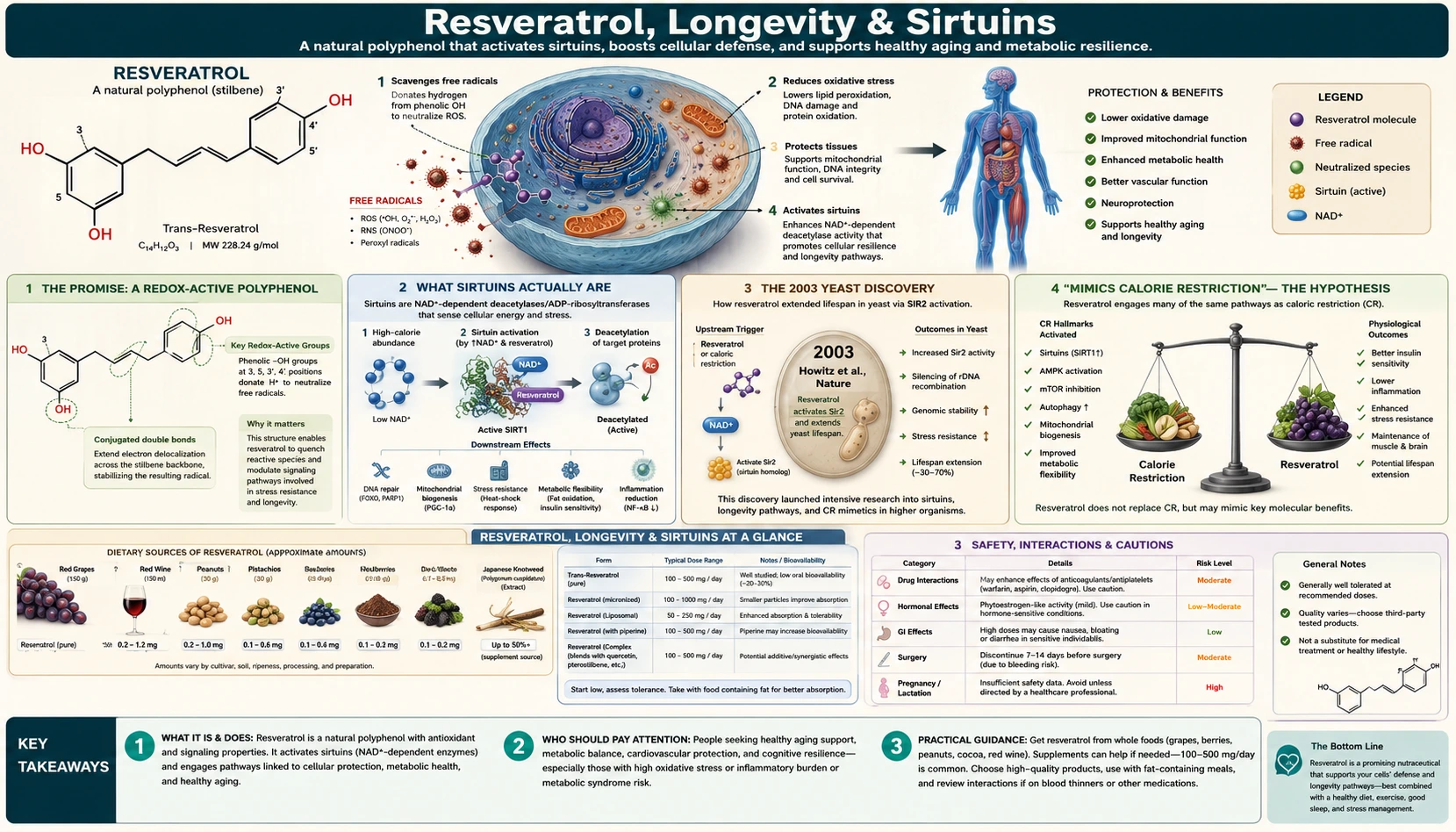
This is the story that made resveratrol famous and the one most distorted by hype. In 2003 a Harvard lab reported that resveratrol activated sirtuins and extended the lifespan of yeast; in 2006 it made obese mice live longer and run farther; a company was founded, a pharmaceutical giant paid hundreds of millions of dollars for it, and resveratrol became the face of a "cure for aging." Then the careful follow-up work arrived: on a normal diet the mice did not live longer, resveratrol may not even be a direct sirtuin activator (the original assay had an artifact), a human population study found dietary resveratrol unrelated to survival, and the molecule barely survives digestion. This page tells that arc honestly — the genuinely exciting biology, the commercial overreach, and the sobering gap between mouse and human.
Table of Contents
- The Promise
- What Sirtuins Actually Are
- The 2003 Yeast Discovery
- "Mimics Calorie Restriction" — the Hypothesis
- The Mouse Data: Exciting but Conditional
- Is Resveratrol Even a Direct Sirtuin Activator?
- Sirtris, GSK, and the Hype Machine
- The Human Longevity Evidence Gap
- The Bioavailability Problem
- Honest Bottom Line
- Cautions
- Key Research Papers
- Connections
- Featured Videos
The Promise
The dream behind resveratrol is one of the oldest in medicine: a pill that slows aging itself. The scientific hook that made the dream briefly credible was calorie restriction — the single most reproducible way to extend lifespan in laboratory animals. Eating roughly 30% fewer calories, without malnutrition, reliably lengthens the lives of yeast, worms, flies, mice, and rats, and improves many markers of health. If a molecule could switch on the same machinery calorie restriction uses — a "calorie-restriction mimetic" — it might deliver the benefits without the deprivation. Resveratrol was proposed as exactly that molecule. The rest of this page is the story of how well that proposal held up.
What Sirtuins Actually Are
Sirtuins are a family of enzymes (in mammals, SIRT1 through SIRT7) descended from the yeast gene Sir2 (Silent Information Regulator 2). They are NAD+-dependent deacetylases: they remove acetyl groups from proteins, and crucially they require the coenzyme NAD+ to do it. Because NAD+ levels rise when a cell is energy-stressed (fasting, exercise, calorie restriction) and fall with overfeeding and age, sirtuins act as sensors of the cell's energy state, adjusting gene expression, DNA repair, mitochondrial function, and metabolism accordingly.
SIRT1, the most studied, deacetylates targets including the transcription co-activator PGC-1α (a master switch for mitochondrial biogenesis), the tumor-suppressor p53, the FOXO family, and NF-κB. Through these it can, in principle, promote mitochondrial health, stress resistance, and reduced inflammation. This is genuinely important biology — the question was always whether resveratrol meaningfully engages it in a living human at an achievable dose. The dependence of sirtuins on NAD+ is also why the field's attention later shifted toward raising NAD+ directly; see NAD+ / NMN.
The 2003 Yeast Discovery
The paper that started everything was Howitz, Sinclair, and colleagues in Nature (2003). Screening for small molecules that could activate Sir2, they identified a class of plant polyphenols — resveratrol chief among them — that appeared to stimulate the enzyme, and reported that resveratrol extended the replicative lifespan of budding yeast by up to about 70%, apparently by mimicking the effect of calorie restriction on Sir2. Later work extended the lifespan claims to worms (C. elegans) and fruit flies.
This was a legitimately exciting result and it launched a decade of intense research. But two cautions were present almost from the start, and both matured into the controversy described below: the lifespan extensions were in very simple organisms, and the biochemical assay used to declare resveratrol a "sirtuin activator" had a hidden feature that would later be shown to distort the result.
"Mimics Calorie Restriction" — the Hypothesis
The framing that captured public imagination was that resveratrol is a calorie-restriction mimetic: a compound that tricks the body into the fasted, stress-resistant, longevity-favoring state without actually eating less. Because Sir2/SIRT1 is one of the pathways through which calorie restriction is thought to act, and because resveratrol appeared to activate it, the logical leap was natural.
The leap is where the trouble began. "Activates a pathway that overlaps with calorie restriction" is a much weaker claim than "reproduces the lifespan and health benefits of calorie restriction." Calorie restriction works through many overlapping mechanisms (mTOR, AMPK, insulin/IGF-1, autophagy, and sirtuins), and even calorie restriction's own longevity benefit is not universal across species or genetic backgrounds. A single molecule nudging one node of that network was never guaranteed to deliver the whole effect — and, as it turned out, it did not.
The Mouse Data: Exciting but Conditional
The mouse studies are where honesty matters most, because the headlines reported only half of them.
The famous positive result (Baur, Sinclair, et al., Nature 2006). Middle-aged mice fed a high-calorie (high-fat) diet plus resveratrol survived significantly longer than mice on the high-calorie diet alone, and their physiology shifted toward that of mice on a standard diet: better insulin sensitivity, lower IGF-1, increased AMPK and PGC-1α activity, more mitochondria, better motor coordination. The same year, Lagouge and colleagues (Cell 2006) showed resveratrol increased mitochondrial number and running endurance in mice by activating SIRT1 and PGC-1α. These are real, well-conducted studies.
The crucial caveat (Pearson, et al., Cell Metabolism 2008). The same broad research program then tested resveratrol in mice on a standard, healthy diet — and found that it improved many markers of aging (reduced inflammation and cataracts, better bone density, greater aortic elasticity, improved motor function) but did not extend lifespan. In other words, resveratrol rescued mice from the harms of an unhealthy diet, but did not make already-healthy mice live longer.
The honest synthesis is important: resveratrol looks most like a protector against metabolic damage in the context of overnutrition, and much less like a genuine longevity drug in healthy animals. The dramatic survival benefit required an unhealthy baseline for it to counteract. Independent replication attempts, including large studies by the U.S. National Institute on Aging's Interventions Testing Program, have generally failed to show consistent lifespan extension from resveratrol in normally-fed mice.
Is Resveratrol Even a Direct Sirtuin Activator?
Beneath the lifespan debate sat a more fundamental biochemical problem. The assay used to show that resveratrol "activates SIRT1" relied on a peptide substrate carrying an attached fluorophore (a fluorescent tag used to read out enzyme activity). Kaeberlein and colleagues (J. Biol. Chem. 2005) demonstrated that resveratrol's apparent activation was substrate-specific — it appeared only with the fluorophore-tagged peptide. Pacholec and colleagues at Pfizer (J. Biol. Chem. 2010) drove the point home: resveratrol and several synthetic "sirtuin activators" did not activate SIRT1 against native, untagged substrates or full-length proteins; the activation was an artifact of the fluorescent label.
This does not mean resveratrol does nothing to sirtuin signaling — it may act indirectly, for example by inhibiting cAMP phosphodiesterases and thereby raising AMPK and NAD+, which then engages SIRT1. But it does mean the simple, headline story — "resveratrol is a direct sirtuin activator that turns on the longevity gene" — was, at minimum, badly oversimplified and, in the direct-binding sense claimed, likely wrong. The mechanism is still debated; the marketing was not.
Sirtris, GSK, and the Hype Machine
The science did not stay in the lab. In 2004 David Sinclair co-founded Sirtris Pharmaceuticals to develop sirtuin-activating compounds; in 2008 GlaxoSmithKline acquired Sirtris for approximately $720 million. Resveratrol itself, being an unpatentable natural product with poor bioavailability, was never the drug — Sirtris pursued patentable synthetic activators (the "STACs," such as SRT1720) said to be far more potent. It was precisely those synthetic compounds that Pacholec's 2010 paper reported were not direct SIRT1 activators either, deepening the controversy. GSK eventually wound down the Sirtris unit.
Meanwhile, a wave of popular books, television segments, and supplement marketing promoted resveratrol directly to consumers as an anti-aging breakthrough, often citing the yeast and high-calorie-mouse data while omitting the standard-diet-mouse null result and the direct-activation controversy. The commercial narrative outran the evidence by a wide margin. This is the central reason a page like this one has to exist: the public story and the scientific story diverged, and the public story sold supplements. For how the discovery unfolded historically, see the Resveratrol History page.
The Human Longevity Evidence Gap
Here the honesty is simplest, because there is almost nothing to report. No human trial has ever shown that resveratrol extends lifespan or delays aging — and, practically, none ever will, because a human lifespan trial would take many decades and enormous numbers of participants. The closest real-world evidence is observational.
The most cited such study is Semba and colleagues (JAMA Internal Medicine 2014), which used the InCHIANTI cohort of older adults in the Chianti region of Italy — a population whose diet naturally contains resveratrol from wine and food. The researchers measured urinary resveratrol metabolites as a marker of dietary intake and followed the participants for nine years. The result was blunt: resveratrol levels were not associated with inflammatory markers, cardiovascular disease, cancer, or all-cause mortality. Dietary resveratrol, in the one population where you might most expect to see a longevity signal, showed none.
This is not proof that high-dose supplemental resveratrol does nothing over a lifetime — observational dietary levels are far lower than supplement doses, and the study cannot address that. But it directly refutes the popular claim that the resveratrol in a Mediterranean diet is a driver of longevity, and it is the best human longevity-relevant data we have.
The Bioavailability Problem
Even setting aside the lifespan question, there is a pharmacological reason to be skeptical of resveratrol as a systemic anti-aging agent: very little of it reaches your tissues in active form. Walle and colleagues (Drug Metabolism and Disposition 2004) gave people a 25 mg oral dose and found that although resveratrol was well absorbed (about 70%), its oral bioavailability was so low as to be nearly undetectable — almost all of it was rapidly converted to resveratrol glucuronides and sulfates by the gut and liver. Boocock and colleagues (2007) confirmed that even large doses up to 5 grams produce only modest peak concentrations of free resveratrol, dominated by these metabolites.
The metabolites may retain some activity and can be reconverted to resveratrol in tissues to a limited degree, which keeps the door open a crack. But the basic fact remains: the concentrations of free resveratrol used to produce dramatic effects in cell culture (often tens of micromolar) are far higher than what oral dosing achieves in human blood or tissue. Any honest account of resveratrol's longevity potential has to sit inside this constraint.
Honest Bottom Line
- The yeast, worm, fly, and high-calorie-mouse data are real and interesting. Resveratrol engages genuine stress-response and metabolic pathways.
- The longevity claim does not survive scrutiny in mammals: on a normal diet, resveratrol improved healthspan markers but did not extend mouse lifespan, and independent testing programs have not found consistent lifespan extension.
- The "direct sirtuin activator" mechanism was largely an assay artifact (the fluorophore problem); any effect on sirtuins is likely indirect and is still debated.
- There is no human longevity evidence, and the best observational study found dietary resveratrol unrelated to mortality.
- Bioavailability is very low, undercutting the systemic anti-aging premise.
- Resveratrol is best described today as a metabolically active polyphenol with modest, condition-dependent effects — not an anti-aging drug. The interventions with real longevity-relevant evidence remain not smoking, physical activity, sleep, and a whole-food diet.
Cautions
- Do not treat resveratrol as life-extension insurance. The evidence does not support it, and betting a health strategy on it means neglecting interventions that do work.
- High-dose supplements can cause gastrointestinal upset (nausea, cramping, diarrhea), most notably at the multi-gram doses used in pharmacokinetic studies.
- Drug interactions via cytochrome P450 inhibition and antiplatelet activity apply here as on every resveratrol page — see the Heart & Circulation and Antioxidant pages.
- Phytoestrogen activity warrants caution in hormone-sensitive conditions.
- Pregnancy and breastfeeding: avoid supplemental doses; safety is not established.
Key Research Papers
- Howitz KT, Sinclair DA, et al. (2003). Small molecule activators of sirtuins extend Saccharomyces cerevisiae lifespan. Nature, 425(6954), 191–196. — PubMed 12939617
- Baur JA, Sinclair DA, et al. (2006). Resveratrol improves health and survival of mice on a high-calorie diet. Nature, 444(7117), 337–342. — PubMed 17086191
- Lagouge M, et al. (2006). Resveratrol improves mitochondrial function and protects against metabolic disease by activating SIRT1 and PGC-1α. Cell, 127(6), 1109–1122. — PubMed 17112576
- Pearson KJ, et al. (2008). Resveratrol delays age-related deterioration and mimics transcriptional aspects of dietary restriction without extending life span. Cell Metabolism, 8(2), 157–168. — PubMed 18599363
- Kaeberlein M, et al. (2005). Substrate-specific activation of sirtuins by resveratrol. Journal of Biological Chemistry, 280(17), 17038–17045. — Search PubMed
- Pacholec M, et al. (2010). SRT1720, SRT2183, SRT1460, and resveratrol are not direct activators of SIRT1. Journal of Biological Chemistry, 285(11), 8340–8351. — PubMed 20061378
- Semba RD, et al. (2014). Resveratrol levels and all-cause mortality in older community-dwelling adults. JAMA Internal Medicine, 174(7), 1077–1084. — PubMed 24819981
- Walle T, et al. (2004). High absorption but very low bioavailability of oral resveratrol in humans. Drug Metabolism and Disposition, 32(12), 1377–1382. — PubMed 15333514
- Boocock DJ, et al. (2007). Phase I dose escalation pharmacokinetic study of resveratrol in healthy volunteers. Cancer Epidemiology, Biomarkers & Prevention, 16(6), 1246–1252. — PubMed 17548692
- Timmers S, et al. (2011). Calorie restriction-like effects of 30 days of resveratrol supplementation in obese humans. Cell Metabolism, 14(5), 612–622. — PubMed 22055504
PubMed Topic Searches
- PubMed: resveratrol & sirtuins
- PubMed: calorie-restriction mimetics
- PubMed: resveratrol & mouse lifespan
- PubMed: SIRT1 activation assay artifact
- PubMed: resveratrol bioavailability
Connections
- Resveratrol Benefits Hub
- Resveratrol Overview
- Resveratrol History & Discovery
- Metabolic & Blood Sugar
- Antioxidant & Cellular Protection
- NAD+ / NMN
- Spermidine (Autophagy)
- Fisetin (Senolytic)
- CoQ10 (Mitochondria)
- Alpha-Lipoic Acid
- Curcumin
- Alzheimer's Disease
- Metabolic Syndrome
- All Antioxidants
- Minerals