CoQ10 for Heart Failure
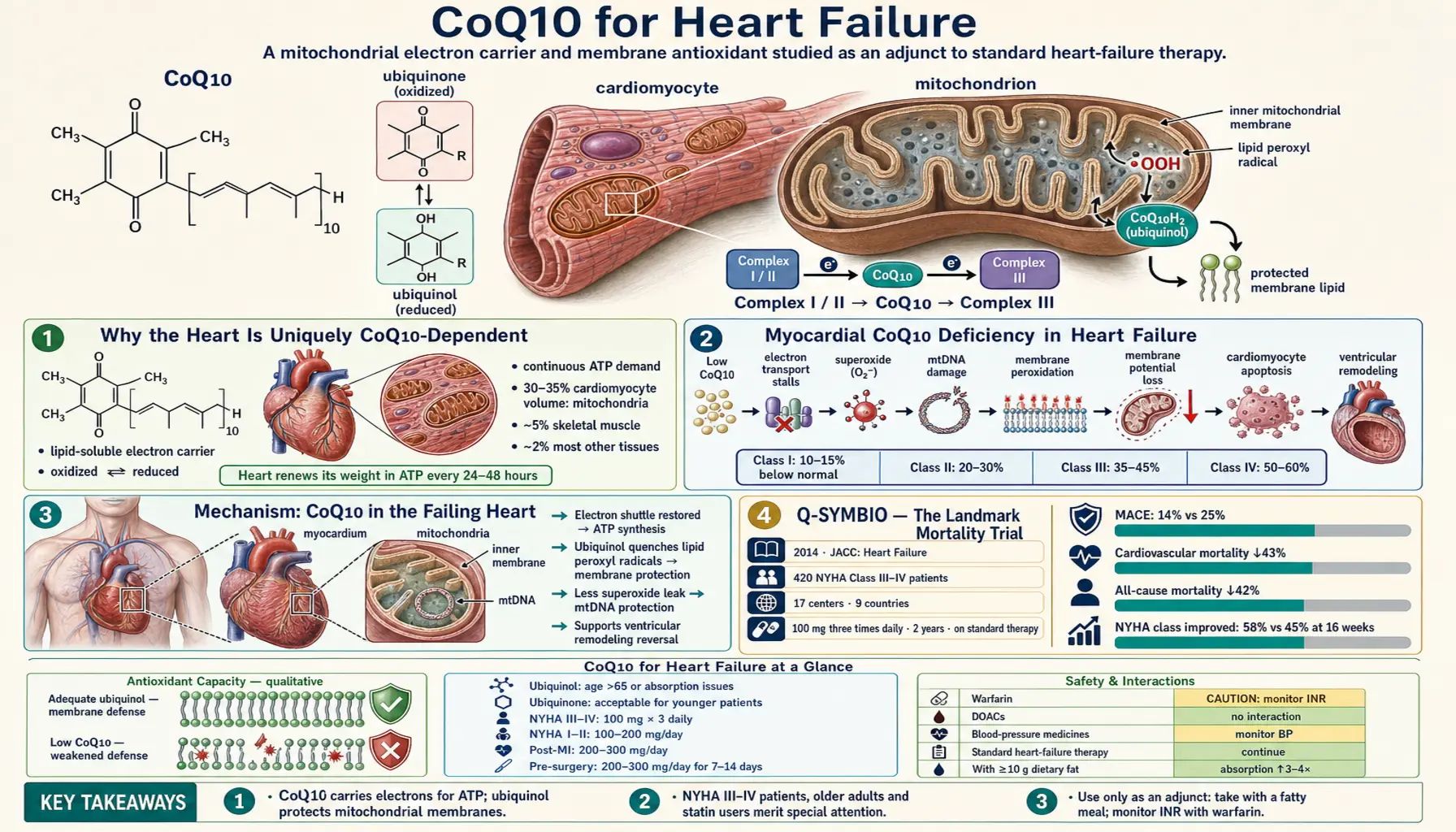
Heart failure is the condition in which coenzyme Q10 (CoQ10) has its largest outcome trial. In Q-SYMBIO (Mortensen et al. 2014), 420 people with moderate to severe heart failure on standard therapy were randomized to CoQ10 100 mg three times daily or placebo for 2 years. Nothing changed significantly at 16 weeks; at 2 years, major adverse cardiovascular events occurred in 15% of the CoQ10 group vs 26% with placebo (hazard ratio 0.50), with fewer cardiovascular and all-cause deaths. The trial enrolled fewer people than the 550 planned, and the 2021 Cochrane review found “no convincing evidence to support or refute” CoQ10 for heart failure. The KiSel-10 trial in older Swedish adults gave selenium together with CoQ10 and reported lower cardiovascular mortality; its authors call the findings hypothesis-generating. This page sets out those trials, the earlier studies and meta-analyses, the doses used, and the safety findings.
Interactive Visualization Free Radicals & Your Antioxidant Network Follow one superoxide radical down the whole relay — SOD, catalase, glutathione, vitamin E, vitamin C, NADPH — then release free iron and watch a membrane tear itself apart. Launch →
Table of Contents
- Why CoQ10 Matters to Heart Muscle
- Myocardial CoQ10 in Heart Failure
- Proposed Mechanism in the Failing Heart
- Q-SYMBIO — The Largest Outcome Trial
- KiSel-10 — Selenium Plus CoQ10 in Older Adults
- Earlier Trials and Case Series
- Meta-Analyses and Cochrane Reviews
- Ubiquinol vs Ubiquinone: What the Studies Found
- Doses and Schedules Used in Studies
- CoQ10 Alongside Standard Heart-Failure Therapy
- Common Questions, Answered From the Research
- Safety Findings Relevant to Heart Failure
- Key Research Papers
- Connections
- Featured Videos
Why CoQ10 Matters to Heart Muscle
The heart contracts continuously and depends on a steady supply of ATP made in its mitochondria. CoQ10 is the fat-soluble electron carrier that passes electrons from Complexes I and II of the electron transport chain to Complex III, a central step in that ATP production. The body makes its own CoQ10 through the mevalonate pathway, the same pathway statins block.
In a study of human organs from newborns to people aged 81 (Kalén et al. 1989), ubiquinone content in most organs, including the heart, peaked at about 20 years of age and then fell with further aging. Whether this age-related fall contributes to heart failure in older adults has not been established.
Myocardial CoQ10 in Heart Failure
The early tissue measurements came from Karl Folkers, Svend Mortensen and colleagues, who measured CoQ10 by HPLC in endomyocardial biopsies taken after routine heart catheterization:
- Folkers et al. 1985 (43 people with cardiomyopathy): 6 were in New York Heart Association (NYHA) class I, 18 in class II, 11 in class III and 8 in class IV. Heart-muscle CoQ10 was lower in class IV than in class I, and lower in classes III-IV than in classes I-II. Biopsies from healthy hearts were not available for comparison, for ethical reasons. In five patients biopsied again after 2-8 months of CoQ10, tissue levels had risen by 20% to 85%. Blood levels also fell with disease severity, but less markedly than the biopsy levels.
- Mortensen et al. 1990 (a review of biopsies from 45 patients): CoQ10 was lower in several kinds of myocardial failure than in “normal” myocardium (0.42 µg/mg dry weight). In dilated cardiomyopathy, classes III-IV had lower tissue CoQ10 than classes I-II (0.28 vs 0.37 µg/mg).
These studies show an association between lower heart-muscle CoQ10 and more severe symptoms. They do not show whether low CoQ10 drives the disease or results from it.
Proposed Mechanism in the Failing Heart
The Q-SYMBIO investigators summarize the rationale this way: CoQ10 is an essential cofactor for energy production and also an antioxidant, and a low level of myocardial CoQ10 is related to the severity of heart failure. The 2003 design paper for the trial describes energy starvation of the myocardium as “probably a dominant feature” of heart failure. The 2021 Cochrane review lists further proposed roles: reducing the harm of reactive oxygen species, stabilising calcium-dependent ion channels in heart muscle, and preserving metabolites needed for ATP synthesis.
Tissue studies show that oral CoQ10 reaches heart muscle. In a randomized trial in people having elective cardiac surgery (Rosenfeldt et al. 2005), 300 mg/day for 2 weeks before the operation raised CoQ10 in serum, in atrial muscle and in isolated heart mitochondria, made mitochondrial respiration more efficient and improved the recovery of excised atrial muscle after a laboratory hypoxia test. These are tissue and laboratory measures; that trial found no difference in heart function or troponin release around surgery.
The mechanism remains a hypothesis. The outcome trials below test whether the theory translates into clinical benefit.
Q-SYMBIO — The Largest Outcome Trial
Q-SYMBIO (Mortensen et al., 2014, JACC: Heart Failure) is the largest randomized, double-blind trial of CoQ10 in heart failure with clinical outcomes as its endpoint.
Design
- Population: people with moderate to severe chronic heart failure on standard therapy; 420 were enrolled. The 2003 design paper had planned 550 patients in NYHA class III-IV.
- Intervention: CoQ10 100 mg three times daily, or placebo, for 2 years, in addition to standard therapy.
- Short-term primary endpoints at 16 weeks: changes in NYHA class, 6-minute walk test and NT-proBNP.
- Long-term primary endpoint at 2 years: major adverse cardiovascular events (MACE), analysed as time to first event.
Results reported in the abstract
- Short-term endpoints at 16 weeks: no significant changes.
- MACE at 2 years: 15% of the CoQ10 group vs 26% of the placebo group (hazard ratio 0.50; 95% CI 0.32 to 0.80; p = 0.003, intention to treat).
- Cardiovascular mortality: 9% vs 16% (p = 0.026).
- All-cause mortality: 10% vs 18% (p = 0.018).
- Hospital stays for heart failure: lower with CoQ10 (p = 0.033).
- NYHA class: improved in the CoQ10 group after 2 years (p = 0.028).
- Safety: the authors concluded that long-term CoQ10 treatment was safe.
Q-SYMBIO event rates at 2 years, as reported in the trial abstract.
Limits of the evidence
Q-SYMBIO is small for a mortality trial. Its 2003 design paper planned 550 patients; the published trial enrolled 420, and its abstract does not report why enrolment ended below the planned size. A 2016 state-of-the-art review (Sharma et al., Circulation: Heart Failure) described the trial as “having limitations” and called for adequately powered randomized trials. The 2021 Cochrane review (Al Saadi et al.; 11 studies, 1,573 participants) found that CoQ10 probably reduces all-cause mortality (RR 0.58; 95% CI 0.35 to 0.95) and heart-failure hospitalisation (RR 0.62; 95% CI 0.49 to 0.78); the mortality estimate rests on this one 420-patient trial. The review judged every included study to have unclear or high risk of bias in at least one domain, and concluded that there is “currently no convincing evidence to support or refute” CoQ10 for heart failure. Q-SYMBIO tested CoQ10 alongside standard heart-failure therapy, not as a replacement for it.
What the heart-failure guidelines say
According to a 2022 review (Filipiak et al., Journal of Cardiovascular Development and Disease), the 2021 European Society of Cardiology (ESC) heart-failure guideline does not mention CoQ10, and the 2022 AHA/ACC/HFSA heart-failure guideline mentions CoQ10 in its treatment chapter but does not define its place in heart-failure management. The review’s first author was one of the Q-SYMBIO investigators, and its authors argue that the trial deserves a place in future guidelines; that is their view, not a guideline position.
KiSel-10 — Selenium Plus CoQ10 in Older Adults
KiSel-10, led by Urban Alehagen in Sweden, tested combined selenium and CoQ10 in older people from the general population, not specifically in people with heart failure. The authors’ rationale was that selenium intake is low in Europe and that the body’s own CoQ10 production falls with age.
Design
- Population: 443 Swedish citizens aged 70-88 from a rural municipality, described in the follow-up papers as healthy elderly people.
- Intervention: CoQ10 200 mg/day plus selenium yeast 200 µg/day, or placebo, for four years.
- Follow-up: the main report at 5.2 years, then analyses at 10 and 12 years.
Results
- Main report (2013): over 5.2 years, cardiovascular mortality was 5.9% in the active group vs 12.6% with placebo (P = 0.015). NT-proBNP was lower (214 vs 302 ng/L at 48 months; P = 0.014), and an echocardiographic cardiac function score was better in the active group (P = 0.03).
- At 10 years (2015): reduced cardiovascular mortality risk in the active group (hazard ratio 0.51; 95% CI 0.36-0.74).
- At 12 years (2018): cardiovascular mortality 28.1% vs 38.7% (HR 0.59; 95% CI 0.42-0.81). The authors write that the mechanisms behind the persisting difference “remain to be fully elucidated.”
Limits of the evidence
The authors state that, since this was a small study, the observations “should be regarded as hypothesis-generating.” Because selenium and CoQ10 were given together, the trial cannot separate the effect of one from the other, and its results cannot be credited to CoQ10 alone. The 2018 paper discloses that the trial tablets were supplied by a supplement manufacturer.
Earlier Trials and Case Series
Q-SYMBIO followed roughly three decades of smaller studies. In the 2003 design paper, Mortensen counted 13 double-blind studies, of which 3 (about 10% of the patients treated) had neutral results; the rest reported improvements in measures such as NYHA class, exercise capacity and hospitalisation. That paper was written by the trial’s lead investigator to explain why the trial was being run.
Mortensen et al. (1990, International Journal of Tissue Reactions)
A review of the group’s own work. Besides the biopsy measurements described above, it reports an open study of 40 people in severe heart failure (NYHA class III-IV) given CoQ10 100 mg daily: nearly two thirds showed subjective and objective improvement, with responders making up 69% of those with cardiomyopathy and 43% of those with ischaemic heart disease. It was not placebo-controlled.
Morisco, Trimarco and Condorelli (1993, Clinical Investigator)
641 people with chronic congestive heart failure in NYHA class III-IV, on conventional treatment, were randomized to CoQ10 2 mg/kg per day (319) or placebo (322) for 1 year, double-blind. Fewer people in the CoQ10 group needed hospital admission for worsening heart failure (73 vs 118; P < 0.001), and the abstract reports fewer episodes of pulmonary edema (20 vs 51) and cardiac asthma (97 vs 198) with CoQ10 (both P < 0.001).
Watson et al. (1999, Journal of the American College of Cardiology) — no effect
Thirty people with ischaemic or idiopathic dilated cardiomyopathy (ejection fraction 26%) entered a double-blind crossover of CoQ10 vs placebo, 3 months each; 27 completed both phases. Plasma CoQ10 more than doubled, but there was no significant difference in ejection fraction, cardiac volumes, haemodynamics or quality of life. The authors concluded that CoQ10 “failed to improve resting left ventricular systolic function or quality of life.”
Langsjoen and Langsjoen (2008, BioFactors) — seven-patient case series
Seven people with advanced heart failure (mean ejection fraction 22%) had low plasma CoQ10 (mean 1.6 µg/mL) on an average of 450 mg/day of ubiquinone. After a change to an average of 580 mg/day of ubiquinol, mean plasma CoQ10 rose to 6.5 µg/mL, mean ejection fraction rose from 22% to 39%, and mean NYHA class went from IV to II. The authors suggested that intestinal oedema in critically ill patients may impair absorption. This was an uncontrolled report of seven patients.
Meta-Analyses and Cochrane Reviews
Pooled analyses of the trials reach different conclusions, depending on which trials and outcomes they include:
Sander et al. (2006, Journal of Cardiac Failure)
Of 11 randomized controlled trials identified, 10 measured ejection fraction (277 patients) and 2 measured cardiac output (42 patients). Doses ranged from 60 to 200 mg/day for 1 to 6 months. Ejection fraction improved by a net 3.7% (95% CI 1.59-5.77), with a larger effect in patients not taking ACE inhibitors (6.74%), and cardiac output rose by an average of 0.28 L/minute. The authors concluded that CoQ10 enhances systolic function but that its effectiveness “may be reduced with concomitant use of current standard therapies.”
Madmani et al. (2014, Cochrane review)
Seven studies with 914 participants. Its searches ran in January 2013, before Q-SYMBIO was published. There were no data on clinical events from published randomized trials, and pooled analysis showed no clear effect on ejection fraction or exercise capacity. The authors concluded that “no conclusions can be drawn on the benefits or harms” of CoQ10 in heart failure. This version was replaced by the 2021 update below.
Lei and Liu (2017, BMC Cardiovascular Disorders)
Fourteen randomized trials with 2,149 patients, including Q-SYMBIO. CoQ10 was associated with lower mortality than placebo (RR 0.69; 95% CI 0.50-0.95) and greater improvement in exercise capacity. No significant differences were found in ejection fraction or NYHA class.
Al Saadi et al. (2021, updated Cochrane review)
Eleven studies with 1,573 participants. CoQ10 probably reduces all-cause mortality (RR 0.58; 95% CI 0.35 to 0.95; one study, 420 participants) and heart-failure hospitalisation (RR 0.62; two studies, 1,061 participants), both moderate-quality evidence. Results for myocardial infarction, stroke, exercise capacity and adverse events were inconclusive, and it was very uncertain whether CoQ10 changes ejection fraction. The authors concluded that there is “currently no convincing evidence to support or refute” CoQ10 for heart failure and that future trials are needed.
Ubiquinol vs Ubiquinone: What the Studies Found
Ubiquinone is the oxidized form of CoQ10 and ubiquinol the reduced form; the body converts one to the other. Both Q-SYMBIO and KiSel-10 used ubiquinone, according to a 2020 review of CoQ10 bioavailability (Mantle & Dybring). Whether ubiquinol is better absorbed is disputed:
- In a double-blind crossover in 10 older men (Zhang et al. 2018), 200 mg/day of ubiquinol for 2 weeks raised total plasma CoQ10 from 1.3 to 3.4 µmol/L, while the same dose of ubiquinone produced no significant increase; six of the 10 men responded more to ubiquinol and two more to ubiquinone.
- In a double-blind crossover of seven 100 mg products in 14 young, healthy volunteers (López-Lluch et al. 2019), absorption differed widely between products; the two best absorbed were soft-gel capsules of ubiquinone and of ubiquinol. The carrier and solubilization affected absorption, and individuals varied widely.
- The 2020 review (Mantle & Dybring) concluded that the idea of superior ubiquinol bioavailability “would appear to be mistaken,” arguing that studies favouring ubiquinol compared it with ubiquinone that had not undergone crystal dispersion. Both authors are employees of a company that makes ubiquinone supplements.
- The heart-failure ubiquinol data described on this page come from the uncontrolled seven-patient Langsjoen case series above.
The heart-failure outcome trials described on this page used ubiquinone.
Doses and Schedules Used in Studies
The doses below are those used in the studies described on this page; they are reported as findings, not instructions. Decisions about supplements belong with a clinician.
- Q-SYMBIO (moderate to severe heart failure): ubiquinone 100 mg three times daily (300 mg/day) for 2 years, alongside standard therapy.
- KiSel-10 (older adults from the general population): 200 mg/day CoQ10 combined with 200 µg/day selenium yeast for four years.
- Morisco et al. 1993: 2 mg/kg per day for 1 year.
- Trials pooled by Sander et al. 2006: 60 to 200 mg/day for 1 to 6 months.
- Before cardiac surgery (Rosenfeldt et al. 2005): 300 mg/day for 2 weeks before the operation; tissue CoQ10 rose, with no difference in heart function or troponin release after surgery.
- Langsjoen case series 2008: an average of 580 mg/day of ubiquinol (range 450-900 mg/day) in seven patients.
Q-SYMBIO measured its outcomes at 16 weeks and at 2 years: the 16-week measures did not change significantly, and the differences in events, deaths and NYHA class were reported at 2 years.
CoQ10 Alongside Standard Heart-Failure Therapy
Every outcome trial on this page tested CoQ10 in addition to standard treatment. Q-SYMBIO patients stayed on their usual heart-failure therapy, and the Morisco trial patients on conventional treatment. None of them tested CoQ10 as a replacement for any heart-failure medicine.
- ACE inhibitors: in the Sander meta-analysis the gain in ejection fraction was larger in patients not taking ACE inhibitors (6.74% vs 3.7% overall), and the authors suggested CoQ10’s effect may be smaller on top of current standard therapies.
- Modern therapies: the 2016 state-of-the-art review (Sharma et al.) notes that the trials over the past 30 years were limited by small numbers and lack of contemporary heart-failure therapies.
- Blood-pressure medicines: some uncontrolled and small randomized studies reported blood-pressure falls with CoQ10 (Rosenfeldt et al. 2007), which raises the possibility of an added effect with antihypertensive drugs; the Cochrane review of CoQ10 in primary hypertension (Ho et al. 2016) found no significant effect on blood pressure.
- Warfarin: see the safety section below.
- Selenium: in KiSel-10, selenium was part of the tested combination; the trial was in older adults from the general population and cannot show what either supplement does on its own.
- Statins: statins block the pathway the body uses to make CoQ10; CoQ10 trials in statin muscle symptoms are covered on the CoQ10 statin myopathy page.
Common Questions, Answered From the Research
Does CoQ10 lower the risk of death in heart failure?
One trial, Q-SYMBIO, reported fewer deaths over 2 years (all-cause mortality 10% vs 18%). The 2021 Cochrane review rated this as moderate-quality evidence from that single trial and concluded that there is currently no convincing evidence to support or refute CoQ10 for heart failure.
How does CoQ10 compare with standard heart-failure medicines?
The trials described here tested CoQ10 only as an add-on to standard therapy, not against any heart-failure medicine. Q-SYMBIO, the largest, enrolled 420 people.
Do heart-failure guidelines include CoQ10?
According to the 2022 Filipiak review, the 2021 ESC guideline does not mention CoQ10 and the 2022 AHA/ACC/HFSA guideline mentions it without defining its place in management.
How quickly were effects seen in the trials?
In Q-SYMBIO, NYHA class, 6-minute walk distance and NT-proBNP did not change significantly at 16 weeks; the differences were reported at 2 years.
Is ubiquinol better than ubiquinone for heart failure?
The heart-failure outcome trials used ubiquinone. The ubiquinol data in heart failure described here come from a seven-patient case series, and absorption studies in healthy people disagree.
Did the benefit in KiSel-10 come from CoQ10?
That cannot be told from the trial, because selenium and CoQ10 were given together. The authors call the findings hypothesis-generating.
What about warfarin?
Case reports describe a reduced warfarin effect with CoQ10, while a small randomized crossover trial found no change in INR (details below). Decisions about medicines and supplements belong with a clinician.
Safety Findings Relevant to Heart Failure
- Overall tolerability — the Q-SYMBIO authors concluded that long-term CoQ10 treatment was safe. The 2021 Cochrane review found the evidence on adverse events inconclusive (RR 0.70; 95% CI 0.45 to 1.10; 2 studies, 568 participants). The 2016 state-of-the-art review describes CoQ10 as relatively safe, with few drug interactions and side effects.
- Warfarin — CoQ10 has a chemical structure similar to vitamin K (Sharma et al. 2016). Case reports describe a reduced effect of warfarin with CoQ10 (Spigset 1994). In a randomized, double-blind, placebo-controlled crossover trial in 24 outpatients on stable long-term warfarin (Engelsen et al. 2002), CoQ10 100 mg/day for four weeks did not change the INR or the warfarin dose.
- Blood pressure — small studies reported blood-pressure falls (Rosenfeldt et al. 2007), while the Cochrane review in primary hypertension (Ho et al. 2016) found no significant effect. The research raises a question of an added effect for people already taking blood-pressure medicines.
- Standard therapy — every trial described here tested CoQ10 on top of standard heart-failure treatment; there is no trial evidence for CoQ10 in place of it.
Key Research Papers
- Mortensen SA, Rosenfeldt F, Kumar A, et al. (2014). The effect of coenzyme Q10 on morbidity and mortality in chronic heart failure: results from Q-SYMBIO: a randomized double-blind trial. JACC Heart Fail 2(6):641-9 — PubMed PMID: 25282031
- Alehagen U, Johansson P, Björnstedt M, et al. (2013). Cardiovascular mortality and N-terminal-proBNP reduced after combined selenium and coenzyme Q10 supplementation: a 5-year prospective randomized double-blind placebo-controlled trial among elderly Swedish citizens. Int J Cardiol 167(5):1860-6 — PubMed PMID: 22626835
- Alehagen U, Aaseth J, Alexander J, et al. (2018). Still reduced cardiovascular mortality 12 years after supplementation with selenium and coenzyme Q10 for four years: A validation of previous 10-year follow-up results of a prospective randomized double-blind placebo-controlled trial in elderly. PLoS One 13(4):e0193120 — PubMed PMID: 29641571
- Mortensen SA, Vadhanavikit S, Muratsu K, et al. (1990). Coenzyme Q10: clinical benefits with biochemical correlates suggesting a scientific breakthrough in the management of chronic heart failure. Int J Tissue React 12(3):155-62 — PubMed PMID: 2276893
- Sander S, Coleman CI, Patel AA, et al. (2006). The impact of coenzyme Q10 on systolic function in patients with chronic heart failure. J Card Fail 12(6):464-72 — PubMed PMID: 16911914
- Madmani ME, Yusuf Solaiman A, Tamr Agha K, et al. (2014). Coenzyme Q10 for heart failure. Cochrane Database Syst Rev (6):CD008684 — PubMed PMID: 24049047 (superseded by the 2021 update, PubMed PMID: 35608922)
- Lei L, Liu Y (2017). Efficacy of coenzyme Q10 in patients with cardiac failure: a meta-analysis of clinical trials. BMC Cardiovasc Disord 17(1):196 — PubMed PMID: 28738783
- Langsjoen PH, Langsjoen AM (2008). Supplemental ubiquinol in patients with advanced congestive heart failure. Biofactors 32(1-4):119-28 — PubMed PMID: 19096107
- Morisco C, Trimarco B, Condorelli M (1993). Effect of coenzyme Q10 therapy in patients with congestive heart failure: a long-term multicenter randomized study. Clin Investig 71(8 Suppl):S134-6 — PubMed PMID: 8241697
- Watson PS, Scalia GM, Galbraith A, et al. (1999). Lack of effect of coenzyme Q on left ventricular function in patients with congestive heart failure. J Am Coll Cardiol 33(6):1549-52 — PubMed PMID: 10334422
- Folkers K, Vadhanavikit S, Mortensen SA (1985). Biochemical rationale and myocardial tissue data on the effective therapy of cardiomyopathy with coenzyme Q10. Proc Natl Acad Sci U S A 82(3):901-4 — PubMed PMID: 3856239
- Rosenfeldt F, Marasco S, Lyon W, et al. (2005). Coenzyme Q10 therapy before cardiac surgery improves mitochondrial function and in vitro contractility of myocardial tissue. J Thorac Cardiovasc Surg 129(1):25-32 — PubMed PMID: 15632821
- Mortensen SA (2003). Overview on coenzyme Q10 as adjunctive therapy in chronic heart failure. Rationale, design and end-points of "Q-symbio"--a multinational trial. Biofactors 18(1-4):79-89 — PubMed PMID: 14695923
- Alehagen U, Aaseth J, Johansson P (2015). Reduced Cardiovascular Mortality 10 Years after Supplementation with Selenium and Coenzyme Q10 for Four Years: Follow-Up Results of a Prospective Randomized Double-Blind Placebo-Controlled Trial in Elderly Citizens. PLoS One 10(12):e0141641 — PubMed PMID: 26624886
- Al Saadi T, Assaf Y, Farwati M, et al. (2021). Coenzyme Q10 for heart failure. Cochrane Database Syst Rev 2021(2):CD008684 — PubMed PMID: 35608922
- Sharma A, Fonarow GC, Butler J, et al. (2016). Coenzyme Q10 and Heart Failure: A State-of-the-Art Review. Circ Heart Fail 9(4):e002639 — PubMed PMID: 27012265
- Filipiak KJ, Surma S, Romańczyk M, et al. (2022). Heart Failure-Do We Need New Drugs or Have Them Already? A Case of Coenzyme Q10. J Cardiovasc Dev Dis 9(5):161 — PubMed PMID: 35621872
- McDonagh TA, Metra M, Adamo M, et al. (2021). 2021 ESC Guidelines for the diagnosis and treatment of acute and chronic heart failure. Eur Heart J 42(36):3599-3726 — PubMed PMID: 34447992
- Heidenreich PA, Bozkurt B, Aguilar D, et al. (2022). 2022 AHA/ACC/HFSA Guideline for the Management of Heart Failure: A Report of the American College of Cardiology/American Heart Association Joint Committee on Clinical Practice Guidelines. Circulation 145(18):e895-e1032 — PubMed PMID: 35363499
- Kalén A, Appelkvist EL, Dallner G (1989). Age-related changes in the lipid compositions of rat and human tissues. Lipids 24(7):579-84 — PubMed PMID: 2779364
- Zhang Y, Liu J, Chen XQ, et al. (2018). Ubiquinol is superior to ubiquinone to enhance Coenzyme Q10 status in older men. Food Funct 9(11):5653-5659 — PubMed PMID: 30302465
- López-Lluch G, Del Pozo-Cruz J, Sánchez-Cuesta A, et al. (2019). Bioavailability of coenzyme Q10 supplements depends on carrier lipids and solubilization. Nutrition 57:133-140 — PubMed PMID: 30153575
- Mantle D, Dybring A (2020). Bioavailability of Coenzyme Q(10): An Overview of the Absorption Process and Subsequent Metabolism. Antioxidants (Basel) 9(5):386 — PubMed PMID: 32380795
- Spigset O (1994). Reduced effect of warfarin caused by ubidecarenone. Lancet 344(8933):1372-3 — PubMed PMID: 7968059
- Engelsen J, Nielsen JD, Winther K (2002). Effect of coenzyme Q10 and Ginkgo biloba on warfarin dosage in stable, long-term warfarin treated outpatients. A randomised, double blind, placebo-crossover trial. Thromb Haemost 87(6):1075-6 — PubMed PMID: 12083489
- Rosenfeldt FL, Haas SJ, Krum H, et al. (2007). Coenzyme Q10 in the treatment of hypertension: a meta-analysis of the clinical trials. J Hum Hypertens 21(4):297-306 — PubMed PMID: 17287847
- Ho MJ, Li EC, Wright JM (2016). Blood pressure lowering efficacy of coenzyme Q10 for primary hypertension. Cochrane Database Syst Rev 3(3):CD007435 — PubMed PMID: 26935713
PubMed Topic Searches
Connections
- Free Radicals & Your Antioxidant Network — interactive animation
- CoQ10 Overview
- CoQ10 Benefits Hub
- CoQ10 for Statin Myopathy
- CoQ10 for Migraine
- CoQ10 for Fertility
- Heart Failure (Disease)
- Cardiovascular Disease
- Lipid Panel
- Apolipoprotein B
- Coronary Calcium Score
- Alpha Lipoic Acid
- NAC
- NAD+ & NMN
- All Antioxidants
- Selenium
- Magnesium
- Creatine
- Omega-3 Fatty Acids
- Oxidative Stress
- Longevity Protocols
- History