Coenzyme Q10 (CoQ10) for Fertility (Male & Female)
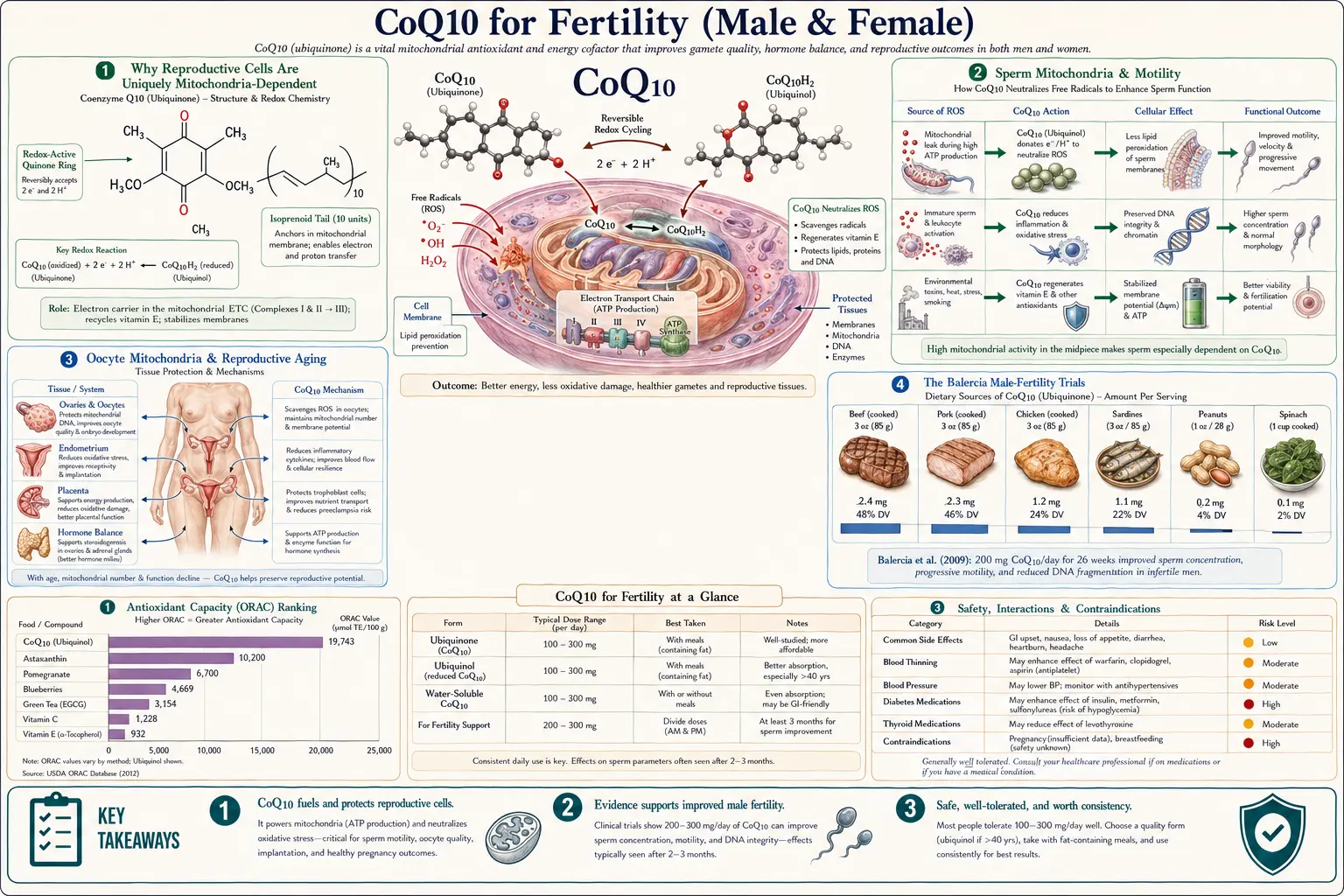
Sperm and eggs both depend on mitochondria, and coenzyme Q10 (CoQ10) is part of the mitochondrial energy chain as well as a membrane antioxidant, which is why it has been studied in fertility. In men with low sperm motility, placebo-controlled trials (Balercia 2009 and others) found that coenzyme Q10 improved sperm measures, but a 2013 meta-analysis of three trials found that coenzyme Q10 did not increase pregnancy rates, and none of the trials reported live births. In women having IVF, a double-blind trial of coenzyme Q10 600 mg/day in women aged 35-43 (Bentov 2014) was stopped early and found no significant differences, and a trial in women under 35 with poor ovarian reserve (Xu 2018) found more eggs and better embryos without a significant difference in pregnancy or live birth. Cochrane reviews of antioxidants as a group rate the evidence for live birth as very low certainty in both men and women, and a large US trial of a multi-antioxidant formula for men (MOXI) found no benefit. This deep-dive covers these studies, the proposed sperm and egg mechanisms, the doses the trials used and what remains untested.
Interactive Visualization Free Radicals & Your Antioxidant Network Follow one superoxide radical down the whole relay — superoxide dismutase (SOD), catalase, glutathione, vitamin E, vitamin C, reduced nicotinamide adenine dinucleotide phosphate (NADPH) — then release free iron and watch a membrane tear itself apart. Launch → Interactive Visualization Fertilization — follow the sperm and time the fertile window Watch 200 million sperm thin to a few hundred at the egg, harden the zona against the second one — then miss the window by two days and see nothing happen at all. Launch →
Table of Contents
- Why Reproductive Cells Are Uniquely Mitochondria-Dependent
- Sperm Mitochondria & Motility
- Oocyte Mitochondria & Reproductive Aging
- The Balercia Male-Fertility Trials
- Meta-Analyses, Cochrane Review and the MOXI Trial
- The Bentov & Casper IVF Trial
- Xu 2018 — Young Women with Poor Ovarian Reserve
- Doses Used in Male-Fertility Trials
- Doses Used in Female-Fertility Trials
- Combination Therapy (Zinc, Selenium, DHEA, Vitamin D)
- Timing Before IVF: What Was Tested
- Patient FAQ
- Safety and Interactions
- Key Research Papers
- Connections
- Featured Videos
Why Reproductive Cells Are Uniquely Mitochondria-Dependent
Sperm and eggs (oocytes) both depend on mitochondria, but in different ways. Coenzyme Q10 is part of the mitochondrial electron transport chain, carrying electrons from Complexes I and II to Complex III, and it also acts as a fat-soluble antioxidant in cell membranes. That dual role is the reason it has been studied in fertility.
Sperm
A mature sperm cell has three working parts: the head, which carries the father's chromosomes and the acrosome (the enzyme cap used to penetrate the egg's outer coat); the midpiece, where the sperm's mitochondria are wrapped around the base of the tail; and the tail (flagellum), which drives swimming. The midpiece mitochondria supply energy for the tail's movement, and they also produce reactive oxygen species (ROS) as a by-product. Sperm membranes are rich in polyunsaturated fats that oxidize easily, so membrane antioxidants such as ubiquinol (the reduced form of coenzyme Q10) have been proposed as protective.
In the placebo-controlled trial by Balercia and colleagues (2009), described below, men with lower starting sperm motility and lower seminal coenzyme Q10 levels were more likely to respond to coenzyme Q10.
Oocytes
The egg is one of the largest cells in the body and carries a very large population of mitochondria. After fertilization the embryo keeps only the mother's mitochondria, because the sperm's mitochondria are not passed on, so the egg's mitochondria have to power the first cell divisions.
Eggs are formed before a woman is born and stay arrested part-way through meiosis for decades until ovulation. The age-related decline in egg quality has several proposed causes. In a study of eggs from naturally cycling women, abnormal meiotic spindles with misplaced chromosomes were seen in 79% of eggs from women aged 40-45, against 17% of eggs from women aged 20-25 showing aneuploid conditions (Battaglia 1996). Bentov and colleagues (2014) note that most age-related aneuploidy arises at the second meiotic division and is attributed mostly to dysfunction of the cohesin and shugoshin proteins that hold chromosomes together; reduced mitochondrial function is a further proposed contributor.
Sperm Mitochondria & Motility
Asthenozoospermia means reduced sperm motility on a semen analysis, judged against World Health Organization reference limits. “Idiopathic” means no anatomical, hormonal or infectious cause was found. Oxidative stress is one proposed cause; a 2022 Cochrane review notes estimates that 25% to 87% of male subfertility is considered to be due to the effect of oxidative stress (de Ligny 2022).
Sperm function depends on:
- Energy supply — the tail's beating consumes adenosine triphosphate (ATP)
- Membrane integrity — the sperm membrane is vulnerable to damage from lipid peroxidation
- DNA integrity — oxidative damage to sperm DNA (measured as DNA fragmentation) is studied as a factor in fertilization and pregnancy
- Acrosome function — the acrosome must release its enzymes at the right moment to let the sperm penetrate the egg's coat
Coenzyme Q10 is proposed to act on the first three through its roles in adenosine triphosphate production and as a membrane antioxidant. In the trials cited on this page, coenzyme Q10 by mouth raised coenzyme Q10 levels in seminal plasma and in sperm cells (Balercia 2004; Balercia 2009), and lowered a blood marker of lipid peroxidation while raising the total antioxidant capacity of seminal plasma (Nadjarzadeh 2011). Whether these changes lead to more pregnancies is the open question covered in the sections below.
Oocyte Mitochondria & Reproductive Aging
The fall in fertility with a woman's age is steep. Bentov and colleagues (2014) quote a US national report for 2005 in which the live-birth rate after IVF with fresh embryo transfer fell from 43% in women under 35 to 6% in women over 42. Because donor eggs from younger women do not show the same age-related decline, the egg itself is considered the main target of reproductive aging.
Evidence linking egg mitochondria to egg quality:
- Adenosine triphosphate content — in 20 IVF patients, embryos from groups of eggs with an adenosine triphosphate content of at least 2 pmol per egg had a higher potential for continued development and implantation; meiotic maturation itself occurred over a wide range of adenosine triphosphate contents (Van Blerkom 1995)
- Spindle structure — eggs from women aged 40-45 frequently showed abnormal meiotic spindles and misaligned chromosomes (Battaglia 1996)
- Coenzyme Q10 production in eggs (mainly mouse work) — eggs from older females showed less oxidative phosphorylation and less adenosine triphosphate, and lower expression of two CoQ-production enzymes (Pdss2 and Coq6) was found in older eggs in both mice and humans. In mice, coenzyme Q10 reversed the age-related decline in egg quality and number, and disrupting CoQ production in mouse eggs caused more spindle abnormalities, reduced ovarian reserve and infertility, which dietary coenzyme Q10 given to the mothers prevented (Ben-Meir 2015, an animal study)
A review by Bentov and Casper (2013) sets out the case for mitochondrial dysfunction and oxygen radicals in reproductive aging and discusses coenzyme Q10 deficiency as a possible contributor. This line of reasoning, built largely on animal work, is why coenzyme Q10 has been tested in women having IVF.
The Balercia Male-Fertility Trials
Giancarlo Balercia and colleagues in Ancona, Italy, published two of the first clinical studies of coenzyme Q10 in men with idiopathic asthenozoospermia.
Balercia 2004 (Fertility and Sterility)
- An open, uncontrolled pilot study: there was no placebo or comparison group
- Coenzyme Q10 was given by mouth, with semen samples at baseline and after 6 months
- Coenzyme Q10 rose significantly in seminal plasma and in sperm cells, phosphatidylcholine also rose, and sperm motility increased significantly on computer-assisted analysis
- Changes in coenzyme Q10 content were associated with changes in the motility measures
- The abstract does not report pregnancies
Balercia 2009 (Fertility and Sterility)
A placebo-controlled, double-blind randomized trial:
- 60 infertile men aged 27-39 with idiopathic asthenozoospermia (sperm concentration above 20 × 10&sup6;/mL, forward motility below 50%, normal morphology above 30%); 55 completed the study
- 1 month of run-in, then coenzyme Q10 200 mg/day or placebo for 6 months, then 3 months of follow-up
- Outcomes: changes in the semen measures used to select patients, and coenzyme Q10 and ubiquinol levels in seminal plasma and sperm
Results reported in the abstract:
- Coenzyme Q10 and ubiquinol rose significantly in seminal plasma and in sperm cells
- Sperm motility improved
- The link between the rise in coenzyme Q10 and the change in motility was weak
- Men with lower baseline motility and lower coenzyme Q10 levels were significantly more likely to respond
- Pregnancy rates are not reported in the abstract
Other trials in men
- Safarinejad 2009 (Journal of Urology): 212 men with idiopathic oligoasthenoteratospermia (low count, low motility and abnormal shape) were randomized to coenzyme Q10 300 mg/day or placebo for 26 weeks, followed by a 30-week treatment-free phase. Sperm density and motility improved significantly with coenzyme Q10 (each p = 0.01), and the authors called for further studies of the effect on pregnancy rate. The journal published an expression of concern about this paper in 2023.
- Nadjarzadeh 2011 (Journal of Endocrinological Investigation): 47 men with idiopathic oligoasthenoteratozoospermia were randomized to coenzyme Q10 200 mg/day or placebo for 12 weeks. Semen parameters did not change significantly, although the total antioxidant capacity of seminal plasma rose and a blood marker of lipid peroxidation fell.
Meta-Analyses, Cochrane Review and the MOXI Trial
Lafuente 2013 meta-analysis (Journal of Assisted Reproduction and Genetics)
This meta-analysis pooled three trials of coenzyme Q10 by mouth: 149 men on coenzyme Q10 and 147 on placebo.
- Live births: none of the trials reported any data
- Pregnancy: coenzyme Q10 did not increase pregnancy rates
- Seminal coenzyme Q10: significantly higher (reported as relative risk (RR) 49.55, 95% confidence interval (CI) 46.44 to 52.66)
- Sperm concentration: significantly higher (reported as relative risk 5.33, 95% confidence interval 4.18 to 6.47)
- Sperm motility: significantly higher (reported as relative risk 4.50, 95% confidence interval 3.92 to 5.08)
The authors concluded that there is no evidence that coenzyme Q10 increases either live birth or pregnancy rates, although sperm parameters improved overall, and that adequately powered trials are needed.
Cochrane review: antioxidants for male subfertility (de Ligny 2022)
The 2022 update of this Cochrane review included 90 studies with 10,303 subfertile men and 20 different oral antioxidants, coenzyme Q10 among them. Its pooled results are for antioxidants as a group; the abstract gives no separate figure for coenzyme Q10.
- Live birth: antioxidants may increase live birth (odds ratio (OR) 1.43, 95% confidence interval 1.07 to 1.91; 12 trials, 1,283 men; very low-certainty evidence). When trials at high risk of bias were removed, there was no evidence of an increase (Peto odds ratio 1.22, 95% confidence interval 0.85 to 1.75; 8 trials, 827 men).
- Clinical pregnancy: antioxidants may increase clinical pregnancy (odds ratio 1.89, 95% confidence interval 1.45 to 2.47; 20 trials, 1,706 men; low-certainty evidence).
- Miscarriage: no evidence of a difference (odds ratio 1.46, 95% confidence interval 0.75 to 2.83; 6 trials, 664 men; very low-certainty evidence).
- Stomach upset: antioxidants may increase mild gastrointestinal discomfort (odds ratio 2.70, 95% confidence interval 1.46 to 4.99; 16 trials, 1,355 men; low-certainty evidence).
The reviewers describe the current evidence as inconclusive, because of serious risk of bias, poor reporting of live births and pregnancies, high attrition and small trials. The earlier 2019 version of the review (Smits 2019) had also rated its evidence low to very low quality.
The MOXI trial (Steiner 2020)
The Males, Antioxidants, and Infertility (MOXI) trial was a multicentre, double-blind, placebo-controlled trial at nine US fertility centres in 174 men with male-factor infertility. The antioxidant formula contained vitamin C 500 mg, vitamin E 400 mg, selenium 0.20 mg, L-carnitine 1,000 mg, zinc 20 mg, folic acid 1,000 µg and lycopene 10 mg daily; it did not contain coenzyme Q10. After 3 months, there were no significant differences in sperm morphology, motility or DNA fragmentation, and cumulative live birth at 6 months did not differ (15% with antioxidants vs 24% with placebo). The authors concluded that antioxidants did not improve semen parameters or DNA integrity, and that, although the trial was limited by sample size, treating the male partner did not appear to improve pregnancy or live-birth rates.
The Bentov & Casper IVF Trial
Yaakov Bentov and Robert Casper at the Toronto Centre for Advanced Reproductive Technology and Mount Sinai Hospital in Toronto led the first randomized trial of coenzyme Q10 in older women having IVF, after their group's work in aged mice.
Bentov & Casper 2013 (Fertility and Sterility review)
A review titled “The aging oocyte — can mitochondrial function be improved?” It discusses possible causes of age-related decline in female fertility, presents evidence for a central role of mitochondrial dysfunction and oxygen radicals, and explores coenzyme Q10 deficiency as a contributing factor and the effects of giving coenzyme Q10. It is a review, not a trial.
Bentov 2014 (Clinical Medicine Insights: Reproductive Health)
A double-blind, placebo-controlled randomized trial:
- Women aged 35-43 having IVF with ICSI, given coenzyme Q10 600 mg/day or matching placebo capsules; the full text reports that the capsules were taken once a day with breakfast for two months before and up to egg retrieval
- Primary outcome: the rate of aneuploidy in eggs after meiosis, measured by polar-body biopsy and comparative genomic hybridization; the power calculation called for 27 women in each arm
- The trial was stopped early because of safety concerns about the effect of polar-body biopsy on embryo quality and implantation
- 39 women were randomized (17 coenzyme Q10, 22 placebo), 27 started the study capsules (12 and 15), and 24 completed an IVF-ICSI cycle with biopsy and embryo transfer (10 and 14)
Results:
- Aneuploidy rate: 46.5% with coenzyme Q10 vs 62.8% with placebo
- Clinical pregnancy rate: 33% vs 26.7%
- No significant differences in outcome were detected between the groups; the authors state the final study was underpowered to detect a difference in aneuploidy
The paper's competing-interests statement discloses that one author had a consultancy agreement with a maker of a coenzyme Q10 product.
The same Toronto group's mouse study (Ben-Meir 2015) is described in the oocyte section above; its findings come from animals and have not been confirmed by a completed human trial of the same design.
Xu 2018 — Young Women with Poor Ovarian Reserve
Xu and colleagues in Beijing published a randomized controlled trial in 2018 (Reproductive Biology and Endocrinology) in women classed as POSEIDON group 3: under 35 years old, with poor ovarian reserve measures before stimulation.
Design
- 186 women were enrolled (93 per arm) and randomized to coenzyme Q10 200 mg three times a day (600 mg/day) for 60 days before the IVF-ICSI cycle, or no pretreatment; there was no placebo and the treatment was open label
- 169 were analysed (76 coenzyme Q10, 93 controls); 17 women in the coenzyme Q10 arm were excluded, one who changed her mind about treatment and 16 who stopped coenzyme Q10, reporting difficulty with the three-times-a-day schedule
- Primary outcome: the number of high-quality embryos
Results
- Eggs retrieved: median 4 (IQR 2-5) with coenzyme Q10 vs 2 (IQR 1-4) in controls (p = 0.002)
- Fertilization rate: 67.49% vs 45.06% (p = 0.001)
- High-quality embryos: median 1 (IQR 0-2) vs 0 (IQR 0-1.75) (p = 0.03)
- Coenzyme Q10 pretreatment was followed by lower gonadotropin requirements and higher peak estradiol levels
- Embryo transfer cancelled because of poor embryo development: 8.33% vs 22.89% (p = 0.04)
- Women with frozen embryos available: 18.42% vs 4.3% (p = 0.012)
- Cumulative clinical pregnancy: 31.58% vs 17.20% (p = 0.11, not significant)
- Cumulative live birth: 28.95% vs 15.54% (p = 0.08, not significant)
- No local or systemic side effects of coenzyme Q10 were reported
The authors concluded that coenzyme Q10 pretreatment improved ovarian response and embryo measures in young women with poor ovarian reserve, and that further work is required to find out whether it affects clinical endpoints such as pregnancy and live birth. The trial was in women under 35, so it does not directly test coenzyme Q10 in older women.
Egg and embryo measures compared with pregnancy and birth outcomes in the two CoQ10 IVF trials, as reported by the trial authors.
Doses Used in Male-Fertility Trials
These are the regimens the cited trials used. They describe research, not a treatment plan.
- Balercia 2009: coenzyme Q10 200 mg/day for 6 months
- Safarinejad 2009: coenzyme Q10 300 mg/day for 26 weeks
- Nadjarzadeh 2011: coenzyme Q10 200 mg/day for 12 weeks (no significant change in semen parameters)
- Lafuente 2013: pooled three oral coenzyme Q10 trials and found no increase in pregnancy rates
The trials used coenzyme Q10 (ubiquinone); none of those cited here compared ubiquinone with ubiquinol for fertility outcomes. Combination products containing zinc, selenium, L-carnitine, vitamins C and E and folate are widely sold for male fertility; the largest placebo-controlled trial of such a combination (MOXI, described above) found no improvement in semen parameters, DNA fragmentation or live birth. Smoking, alcohol, heat exposure, excess body weight and some environmental chemicals are often discussed as factors in sperm quality; they are outside the trials cited on this page.
Doses Used in Female-Fertility Trials
- Bentov 2014: coenzyme Q10 600 mg/day (taken once a day with breakfast) for two months before and up to egg retrieval, in women aged 35-43 having IVF-ICSI; stopped early, no significant differences
- Xu 2018: coenzyme Q10 200 mg three times a day (600 mg/day) for 60 days before IVF-ICSI, in women under 35 with poor ovarian reserve; better egg and embryo measures, no significant difference in pregnancy or live birth
No trial cited here tested coenzyme Q10 in women trying to conceive without IVF, compared doses, or compared ubiquinol with ubiquinone. The 2020 Cochrane review of antioxidants for female subfertility, which included coenzyme Q10 among 63 trials, is summarised in the FAQ below.
Combination Therapy (Zinc, Selenium, DHEA, Vitamin D)
In fertility practice coenzyme Q10 is often discussed alongside other supplements. The cited evidence on the combinations is limited:
Men: multi-antioxidant formulas
The MOXI trial tested a daily combination of vitamin C, vitamin E, selenium, L-carnitine, zinc, folic acid and lycopene against placebo in 174 men and found no improvement in semen parameters or DNA integrity, and no difference in live birth (Steiner 2020). The 2022 Cochrane review could not draw conclusions from comparisons of one antioxidant with another, because too few studies compared the same products (de Ligny 2022).
Women: DHEA and other add-ons
DHEA is a hormone, not an antioxidant. The 2024 Cochrane review of androgens for women having assisted reproduction found that DHEA pretreatment likely results in little to no difference in live birth or ongoing pregnancy (odds ratio 1.30, 95% confidence interval 0.95 to 1.76; 9 trials, 1,433 women; moderate-certainty evidence); data on adverse events were sparse (Naik 2024). No trial cited on this page tested coenzyme Q10 combined with DHEA and vitamin D. Inositol, melatonin and DHEA in IVF are covered on the inositol fertility page.
Polycystic ovary syndrome (PCOS)
The one randomized trial of coenzyme Q10 with clomiphene for ovulation induction in clomiphene-resistant polycystic ovary syndrome (101 women, published in 2014) was retracted in 2023; the retraction notice in PubMed does not state the reason (El Refaeey 2014; notice PubMed PMID: 37683569). No other coenzyme Q10 trial in polycystic ovary syndrome is cited on this page.
Timing Before IVF: What Was Tested
The two IVF trials gave coenzyme Q10 for about two months before the cycle: two months before and up to egg retrieval (Bentov 2014) and 60 days before the IVF-ICSI cycle (Xu 2018). The rationale offered is that eggs grow and mature over a period of months before ovulation, so a supplement would need time to affect the eggs retrieved.
Neither trial compared different lengths of pretreatment, so claims that coenzyme Q10 must be started a fixed number of days or months before stimulation, or that shorter courses give smaller effects, were not tested in the trials cited here. Neither trial tested coenzyme Q10 in frozen embryo transfer cycles or in donor-egg cycles.
Patient FAQ
Q: Is there evidence that coenzyme Q10 improves pregnancy rates in women in their late 30s?
Not yet. The one placebo-controlled trial in women aged 35-43 having IVF (Bentov 2014) was stopped early, enrolled fewer women than planned, and found no significant differences in aneuploidy or pregnancy. The 2020 Cochrane review of antioxidants for female subfertility, which included coenzyme Q10 among 63 trials and 7,760 women, was uncertain whether antioxidants improve live birth (odds ratio 1.81, 95% confidence interval 1.36 to 2.43; 13 trials, 1,227 women; very low-quality evidence) and found that they may improve clinical pregnancy (odds ratio 1.65, 95% confidence interval 1.43 to 1.89; 35 trials, 5,165 women; low-quality evidence), with no difference in miscarriage (Showell 2020). The reviewers concluded that there is limited evidence in support of oral antioxidants for subfertile women.
Q: Does coenzyme Q10 help men with low sperm motility?
In men with idiopathic asthenozoospermia, placebo-controlled trials and a meta-analysis found improved sperm measures such as motility and concentration (Balercia 2009; Lafuente 2013), though one trial found no significant change (Nadjarzadeh 2011). The meta-analysis found no increase in pregnancy rates, and none of its trials reported live births (Lafuente 2013).
Q: What doses were used in the IVF trials?
Both IVF trials used 600 mg/day for about two months before the cycle (Bentov 2014; Xu 2018). Different durations were not compared.
Q: Ubiquinol or ubiquinone for fertility?
The fertility trials cited here describe their supplement as coenzyme Q10; the Bentov and Xu reports describe coenzyme Q10 capsules rather than ubiquinol, and the Balercia trials measured ubiquinol in semen after giving coenzyme Q10. No cited trial compared the two forms for fertility outcomes.
Q: Was 600 mg/day well tolerated?
In the Xu 2018 trial no local or systemic side effects were reported over 60 days, although 16 women stopped because they found the three-times-a-day schedule hard to keep up. A 2008 safety review, written by employees of a coenzyme Q10 manufacturer, put the observed safety level from clinical trials at 1,200 mg/day (Hidaka 2008). The 2022 Cochrane review found that antioxidants as a group may cause more mild stomach upset in men (de Ligny 2022).
Q: What is known about coenzyme Q10 during pregnancy?
In a randomized, double-blind, placebo-controlled trial in 235 women at increased risk of pre-eclampsia, coenzyme Q10 200 mg/day from 20 weeks of pregnancy until delivery was associated with less pre-eclampsia (14.4% vs 25.6%; relative risk 0.56; 95% confidence interval 0.33-0.96) (Teran 2009). Published safety data in pregnancy are limited to small trials of this kind.
Q: What about donor-egg IVF?
The rationale for coenzyme Q10 in IVF is the aging of the woman's own eggs. No trial cited here tested coenzyme Q10 in donor-egg cycles.
Q: What about polycystic ovary syndrome-related infertility?
The only randomized trial of coenzyme Q10 in polycystic ovary syndrome found for this page was retracted in 2023 (El Refaeey 2014). Inositol in polycystic ovary syndrome is covered on the inositol fertility page.
Safety and Interactions
- Side effects in trials — the Xu 2018 trial reported no local or systemic side effects at 600 mg/day for 60 days. The 2022 Cochrane review found that antioxidants as a group may increase mild gastrointestinal discomfort in men (low-certainty evidence).
- Warfarin — case reports describe a reduced effect of warfarin with coenzyme Q10 (Spigset 1994). In a randomized, double-blind, placebo-controlled crossover trial in 24 outpatients on stable long-term warfarin, coenzyme Q10 100 mg/day for four weeks did not change the international normalized ratio (INR) or the warfarin dose (Engelsen 2002; Engelsen 2003).
- DHEA — often discussed alongside coenzyme Q10 in IVF; it is a hormone, and the 2024 Cochrane review reports that data on its adverse events are sparse (Naik 2024).
- Pregnancy — published safety data on coenzyme Q10 in pregnancy are limited to small trials such as Teran 2009.
- Male-factor combinations — the MOXI trial found no benefit of a multi-antioxidant formula for semen quality or live birth (Steiner 2020).
Decisions about supplements during fertility treatment belong with a clinician, because they interact with the treatment protocol.
Key Research Papers
- Balercia G, Mosca F, Mantero F, Boscaro M, Mancini A, Ricciardo-Lamonica G, Littarru G. (2004). Coenzyme Q(10) supplementation in infertile men with idiopathic asthenozoospermia: an open, uncontrolled pilot study. Fertility and Sterility 81(1):93-98. — PubMed PMID: 14711549
- Balercia G, Buldreghini E, Vignini A, Tiano L, Paggi F, Amoroso S, Ricciardo-Lamonica G, Boscaro M, Lenzi A, Littarru G. (2009). Coenzyme Q10 treatment in infertile men with idiopathic asthenozoospermia: a placebo-controlled, double-blind randomized trial. Fertility and Sterility 91(5):1785-1792. — PubMed PMID: 18395716
- Lafuente R, González-Comadrán M, Solà I, López G, Brassesco M, Carreras R, Checa MA. (2013). Coenzyme Q10 and male infertility: a meta-analysis. Journal of Assisted Reproduction and Genetics 30(9):1147-1156. — PubMed PMID: 23912751
- Safarinejad MR. (2009). Efficacy of coenzyme Q10 on semen parameters, sperm function and reproductive hormones in infertile men. Journal of Urology 182(1):237-248. — PubMed PMID: 19447425 — The journal published an expression of concern in 2023 (doi:10.1097/JU.0000000000003110).
- Bentov Y, Casper RF. (2013). The aging oocyte—can mitochondrial function be improved? Fertility and Sterility 99(1):18-22. — PubMed PMID: 23273985
- Bentov Y, Hannam T, Jurisicova A, Esfandiari N, Casper RF. (2014). Coenzyme Q10 supplementation and oocyte aneuploidy in women undergoing IVF-ICSI treatment. Clinical Medicine Insights: Reproductive Health 8:31-36. — PubMed PMID: 24987272
- Xu Y, Nisenblat V, Lu C, Li R, Qiao J, Zhen X, Wang S. (2018). Pretreatment with coenzyme Q10 improves ovarian response and embryo quality in low-prognosis young women with decreased ovarian reserve: a randomized controlled trial. Reproductive Biology and Endocrinology 16(1):29. — PubMed PMID: 29587861
- Ben-Meir A, Burstein E, Borrego-Alvarez A, Chong J, Wong E, Yavorska T, et al. (2015). Coenzyme Q10 restores oocyte mitochondrial function and fertility during reproductive aging. Aging Cell 14(5):887-895. — PubMed PMID: 26111777 — Mainly an animal (mouse) study.
- Nadjarzadeh A, Sadeghi MR, Amirjannati N, Vafa MR, Motevalian SA, Gohari MR, Akhondi MA, Yavari P, Shidfar F. (2011). Coenzyme Q10 improves seminal oxidative defense but does not affect on semen parameters in idiopathic oligoasthenoteratozoospermia: a randomized double-blind, placebo controlled trial. Journal of Endocrinological Investigation 34(8):e224-e228. — PubMed PMID: 21399391
- Smits RM, Mackenzie-Proctor R, Yazdani A, Stankiewicz MT, Jordan V, Showell MG. (2019). Antioxidants for male subfertility. Cochrane Database of Systematic Reviews 3:CD007411. — PubMed PMID: 30866036 — Superseded by the 2022 update (de Ligny 2022).
- Showell MG, Mackenzie-Proctor R, Jordan V, Hart RJ. (2017). Antioxidants for female subfertility. Cochrane Database of Systematic Reviews 7:CD007807. — PubMed PMID: 28752910 — Superseded by the 2020 update (Showell 2020).
- Van Blerkom J, Davis PW, Lee J. (1995). ATP content of human oocytes and developmental potential and outcome after in-vitro fertilization and embryo transfer. Human Reproduction 10(2):415-424. — PubMed PMID: 7769073 — Replaces an off-topic entry (a zebrafish insecticide study, Wang 2010) that had been cited here for oocyte mitochondria.
- de Ligny W, Smits RM, Mackenzie-Proctor R, Jordan V, Fleischer K, de Bruin JP, Showell MG. (2022). Antioxidants for male subfertility. Cochrane Database of Systematic Reviews 5(5):CD007411. — PubMed PMID: 35506389
- Showell MG, Mackenzie-Proctor R, Jordan V, Hart RJ. (2020). Antioxidants for female subfertility. Cochrane Database of Systematic Reviews 8(8):CD007807. — PubMed PMID: 32851663
- Steiner AZ, Hansen KR, Barnhart KT, Cedars MI, Legro RS, Diamond MP, et al.; Reproductive Medicine Network. (2020). The effect of antioxidants on male factor infertility: the Males, Antioxidants, and Infertility (MOXI) randomized clinical trial. Fertility and Sterility 113(3):552-560.e3. — PubMed PMID: 32111479
- Battaglia DE, Goodwin P, Klein NA, Soules MR. (1996). Influence of maternal age on meiotic spindle assembly in oocytes from naturally cycling women. Human Reproduction 11(10):2217-2222. — PubMed PMID: 8943533
- Naik S, Lepine S, Nagels HE, Siristatidis CS, Kroon B, McDowell S. (2024). Androgens (dehydroepiandrosterone or testosterone) for women undergoing assisted reproduction. Cochrane Database of Systematic Reviews 6(6):CD009749. — PubMed PMID: 38837771
- El Refaeey A, Selem A, Badawy A. (2014). Combined coenzyme Q10 and clomiphene citrate for ovulation induction in clomiphene-citrate-resistant polycystic ovary syndrome. Reproductive BioMedicine Online 29(1):119-124. — PubMed PMID: 24813752 — Retracted (retraction notice: PubMed PMID: 37683569)
- Hidaka T, Fujii K, Funahashi I, Fukutomi N, Hosoe K. (2008). Safety assessment of coenzyme Q10 (CoQ10). BioFactors 32(1-4):199-208. — PubMed PMID: 19096117
- Spigset O. (1994). Reduced effect of warfarin caused by ubidecarenone. Lancet 344(8933):1372-1373. — PubMed PMID: 7968059
- Engelsen J, Nielsen JD, Winther K. (2002). Effect of coenzyme Q10 and Ginkgo biloba on warfarin dosage in stable, long-term warfarin treated outpatients. A randomised, double blind, placebo-crossover trial. Thrombosis and Haemostasis 87(6):1075-1076. — PubMed PMID: 12083489
- Engelsen J, Nielsen JD, Hansen KF. (2003). Effect of Coenzyme Q10 and Ginkgo biloba on warfarin dosage in patients on long-term warfarin treatment. A randomized, double-blind, placebo-controlled cross-over trial. (article in Danish, English abstract) Ugeskrift for Laeger 165(18):1868-1871. — PubMed PMID: 12772396
- Teran E, Hernandez I, Nieto B, Tavara R, Ocampo JE, Calle A. (2009). Coenzyme Q10 supplementation during pregnancy reduces the risk of pre-eclampsia. International Journal of Gynaecology and Obstetrics 105(1):43-45. — PubMed PMID: 19154996
PubMed Topic Searches
Connections
- Fertilization: How Sperm Meets Egg — interactive animation
- Free Radicals & Your Antioxidant Network — interactive animation
- Coenzyme Q10 Overview
- Coenzyme Q10 Benefits Hub
- Coenzyme Q10 for Heart Failure
- Coenzyme Q10 for Statin Myopathy
- Coenzyme Q10 for Migraine
- Reproductive Medicine
- Zinc
- Selenium
- Magnesium
- Vitamin D
- Vitamin E
- Folate (B9)
- L-Carnitine
- N-Acetylcysteine
- Alpha Lipoic Acid
- All Antioxidants
- Omega-3 Fatty Acids
- Oxidative Stress
- Longevity Protocols
- History