Alpha Lipoic Acid: History and Discovery
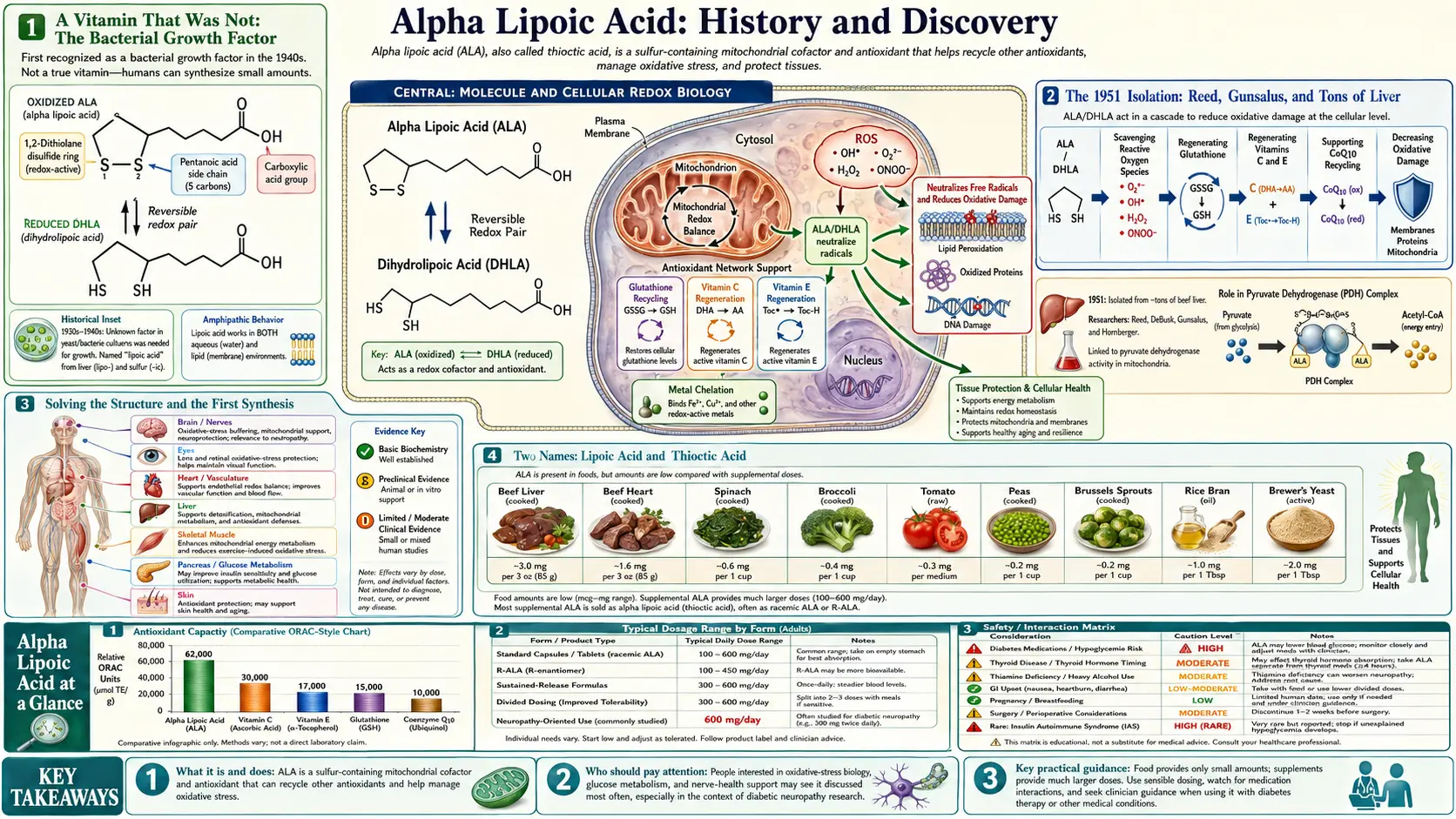
Unlike a herb or a food, alpha lipoic acid has a history that is almost entirely a story of the laboratory. It is a small sulfur-containing molecule the body makes for itself and that every cell on Earth has relied on for billions of years — yet no one knew it existed until the middle of the twentieth century. Its discovery began not with medicine but with bacteria that would not grow, and it was pieced together by named biochemists working with industrial-scale tools. This article traces what the historical record actually supports: how a mysterious bacterial "growth factor" was tracked down and crystallized in 1951, who isolated it and from what, how its chemical structure was solved and the compound first synthesized, how it picked up two different names, when it first reached the clinic, and how a vitamin-like cofactor came to be re-understood as a "universal antioxidant." Where the record is firm we say so; where a detail is uncertain or popularly repeated without a solid source, we say that too.
Interactive Visualization Free Radicals & Your Antioxidant Network Follow one superoxide radical down the whole relay — SOD, catalase, glutathione, vitamin E, vitamin C, NADPH — then release free iron and watch a membrane tear itself apart. Launch →
Table of Contents
- A Vitamin That Was Not: The Bacterial Growth Factor
- The 1951 Isolation: Reed, Gunsalus, and Tons of Liver
- Solving the Structure and the First Synthesis
- Two Names: Lipoic Acid and Thioctic Acid
- From Curiosity to Cornerstone of Metabolism
- Into the Clinic: Mushroom Poisoning and Germany
- The Antioxidant Re-Discovery: Packer and the 1990s
- Research Papers and References
- Connections
- Featured Videos
A Vitamin That Was Not: The Bacterial Growth Factor
Alpha lipoic acid entered science by the side door. In the 1930s and 1940s, microbiologists studying how bacteria grow noticed that certain microbes would not multiply in a purified laboratory broth unless something extra — some trace substance present in natural materials like potato extract, liver, or yeast — was added. Hunting down these mystery substances was one of the great projects of mid-century biochemistry, and it is how most of the B vitamins were found. Alpha lipoic acid was, for a while, thought to be another such vitamin.
The trail that led to it is usually credited to the American microbiologist Esmond E. Snell and colleagues, who in the late 1930s and 1940s described a bacterial growth requirement that could not be explained by any known vitamin. The active material went by descriptive working names that captured what it did rather than what it was: the "acetate-replacing factor" (because it let bacteria grow without added acetate) and the "pyruvate oxidation factor" (because it was needed for cells to burn pyruvate, a key product of sugar breakdown). These two threads — chased in different laboratories — turned out to be the same molecule.
It is worth being precise here, because the popular literature often is not. Some sources date alpha lipoic acid's "discovery" to 1937 on the strength of these early growth-factor observations. That is a reasonable marker for when the effect was first noticed, but the substance itself had not been seen, named, or chemically defined — that came later. In its first years on the scientific stage, alpha lipoic acid was an invisible activity in a test tube, known only by what disappeared from a culture when it was absent.
The 1951 Isolation: Reed, Gunsalus, and Tons of Liver
The decisive breakthrough — the moment the mystery factor became a real, holdable substance — came in 1951. The biochemist Lester J. Reed, working at the University of Texas at Austin, together with I. C. Gunsalus and co-workers B. G. DeBusk and C. S. Hornberger Jr., isolated the factor in pure, crystalline form and gave it the name α-lipoic acid ("lipoic" from the Greek for fat, because the molecule dissolves readily in fats and oils). Their report, "Crystalline α-lipoic acid: a catalytic agent associated with pyruvate dehydrogenase," appeared in the journal Science in July 1951.
What makes the isolation memorable is the sheer scale of the effort it took, which reflects how vanishingly little of the substance living tissue contains. Working in collaboration with the pharmaceutical company Eli Lilly and Company — which had access to industrial quantities of animal liver as a by-product — the team processed an enormous mass of water-insoluble liver residue to extract only about 30 milligrams of the pure crystalline acid. By Reed's own later accounts the purification spanned a roughly three-hundred-thousand-fold concentration of the starting material. A few dozen milligrams from a quantity of liver measured in tons is the kind of ratio that explains why the molecule had stayed hidden for so long.
This is the central, well-documented founding event of alpha lipoic acid's history, and it has named human authors and a fixed date — a contrast with the histories of traditional herbs, which emerge anonymously from culture. Reed in particular would spend much of his career working out exactly what this molecule does inside the cell, and his laboratory's connection to lipoic acid ran for decades.
Solving the Structure and the First Synthesis
Isolating a molecule is not the same as knowing what it looks like. Through the early 1950s, chemists worked to determine alpha lipoic acid's exact structure — and the answer was unusual enough to be interesting in its own right. Alpha lipoic acid turned out to be a short fatty-acid chain capped by a small five-membered ring containing two sulfur atoms joined in a disulfide bond (the structure now written as 1,2-dithiolane-3-pentanoic acid). That sulfur-bearing ring is the chemically reactive heart of the molecule and the reason it can shuttle electrons so readily.
Two milestones bracket the structural work. The first total chemical synthesis of the compound — making it from scratch in the laboratory rather than extracting it from tissue — was reported in 1952 by M. W. Bullock and colleagues, chemists at Lederle Laboratories (the pharmaceutical division of American Cyanamid), in the Journal of the American Chemical Society. (Eli Lilly chemists, including Q. F. Soper and A. Pohland, published their own synthesis of the molecule shortly afterward.) The full account of the isolation, characterization, and structure followed in 1953 in the same journal, authored by Reed, Gunsalus, and a team that included Eli Lilly chemists. Being able to synthesize the molecule mattered for two reasons: it confirmed that the proposed structure was correct (a synthetic sample behaving identically to the natural one is strong proof), and it meant the compound could be produced in useful quantities without grinding up tons of liver.
One structural detail has shaped everything since. Alpha lipoic acid is "chiral" — it exists in two mirror-image forms, called the R and S enantiomers. Only the R-form is made by living cells and found in food; the laboratory synthesis of the 1950s produced a 50/50 mixture of both. That distinction between the natural R-form and the synthetic mixture is not a piece of marketing invented later — it is a direct consequence of how the molecule was first made, and it remains central to how supplements are formulated and compared today.
Two Names: Lipoic Acid and Thioctic Acid
Anyone reading about this compound quickly meets a small confusion: it has two names. It is called both lipoic acid (or alpha lipoic acid, ALA) and thioctic acid. Both are legitimate, both are old, and both are still in use — the difference is largely geographic and historical.
Lipoic acid was the name introduced by Reed and Gunsalus at the 1951 isolation, drawing on the Greek root for fat to reflect the molecule's fat-solubility. Thioctic acid is an alternative chemical name for the very same substance; the "thio" prefix signals the two sulfur atoms that define its structure. As a rough rule, English-language biochemistry and the North American supplement market have favored "alpha lipoic acid," while "thioctic acid" (in German, Thioctsäure) became the standard name in continental European medicine, especially in Germany, where the compound was developed as a pharmaceutical. This is why a German prescription product and an American capsule on the same shelf can carry different names for an identical molecule.
A note on honesty: the precise wording of how and exactly when "thioctic acid" was coined is not something we can pin down from a single authoritative source, so we describe it simply as the long-established alternative chemical name rather than attaching it to a specific person or date. What is not in doubt is that lipoic acid, alpha lipoic acid, thioctic acid, and the chemical names 1,2-dithiolane-3-pentanoic acid and 6,8-thioctic acid all refer to the same compound.
From Curiosity to Cornerstone of Metabolism
Once the molecule was in hand, the question became: what does the body actually use it for? The answer, worked out over the 1950s and 1960s largely through Reed's continuing research, reshaped the textbook picture of metabolism. Alpha lipoic acid is not free-floating in the cell the way a vitamin like vitamin C is. Instead it is covalently bonded onto a handful of giant enzyme machines in the mitochondria — above all the pyruvate dehydrogenase complex and the α-ketoglutarate dehydrogenase complex — where it acts as a tiny swinging arm that carries chemical groups from one part of the enzyme to the next.
These are not minor enzymes. They sit at the gateway where the products of digested carbohydrate enter the cell's main energy-producing cycle. Without functioning lipoic acid bound into them, a cell cannot efficiently turn food into ATP, the energy currency of life. Reed's decades of work dissecting these "α-keto acid dehydrogenase complexes" — some of the largest and most intricate enzyme assemblies known — established lipoic acid as an indispensable cofactor of core metabolism, present in organisms from bacteria to humans.
This discovery also settled the old "is it a vitamin?" question. A vitamin, by definition, is something the body cannot make and must obtain from the diet. But the body does synthesize its own lipoic acid and attaches it directly to those enzymes. So, despite its vitamin-like history as a bacterial growth factor, lipoic acid is properly classed as an endogenously produced cofactor, not a vitamin. The dietary amounts in foods such as liver, kidney, heart, spinach, and broccoli are real but very small — nowhere near the doses later used therapeutically.
Into the Clinic: Mushroom Poisoning and Germany
Alpha lipoic acid's journey from the metabolism textbook to the pharmacy began in Europe, and its first widely reported medical use is a striking one. In 1959, German physicians described using the compound to treat acute poisoning by Amanita phalloides — the death-cap mushroom, whose toxins cause catastrophic liver failure. This earliest clinical application was rooted in the molecule's ability to protect the liver against oxidative damage, and intravenous lipoic acid became part of the supportive treatment for death-cap poisoning in parts of Europe.
From that beginning, German medicine became the center of gravity for alpha lipoic acid as a drug. Researchers there pursued its use for the nerve damage of diabetes — diabetic peripheral neuropathy, the burning and tingling pain in the feet and hands that affects many long-term diabetics — and the compound was developed and licensed as a prescription medicine for that indication, marketed under the thioctic-acid name. This European pharmaceutical heritage is why, decades later, the largest and most rigorous clinical trials of the compound (the ALADIN, SYDNEY, and NATHAN trial series) were predominantly European, designed to satisfy drug regulators rather than supplement marketers.
The capstone of that clinical program came much later, in 2011, with the publication of the four-year NATHAN 1 trial led by Dan Ziegler and colleagues in the journal Diabetes Care — the longest controlled study of oral alpha lipoic acid for diabetic neuropathy. The detailed clinical evidence is covered in the companion Benefits articles and on the main Alpha Lipoic Acid page; what matters for the history is the unbroken line from a 1959 mushroom-poisoning case to a multi-year regulatory trial in the twenty-first century.
The Antioxidant Re-Discovery: Packer and the 1990s
For its first few decades in the literature, alpha lipoic acid was understood almost entirely as a metabolic cofactor — a cog in the energy machinery. Its modern fame as an antioxidant is a later development, and it is closely associated with one researcher in particular: Lester Packer of the University of California, Berkeley, a leading figure in free-radical and antioxidant science.
In 1995, Packer, together with E. H. Witt and H. J. Tritschler, published an influential review titled "Alpha-lipoic acid as a biological antioxidant" in the journal Free Radical Biology & Medicine. The paper laid out the case that lipoic acid and its reduced partner, dihydrolipoic acid, are unusually versatile antioxidants — able to neutralize several kinds of reactive oxygen species, to work in both watery and fatty parts of the cell, and, most strikingly, to help regenerate other antioxidants such as vitamin C, vitamin E, and glutathione after they have been used up. This regenerating, network-spanning behavior is the basis of the popular description of lipoic acid as a "universal antioxidant."
This same era saw lipoic acid joined to the broader science of mitochondria and aging. Work at Berkeley by Bruce Ames and Tory Hagen explored combining alpha lipoic acid with another mitochondrial nutrient, acetyl-L-carnitine, to counter age-related decline in cellular energy production — research that helped move lipoic acid into the longevity and "anti-aging" conversation. The honest summary of this chapter is that the antioxidant framing did not replace the older metabolic understanding; it added to it. The molecule Reed crystallized to explain how cells burn sugar turned out, forty years on, to also be one of the most flexible redox agents the body has — and it is this second life, as a supplement and an antioxidant, that most people encounter today.
Research Papers and References
The list below combines the key primary papers in alpha lipoic acid's documented history with curated PubMed topic-search links into the discovery, biochemistry, and clinical literature. Author names, titles, and journals are given as plain text; only the stable DOI, PMID, or archive link is hyperlinked, and each opens in a new tab. Some early-1950s details (the exact tonnage of liver processed; the precise coining of the name "thioctic acid") are described in the article as approximate or uncertain because they are not pinned to a single authoritative source.
- Reed LJ, DeBusk BG, Gunsalus IC, Hornberger CS Jr. Crystalline alpha-lipoic acid: a catalytic agent associated with pyruvate dehydrogenase. Science. 1951;114(2952):93-94. — PMID: 14854913
- Reed LJ, Gunsalus IC, Schnakenberg GHF, Soper QF, Boaz HE, Kern SF, Parke TV. Isolation, characterization and structure of alpha-lipoic acid. Journal of the American Chemical Society. 1953;75(6):1267-1270. — doi:10.1021/ja01102a001
- Packer L, Witt EH, Tritschler HJ. Alpha-lipoic acid as a biological antioxidant. Free Radical Biology & Medicine. 1995;19(2):227-250. — PMID: 7649494
- Ziegler D, Low PA, Litchy WJ, Boulton AJ, Vinik AI, Freeman R, et al. Efficacy and safety of antioxidant treatment with alpha-lipoic acid over 4 years in diabetic polyneuropathy: the NATHAN 1 trial. Diabetes Care. 2011;34(9):2054-2060. — doi:10.2337/dc11-0503 · PMID: 21775755
- Mijnhout GS, Kollen BJ, Alkhalaf A, Kleefstra N, Bilo HJG. Alpha lipoic acid for symptomatic peripheral neuropathy in patients with diabetes: a meta-analysis of randomized controlled trials. International Journal of Endocrinology. 2012;2012:456279. — PMID: 22331979
- Alpha lipoic acid — discovery, isolation, and history — PubMed: lipoic acid discovery and isolation history
- Lipoic acid biosynthesis, enzyme cofactor function, and dietary sources — PubMed: lipoic acid biosynthesis and cofactor function
External Authoritative Resources
- Linus Pauling Institute — Lipoic Acid Micronutrient Information Center
- NCCIH — Diabetes and Dietary Supplements (alpha-lipoic acid)
- MedlinePlus — Alpha Lipoic Acid
- PubMed — All research on alpha lipoic acid
Connections
- Free Radicals & Your Antioxidant Network — interactive animation
- Alpha Lipoic Acid
- Alpha Lipoic Acid Benefits
- All Antioxidants
- Glutathione
- NAC (N-Acetylcysteine)
- CoQ10
- Vitamin C
- Vitamin E