Proline: History and Discovery
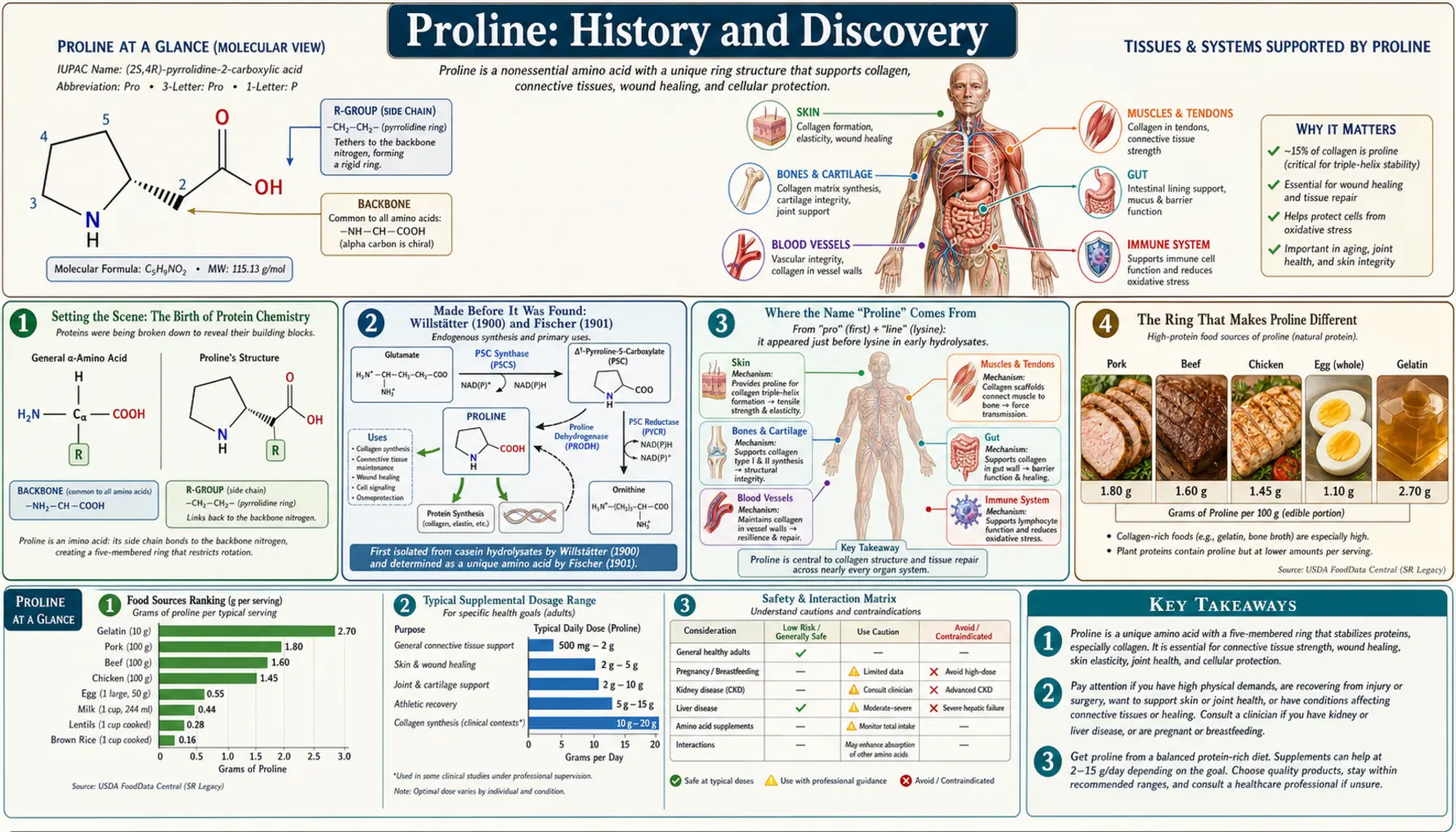
Proline has an unusual place in the history of biochemistry: it was one of the few amino acids made in a laboratory before anyone managed to pull it out of a living protein. In 1900 the German chemist Richard Willstätter synthesised it from scratch; the very next year, in 1901, the great chemist Emil Fischer isolated the same molecule from the milk protein casein and gave it the name we still use today — "proline," after the chemical ring at its heart. This article tells that story plainly: who first made and found this amino acid, where its name comes from, why its odd ring-shaped structure matters so much for collagen, and how a single discovery in 1901 connects to the broader birth of protein chemistry. Where the record is firm we say so; where a detail is interpretation or still debated, we name it as such.
Table of Contents
- Setting the Scene: The Birth of Protein Chemistry
- Made Before It Was Found: Willstätter (1900) and Fischer (1901)
- Where the Name "Proline" Comes From
- The Ring That Makes Proline Different
- Hydroxyproline: Proline's Modified Twin (1902)
- From Amino Acid to Collagen: The Triple Helix
- Emil Fischer and the Nobel Prize of 1902
- From a Glass Flask to Modern Biology
- Research Papers and References
- Connections
- Featured Videos
Setting the Scene: The Birth of Protein Chemistry
To understand when and how proline was discovered, it helps to picture the science of the time. By the early nineteenth century chemists knew that living things were built largely from a family of nitrogen-rich substances found in egg white, blood, wheat, and meat — but they had no agreed name for them and no idea what they were made of. That changed in 1838, when the Dutch chemist Gerardus Johannes Mulder described these nitrogen-containing materials and the Swedish chemist Jöns Jacob Berzelius suggested a name for them: protein, from the Greek prōteios, meaning "primary" or "of first importance." The word announced a conviction — that these were the fundamental stuff of the living world.
Through the rest of the 1800s, chemists slowly took proteins apart and found that they were built from smaller units — the amino acids. The earliest of these had been isolated decades before anyone spoke of "proteins" at all: asparagine, the first amino acid ever isolated, was obtained from asparagus juice in 1806; glycine was isolated from gelatin in 1820 and called the "sugar of gelatin" for its sweet taste. One by one, more were teased out of natural sources over the following century. Proline, however, did not arrive by that route. It came late, and it came backwards — built in a flask first, and only afterwards recognised inside a protein. The next section tells how.
Made Before It Was Found: Willstätter (1900) and Fischer (1901)
Proline's discovery is a two-step story, and the order is part of what makes it interesting. The first step was chemical synthesis. In 1900, the German chemist Richard Willstätter — then early in a career that would later earn him a Nobel Prize of his own for work on plant pigments — prepared proline in the laboratory. He built it up from simple starting materials (in the language of the chemistry, the sodium salt of malonic ester reacted with 1,3-dibromopropane, a three-carbon "trimethylene" chain). Willstätter had made the molecule before it had ever knowingly been seen in nature.
The second step came just one year later. In 1901, Emil Fischer — the towering figure of early protein chemistry — isolated proline from a natural protein, obtaining it from hydrolysed casein, the principal protein of milk. (He also recovered it from other protein sources, and produced it synthetically by his own route, through a phthalimido-propylmalonic ester.) Because Fischer was systematically breaking proteins down into their component amino acids and identifying each one, his 1901 work is what established proline as a genuine building block of proteins — not merely a chemist's invention.
So the credit divides cleanly and is well documented. Willstätter (1900) is credited with first synthesising proline; Fischer (1901) with first isolating it from a protein and naming it. This sequence — lab synthesis preceding natural isolation — is unusual among the amino acids, most of which were pulled from a plant or animal source first and synthesised only later. It is the single most-repeated fact about proline's history, and it is one of the better-attested discovery stories in the whole amino-acid family.
Where the Name "Proline" Comes From
The name proline is a shortened, tidied-up form drawn from pyrrolidine — the name of the five-membered, nitrogen-containing ring that sits at the centre of the molecule. Pyrrolidine is itself a member of a family of ring compounds whose names trace back to pyrrole, and ultimately to the Greek pyrrhos, meaning "reddish" or "fiery" (an old reference to a colour reaction). In other words, proline is named not for where it was found or what it tastes like — the way asparagine points to asparagus or glycine to its sweetness — but for its chemical structure. The name tells you, at a glance, that this amino acid carries a pyrrolidine ring.
Fischer's practice of naming the molecule after its defining ring fits the moment: by 1901 chemists were beginning to understand amino acids structurally, not just as mystery extracts, and proline's ring was exactly the feature that set it apart. Its hydroxylated relative, discovered shortly afterwards, was originally called oxyproline — the older term for what we now call hydroxyproline — again naming the new compound straight off the parent proline. Names, here, are a kind of map of how the chemistry was understood.
The Ring That Makes Proline Different
The reason proline mattered enough to be singled out is structural, and it is worth explaining in plain terms. In a "standard" amino acid, a free amino group (−NH2) hangs off the central carbon like a small flexible arm. In proline, that nitrogen is not free at all: it is tied back into the molecule, looping around to join the side chain and close a rigid five-membered ring. Because the nitrogen is built into a ring — making it a secondary amine rather than a free primary amino group — proline is often described as an imino acid rather than a true amino acid. Fischer recognised this whole class as something new, calling proline and oxyproline the cyclic (ring-shaped) amino acids.
This is not a mere technicality. That stiff ring means proline cannot bend and rotate as freely as other amino acids can when it sits in a protein chain. Where most amino acids let a protein backbone flex, proline forces a kink, a turn, a fixed angle. Far from being a defect, this rigidity is precisely why proline is indispensable to one particular protein — collagen — whose rope-like structure depends on regular, predictable turns. The discovery of proline's unusual ring in 1901 was, in hindsight, the first clue to how the body's most abundant structural protein holds its shape.
Hydroxyproline: Proline's Modified Twin (1902)
The proline story has a close sequel that belongs in any honest history of the molecule. In 1902, just a year after isolating proline, Emil Fischer isolated a closely related compound from gelatin — the protein obtained by boiling collagen-rich animal tissue. This new amino acid was proline with an extra oxygen-and-hydrogen (a hydroxyl group) attached, and Fischer named it oxyproline, the term later standardised to hydroxyproline. A racemic (mixed-handed) form of 4-hydroxyproline was synthesised a few years afterwards by Hermann Leuchs.
Hydroxyproline turned out to be one of the most telling molecules in all of biochemistry, because it is found almost exclusively in collagen (and a few related proteins), where it makes up roughly an eighth of the amino acids. That made it a chemical fingerprint: for much of the twentieth century, measuring hydroxyproline was the standard way to estimate how much collagen a tissue or a sample contained. The fact that Fischer found this collagen-specific molecule by modifying proline — and found it in gelatin, the cooked form of collagen — foreshadowed the central truth that the next section makes explicit: proline and its hydroxyl twin are the molecules that build the body's scaffolding.
From Amino Acid to Collagen: The Triple Helix
Knowing what proline was took until 1901; understanding what it did in the body took another half-century. Collagen, the most abundant protein in humans, had been used for ages in the form of glue, gelatin, and leather long before anyone knew its molecular shape. The breakthrough came in the mid-1950s in Madras (now Chennai), India, where the physicist G. N. Ramachandran and his colleagues — notably Gopinath Kartha — proposed that collagen is built from three polypeptide chains wound around one another in a triple helix. Their structure, published around 1954–1955, became known as the "Madras helix."
Proline sits at the very heart of that structure. Collagen's chains follow a strict repeating pattern in which the smallest amino acid, glycine, must appear at every third position, while the other two positions are very often filled by proline and hydroxyproline. It is proline's rigid ring — the feature Fischer flagged in 1901 — that locks each chain into the precise twist the triple helix requires, and the hydroxyl groups on hydroxyproline that help hold the three chains together. In other words, the odd ring-shaped imino acid discovered in milk protein in 1901 is one of the two or three molecules that physically make collagen possible. The history of proline and the structural biology of collagen are, in the end, the same story told from two ends.
The early details of collagen's structure were vigorously debated, and the model was refined over the following years by Ramachandran's group and others; the broad picture of a glycine-and-proline-rich triple helix, however, has stood. It is one of the landmark achievements of twentieth-century structural biology, and it is the reason proline is now spoken of, first and foremost, as "the collagen amino acid."
Emil Fischer and the Nobel Prize of 1902
It is no accident that the same name — Emil Fischer — runs through the discovery of proline, of hydroxyproline, and of the very idea of how amino acids join together. Fischer was the central figure of early protein chemistry. In 1902, the year after he isolated proline, he was awarded the Nobel Prize in Chemistry — though, importantly, the prize was given "for his work on sugar and purine syntheses," not specifically for his protein work, which was still unfolding. His Nobel citation reflects where his fame then chiefly rested: on sorting out the chemistry of sugars and of the purines (the family that includes caffeine, uric acid, and the building blocks of DNA).
It was in the years 1899 to 1908 that Fischer turned to proteins and made the contributions that touch proline most directly. He developed methods to separate and identify the individual amino acids, and in doing so he recognised the cyclic amino acids, proline and oxyproline, as a genuinely new type. He also established the nature of the chemical link that joins amino acids into chains — the peptide bond — and in 1901, the same year he isolated proline, he and a collaborator synthesised the simplest dipeptide, glycyl-glycine. By 1907 he had built a chain of eighteen amino acids in the laboratory and shown it behaved like a natural protein fragment. The isolation of proline was thus one thread in a much larger achievement: the moment chemistry first showed, concretely, how proteins are assembled from amino acids.
From a Glass Flask to Modern Biology
The arc of proline's history runs from a synthetic curiosity to a molecule at the centre of human structural biology. Willstätter built it in 1900; Fischer found it in casein in 1901 and in gelatin's hydroxylated form in 1902; Ramachandran's triple helix in the 1950s explained why those discoveries mattered so much for collagen. In the decades since, proline has only grown in interest. Biochemists learned that the conversion of proline to hydroxyproline inside collagen requires vitamin C — the missing link that explains why the vitamin-C-deficiency disease scurvy is, at bottom, a disease of failed collagen. More recently, the simple ring that defines proline has turned out to give proteins a built-in molecular switch: a slow flip in the geometry around proline (its cis–trans isomerisation) helps regulate how proteins fold and function, an active area of modern research.
For everyday purposes, the practical importance of proline — for skin, joints, blood vessels, the gut lining, and wound healing — is covered in the companion Proline Benefits articles and on the main Proline page; this history is concerned only with how the molecule came to be known. The honest summary is a satisfying one: unlike many traditional remedies whose history is a tangle of folklore, proline's origin story is precise, dated, and credited to named scientists. A chemist made it in 1900; a year later another chemist found the same molecule hiding inside the proteins of living things — and gave it the name, drawn from its own ring, that it still carries.
Research Papers and References
The list below combines peer-reviewed sources and authoritative references for the historical claims on this page. The earliest discovery work (Willstätter's 1900 synthesis and Fischer's 1901–1902 isolations) is documented in the secondary historical literature cited here rather than by linking the original century-old German papers. Author names, titles, and journals are given as plain text; only the stable DOI, PMID, or archive link is hyperlinked, and each opens in a new tab.
- Gurung D, Danielson JA, Tasnim A, Zhang JT, Zou Y, Liu JY. Proline Isomerization: From the Chemistry and Biology to Therapeutic Opportunities. Biology (Basel). 2023;12(7):1008. — doi:10.3390/biology12071008 · PMID: 37508437
- Bhattacharjee A, Bansal M. Collagen structure: the Madras triple helix and the current scenario. IUBMB Life. 2005;57(3):161-172. — doi:10.1080/15216540500090710 · PMID: 16036578
- Vickery HB, Schmidt CLA. The History of the Discovery of the Amino Acids. Chemical Reviews. 1931;9(2):169-318. — doi:10.1021/cr60033a001
- The Nobel Prize in Chemistry 1902 — Emil Fischer (biographical; notes his discovery of the cyclic amino acids proline and oxyproline). — NobelPrize.org
- Proline — discovery, synthesis, and naming — PubMed: proline history and discovery
- Hydroxyproline and collagen structure — history and biochemistry — PubMed: hydroxyproline and collagen structure
External Authoritative Resources
- NobelPrize.org — The Nobel Prize in Chemistry 1902 (Emil Fischer)
- PubChem — Proline (compound record)
- PubMed — research on proline