Leucine and mTOR Activation
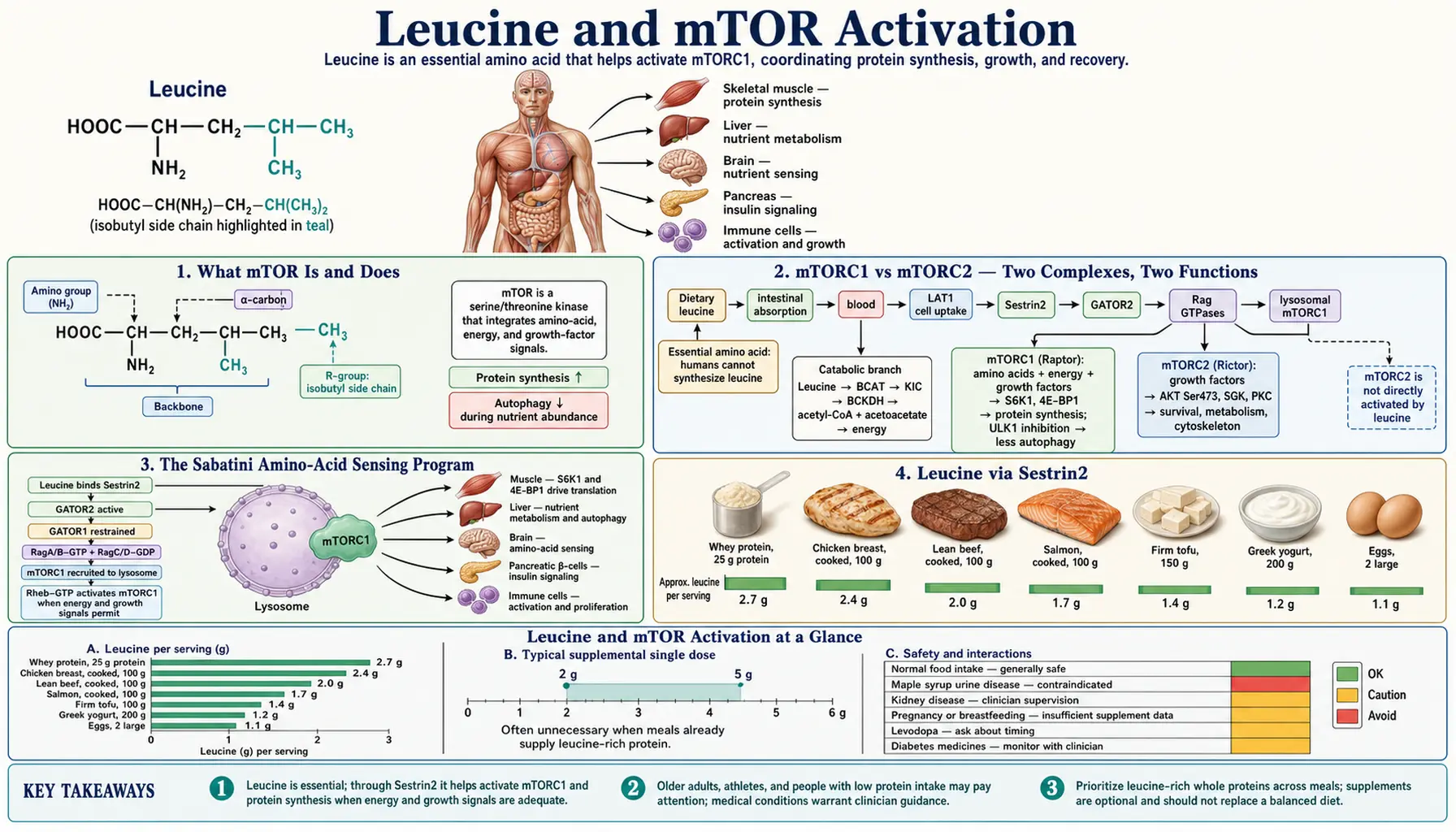
mTOR (mechanistic target of rapamycin) is the cell's central nutrient-and-growth integrator — a serine/threonine kinase that switches on protein synthesis, lipid synthesis, and ribosome biogenesis when conditions are favorable, and switches them off (allowing autophagy and metabolic recycling to dominate) when they are not. David Sabatini's lab at the Whitehead Institute spent two decades mapping the amino-acid sensing arm of mTORC1, identifying Sestrin2 as the direct leucine sensor, CASTOR1 as the direct arginine sensor, and SAMTOR as the direct S-adenosylmethionine sensor — three structurally distinct molecular sensors that each gate mTORC1 activity through the GATOR1/GATOR2/Rag GTPase cascade. The same pathway is exquisitely sensitive to the macrolide drug rapamycin, which inhibits mTORC1 and produces large life-extension effects in mice, worms, and flies. Leucine is therefore not just an anabolic nutrient — it is the principal dietary input that opposes the longevity-protective effect of rapamycin, and the resulting tradeoff (anabolism in muscle vs autophagy and longevity in the body as a whole) is one of the central tensions in contemporary nutrition and aging research.
Table of Contents
- What mTOR Is and Does
- mTORC1 vs mTORC2 — Two Complexes, Two Functions
- The Sabatini Amino-Acid Sensing Program
- Leucine via Sestrin2
- Arginine via CASTOR1
- S-Adenosylmethionine via SAMTOR
- The Rapamycin Longevity Paradigm
- mTOR vs Autophagy — The Antagonistic Pair
- Why Leucine Matters Less in Young Muscle
- Clinical Implications and the Tradeoff
- Key Research Papers
- Connections
- Featured Videos
What mTOR Is and Does
mTOR (mechanistic target of rapamycin, formerly mammalian target of rapamycin) is a 289 kDa serine/threonine protein kinase belonging to the PIKK family (phosphatidylinositol 3-kinase-related kinases). It is the catalytic subunit of two distinct multiprotein complexes — mTORC1 and mTORC2 — that share mTOR and a regulatory subunit called mLST8 but differ in their other components, their upstream inputs, and their downstream substrates.
The kinase was discovered through the pharmacology of rapamycin, a macrolide isolated in 1972 from a soil bacterium (Streptomyces hygroscopicus) on Easter Island (Rapa Nui — hence the name). Rapamycin's biological activity was first studied as an antifungal agent, then as an immunosuppressant (FDA-approved as sirolimus to prevent kidney transplant rejection), and finally as a tumor-suppressing agent and longevity drug. The protein target of rapamycin was identified in yeast in 1991 (TOR1 and TOR2) and in mammals in 1994 (mTOR), launching three decades of intensive mechanistic research.
The kinase's biological role is fundamentally that of an integrator: mTOR receives signals from nutrient status (amino acids, glucose), energy status (AMP/ATP ratio via AMPK), growth factor signaling (insulin, IGF-1 via PI3K/AKT), oxygen tension, and DNA damage. When all signals are favorable, mTOR phosphorylates a battery of downstream substrates that collectively switch on cell growth, protein synthesis, lipid synthesis, ribosome biogenesis, and cell-cycle progression. When any of the signals are unfavorable, mTOR is silenced, and the cell instead activates autophagy (recycling of intracellular components for energy and amino acids), reduces protein synthesis, and conserves resources.
mTORC1 vs mTORC2 — Two Complexes, Two Functions
mTORC1 is the better-characterized complex and the one that responds to amino acid signaling. Its core components are mTOR, Raptor (regulatory-associated protein of mTOR), mLST8, PRAS40, and DEPTOR. mTORC1 phosphorylates substrates that include 4E-BP1, S6K1, ULK1, TFEB, and Lipin-1, driving protein synthesis, lipid synthesis, ribosome biogenesis, and inhibition of autophagy. mTORC1 is acutely sensitive to rapamycin — rapamycin binds FKBP12 and the rapamycin-FKBP12 complex binds the FRB domain of mTOR within mTORC1, allosterically inhibiting kinase activity toward most substrates within minutes.
mTORC2 is the complex that contains Rictor (rapamycin-insensitive companion of mTOR) instead of Raptor, plus mSin1 and Protor. mTORC2 phosphorylates AKT at Ser473 (completing AKT activation that PDK1 starts at Thr308), SGK1, and PKCalpha. mTORC2 is involved in cytoskeletal organization, cell survival, and metabolism. Acute rapamycin does not inhibit mTORC2, but chronic rapamycin exposure can disrupt mTORC2 assembly and produce off-target effects including glucose intolerance — an important consideration for long-term rapamycin therapy.
The leucine sensing pathway operates exclusively on mTORC1. Sestrin2, GATOR1, GATOR2, and the Rag GTPases all converge on the recruitment of mTORC1 (via Raptor binding to active RagA/B) to the lysosomal surface. mTORC2 has a distinct, less well-defined nutrient-sensing arm that does not depend on Sestrin2.
The Sabatini Amino-Acid Sensing Program
The molecular identification of amino-acid sensors was a major research program at the Whitehead Institute under David Sabatini between approximately 2010 and 2020. Before this work, the field knew that amino acid availability gated mTORC1 activity but did not know how amino acids were sensed at the molecular level — whether there was a single master sensor, distinct sensors for distinct amino acids, or some indirect mechanism through tRNA charging or proteasomal flux.
The Sabatini lab's answer turned out to be the second option: distinct molecular sensors for distinct amino acids, each producing the same downstream output (relief of GATOR2 inhibition by Sestrin2 or its analog, leading to activation of the Rag GTPases). The three sensors identified to date are:
- Sestrin2 — the leucine sensor, characterized in Wolfson et al. Nature 2016 and Saxton et al. Science 2016.
- CASTOR1 — the arginine sensor, characterized in Chantranupong et al. Cell 2016 and Saxton et al. Science 2016 (companion paper).
- SAMTOR — the S-adenosylmethionine sensor (and thus an indirect methionine sensor), characterized in Gu et al. Science 2017.
The discovery program established several principles. First, amino-acid sensing is mechanistically distinct from substrate availability — the sensors are dedicated regulatory proteins, not the enzymes that use the amino acids as substrates. Second, the sensors are highly selective — Sestrin2 binds leucine but not isoleucine or valine despite their structural similarity, ruling out promiscuous BCAA sensing. Third, the sensors operate at physiologically relevant concentrations, with binding affinities tuned to the dynamic range between fasting and postprandial plasma levels.
Leucine via Sestrin2
Sestrin2 (and its paralogs Sestrin1 and Sestrin3) is a cytosolic protein originally characterized as a stress-response gene induced by DNA damage and oxidative stress. The Sabatini lab's breakthrough was recognizing that Sestrin2 also functions as a direct leucine sensor, binding a single leucine molecule in a deep hydrophobic pocket and undergoing a conformational change that releases its inhibition on the GATOR2 complex.
The leucine-binding pocket is highly specific. Crystallographic and biochemical studies show that Sestrin2 binds leucine with Kd approximately 20 µM, isoleucine with Kd approximately 400 µM (20-fold weaker), and valine with Kd > 1 mM (50-fold weaker than leucine). Methionine and the aromatic amino acids do not measurably bind. The specificity arises from the precise geometry of the hydrophobic pocket, which accommodates leucine's branched isobutyl side chain but not the slightly different geometry of isoleucine's sec-butyl group.
The functional consequence of the high specificity is that Sestrin2-dependent mTORC1 activation requires leucine specifically — not generic essential amino acids, not branched-chain amino acids collectively, just leucine. This is why early studies attempting to use BCAA mixtures to stimulate MPS found that the leucine component drove the response and isoleucine/valine added little.
Once leucine binds, Sestrin2 dissociates from GATOR2. Free GATOR2 then inhibits GATOR1. GATOR1 (in its non-inhibited state) is a GAP for the Rag GTPases that normally keeps them in the inactive GDP-loaded state. Without GATOR1 activity, the Rag heterodimer loads GTP, assumes its active conformation, and recruits mTORC1 to the lysosomal surface via Raptor.
Arginine via CASTOR1
CASTOR1 (cellular arginine sensor for mTORC1) is structurally unrelated to Sestrin2 but performs an analogous function for arginine. CASTOR1 binds free arginine in a hydrophobic pocket and undergoes a conformational change that releases its inhibition on GATOR2. CASTOR1 can heterodimerize with CASTOR2, and only the CASTOR1 subunit binds arginine, making the heterodimer responsive to arginine concentration.
The dual leucine-arginine sensing means that mTORC1 requires both leucine and arginine to be present at adequate concentration to fire fully. Sestrin2 must be relieved of leucine binding, AND CASTOR1 must be relieved of arginine binding, for GATOR2 to fully release GATOR1 and for the Rags to activate mTORC1. This AND-logic explains why arginine deprivation (e.g., in arginine-auxotrophic cancers being treated with pegylated arginine deiminase) profoundly suppresses mTORC1 activity even in leucine-replete conditions.
For practical nutrition, the implication is that protein quality matters not only for leucine content but for arginine content. Most animal proteins are arginine-replete (meat, eggs, dairy, fish all deliver 1.5–2.5% of total amino acids as arginine). Some plant proteins (peanuts, tree nuts, seeds, soy) are arginine-rich; others (lean grains) are arginine-modest. Arginine deficiency is rare in well-fed populations but can become relevant in surgical recovery, where supplemental arginine is sometimes prescribed to support wound healing through both nitric oxide and mTORC1 pathways.
S-Adenosylmethionine via SAMTOR
SAMTOR is the third amino-acid-related sensor identified by the Sabatini lab (Gu et al., Science 2017). It does not bind methionine directly; instead it binds S-adenosylmethionine (SAM), the universal methyl donor that is synthesized from methionine plus ATP. SAM levels track methionine availability with a short delay, and SAMTOR functions as an indirect methionine sensor through SAM.
SAMTOR's mechanism is opposite-polarity to Sestrin2 and CASTOR1: when SAMTOR binds SAM (i.e., when SAM levels are high, indicating methionine repletion), SAMTOR releases its inhibition on GATOR1 and allows GATOR1 to suppress the Rag GTPases. Wait — that's backward from what the cell needs. Let me restate: SAMTOR binds GATOR1 and reduces GATOR1 activity, but only when SAM is absent. When SAM is present, SAMTOR releases GATOR1, allowing GATOR1 to suppress the Rags. So high SAM (high methionine) actually suppresses mTORC1 via SAMTOR. This counterintuitive polarity reflects the special status of methionine and SAM in regulating one-carbon metabolism, transmethylation reactions, and the cellular response to methionine restriction — another life-extending intervention.
The methionine restriction literature (Orentreich, Cabreiro, and others) shows that low-methionine diets extend lifespan in multiple model organisms and reduce age-related disease in rodents. SAMTOR provides the molecular link — methionine restriction reduces SAM, releases SAMTOR's suppression of GATOR1, suppresses mTORC1, and engages the same autophagic, longevity-protective program that rapamycin engages pharmacologically.
The Rapamycin Longevity Paradigm
The connection between mTOR and aging is one of the most robust findings in biogerontology. Rapamycin extends lifespan in mice (median lifespan extension of 9–14% in males, 14–26% in females, depending on dose and timing per Harrison et al. Nature 2009 and subsequent ITP studies), in C. elegans, in Drosophila, and probably in many other organisms. The effect persists even when rapamycin is started late in life, raising the possibility of true rejuvenation rather than just slowing of decline.
The mechanism is thought to involve suppression of mTORC1, leading to increased autophagy (clearance of damaged proteins, dysfunctional mitochondria, and other accumulated cellular debris), improved proteostasis, reduced inflammation, and metabolic reprogramming. The same dietary interventions that extend lifespan — caloric restriction, protein restriction, methionine restriction, intermittent fasting — all converge on mTORC1 suppression as a final common pathway.
This creates a genuine tradeoff for the anabolic nutrition of leucine. The same leucine signaling that maintains muscle mass and prevents sarcopenia in older adults also suppresses autophagy and engages the anabolic program associated with accelerated aging. Maximizing per-meal leucine for MPS necessarily means signaling against the autophagic program that drives rapamycin's longevity effect.
The contemporary consensus among researchers attempting to balance these effects (Peter Attia's framework, Valter Longo's fasting-mimicking diet protocols, the Bret Ardis line of thinking on amino acid timing) is approximately: in early adulthood, when sarcopenia is not yet a concern, modest mTORC1 activation paired with periodic protein restriction (fasting days, vegetarian days, restricted-feeding windows) likely captures most of the benefit of both anabolism and autophagy. In late adulthood, when sarcopenia and frailty become primary risks, the balance tips toward maximizing per-meal leucine to preserve muscle, accepting some loss of autophagic activity as the price.
The rapamycin-as-longevity-drug clinical trials (Mannick et al., Sehgal's legacy work, the dog aging projects) are ongoing. As of the mid-2020s, no large human trial has demonstrated rapamycin-mediated lifespan extension, but the rodent data, the mechanism, and the surrogate markers all suggest the effect is real and translatable. For practical use, low-dose rapamycin (5–6 mg weekly, off-label) is gaining traction in longevity clinics, with the explicit recommendation to not combine it with high-leucine protein meals close to the dose — the two interventions work against each other at the molecular level.
mTOR vs Autophagy — The Antagonistic Pair
Autophagy is the cellular process of degrading and recycling damaged organelles, misfolded proteins, and other intracellular debris. It is the principal route by which long-lived cells (neurons, cardiomyocytes, skeletal muscle fibers) maintain proteostasis over decades. Loss of autophagic capacity is a hallmark of aging and a contributor to neurodegeneration, cardiomyopathy, and sarcopenia itself.
mTORC1 directly suppresses autophagy at multiple levels. The most direct mechanism: mTORC1 phosphorylates ULK1 (the kinase that initiates autophagosome formation) at Ser757, blocking its activation. mTORC1 also phosphorylates TFEB (transcription factor EB), retaining it in the cytoplasm and preventing it from entering the nucleus where it would drive transcription of autophagy and lysosomal genes. When mTORC1 is inhibited (by rapamycin, by amino acid withdrawal, by AMPK activation during energy stress), ULK1 is rapidly dephosphorylated and activated, TFEB translocates to the nucleus, and autophagy is initiated within minutes to hours.
The antagonistic relationship between mTORC1 and autophagy means that any intervention that maintains autophagy (caloric restriction, fasting, methionine restriction, exercise, rapamycin) necessarily reduces mTORC1 activity, and any intervention that activates mTORC1 (high-leucine meals, growth factor signaling, insulin) necessarily suppresses autophagy.
For muscle specifically, the picture is more nuanced. Skeletal muscle requires both functioning autophagy (for proteostasis and mitochondrial quality control) and functioning mTORC1 (for protein synthesis and hypertrophy). Knockout of autophagy genes in muscle (Atg7-KO mice) produces severe atrophy, weakness, and accelerated aging-like phenotypes. Knockout of mTORC1 components (Raptor-KO muscle) produces equally severe atrophy. The two pathways must alternate — mTORC1 active in the fed/post-exercise state to build, autophagy active in the fasted/rested state to clean up. The "anabolic window" framing of nutrition (eat protein after exercise to trigger mTORC1, fast between meals to allow autophagy) is a behavioral implementation of this molecular biology.
Why Leucine Matters Less in Young Muscle
Young adult muscle is relatively insensitive to per-meal leucine content because young muscle has a low threshold for mTORC1 activation and a long refractory window. Most young adults reach the MPS threshold with any reasonable protein-containing meal (15–20 g of protein delivers 1.5–2.0 g of leucine, which is enough). The dose-response curve in young muscle is shallow above the threshold — going from 20 g to 40 g of protein per meal in a 25-year-old produces only modest incremental MPS.
Older muscle behaves differently. The phenomenon of "anabolic resistance" — first characterized by Cuthbertson, Rennie, and colleagues in the early 2000s — describes the blunted MPS response of older muscle to a standard amino acid stimulus. An identical 10 g essential amino acid bolus produces approximately 30–40% less MPS in a 70-year-old than in a 25-year-old. The mechanism is multifactorial: reduced satellite cell number, reduced mTORC1 signaling at any given amino acid concentration, reduced muscle perfusion in response to amino acid infusion (insulin-mediated vasodilation declines with age), and reduced ribosomal capacity.
The practical solution is to push older muscle past its higher anabolic-resistance threshold by increasing per-meal leucine. Where 20 g of protein per meal might suffice for a 25-year-old, 35–40 g per meal is typically required for a 70-year-old to achieve comparable absolute MPS rates. This is why protein recommendations for older adults are higher than for younger adults (1.0–1.2 g/kg/day vs the 0.8 g/kg/day RDA) and why leucine-enriched whey supplementation has emerged as the standard intervention for sarcopenia prevention in clinical trials.
For young, healthy, active adults, the headline message is that worry about per-meal leucine content is largely overblown. A balanced diet with 25–30 g of high-quality protein per meal exceeds the threshold without thought. For older adults, the picture inverts — deliberate attention to per-meal leucine content (and free-form leucine supplementation when food intake is limited) becomes one of the highest-leverage interventions for healthspan.
Clinical Implications and the Tradeoff
- For young athletes — the dominant goal is hypertrophy, performance, and recovery. Maximize per-meal leucine (25–40 g protein per meal, whey protein around training). The mTOR-autophagy tradeoff is real but the absolute autophagic burden is low at young ages, and the muscle-building benefit is large.
- For middle-aged active adults — balance is the goal. Moderate per-meal leucine (25–30 g protein per meal), pair with regular fasting periods (12–14 hour overnight fast, occasional 24-hour fasts, or periodic fasting-mimicking diet days) to engage autophagy. Resistance training 2–4 times per week to sensitize muscle to leucine and reduce the dose required.
- For older adults (over 65) — sarcopenia prevention dominates. Aggressive per-meal leucine (30–40 g protein per meal, plus whey or essential amino acid supplementation if appetite limits intake). The autophagy tradeoff matters less at this stage because the immediate functional and mortality consequences of muscle loss outweigh the speculative longevity penalty.
- For longevity-focused adults pursuing rapamycin or methionine restriction — understand that high-leucine meals work against the intervention. Time protein-rich meals well away from the rapamycin dose (e.g., rapamycin in the morning fasted, protein-rich meal late afternoon). For methionine restriction, reduce intake of methionine-rich animal proteins (poultry, beef, eggs) and substitute lower-methionine plant proteins (legumes, vegetables, grains) while ensuring adequate total essential amino acids.
- For cancer patients — the picture is complicated. Tumors are often hyperdependent on mTORC1 signaling, making mTOR inhibitors (rapamycin, everolimus, temsirolimus) effective in some cancers. Cancer cachexia simultaneously demands muscle preservation through leucine-driven MPS. The patient-specific balance requires oncologic input.
The deeper lesson from the mTOR biology is that "nutrition" cannot be optimized for a single output. Maximizing muscle mass and maximizing longevity are not the same goal, and pretending otherwise leads to confused recommendations. Leucine is the right input for the first; restricting leucine (or pulsing it) is part of the right approach to the second. Choose the goal first, then choose the nutrition.
Key Research Papers
- Wolfson RL et al. (2016). Sestrin2 is a leucine sensor for the mTORC1 pathway. Nature. — PubMed
- Chantranupong L et al. (2016). The CASTOR proteins are arginine sensors for the mTORC1 pathway. Cell. — PubMed
- Gu X et al. (2017). SAMTOR is an S-adenosylmethionine sensor for the mTORC1 pathway. Science. — PubMed
- Saxton RA, Sabatini DM (2017). mTOR signaling in growth, metabolism, and disease. Cell. — PubMed
- Harrison DE et al. (2009). Rapamycin fed late in life extends lifespan in genetically heterogeneous mice. Nature. — PubMed
- Björkoy G et al. (2005). p62/SQSTM1 forms protein aggregates degraded by autophagy. Journal of Cell Biology. — PubMed
- Settembre C et al. (2012). A lysosome-to-nucleus signalling mechanism senses and regulates the lysosome via mTOR and TFEB. EMBO Journal. — PubMed
- Sancak Y et al. (2008). The Rag GTPases bind raptor and mediate amino acid signaling to mTORC1. Science. — PubMed
- Kim J et al. (2011). AMPK and mTOR regulate autophagy through direct phosphorylation of Ulk1. Nature Cell Biology. — PubMed
- Mannick JB et al. (2014). mTOR inhibition improves immune function in the elderly. Science Translational Medicine. — PubMed
- Cuthbertson D et al. (2005). Anabolic signaling deficits underlie amino acid resistance of wasting, aging muscle. FASEB Journal. — PubMed
- Levine ME et al. (2014). Low protein intake is associated with a major reduction in IGF-1, cancer, and overall mortality in the 65 and younger but not older population. Cell Metabolism. — PubMed
PubMed Topic Searches
- PubMed: Sestrin2 leucine sensor
- PubMed: Rapamycin longevity
- PubMed: mTOR vs autophagy
- PubMed: Anabolic resistance in aging muscle
- PubMed: Methionine restriction and lifespan
Connections
- All Amino Acids
- Leucine Benefits Hub
- Leucine Overview
- Muscle Protein Synthesis
- Sarcopenia Prevention
- Recovery and Exercise
- Rapamycin (mTOR Inhibitor)
- Methionine (SAMTOR Substrate)
- Arginine (CASTOR1 Substrate)
- Isoleucine
- Valine
- Intermittent Fasting
- Caloric Restriction
- Insulin Resistance
- Geriatrics