Leucine: History and Discovery
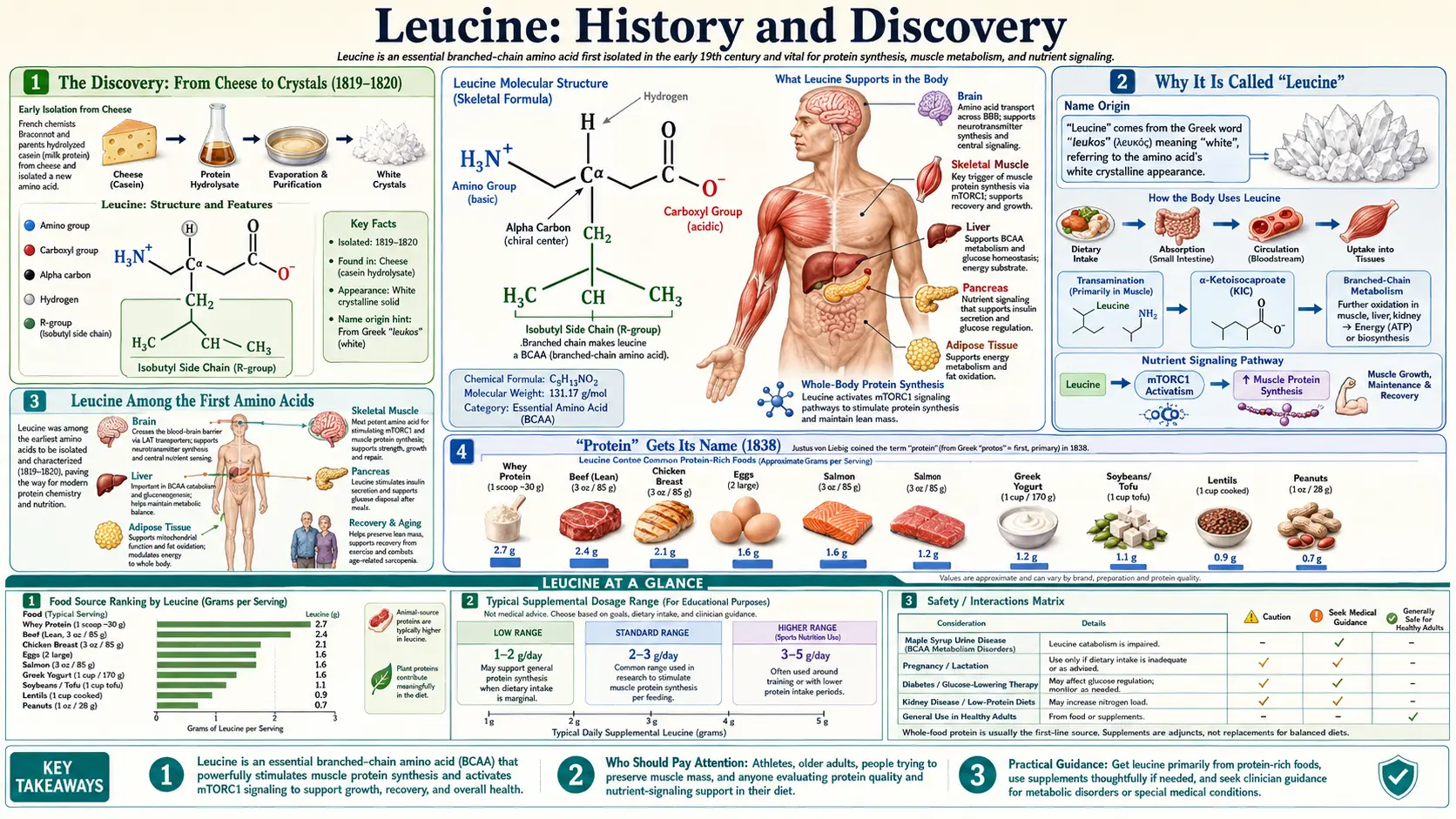
Leucine has one of the longest histories of any amino acid. It was first pulled out of cheese in 1819 by the French chemist Joseph Louis Proust — who did not yet know what to make of it — and then isolated again from muscle the following year by Henri Braconnot, who gave it the name we still use, from the Greek word for "white," after its pale crystals. This article tells that story plainly: how leucine was discovered, where its name comes from, how it fits among the very first amino acids ever found, the moment a century later when William Cumming Rose proved that humans cannot live without it, and how a remedy first scraped off old cheese became one of the most studied molecules in modern nutrition. Where the historical record is firm we say so; where a date or a claim is debated, we say that too.
Table of Contents
- The Discovery: From Cheese to Crystals (1819–1820)
- Why It Is Called "Leucine"
- Leucine Among the First Amino Acids
- "Protein" Gets Its Name (1838)
- Working Out the Structure: Fischer and the Peptide Bond
- The Branched-Chain Family: Isoleucine and Valine
- Proving It Is Essential: William Cumming Rose
- From Old Cheese to Modern Nutrition Science
- Research Papers and References
- Connections
- Featured Videos
The Discovery: From Cheese to Crystals (1819–1820)
Leucine's story begins, fittingly for a food molecule, with cheese. In 1819, the French chemist Joseph Louis Proust — already famous for the law of definite proportions in chemistry — was studying how cheese ages and ferments when he isolated a new substance from it. He did not recognise it as what we now call an amino acid; that whole category of molecule did not yet exist as an idea. Proust simply named what he had found oxide caséeux ("cheesy oxide"), after the Latin caseus, meaning cheese. This was leucine, obtained for the first time, though no one yet knew what it was.
The decisive step came a year later. In 1820, the French chemist and pharmacist Henri Braconnot, working in Nancy, treated muscle fibre and wool with acid — a process now called acid hydrolysis, which breaks a protein down into its building blocks — and obtained the same white, crystalline material. It was Braconnot who gave it the lasting name leucine and who recognised it as a distinct chemical individual rather than an oddity of cheese. The same year, in the same line of work, he also isolated glycine from gelatin, which he called the "sugar of gelatin" for its sweet taste. Braconnot's hydrolysis experiments were, in effect, the opening of the door to amino-acid chemistry.
For a while the two discoveries were not obviously connected. Proust's "cheesy oxide" and Braconnot's "leucine" were treated as separate things, and an alternative name, aposépédine, also circulated in the 1820s. It was only later — by around 1839, as the chemistry matured — that they were recognised as one and the same compound, and Braconnot's name leucine won out. The honest summary is this: Proust obtained it first, in 1819, from cheese; Braconnot isolated and named it in 1820 from muscle and wool; and the name he chose is the one the world still uses two centuries later.
Why It Is Called "Leucine"
The name leucine comes from the ancient Greek word leukos (λευκóς), meaning "white." The reason is simple and visual: when leucine is purified from a protein hydrolysate, it forms a pale, white crystalline powder, and that colour is what Braconnot fixed on when he named it. The same Greek root appears in other familiar medical words — leukocyte (white blood cell) and leukaemia (literally "white blood") — so anyone who has met those terms already knows the root behind leucine.
This is worth dwelling on because it captures how early chemists worked. They could not yet see a molecule's structure, so they named substances for the plainest things they could observe — a taste, a smell, a source, or, as here, a colour. Glycine was named for being sweet (Greek glykys); asparagine for the asparagus it first came from; tyrosine for cheese again (Greek tyros). Leucine, named for its whiteness, sits squarely in that tradition. The name records not what the molecule does in the body — that took another 150 years to uncover — but simply what it looked like on the bench in 1820.
Leucine Among the First Amino Acids
To appreciate leucine's place in history, it helps to see how early it arrived. The first amino acid ever isolated was asparagine, obtained from asparagus juice in 1806 by Louis-Nicolas Vauquelin and Pierre Jean Robiquet. Cystine followed in 1810 (William Hyde Wollaston, from a bladder stone). Then came leucine itself — Proust in 1819, Braconnot in 1820 — alongside glycine from gelatin in 1820. Leucine was therefore among the very first handful of amino acids known to chemistry, isolated when the field was barely a decade old.
For comparison, many of the amino acids now considered household names came much later: tyrosine in 1846 (Justus von Liebig, from cheese), tryptophan in 1901 (Frederick Gowland Hopkins and Sydney Cole), and threonine — the last of the common amino acids to be found — not until 1935. The full set of the roughly twenty amino acids that make up our proteins took well over a century to assemble, from 1806 to 1935. Leucine stands near the front of that long procession, which is part of why its early history is so often retold.
There is a neat irony in this. Leucine was one of the first amino acids discovered, yet it is also one of the most important, gram for gram, in human muscle nutrition — a fact that would only become clear in the twentieth century. The molecule sat in the textbooks for over a hundred years as a known but unremarkable constituent of protein before its special role was understood.
"Protein" Gets Its Name (1838)
While individual amino acids like leucine were being pulled out one by one, chemists were also trying to make sense of the larger substances they came from. In 1838 the Dutch chemist Gerardus Johannes Mulder introduced the word protein for the nitrogen-rich material that seemed to be the fundamental stuff of living tissue. The term is usually credited to a suggestion from the great Swedish chemist Jöns Jacob Berzelius, who proposed it in a letter; it comes from the Greek proteios, meaning "primary" or "of the first rank," reflecting the belief that these were the most important molecules of life.
This matters to leucine's story for a direct reason: Mulder was himself among the chemists who worked on the breakdown products of proteins, and leucine was one of the substances that turned up in that work. The picture coming into focus in the first half of the nineteenth century was that proteins — the "primary" molecules — could be broken down into smaller, definite building blocks, and that leucine was one of those blocks. The grand category (protein) and its components (amino acids such as leucine) were being mapped in parallel, by overlapping circles of chemists, in the same few decades.
Working Out the Structure: Fischer and the Peptide Bond
Isolating leucine and naming it was only the beginning. Knowing exactly what its molecule looked like, and how amino acids join together to form proteins, took the rest of the nineteenth century and the turn of the twentieth. The towering figure here is the German chemist Hermann Emil Fischer, who won the Nobel Prize in Chemistry in 1902 "in recognition of the extraordinary services he has rendered by his work on sugar and purine syntheses." Although his Nobel citation was for sugars and purines, Fischer went on to do the foundational work on amino acids and proteins.
Fischer's great contribution to this part of the story was the idea of the peptide bond — the specific chemical link that joins one amino acid to the next, like beads on a string, to build a protein. He and his colleagues did not just propose this; they synthesised real chains of amino acids in the laboratory to prove it could be done. In one celebrated effort his group built an eighteen-unit peptide containing fifteen glycine and three leucine residues — an early demonstration, with leucine itself in the chain, that proteins are strings of amino acids joined end to end. Fischer's work turned amino acids from a list of isolated curiosities into the understood alphabet of proteins.
The Branched-Chain Family: Isoleucine and Valine
Leucine does not stand alone. It is the best known of the three branched-chain amino acids (BCAAs), so called because their carbon skeletons branch like a forked twig. The other two are isoleucine and valine, and their discoveries are woven into leucine's own.
The connection is right there in the name isoleucine — meaning "an isomer of leucine," a molecule built from the same atoms arranged differently. Isoleucine was discovered by the German chemist Felix Ehrlich around 1903–1904, while he was studying the by-products of beet-sugar refining. Ehrlich noticed the close family resemblance between leucine and isoleucine, and between each of them and a corresponding "fusel" alcohol formed during fermentation — an observation that led to lasting insight into how the body and yeasts break these amino acids down. Valine, the third member, has a longer pedigree than its 20th-century characterisation suggests: it was first isolated as early as 1856 by the Austrian–German chemist Eugen von Gorup-Besanez, from an extract of pancreas. Its modern characterisation came later — Emil Fischer obtained it from the milk protein casein in 1901 and around 1906 worked out which optical form occurs in proteins, fixing the name valine (after valeric acid) that we use today. Together these three branched-chain amino acids would, decades later, become the centrepiece of sports-nutrition science — with leucine, the eldest of the three, recognised as the most powerful trigger of muscle building.
Proving It Is Essential: William Cumming Rose
For more than a century after its discovery, leucine was known to be present in protein, but no one had proved that we actually need it in the diet. That proof came from the American biochemist William Cumming Rose at the University of Illinois, in a series of meticulous experiments running from the 1930s into the 1950s — work that created the modern concept of an "essential amino acid."
Rose's method was elegant. Instead of feeding animals whole proteins, he fed them purified mixtures of individual amino acids, then removed them one at a time to see which were indispensable for life and growth. Working first with rats, he established that a specific set of amino acids — including leucine — could not be made by the body fast enough and had to come from food. (This same line of research famously led him, in 1935, to discover threonine, the last of the common amino acids to be found, when his amino-acid mixtures still failed to keep rats alive until that missing piece was identified.)
From 1942 onward Rose carried the work into human subjects, persuading volunteers to live on carefully controlled amino-acid diets while he measured their nitrogen balance — the bookkeeping of protein going in versus nitrogen lost — to judge whether each amino acid was truly required. His landmark summary, "Amino Acid Requirements of Man" (1949), and the studies that followed established that humans have eight dietary-essential amino acids, with leucine firmly among them, and even put numbers on how much of each an adult needs. Rose's nitrogen-balance studies are the reason leucine appears today on every chart of the essential amino acids, and the reason we can say with confidence that it must be supplied by the food we eat.
From Old Cheese to Modern Nutrition Science
The final chapter of leucine's history is the most active. Through the second half of the twentieth century, researchers noticed that leucine was not merely a building block to be strung into proteins — it also behaved like a signal, telling the body when to build. By the 1970s and 1980s, studies showed that leucine specifically could stimulate the making of new muscle protein, more so than the other amino acids.
The mechanism was finally pinned down in the modern era. Leucine turns out to switch on a master growth-control system in the cell known as mTOR (the mechanistic target of rapamycin), which governs protein synthesis. A key piece of that puzzle fell into place in 2016, when researchers identified a protein called Sestrin2 as the cell's actual "leucine sensor" — the molecular detector that feels how much leucine is present and reports it to mTOR. In other words, the body has a dedicated leucine-measuring device, which is a striking thing to learn about a molecule first scraped out of ageing cheese two hundred years earlier.
This is the genuine arc of leucine's history: from an unidentified "cheesy oxide" in 1819, to a named white crystal in 1820, to a proven dietary essential in the mid-twentieth century, to one of the most intensively studied signalling molecules in human nutrition today. The detailed evidence on what leucine does — for muscle, recovery, ageing, and metabolism — is covered in the companion Leucine Benefits articles and on the main Leucine page. This history is concerned only with how leucine came to be known in the first place — and how a discovery made in a French cheese cellar grew into a cornerstone of modern protein science.
Research Papers and References
The list below combines peer-reviewed sources on leucine and the history of amino-acid science with curated PubMed topic-search links. Historical milestones attributed to Proust (1819), Braconnot (1820), Mulder and Berzelius (1838), and Emil Fischer are drawn from the chemical and biographical record and are named in the article as historical events. Author names, titles, and journals are given as plain text; only the stable DOI, PMID, or archive link is hyperlinked, and each opens in a new tab.
- Simoni RD, Hill RL, Vaughan M. The discovery of the amino acid threonine: the work of William C. Rose [classical article]. Journal of Biological Chemistry. 2002;277(37):E25. — PMID: 12218068
- Rose WC. Amino acid requirements of man (Nutrition Classics reprint, Federation Proceedings 8(2):546-552, June 1949). Nutrition Reviews. 1976;34(10):307-309. — PMID: 794768
- Wolfson RL, Chantranupong L, Saxton RA, Shen K, Scaria SM, Cantor JR, Sabatini DM. Sestrin2 is a leucine sensor for the mTORC1 pathway. Science. 2016;351(6268):43-48. — doi:10.1126/science.aab2674
- Li F, Yin Y, Tan B, Kong X, Wu G. Leucine nutrition in animals and humans: mTOR signaling and beyond. Amino Acids. 2011;41(5):1185-1193. — doi:10.1007/s00726-011-0983-2
- Hermann Emil Fischer — Facts (Nobel Prize in Chemistry 1902). NobelPrize.org. — NobelPrize.org: Fischer 1902
- Leucine — history and discovery — PubMed: leucine history and discovery
- Essential amino acids and the work of William Cumming Rose — PubMed: essential amino acids and nitrogen balance
External Authoritative Resources
- NobelPrize.org — Emil Fischer, Biographical
- NIH Office of Dietary Supplements — Fact Sheets
- PubMed — All research on leucine