L-Theanine for Sleep Quality
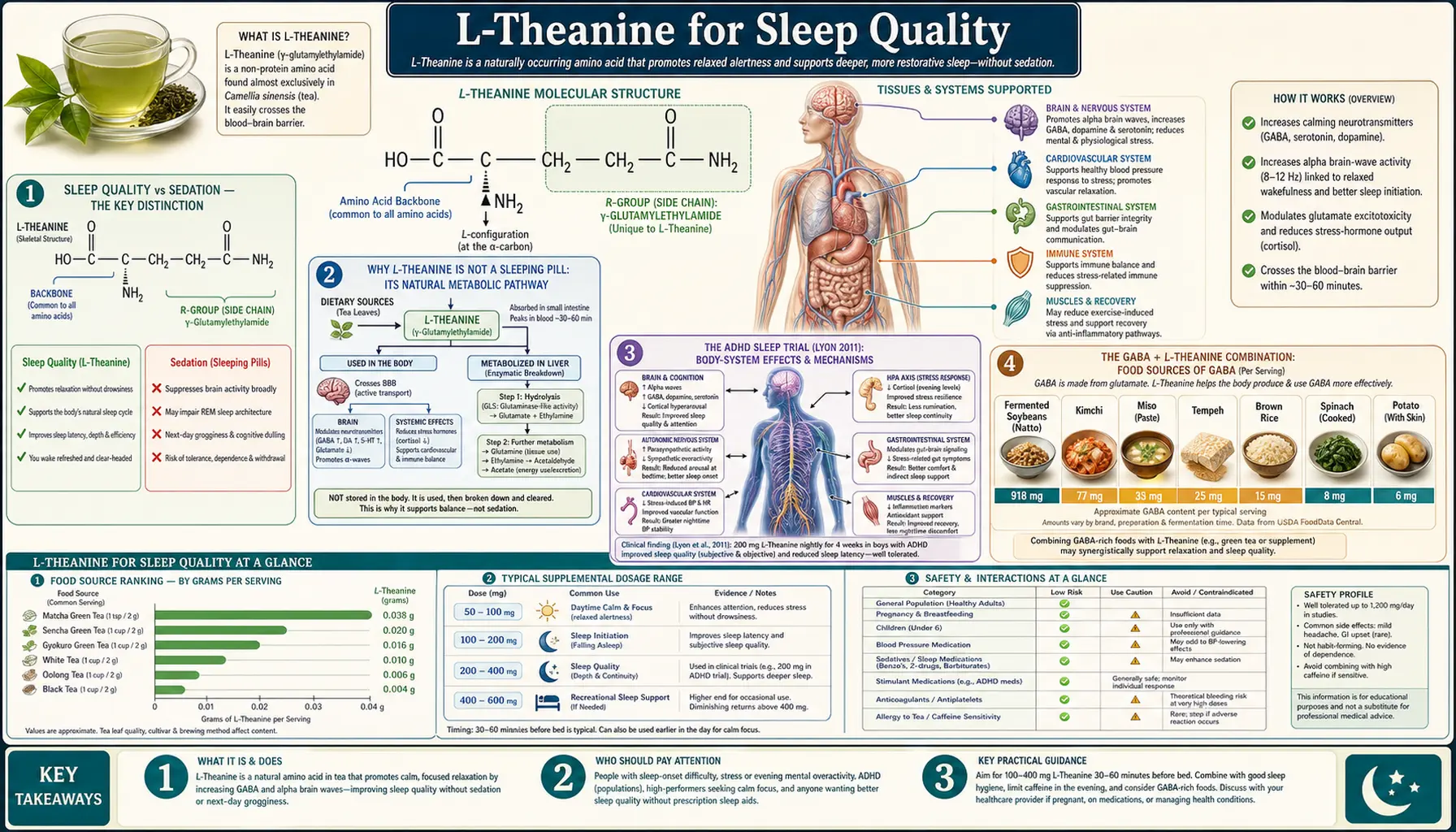
L-Theanine is often sold as a "sleep supplement," but that label is slightly misleading in a way worth understanding. It is not a sedative and does not knock you out; in blinded studies it does not reliably make you fall asleep faster. What the evidence more genuinely supports is an improvement in sleep quality — the sense of having slept more restfully — largely by lowering the pre-sleep stress and mental arousal that keep people wired at bedtime. The clearest data come from an unusual place: a trial in boys with ADHD.
Interactive Visualization Caffeine, Adenosine & Why Coffee Stops Working Caffeine doesn’t give you energy — it blocks the tiredness signal while adenosine keeps piling up behind the blockade. Move your coffee to 2 p.m. and watch your deep sleep vanish. Launch →
Table of Contents
- Sleep Quality vs Sedation — The Key Distinction
- Why L-Theanine Is Not a Sleeping Pill
- The ADHD Sleep Trial (Lyon 2011)
- The GABA + L-Theanine Combination
- Sleep in Anxiety and Depression Contexts
- How It Might Work for Sleep
- Practical Use for Sleep
- What to Expect — Honest Effect Size
- Cautions
- Key Research Papers
- Connections
- Featured Videos
Sleep Quality vs Sedation — The Key Distinction
The most important idea on this page is the difference between two things people lump together as "helping you sleep":
- Sedation / hypnotic effect — a drug pushes you toward unconsciousness. Sleeping pills, alcohol, and sedating antihistamines work this way. They shorten how long it takes to fall asleep (sleep latency) but often at the cost of altered sleep architecture and grogginess the next day.
- Sleep quality — how restorative and undisturbed your sleep is, and how rested you feel on waking. This can improve even if you did not fall asleep any faster, simply because you went to bed less anxious and slept more soundly.
L-theanine acts almost entirely in the second category. It is not sedating — you can take it during the day for calm focus without feeling sleepy. Its potential sleep benefit comes not from a knock-out effect but from lowering the mental and physiological arousal that so often stands between a busy mind and restful sleep.
Why L-Theanine Is Not a Sleeping Pill
Several lines of evidence confirm the non-sedative nature of L-theanine:
- No daytime drowsiness. The same alpha-wave "calm alertness" effect described on the Calm Focus page is specifically not the slow-wave (theta/delta) pattern of drowsiness. People take it before work and driving without impairment.
- Sleep-latency effects are modest. In healthy adults, L-theanine alone does not consistently shorten the time it takes to fall asleep — a hallmark of a true hypnotic.
- It is safe to combine with caffeine. A genuine sedative would fight caffeine; L-theanine is used with caffeine for daytime focus (see Caffeine Synergy). That alone tells you it is not a sleeping drug.
This is actually a selling point for people who want help sleeping without the hangover, dependence, or next-day fog of hypnotics. Rao and colleagues (2015), reviewing candidate natural sleep aids, highlighted exactly this profile: L-theanine improves relaxation and sleep quality without the risks of sedative-hypnotic drugs.
The ADHD Sleep Trial (Lyon 2011)
The most-cited objective sleep study is Lyon, Kapoor, and Juneja (2011). They gave boys aged 8–12 with diagnosed ADHD either 400 mg/day of L-theanine (as the purified Suntheanine form, split into two doses) or placebo for six weeks, and measured sleep objectively with actigraphy (a wrist device that tracks movement).
Results:
- The L-theanine group showed higher sleep efficiency and sleep percentage — they spent more of their time in bed actually asleep.
- They showed less "non-restful" sleep and reduced nighttime activity.
- Notably, L-theanine did not significantly shorten sleep latency — consistent with the theme that it improves sleep quality rather than acting as a sedative.
- It was well tolerated, with no serious side effects at that dose in children.
Two honest caveats: this was a single, relatively small trial in a specific pediatric population (boys with ADHD, who commonly have disrupted sleep), so the results do not automatically generalize to healthy adults or to insomnia. And the effect, while statistically real, was a modest improvement in sleep efficiency, not a transformation. Still, it is one of the few studies with objective (not just self-reported) sleep measurement, which is why it carries weight.
The GABA + L-Theanine Combination
Some of the more interesting sleep data come from combining L-theanine with GABA, the brain's main inhibitory neurotransmitter. Kim and colleagues (2019) reported that a GABA/L-theanine mixture decreased sleep latency and increased the duration of both REM and NREM (deep) sleep in an animal model, apparently through effects on GABA and glutamate receptor systems — and did so more effectively than either compound alone.
This synergy is biologically plausible: L-theanine appears to raise GABA tone, and supplying GABA alongside it may reinforce the calming, sleep-supporting signal. It also fits the broader pattern that L-theanine tends to work best as a modulator that amplifies the body's own relaxation pathways rather than as a stand-alone knock-out agent. That said, the strongest GABA/theanine sleep data so far are pre-clinical (animal) or from short human studies, so this remains a promising rather than a settled combination.
Sleep in Anxiety and Depression Contexts
Because L-theanine's clearest mechanism is stress reduction, its most credible sleep benefit is in people whose poor sleep is driven by a racing, anxious mind rather than by a primary sleep disorder:
- In the Hidese (2019) randomized controlled trial in healthy adults, four weeks of L-theanine (200 mg/day) improved several stress-related and sleep-related measures, including aspects of sleep quality, alongside better performance on some cognitive tests.
- In the Hidese (2017) open-label study in major depression, sleep quality (measured with the Pittsburgh Sleep Quality Index) improved along with mood and anxiety — though, being open-label, this is suggestive rather than definitive.
- In the Ritsner (2011) schizophrenia trial, adjunctive L-theanine reduced anxiety and activation symptoms that commonly interfere with sleep.
- Even the largely negative Sarris (2019) generalized-anxiety trial hinted at a possible self-reported sleep benefit despite no effect on core anxiety.
The unifying idea: if what keeps you awake is stress and mental arousal, a compound that reliably buffers acute stress is a rational (low-risk) thing to try. If your insomnia has another cause — pain, sleep apnea, circadian misalignment, restless legs — L-theanine is unlikely to be the answer, and those conditions deserve proper evaluation. See our pages on insomnia and circadian rhythm sleep-wake disorders.
How It Might Work for Sleep
The proposed sleep mechanism follows directly from L-theanine's daytime effects:
- Lowering pre-sleep arousal. By buffering the sympathetic ("fight-or-flight") stress response — lower heart rate, lower stress-marker levels — L-theanine helps the body shift toward the parasympathetic "rest and digest" state that precedes sleep.
- Increasing alpha activity. The rise in relaxed-alert alpha rhythm may ease the transition from wakefulness toward sleep onset for an over-stimulated brain.
- Supporting GABA tone. A gentle nudge to inhibitory GABA signaling is consistent with a calmer, more sleep-permissive nervous system.
Crucially, none of these is a sedative mechanism. They are "remove the obstacle" mechanisms — L-theanine clears away the stress that blocks sleep rather than forcing sleep chemically.
Practical Use for Sleep
- Dose: Studies use roughly 200–400 mg. For sleep, many people take 200 mg about 30–60 minutes before bed. Full details are on the Sources & Dosing page.
- Timing: Because it is not sedating, timing is flexible — the goal is to be in a calmer state at bedtime, not to trigger drowsiness.
- Stacking: It is commonly combined with magnesium, glycine, or GABA for sleep. Evidence for these combinations is limited but the safety profile is favorable.
- Sleep hygiene first: No supplement outperforms consistent sleep and wake times, a dark cool room, and cutting off caffeine early in the day. L-theanine is a small helper, not a fix for a disrupted schedule.
What to Expect — Honest Effect Size
Set expectations accurately: L-theanine will not knock you out, and it may not shorten how long you take to fall asleep. What some people report — and what the better studies support — is waking feeling somewhat more rested, with a calmer transition into bed. This is a subtle, quality-of-sleep effect, most noticeable in people whose sleep is disturbed by stress. If you have moderate-to-severe insomnia, the evidence does not support relying on L-theanine as a primary treatment, and cognitive behavioral therapy for insomnia (CBT-I) remains the first-line, best-supported option.
Cautions
- Not for undiagnosed chronic insomnia. Persistent insomnia deserves a proper cause work-up (see Insomnia); do not self-treat indefinitely.
- Blood-pressure and sedative medications. As with any calming supplement, check with a pharmacist if you take antihypertensives or CNS-active drugs.
- Children. The ADHD trial used 400 mg/day in boys under medical supervision; giving supplements to children should be a clinician-guided decision, not a DIY one.
- Pregnancy and breastfeeding. Insufficient data for supplemental doses; best avoided without medical advice.
Key Research Papers
- Lyon MR, Kapoor MP, Juneja LR (2011). The effects of L-theanine (Suntheanine) on objective sleep quality in boys with attention deficit hyperactivity disorder (ADHD): a randomized, double-blind, placebo-controlled clinical trial. Alternative Medicine Review. — PubMed
- Kim S, Jo K, Hong KB, Han SH, Suh HJ (2019). GABA and L-theanine mixture decreases sleep latency and improves NREM sleep. Pharmaceutical Biology. — PubMed
- Rao TP, Ozeki M, Juneja LR (2015). In search of a safe natural sleep aid. Journal of the American College of Nutrition. — Search PubMed
- Hidese S, Ogawa S, Ota M, et al. (2019). Effects of L-theanine administration on stress-related symptoms and cognitive functions in healthy adults: a randomized controlled trial. Nutrients. — PubMed
- Hidese S, Ota M, Wakabayashi C, et al. (2017). Effects of chronic L-theanine administration in patients with major depressive disorder: an open-label study. Acta Neuropsychiatrica. — PubMed
- Kimura K, Ozeki M, Juneja LR, Ohira H (2007). L-Theanine reduces psychological and physiological stress responses. Biological Psychology. — PubMed
- Ritsner MS, Miodownik C, Ratner Y, et al. (2011). L-theanine relieves positive, activation, and anxiety symptoms in patients with schizophrenia and schizoaffective disorder. Journal of Clinical Psychiatry. — PubMed
- Sarris J, Byrne GJ, Cribb L, et al. (2019). L-theanine in the adjunctive treatment of generalized anxiety disorder: a double-blind, randomised, placebo-controlled trial. Journal of Psychiatric Research. — PubMed
- Türközü D, Şanlıer N (2017). L-theanine, unique amino acid of tea, and its metabolism, health effects, and safety. Critical Reviews in Food Science and Nutrition. — PubMed
- Nobre AC, Rao A, Owen GN (2008). L-theanine, a natural constituent in tea, and its effect on mental state. Asia Pacific Journal of Clinical Nutrition. — PubMed
PubMed Topic Searches
- PubMed: Theanine sleep quality
- PubMed: Theanine + GABA sleep
- PubMed: Theanine ADHD sleep
- PubMed: Theanine relaxation/sleep RCTs
External Authoritative Resources
- MedlinePlus — Theanine
- National Sleep Foundation (general sleep-hygiene and insomnia guidance)
- PubMed — all theanine sleep research
Connections
- All Amino Acids
- Caffeine, Adenosine & Why Coffee Stops Working — interactive animation
- L-Theanine Overview
- L-Theanine Benefits Hub
- L-Theanine for Calm Focus & Anxiety
- L-Theanine Sources & Dosing
- GABA
- Glycine
- Tryptophan
- 5-HTP
- Magnesium
- Insomnia
- ADHD
- Depression
- Circadian Rhythm Sleep-Wake Disorders
- Chamomile
- Green Tea