Histidine: History and Discovery
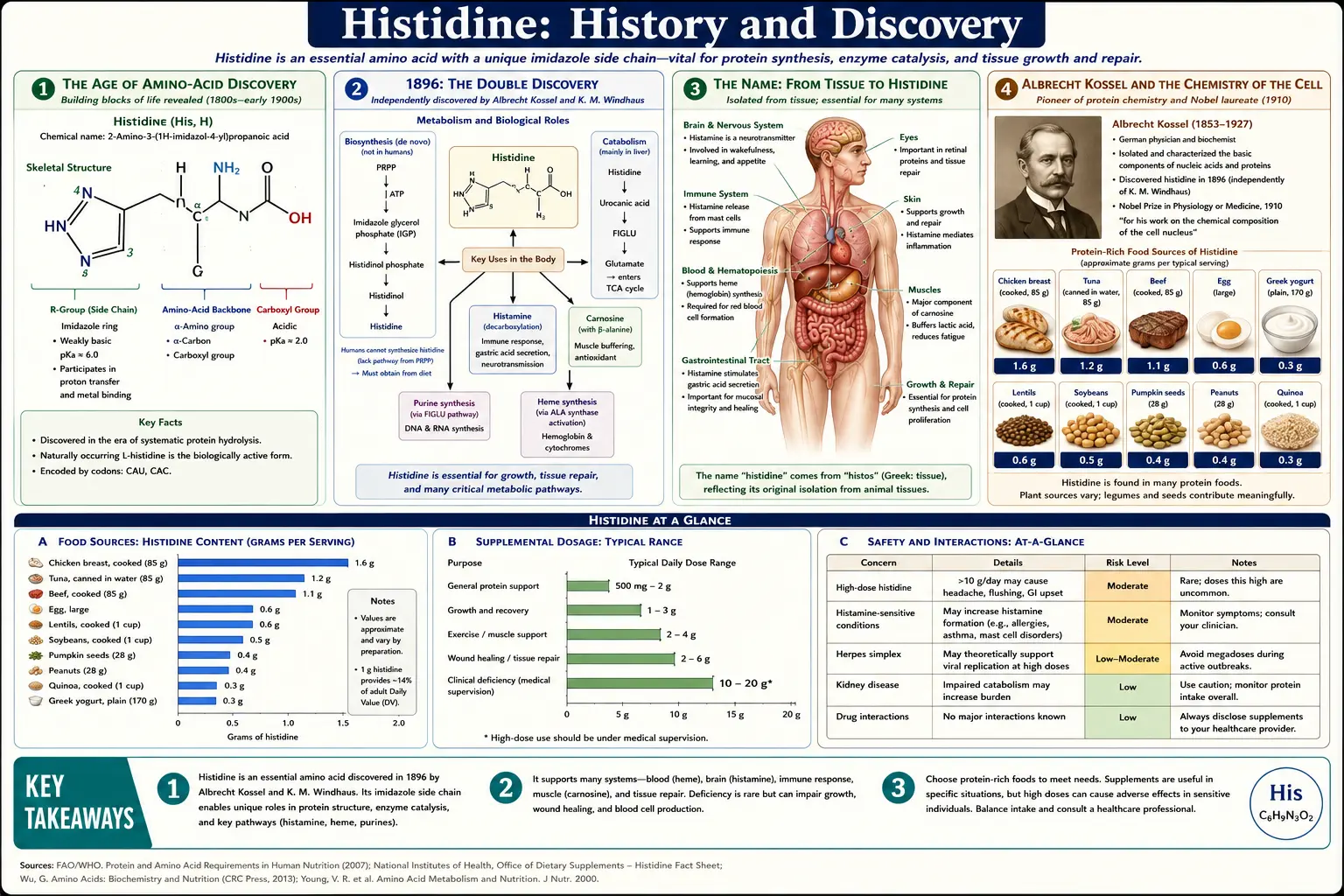
In 1896 two chemists, working separately and with different methods, both pulled the same new building block of protein out of fish — and because they found it inside animal tissue, they named it after the Greek word for tissue, histós. That double discovery, credited to the German biochemist Albrecht Kossel and the Swedish chemist Sven Gustaf Hedin, is the starting point of histidine's story. This article traces what the record actually supports: how histidine was isolated and by whom, where its name comes from, how its unusual ring-shaped side chain was pinned down by chemical synthesis in 1911, how William Cumming Rose's mid-twentieth-century feeding studies sorted the "essential" amino acids from the rest, and the long, genuinely argued question of whether adults — not just infants — truly need histidine in the diet. Where the history is firm we say so; where a point was disputed or is still being settled, we name it as such.
Table of Contents
- The Age of Amino-Acid Discovery
- 1896: The Double Discovery
- The Name: From Tissue to Histidine
- Albrecht Kossel and the Chemistry of the Cell
- Confirming the Structure: Pyman's 1911 Synthesis
- Rose, Nitrogen Balance, and the Essential Amino Acids
- The Long Debate: Is Histidine Essential for Adults?
- From Curiosity to Clinic
- Research Papers and References
- Connections
- Featured Videos
The Age of Amino-Acid Discovery
Histidine arrived fairly late in a long parade of discoveries. The first amino acid ever isolated was asparagine, drawn from asparagus juice in 1806 by the French chemists Louis-Nicolas Vauquelin and Pierre-Jean Robiquet. Over the following decades chemists teased out more of these building blocks one at a time: glycine from gelatin in 1820 (Henri Braconnot called it the "sugar of gelatin" for its sweet taste), tyrosine from cheese in 1846 (Justus von Liebig, who named it from the Greek tyros, "cheese"), and many others. The names themselves often record where each was first found — a habit of nineteenth-century chemistry that histidine would follow exactly.
Behind this slow accumulation lay a bigger idea taking shape. In 1838 the nitrogen-rich substances that make up so much of living tissue got a name: protein, from a Greek root meaning "of first importance." The Dutch chemist Gerardus Johannes Mulder was the first to describe these substances chemically, but the word itself was coined by the great Swedish chemist Jöns Jacob Berzelius, who proposed it to Mulder in a letter; Mulder then adopted it in his published work. By the time histidine was isolated, chemists understood that proteins were built from amino-acid units, and the race was on to find and count them all. The final piece of the puzzle — proving that amino acids are strung together by a specific chemical link, the peptide bond — was the work of Emil Fischer, who shared in this field's foundational chemistry and received the Nobel Prize in Chemistry in 1902 for his work on sugars and purines. Histidine, isolated in 1896, belongs squarely to this heroic age of protein chemistry: late enough to be one of the last common amino acids found, early enough that its discovery was front-page chemistry.
1896: The Double Discovery
Histidine's isolation is unusual in that two researchers reached it in the same year, by different routes, working with different starting materials. This is why reference sources almost always credit the discovery to both names together: Albrecht Kossel, a German biochemist, and Sven Gustaf Hedin, a Swedish chemist, both reported the new amino acid in 1896.
The two men got there from opposite directions. Kossel isolated histidine from sturine — a protamine, that is, a small, exceptionally basic protein found in fish sperm. Working from this protamine and its breakdown products, he precipitated the new compound using mercury salts from alkaline solution. Hedin, meanwhile, obtained histidine from the acid breakdown (hydrolysis) of ordinary proteins, separating it out as a precipitate formed with silver nitrate and ammonia. That two such different procedures — one starting from a peculiar fish-sperm protein, the other from common protein hydrolysates — converged on the same molecule in the same year is a small piece of luck and a sign that histidine is, in fact, a widespread component of proteins waiting to be found.
Sources differ slightly on the fine print — some describe Kossel's source protamine in terms of one fish species or another — but the central facts are firm and consistently reported: the year (1896), the two discoverers (Kossel and Hedin), and the broad methods (a protamine source for Kossel, protein hydrolysates for Hedin). Because both arrived independently and at the same time, the honest description is a shared, simultaneous discovery rather than a contested priority claim; this page presents it that way.
The Name: From Tissue to Histidine
The name histidine follows the old naming habit of nineteenth-century chemistry: it records where the substance was found. It comes from the Greek histós (ἱστός), meaning "tissue" — because the amino acid was isolated from the protein of animal tissue. The same Greek root sits inside familiar modern words such as histology (the study of tissues) and histamine, the signalling molecule the body makes directly from histidine. The shared root is not a coincidence: histamine is literally the amine made from histidine, and the two names grew from the same idea of something belonging to the tissues.
It is worth noting what the name does not tell us. Unlike "asparagine" (from asparagus) or "tyrosine" (from cheese), histidine's name does not point to a single food or plant; it points to the general fact that the compound is a constituent of bodily tissue protein. That broad naming fits a molecule that turned out to be everywhere in the body — built into haemoglobin, packed into muscle as part of the dipeptide carnosine, and present at the working core of countless enzymes.
Albrecht Kossel and the Chemistry of the Cell
Of the two discoverers, Albrecht Kossel (1853–1927) is the more celebrated, and histidine was only one thread in a remarkable career. Kossel was a pioneer of the chemistry of the cell nucleus. Across roughly 1885 to 1901, he and his students used hydrolysis and careful chemical analysis to identify the components of nucleic acids — the bases adenine, cytosine, guanine, thymine, and uracil — the very letters that would later be recognised as the alphabet of DNA. He also isolated other biological compounds, including histidine (1896) and the amine agmatine.
In 1910 Kossel received the Nobel Prize in Physiology or Medicine, awarded for his contributions to the chemistry of the cell through his work on proteins and nucleic substances. It is worth being precise here, because it is easy to overstate: the prize honoured his broad body of work on the chemistry of the cell, especially nucleic acids and proteins — it was not awarded specifically "for discovering histidine." Histidine was one notable isolation among many achievements. Still, the connection matters for our story: the amino acid was found not by chance but by one of the most rigorous analytical chemists of the era, in the course of systematically taking proteins apart to see what they were made of.
Sven Gustaf Hedin, histidine's co-discoverer, is less of a household name today but was a respected physiological chemist of the same generation; the simultaneous isolation by two careful workers is part of why the 1896 attribution has stood so firmly.
Confirming the Structure: Pyman's 1911 Synthesis
Isolating a substance and knowing exactly what it looks like are two different things. Histidine's defining feature is its side chain: a five-membered, nitrogen-containing ring called an imidazole. That ring is the source of nearly everything histidine does in the body — it lets the amino acid pick up and release protons near the body's own pH (making it a natural buffer), grip metal ions like copper and zinc, and sit at the catalytic heart of enzymes. But in the years right after 1896, the precise structure of the molecule still had to be proven.
The clinching evidence came from chemical synthesis. In 1911, the British chemist Frank Lee Pyman published a synthesis of histidine in the Journal of the Chemical Society. By building the molecule up from simpler, known starting materials and showing that the laboratory-made product matched natural histidine, Pyman confirmed the imidazole-containing structure beyond reasonable doubt. This is a recurring pattern in the history of the amino acids: a substance is first isolated from nature, and only later is its structure proven by total synthesis. For histidine, isolation came in 1896 and the synthetic proof of structure in 1911.
Rose, Nitrogen Balance, and the Essential Amino Acids
Knowing what histidine is did not answer a more practical question: does the body need to eat it? Some amino acids the body can manufacture for itself; others it cannot, and must obtain from food. The amino acids in this second group are called essential (or indispensable). Sorting one group from the other was the great achievement of the American biochemist William Cumming Rose and his collaborators, working chiefly through the 1930s and 1940s.
Rose's method was elegant in principle. He fed animals — and later healthy human volunteers — carefully controlled diets in which the protein was replaced by purified mixtures of individual amino acids, then removed one amino acid at a time. His key measurement was nitrogen balance: because protein is the body's main store of nitrogen, comparing the nitrogen eaten against the nitrogen excreted reveals whether the body is building tissue up or breaking it down. If dropping a particular amino acid pushed a subject into negative nitrogen balance — losing more than they took in — that amino acid was essential. In his rat studies, histidine behaved as one of the amino acids the animal could not do without; it was counted among the essential amino acids for the rat. (It was this same line of rat-feeding work that led Rose to identify threonine in 1935 — the last of the common amino acids to be discovered — before he turned to the human requirement studies for which he is best known.)
The modern tally of nine essential amino acids for humans — histidine, isoleucine, leucine, lysine, methionine, phenylalanine, threonine, tryptophan, and valine — grew directly out of this nitrogen-balance tradition. But histidine's exact place on that list turned out to be the most stubbornly argued of all, as the next section explains.
The Long Debate: Is Histidine Essential for Adults?
For decades, histidine occupied an awkward middle ground. It was clearly essential for infants — rapidly growing babies plainly needed it from the diet — but whether healthy adults required dietary histidine was genuinely uncertain. Short feeding studies kept producing a puzzle: adults placed on histidine-free diets did not slide into negative nitrogen balance nearly as fast as they did when other essential amino acids were withheld. The body seemed to have a buffer. We now understand part of the reason: the body holds large reserves of histidine, especially locked up in muscle as carnosine and in the blood as part of haemoglobin, and it can draw on these stores to ride out a short shortfall. That hidden reserve made histidine look non-essential in brief experiments.
The turning point came from studies that lasted long enough, and looked closely enough, to drain those reserves. A landmark came in 1975, when Joel Kopple and Mackenzie Swendseid reported in the Journal of Clinical Investigation that both healthy men and men with chronic kidney failure, fed a histidine-deficient diet, eventually developed clear signs of deficiency — negative nitrogen balance, falling blood histidine and muscle histidine, anaemia, and a dry, scaly skin rash — all of which reversed when histidine was put back in the diet. Their conclusion was direct: histidine is an essential amino acid in normal and chronically uremic man. Later long-term work, such as the 2002 histidine-depletion study by Wantanee Kriengsinyos, Paul Pencharz, and colleagues, continued to probe how adults adapt their protein metabolism to a histidine shortage, refining rather than overturning the picture.
The settled modern view — reflected in current nutrition references and reviews — is that histidine is essential for adults as well as infants, which is why it sits on the standard list of nine essential amino acids. The honest historical note is that this took a long time to nail down, precisely because the body's histidine reserves are deep enough to mask a deficiency for weeks. It is a good example of how a question that sounds simple — "do we need to eat this?" — can take most of a century of careful experiments to answer well.
From Curiosity to Clinic
What began in 1896 as a chemical curiosity isolated from fish-sperm protein has become a molecule of broad practical interest. Once chemists understood histidine's imidazole ring, its many roles fell into place: it is the sole raw material for histamine (central to immune defence, stomach-acid secretion, and brain wakefulness), a key partner with beta-alanine in the antioxidant muscle dipeptide carnosine, a proton buffer that helps the blood hold its pH steady, and a metal-gripping residue built into the working sites of countless enzymes and into haemoglobin itself.
That breadth is exactly why histidine reappeared in clinical research in the late twentieth and early twenty-first centuries — studied in kidney disease, where blood levels often run low; in anaemia; in inflammatory and joint conditions; and as a dietary supplement. A widely cited 2020 review by Milan Holeček in Nutrients gathered this modern evidence together, surveying histidine's metabolism, its physiological importance, and the rationale — and the cautions — around using it as a supplement. The thread is unbroken: the same imidazole ring that Kossel and Hedin first captured in 1896, and that Pyman pinned down by synthesis in 1911, is the reason histidine matters in a hospital nutrition unit today. The detailed evidence on histidine's functions, food sources, dosing, and cautions lives in the companion Histidine Benefits articles and on the main Histidine page; this history is concerned only with how it came to be known in the first place.
Research Papers and References
The list below pairs key peer-reviewed sources on histidine's discovery, structure, and essentiality with curated PubMed topic-search links into the historical and metabolic literature. Author names, titles, and journals are given as plain text; only the stable DOI, PMID, or archive link is hyperlinked, and each opens in a new tab. The historical attribution of histidine's 1896 isolation to Albrecht Kossel and Sven Gustaf Hedin is drawn from standard biochemical references rather than from a single modern citation.
- Pyman FL. CLVII.—The synthesis of histidine. Journal of the Chemical Society, Transactions. 1911;99:1386-1401. — doi:10.1039/CT9119901386
- Kopple JD, Swendseid ME. Evidence that histidine is an essential amino acid in normal and chronically uremic man. Journal of Clinical Investigation. 1975;55(5):881-891. — PMID: 1123426
- Kriengsinyos W, Rafii M, Wykes LJ, Ball RO, Pencharz PB. Long-term effects of histidine depletion on whole-body protein metabolism in healthy adults. The Journal of Nutrition. 2002;132(11):3340-3348. — PMID: 12421848
- Holeček M. Histidine in health and disease: metabolism, physiological importance, and use as a supplement. Nutrients. 2020;12(3):848. — doi:10.3390/nu12030848
- Albrecht Kossel — biographical and Nobel Prize information (Nobel Prize in Physiology or Medicine, 1910). — NobelPrize.org: Albrecht Kossel
- Histidine — discovery, isolation, and naming (history) — PubMed: histidine discovery and history
- Histidine — essential amino acid status and requirements — PubMed: histidine essentiality and requirements
External Authoritative Resources
- NobelPrize.org — The Nobel Prize in Physiology or Medicine 1910 (Albrecht Kossel)
- NIH Office of Dietary Supplements — Fact Sheets
- PubMed — All research on histidine