Threonine — Benefits Deep Dive
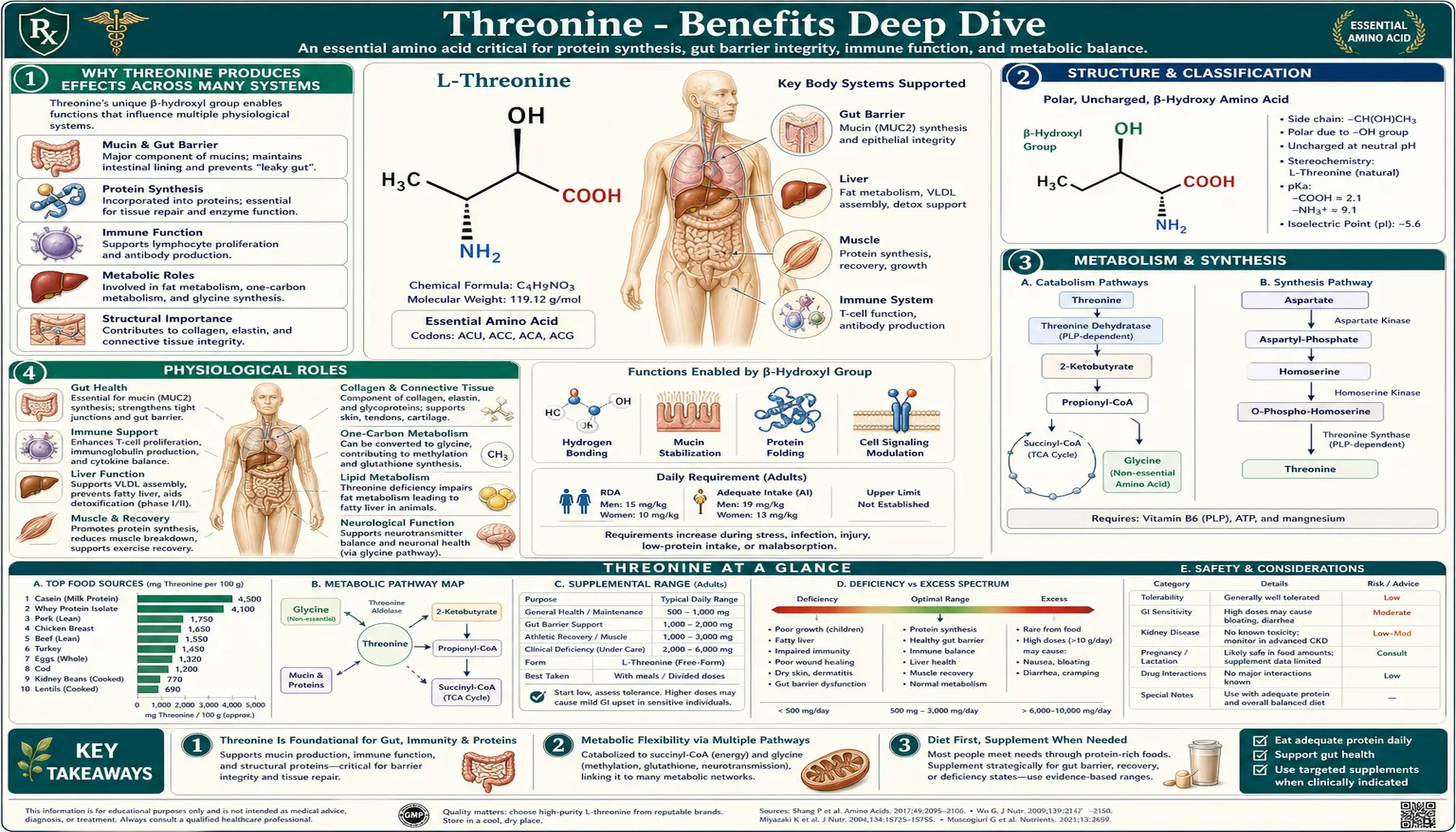
Threonine is one of the nine essential amino acids and one of the least-studied yet most-required of them. It is the dominant building block of intestinal mucin — the MUC2 protein that forms the protective mucus layer of the gut is approximately 30% threonine by amino-acid composition. It is the O-glycosylation residue in immunoglobulin hinges — the threonine-rich linker of IgA1 carries the sugar coat that determines whether the antibody can survive and function at mucosal surfaces. It is one of the four classical lipotropes, alongside choline, methionine, and inositol, whose deficiency in classical rat-feeding studies produces fatty liver within weeks. And it is a quiet but real contributor to collagen and connective-tissue protein synthesis, including the tooth-enamel matrix proteins amelogenin and enamelin. Four benefit pages below explore each domain where threonine's role is largest and the clinical translation most actionable.
Deep-Dive Articles
Gut Mucin & the Intestinal Barrier
Threonine accounts for approximately 30% of intestinal mucin (MUC2) amino-acid content. Mucin O-glycosylation requires threonine and serine as the chemical anchors for the dense sugar coat. The gut-bacteria-fed mucin layer that protects against inflammatory bowel disease (IBD), ulcerative colitis, and bacterial translocation depends on continuous goblet-cell threonine supply. In a 2010 study by Wang and colleagues, weanling pigs fed half the control level of threonine (0.37% of the diet instead of 0.74%) for 14 days had less mucin in the small intestine and lower MUC2 gene activity; an excess (1.11%) also lowered mucin. Parallels to human inflammatory bowel disease, ulcerative colitis, and post-antibiotic gut recovery.
Read the deep dive →Collagen & Connective Tissue
Threonine occupies the X and Y positions of the collagen Gly-X-Y triple helix, sits in the telopeptide regions that participate in crosslinks, and is part of the tooth-enamel matrix proteins amelogenin (a proline-rich protein) and enamelin. Less recognized than glycine and proline as a collagen partner but functionally essential. Roles in bone matrix proteins (osteocalcin, osteopontin), cartilage proteoglycans, vascular elastin, and wound healing.
Read the deep dive →Immune Function
Threonine is a major building block of the immunoglobulin A1 (IgA1) hinge — a proline-rich stretch that is a tandem repeat of threonine, serine, and proline densely decorated with O-linked sugars. Class-switching to immunoglobulin A (IgA), mucosal immunity at the gut and respiratory epithelium, lymphocyte proliferation, and the GALT immune compartment all depend on adequate threonine supply. Connection to immunoglobulin A nephropathy and to recurrent mucosal infection in adults.
Read the deep dive →Liver & Lipid Metabolism
Threonine is one of the four classical lipotropes (alongside choline, methionine, and inositol). Deficiency produces fatty liver in animal models within weeks. The proposed mechanism runs through one-carbon metabolism: threonine to glycine to the methionine cycle to S-adenosylmethionine to phosphatidylcholine to very-low-density lipoprotein (VLDL) assembly. That route is animal biochemistry: in rat liver cells about 65% of threonine breakdown bypasses glycine, and in humans the gene for the enzyme that starts the glycine route is a non-working “pseudogene”. Methionine and choline can partially substitute. Modern non-alcoholic fatty liver disease (NAFLD) has different primary drivers but the lipotropic chemistry remains relevant. Phase II detoxification via glycine conjugation.
Read the deep dive →Table of Contents
- Deep-Dive Articles
- Why Threonine Produces Effects Across Many Systems
- More Threonine Is Not Always Better for the Gut
- Research Papers: Gut Mucin & Barrier
- Research Papers: Collagen & Connective Tissue
- Research Papers: Immune Function
- Research Papers: Liver & Lipid Metabolism
- Research Papers: Cross-Cutting (Metabolism, Status, Safety)
- External Authoritative Resources
- Connections
- Featured Videos
Why Threonine Produces Effects Across Many Systems
Most essential amino acids have a single dominant role that explains the bulk of their clinical importance — lysine for collagen crosslinking, methionine as the universal methyl donor source, tryptophan for serotonin synthesis, the branched-chain amino acids for muscle protein synthesis signaling. Threonine is unusual because its diverse roles in the body trace back to a single chemical feature: threonine's hydroxyl side chain is, together with serine's, the main attachment point for mucin-type O-linked glycans, the carbohydrate decorations attached to glycoproteins throughout the body (collagen is the exception: its sugars attach to hydroxylysine).
Glycoproteins are everywhere. They make up the mucin barrier of the gut, the hinge regions of immunoglobulins, the surface markers of cell membranes, the connective tissue proteoglycans of cartilage and bone, the matrix proteins of tooth enamel, and the carrier proteins of the blood. Any time the body needs to attach sugars to a protein for functional purpose — whether to make the protein more soluble, to mark it for tissue-specific targeting, to protect it from proteolysis, or to give it bulk and viscosity — the attachment point is typically a threonine or serine hydroxyl.
This single biochemical fact organizes the entire clinical landscape of threonine effects:
- Mucin glycoproteins (gut barrier) — MUC2 is approximately 30% threonine, with most of those threonines carrying O-linked GalNAc-based glycans. The protective mucus layer of the gut is, in effect, a threonine-built glycan forest. In threonine-deficient piglets, mucin production falls; thinning of the mucus barrier is a feature of inflammatory bowel disease, as detailed in our Gut Mucin and Barrier deep-dive.
- Immunoglobulin glycoproteins (antibody function) — the IgA1 hinge is a tandem repeat of threonine and serine carrying nine O-glycan attachment sites. Mucosal immunity, class switching, and the immunoglobulin A nephropathy disease mechanism all trace to this glycosylated hinge. See the Immune Function deep-dive.
- Connective tissue glycoproteins (collagen, enamel, proteoglycans) — threonine occupies key residues in collagen sequences (collagen's own sugars attach to hydroxylysine, not threonine) and is part of amelogenin, the proline-rich enamel matrix protein. Aggrecan and osteopontin carry O-glycans on threonine. See the Collagen and Connective Tissue deep-dive.
- One-carbon metabolism and lipotropic effects — in animals, part of threonine is broken down to glycine, which can feed the methionine cycle that supports phosphatidylcholine synthesis. Phosphatidylcholine is the surfactant phospholipid required for very-low-density lipoprotein assembly and triglyceride export from the liver. This was the proposed mechanism behind threonine's classical lipotropic role and the protection against fatty liver seen in rat-feeding studies. The glycine route is a minor one, however: in isolated rat liver cells about 65% of threonine breakdown runs through a different enzyme (threonine dehydratase) that does not make glycine, and in humans the gene for L-threonine 3-dehydrogenase, the enzyme that starts the glycine route, is an “expressed pseudogene” that makes shortened, non-working proteins. The fatty-liver link is therefore animal biochemistry, not a proven human pathway. See the Liver and Lipid Metabolism deep-dive.
The clearest test of the mucin link comes from newborn piglets. In a 2007 study, piglets fed through a stomach tube for 8 days received either enough threonine (0.6 g per kg of body weight a day) or one-sixth of that (0.1 g). The low-threonine piglets had less mucosal tissue and less mucin in the colon, fewer acid-mucin-making goblet cells in the small intestine, and persistent diarrhea. Piglets given the missing threonine by vein instead kept most of these measures normal. The authors read this, together with their earlier finding that piglets fed by vein need only about 40–45% as much threonine as piglets fed by mouth, as a sign that much of the threonine eaten is used by the gut itself to make mucus.
The therapeutic implication of this unified mechanism is that threonine adequacy supports all four domains simultaneously, and threonine inadequacy compromises all four simultaneously. A patient with marginal threonine status (chronic gut disease, restrictive vegan diet, severe burn injury, prolonged parenteral nutrition) is at risk for impaired mucus barrier, reduced antibody production, compromised connective tissue repair, and reduced hepatic lipid export — all linked through the central glycoprotein biology that threonine enables.
The corollary is that threonine is well-supplied by ordinary varied diets containing eggs, dairy, fish, poultry, fermented soy (natto, tempeh, miso), or legumes. Standalone L-threonine supplements are rarely used in clinical nutrition; the usual approach for people at risk is a total high-quality protein intake of 1.0-1.5 g/kg/day from biologically complete sources, which delivers threonine alongside all the other essential amino acids.
More Threonine Is Not Always Better for the Gut
Pig studies show that the gut lining works best within a range of threonine intake, not at the highest intake. In a 2010 study, four groups of 8 weanling pigs were fed diets with 0.37%, 0.74%, 0.89% or 1.11% digestible threonine for 14 days. Both the lowest and the highest level distorted the finger-like folds (villi) of the upper small intestine, and both lowered total mucin in the duodenum and MUC2 gene activity compared with the 0.89% diet. The highest level also raised the rate of cell death (apoptosis) in the lining. The authors concluded that 0.89% was the best level for gut barrier function in weanling pigs.
An earlier study by the same research group fed young pigs 0.37%, 0.74% or 1.11% threonine for 14 days and found that both the low and the high diet reduced protein production in the jejunal lining, in mucins and in skeletal muscle compared with 0.74%. Both studies were done in young pigs.
Research Papers: Gut Mucin & Barrier
- Wang W, Zeng X, Mao X, Wu G, Qiao S (2010). Optimal dietary true ileal digestible threonine for supporting the mucosal barrier in small intestine of weanling pigs. J Nutr 140(5):981-6 — PubMed PMID: 20335627
- Law GK, Bertolo RF, Adjiri-Awere A, Pencharz PB, Ball RO (2007). Adequate oral threonine is critical for mucin production and gut function in neonatal piglets. Am J Physiol Gastrointest Liver Physiol 292(5):G1293-301 — PubMed PMID: 17234895
- Wang X, Qiao S, Yin Y, Yue L, Wang Z, Wu G (2007). A deficiency or excess of dietary threonine reduces protein synthesis in jejunum and skeletal muscle of young pigs. J Nutr 137(6):1442-6 — PubMed PMID: 17513404
- Velcich A et al. (2002). Colorectal cancer in mice genetically deficient in MUC2 — PubMed: Muc2 knockout colitis and cancer
- van der Sluis M et al. (2006). Muc2-deficient mice spontaneously develop colitis — PubMed: Spontaneous colitis in Muc2-null mice
- Johansson MEV et al. (2008). The inner of the two Muc2 mucin-dependent mucus layers in colon is devoid of bacteria — PubMed: Two-layer colonic mucus
- Hansson GC (2012). Role of mucus layers in gut infection and inflammation — PubMed: Mucus layer review
- Pullan RD et al. (1994). Thickness of adherent mucus gel on colonic mucosa in humans and its relevance to colitis — PubMed: Mucus thickness in UC
- Bertolo RF, Chen CZ, Law G, Pencharz PB, Ball RO (1998). Threonine requirement of neonatal piglets receiving total parenteral nutrition is considerably lower than that of piglets receiving an identical diet intragastrically. J Nutr 128(10):1752-9 — PubMed PMID: 9772146
- Faure M et al. (2006). Specific amino acids increase mucin synthesis and microbiota in DSS-treated rats — PubMed: Threonine in DSS colitis model
- Desai MS et al. (2016). A dietary fiber-deprived gut microbiota degrades the colonic mucus barrier — PubMed: Fiber deprivation and mucus degradation
- Bansil R, Turner BS (2018). The biology of mucus: composition, synthesis and organization — PubMed: Mucus biology review
Research Papers: Collagen & Connective Tissue
- Shoulders MD, Raines RT (2009). Collagen structure and stability — PubMed: Collagen structure review
- Ramshaw JA, Shah NK, Brodsky B (1998). Gly-X-Y tripeptide frequencies in collagen — PubMed: Gly-X-Y composition
- Eyre DR, Wu JJ (2005). Collagen cross-links — PubMed: Crosslink chemistry
- Margolis HC et al. (2006). Role of macromolecular assembly of enamel matrix proteins in enamel formation — PubMed: Amelogenin self-assembly
- Termine JD, Belcourt AB, Christner PJ, Conn KM, Nylen MU (1980). Properties of dissociatively extracted fetal tooth matrix proteins. I. Principal molecular species in developing bovine enamel. J Biol Chem 255(20):9760-8 — PubMed PMID: 7430099
- De Giorgi F, Fumagalli M, Scietti L, Forneris F (2021). Collagen hydroxylysine glycosylation: non-conventional substrates for atypical glycosyltransferase enzymes. Biochem Soc Trans 49(2):855-866 — PubMed PMID: 33704379
- Mithieux SM, Weiss AS (2005). Elastin — PubMed: Elastin review
- Demling RH (2009). Nutrition, anabolism, and the wound healing process: an overview — PubMed: Nutrition and wound healing
- Zague V et al. (2011). Collagen hydrolysate intake increases skin collagen expression — PubMed: Collagen hydrolysate and skin
- Clark KL et al. (2008). 24-week study on collagen hydrolysate supplementation in athletes with joint pain — PubMed: Collagen and joint pain
- Khatri M et al. (2021). The effects of collagen peptide supplementation: a systematic review — PubMed: Collagen peptide systematic review
Research Papers: Immune Function
- Mao X, Lai X, Yu B, He J, Yu J, Zheng P, Tian G, Zhang K, Chen D (2014). Effects of dietary threonine supplementation on immune challenge induced by swine Pseudorabies live vaccine in weaned pigs. Arch Anim Nutr 68(1):1-15 — PubMed PMID: 24422657
- Johnson QR, Lindsay RJ, Raval SR, Dobbs JS, Nellas RB, Shen T (2014). Effects of branched O-glycosylation on a semiflexible peptide linker. J Phys Chem B 118(8):2050-7 — PubMed PMID: 24533620
- Li P et al. (2007). Amino acids and immune function — PubMed: Amino acids and immunity review
- Mestecky J, Russell MW (1986). IgA subclasses — PubMed: IgA subclasses
- Kerr MA (1990). The structure and function of human IgA — PubMed: IgA structure-function
- Suzuki H et al. (2008). Aberrantly glycosylated IgA1 in IgA nephropathy — PubMed: IgA nephropathy glycosylation
- Field CJ, Johnson IR, Schley PD (2002). Nutrients and their role in host resistance to infection — PubMed: Nutrients and host resistance
- Faure M et al. (2007). Threonine utilization for synthesis of acute-phase proteins and mucins is increased during sepsis in rats — PubMed: Threonine in sepsis
- Calder PC (2006). Branched-chain amino acids and immunity — PubMed: BCAA and immunity
- Hosomi K, Kunisawa J (2017). The specific roles of vitamins in the regulation of immunosurveillance in the gut — PubMed: Gut immunosurveillance
Research Papers: Liver & Lipid Metabolism
- Best CH, Huntsman ME (1932). The effects of the components of lecithine upon deposition of fat in the liver — PubMed: Best 1932 lipotrope foundation
- Channon HJ et al. (1938). The action of various substances on the fatty livers produced in rats by a diet rich in cholesterol — PubMed: Channon lipotrope studies
- Vance DE, Vance JE (2008). Phospholipid biosynthesis in mammalian cells — PubMed: Phospholipid biosynthesis review
- Vance DE (2014). Phospholipid methylation in mammals: from biochemistry to physiological function — PubMed: PEMT pathway review
- Zeisel SH, da Costa KA (2009). Choline: an essential nutrient for public health — PubMed: Choline as essential nutrient
- Corbin KD, Zeisel SH (2012). Choline metabolism and nonalcoholic fatty liver disease progression — PubMed: Choline and NAFLD
- Edgar AJ (2002). The human L-threonine 3-dehydrogenase gene is an expressed pseudogene. BMC Genet 3:18 — PubMed PMID: 12361482
- Wang W et al. (2013). Glycine metabolism in animals and humans — PubMed: Glycine metabolism review
- Niculescu MD, Zeisel SH (2002). Diet, methyl donors and DNA methylation: folate, methionine, choline interactions — PubMed: Methyl donor interactions
Research Papers: Cross-Cutting (Metabolism, Status, Safety)
- McCoy RH, Meyer CE, Rose WC (1935). Feeding experiments with mixtures of highly purified amino acids. VIII. Isolation and identification of a new essential amino acid. J Biol Chem 112(1):283-302 — doi:10.1016/S0021-9258(18)74986-7
- WHO/FAO/UNU (2007). Protein and amino acid requirements in human nutrition — PubMed: WHO protein requirements
- Pencharz PB, Ball RO (2003). Different approaches to define individual amino acid requirements — PubMed: Amino acid requirement methodology
- Wandall HH et al. (1997). Substrate specificities of human GalNAc-transferases — PubMed: GalNAc-transferase specificity
- Bertolo RF, Burrin DG (2008). Comparative aspects of tissue glutamine and proline metabolism — PubMed: Splanchnic AA metabolism
- House JD, Hall BN, Brosnan JT (2001). Threonine metabolism in isolated rat hepatocytes. Am J Physiol Endocrinol Metab 281(6):E1300-7 — PubMed PMID: 11701446
- Ballevre O et al. (1990). Quantitative partition of threonine oxidation in pigs — PubMed: Threonine catabolic pathways
- Wu G (2009). Amino acids: metabolism, functions, and nutrition — PubMed: Comprehensive amino acid review
External Authoritative Resources
- U.S. National Institutes of Health (NIH) Office of Dietary Supplements — All Fact Sheets (no dedicated threonine fact sheet, but the related amino acid resources are comprehensive)
- Linus Pauling Institute Micronutrient Information Center — the most authoritative continuous-updated nutrient resource (covers choline, methionine, and related lipotropic factors)
- WHO/FAO/UNU Protein and Amino Acid Requirements in Human Nutrition (2007) — the canonical authoritative source on amino acid requirements including the 15 mg/kg/day threonine adult value
- MedlinePlus — U.S. National Institutes of Health consumer health information
- PubMed — All research on threonine (10,000+ papers)
Connections
- All Amino Acids
- Threonine (Main Page)
- Threonine for Gut Mucin and Barrier
- Threonine for Collagen and Connective Tissue
- Threonine for Immune Function
- Threonine for Liver and Lipid Metabolism
- Glycine (Threonine Metabolite)
- Methionine (Lipotrope Partner)
- Serine (Co-glycosylation Residue)
- Proline
- Lysine
- Glutamine
- Arginine
- Collagen
- Bone Broth
- Inflammatory Bowel Disease
- Ulcerative Colitis
- Crohn's Disease
- Hepatology
- Gut-Brain Axis
- Immune Boosting
- Eggs
- Lentils
- Zinc
- Vitamin A for Immune Function
- History
- Sources