Lysine for Calcium Absorption
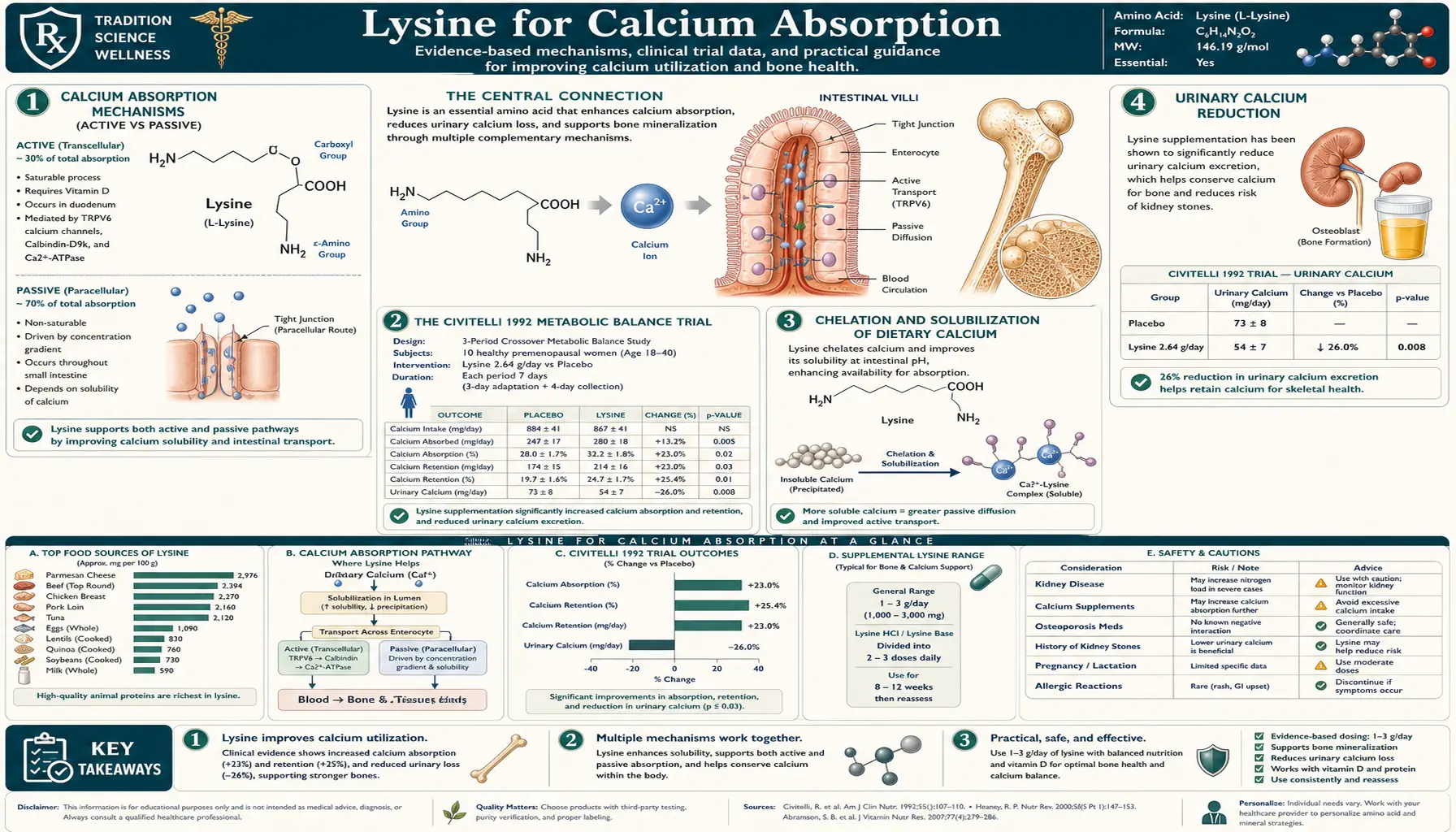
Lysine, an essential amino acid, has been studied for a possible effect on how the body absorbs and keeps calcium. The human evidence is small. The main study, by Roberto Civitelli, Louis Avioli, Carlo Gennari and colleagues (published in Nutrition in 1992), combined two short experiments: in 15 healthy and 15 osteoporotic women given a single 3 g oral calcium load, adding 400 mg of L-lysine blunted the rise in urinary calcium in the healthy women; and in 45 osteoporotic patients, short-term L-lysine (800 mg/day) raised intestinal calcium absorption measured with a 47-calcium tracer, while L-valine and L-tryptophan did not. The authors suggested a possible role for lysine in osteoporosis, but no trial has tested lysine against bone density or fracture outcomes, and a 2025 review lists lysine in osteoporosis therapy as a question still needing investigation (Holeček 2025).
Table of Contents
- Calcium Absorption Mechanisms (Active vs Passive)
- The Civitelli 1992 Calcium Studies
- Proposed Mechanisms: Chelation and Solubilization
- Urinary Calcium
- Lysine Alongside Calcium, Vitamin D and Vitamin K2
- Lysine and the Bone Collagen Matrix
- Osteoporosis Evidence and Its Limits
- Lysine in Cereal-Staple Diets
- Kidney Stones and Hypercalciuria
- Doses Used in Studies
- Cautions
- Key Research Papers
- Connections
- Featured Videos
Calcium Absorption Mechanisms (Active vs Passive)
Intestinal calcium absorption is usually described as the sum of two pathways (Fleet and Schoch 2010). The saturable, transcellular pathway carries calcium through the intestinal cells; textbook descriptions give apical entry through TRPV6 channels, carriage across the cell bound to calbindin-D9k, and export by the PMCA1b calcium pump. Habitual low calcium intake up-regulates this pathway through increased production of 1,25-dihydroxyvitamin D (calcitriol), and low vitamin D status or defects in the vitamin D receptor limit it.
The non-saturable pathway depends mainly on how much calcium is in the gut lumen; calcium moves between cells through the tight junctions. There is some evidence that this pathway in the ileum is also influenced by vitamin D status, but the mechanism is unclear (Fleet and Schoch 2010).
Absorption efficiency varies widely between people. In a 17-year series of 526 absorption studies in 189 middle-aged women, the fraction absorbed fell as intake rose (from about 45% at intakes near 200 mg/day to about 15% above 2,000 mg/day), declined slowly with age, and dropped once more at menopause (Heaney 1989).
Which of these pathways lysine might act on has not been established. The Civitelli studies measured total absorption and urinary calcium, not individual transport steps.
The Civitelli 1992 Calcium Studies
The human paper is Civitelli R, Villareal DT, Agnusdei D, Nardi P, Avioli LV, Gennari C (1992). Dietary L-lysine and calcium metabolism in humans. Nutrition (Institute of Medical Pathology, University of Siena). The authors note that earlier animal studies had shown that some amino acids, particularly L-lysine, can increase calcium absorption. The work received the 1992 John M. Kinney International Award for Nutrition and Metabolism (Civitelli 1993). It contains two separate experiments:
- Acute calcium-load study — 15 healthy and 15 osteoporotic women received an oral calcium load (3 g as calcium chloride) with or without 400 mg of L-lysine. In every group serum total and ionized calcium rose and urinary calcium rose, except in the healthy women given lysine, whose calciuric response was blunted.
- Absorption study — 45 osteoporotic patients received short-term dietary supplementation with L-lysine, L-valine or L-tryptophan (800 mg/day). Intestinal absorption of a 47-calcium tracer rose significantly with L-lysine, but not with L-valine or L-tryptophan.
The authors concluded that L-lysine can both enhance intestinal calcium absorption and improve renal conservation of absorbed calcium, and that the combined effects “may contribute” to a positive calcium balance, suggesting a potential use for lysine supplements in osteoporosis. The abstract does not report effect sizes as percentages, parathyroid hormone results, or nitrogen or amino acid balance.
Limits worth knowing: both experiments were short; the urinary effect was seen after a single large calcium load and only in the healthy women; and the absorption experiment measured tracer uptake, not bone density or fractures. A related laboratory study by the same group found that, in cultured human skin fibroblasts, removing lysine from the growth medium raised intracellular calcium and reduced calcium efflux, while removing arginine had no effect (Civitelli 1989) — a cell-culture finding, not a human result. No larger human study repeating the 1992 design was identified in PubMed.
Proposed Mechanisms: Chelation and Solubilization
How lysine might raise calcium absorption is not known. One proposed explanation is that lysine, or other amino acids, form soluble complexes with calcium in the gut and keep it from precipitating with phosphate or binding to oxalate and phytate. The early rat work on amino acids and the absorption of calcium-45 and strontium-89 (Wasserman, Comar and Nold 1956) is often cited in this context. No human study identified for this page tested the chelation explanation directly.
The effect of oxalate on calcium itself is well measured. In a randomized cross-over study in 13 healthy adults given test meals with 200 mg of labelled calcium, mean calcium absorption was 27.6% from milk and 5.1% from spinach, whose oxalate slightly exceeded its calcium (Heaney 1988). Whether lysine changes absorption from high-oxalate or high-phytate foods has not been studied.
Calcium salts such as citrate, malate and glycinate, and calcium-amino-acid complexes, are sold as supplements; no study was identified comparing free lysine taken with a meal against such a complex.
Urinary Calcium
The second finding in the Civitelli paper concerns the kidney. After a 3 g oral calcium load, urinary calcium rose in all groups except the healthy women who were also given 400 mg of lysine, whose calciuric response was blunted. Serum calcium rose in all groups. The osteoporotic women given lysine did not show the blunted response. The authors interpreted the finding as improved renal conservation of the absorbed calcium; the mechanism was not studied.
Urinary calcium is shaped by many dietary factors. In short-term trials in healthy adults with calcium intake held constant, raising dietary protein from 0.7 to 2.1 g/kg increased urinary calcium in 20 women, and also increased intestinal calcium absorption, from 18.4% to 26.3%; protein intakes at and below 0.8 g/kg were associated with a probable fall in calcium absorption (Kerstetter 2003). Lysine is one component of dietary protein, and the wider literature on protein, amino-acid-sensing receptors and calcium is reviewed by Conigrave, Brown and Rizzoli (2008) and Heaney (2007).
No trial of lysine in people with idiopathic hypercalciuria was identified in PubMed.
Lysine Alongside Calcium, Vitamin D and Vitamin K2
Lysine is often discussed together with the better-studied nutrients for bone:
- Calcium, vitamin D and protein — a 2014 consensus statement from the European Society for Clinical and Economic Aspects of Osteoporosis and Osteoarthritis (ESCEO) recommends, for postmenopausal women, dietary protein of 1.0-1.2 g/kg body weight per day with at least 20-25 g of high-quality protein at each main meal, vitamin D intake of 800 IU/day to keep serum 25-hydroxyvitamin D above 50 nmol/L, calcium intake of 1,000 mg/day, and physical activity 3-5 times a week (Rizzoli 2014). The statement does not single out lysine. The vitamin is covered on the Vitamin D3 page.
- Vitamin K — vitamin K is required for the gamma-carboxylation of bone and vascular proteins such as osteocalcin; the idea that vitamin K2 directs calcium toward bone and away from arteries is a hypothesis discussed on the Vitamin K page.
- Lysine — a building block of collagen, the protein framework of bone (see the companion Collagen Synthesis page), and the subject of the short calcium studies described above.
No trial was identified that tested lysine combined with calcium, vitamin D and vitamin K against bone density or fractures, so the size of any combined effect is unknown.
Magnesium, boron and zinc are also discussed in relation to bone; the Morley Robbins series covers one practitioner's view of mineral balance.
Lysine and the Bone Collagen Matrix
Bone is a composite: hydroxyapatite mineral laid down on a type I collagen scaffold. The mineral gives stiffness and compressive strength; the collagen gives tensile strength and resistance to cracking. In osteogenesis imperfecta (“brittle bone disease”), mutations affecting type I collagen lead to repeated low-impact fractures.
Bone collagen goes through the same lysine chemistry as collagen elsewhere: lysyl hydroxylases (which need vitamin C) hydroxylate specific lysines, and the copper-dependent enzyme lysyl oxidase starts the cross-links, as described on the Collagen Synthesis page. Whether extra dietary lysine improves bone collagen in people who already eat enough protein has not been tested in published human trials.
Pyridinoline (PYD) and deoxypyridinoline (DPD) are lysine-derived collagen cross-links. They are released when bone is resorbed, so urinary PYD and DPD have been used as markers of bone resorption. Raised levels reflect increased bone breakdown, not a shortage or surplus of dietary lysine.
Osteoporosis Evidence and Its Limits
The evidence linking lysine to osteoporosis is limited to the following:
- The Civitelli 1992 studies — short experiments measuring calcium absorption and urinary calcium, including 45 osteoporotic patients in the absorption arm; no bone-density or fracture outcome.
- Animal work — a 1996 study in 50 ovariectomized rats (the usual model of postmenopausal bone loss) tested a combination of lactose, L-arginine and L-lysine, not lysine alone. Its preliminary results suggested the combination given as therapy might lessen the loss of bone mineral content, and the authors stated that further research was needed (Fini 1996).
- Reviews — a 2025 review of lysine metabolism lists the use of lysine in osteoporosis therapy among the questions still needing investigation (Holeček 2025).
No randomized trial of lysine with bone mineral density or fracture outcomes was identified in PubMed, so lysine has not been shown to prevent or treat osteoporosis. Established osteoporosis treatments have been tested in large fracture-outcome trials; lysine has not. Decisions about supplements and bone treatment belong with a clinician.
Lysine in Cereal-Staple Diets
Lysine is the limiting amino acid in diets based on wheat as the staple (Smriga 2004). Protein quality is commonly scored by the protein digestibility-corrected amino acid score (PDCAAS), adopted by FAO/WHO, which compares a protein's first limiting essential amino acid with a reference pattern; by such evaluations milk proteins are superior to plant proteins in cereal-based diets (Schaafsma 2000). Cereal proteins are low in lysine and legume proteins are relatively rich in it, which is why cereal-and-legume combinations are described as complementary.
Lysine fortification has been tested in randomized trials in low-income communities, but none measured bone:
- Northwest Syria, 3 months — in a double-blind trial of lysine-fortified wheat, the plasma cortisol response to blood drawing was reduced in women, sympathetic arousal was reduced in men, and trait anxiety was reduced in men (Smriga 2004). The anxiety findings are covered on the Anxiety and Stress page.
- Northwest Syria, 16 weeks — in households randomized to lysine-fortified or control flour, complement C3 was higher in men and diarrheal morbidity was lower in women given lysine; no other significant differences between groups were found, including in the anthropometric (growth and body-size) measures collected (Ghosh 2008).
- Accra, Ghana — in a double-blind trial of 1 g lysine/day versus placebo in 271 men, women and children, 30% of men, 50% of women and 15% of children were at risk of lysine inadequacy at baseline; lysine reduced diarrheal episodes in children and respiratory morbidity in men (Ghosh 2010).
Whether long-term low lysine intake in cereal-staple populations affects peak bone mass or fracture risk has not been studied directly. Mixed diets that include legumes or animal protein generally supply ample lysine; intake is lowest in diets built mainly on cereals with little legume or animal protein.
Kidney Stones and Hypercalciuria
Calcium oxalate stones, the most common kidney stone type, form when urine is supersaturated with calcium and oxalate. The lysine evidence here is limited to laboratory and observational work:
- In a Bulgarian study of 15 control subjects and 56 calcium oxalate stone formers, more than 40% of stone formers tended to have decreased urinary lysine excretion. In the laboratory, DL-lysine at increased concentrations acted as a dissolving agent for calcium oxalate crystals and stones in physiological solutions, and the author discussed lysine as a possible natural regulator of calcium oxalate crystallization in urine (Atanassova 2014).
- The Civitelli acute-load study found a blunted urinary calcium response with lysine in healthy women, not in osteoporotic women (Civitelli 1992).
No clinical trial of lysine for kidney-stone prevention was identified in PubMed, and no stone-prevention guideline identified for this page includes lysine.
Cystinuria is a different, inherited stone disease. It is caused by mutations in SLC3A1 and SLC7A9, which encode the two subunits (rBAT and b0,+AT) of a kidney transporter that reabsorbs cystine and the dibasic amino acids, lysine among them (Eggermann 2012). Because lysine uses the same transporter, the research raises a theoretical concern about lysine loading in people with cystinuria; this has not been tested in trials.
Doses Used in Studies
- Civitelli 1992, acute study — 400 mg L-lysine given once with a 3 g calcium (as calcium chloride) load.
- Civitelli 1992, absorption study — 800 mg/day L-lysine, short term, in osteoporotic patients.
- Ghana trial — 1 g lysine/day versus placebo; outcomes were morbidity, growth and anxiety, not bone (Ghosh 2010).
- Syrian trials — lysine added to household wheat flour (Smriga 2004; Ghosh 2008).
No dose of lysine has been established for calcium absorption or bone health, because no trial has measured bone outcomes. Doses used for other purposes, such as herpes, are covered on the Herpes Prevention page. Decisions about supplements belong with a clinician.
Cautions
- Cystinuria — lysine and cystine share the rBAT/b0,+AT kidney transporter that is defective in this inherited disease (Eggermann 2012), which raises a theoretical concern about lysine loading in people with cystinuria; no trial has tested it.
- Reduced kidney function — no safety data for lysine supplements in people with chronic kidney disease were identified.
- High-dose vitamin D — very high vitamin D intakes can cause high blood calcium on their own; whether lysine adds to that risk has not been studied.
- Pregnancy — lysine from food is part of a normal diet; no studies of supplemental lysine doses in pregnancy were identified.
- Size of the evidence — the human calcium data come from short experiments in one 1992 paper. Lysine has not been shown to replace calcium, vitamin D or osteoporosis treatment, or to change bone density or fracture risk.
Key Research Papers
- Civitelli R, Villareal DT, Agnusdei D, Nardi P, Avioli LV, Gennari C (1992). Dietary L-lysine and calcium metabolism in humans. Nutrition 8(6):400-5. — PubMed PMID: 1486246
- Wasserman RH, Comar CL, Nold MM (1956). The influence of amino acids and other organic compounds on the gastrointestinal absorption of calcium 45 and strontium 89 in the rat. Journal of Nutrition 59(3):371-83. — PubMed PMID: 13357972
- Pellegrino ED, Biltz RM (1965). The composition of human bone in uremia. Observations on the reservoir functions of bone and demonstration of a labile fraction of bone carbonate. Medicine (Baltimore) 44(5):397-418. — PubMed PMID: 5318076
- Conigrave AD, Brown EM, Rizzoli R (2008). Dietary protein and bone health: roles of amino acid-sensing receptors in the control of calcium metabolism and bone homeostasis. Annual Review of Nutrition 28:131-55. — PubMed PMID: 18466091
- Heaney RP, Recker RR, Stegman MR, Moy AJ (1989). Calcium absorption in women: relationships to calcium intake, estrogen status, and age. Journal of Bone and Mineral Research 4(4):469-75. — PubMed PMID: 2816496
- Smriga M, Ghosh S, Mouneimne Y, Pellett PL, Scrimshaw NS (2004). Lysine fortification reduces anxiety and lessens stress in family members in economically weak communities in Northwest Syria. Proceedings of the National Academy of Sciences 101(22):8285-8. — PubMed PMID: 15159538
- Ghosh S, Smriga M, Vuvor F, Suri D, Mohammed H, Armah SM, Scrimshaw NS (2010). Effect of lysine supplementation on health and morbidity in subjects belonging to poor peri-urban households in Accra, Ghana. American Journal of Clinical Nutrition 92(4):928-39. — PubMed PMID: 20720257
- Heaney RP (2007). Effects of protein on the calcium economy. International Congress Series 1297:191-7. — doi:10.1016/j.ics.2006.08.025
- Kerstetter JE, O'Brien KO, Insogna KL (2003). Dietary protein, calcium metabolism, and skeletal homeostasis revisited. American Journal of Clinical Nutrition 78(3 Suppl):584S-592S. — PubMed PMID: 12936953
- Rizzoli R, Stevenson JC, Bauer JM, et al. (2014). The role of dietary protein and vitamin D in maintaining musculoskeletal health in postmenopausal women: a consensus statement from the European Society for Clinical and Economic Aspects of Osteoporosis and Osteoarthritis (ESCEO). Maturitas 79(1):122-32. — PubMed PMID: 25082206
- Bilezikian JP, Brandi ML, Eastell R, Silverberg SJ, Udelsman R, Marcocci C, Potts JT Jr (2014). Guidelines for the management of asymptomatic primary hyperparathyroidism: summary statement from the Fourth International Workshop. Journal of Clinical Endocrinology and Metabolism 99(10):3561-9. — PubMed PMID: 25162665
- Schaafsma G (2000). The protein digestibility-corrected amino acid score. Journal of Nutrition 130(7):1865S-7S. — PubMed PMID: 10867064
- Civitelli R (1993). The 1992 John M. Kinney International Award for Nutrition and Metabolism. Dietary L-lysine and calcium metabolism in humans: background. Nutrition 9(3):299-300. — PubMed PMID: 8353378
- Civitelli R, Fedde KN, Harter J, Halstead LR, Gennari C, Avioli LV (1989). Effect of L-lysine on cytosolic calcium homeostasis in cultured human normal fibroblasts. Calcified Tissue International 45(3):193-7. — PubMed PMID: 2505911
- Fleet JC, Schoch RD (2010). Molecular mechanisms for regulation of intestinal calcium absorption by vitamin D and other factors. Critical Reviews in Clinical Laboratory Sciences 47(4):181-95. — PubMed PMID: 21182397
- Heaney RP, Weaver CM, Recker RR (1988). Calcium absorbability from spinach. American Journal of Clinical Nutrition 47(4):707-9. — PubMed PMID: 3354496
- Fini M, Giardino R, Mongiorgi R, et al. (1996). [Experimental osteoporosis caused by estrogen deficiency in rats. Role of a lactose, L-arginine and L-lysine combination in the prevention and therapy]. Minerva Medica 87(3):81-8 (in Italian). — PubMed PMID: 8668292
- Ghosh S, Pellett PL, Aw-Hassan A, Mouneime Y, Smriga M, Scrimshaw NS (2008). Impact of lysine-fortified wheat flour on morbidity and immunologic variables among members of rural families in northwest Syria. Food and Nutrition Bulletin 29(3):163-71. — PubMed PMID: 18947029
- Atanassova SS (2014). Influence of the lysine on the calcium oxalate renal calculi. International Urology and Nephrology 46(3):593-7. — PubMed PMID: 24057683
- Eggermann T, Venghaus A, Zerres K (2012). Cystinuria: an inborn cause of urolithiasis. Orphanet Journal of Rare Diseases 7:19. — PubMed PMID: 22480232
- Holeček M (2025). Lysine: sources, metabolism, physiological importance, and use as a supplement. International Journal of Molecular Sciences 26(18):8791. — PubMed PMID: 41009362