Lysine for Collagen Synthesis
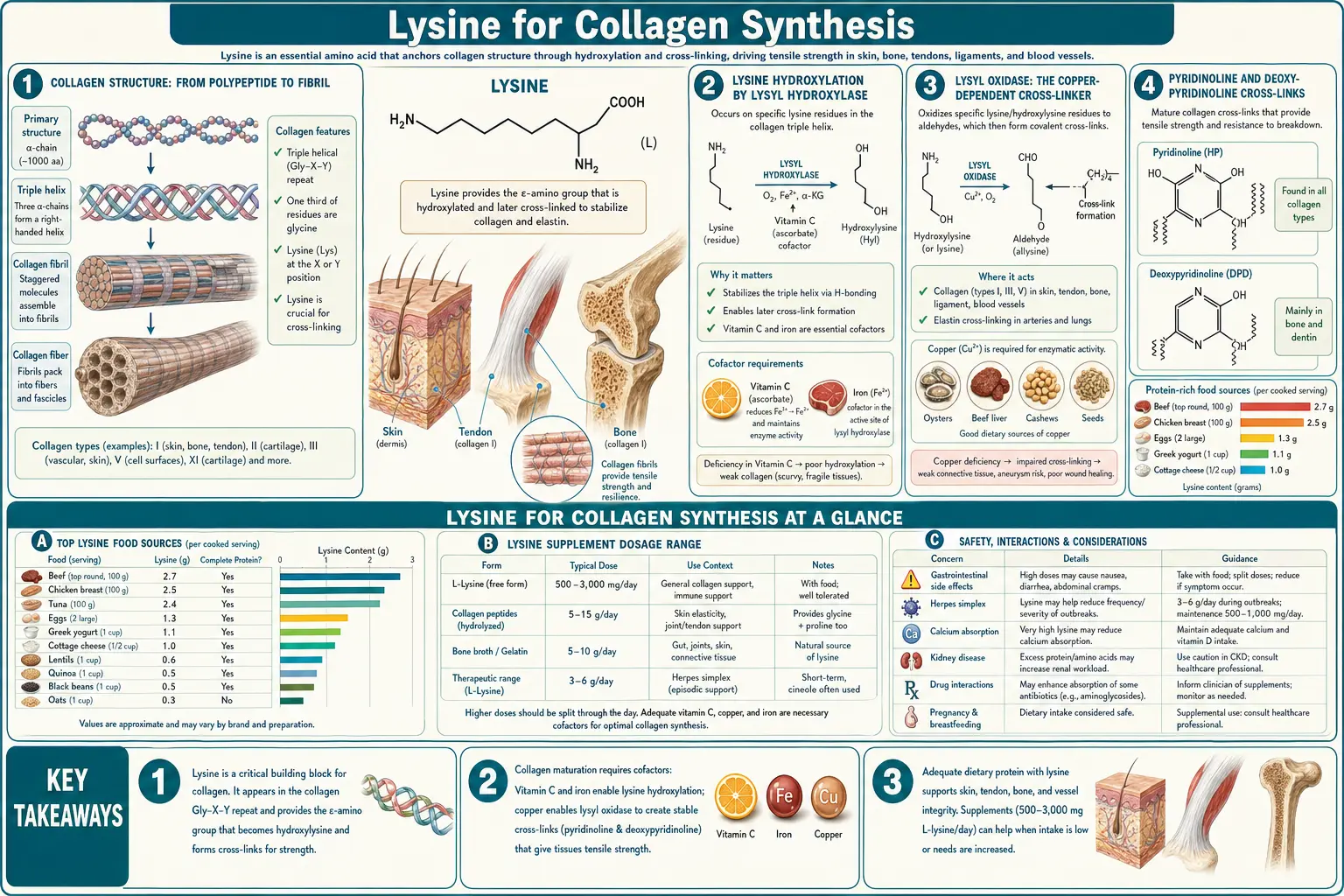
Collagens are the most abundant proteins in mammals and form the structural framework of tissues under tension — skin, tendons, ligaments, cartilage, bone, blood vessels, cornea and dentin. The chemistry that turns a newly made collagen chain into a stable, cross-linked fibril depends on lysine. Specific lysine residues are first hydroxylated to hydroxylysine by the lysyl hydroxylases (LH1, LH2, LH3); lysine and hydroxylysine residues are later oxidized by the copper-dependent enzyme lysyl oxidase, starting the cross-links (including pyridinoline and deoxypyridinoline) that give mature fibrils their strength. Vitamin C keeps the hydroxylases active, and copper is required by lysyl oxidase. Inherited defects in these steps (PLOD1 mutations in kyphoscoliotic Ehlers-Danlos syndrome, ATP7A mutations in Menkes disease) and severe vitamin C deficiency (scurvy) both produce connective-tissue disease. Whether extra lysine in the diet improves collagen in people who already eat enough protein has not been tested in published human trials.
Table of Contents
- Collagen Structure: From Polypeptide to Fibril
- Lysine Hydroxylation by Lysyl Hydroxylase
- Lysyl Oxidase: The Copper-Dependent Cross-Linker
- Pyridinoline and Deoxypyridinoline Cross-Links
- The Vitamin C Cofactor Requirement
- The Copper Cofactor Requirement
- Ehlers-Danlos Syndromes and Related Collagenopathies
- Wound Healing and Surgical Recovery
- Skin Aging, Wrinkles, and Cosmetic Applications
- Tendons, Ligaments, and Sports Injury
- Doses Used in Studies
- Cautions
- Key Research Papers
- Connections
- Featured Videos
Collagen Structure: From Polypeptide to Fibril
Collagen is not a single protein but a family of 28 related proteins (collagen types I through XXVIII) that each contain at least one triple-helical domain (Ricard-Blum 2011). The dominant forms are type I (the major collagen of skin, tendon, bone, dentin, fascia and sclera), type II (cartilage), type III (blood vessels and reticular fibers) and type IV (basement membranes). Type I collagen is made of two α1 chains and one α2 chain wound into a long triple helix with short non-helical telopeptides at each end (Yamauchi and Sricholpech 2012). The helix depends on the repeating tripeptide Gly-X-Y, where X is most often proline and Y most often hydroxyproline; glycine's small size at every third position lets the three chains pack tightly at the helix core.
Biosynthesis runs in stages: (1) the α chains are made on ribosomes of the rough endoplasmic reticulum; (2) specific proline and lysine residues are hydroxylated inside the cell (prolyl and lysyl hydroxylases); (3) some hydroxylysines in the helical domain receive galactose or glucose-galactose; (4) three chains assemble into a procollagen triple helix; (5) procollagen is secreted; (6) the end propeptides are cut off; (7) the molecules assemble into staggered fibrils; and (8) outside the cell, lysyl oxidase converts lysine and hydroxylysine residues in the telopeptides into reactive aldehydes, which then form covalent cross-links without further enzymes (Yamauchi and Sricholpech 2012). Steps 2 and 8 are both lysine chemistry, and the inherited diseases described below show what happens when either fails.
Lysine Hydroxylation by Lysyl Hydroxylase
Specific lysine residues (in the Y position of Gly-X-Y in the helix, and in the telopeptides) are hydroxylated to hydroxylysine by the lysyl hydroxylases. Humans express three isoforms: LH1 (PLOD1), LH2 (PLOD2) and LH3 (PLOD3) (Salo and Myllyharju 2021). These are 2-oxoglutarate-dependent dioxygenases: they use molecular oxygen and 2-oxoglutarate (alpha-ketoglutarate), release succinate and carbon dioxide, and have an iron atom at the catalytic centre.
Mutations in PLOD1 cause the kyphoscoliotic type of Ehlers-Danlos syndrome (formerly EDS type VI; kEDS-PLOD1 in the 2017 classification). Reported features include low muscle tone and kyphoscoliosis at birth, generalized joint laxity, skin fragility and hyperextensibility (Yeowell and Walker 2000), and, in a 15-patient series, arterial rupture before and after birth in some patients (Rohrbach 2011). Because collagen lysines are under-hydroxylated, the pattern of the two urinary cross-links changes: the ratio of lysyl pyridinoline (deoxypyridinoline) to hydroxylysyl pyridinoline (pyridinoline) is raised, and this urinary test is used in diagnosis (Rohrbach 2011; Malfait 2017).
Mutations in PLOD2, which encodes the telopeptide lysyl hydroxylase, were found in Bruck syndrome (brittle bones with joint contractures), whose bone collagen is deficient in pyridinoline cross-links (van der Slot 2003). Mutations in PLOD3 were reported in 2008 in a recessive connective-tissue disorder with severe morbidity and features overlapping several known collagen disorders (Salo 2008). These diseases are rare, but they show how much normal collagen depends on hydroxylated lysine.
Hydroxylysine has two roles (Yeowell and Walker 2000): it is the attachment site for galactose and glucose-galactose, and it is a precursor of the cross-links that give collagen its tensile strength, as described in the next section.
Lysyl Oxidase: The Copper-Dependent Cross-Linker
Lysyl oxidase (LOX) is secreted into the extracellular matrix, where it oxidizes lysine residues in collagen and elastin, starting the covalent cross-links that stabilize these fibrous proteins (Kagan and Li 2003). It converts the epsilon-amino group (−NH2) of specific lysine and hydroxylysine residues into a reactive aldehyde (−CHO); these residues are called allysine and hydroxyallysine. The aldehydes then condense, without further enzymes, with neighbouring residues to form intra- and inter-molecular cross-links (Yamauchi and Sricholpech 2012).
Its activity depends on both a copper atom and a carbonyl cofactor (Kagan and Li 2003). That cofactor, identified in 1996 in lysyl oxidase from bovine aorta, is lysine tyrosylquinone (LTQ), formed by cross-linking the side chain of a lysine with a modified tyrosine in the enzyme itself (Wang 1996). (Older descriptions sometimes give the related topaquinone, TPQ, which is the cofactor of other copper amine oxidases.)
When cross-linking fails, connective tissue is fragile. Menkes disease, caused by defects in the copper transporter ATP7A, is an infantile-onset condition that is usually lethal; early copper injections improve survival in some patients, and occipital horn syndrome is a milder allelic variant (Kaler 2011). The connective-tissue features of these disorders are attributed in part to reduced activity of copper-dependent enzymes, lysyl oxidase among them.
Collagen hydroxylation and cross-linking therefore depend on vitamin C (for the hydroxylases) and copper (for lysyl oxidase), as well as on lysine as a building block of the protein chain.
Pyridinoline and Deoxypyridinoline Cross-Links
Two well-studied mature collagen cross-links are pyridinoline (PYD; hydroxylysyl pyridinoline) and deoxypyridinoline (DPD; lysyl pyridinoline), each formed from three lysine-derived residues joined in a pyridinium ring. PYD is built from three hydroxylysine residues; DPD from two hydroxylysines and one lysine, the un-hydroxylated lysine making it “deoxy”. Formation of these cross-links depends on hydroxylation of telopeptide lysines, which is why PLOD2 activity and pyridinoline content are linked (van der Slot 2003).
Their significance is twofold:
- Mechanical function — lysyl oxidase-mediated cross-linking is essential for normal tissue function, whereas non-enzymatic cross-links that accumulate with age generally change tissue structure in harmful ways (Robins 2007).
- Bone turnover markers — when bone is resorbed, PYD and DPD are released and excreted in urine, so urinary DPD and PYD have been used as markers of bone resorption; PYD is also present in cartilage and has been studied in joint disease research. In 2011 the International Osteoporosis Foundation and the IFCC chose serum CTX (a type I collagen cross-linked telopeptide) as the reference bone-resorption marker and serum PINP as the reference formation marker (Vasikaran 2011).
Raised resorption markers reflect increased bone breakdown, not a shortage or surplus of dietary lysine; the urinary cross-link pattern is a guide to dietary lysine status only in the sense of the inherited hydroxylation defects described above.
The bone-density side of lysine is covered on the companion page Lysine for Calcium Absorption.
The Vitamin C Cofactor Requirement
Vitamin C (ascorbate) is a near-specific requirement of both prolyl hydroxylase and lysyl hydroxylase, but it is not used up in most catalytic cycles. The hydroxylases occasionally run an “uncoupled” cycle in which 2-oxoglutarate is broken down without hydroxylating a residue, leaving the active-site iron in an inactive state; ascorbate is consumed in those cycles, and its main role in the body is thought to be reactivating the enzymes afterwards (Myllylä 1984). In cultured skin fibroblasts, ascorbic acid increases collagen synthesis (Pinnell 1987).
Scurvy — severe vitamin C deficiency — produces the classic signs of connective-tissue failure: bleeding gums, loosened teeth, poor wound healing, bleeding around hair follicles and joint pain; untreated, it can be fatal. These signs are attributed largely to defective hydroxylation of proline and lysine in newly made collagen (Salo and Myllyharju 2021).
Supplement regimens marketed for collagen often combine lysine with vitamin C. In a 1992 paper in the Journal of Orthomolecular Medicine, Matthias Rath and Linus Pauling proposed a “unified theory” of cardiovascular disease centred on vitamin C deficiency, with vitamin C and lysine proposed as treatment. No controlled clinical trial testing that proposal was identified in PubMed.
The Vitamin C page covers the vitamin in full.
The Copper Cofactor Requirement
Copper is the other nutritional input. Lysyl oxidase needs copper for activity and for its LTQ cofactor (Kagan and Li 2003; Wang 1996).
The US Recommended Dietary Allowance for copper in adults is 900 mcg/day (Institute of Medicine, 2001), and frank copper deficiency is uncommon in adults eating varied diets. Recognized causes include:
- Weight-loss surgery — the 2016 micronutrient guideline update of the American Society for Metabolic and Bariatric Surgery covers screening for, preventing and treating copper deficiency after these operations (Parrott 2017).
- Excessive zinc intake — high-dose zinc taken for long periods induces metallothionein in intestinal cells, which binds copper and holds it in the gut lining until the cells are shed. Case reports describe zinc-induced copper deficiency presenting as anemia and spinal-cord damage (myelopathy).
- Over-treatment of Wilson disease — copper-lowering drugs such as D-penicillamine or trientine can over-shoot and cause copper deficiency.
- Menkes disease and occipital horn syndrome — inherited ATP7A copper-transport disorders (Kaler 2011).
Food sources of copper listed by the US National Institutes of Health include organ meats such as beef liver, oysters and other shellfish, nuts, seeds and dark chocolate. No trial was identified that tested whether lysine affects collagen differently depending on copper status. The Copper page and the Morley Robbins copper-iron-magnesium series cover copper further.
Ehlers-Danlos Syndromes and Related Collagenopathies
The Ehlers-Danlos syndromes (EDS) are a clinically and genetically varied group of heritable connective-tissue disorders marked by joint hypermobility, skin hyperextensibility and tissue fragility. The 2017 international classification recognizes 13 subtypes; except for hypermobile EDS, a definite diagnosis rests on finding the causative genetic variant (Malfait 2017). The subtypes most relevant to lysine chemistry and related collagen genes are:
- Kyphoscoliotic EDS (kEDS) — caused by mutations in PLOD1 (lysyl hydroxylase 1) or FKBP14. Reported features include low muscle tone and kyphoscoliosis at birth, joint hypermobility, skin hyperextensibility and fragility, and in some patients vascular rupture (Rohrbach 2011). The biochemical marker is a raised ratio of urinary lysyl pyridinoline to hydroxylysyl pyridinoline, reflecting under-hydroxylated lysine in collagen.
- Classical, vascular and hypermobile EDS — classical EDS is mainly caused by COL5A1/COL5A2 variants (type V collagen) and vascular EDS by COL3A1 variants (type III collagen); no gene has been identified for hypermobile EDS, which is diagnosed on clinical criteria (Malfait 2017).
- Cutis laxa syndromes — related disorders involving elastic fibres, with loose, sagging skin and, in some forms, serious arterial disease.
Inherited collagen disorders are not cured by nutrition. One 1987 report described two people with EDS type VI; one was given oral sodium ascorbate (5 g/day), which raised urinary hydroxylysine and hydroxyproline, and after a year bleeding time, wound healing and muscle strength were reported improved (Dembure 1987). That is a single case, not a controlled trial. No published trial of lysine supplements in any EDS subtype was identified.
The Ehlers-Danlos page and the Rheumatology section cover these conditions further.
Wound Healing and Surgical Recovery
Wound healing is the classic example of rapid collagen synthesis under stress. Its phases are hemostasis (clotting), inflammation, proliferation with intense new collagen deposition (type III first, then type I), and a long remodeling phase in which collagen is turned over and cross-links mature. Both hydroxylation and cross-linking of that new collagen involve lysine residues.
No randomized trial testing lysine on its own for wound healing in people was identified in PubMed. The human trials in this area have tested mixtures in which lysine was not the studied ingredient:
- Collagen deposition in older adults — in a double-blind randomized study of 35 healthy volunteers aged 70 or older, a daily mixture of 14 g arginine, 3 g HMB (a leucine metabolite) and 14 g glutamine significantly increased collagen deposition (measured as hydroxyproline) in small implanted test tubes compared with a non-essential amino acid control, with no effect on total protein deposition (Williams 2002).
- Pressure ulcers — in a multicentre randomized trial of 200 malnourished adults with stage II–IV pressure ulcers, an energy-dense, protein-rich oral formula enriched with arginine, zinc and antioxidants (400 mL/day for 8 weeks) reduced ulcer area by a mean 60.9%, compared with 45.2% for an isocaloric, isonitrogenous control formula (adjusted difference 18.7%, P = 0.017); other secondary end points, including complete healing, did not differ (Cereda 2015).
- Burns and major illness — major burns greatly raise whole-body protein turnover, and nutrition support in these settings focuses on overall protein and energy rather than on lysine alone.
A critical review of amino acid supplementation for wound healing concluded that, although it may seem a reasonable strategy, a number of biochemical and physiological barriers limit what oral amino acids can achieve (Albaugh 2017).
Skin Aging, Wrinkles, and Cosmetic Applications
Skin aging has two main components: (1) intrinsic, chronological aging, with declining collagen synthesis by dermal fibroblasts, and (2) extrinsic photoaging, in which ultraviolet light damages existing dermal collagen and elastin. Both reduce the density and quality of dermal collagen and produce wrinkles, sagging, thinning and reduced elasticity.
Oral collagen supplements are sold widely for skin. A 2019 systematic review (Choi 2019, Journal of Drugs in Dermatology) included 11 randomized placebo-controlled trials with 805 participants; it was a narrative review of the trials, not a pooled meta-analysis. Eight trials used collagen hydrolysate (2.5 to 10 g/day for 8 to 24 weeks) for pressure ulcers, dry skin, skin aging and cellulite; two used collagen tripeptide (3 g/day for 4 to 12 weeks) and reported improved skin elasticity and hydration. The authors called the results “preliminary” but promising, reported increases in skin elasticity, hydration and dermal collagen density, noted no reported adverse events, and called for further studies to set dosing. Ingested collagen is largely broken down to amino acids and small peptides; in one trial, gelatin raised blood glycine, proline, hydroxyproline and hydroxylysine within an hour (Shaw 2017). Whether some collagen-derived peptides act as signals to fibroblasts is a proposed, not established, mechanism.
None of these trials tested free L-lysine, and no randomized trial of oral lysine for skin aging was identified. Topical lysine faces the same penetration problem discussed on the Herpes Prevention page: the amino acid is highly water-soluble and is not expected to cross the outer skin layer readily, and no controlled trial of topical lysine for skin aging was identified.
Tendons, Ligaments, and Sports Injury
Tendons (muscle to bone) and ligaments (bone to bone) are made largely of type I collagen arranged in parallel fibrils that carry tensile load. Acute injuries and chronic overuse (tendinopathy) both require new collagen for repair, which raises the question of whether nutrition can support it.
The most cited trial is Shaw et al. (2017, American Journal of Clinical Nutrition): eight healthy men took part in a randomized, double-blind crossover study, drinking 5 or 15 g of vitamin C-enriched gelatin or a placebo one hour before 6 minutes of rope-skipping, three times a day for 3 days. Gelatin raised blood glycine, proline, hydroxyproline and hydroxylysine, and men who took 15 g before exercise had double the amino-terminal propeptide of type I collagen (PINP) in their blood, a marker of collagen synthesis. Serum taken after gelatin also increased collagen content and improved mechanics of lab-grown engineered ligaments. The authors concluded that gelatin added to intermittent exercise could play a role in injury prevention and tissue repair; the trial measured blood markers in eight people, not injury rates or healing, and it did not test lysine.
No trial of L-lysine supplements for tendon or ligament healing in people was identified.
Doses Used in Studies
No dose of lysine for collagen support has been established, because no human trial has tested lysine on its own for a collagen outcome. The amounts used in the related studies cited on this page were:
- Collagen hydrolysate for skin — 2.5 to 10 g/day for 8 to 24 weeks; collagen tripeptide 3 g/day for 4 to 12 weeks (the trials reviewed by Choi 2019).
- Gelatin before exercise — 5 or 15 g of vitamin C-enriched gelatin one hour before 6 minutes of rope-skipping, three times a day for 3 days (Shaw 2017).
- Amino acid mixture for collagen deposition — 14 g arginine, 3 g HMB and 14 g glutamine daily for 14 days in adults aged 70 or older (Williams 2002).
- Pressure-ulcer formula — 400 mL/day of an arginine-, zinc- and antioxidant-enriched high-protein formula for 8 weeks (Cereda 2015).
- Vitamin C in EDS type VI — 5 g/day sodium ascorbate in a single case report (Dembure 1987).
- Copper — the adult RDA is 900 mcg/day (Institute of Medicine, 2001).
- Form — supplemental lysine is most commonly sold as L-lysine hydrochloride. Products combining lysine with proline or vitamin C are sold for connective tissue; no trial of these combinations for collagen outcomes was identified.
Doses used for other purposes, such as herpes, are covered on the Herpes Prevention page. Decisions about supplements belong with a clinician.
Cautions
- Vitamin C — collagen hydroxylation depends on vitamin C; extra lysine does not make up for vitamin C deficiency.
- Copper and zinc — long-term high-dose zinc can cause copper deficiency; case reports describe anemia and myelopathy, and the research raises a concern for people taking high-dose zinc for long periods.
- Kidneys — a 1996 case report described a 44-year-old woman who developed Fanconi's syndrome and tubulointerstitial nephritis, progressing to chronic kidney failure, in association with L-lysine ingestion (Lo 1996). Safety data on high-dose amino acid supplements in people with reduced kidney function are limited.
- Pregnancy — lysine from food is part of a normal diet; there is no good safety data on high supplemental doses in pregnancy.
- Liver disease — advanced cirrhosis alters amino acid metabolism.
- Limits of the evidence — nutritional sufficiency is necessary but not sufficient for normal collagen. Genetic collagen disorders (EDS, osteogenesis imperfecta, Marfan syndrome, cutis laxa) are not cured by supplements; osteogenesis imperfecta, for example, is mostly caused by mutations in the type I collagen genes, and its main drug advance has been bisphosphonate treatment (Rauch and Glorieux 2004). No trial has shown that lysine supplements reverse skin aging.
Key Research Papers
- Yamauchi M, Sricholpech M (2012). Lysine post-translational modifications of collagen. Essays in Biochemistry 52:113-33. — PubMed PMID: 22708567
- Kagan HM, Li W (2003). Lysyl oxidase: properties, specificity, and biological roles inside and outside of the cell. Journal of Cellular Biochemistry 88(4):660-72. — PubMed PMID: 12577300
- Pinnell SR, Murad S, Darr D (1987). Induction of collagen synthesis by ascorbic acid. A possible mechanism. Archives of Dermatology 123(12):1684-6. — PubMed PMID: 2825607
- Rauch F, Glorieux FH (2004). Osteogenesis imperfecta. The Lancet 363(9418):1377-85. — PubMed PMID: 15110498
- Yeowell HN, Walker LC (2000). Mutations in the lysyl hydroxylase 1 gene that result in enzyme deficiency and the clinical phenotype of Ehlers-Danlos syndrome type VI. Molecular Genetics and Metabolism 71(1-2):212-24. — PubMed PMID: 11001813
- Malfait F, Francomano C, Byers P, et al. (2017). The 2017 international classification of the Ehlers-Danlos syndromes. American Journal of Medical Genetics Part C 175(1):8-26. — PubMed PMID: 28306229
- Eyre DR, Wu JJ (2005). Collagen cross-links. Topics in Current Chemistry 247:207-229. — doi:10.1007/b103828
- Robins SP (2007). Biochemistry and functional significance of collagen cross-linking. Biochemical Society Transactions 35(Pt 5):849-52. — PubMed PMID: 17956230
- Shaw G, Lee-Barthel A, Ross ML, Wang B, Baar K (2017). Vitamin C-enriched gelatin supplementation before intermittent activity augments collagen synthesis. American Journal of Clinical Nutrition 105(1):136-143. — PubMed PMID: 27852613
- Choi FD, Sung CT, Juhasz ML, Mesinkovska NA (2019). Oral collagen supplementation: a systematic review of dermatological applications. Journal of Drugs in Dermatology 18(1):9-16. — PubMed PMID: 30681787
- Albaugh VL, Mukherjee K, Barbul A (2017). Proline precursors and collagen synthesis: biochemical challenges of nutrient supplementation and wound healing. Journal of Nutrition 147(11):2011-2017. — PubMed PMID: 28978679
- Mehri A (2020). Trace elements in human nutrition (II) — an update. International Journal of Preventive Medicine 11:2. — PubMed PMID: 32042399
- Rath M, Pauling L (1992). A unified theory of human cardiovascular disease leading the way to the abolition of this disease as a cause for human mortality. Journal of Orthomolecular Medicine. (Not indexed in PubMed or Crossref; no identifier link.)
- Carr AC, Maggini S (2017). Vitamin C and immune function. Nutrients 9(11):1211. — PubMed PMID: 29099763
- Wang SX, Mure M, Medzihradszky KF, et al. (1996). A crosslinked cofactor in lysyl oxidase: redox function for amino acid side chains. Science 273(5278):1078-84. — PubMed PMID: 8688089
- Myllylä R, Majamaa K, Günzler V, Hanauske-Abel HM, Kivirikko KI (1984). Ascorbate is consumed stoichiometrically in the uncoupled reactions catalyzed by prolyl 4-hydroxylase and lysyl hydroxylase. Journal of Biological Chemistry 259(9):5403-5. — PubMed PMID: 6325436
- Salo AM, Myllyharju J (2021). Prolyl and lysyl hydroxylases in collagen synthesis. Experimental Dermatology 30(1):38-49. — PubMed PMID: 32969070
- Ricard-Blum S (2011). The collagen family. Cold Spring Harbor Perspectives in Biology 3(1):a004978. — PubMed PMID: 21421911
- Rohrbach M, Vandersteen A, Yiş U, et al. (2011). Phenotypic variability of the kyphoscoliotic type of Ehlers-Danlos syndrome (EDS VIA): clinical, molecular and biochemical delineation. Orphanet Journal of Rare Diseases 6:46. — PubMed PMID: 21699693
- van der Slot AJ, Zuurmond AM, Bardoel AF, et al. (2003). Identification of PLOD2 as telopeptide lysyl hydroxylase, an important enzyme in fibrosis. Journal of Biological Chemistry 278(42):40967-72. — PubMed PMID: 12881513
- Salo AM, Cox H, Farndon P, et al. (2008). A connective tissue disorder caused by mutations of the lysyl hydroxylase 3 gene. American Journal of Human Genetics 83(4):495-503. — PubMed PMID: 18834968
- Kaler SG (2011). ATP7A-related copper transport diseases — emerging concepts and future trends. Nature Reviews Neurology 7(1):15-29. — PubMed PMID: 21221114
- Vasikaran S, Cooper C, Eastell R, et al. (2011). International Osteoporosis Foundation and International Federation of Clinical Chemistry and Laboratory Medicine position on bone marker standards in osteoporosis. Clinical Chemistry and Laboratory Medicine 49(8):1271-1274. — PubMed PMID: 21605012
- Dembure PP, Janko AR, Priest JH, Elsas LJ (1987). Ascorbate regulation of collagen biosynthesis in Ehlers-Danlos syndrome, type VI. Metabolism 36(7):687-91. — PubMed PMID: 3110540
- Williams JZ, Abumrad N, Barbul A (2002). Effect of a specialized amino acid mixture on human collagen deposition. Annals of Surgery 236(3):369-74. — PubMed PMID: 12192323
- Cereda E, Klersy C, Serioli M, Crespi A, D'Andrea F (2015). A nutritional formula enriched with arginine, zinc, and antioxidants for the healing of pressure ulcers: a randomized trial. Annals of Internal Medicine 162(3):167-74. — PubMed PMID: 25643304
- Parrott J, Frank L, Rabena R, et al. (2017). American Society for Metabolic and Bariatric Surgery Integrated Health Nutritional Guidelines for the Surgical Weight Loss Patient 2016 Update: Micronutrients. Surgery for Obesity and Related Diseases 13(5):727-741. — PubMed PMID: 28392254
- Lo JC, Chertow GM, Rennke H, Seifter JL (1996). Fanconi's syndrome and tubulointerstitial nephritis in association with L-lysine ingestion. American Journal of Kidney Diseases 28(4):614-7. — PubMed PMID: 8840955
PubMed Topic Searches
Connections
- All Amino Acids
- Lysine Overview
- Lysine Benefits Hub
- Lysine for Herpes Prevention
- Lysine for Calcium Absorption
- Lysine for Anxiety and Stress
- Proline (the other collagen amino acid)
- Glycine (every third collagen residue)
- Vitamin C (hydroxylase cofactor)
- Copper (lysyl oxidase cofactor)
- Collagen Peptides
- Bone Broth
- Morley Robbins (copper-iron series)
- Lysine Remedy Page
- History
- Sources