Lysine — Benefits Deep Dive
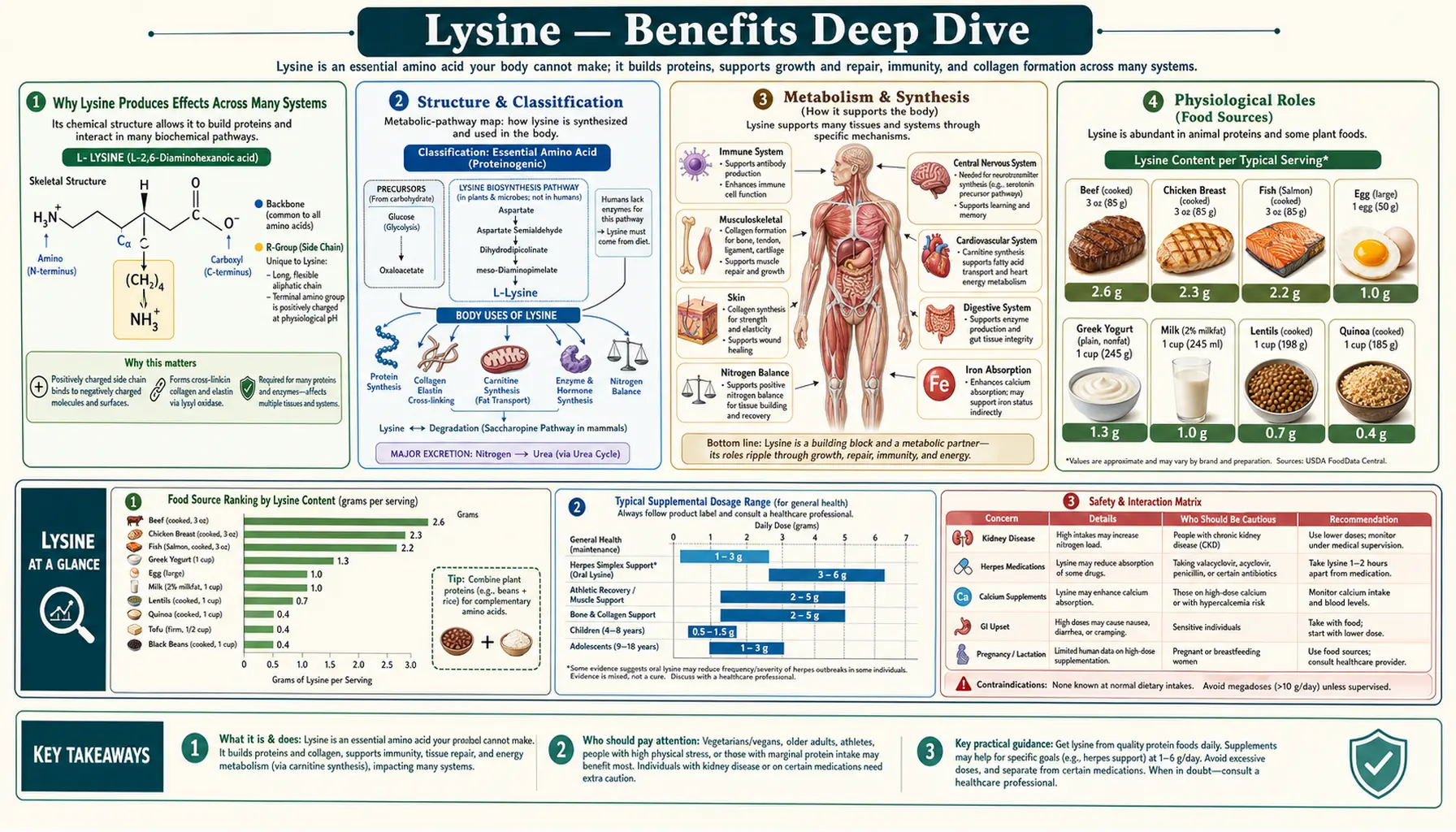
L-Lysine is one of the nine essential amino acids, which the body cannot make and must get from food. Beyond its role as a building block of protein, it has been studied for four possible effects, each resting on a different line of chemistry: antagonism of arginine in herpes simplex virus replication (shown in tissue culture; human trials of lysine against cold-sore and genital-herpes recurrences gave mixed results), collagen cross-linking (specific lysine residues are hydroxylated by lysyl hydroxylases, which need vitamin C, and then oxidized by the copper-dependent enzyme lysyl oxidase), calcium absorption and urinary calcium (two short experiments in one 1992 paper), and a weak partial block of the serotonin 5-HT4 receptor (found in rat and tissue studies; a handful of small human trials, mostly from one research network, measured anxiety). The deep-dive pages below set out what each study measured and found, the doses the trials used, and what has not been studied.
Deep-Dive Articles
Herpes Prevention
The arginine-lysine antagonism seen in tissue culture (Tankersley 1964; Griffith 1981), the reports of Kagan, Griffith and colleagues from 1974 to 1987, the controlled trials with positive and negative results (Griffith 1987; DiGiovanna 1984; Milman 1980), the doses those trials used (312 mg to 3 g/day), the popular high-arginine and high-lysine food lists that no trial has tested, topical lysine, and what the 2015 Cochrane review found for lysine and for prescription antivirals.
Read the deep dive →Collagen Synthesis
How the lysyl hydroxylases (PLOD1-3), which need vitamin C, and the copper-dependent enzyme lysyl oxidase turn lysine residues into the cross-links of mature collagen; pyridinoline and deoxypyridinoline as bone-resorption markers; inherited defects such as kyphoscoliotic Ehlers-Danlos syndrome and Menkes disease; and the gap in the evidence: no published human trial has tested lysine on its own for wound healing, skin, tendons or any other collagen outcome.
Read the deep dive →Calcium Absorption
The Civitelli 1992 paper, which combined two short experiments: 400 mg of L-lysine blunted the rise in urinary calcium after a 3 g calcium load in 15 healthy women (not in 15 osteoporotic women), and 800 mg/day raised absorption of a calcium-47 tracer in 45 osteoporotic patients. The abstract gives no percentage effects, and no trial has measured bone density or fractures. Also covered: lysine in cereal-staple diets, the 2014 ESCEO protein and vitamin D consensus, and cystinuria.
Read the deep dive →Anxiety and Stress
The 3-month Syria wheat-fortification trial (Smriga 2004: lower trait anxiety in men, a smaller cortisol response to blood drawing in women), the one-week Japanese trial of lysine plus arginine in 108 healthy adults (Smriga 2007: lower trait and state anxiety, lower basal salivary cortisol in men), the 2005 Slovak trial in which stress hormones rose rather than fell (Jezova 2005), the 2010 Ghana trial whose abstract reports no anxiety result, and the 5-HT4 receptor findings, which come from rats and tissue.
Read the deep dive →Herpes Simplex & Cold Sores
Latent HSV-1 and HSV-2 infection, cold sores and genital outbreaks, the arginine dependence of HSV in tissue culture, the Griffith, Thein and DiGiovanna trials and their mixed results, the doses those trials used, and how lysine compares with oral antivirals: the 2015 Cochrane review found that long-term oral antivirals can prevent cold sores with a small clinical benefit, and found no evidence of efficacy for lysine.
Read the deep dive →Lysine-Arginine Ratio
Foods that popular sources list as lysine-dominant (fish, poultry, eggs, dairy, legumes) or arginine-dominant (chocolate, nuts, seeds), how a food's lysine-to-arginine ratio is calculated, arginine's role as the substrate for nitric oxide, and the tension with the lysine-plus-arginine anxiety trials. No controlled trial testing a dietary ratio against herpes recurrence was identified (see the Herpes Prevention page).
Read the deep dive →Dosing & Forms
Supplement forms (most commonly L-lysine hydrochloride), the doses used in published trials (from 312 mg/day in herpes studies to 2.64-3 g/day of lysine plus an equal amount of arginine in anxiety studies), a 2020 expert-panel proposal of 6.0 g/day as a no-observed-adverse-effect level for healthy adults (Cynober 2020), a 1996 case report of kidney injury linked to L-lysine (Lo 1996), and interaction and safety questions.
Read the deep dive →Table of Contents
- Deep-Dive Articles
- Why Lysine Is Studied Across Many Systems
- Research Papers: Herpes Prevention
- Research Papers: Collagen Synthesis
- Research Papers: Calcium Absorption and Bone
- Research Papers: Anxiety and Stress
- Research Papers: Cross-Cutting (Metabolism, Dosing, Safety)
- External Authoritative Resources
- Connections
- Featured Videos
Why Lysine Is Studied Across Many Systems
Most essential amino acids are discussed mainly as building blocks of protein. Lysine has also been studied through four separate lines of chemistry, which match the deep-dive pages:
- Competition with arginine — lysine and arginine are both positively charged at physiological pH and share cell transporters for cationic amino acids. In tissue culture, herpes simplex virus needs arginine to replicate, and lysine antagonizes arginine's growth-promoting effect (Tankersley 1964; Griffith 1981). This is the basis of the proposed herpes prevention use, lysine's best-known proposed clinical use. The human trials gave mixed results, and the 2015 Cochrane review of cold-sore prevention found no evidence of efficacy for lysine (Chi 2015).
- Collagen modification by lysyl hydroxylase and lysyl oxidase — specific lysine residues in new collagen chains are hydroxylated by the lysyl hydroxylases (PLOD1-3), which need vitamin C; outside the cell, the copper-dependent enzyme lysyl oxidase oxidizes lysine and hydroxylysine residues, starting the cross-links, including pyridinoline and deoxypyridinoline, that stabilize mature fibrils (Yamauchi and Sricholpech 2012). Inherited defects in these steps cause connective-tissue disease. Whether extra dietary lysine improves collagen in people who already eat enough protein has not been tested in published human trials; see collagen synthesis.
- Calcium absorption and urinary calcium — in one 1992 paper, L-lysine raised intestinal absorption of a calcium-47 tracer in osteoporotic patients and blunted the rise in urinary calcium after a calcium load in healthy women (Civitelli 1992). How lysine might do this is not known; soluble lysine-calcium complexes in the gut are one proposed explanation that has not been tested directly in people. No trial has measured bone density or fractures; see calcium absorption.
- Partial block of the serotonin 5-HT4 receptor — in a binding assay lysine inhibited a small fraction of serotonin binding to the 5-HT4 receptor, and in rats oral lysine blocked anxiety induced by a 5-HT4 agonist (Smriga and Torii 2003); whether doses used in people reach a level that blocks brain 5-HT4 receptors has not been measured. The human trials that measured anxiety are small and mostly from one research network, and their cortisol findings point in different directions; see anxiety and stress.
The four lines of evidence differ in strength. Herpes has the most human trials, with mixed results; the calcium and anxiety findings rest on a few small, short studies; and for collagen there is no human trial of lysine on its own. No study was identified that tested whether one lysine dose produces more than one of these effects.
The herpes and anxiety research also pull in different directions on arginine. The herpes hypothesis holds that the virus needs arginine and that lysine antagonizes it, and popular herpes diet lists restrict arginine-rich foods; the 2007 Japanese and 2005 Slovak anxiety trials gave lysine together with an equal amount of arginine (Smriga 2007; Jezova 2005). No study has examined lysine-plus-arginine doses in people with recurrent herpes. Decisions about supplements belong with a clinician.
Research Papers: Herpes Prevention
- Griffith RS, Norins AL, Kagan C (1978). A multicentered study of lysine therapy in Herpes simplex infection. Dermatologica 156(5):257-67. — PubMed PMID: 640102
- Griffith RS, Walsh DE, Myrmel KH, Thompson RW, Behforooz A (1987). Success of L-lysine therapy in frequently recurrent herpes simplex infection. Treatment and prophylaxis. Dermatologica 175(4):183-90. — PubMed PMID: 3115841
- Tankersley RW Jr (1964). Amino acid requirements of herpes simplex virus in human cells. Journal of Bacteriology 87(3):609-13. — PubMed PMID: 14127578
- Thein DJ, Hurt WC (1984). Lysine as a prophylactic agent in the treatment of recurrent herpes simplex labialis. Oral Surgery, Oral Medicine, Oral Pathology 58(6):659-66. — PubMed PMID: 6438572
- DiGiovanna JJ, Blank H (1984). Failure of lysine in frequently recurrent herpes simplex infection. Treatment and prophylaxis. Archives of Dermatology 120(1):48-51. — PubMed PMID: 6419679
- Milman N, Scheibel J, Jessen O (1980). Lysine prophylaxis in recurrent herpes simplex labialis: a double-blind, controlled crossover study. Acta Dermato-Venereologica 60(1):85-7. — PubMed PMID: 6153847
- McCune MA, Perry HO, Muller SA, O'Fallon WM (1984). Treatment of recurrent herpes simplex infections with L-lysine monohydrochloride. Cutis 34(4):366-73. — PubMed PMID: 6435961
- Singh BB, Udani J, Vinjamury SP, Der-Martirosian C, Gandhi S, Khorsan R et al. (2005). Safety and effectiveness of an L-lysine, zinc, and herbal-based product on the treatment of facial and circumoral herpes. Alternative Medicine Review 10(2):123-7. — PubMed PMID: 15989381
- Mailoo VJ, Rampes S (2017). Lysine for Herpes Simplex Prophylaxis: A Review of the Evidence. Integrative Medicine (Encinitas) 16(3):42-46. — PubMed PMID: 30881246
- Pedrazini MC, da Silva MH, Groppo FC (2022). L-lysine: Its antagonism with L-arginine in controlling viral infection. Narrative literature review. British Journal of Clinical Pharmacology 88(11):4708-4723. — PubMed PMID: 35723628
- Griffith RS, DeLong DC, Nelson JD (1981). Relation of arginine-lysine antagonism to herpes simplex growth in tissue culture. Chemotherapy 27(3):209-13. — PubMed PMID: 6262023
- Chi CC, Wang SH, Delamere FM, Wojnarowska F, Peters MC, Kanjirath PP (2015). Interventions for prevention of herpes simplex labialis (cold sores on the lips). Cochrane Database of Systematic Reviews (8):CD010095. — PubMed PMID: 26252373
Research Papers: Collagen Synthesis
- Yamauchi M, Sricholpech M (2012). Lysine post-translational modifications of collagen. Essays in Biochemistry 52:113-33. — PubMed PMID: 22708567
- Kagan HM, Li W (2003). Lysyl oxidase: properties, specificity, and biological roles inside and outside of the cell. Journal of Cellular Biochemistry 88(4):660-72. — PubMed PMID: 12577300
- Pinnell SR, Murad S, Darr D (1987). Induction of collagen synthesis by ascorbic acid. A possible mechanism. Archives of Dermatology 123(12):1684-6. — PubMed PMID: 2825607
- Yeowell HN, Walker LC (2000). Mutations in the lysyl hydroxylase 1 gene that result in enzyme deficiency and the clinical phenotype of Ehlers-Danlos syndrome type VI. Molecular Genetics and Metabolism 71(1-2):212-24. — PubMed PMID: 11001813
- Malfait F, Francomano C, Byers P, et al. (2017). The 2017 international classification of the Ehlers-Danlos syndromes. American Journal of Medical Genetics Part C 175(1):8-26. — PubMed PMID: 28306229
- Eyre DR, Wu JJ (2005). Collagen cross-links. Topics in Current Chemistry 247:207-229. — doi:10.1007/b103828
- Shaw G, Lee-Barthel A, Ross ML, Wang B, Baar K (2017). Vitamin C-enriched gelatin supplementation before intermittent activity augments collagen synthesis. American Journal of Clinical Nutrition 105(1):136-143. — PubMed PMID: 27852613
- Choi FD, Sung CT, Juhasz ML, Mesinkovska NA (2019). Oral collagen supplementation: a systematic review of dermatological applications. Journal of Drugs in Dermatology 18(1):9-16. — PubMed PMID: 30681787
- Albaugh VL, Mukherjee K, Barbul A (2017). Proline precursors and collagen synthesis: biochemical challenges of nutrient supplementation and wound healing. Journal of Nutrition 147(11):2011-2017. — PubMed PMID: 28978679
- Rath M, Pauling L (1992). A unified theory of human cardiovascular disease leading the way to the abolition of this disease as a cause for human mortality. Journal of Orthomolecular Medicine. (Not indexed in PubMed or Crossref; no identifier link.)
Research Papers: Calcium Absorption and Bone
- Civitelli R, Villareal DT, Agnusdei D, Nardi P, Avioli LV, Gennari C (1992). Dietary L-lysine and calcium metabolism in humans. Nutrition 8(6):400-5. — PubMed PMID: 1486246
- Wasserman RH, Comar CL, Nold MM (1956). The influence of amino acids and other organic compounds on the gastrointestinal absorption of calcium 45 and strontium 89 in the rat. Journal of Nutrition 59(3):371-83. — PubMed PMID: 13357972
- Conigrave AD, Brown EM, Rizzoli R (2008). Dietary protein and bone health: roles of amino acid-sensing receptors in the control of calcium metabolism and bone homeostasis. Annual Review of Nutrition 28:131-55. — PubMed PMID: 18466091
- Heaney RP, Recker RR, Stegman MR, Moy AJ (1989). Calcium absorption in women: relationships to calcium intake, estrogen status, and age. Journal of Bone and Mineral Research 4(4):469-75. — PubMed PMID: 2816496
- Kerstetter JE, O'Brien KO, Insogna KL (2003). Dietary protein, calcium metabolism, and skeletal homeostasis revisited. American Journal of Clinical Nutrition 78(3 Suppl):584S-592S. — PubMed PMID: 12936953
- Rizzoli R, Stevenson JC, Bauer JM, et al. (2014). The role of dietary protein and vitamin D in maintaining musculoskeletal health in postmenopausal women: a consensus statement from the European Society for Clinical and Economic Aspects of Osteoporosis and Osteoarthritis (ESCEO). Maturitas 79(1):122-32. — PubMed PMID: 25082206
- Bilezikian JP, Brandi ML, Eastell R, Silverberg SJ, Udelsman R, Marcocci C, Potts JT Jr (2014). Guidelines for the management of asymptomatic primary hyperparathyroidism: summary statement from the Fourth International Workshop. Journal of Clinical Endocrinology and Metabolism 99(10):3561-9. — PubMed PMID: 25162665
- Schaafsma G (2000). The protein digestibility-corrected amino acid score. Journal of Nutrition 130(7):1865S-7S. — PubMed PMID: 10867064
Research Papers: Anxiety and Stress
- Smriga M, Ghosh S, Mouneimne Y, Pellett PL, Scrimshaw NS (2004). Lysine fortification reduces anxiety and lessens stress in family members in economically weak communities in Northwest Syria. Proceedings of the National Academy of Sciences 101(22):8285-8. — PubMed PMID: 15159538
- Smriga M, Ando T, Akutsu M, Furukawa Y, Miwa K, Morinaga Y (2007). Oral treatment with L-lysine and L-arginine reduces anxiety and basal cortisol levels in healthy humans. Biomedical Research 28(2):85-90. — PubMed PMID: 17510493
- Ghosh S, Smriga M, Vuvor F, Suri D, Mohammed H, Armah SM, Scrimshaw NS (2010). Effect of lysine supplementation on health and morbidity in subjects belonging to poor peri-urban households in Accra, Ghana. American Journal of Clinical Nutrition 92(4):928-39. — PubMed PMID: 20720257
- Smriga M, Torii K (2003). L-Lysine acts like a partial serotonin receptor 4 antagonist and inhibits serotonin-mediated intestinal pathologies and anxiety in rats. Proceedings of the National Academy of Sciences 100(26):15370-5. — PubMed PMID: 14676321
- Smriga M, Kameishi M, Uneyama H, Torii K (2002). Dietary L-lysine deficiency increases stress-induced anxiety and fecal excretion in rats. Journal of Nutrition 132(12):3744-6. — PubMed PMID: 12468617
- Srinongkote S, Smriga M, Nakagawa K, Toride Y (2003). A diet fortified with L-lysine and L-arginine reduces plasma cortisol and blocks anxiogenic response to transportation in pigs. Nutritional Neuroscience 6(5):283-9. — PubMed PMID: 14609314
- Lakhan SE, Vieira KF (2010). Nutritional and herbal supplements for anxiety and anxiety-related disorders: systematic review. Nutrition Journal 9:42. — PubMed PMID: 20929532
- Lopresti AL, Smith SJ, Malvi H, Kodgule R (2019). An investigation into the stress-relieving and pharmacological actions of an ashwagandha (Withania somnifera) extract: A randomized, double-blind, placebo-controlled study. Medicine 98(37):e17186. — PubMed PMID: 31517876
- Hidese S, Ogawa S, Ota M, Ishida I, Yasukawa Z, Ozeki M, Kunugi H (2019). Effects of L-Theanine Administration on Stress-Related Symptoms and Cognitive Functions in Healthy Adults: A Randomized Controlled Trial. Nutrients 11(10):2362. — PubMed PMID: 31623400
- Scrimshaw NS (2003). Historical concepts of interactions, synergism and antagonism between nutrition and infection. Journal of Nutrition 133(1):316S-321S. — PubMed PMID: 12514318
- Jezova D, Makatsori A, Smriga M, Morinaga Y, Duncko R (2005). Subchronic treatment with amino acid mixture of L-lysine and L-arginine modifies neuroendocrine activation during psychosocial stress in subjects with high trait anxiety. Nutritional Neuroscience 8(3):155-60. — PubMed PMID: 16117182
Research Papers: Cross-Cutting (Metabolism, Dosing, Safety)
- Flodin NW (1997). The metabolic roles, pharmacology, and toxicology of lysine. Journal of the American College of Nutrition 16(1):7-21. — PubMed PMID: 9013429
- Pellett PL, Ghosh S (2004). Lysine fortification: past, present, and future. Food and Nutrition Bulletin 25(2):107-13. — PubMed PMID: 15214255
- Hayamizu K, Oshima I, Nakano M (2020). Comprehensive Safety Assessment of l-Lysine Supplementation from Clinical Studies: A Systematic Review. Journal of Nutrition 150(Suppl 1):2561S-2569S. — PubMed PMID: 33000161
- Joint WHO/FAO/UNU Expert Consultation (2007). Protein and amino acid requirements in human nutrition. World Health Organization Technical Report Series (935):1-265. — PubMed PMID: 18330140
- Pencharz PB, Ball RO (2003). Different approaches to define individual amino acid requirements. Annual Review of Nutrition 23:101-16. — PubMed PMID: 12626690
- Elango R, Ball RO, Pencharz PB (2008). Indicator amino acid oxidation: concept and application. Journal of Nutrition 138(2):243-6. — PubMed PMID: 18203885
- Wu G (2010). Functional amino acids in growth, reproduction, and health. Advances in Nutrition 1(1):31-7. — PubMed PMID: 22043449
- Cynober L, Bier DM, Stover P, Kadowaki M, Morris SM, Elango R, Smriga M (2020). Proposals for Upper Limits of Safe Intake for Methionine, Histidine, and Lysine in Healthy Humans. Journal of Nutrition 150(Suppl 1):2606S-2608S. — PubMed PMID: 33000163
- Lo JC, Chertow GM, Rennke H, Seifter JL (1996). Fanconi's syndrome and tubulointerstitial nephritis in association with L-lysine ingestion. American Journal of Kidney Diseases 28(4):614-7. — PubMed PMID: 8840955
External Authoritative Resources
- Linus Pauling Institute — Micronutrient Information Center
- NIH Office of Dietary Supplements — All Fact Sheets
- WHO/FAO/UNU Technical Report 935 (2007) — Protein and amino acid requirements in human nutrition
- LactMed (NIH) — Lysine
- PubMed — All research on lysine
Connections
- All Amino Acids
- Lysine (Main Page)
- Lysine for Herpes Prevention
- Lysine for Collagen Synthesis
- Lysine for Calcium Absorption
- Lysine for Anxiety and Stress
- Lysine for Herpes Simplex & Cold Sores
- Lysine-Arginine Ratio
- Lysine Dosing & Forms
- Arginine
- Proline
- Glycine
- Tryptophan
- Threonine
- Vitamin C (hydroxylase cofactor)
- Vitamin D3 (bone synergy)
- Vitamin K2 (bone synergy)
- Calcium
- Copper (lysyl oxidase cofactor)
- Zinc
- Collagen Peptides
- Bone Broth
- Anxiety
- Dermatology (Cold Sores)
- Osteoporosis
- Morley Robbins (mineral series)
- Lysine Remedy Page
- Immune Boosting
- Ashwagandha
- Lemon Balm
- Pork
- History
- Sources