⚠ Evidence warning: Clinical trials or other evidence do not support the claims that histidine helps rheumatoid arthritis grip strength and connective tissue repair, and that it helps chronic kidney disease through hemoglobin and diamine oxidase support. This page keeps it as a report of what people, websites or other media say.
Histidine — Benefits Deep Dive
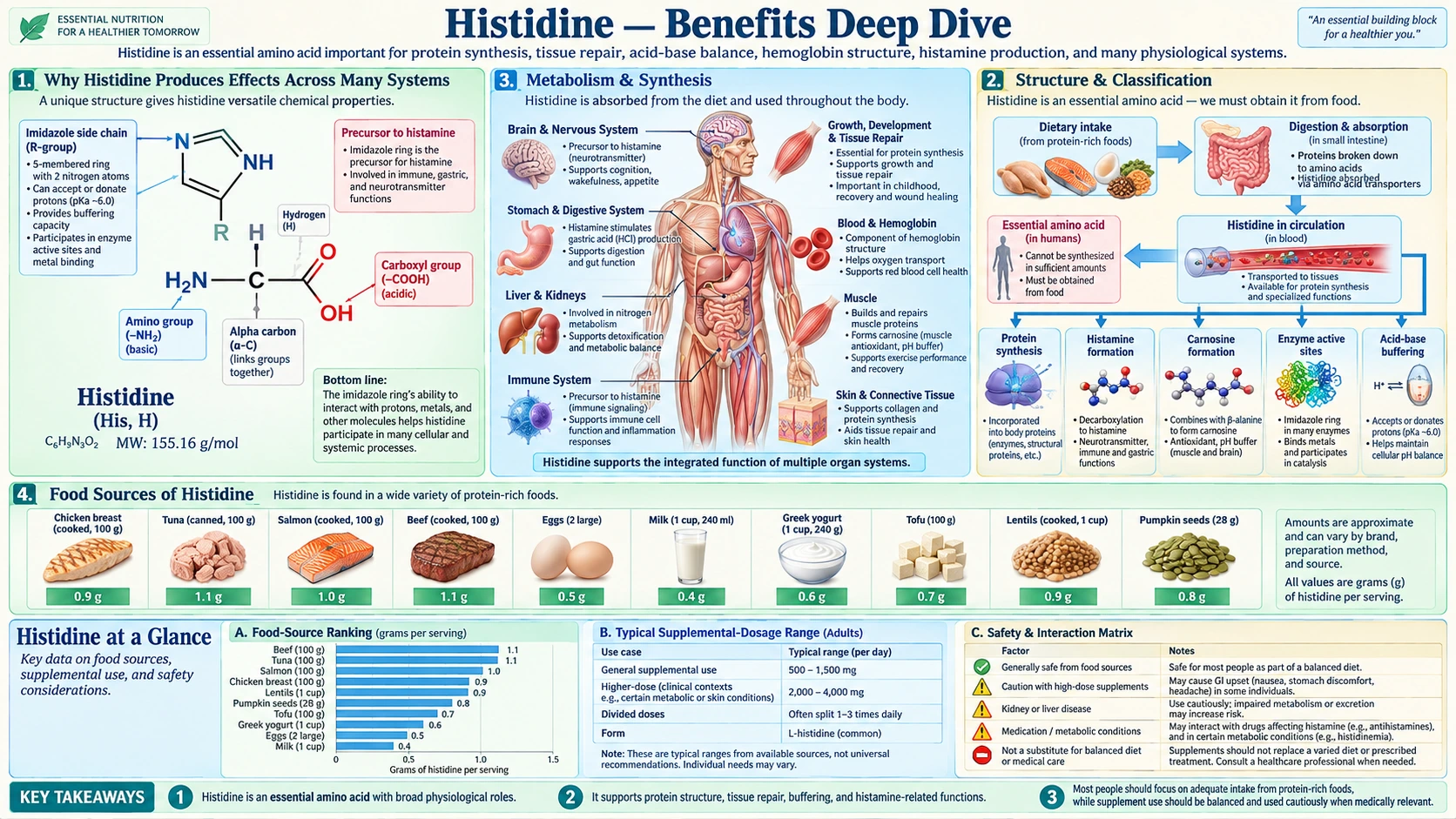
Histidine is the only proteinogenic amino acid with an imidazole ring — a five-membered aromatic heterocycle with two nitrogen atoms whose pKa near physiological pH allows it to switch between protonated and deprotonated forms with biological signaling consequences. That single chemical feature is why histidine is the residue most commonly found at the active sites of enzymes, why it coordinates with the iron atom of hemoglobin at the F8 proximal position to enable reversible oxygen binding, why it is the precursor to histamine (the body's primary allergy and gastric-acid mediator), and why combined with beta-alanine it forms carnosine, the dominant intracellular pH buffer and antioxidant of skeletal muscle. Four deep-dive pages below explore the four largest clinical territories where histidine's biology produces real-world consequences — allergy and mast cell disease, oxygen transport and chronic kidney disease-associated anemia, the carnosine antioxidant system relevant to diabetes complications and exercise performance, and the wound-healing and joint-tissue biology, including the 1977 Pinals trial in rheumatoid arthritis, in which none of the clinical measurements showed an advantage of histidine over placebo.
Deep-Dive Articles
Histamine & Allergy
Histidine decarboxylase (HDC) converting histidine to histamine, the four H1/H2/H3/H4 receptor systems, mast cell activation syndrome (MCAS), the low-histamine diet for chronic urticaria, the diamine oxidase (DAO) and histamine N-methyltransferase (HNMT) degradation enzymes, and the antihistamine drug history from Bovet's 1937 piperoxan through diphenhydramine, the H2-blocker revolution (cimetidine, famotidine), the newest H3 narcolepsy drugs, and H4 receptor drug candidates for chronic pruritus still in trials.
Read the deep dive →Hemoglobin Synthesis
The proximal F8 histidine that coordinates with the iron-heme to enable reversible O2 binding, the distal E7 histidine that discriminates against carbon monoxide poisoning, the Bohr effect's pH-driven release of O2 in metabolically active tissue, the molecular basis of cooperative sigmoid binding, histidine deficiency anemia, and the documented plasma histidine depletion in chronic kidney disease and dialysis.
Read the deep dive →Antioxidant Defense
Carnosine (beta-alanyl-histidine) as the dominant intracellular muscle antioxidant and advanced-glycation-end-product (AGE) scavenger, the carnosine synthase adenosine triphosphate-dependent biosynthesis pathway, anserine in poultry and fish muscle, polaprezinc (zinc-L-carnosine) for gastric ulcer, the age-related 60% decline in muscle carnosine, the CNDP1 carnosinase genetic protection against diabetic nephropathy, and the beta-alanine supplementation that raises muscle carnosine for exercise performance.
Read the deep dive →Wound & Joint Health
Low serum histidine in rheumatoid arthritis (a 50-year-replicated finding), the Pinals 1977 randomized, placebo-controlled trial of 4.5 g/day histidine for rheumatoid arthritis, in which none of the clinical measurements showed an advantage over placebo, histidine's role in cartilage proteoglycan synthesis and aggrecan assembly, the imidazole-copper chelation that powers lysyl oxidase collagen cross-linking, the paradoxical gastric ulcer-protective effect through mucus and bicarbonate stimulation, and clinical protocols for inflammatory joint disease.
Read the deep dive →Table of Contents
- Deep-Dive Articles
- Why Histidine Produces Effects Across Many Systems
- How Much Histidine People Have Tolerated
- Research Papers: Histamine, Mast Cells, and Allergy
- Research Papers: Hemoglobin and Oxygen Transport
- Research Papers: Carnosine and Antioxidant Defense
- Research Papers: Joints, Wound Healing, and Inflammation
- Research Papers: Cross-Cutting (Metabolism, Status, Safety)
- External Authoritative Resources
- Connections
- Featured Videos
Why Histidine Produces Effects Across Many Systems
Most amino acids contribute primarily to protein structure and have at most one or two specialized non-protein roles (e.g., glycine as inhibitory neurotransmitter, tryptophan as serotonin precursor). Histidine is unusual because the single chemical feature that distinguishes it — the imidazole side chain — underlies five distinct categories of biological effect. Each maps to one of the deep-dive territories above:
- Proton donor/acceptor near physiological pH — the imidazole pKa is approximately 6.0, just below physiological pH (7.4), so the side chain can readily protonate and deprotonate with small pH shifts. This is why histidine is the residue most frequently found at the catalytic sites of enzymes: the imidazole can act as a general acid in one half-step of a reaction and as a general base in the next. The Bohr effect of hemoglobin (pH-driven release of O2 in metabolically active tissue) depends on the same chemistry — selected histidine residues protonate and deprotonate to stabilize different hemoglobin conformations as local pH shifts. More in the Hemoglobin Synthesis deep-dive.
- Metal coordination ligand — the imidazole nitrogen is a good ligand for divalent transition metals: iron, copper, zinc, nickel, cobalt. This is the mechanism by which histidine F8 in hemoglobin coordinates with the heme iron, by which histidine residues in metalloenzymes coordinate with catalytic zinc or copper (carbonic anhydrase, lysyl oxidase, matrix metalloproteinases, superoxide dismutase 1), and by which histidine acts as a copper buffer in cellular copper trafficking. The connective-tissue consequences are explored in the Wound and Joint Health deep-dive.
- Direct antioxidant via imidazole radical scavenging — the imidazole ring can react directly with hydroxyl radicals, singlet oxygen, and the alpha-beta unsaturated aldehyde 4-hydroxynonenal. Free histidine is an antioxidant; downstream carnosine is a much more efficient one because the kinetic environment of the dipeptide is optimized for these reactions. More in the Antioxidant Defense deep-dive.
- Histamine precursor — the decarboxylation of histidine by histidine decarboxylase produces histamine, which signals through four distinct G-protein-coupled receptors (H1-H4) to mediate allergic inflammation, gastric acid secretion, central nervous system (CNS) arousal, and chronic inflammatory recruitment. This is the largest commercial pharmacology of histidine's biology — the antihistamine drug class is a multi-billion-dollar market. More in the Histamine and Allergy deep-dive.
- Carnosine biosynthesis substrate — histidine combines with beta-alanine to form carnosine, the dominant intracellular pH buffer and antioxidant in skeletal muscle. Carnosine has its own distinct functional repertoire (advanced-glycation-end-product quenching, 4-hydroxynonenal scavenging, metal chelation, pH buffering) that is mostly orthogonal to histidine's other roles. Because beta-alanine is rate-limiting for carnosine synthesis, the practical leverage point for raising muscle carnosine is beta-alanine supplementation, not histidine. More in the Antioxidant Defense deep-dive.
The therapeutic complication is that these five mechanisms can pull in opposite directions in the same patient. A rheumatoid arthritis patient with low serum histidine may benefit from histidine supplementation for grip strength and connective tissue repair, but a fibromyalgia patient with mast-cell-driven histamine excess may be worsened by the same supplementation. A diabetes patient may benefit from beta-alanine for carnosine-mediated advanced-glycation-end-product quenching, while a chronic kidney disease patient may benefit from histidine directly for both hemoglobin synthesis and diamine oxidase support. On this reasoning, which of these effects matters most depends on a person's main health problem.
The 1977 rheumatoid arthritis trial by Pinals and colleagues gave L-histidine 4.5 g daily or placebo for 30 weeks. None of the clinical measurements showed an advantage of histidine over placebo. A small fall in rheumatoid factor and a small rise in hematocrit (the share of blood made up of red cells) appeared only in the histidine group, and no adverse effects were noted. Physicians and patients gave subjective evaluations that were suggestive of benefit in more active and prolonged disease. The authors wrote that histidine "cannot be advocated as a therapeutic agent in rheumatoid arthritis" but that further studies in certain groups of patients "seem justified."
How Much Histidine People Have Tolerated
Ordinary diets supply about 1.52 to 5.20 g of histidine a day. In a 2020 tolerance study, healthy adults aged 21 to 50 took histidine capsules for 4 weeks at 4, 8 and 12 g per day, or at 16 g per day. Values stayed within normal reference ranges at every dose, but changes in blood measures at 12 g led the researchers to set the no-observed-adverse-effect level at 8 g per day. At 16 g, mean serum zinc fell and aspartate aminotransferase, a liver enzyme, rose.
A 2020 review reports decreased serum zinc and cognitive impairment at intakes above 24 g per day. It notes that little research covers doses between 4.5 and 24 g per day, and states that no tolerable upper level has been established for histidine.
Research Papers: Histamine, Mast Cells, and Allergy
- Dale HH (1920). Croonian Lecture: The biological significance of anaphylaxis. Proceedings of the Royal Society of London, Series B. 91:126-146. The original histamine-anaphylaxis link. — doi:10.1098/rspb.1920.0005
- Bovet D, Staub AM (1937). Early synthetic antihistamines: aryl ethers such as the thymol ether 929F, reported the same year as piperoxan (933F). Comptes Rendus de la Societe de Biologie. — PubMed: Bovet piperoxan
- Parsons ME, Ganellin CR (2006). Histamine and its receptors. British Journal of Pharmacology. 147 Suppl 1:S127-35. — PubMed PMID: 16402096
- Black JW, Duncan WA, Durant CJ, Ganellin CR, Parsons EM (1972). Definition and antagonism of histamine H2-receptors. Nature. 236(5347):385-90. — PubMed PMID: 4401751
- Arrang JM, Garbarg M, Schwartz JC (1983). Auto-inhibition of brain histamine release mediated by a novel class (H3) of histamine receptor. Nature. 302(5911):832-7. — PubMed PMID: 6188956
- Oda T, Morikawa N, Saito Y, Masuho Y, Matsumoto S (2000). Molecular cloning and characterization of a novel type of histamine receptor preferentially expressed in leukocytes. Journal of Biological Chemistry. 275(47):36781-6. — PubMed PMID: 10973974
- Maintz L, Novak N (2007). Histamine and histamine intolerance. American Journal of Clinical Nutrition. 85(5):1185-96. The diamine oxidase and histamine N-methyltransferase reference review. — PubMed PMID: 17490952
- Akin C, Valent P, Metcalfe DD (2010). Mast cell activation syndrome: Proposed diagnostic criteria. Journal of Allergy and Clinical Immunology. 126(6):1099-104.e4. — PubMed PMID: 21035176
- McNeil BD, Pundir P, Meeker S, Han L, Undem BJ, Kulka M, Dong X (2015). Identification of a mast-cell-specific receptor crucial for pseudo-allergic drug reactions. Nature. 519(7542):237-41. — PubMed PMID: 25517090
- Schwartz JC (2011). The histamine H3 receptor: from discovery to clinical trials with pitolisant. British Journal of Pharmacology. 163(4):713-21. — PubMed PMID: 21615387
- Thurmond RL, Gelfand EW, Dunford PJ (2008). The role of histamine H1 and H4 receptors in allergic inflammation: the search for new antihistamines. Nature Reviews Drug Discovery. 7(1):41-53. — PubMed PMID: 18172439
- Schnedl WJ, Enko D (2021). Histamine Intolerance Originates in the Gut. Nutrients. 13(4):1262. — PubMed PMID: 33921522
- Comas-Baste O, Sanchez-Perez S, Veciana-Nogues MT, Latorre-Moratalla M, Vidal-Carou MDC (2020). Histamine Intolerance: The Current State of the Art. Biomolecules. 10(8):1181. — PubMed PMID: 32824107
Research Papers: Hemoglobin and Oxygen Transport
- Perutz MF (1962). Structure of haemoglobin. Nobel Lecture. — PubMed: Perutz Nobel
- Pauling L, Coryell CD (1936). Magnetic properties of hemoglobin and oxyhemoglobin. PNAS. The Pauling O2 binding model. — PubMed: Pauling 1936
- Bohr C, Hasselbalch K, Krogh A (1904). The Bohr effect. Skand Archiv Physiol. — PubMed: Bohr 1904
- Perutz MF et al. (1998). Stereochemical mechanism of cooperative effects in hemoglobin. Annual Review of Biophysics. — PubMed: Cooperativity mechanism
- Springer BA, Egeberg KD, Sligar SG, Rohlfs RJ, Mathews AJ, Olson JS (1989). Discrimination between oxygen and carbon monoxide and inhibition of autooxidation by myoglobin. Site-directed mutagenesis of the distal histidine. Journal of Biological Chemistry. 264(6):3057-60. — PubMed PMID: 2644279
- Watanabe M, Suliman ME, Qureshi AR, et al. (2008). Consequences of low plasma histidine in chronic kidney disease patients: associations with inflammation, oxidative stress, and mortality. American Journal of Clinical Nutrition. 87(6):1860-6. — PubMed PMID: 18541578
- Kopple JD, Swendseid ME (1975). Evidence that histidine is an essential amino acid in normal and chronically uremic man. Journal of Clinical Investigation. 55(5):881-91. — PubMed PMID: 1123426
- Holecek M (2020). Histidine in Health and Disease: Metabolism, Physiological Importance, and Use as a Supplement. Nutrients. 12(3):848. — PubMed PMID: 32235743
- Vera-Aviles M, Vantana E, Kardinasari E, Koh NL, Latunde-Dada GO (2018). Protective Role of Histidine Supplementation Against Oxidative Stress Damage in the Management of Anemia of Chronic Kidney Disease. Pharmaceuticals (Basel). 11(4):111. — PubMed PMID: 30347874
Research Papers: Carnosine and Antioxidant Defense
A 2022 pooled analysis of 3 randomized trials and 396 people found that adding polaprezinc (zinc-L-carnosine) to standard triple therapy raised Helicobacter pylori eradication (odds ratio 2.01, 95% CI 1.27-3.21, counting everyone randomized), with no difference in adverse events. The authors call the evidence still scarce and say larger trials are needed.
- Gulewitsch W, Amiradzibi S (1900). Original isolation of carnosine. Berichte der deutschen chemischen Gesellschaft. — PubMed: Carnosine isolation
- Boldyrev AA, Aldini G, Derave W (2013). Physiology and pathophysiology of carnosine. Physiological Reviews. 93(4):1803-45. — PubMed PMID: 24137022
- Harris RC, Tallon MJ, Dunnett M, et al. (2006). The absorption of orally supplied beta-alanine and its effect on muscle carnosine synthesis in human vastus lateralis. Amino Acids. 30(3):279-89. — PubMed PMID: 16554972
- Aldini G, Carini M, Beretta G, Bradamante S, Facino RM (2002). Carnosine is a quencher of 4-hydroxy-nonenal: through what mechanism of reaction? Biochemical and Biophysical Research Communications. 298(5):699-706. — PubMed PMID: 12419310
- Janssen B, Hohenadel D, Brinkkoetter P, et al. (2005). Carnosine as a protective factor in diabetic nephropathy: association with a leucine repeat of the carnosinase gene CNDP1. Diabetes. 54(8):2320-7. The Mannheim allele. — PubMed PMID: 16046297
- Hipkiss AR (2009). Carnosine in nutrition and health. Advances in Food and Nutrition Research. — PubMed: Hipkiss review
- Trexler ET, Smith-Ryan AE, Stout JR, et al. (2015). International society of sports nutrition position stand: Beta-Alanine. Journal of the International Society of Sports Nutrition. 12:30. — PubMed PMID: 26175657
- Sale C, Saunders B, Harris RC (2010). Effect of beta-alanine supplementation on muscle carnosine concentrations and exercise performance. Amino Acids. 39(2):321-33. — PubMed PMID: 20091069
- Mahmoud A, Abuelazm M, Ahmed AAS, Abdalshafy H, Abdelazeem B, Brasic JR (2022). Efficacy and Safety of Polaprezinc-Based Therapy versus the Standard Triple Therapy for Helicobacter pylori Eradication: A Systematic Review and Meta-Analysis of Randomized Controlled Trials. Nutrients. 14(19):4126. — PubMed PMID: 36235778
- Stegen S, Stegen B, Aldini G, et al. (2015). Plasma carnosine, but not muscle carnosine, attenuates high-fat diet-induced metabolic stress. Applied Physiology, Nutrition, and Metabolism. 40(9):868-76. A rat study. — PubMed PMID: 26307517
- Hipkiss AR (2015). Possible Benefit of Dietary Carnosine towards Depressive Disorders. Aging and Disease. 6(5):300-3. — PubMed PMID: 26425385
Research Papers: Joints, Wound Healing, and Inflammation
In a double-blind trial of 100 obese women with metabolic syndrome, 4 g of histidine a day for 12 weeks lowered waist size by 2.86 cm, fat mass by 2.71 kg and the homeostasis-model insulin resistance score by 1.09, compared with placebo. 92 women finished, and no side effects were observed.
- Gerber DA (1975). Low free serum histidine concentration in rheumatoid arthritis. A measure of disease activity. Journal of Clinical Investigation. 55(6):1164-73. — PubMed PMID: 1079527
- Pinals RS, Harris ED, Burnett JB, Gerber DA (1977). Treatment of rheumatoid arthritis with L-histidine: a randomized, placebo-controlled, double-blind trial. Journal of Rheumatology. 4(4):414-9. — PubMed PMID: 342692
- Andou A, Hisamatsu T, Okamoto S, et al. (2009). Dietary histidine ameliorates murine colitis by inhibition of proinflammatory cytokine production from macrophages. Gastroenterology. 136(2):564-74.e2. — PubMed PMID: 19027739
- Niu YC, Feng RN, Hou Y, Li K, Kang Z, Wang J, Sun CH, Li Y (2012). Histidine and arginine are associated with inflammation and oxidative stress in obese women. British Journal of Nutrition. 108(1):57-61. — PubMed PMID: 21996294
- Feng RN, Niu YC, Sun XW, et al. (2013). Histidine supplementation improves insulin resistance through suppressed inflammation in obese women with the metabolic syndrome: a randomised controlled trial. Diabetologia. 56(5):985-94. — PubMed PMID: 23361591
- Hasegawa S, Ichiyama T, Sonaka I, et al. (2012). Cysteine, histidine and glycine exhibit anti-inflammatory effects in human coronary arterial endothelial cells. Clinical and Experimental Immunology. 167(2):269-74. — PubMed PMID: 22236003
- Kruidenier L, Verspaget HW (2002). Review article: oxidative stress as a pathogenic factor in inflammatory bowel disease--radicals or ridiculous? Alimentary Pharmacology and Therapeutics. 16(12):1997-2015. — PubMed PMID: 12452933
- Holecek M (2020). Histidine in Health and Disease: Metabolism, Physiological Importance, and Use as a Supplement. Nutrients. 12(3):848. — PubMed PMID: 32235743
Research Papers: Cross-Cutting (Metabolism, Status, Safety)
- Histidine decarboxylase (HDC) enzymology and tissue distribution — PubMed: HDC enzymology
- Histidase / urocanase / FIGLU catabolic pathway and folate requirement — PubMed: FIGLU pathway
- Histidinemia (inborn error of histidine catabolism) — PubMed: Histidinemia
- Plasma amino acid profiling methodology and reference ranges — PubMed: Amino acid profiling
- Gheller ME, Vermeylen F, Handzlik MK, et al. (2020). Tolerance to graded dosages of histidine supplementation in healthy human adults. American Journal of Clinical Nutrition. 112(5):1358-1367. — PubMed PMID: 32766885
- Thalacker-Mercer AE, Gheller ME (2020). Benefits and Adverse Effects of Histidine Supplementation. Journal of Nutrition. 150(Suppl 1):2588S-2592S. — PubMed PMID: 33000165
- L-histidine safety, upper limit, and side effect profile — PubMed: Histidine safety
- WHO/FAO requirement estimate for histidine in adults — PubMed: WHO requirement
- Histidine in parenteral nutrition formulations and amino acid blends — PubMed: TPN histidine
- Vegetarian and vegan amino acid intake including histidine and beta-alanine — PubMed: Vegan amino acid intake
- Histidine interactions with copper, zinc, and other transition metals — PubMed: Histidine metal chelation
- Histidine in pregnancy, lactation, and pediatric requirements — PubMed: Pregnancy/pediatric
External Authoritative Resources
- PubMed — All research on histidine (~30,000+ papers)
- PubMed — All research on carnosine (~10,000+ papers)
- MedlinePlus — Amino acids
- U.S. National Institutes of Health (NIH) Office of Dietary Supplements — Dietary Supplements for Exercise and Athletic Performance
- FAO/WHO/UNU — Protein and amino acid requirements in human nutrition
- UniProt — Histidine decarboxylase (HDC) entry
- PubMed — Histidine and rheumatoid arthritis
Connections
- All Amino Acids
- Histidine (Main Page)
- Histidine, Histamine, and Allergy
- Histidine for Hemoglobin Synthesis
- Histidine and Carnosine Antioxidant Defense
- Histidine for Wound and Joint Health
- Beta-Alanine (Carnosine Precursor)
- Lysine
- Arginine
- Glycine
- Proline
- Vitamin B6 (Histidine Decarboxylase Cofactor)
- Copper (Diamine Oxidase and Lysyl Oxidase Cofactor)
- Zinc (Polaprezinc)
- Iron (Hemoglobin)
- Anemia
- Chronic Kidney Disease
- Arthritis
- Type 2 Diabetes
- Eczema (Atopic Dermatitis)
- Quercetin (Mast Cell Stabilizer)
- Oxidative Stress
- Chicken (Anserine Source)
- Tuna (Anserine Source)
- History
- Sources