Histidine: Food Sources & Daily Intake
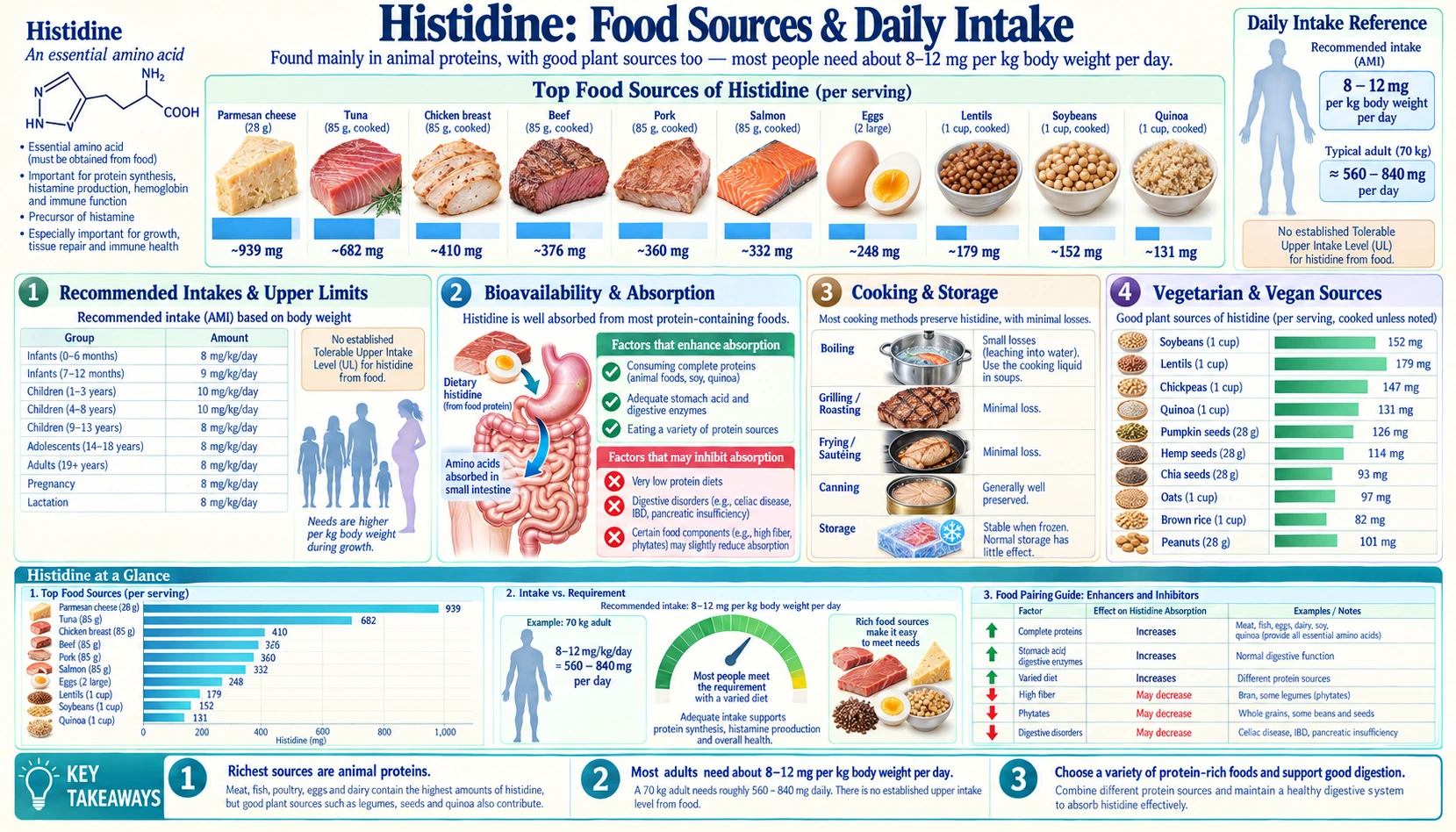
Histidine is an essential amino acid — adults make only a trace of it, so it has to come from food. It is the raw material for histamine, the signal behind immune defense, stomach-acid release and wakefulness, and it sits at the oxygen-binding heart of hemoglobin, the protein that carries oxygen in your blood. Paired with beta-alanine it forms carnosine, a buffer concentrated in muscle that mops up acid during hard exercise, and its ring-shaped side chain is unusually good at binding metals like zinc, copper and iron inside enzymes. The richest sources are concentrated animal proteins — cheese, meat, fish, eggs — followed by legumes, seeds and peanuts. The table below shows grams of histidine per 100 g of food; there is no U.S. Food and Drug Administration (FDA) Daily Value for individual amino acids, so amounts are absolute.
| Histidine: Food Sources & Daily Intake | |||||
|---|---|---|---|---|---|
| Rank | Food (serving) | Per 100 g | Glucose | Fructose | Notes |
| 1 | Parmesan Cheese 1 oz / 28 g | 🟢 1.4 g | — | — | Concentrated protein. |
| 2 | Pork 3 oz / 85 g | 🟢 1.1 g | 0 | 0 | |
| 3 | Beef Meat 3 oz / 85 g | 🟢 1.0 g | 0 | 0 | |
| 4 | Chicken Breast 3 oz / 85 g | 🟢 1.0 g | 0 | 0 | Carnosine-rich meat. |
| 5 | Pumpkin Seeds 1 oz / 28 g | 🟢 0.8 g | 0.1 | 0.1 | |
| 6 | Tuna 3 oz / 85 g | 🟢 0.8 g | 0 | 0 | |
| 7 | Salmon 3 oz / 85 g | 🟢 0.7 g | 0 | 0 | |
| 8 | Cheddar Cheese 1 oz / 28 g | 🟢 0.7 g | 0 | 0 | |
| 9 | Cod 3 oz / 85 g | 🟢 0.7 g | 0 | 0 | Lean, protein-rich. |
| 10 | Pork Organ Meats 3 oz / 85 g | 🟡 0.6 g | — | — | Nutrient-dense organ meat. |
| 11 | Sunflower Seeds 1 oz / 28 g | 🟡 0.5 g | — | — | |
| 12 | Chicken Organ Meats 3 oz / 85 g | 🟡 0.3 g | 0 | 0 | Nutrient-dense organ meat (giblets). |
| 13 | Egg 1 large / 50 g | 🟡 0.3 g | — | — | |
| 14 | White Beans 1 cup / 179 g | 🟡 0.3 g | — | — | |
| 15 | Lentils 1 cup / 198 g | 🟡 0.3 g | — | — | USDA lists 0.25 g per 100 g cooked. |
| 16 | Brown Rice 1 cup / 195 g | ⚪ 0.1 g | 0 | 0 | Common staple. |
Table of Contents
How to Read These Tables
- Essential amino acid. Adults synthesize only tiny amounts of histidine, so a regular dietary supply matters. The nine essential amino acids must come from food; the other eleven the body can build itself.
- Grams per 100 g, not %DV. There is no U.S. Food and Drug Administration Daily Value for individual amino acids, so this table reports the absolute grams per 100 g of food and ranks foods by that. A typical serving is shown beside each food.
- Complete vs incomplete protein. Animal foods are “complete” they carry all the essential amino acids in good proportion. Most single plant foods are lower in one or two; eating a variety of legumes, seeds and nuts across the day covers the gaps.
Recommended Intakes & Upper Limits
Histidine has no Daily Value: the U.S. food-label rules (21 CFR 101.9) set none for it, and the green and yellow marks in the food table above only rank each food against the richest food listed. The table below summarizes its status.
| Reference | Adult value | Notes |
|---|---|---|
| Essential? | Yes — essential | Adults make only tiny amounts, so it must come from food. |
| Adult requirement | 10 mg/kg/day | WHO/FAO/UNU 2007 estimate (range ~8–12). |
| ≈ for a 70 kg adult | ~700 mg/day | Easily met by a normal protein intake (~0.8 g protein/kg). |
| Key roles | Histamine, hemoglobin & carnosine | Precursor to histamine, part of hemoglobin, and forms muscle-buffering carnosine; also binds metals. |
Bioavailability & Absorption
Histidine from food is well absorbed as part of dietary protein. What matters most is total protein quality and quantity: animal proteins (meat, fish, eggs, dairy) are complete and histidine-rich, while plant proteins are usually a little lower and benefit from variety. Meat and fish carry a bonus — much of their histidine is already packaged as carnosine, the histidine-containing muscle dipeptide, which is why animal foods are the main dietary source of it. An adult’s need of about 700 mg a day is covered by ordinary protein intake. Spreading roughly 20–40 g of quality protein across each meal comfortably covers an adult’s histidine needs.
Cooking & Storage
Amino acids are stable to ordinary cooking — histidine is not destroyed by normal heat, and cooking actually makes protein easier to digest. One quirk worth knowing: in fish that has been poorly chilled, bacteria can convert free histidine into histamine, which causes scombroid fish poisoning — a 2010 review describes scombroid poisoning as the result of mishandling, with inadequate cooling after the catch letting bacteria make histamine from the fish’s free histidine. The hazard lies in the poorly chilled fish, not in histidine in the diet, and histidine itself is not destroyed by normal cooking heat.
Vegetarian & Vegan Sources
Plant-based eaters can get plenty of histidine, but it takes a little planning because plant proteins are less histidine-dense than animal ones. The strongest plant sources are lentils, white and black beans, chickpeas, peanuts, and pumpkin and sunflower seeds. Eating a variety across the day (legumes + seeds + nuts) supplies all the essential amino acids; total protein simply needs to be a bit higher than for omnivores to reach the same histidine. One trade-off to note: muscle carnosine tends to run lower on a plant-based diet because carnosine itself comes only from meat and fish — though the body can still build some from dietary histidine and beta-alanine.
Who Needs to Pay Attention
Outright histidine deficiency is rare in anyone eating enough total protein, because everyday diets supply far more than the ~700 mg an adult needs. It matters most in two groups. Infants cannot make histidine at all and depend entirely on the diet, which is why it is treated as strictly essential in early life. People with advanced chronic kidney disease can run low: a 2008 Swedish study of 325 patients measured shortly before they started dialysis found that low blood histidine went with lower hemoglobin, inflammation, oxidative stress and protein-energy wasting (loss of muscle and body protein), and with more deaths over up to 5 years of follow-up (hazard ratio 1.55 after adjusting for age, sex, heart disease, inflammation, diabetes and other factors). For other people, ordinary protein intake covers the requirement; supplements are not needed to reach it.
Histidine has also been tested as a supplement. In a 2013 randomized, double-blind, placebo-controlled trial in China, 100 obese women aged 33 to 51 with metabolic syndrome took 4 g of histidine a day or a placebo for 12 weeks. Compared with placebo, the histidine group had lower insulin resistance (HOMA-IR down 1.09), a smaller waist (down 2.86 cm), less fat mass (down 2.71 kg) and lower inflammation markers (TNF-α and IL-6), and no side effects were seen. It is one trial in one group of women.
Key Research Papers
- NIH MedlinePlus — Amino acids
- National Academies — Dietary Reference Intakes: Protein and Amino Acids (2005), Chapter 10
- Watanabe M, Suliman ME, Qureshi AR, Garcia-Lopez E, Bárány P, Heimbürger O, Stenvinkel P, Lindholm B. Consequences of low plasma histidine in chronic kidney disease patients: associations with inflammation, oxidative stress, and mortality. Am J Clin Nutr. 2008;87(6):1860-1866. — PubMed PMID: 18541578
- Feng RN, Niu YC, Sun XW, Li Q, Zhao C, Wang C, Guo FC, Sun CH, Li Y. Histidine supplementation improves insulin resistance through suppressed inflammation in obese women with the metabolic syndrome: a randomised controlled trial. Diabetologia. 2013;56(5):985-994. — PubMed PMID: 23361591
- Hungerford JM. Scombroid poisoning: a review. Toxicon. 2010;56(2):231-243. — PubMed PMID: 20152850
- PubMed — histidine metabolism and physiological effects. — Search PubMed
- PubMed — histidine requirement in adults and kidney disease. — Search PubMed