Collagen — Benefits Deep Dive
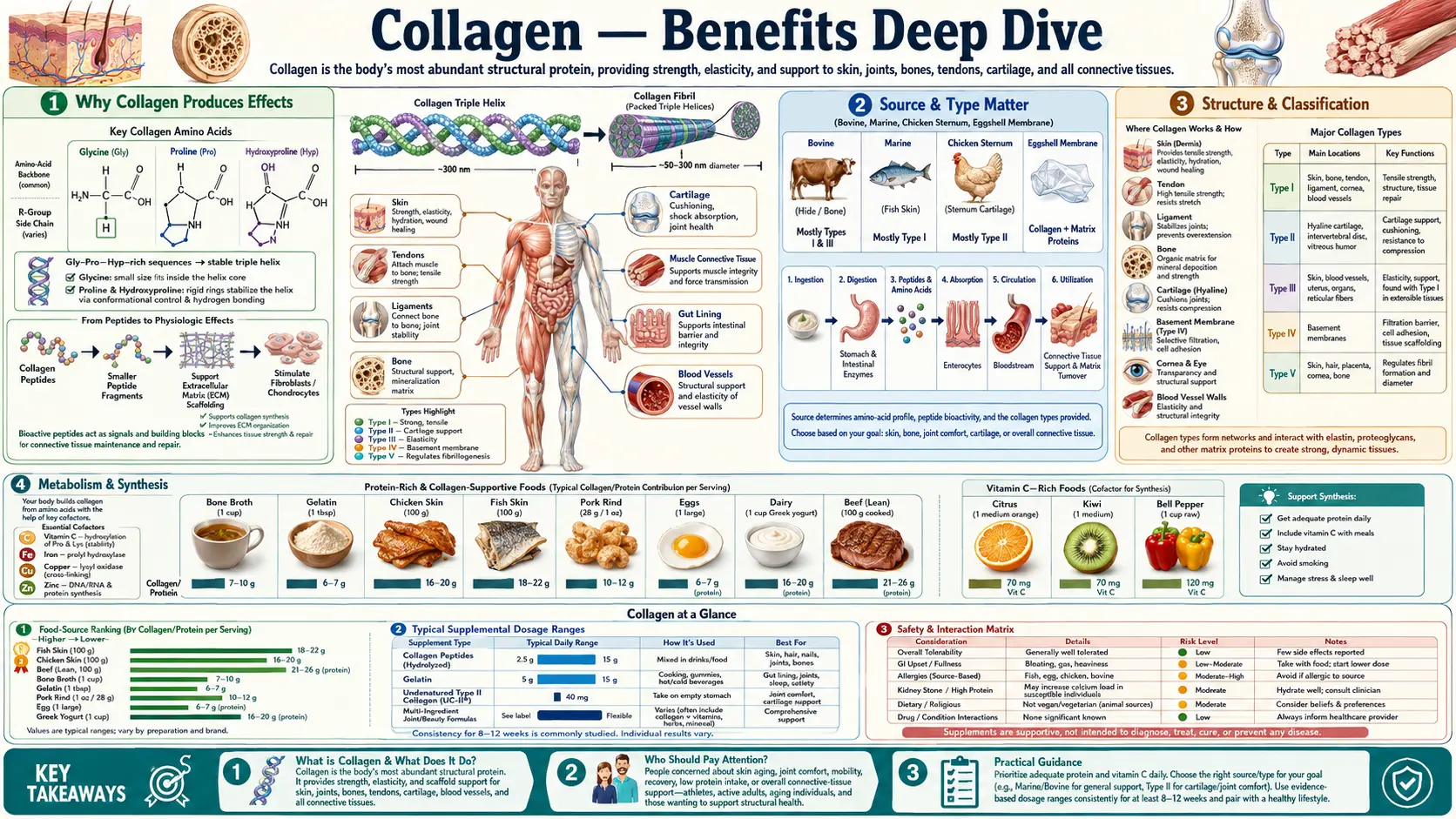
Hydrolyzed collagen (collagen hydrolysate, collagen peptides) is collagen broken by enzymes into small peptides and taken in gram amounts; undenatured type II collagen from chicken sternum cartilage is a different product, studied in milligram amounts. Collagen is the most abundant protein in animals (Shoulders 2009), and its triple helix needs a glycine at every third position (Xiao 2011). After people ingested gelatin hydrolysates, collagen-derived peptides — mainly prolyl-hydroxyproline (Pro-Hyp) — appeared in their blood, peaking 1-2 hours later (Iwai 2005); in mouse cells and mice, Pro-Hyp stimulated skin fibroblasts and protected cartilage (Shigemura 2009; Nakatani 2009). Placebo-controlled trials, many run or funded by collagen suppliers, report changes in skin elasticity, joint pain and bone mineral density, and an open-label trial without a placebo group reports nail changes. A 2025 meta-analysis of 23 skin trials found an overall benefit, but no effect in the trials not funded by companies and no significant effect in the high-quality trials (Myung 2025). The deep dives below set out what each trial found and who funded it where the paper says so.
Deep-Dive Articles
Skin Elasticity & Anti-Aging
Two 8-week placebo-controlled trials by Proksch and colleagues (2014) of 2.5 g or 5 g a day of collagen peptides reported better skin elasticity and less eye-wrinkle volume, and Asserin 2015 reported higher skin hydration and dermal collagen density. Pro-Hyp, the main collagen peptide found in blood after ingestion (Iwai 2005), stimulated mouse skin fibroblasts in culture (Shigemura 2009) — a laboratory finding. A 2025 meta-analysis found no effect in the skin trials not funded by companies and no significant effect in the high-quality trials (Myung 2025).
Read the deep dive →Joint Health
Hydrolyzed collagen in grams: Clark 2008 (10 g a day for 24 weeks in athletes; data from 97 of 147 could be evaluated), Zdzieblik 2017 (5 g) and Bruyère 2012 (1.2 g) reported improvements over placebo on their main pain measures, and the McAlindon 2011 pilot found an MRI cartilage change but no difference in symptoms. Undenatured type II collagen at 40 mg a day: in Lugo 2016 it did better than placebo, and better than glucosamine plus chondroitin in the primary analysis only (p = 0.04); Lugo 2016 and Crowley 2009 were both sponsored by the ingredient's supplier. The proposed oral-tolerance mechanism rests on animal studies.
Read the deep dive →Bone Density
König 2018: 131 postmenopausal women with reduced bone mineral density took 5 g a day of collagen peptides or placebo for 12 months; bone mineral density of the spine and femoral neck rose compared with placebo, and a marker of bone formation rose; one author listed a collagen research institute. A 4-year open-label follow-up of 31 of the women, with no placebo group, is also described (Zdzieblik 2021), along with the osteoporosis drug trials the collagen results can be read against.
Read the deep dive →Hair & Nails
Hexsel 2017: in an open-label trial with no placebo group, 25 people with brittle nails took 2.5 g a day of collagen peptides for 24 weeks; the authors reported a 12% increase in nail growth rate and a 42% fall in the frequency of broken nails. Two of the six authors listed a collagen research institute. The deep dive also covers the hair studies and the biotin research.
Read the deep dive →Interactive Visualization Vitamin C, Collagen & Why Sailors Fell Apart Zip three protein chains into the strongest rope in biology — then take the vitamin C away and watch the helix unravel, and old healed scars split back open. Launch →
Table of Contents
How Collagen Is Proposed to Work
A long-standing objection to oral collagen is that it is a protein like any other: it is digested into amino acids, and the body cannot tell which protein those amino acids came from. Research since the 2000s has examined three proposed mechanisms. How much each contributes in people has not been established.
- Collagen peptides in the blood (Pro-Hyp) — Hydroxyproline (Hyp) is a characteristic amino acid of collagen. In healthy volunteers who ingested 9.4-23 g of gelatin hydrolysates after a 12-hour fast, the peptide form of hydroxyproline in plasma rose from negligible levels to a peak of 20-60 nmol/mL after 1-2 hours and fell to half of that by 4 hours; the main peptide was Pro-Hyp, with small amounts of others including Pro-Hyp-Gly (Iwai 2005). In the laboratory, Pro-Hyp increased the migration and growth of fibroblasts from mouse skin (Shigemura 2009), and in mice and cultured cartilage cells it limited cartilage thinning and increased glycosaminoglycan and aggrecan expression (Nakatani 2009). These are animal and cell findings, not human results.
- Amino acid supply (glycine, proline, hydroxyproline) — Glycine is mandatory at every third position of the collagen triple helix, and the imino acids proline and hydroxyproline readily occupy the other two (Bhattacharjee 2005), so collagen is rich in these amino acids. A 2009 modelling study estimated that the body's own glycine synthesis (about 3 g/day) plus a typical diet (1.5-3.0 g/day) may fall short of the amount needed for all metabolic uses, including collagen synthesis, by about 10 g per day for a 70 kg adult (Meléndez-Hevia 2009). That figure is a model estimate and a hypothesis, not a measured deficiency; it is covered on the Glycine for Collagen Synthesis page.
- Oral tolerance (proposed for undenatured type II collagen) — Undenatured type II collagen was given at 40 mg a day in the knee osteoarthritis trials (Crowley 2009; Lugo 2016). The proposed mechanism is oral tolerance: an antigen eaten in small amounts dampening a later immune response to it. The evidence for that mechanism comes from animals — in mice, soluble type II collagen given by stomach tube before immunization suppressed collagen-induced arthritis, while denatured type II collagen had no observable effect (Nagler-Anderson 1986). It has not been shown in people; the Lugo 2016 authors wrote that additional studies to elucidate the mechanism are warranted. These trials measured joint symptoms, not skin, bone or nail outcomes.
The products differ in source, collagen type and form, and each trial tested one specific product, as the next section describes.
Sources & Forms Studied (Bovine, Marine, Chicken Sternum, Eggshell Membrane)
Collagen products come from several animal sources. Each trial on these pages tested one specific product, so a result from one source or form may not carry over to another:
- Bovine hide and bone — a common source of collagen hydrolysate. The skin, bone and nail trials in the deep dives each tested a specific collagen peptide preparation; their abstracts do not compare animal sources.
- Marine (fish skin and scales) — another source of collagen hydrolysate. None of the trials cited on this page compared marine with bovine collagen for absorption or for any clinical outcome.
- Chicken sternal cartilage — the source of undenatured type II collagen (Lugo 2016). The knee osteoarthritis trials gave it at 40 mg a day, while the hydrolyzed collagen joint trials used gram amounts (10 g in Clark 2008, 5 g in Zdzieblik 2017, 1.2 g in Bruyère 2012). The two forms were tested at different doses and for different proposed reasons, and none of the trials cited here compared them directly (see the Joint Health deep dive).
- Eggshell membrane — described in its trial report as containing glycosaminoglycans and proteins. In a randomized, double-blind, placebo-controlled trial, 67 people with knee osteoarthritis took 500 mg a day or placebo for 8 weeks; response rates for WOMAC pain and stiffness were significantly better than placebo at all time points, while function and overall WOMAC scores did not improve significantly (Ruff 2009). The first author worked for the company that makes the ingredient.
The amounts used in the trials were: skin — 2.5 g or 5 g of collagen peptides daily for 8 weeks (Proksch 2014); bone — 5 g daily for 12 months (König 2018); nails — 2.5 g daily for 24 weeks (Hexsel 2017); joints — 10 g, 5 g or 1.2 g of hydrolyzed collagen daily (Clark 2008; Zdzieblik 2017; Bruyère 2012), 40 mg of undenatured type II collagen daily (Crowley 2009; Lugo 2016) and 500 mg of eggshell membrane daily (Ruff 2009). These amounts describe the research, not a regimen. None of the trials cited on this page tested a multi-source “multi-collagen” blend. Decisions about supplements belong with a clinician.
Key Research Papers
- Proksch E et al. (2014). Oral supplementation of specific collagen peptides has beneficial effects on human skin physiology: a double-blind, placebo-controlled study. Skin Pharmacology and Physiology. 27(1):47-55. — PubMed PMID: 23949208 (Editorial note: this entry previously linked PMID 24401291, the same group's wrinkle trial, now listed separately below.)
- Shigemura Y et al. (2009). Effect of Prolyl-hydroxyproline (Pro-Hyp), a food-derived collagen peptide in human blood, on growth of fibroblasts from mouse skin. Journal of Agricultural and Food Chemistry. — PubMed PMID: 19128041
- König D et al. (2018). Specific collagen peptides improve bone mineral density and bone markers in postmenopausal women: a randomized controlled study. Nutrients. — PubMed PMID: 29337906
- Clark KL et al. (2008). 24-Week study on the use of collagen hydrolysate as a dietary supplement in athletes with activity-related joint pain. Current Medical Research and Opinion. — PubMed PMID: 18416885
- Hexsel D et al. (2017). Oral supplementation with specific bioactive collagen peptides improves nail growth and reduces symptoms of brittle nails. Journal of Cosmetic Dermatology. — PubMed PMID: 28786550
- Proksch E et al. (2014). Oral intake of specific bioactive collagen peptides reduces skin wrinkles and increases dermal matrix synthesis. Skin Pharmacology and Physiology. 27(3):113-119. — PubMed PMID: 24401291
- Asserin J, Lati E, Shioya T, Prawitt J (2015). The effect of oral collagen peptide supplementation on skin moisture and the dermal collagen network: evidence from an ex vivo model and randomized, placebo-controlled clinical trials. Journal of Cosmetic Dermatology. 14(4):291-301. — PubMed PMID: 26362110
- Myung SK, Park Y (2025). Effects of collagen supplements on skin aging: a systematic review and meta-analysis of randomized controlled trials. American Journal of Medicine. 138(9):1264-1277. — PubMed PMID: 40324552
- Iwai K et al. (2005). Identification of food-derived collagen peptides in human blood after oral ingestion of gelatin hydrolysates. Journal of Agricultural and Food Chemistry. 53(16):6531-6536. — PubMed PMID: 16076145
- Nakatani S, Mano H, Sampei C, Shimizu J, Wada M (2009). Chondroprotective effect of the bioactive peptide prolyl-hydroxyproline in mouse articular cartilage in vitro and in vivo. Osteoarthritis and Cartilage. 17(12):1620-1627. (Animal and cell study.) — PubMed PMID: 19615963
- Zdzieblik D, Oesser S, König D (2021). Specific bioactive collagen peptides in osteopenia and osteoporosis: long-term observation in postmenopausal women. Journal of Bone Metabolism. 28(3):207-213. (Open-label follow-up.) — PubMed PMID: 34520654
- Lugo JP, Saiyed ZM, Lane NE (2016). Efficacy and tolerability of an undenatured type II collagen supplement in modulating knee osteoarthritis symptoms: a multicenter randomized, double-blind, placebo-controlled study. Nutrition Journal. 15:14. — PubMed PMID: 26822714
- Crowley DC et al. (2009). Safety and efficacy of undenatured type II collagen in the treatment of osteoarthritis of the knee: a clinical trial. International Journal of Medical Sciences. 6(6):312-321. — PubMed PMID: 19847319
- McAlindon TE et al. (2011). Change in knee osteoarthritis cartilage detected by delayed gadolinium enhanced magnetic resonance imaging following treatment with collagen hydrolysate: a pilot randomized controlled trial. Osteoarthritis and Cartilage. 19(4):399-405. — PubMed PMID: 21251991
- Zdzieblik D, Oesser S, Gollhofer A, König D (2017). Improvement of activity-related knee joint discomfort following supplementation of specific collagen peptides. Applied Physiology, Nutrition, and Metabolism. 42(6):588-595. (A correction was published in 2017.) — PubMed PMID: 28177710
- Bruyère O et al. (2012). Effect of collagen hydrolysate in articular pain: a 6-month randomized, double-blind, placebo controlled study. Complementary Therapies in Medicine. 20(3):124-130. — PubMed PMID: 22500661
- Nagler-Anderson C, Bober LA, Robinson ME, Siskind GW, Thorbecke GJ (1986). Suppression of type II collagen-induced arthritis by intragastric administration of soluble type II collagen. Proceedings of the National Academy of Sciences of the USA. 83(19):7443-7446. (Animal study.) — PubMed PMID: 3463976
- Ruff KJ, Winkler A, Jackson RW, DeVore DP, Ritz BW (2009). Eggshell membrane in the treatment of pain and stiffness from osteoarthritis of the knee: a randomized, multicenter, double-blind, placebo-controlled clinical study. Clinical Rheumatology. 28(8):907-914. — PubMed PMID: 19340512
- Shoulders MD, Raines RT (2009). Collagen structure and stability. Annual Review of Biochemistry. 78:929-958. (Review.) — PubMed PMID: 19344236
- Bhattacharjee A, Bansal M (2005). Collagen structure: the Madras triple helix and the current scenario. IUBMB Life. 57(3):161-172. (Review.) — PubMed PMID: 16036578
- Xiao J, Cheng H, Silva T, Baum J, Brodsky B (2011). Osteogenesis imperfecta missense mutations in collagen: structural consequences of a glycine to alanine replacement at a highly charged site. Biochemistry. 50(50):10771-10780. — PubMed PMID: 22054507
- Meléndez-Hevia E, De Paz-Lugo P, Cornish-Bowden A, Cárdenas ML (2009). A weak link in metabolism: the metabolic capacity for glycine biosynthesis does not satisfy the need for collagen synthesis. Journal of Biosciences. 34(6):853-872. — PubMed PMID: 20093739
PubMed Topic Searches
External Authoritative Resources
- Collagen — supplement-evidence summary — a website that summarizes and grades the collagen trial literature
- Choi FD et al. (2019). Oral collagen supplementation: a systematic review of dermatological applications — Journal of Drugs in Dermatology 18(1):9-16; 11 randomized, placebo-controlled trials (805 patients)
- Bolke L et al. (2019). A collagen supplement improves skin hydration, elasticity, roughness, and density (PMC full text) — Nutrients 11(10):2494; a 12-week placebo-controlled trial in 72 women of a drink combining 2.5 g of collagen peptides with vitamin C, zinc, biotin, vitamin E and acerola extract
- de Miranda RB, Weimer P, Rossi RC (2021). Effects of hydrolyzed collagen supplementation on skin aging: a systematic review and meta-analysis — International Journal of Dermatology 60(12):1449-1461; 19 trials, 1,125 participants
- National Academies — Dietary Reference Intakes: Protein and Amino Acids (2005), Chapter 10
- PubMed — All research on collagen peptides / hydrolysate
Connections
- All Amino Acids
- Vitamin C, Collagen & Why Sailors Fell Apart — interactive animation
- Collagen (Main Page)
- Collagen for Skin Elasticity
- Collagen for Joint Health
- Collagen for Bone Density
- Collagen for Hair & Nails
- Bone Broth
- Glycine
- Proline
- Lysine
- Methionine
- Vitamin C (Hydroxylation Cofactor)
- Copper (Lysyl Oxidase Cofactor)
- Zinc
- Calcium
- Magnesium
- Arthritis
- Osteoporosis
- Organ Meats
- Gut Healing
- Probiotics
- History
- Sources