Vitamin E Toxicity: Blood-Thinner Interactions
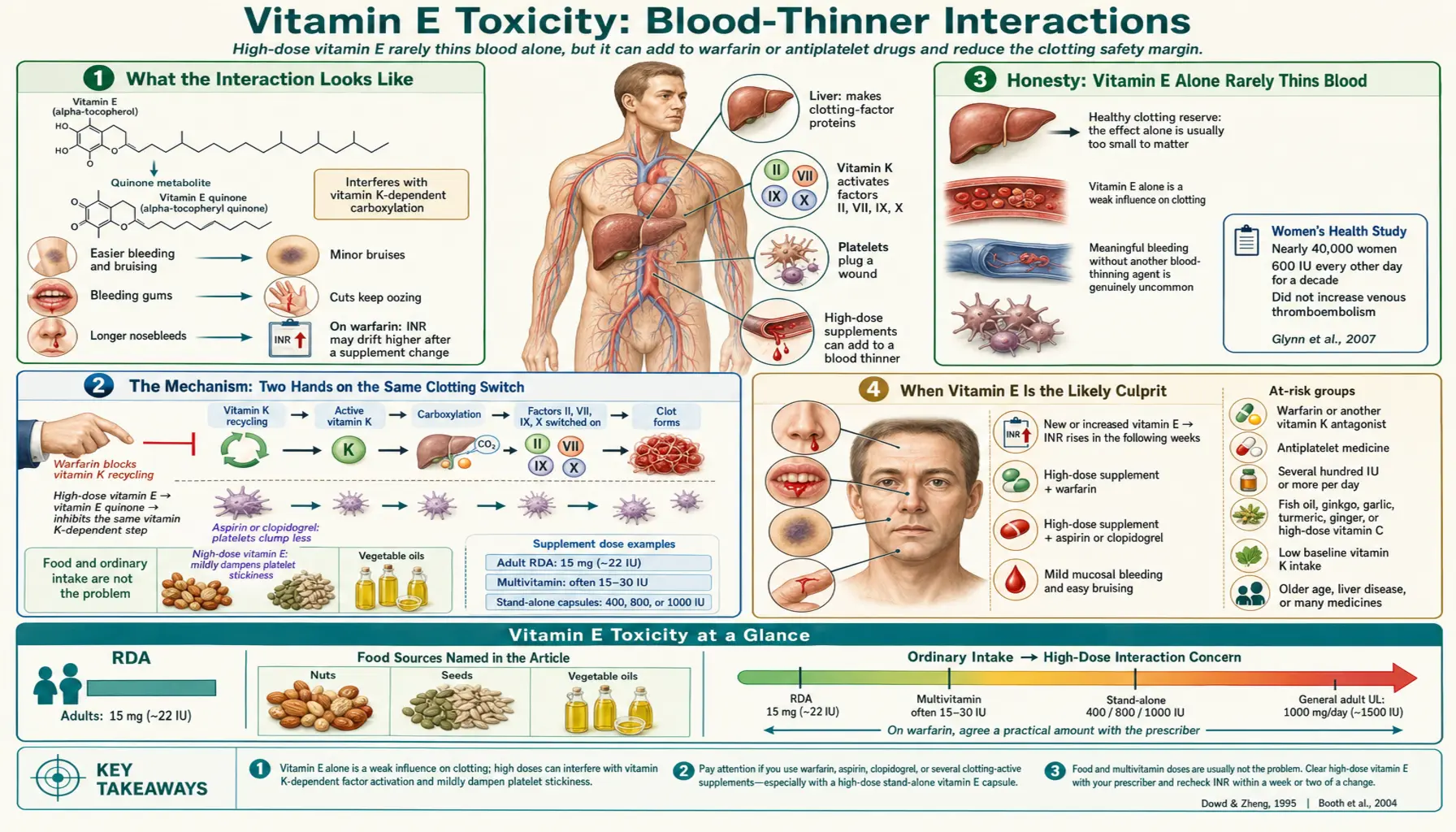
High-dose vitamin E and the blood thinner warfarin push on the same lever from different sides — and that overlap is the single most important reason to be careful with vitamin E supplements if you take a blood thinner. By itself, vitamin E rarely causes a problem; the body keeps it under loose control, and even large doses seldom thin the blood in a healthy person. But layered on top of warfarin or an antiplatelet drug such as aspirin or clopidogrel, a big vitamin E supplement can nudge an already-thinned system toward bleeding. The honest framing matters here: this is not really “vitamin E toxicity” in the way that, say, too much vitamin A is toxic. It is an interaction — a small effect that only becomes meaningful because the medication has already removed the body's safety margin. This page explains exactly how that interaction works, who actually needs to worry, and the simple steps that keep it from ever becoming a bleed.
Table of Contents
- What the Interaction Looks Like
- The Mechanism: Two Hands on the Same Clotting Switch
- Honesty: Vitamin E Alone Rarely Thins Blood
- When Vitamin E Is the Likely Culprit
- What Makes the Interaction More Likely
- Dose: Where the Risk Actually Lives
- Getting Checked: The INR and Coagulation Tests
- Managing It: Stopping, Adjusting, and Monitoring
- When to Seek Care / Red Flags
- Key Research Papers
- Connections
- Featured Videos
What the Interaction Looks Like
An interaction is not a feeling, so there is nothing to “notice” in the moment you swallow a vitamin E capsule alongside your warfarin. What you would notice, if the interaction tipped over into a real effect, is the same thing any over-thinned blood produces: easier bleeding and bruising. The classic early signs are gums that bleed when you brush, nosebleeds that take longer to stop, bruises that appear from minor knocks you do not remember, and small cuts that keep oozing. In someone on warfarin, the more telling clue is often a lab number rather than a symptom — the INR (the blood test that measures how thinned warfarin has made you) drifts higher than usual even though nothing about the warfarin dose has changed.
It is worth being precise about what this page covers and what it does not. The bleeding and bruising themselves — how they look and what to do — are covered on the sibling page Vitamin E and Bleeding & Bruising, and the most feared version, bleeding into the brain, is covered on Vitamin E and Hemorrhagic Stroke Risk. This page is specifically about the interaction with blood-thinning medication: why combining the two raises the stakes, who is actually at risk, and how it is managed. The single sentence to carry away: vitamin E does not usually thin the blood on its own, but on top of a blood thinner it can shift an already-narrow margin in the wrong direction.
The Mechanism: Two Hands on the Same Clotting Switch
To see why the combination matters, it helps to know what each side does to the clotting system. Blood clotting depends on a series of proteins called clotting factors, and several of the most important ones — factors II (prothrombin), VII, IX, and X — can only do their job after they have been chemically “finished” by a reaction that requires vitamin K. Think of vitamin K as the tool that switches these factors on. Without it, the liver still makes the factor proteins, but they come off the line non-functional, like a tool that was never sharpened.
Warfarin works by blocking vitamin K. Specifically, it stops the enzyme that recycles vitamin K back into its active form, so the supply of usable vitamin K dwindles and fewer clotting factors get switched on. That is the entire point of the drug: by partially disabling vitamin K, warfarin keeps the blood from clotting too readily in people at risk of stroke or dangerous clots. The trade-off is that there is now far less spare clotting capacity, so anything that pushes a little further toward bleeding has an outsized effect (Ansell et al., 2008; Holbrook et al., 2005).
Here is where vitamin E comes in. When vitamin E is taken in large amounts, some of it is metabolized into a compound called vitamin E quinone (alpha-tocopheryl quinone). In laboratory work, this metabolite turns out to interfere with the same vitamin K–dependent step that warfarin targets — it inhibits the carboxylation reaction that switches the clotting factors on (Dowd & Zheng, 1995). In other words, high-dose vitamin E nudges the system in the same direction as warfarin: a little less working vitamin K, a few more under-finished clotting factors. Supporting this, a controlled study found that vitamin E supplementation measurably lowered markers of vitamin K–dependent clotting-factor activity even in people not on any blood thinner (Booth et al., 2004) — the effect is real, just usually too small to matter on its own.
An analogy. Picture vitamin K as the only key that unlocks your clotting factors, and warfarin as a thief who has already pocketed most of the keys. You can still open a few locks, just slowly — that controlled slowness is what keeps a warfarin patient safe. Now high-dose vitamin E quietly slips a couple more keys off the ring. On a full key ring (no warfarin) you would never notice the missing keys. But when the ring is already nearly empty, losing even two more can mean a lock that should have opened — a clot that should have formed to seal a small bleed — never gets opened at all. Same lever, two hands, and the second hand only matters because the first one has already done most of the pulling.
Antiplatelet drugs — aspirin, clopidogrel, and similar agents — work by a different route: they stop platelets, the tiny cell fragments that plug a wound, from clumping together. High-dose vitamin E has a mild, separate effect of its own here, dampening platelet stickiness somewhat. So when vitamin E is combined with an antiplatelet drug, the overlap is on the platelet side rather than the vitamin K side — but the theme is identical: two influences pushing the same direction, with the medication having already used up the safety margin.
Honesty: Vitamin E Alone Rarely Thins Blood
It would be easy to read the section above and conclude that vitamin E is dangerous. It is not, for most people. This is the part the alarming headlines usually skip, and it is the most reassuring thing on the page.
In healthy adults not taking a blood thinner, even fairly large vitamin E supplements rarely cause meaningful bleeding. The body holds vitamin E under loose homeostatic control, and the amount of clotting suppression a supplement produces on its own is normally far too small to overcome a person's ample reserve of clotting capacity. The large randomized trials make this clear: in the Women's Health Study, where nearly 40,000 women took 600 IU of vitamin E every other day for a decade, vitamin E did not increase — and if anything slightly reduced — the rate of dangerous clots in the veins (venous thromboembolism) (Glynn et al., 2007). A bleeding catastrophe from vitamin E alone, in a person on no other blood-thinning agent, is genuinely uncommon.
It is also worth keeping the famous vitamin E controversies in perspective. High-dose vitamin E has been linked in pooled analyses to a small increase in overall mortality (Miller et al., 2005) and to a shift in stroke type — slightly fewer clot-type strokes but slightly more bleeding-type strokes (Schürks et al., 2010, discussed on the hemorrhagic stroke page). And the big cardiovascular-prevention trials found vitamin E simply did not help (Lee et al., 2005; Eidelman et al., 2004). Those are good reasons not to take high-dose vitamin E expecting a benefit. But none of them describes a person bleeding because they took vitamin E by itself at ordinary doses; they describe small statistical signals across huge populations.
So the honest bottom line is two-sided. Vitamin E alone is a weak influence on clotting and rarely a problem on its own — and that same weak influence becomes worth respecting the moment it is stacked on top of a drug whose entire job is to remove your clotting safety margin. Both halves of that sentence are true at once, and holding them together is the whole point of this page.
When Vitamin E Is the Likely Culprit
Easy bleeding has many causes, so vitamin E is rarely the first suspect. A few patterns, though, point toward the supplement-plus-medication combination specifically:
- You started or increased vitamin E, and your INR climbed. If you take warfarin, the most reliable clue is an INR that drifts upward in the weeks after you began a vitamin E supplement (or raised the dose) with no change to your warfarin, your diet, or other medicines. A timeline that lines up — new supplement, then rising INR — is the strongest single clue.
- You take a blood thinner and a high-dose supplement. The risk concentrates in people combining an anticoagulant (warfarin) or antiplatelet drug (aspirin, clopidogrel) with vitamin E doses well above the everyday range — typically several hundred IU or more per day.
- You are also taking other supplements that nudge clotting. Vitamin E is frequently sold and taken alongside fish oil, ginkgo, garlic, or high-dose vitamin C. Each has a mild effect of its own, and the combination — the so-called “four Gs and the omega-3s” problem — can add up on top of a blood thinner even when no single one would matter alone.
- The bleeding is mild and mucosal rather than dramatic. A vitamin E–related shift usually shows up as gums, nose, and easy bruising — the gentle, oozy bleeding of mild over-thinning — rather than a sudden major hemorrhage out of nowhere, which points to other causes.
Conversely, several things make vitamin E an unlikely explanation and should redirect attention elsewhere: bleeding in someone on no blood thinner who takes only a modest vitamin E dose; bleeding that began long before any supplement was started; or bleeding accompanied by other findings (weight loss, fevers, a very low platelet count) that suggest a different underlying problem. Honesty cuts both ways — just as vitamin E can be overlooked, it can also be wrongly blamed.
What Makes the Interaction More Likely
The interaction is not all-or-nothing; several factors raise or lower the odds that adding vitamin E will actually move the needle. Recognizing them is most of the battle, because nearly all are within a person's control.
- Taking warfarin or another vitamin K antagonist. This is the central one. Because warfarin already works by suppressing vitamin K, any further nudge to the same pathway lands on an unprotected system. Warfarin also has a notoriously narrow therapeutic window — the gap between “thinned enough to prevent clots” and “thinned too far” is small — so even a modest extra push can carry the INR out of range (Ansell et al., 2008).
- Taking an antiplatelet drug. Aspirin, clopidogrel, prasugrel, ticagrelor, and similar agents are blood thinners of a different kind, and vitamin E's mild platelet effect overlaps with them. Many people on these drugs do not think of themselves as being “on a blood thinner,” which makes the overlap easy to miss.
- High supplement doses. The interaction scales with dose. A small amount of vitamin E in a multivitamin is a non-issue; the concern is the dedicated high-potency capsule (often 400–1000 IU). See the dedicated dose section below.
- Stacking other clotting-active supplements. Fish oil, ginkgo, garlic, turmeric/curcumin, ginger, and high-dose vitamin C each lean the same way. Several mild effects layered together on top of a blood thinner can matter even though none would alone.
- A low baseline vitamin K intake. Vitamin E's effect runs through vitamin K, so someone already eating very few leafy greens has less reserve to absorb the extra suppression. (This cuts both ways for warfarin patients, whose vitamin K intake is supposed to be kept steady, not minimized.)
- Older age, liver disease, and many medications. Older adults, people with reduced liver function, and anyone on a long medication list are more sensitive to anything that shifts clotting, because their baseline reserves and drug-handling are already stretched.
Dose: Where the Risk Actually Lives
Almost everything about this interaction comes down to how much vitamin E, so it is worth being concrete. Vitamin E is measured in milligrams (mg) of alpha-tocopherol or, on older labels, in International Units (IU); roughly, 1 mg of natural vitamin E equals about 1.5 IU.
- The daily requirement (RDA) is small: 15 mg (about 22 IU) for adults. This is easily met from food — nuts, seeds, and vegetable oils — and a person eating normally needs no supplement at all. At this level there is no interaction to speak of.
- A typical multivitamin contains a modest amount (often 15–30 IU). This is not the source of the problem and does not need to be avoided by people on blood thinners.
- Stand-alone vitamin E supplements are the concern. These commonly contain 400, 800, or even 1000 IU per capsule — many times the daily requirement. It is these high-potency products, taken on top of a blood thinner, where the interaction becomes clinically meaningful.
- The tolerable upper limit (UL) is 1000 mg/day (about 1500 IU) of supplemental vitamin E for adults, set largely because of the bleeding-tendency risk. The UL is the ceiling for the general population; for someone on warfarin, the practical safe amount is far lower and should be agreed with the prescriber rather than assumed.
The take-home is simple. Food vitamin E and the small dose in a multivitamin are not what causes trouble. The interaction lives in the high-dose stand-alone capsule — and the higher the dose, the more it matters when a blood thinner has already removed the safety margin.
Getting Checked: The INR and Coagulation Tests
The reassuring practical fact is that this interaction is easy to monitor, because the same blood test that guides warfarin therapy also catches the interaction.
For anyone on warfarin, the key test is the INR (International Normalized Ratio), part of a coagulation panel that also reports the prothrombin time (PT) and aPTT. The INR measures how long blood takes to clot compared with normal: a higher number means thinner blood. Most people on warfarin are targeted to an INR of about 2.0–3.0. If vitamin E (or a stack of clotting-active supplements) is pushing the system further toward bleeding, the INR rises — often the first objective sign, appearing before any bleeding does. That is exactly why warfarin patients have their INR checked regularly, and why any new supplement is a reason to check it sooner rather than waiting for the next routine draw.
A subtlety worth knowing: the INR is excellent for warfarin but does not reflect the effect of antiplatelet drugs like aspirin or clopidogrel, whose action on platelets the INR cannot see. For those, there is no simple everyday blood test; monitoring relies on watching for bleeding symptoms and reviewing the medication and supplement list. A basic blood count (a complete blood count) is sometimes used to confirm the platelet count is normal and to gauge blood loss if bleeding has occurred, but it does not measure the thinning effect itself.
The single most useful “test” of all, though, is the medication-and-supplement review. Because the interaction is so dose- and combination-dependent, simply telling your doctor and pharmacist everything you take — including supplements you may not think of as drugs — lets the risk be managed before any test is even needed.
Managing It: Stopping, Adjusting, and Monitoring
Managing this interaction is refreshingly straightforward, because the offending agent is a supplement you choose to take, not a disease. The steps run from prevention to correction.
- Decide whether you need vitamin E at all. This is the first and often the only step. Because high-dose vitamin E has not been shown to prevent heart disease, cancer, or stroke (Lee et al., 2005; Eidelman et al., 2004), and is linked to small harms at high doses, most people on a blood thinner have little reason to take a high-potency vitamin E capsule in the first place. Stopping it removes the interaction entirely.
- If you take a blood thinner, clear any vitamin E supplement with your prescriber. Do not start, stop, or change a high-dose supplement on your own while on warfarin. The goal is consistency: an abrupt change in either direction can move the INR. If you and your doctor decide a supplement is worthwhile, keep the dose and timing steady so the warfarin dose can be matched to it.
- Re-check the INR around any change. If a vitamin E supplement is started or stopped, the INR should be checked within a week or two so the warfarin dose can be adjusted if needed. This is the same monitoring that warfarin already requires — it simply gets done a little sooner.
- Mind the whole stack, not just vitamin E. Review fish oil, ginkgo, garlic, turmeric, ginger, and high-dose vitamin C at the same time. The safest approach for a warfarin patient is to keep both supplements and vitamin K–rich foods steady rather than swinging from one extreme to another.
- If bleeding has already occurred, get medical help to correct it. Mild over-thinning is usually managed by holding the next warfarin dose and rechecking the INR. More significant bleeding, or a dangerously high INR, is corrected with vitamin K (which directly reverses warfarin's effect) and, in an emergency, with clotting-factor products — all under medical supervision (Ansell et al., 2008). This is also a reason never to take large vitamin K doses on your own to “counteract” a thinner: doing so can throw the warfarin out of range in the opposite direction.
For most people the entire management plan is a single sentence: if you are on a blood thinner, talk to your doctor before taking high-dose vitamin E, and if you are not on one, an ordinary diet or a multivitamin already gives you all the vitamin E you need.
When to Seek Care / Red Flags
Most of the time this interaction is a quiet shift in a lab number, caught and corrected long before any harm. But certain signs mean the blood has been thinned too far and you should seek care right away — by emergency services for the severe ones, not a routine appointment:
- Signs of bleeding in the brain — a sudden severe headache unlike any before, sudden confusion, weakness or numbness on one side, trouble speaking, or loss of vision. This is a medical emergency; call emergency services immediately. (See Vitamin E and Hemorrhagic Stroke Risk and Stroke.)
- Bleeding that will not stop — a nosebleed lasting more than 15–20 minutes, a cut that keeps bleeding despite firm pressure, or bleeding gums that do not settle.
- Blood where it should not be — vomit that looks like coffee grounds or contains blood, black tarry stools or visible blood in the stool, or pink/red urine. These can signal internal bleeding and need urgent assessment.
- Coughing or vomiting blood, or a sudden large bruise — especially a rapidly spreading bruise or swelling after a minor injury.
- Feeling faint, unusually short of breath, or very pale and tired — which can mean enough blood has been lost to matter, even without obvious external bleeding.
And one lower-urgency but important flag: if you are on warfarin and your INR comes back higher than your target after starting any supplement, contact your anticoagulation clinic promptly even if you feel completely well — that is precisely the moment to act, before a bleed ever happens. The whole strategy with blood thinners is to catch the drift on paper rather than in the emergency room.
Key Research Papers
- Booth SL, Golly I, Sacheck JM, et al. (2004). Effect of vitamin E supplementation on vitamin K status in adults with normal coagulation status. American Journal of Clinical Nutrition;80(1):143-148. — DOI: 10.1093/ajcn/80.1.143
- Dowd P, Zheng ZB (1995). On the mechanism of the anticlotting action of vitamin E quinone. Proceedings of the National Academy of Sciences;92(18):8171-8175. — DOI: 10.1073/pnas.92.18.8171
- Holbrook AM, Pereira JA, Labiris R, et al. (2005). Systematic Overview of Warfarin and Its Drug and Food Interactions. Archives of Internal Medicine;165(10):1095-1106. — DOI: 10.1001/archinte.165.10.1095
- Ansell J, Hirsh J, Hylek E, et al. (2008). Pharmacology and Management of the Vitamin K Antagonists. Chest;133(6 Suppl):160S-198S. — DOI: 10.1378/chest.08-0670
- Glynn RJ, Ridker PM, Goldhaber SZ, et al. (2007). Effects of Random Allocation to Vitamin E Supplementation on the Occurrence of Venous Thromboembolism. Circulation;116(13):1497-1503. — DOI: 10.1161/CIRCULATIONAHA.107.716407
- Schürks M, Glynn RJ, Rist PM, et al. (2010). Effects of vitamin E on stroke subtypes: meta-analysis of randomised controlled trials. BMJ;341:c5702. — DOI: 10.1136/bmj.c5702
- Lee IM, Cook NR, Gaziano JM, et al. (2005). Effects of Long-term Vitamin E Supplementation on Cardiovascular Events and Cancer: The Women's Health Study. JAMA;294(1):56-65. — DOI: 10.1001/jama.293.11.1338
- Miller ER, Pastor-Barriuso R, Dalal D, et al. (2005). Meta-Analysis: High-Dosage Vitamin E Supplementation May Increase All-Cause Mortality. Annals of Internal Medicine;142(1):37-46. — DOI: 10.7326/0003-4819-142-1-200501040-00110
- Eidelman RS, Hollar D, Hebert PR, et al. (2004). Randomized Trials of Vitamin E in the Treatment and Prevention of Cardiovascular Disease. Archives of Internal Medicine;164(14):1552-1556. — DOI: 10.1001/archinte.164.14.1552
- Traber MG, Atkinson J (2007). Vitamin E, antioxidant and nothing more. Free Radical Biology and Medicine;43(1):4-15. — DOI: 10.1016/j.freeradbiomed.2007.03.024
- Shearer MJ, Newman P (2009). Roles for Vitamin K Beyond Coagulation. Annual Review of Nutrition;29:89-110. — DOI: 10.1146/annurev-nutr-080508-141217
- Corrigan JJ, Marcus FI (1974). Coagulopathy associated with vitamin E ingestion. JAMA;230(9):1300-1301. — PubMed
PubMed Topic Searches
- PubMed — Vitamin E, warfarin, and the INR
- PubMed — Vitamin E, vitamin K, and clotting-factor carboxylation
- PubMed — Vitamin E and platelet aggregation
- PubMed — Supplements, bleeding risk, and anticoagulants
- PubMed — Vitamin E supplementation and bleeding adverse effects
Connections
- All Vitamins
- Vitamin E Toxicity Hub
- Vitamin E and Bleeding & Bruising
- Vitamin E and Hemorrhagic Stroke Risk
- Vitamin E Deficiency Hub
- Vitamin E Overview
- Vitamin E and Heart Health
- Vitamin K
- Vitamin K2
- Coagulation Panel (PT, INR, aPTT)
- Complete Blood Count
- Stroke
- Atrial Fibrillation
- Deep Vein Thrombosis
- Hematology
- Foods