Former and Deprecated Vitamins: The Complete Reference
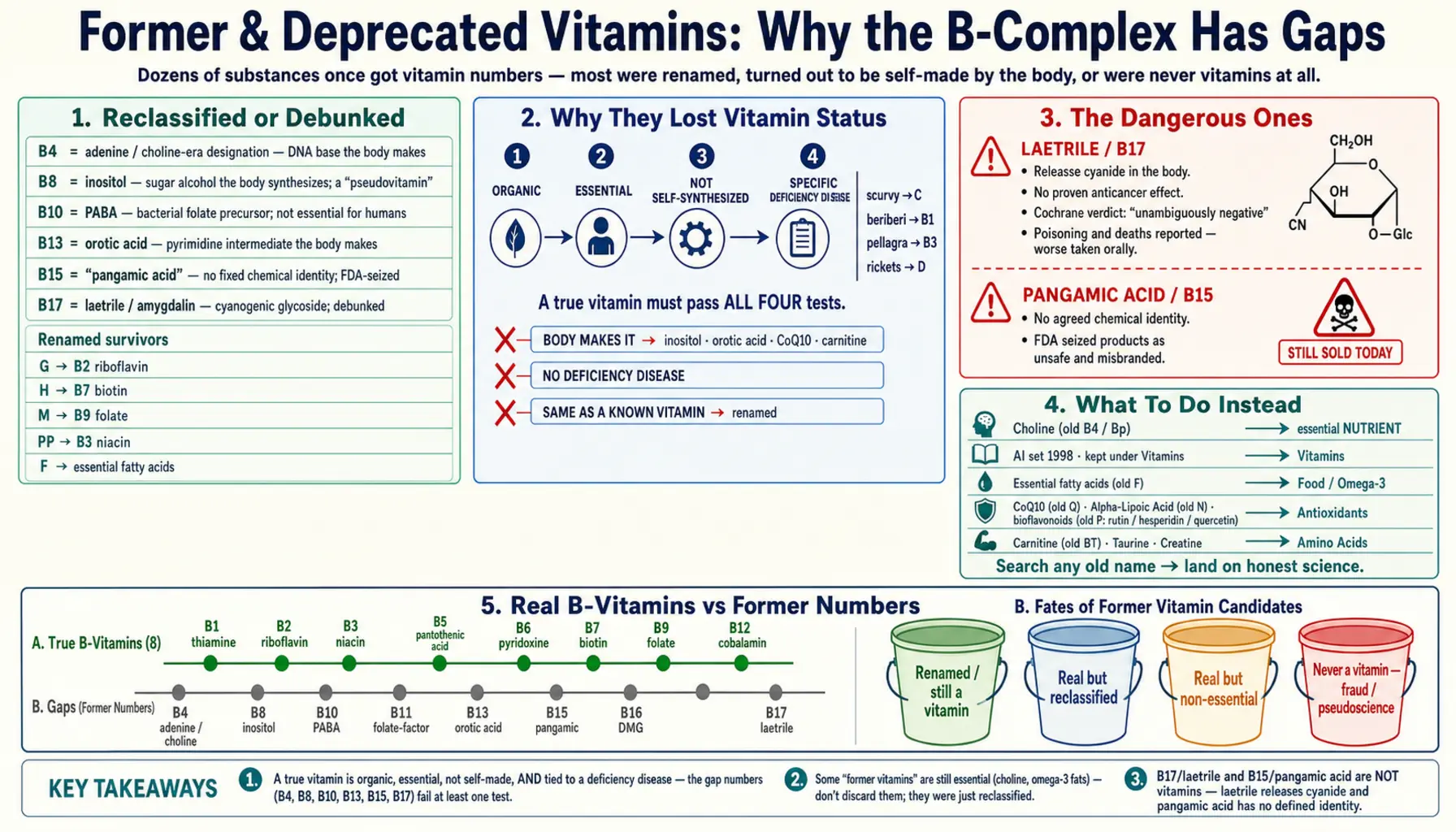
Over the last century, dozens of substances were given vitamin names — numbers like B4, B8, B13, B15 and B17, and letters from F to U. Most of them are no longer considered vitamins. Some were simply renamed; some turned out to be substances the body makes for itself; and a few were never vitamins at all, just marketing. This page is a complete, plain-English map of every retired vitamin designation, what the substance actually is, and where to find honest information about it on this site.
Table of Contents
- What Actually Counts as a Vitamin
- Why a Substance Gets De-Listed
- The Four Fates of a Former Vitamin
- Deprecated B-Number Designations
- Deprecated Letter Vitamins
- Choline, Inositol, and the "B4 vs B8" Mix-Up
- Still Essential — Just Not Called "Vitamins"
- The "Vitamins" That Never Were
- How We Organize These on This Site
- References
- Connections
- Featured Videos
1. What Actually Counts as a Vitamin
A vitamin is an organic compound that meets four conditions at once. It must be (1) organic (carbon-based, which separates vitamins from minerals like iron or zinc); (2) essential, meaning the body needs it for normal function; (3) something the body cannot make in adequate amounts on its own, so it has to come from the diet; and (4) linked to a specific deficiency disease that appears when it is missing and resolves when it is restored — scurvy for vitamin C, beriberi for thiamine, pellagra for niacin, rickets for vitamin D.
That fourth test is the strict one. When scientists in the early twentieth century found a new "accessory food factor," they often handed it a vitamin letter or B-number before its chemistry and biology were fully understood. As the science matured, many of those candidates failed one of the four tests — usually the "essential and cannot be self-synthesized" pair — and quietly lost their vitamin status. The names, however, lived on in old textbooks, supplement labels, and folk wisdom, which is why a question like "what is vitamin B17?" still comes up today.
2. Why a Substance Gets De-Listed
There is no single committee that "cancels" a vitamin. Reclassification happens for a few recurring reasons:
- The body turns out to make it. Inositol and orotic acid are real, useful molecules, but humans synthesize them, so they are not dietary essentials. A nutrient you can manufacture for yourself is, by definition, not a vitamin.
- It was the same thing as a known vitamin. "Vitamin G" was riboflavin (B2); "vitamin H" was biotin (B7); "vitamin M" and "vitamin Bc" were folate (B9); "vitamin PP" was niacin (B3). These were renamed, not removed — they are still vitamins under their modern names.
- It belonged to a different nutrient class. "Vitamin F" is the essential fatty acids; they are genuinely essential, but they are fats, not vitamins.
- It never had a real identity or effect. "Pangamic acid" (B15) had no consistent chemical definition; "vitamin O" was a stabilized-oxygen marketing fraud.
- It was actively harmful or discredited. "Laetrile" (B17) was promoted as a cancer cure but releases cyanide and has no proven benefit.
3. The Four Fates of a Former Vitamin
Almost every retired vitamin name lands in one of four buckets. Keeping these straight prevents two opposite mistakes — dismissing a genuinely essential nutrient because its "vitamin" status was revoked, and trusting a discredited product because it still wears a vitamin label.
- Renamed, still a vitamin. Same molecule, modern name. Examples: G → B2, H → B7, M → B9, PP → B3.
- Real, essential, but reclassified. Still important for health, just not categorized as a vitamin. Examples: choline (an essential nutrient), the essential fatty acids ("vitamin F").
- Real compound, not essential for humans. Exists and may have uses, but you do not need it in the diet because your body makes it or does not require it. Examples: inositol, PABA, orotic acid, ubiquinone (CoQ10), carnitine, alpha-lipoic acid, the bioflavonoids.
- Never a vitamin — pseudoscience or fraud. No defined identity, no proven benefit, sometimes dangerous. Examples: pangamic acid ("B15"), laetrile/amygdalin ("B17"), "vitamin O".
4. Deprecated B-Number Designations
The B-complex was originally thought to be a single substance ("vitamin B") before it was separated into the eight true B vitamins we recognize today (B1, B2, B3, B5, B6, B7, B9, B12). The gaps and high numbers below are the candidates that were proposed for membership and then dropped. The eight survivors keep their own pages under Vitamins.
| Old designation | Substance it referred to | Modern status | On this site |
|---|---|---|---|
| Vitamin B4 | Adenine (also choline or carnitine in some old systems) | Adenine is a DNA/RNA base the body makes; not a vitamin | Choline · Carnitine |
| Vitamin B8 | Inositol (also adenosine monophosphate) | Sugar alcohol the body synthesizes; a "pseudovitamin" | Inositol |
| Vitamin B10 | PABA (para-aminobenzoic acid); also called Bx, H1 | Bacterial folate precursor; not essential for humans | PABA |
| Vitamin B11 | PHGA / "chick growth factor" (a folate-related factor) | Folded into the folate story; not a separate vitamin | Vitamin B9 (Folate) |
| Vitamin B13 | Orotic acid | Pyrimidine intermediate the body makes; used as a mineral carrier | Orotic Acid |
| Vitamin B14 | An ill-defined urinary cell-proliferation factor | Never validated as a vitamin | — |
| Vitamin B15 | "Pangamic acid" | No fixed chemical identity; FDA-seized; not a vitamin | Pangamic Acid |
| Vitamin B16 | Dimethylglycine (DMG) | Body makes it from choline/betaine; not essential | discussed under B15 |
| Vitamin B17 | Amygdalin / laetrile | Cyanogenic glycoside; not a vitamin; debunked & dangerous | Laetrile |
| Vitamin Bp | Choline | Essential nutrient, but classified as a nutrient, not a vitamin | Choline |
| Vitamin BT | Carnitine | Conditionally essential; body makes it from lysine & methionine | Carnitine |
| Vitamin Bm / Bx | Myo-inositol (Bm) and PABA (Bx) | Alternate names for B8 and B10 above | Inositol · PABA |
Several other fragments — Bv, Bw, and various single-study "factors" — appear in old literature without any consistent definition and are omitted here rather than reported as if they were real.
5. Deprecated Letter Vitamins
Before the alphabet was tidied up, vitamins were named roughly in order of discovery (A, B, C, D…). Several later letters were assigned to factors that were eventually merged into other vitamins, reclassified, or discarded.
| Old designation | Substance it referred to | Modern status | On this site |
|---|---|---|---|
| Vitamin F | Essential fatty acids (linoleic & alpha-linolenic acid) | Genuinely essential, but they are fats, not vitamins | Omega-3 Fatty Acids |
| Vitamin G | Riboflavin | Renamed — still a vitamin | Vitamin B2 |
| Vitamin H | Biotin | Renamed — still a vitamin | Vitamin B7 |
| Vitamin J | Choline / catechol ("antipneumonia factor") | Reassigned; choline is an essential nutrient | Choline |
| Vitamin L | Anthranilic acid & related "lactation factors" (L1, L2) | Never validated as vitamins | — |
| Vitamin M | Folate ("M" for monkey; also called Bc) | Renamed — still a vitamin | Vitamin B9 |
| Vitamin N | A postulated factor; later applied to lipoic acid | Reassigned; lipoic acid is a non-essential antioxidant | Alpha-Lipoic Acid |
| Vitamin O | Marketed "stabilized oxygen"; historically also carnitine | Not a vitamin; the "oxygen" product was a fraud | Carnitine |
| Vitamin P | Bioflavonoids (rutin, hesperidin, quercetin); the "permeability factor" | Not a vitamin; beneficial plant polyphenols | Rutin · Hesperidin · Quercetin |
| Vitamin PP | Niacin / nicotinic acid (the "pellagra-preventive factor") | Renamed — still a vitamin | Vitamin B3 |
| Vitamin Q | Ubiquinone (Coenzyme Q10) | Not a vitamin; the body synthesizes it | CoQ10 |
| Vitamin S, T, U, W… | Various "streptogenin", "Goetsch's", cabbage-juice (S-methylmethionine) and other factors | Mostly ill-defined; none are recognized vitamins today | — |
6. Choline, Inositol, and the "B4 vs B8" Mix-Up
This pair causes more confusion than any other, so it is worth stating precisely. Choline was the substance most often tagged vitamin B4 (and, in some systems, "vitamin Bp" or "vitamin J"). Inositol was the one designated vitamin B8. So the common belief that "choline used to be vitamin B8" swaps the two — choline's old number was B4; B8 belonged to inositol.
Both share the same modern fate: they are real, useful molecules that the body can synthesize, so neither meets the strict definition of a vitamin. Choline is now officially recognized as an essential nutrient (the U.S. set an Adequate Intake for it in 1998) but is not classed as a vitamin; inositol is treated as a conditionally beneficial pseudovitamin. You will find both fully covered here, with their historical vitamin numbers stated up front in each page's history section: Choline and Inositol (Vitamin B8). Note that this site also keeps a dedicated Vitamin B4 page that tells the choline / B4 story from the historical-designation angle.
7. Still Essential — Just Not Called "Vitamins"
The most important thing this page can do is keep you from throwing out a genuinely valuable nutrient because its vitamin title was revoked. Two stand out:
- Choline (old vitamin B4 / Bp). Essential for the brain chemical acetylcholine, for cell membranes (as phosphatidylcholine), for liver fat metabolism, and for healthy pregnancy. It lost vitamin status only because the liver can make small amounts — not enough for most people, which is why diet still matters. See Choline.
- Essential fatty acids (old vitamin F). Omega-3 and omega-6 fats are true dietary essentials; a deficiency causes real disease. They are simply categorized as fats rather than vitamins. See Omega-3 Fatty Acids.
Several "fate 3" compounds — CoQ10, carnitine, alpha-lipoic acid, and the bioflavonoids — are not essential but are still studied and supplemented for real reasons. We cover them in the section of the site where they truly belong rather than mislabeling them as vitamins.
8. The "Vitamins" That Never Were
Two former vitamin names deserve an explicit warning because products are still sold under them:
- Pangamic acid ("vitamin B15"). There is no agreed chemical definition of pangamic acid; products sold under the name have contained completely different substances. The U.S. Food and Drug Administration concluded it is not a recognized nutrient and seized products as unsafe and misbranded. See Pangamic Acid.
- Laetrile / amygdalin ("vitamin B17"). Promoted as a natural cancer cure, it is not a vitamin and has no proven anticancer effect. It releases cyanide in the body and has caused poisoning and death, especially when taken by mouth. Controlled trials and a Cochrane systematic review found the risk–benefit balance "unambiguously negative." See Laetrile.
Keeping honest, well-sourced pages for these terms matters: people search for "vitamin B17" hoping for a miracle, and they deserve to land on the evidence rather than a sales pitch.
9. How We Organize These on This Site
Because a "vitamin-related" substance can be many things, we file each one where it scientifically belongs and cross-link generously:
- Former vitamins with no better home — PABA, orotic acid, pangamic acid, laetrile, choline, inositol — live here under Vitamins, each clearly labeled with its retired designation.
- Amino-acid–derived compounds — carnitine, taurine, creatine — live under Amino Acids.
- Antioxidant cofactors and polyphenols — CoQ10, alpha-lipoic acid, PQQ, the flavonoids — live under Antioxidants.
- Essential fats live under Food.
This page is the index that ties the whole web together, so no matter which old name you search for, you can find the substance and the honest science behind it.
References
- Semba RD. The Discovery of the Vitamins. International Journal for Vitamin and Nutrition Research, 2012;82(5):310–315.
- Carpenter KJ. A Short History of Nutritional Science: Part 1 (1785–1885). The Journal of Nutrition, 2003;133(3):638–645.
- Rusznyák S, Szent-Györgyi A. Vitamin P: Flavonols as Vitamins. Nature, 1936;138:27.
- Herbert V. Pangamic acid ("vitamin B15"). The American Journal of Clinical Nutrition, 1979;32(7):1534–1540.
- U.S. Food and Drug Administration. CPG Sec. 457.100 — Pangamic Acid and Pangamic Acid Products Unsafe for Food and Drug Use. FDA Compliance Policy Guide.
- National Cancer Institute. Laetrile/Amygdalin (PDQ®) — Health Professional Version. cancer.gov.
- Further reading on each substance and its citations: see the individual pages linked in the tables above.
Connections
- All Vitamins
- Former vitamins on this site: PABA (B10), Orotic Acid (B13), Pangamic Acid (B15), Laetrile (B17)
- Choline (former vitamin B4 / Bp)
- Inositol (former vitamin B8)
- Vitamin B4 (the choline / B4 story)
- Vitamin B9 (Folate — old vitamin M / B11)
- Vitamin B2 (Riboflavin — old vitamin G)
- Vitamin B3 (Niacin — old vitamin PP)
- Vitamin B7 (Biotin — old vitamin H)
- Carnitine (old vitamin BT)
- CoQ10 (old vitamin Q)
- Alpha-Lipoic Acid (old vitamin N)
- Omega-3 Fatty Acids (old vitamin F)