Vitamin K2 Food Sources and MK-4 vs MK-7
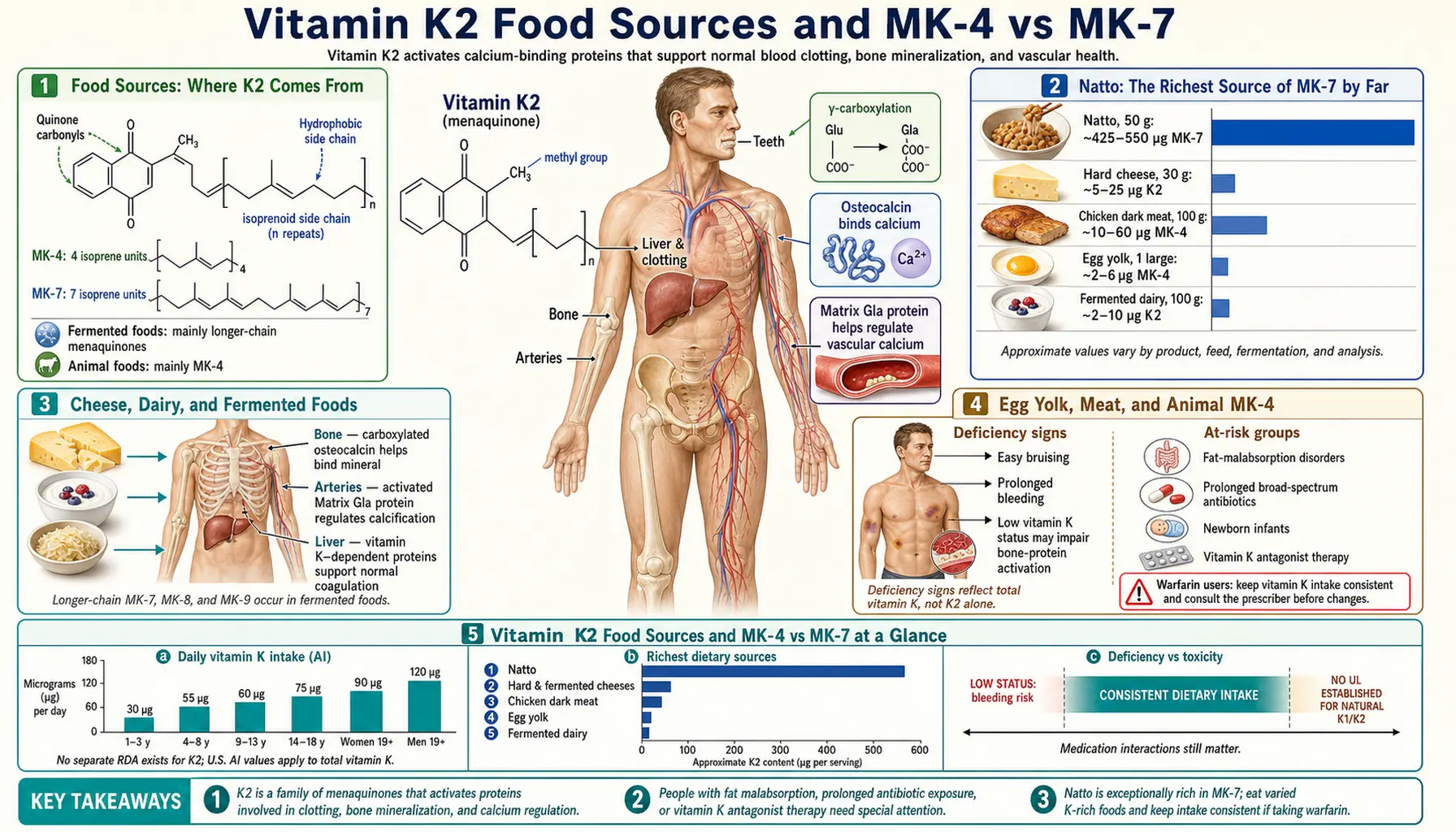
Vitamin K2 (the menaquinones) comes mainly from animal and fermented foods. Natto, the sticky fermented soybean dish, is the richest measured food source of the long-chain menaquinone MK-7, at 939 mcg per 100 g in one Japanese analysis. Full-fat cheeses carry mostly the longer menaquinones MK-9 to MK-11, and egg yolk, meat and dairy carry MK-4. This page sets out what food analyses have measured, how MK-4 and MK-7 differ in half-life and absorption, the doses the trials used, and what the research reports about the interaction with warfarin and other vitamin-K-antagonist anticoagulants, which work by limiting vitamin K.
Table of Contents
- Food Sources: Where K2 Comes From
- Natto: The Richest Measured Source of MK-7
- Cheese, Dairy, and Fermented Foods
- Egg Yolk, Meat, and Animal MK-4
- MK-4 vs MK-7: Two Very Different Molecules
- Pharmacokinetics: Half-Life and Absorption
- Doses Used in the Research
- Warfarin and Vitamin K Antagonists
- Sources and Forms: A Summary of the Findings
- Key Research Papers
- External Resources
- Connections
- Featured Videos
Food Sources: Where K2 Comes From
Unlike vitamin K1, which is abundant in green plants, vitamin K2 is found mainly in animal products and bacterially fermented foods (Schurgers & Vermeer 2000 list K2 in meat, liver, butter, egg yolk, natto, cheese and curd cheese). The menaquinones in food fall into two practical groups: short-chain MK-4, the only menaquinone not made by bacteria, which occurs in animal tissues (animals make it from the menadione in feed and from other dietary forms of vitamin K), and the longer-chain menaquinones (MK-7 and up), which are produced by bacteria during fermentation. Measured amounts from published food analyses:
- Natto — 939 mcg MK-7 per 100 g (Kamao 2007, Japan). MK-7 was found characteristically in fermented soybean products such as natto.
- Full-fat cheeses — total vitamin K of 506 mcg per 100 g in soft cheese, 440 in blue, 289 in semi-soft and 282 in hard cheese, mainly as MK-9, MK-10 and MK-11, with little MK-5 to MK-7 in most dairy products (Fu 2017, US dairy). Non-fermented processed cheese had 98 mcg per 100 g.
- Full-fat milk and dairy — full-fat (4%) milk had 38.1 mcg total vitamin K per 100 g; reduced-fat and fat-free products had about 5–22% of the vitamin K of their full-fat equivalents (Fu 2017).
- Eggs — MK-4 made up 91–98% of the vitamin K in raw whole eggs, and raising the vitamin K3 (menadione) in hen feed raised the eggs' MK-4 content (O'Sullivan 2020).
- Meat, poultry and butter — contain MK-4; a US analysis of meat, dairy, eggs and fast foods found that no single item in these categories was a rich source of any one form of vitamin K, though they may matter because they are eaten in large quantities (Elder 2006).
Outside Japan, where natto is rarely eaten, dietary K2 comes mostly from cheese, egg yolk, and meat — the profile seen in the European cohort studies discussed on the heart page, where cheese was a major dietary K2 contributor.
Natto: The Richest Measured Source of MK-7
Natto is fermented soybeans, traditionally made by fermenting cooked soybeans with the bacterium Bacillus subtilis var. natto, which produces MK-7. In a Japanese food analysis natto contained 939 mcg MK-7 per 100 g, and MK-7 from pulses (including fermented soybean foods) was one of the major contributors to vitamin K intake in young women in eastern Japan, supplying 24.9% of their total vitamin K (Kamao 2007). In a feeding study in six healthy men, circulating K2 concentrations after a natto meal were about 10 times higher than K1 concentrations after a spinach meal (Schurgers & Vermeer 2000).
Kaneki and colleagues (2001) measured serum MK-7 of 5.26 ng/mL in postmenopausal women in Tokyo, where natto is eaten frequently, 1.22 in Hiroshima, where it is seldom eaten, and 0.37 in British women. Frequent natto eaters had significantly higher serum MK-7, and across Japan's prefectures hip-fracture incidence in women was inversely correlated with natto consumption. The authors suggest that higher MK-7 from natto may contribute to a lower fracture risk; this is an ecological correlation, not proof that natto prevents fractures. Natto has a sticky, stringy texture and a strong aroma, and it is a soy food, which matters for people with soy allergy. See Natto.
Cheese, Dairy, and Fermented Foods
In Western diets fermented dairy is the main other source of menaquinones. A US analysis found appreciable menaquinones in full-fat dairy, mainly as MK-9, MK-10 and MK-11, with modest amounts of MK-4, MK-8 and MK-12 and little MK-5 to MK-7 in most products. Fermented cheeses carried the most (282–506 mcg total vitamin K per 100 g by cheese type), non-fermented processed cheese much less (98 mcg), and the vitamin K content of dairy foods was proportional to their fat content (Fu 2017).
Other traditionally fermented foods can contribute variable amounts depending on the microbes involved. In the same analysis, reduced-fat and fat-free dairy products contained about 5–22% of the vitamin K of their full-fat equivalents. For related foods, see Eggs, Milk, and Yogurt.
Egg Yolk, Meat, and Animal MK-4
MK-4 is the only menaquinone not produced by bacteria. Animals and humans make it in their tissues, from the synthetic menadione (vitamin K3) used in animal feed and from other dietary forms of vitamin K, including K1. That is why MK-4 appears in animal foods: egg yolk, meat, poultry and dairy. Feed matters: in a hen-feeding trial, MK-4 made up 91–98% of the vitamin K in eggs, and more vitamin K3 in the feed raised the eggs' MK-4 content (O'Sullivan 2020).
The amounts are modest: a US analysis of 128 meat, 24 dairy-and-egg and 169 fast-food samples found that no single item was a rich source of any one form of vitamin K, though these foods may matter because they are eaten in large quantities (Elder 2006). And in a bioavailability study in healthy Japanese women, a single 420 mcg dose of MK-4 was not detectable in serum at any time point, leading the authors to conclude that “MK-4 present in food does not contribute to the vitamin K status as measured by serum vitamin K levels” (Sato 2012). See Organ Meats, Beef, and Pork.
MK-4 vs MK-7: Two Very Different Molecules
MK-4 and MK-7 are both vitamin K2, but the research describes them as behaving very differently. The differences reported:
- Chain length and origin. MK-4 has a short 4-unit side chain and comes from animal tissue and body synthesis; MK-7 has a long 7-unit chain and comes from bacterial fermentation (natto).
- Half-life. Knapen and colleagues (2007) describe a circulating half-life of about 1–2 hours for MK-4 and about 3 days for MK-7. Schurgers 2007 found that MK-7's very long half-life gave “much more stable serum levels” than vitamin K1 and accumulation to 7- to 8-fold higher levels during prolonged intake.
- Trial doses. The MK-7 bone-loss and arterial-stiffness trials used 180 mcg once a day (Knapen 2013, 2015). The MK-4 bone trials used 45 mg a day, given as three 15 mg doses (Shiraki 2000; Knapen 2007); Knapen and colleagues note that MK-4's short half-life results in fluctuating serum levels, which may explain the requirement for a high dose.
- Absorption at food doses. Sato and colleagues (2012) gave healthy Japanese women a single 420 mcg dose of either form with breakfast: MK-7 reached its maximal serum level at 6 hours and was detected up to 48 hours later, while MK-4 was not detectable in serum at any time point. Taken at 60 mcg a day for 7 days, MK-4 did not raise serum MK-4, while MK-7 raised serum MK-7 significantly in all subjects.
The trials cited on this page did not compare the two forms head to head on bone or vascular outcomes. At nutritional doses, the absorption data favour MK-7; the bone data for MK-4 come from the 45 mg pharmacologic dose, which Japan uses as a prescription osteoporosis drug (menatetrenone). The 2019 updated meta-analysis of vitamin K and fractures, and the later questions about some of the Japanese evidence, are covered on the MK-7 vs MK-4 page.
Pharmacokinetics: Half-Life and Absorption
Schurgers and colleagues (2007) compared synthetic vitamin K1 with natto-derived MK-7 in healthy volunteers. Both were absorbed well, with peak serum concentrations 4 hours after intake. The major difference was MK-7's very long half-life, which produced much more stable serum levels and accumulation to 7- to 8-fold higher levels during prolonged intake, and MK-7 induced more complete carboxylation of osteocalcin (the bone protein). MK-4 was not part of that study; its short half-life is described by Knapen 2007.
The same paper draws the safety consequence: the authors write that “preparations supplying 50 mug/d or more of MK-7 may interfere with oral anticoagulant treatment in a clinically relevant way.” Vitamin K is fat-soluble, and the absorption studies above gave their doses with a meal (Sato 2012: a standardized breakfast); in Schurgers & Vermeer 2000, pure K1 was absorbed faster than food-bound vitamin K (serum peaks at 4 vs 6 hours).
Doses Used in the Research
- Adequate Intake (total vitamin K): the U.S. Adequate Intake for vitamin K is 120 mcg/day for adult men and 90 mcg/day for adult women. The Food and Nutrition Board based it on phylloquinone (K1) intakes in healthy people and did not consider menaquinone intakes (Linus Pauling Institute). There is no separate official requirement for K2.
- MK-7 in trials: 180 mcg once a day for 3 years in the bone-loss and arterial-stiffness trials in healthy postmenopausal women (Knapen 2013, 2015). Trials at other doses are listed on the MK-7 vs MK-4 page.
- MK-4 in trials: 45 mg/day (15 mg three times daily) in the Japanese and Dutch bone trials (Shiraki 2000; Knapen 2007); in Japan this is a prescription osteoporosis drug regimen (menatetrenone).
- Upper limit: no tolerable upper intake level has been established for vitamin K, and no toxicity is known from high doses of K1 or K2; synthetic menadione (K3) is different — given by injection it caused liver toxicity, jaundice and hemolytic anemia in infants, and it is no longer used to treat vitamin K deficiency (Linus Pauling Institute). For people on vitamin K antagonists, the limiting issue in the research is the interaction, not toxicity.
- With food: vitamin K is fat-soluble; the absorption studies cited here gave doses with a meal.
Warfarin and Vitamin K Antagonists
The interaction with vitamin K antagonist anticoagulants is the main safety finding in the vitamin K2 research.
Warfarin and the other vitamin-K-antagonist anticoagulants — acenocoumarol, phenprocoumon — work by limiting vitamin K. They block the enzyme (VKORC1) that recycles vitamin K, which reduces the carboxylation of clotting factors. Added vitamin K — K1 or K2, from a supplement or a large dietary change — opposes the drug: the INR falls and anticoagulation weakens. Fluctuations in INR are often ascribed to changes in dietary vitamin K intake (Schurgers & Vermeer 2000), and the Linus Pauling Institute reports that experts now advise a reasonably constant dietary vitamin K intake for patients taking vitamin K antagonists.
The research on MK-7 specifically:
- Schurgers 2007: the authors concluded that preparations supplying 50 mcg/day or more of MK-7 “may interfere with oral anticoagulant treatment in a clinically relevant way.”
- Theuwissen 2013: 18 healthy volunteers were anticoagulated with acenocoumarol (15 reached a target INR of 2.0). 45 mcg/day of MK-7 lowered the group mean INR by about 40%, and 10 and 20 mcg/day were judged by two hematologists to cause a clinically relevant INR lowering in at least 40% and 60% of subjects. The authors concluded that “the use of MK-7 supplements needs to be avoided in patients receiving VKA therapy.”
- Long half-life: because MK-7 persists in the blood for days (Knapen 2007; Schurgers 2007), its effect on a vitamin K antagonist is not short-lived.
- Direct oral anticoagulants (apixaban, rivaroxaban, dabigatran, edoxaban) inhibit factor Xa or thrombin directly rather than acting on the vitamin K cycle; the interaction studies above tested vitamin K antagonists only.
Decisions about vitamin K supplements, especially alongside anticoagulants, belong with a clinician.
Sources and Forms: A Summary of the Findings
- Whole-food sources. Natto is the richest measured whole-food source of MK-7 (Kamao 2007); full-fat fermented cheeses carry mostly MK-9 to MK-11 (Fu 2017); egg yolk, meat and dairy carry MK-4 (Elder 2006), alongside K1 from green vegetables.
- MK-7 at nutritional doses was absorbed and accumulated in the pharmacokinetic studies (Schurgers 2007; Sato 2012), and the bone-loss and arterial-stiffness trials used 180 mcg/day (Knapen 2013, 2015).
- MK-4 at nutritional doses was not detectable in serum in Sato 2012; its bone trials used the 45 mg/day pharmacologic dose (Shiraki 2000; Knapen 2007).
- Absorption: vitamin K is fat-soluble, and the absorption studies gave their doses with a meal.
- Vitamin K antagonists: MK-7 lowered the INR at doses as low as 10–45 mcg/day in volunteers taking acenocoumarol (Theuwissen 2013) — see the section above.
- Vitamin D, calcium and magnesium work alongside vitamin K in bone and arterial calcium handling; see the calcium-paradox page.
Key Research Papers
- Schurgers LJ et al. (2007). Vitamin K-containing dietary supplements: comparison of synthetic vitamin K1 and natto-derived menaquinone-7. Blood — PubMed PMID: 17158229
- Sato T et al. (2012). Comparison of menaquinone-4 and menaquinone-7 bioavailability in healthy women. Nutrition Journal — PubMed PMID: 23140417
- Kaneki M et al. (2001). Japanese fermented soybean food (natto) as the major determinant of the large geographic difference in circulating vitamin K2. Nutrition — PubMed PMID: 11369171
- Knapen MHJ et al. (2015). Menaquinone-7 supplementation improves arterial stiffness in healthy postmenopausal women. Thromb Haemost — PubMed PMID: 25694037
- Knapen MHJ et al. (2013). Three-year low-dose menaquinone-7 supplementation helps decrease bone loss in healthy postmenopausal women. Osteoporos Int — PubMed PMID: 23525894
- Shiraki M et al. (2000). Vitamin K2 (menatetrenone) effectively prevents fractures and sustains lumbar bone mineral density in osteoporosis. J Bone Miner Res — PubMed PMID: 10750566
- Iwamoto J, Takeda T, Sato Y (2006). Menatetrenone (vitamin K2) and bone quality in the treatment of postmenopausal osteoporosis. Nutrition Reviews 64(12): 509–517 [expression of concern 2020, Nutr Rev 78(7): 612] — PubMed PMID: 17274493
- Schurgers LJ et al. (2007). Regression of warfarin-induced medial elastocalcinosis by high intake of vitamin K in rats. Blood — PubMed PMID: 17138823
- Rennenberg RJMW et al. (2010). Chronic coumarin treatment is associated with increased extracoronary arterial calcification in humans. Blood — PubMed PMID: 20354170
- Schurgers LJ, Cranenburg ECM, Vermeer C (2008). Matrix Gla-protein: the calcification inhibitor in need of vitamin K. Thromb Haemost — PubMed PMID: 18841280
- Vermeer C (2012). Vitamin K: the effect on health beyond coagulation — an overview. Food & Nutrition Research — PubMed PMID: 22489224
- Knapen MHJ, Schurgers LJ, Vermeer C (2007). Vitamin K2 supplementation improves hip bone geometry and bone strength indices in postmenopausal women. Osteoporosis International 18(7): 963–972 — PubMed PMID: 17287908
- Theuwissen E, Teunissen KJ, Spronk HM, Hamulyák K, Ten Cate H, Shearer MJ, Vermeer C, Schurgers LJ (2013). Effect of low-dose supplements of menaquinone-7 (vitamin K2) on the stability of oral anticoagulant treatment: dose-response relationship in healthy volunteers. Journal of Thrombosis and Haemostasis 11(6): 1085–1092 — PubMed PMID: 23530987
- Kamao M, Suhara Y, Tsugawa N, Uwano M, Yamaguchi N, Uenishi K, Ishida H, Sasaki S, Okano T (2007). Vitamin K content of foods and dietary vitamin K intake in Japanese young women. Journal of Nutritional Science and Vitaminology 53(6): 464–470 — PubMed PMID: 18202532
- Fu X, Harshman SG, Shen X, Haytowitz DB, Karl JP, Wolfe BE, Booth SL (2017). Multiple vitamin K forms exist in dairy foods. Current Developments in Nutrition 1(6): e000638 — PubMed PMID: 29955705
- Schurgers LJ, Vermeer C (2000). Determination of phylloquinone and menaquinones in food. Effect of food matrix on circulating vitamin K concentrations. Haemostasis 30(6): 298–307 — PubMed PMID: 11356998
- Elder SJ, Haytowitz DB, Howe J, Peterson JW, Booth SL (2006). Vitamin K contents of meat, dairy, and fast food in the U.S. diet. Journal of Agricultural and Food Chemistry 54(2): 463–467 — PubMed PMID: 16417305
- O'Sullivan SM, E Ball ME, McDonald E, Hull GLJ, Danaher M, Cashman KD (2020). Biofortification of chicken eggs with vitamin K — nutritional and quality improvements. Foods 9(11): 1619 — PubMed PMID: 33172200