MK-7 vs MK-4 — Comparing the Two Principal Vitamin K2 Forms
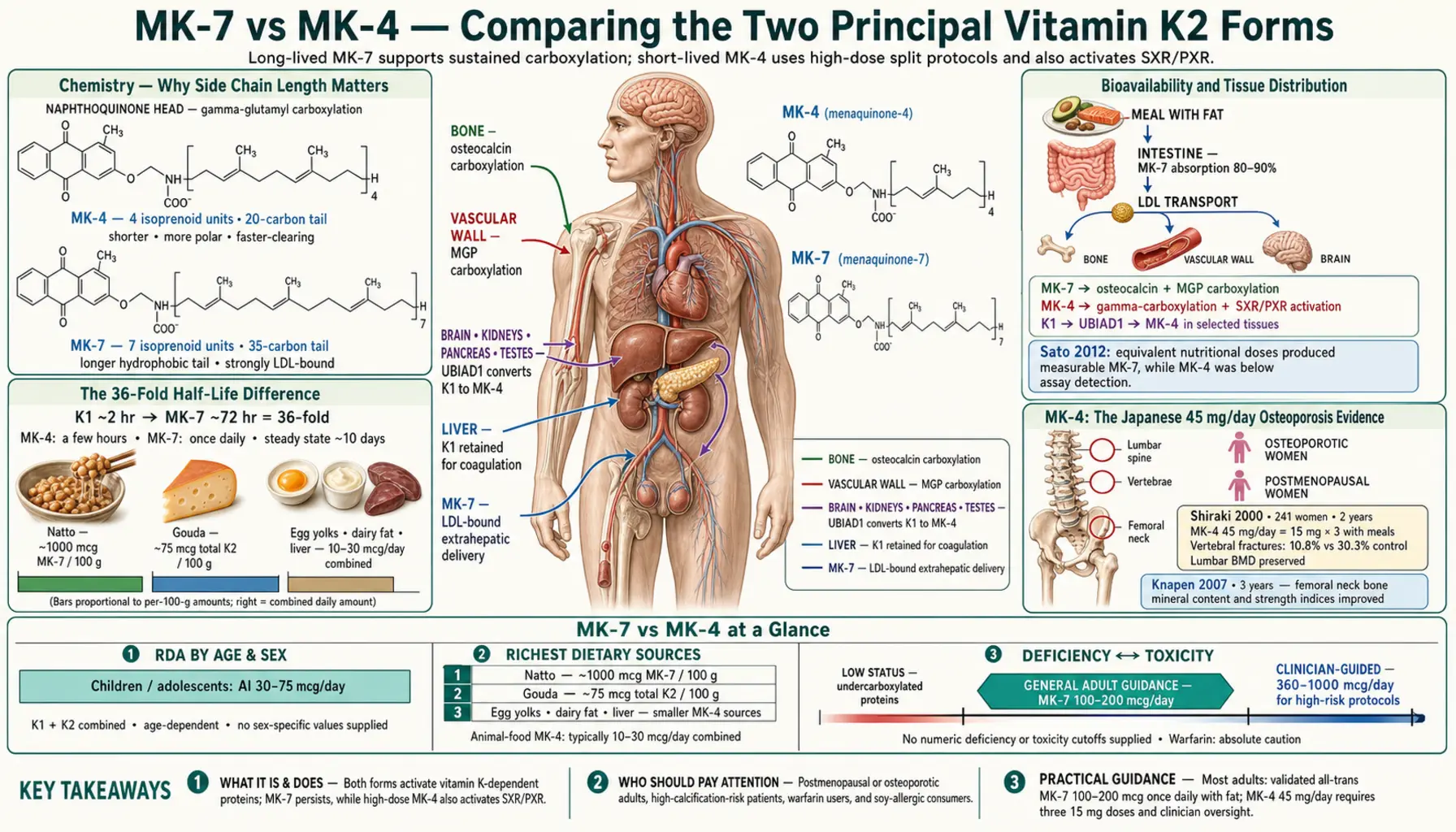
MK-7 and MK-4 are the two forms of vitamin K2 that most supplement research has tested, and their two bodies of evidence look very different. MK-7 (a long-chain menaquinone made by Bacillus subtilis var. natto during natto fermentation, with a circulating half-life its researchers describe as about 3 days, Knapen 2007) is the form used in the trials of bone loss, arterial stiffness and coronary calcification, mostly at 180–720 mcg a day. MK-4 (a short-chain menaquinone with a half-life of about 1–2 hours, found in animal foods and made in the body from vitamin K1 by the UBIAD1 enzyme) is the form prescribed in Japan as the osteoporosis drug menatetrenone, at 45 mg a day (Orimo 2012). This page sets out both bodies of evidence, including the retracted and flagged papers in the menatetrenone literature, the pharmacokinetic differences between the forms, what laboratory testing has found about cis/trans isomers in MK-7 supplements, food sources, and what the research reports about the interaction with warfarin-type anticoagulants.
Table of Contents
- Chemistry — Why Side Chain Length Matters
- The Half-Life Difference
- Bioavailability and Tissue Distribution
- MK-4: The Japanese 45 mg/day Osteoporosis Evidence
- MK-7: Bone, Arterial-Stiffness and Calcification Trials
- Mechanism Beyond Carboxylation: SXR/PXR Receptor Activation
- Cis and Trans MK-7 Isomers in Supplements
- Sources — Natto, Cheese, Egg Yolk and Supplements
- Doses Used in the Trials
- Combination MK-4 + MK-7 Products
- Interactions and Cautions in the Research
- Key Research Papers
- Connections
- Featured Videos
1. Chemistry — Why Side Chain Length Matters
The vitamin K2 menaquinones (MK-n) share the 2-methyl-1,4-naphthoquinone ring of vitamin K, with a chain of isoprene units attached to it (Sato 2012). The menaquinones differ in the length of that side chain, from four isoprenoid residues in MK-4 up to nine in MK-9, and longer ones have been described (Knapen 2007).
- MK-4 (menaquinone-4) has a side chain of 4 isoprenoid units. Its circulating half-life is about 1–2 hours (Knapen 2007).
- MK-7 (menaquinone-7) has a side chain of 7 isoprenoid units. Its half-life in the circulation is described as about 3 days (Knapen 2007), and Schurgers 2007 reported "accumulation of MK-7 to higher levels (7- to 8-fold) during prolonged intake".
- Longer menaquinones also occur in foods. Fu 2017 measured MK-4 to MK-13 in US dairy products and found mainly MK-9, MK-10 and MK-11, with little MK-5 to MK-7 or MK-13 in most products. Schurgers and Vermeer (2002) describe MK-9 as having a very long half-life in the circulation.
Vitamin K is a cofactor in the production of the blood coagulation factors in the liver, osteocalcin in bone and matrix Gla protein in cartilage and the vessel wall (Schurgers 2007). The studies below compare how long each form stays in the circulation and how it is carried to the tissues.
2. The Half-Life Difference
Plasma half-life is the main pharmacological difference between the two forms.
| Form | Half-Life | Behavior With Intake | Source |
|---|---|---|---|
| K1 (phylloquinone) | Much shorter than MK-7 | Less stable serum levels than MK-7; peak about 4 hours after intake | Schurgers 2007 |
| MK-4 | About 1–2 hours | Serum levels fluctuate even at 15 mg three times daily; not detectable in serum after a single 420 mcg dose | Knapen 2007; Sato 2012 |
| MK-7 | About 3 days | Accumulates during prolonged intake; detected up to 48 hours after a single 420 mcg dose | Knapen 2007; Schurgers 2007; Sato 2012 |
| MK-9 | Very long | Described as a more constant source of vitamin K than K1 or MK-4 | Schurgers & Vermeer 2002 |
Schurgers 2007 found that the very long half-life of MK-7 resulted in "much more stable serum levels" than vitamin K1, and that MK-7 "induced more complete carboxylation of osteocalcin". The long half-life is the main pharmacokinetic contrast with K1 and MK-4.
Knapen and colleagues attribute the MK-4 dosing schedule to its short half-life: in their trial, MK-4 "was given three times daily in a dose of 15 mg per helping", and they note that even at this regimen its short half-life "will result in fluctuating K2 serum levels, which may explain the requirement of a high dose." The MK-7 trials, by contrast, used 180–720 mcg once a day. The trials cited on this page did not compare the two forms head to head on bone or vascular outcomes.
3. Bioavailability and Tissue Distribution
- MK-7 is well absorbed. Schurgers 2007 found both K1 and MK-7 "absorbed well", with peak serum concentrations 4 hours after intake. In Sato 2012, a single 420 mcg dose of MK-7 taken with a standardized breakfast reached its maximal serum level 6 hours after intake and was detected up to 48 hours later.
- MK-4 at nutritional doses was not detected in serum. In the same Sato 2012 study of healthy Japanese women, a single 420 mcg dose of MK-4 was not detectable in the serum of any subject at any time point, and 60 mcg/day for 7 days did not raise serum MK-4, while 60 mcg/day of MK-7 raised serum MK-7 significantly in all subjects. The authors concluded that "MK-4 present in food does not contribute to the vitamin K status as measured by serum vitamin K levels." The MK-4 trials with bone outcomes used 45 mg/day.
- Lipoprotein transport differs between K1 and the menaquinones. Schurgers and Vermeer (2002) gave K1, MK-4 and MK-9 to 6 healthy men. For the first 4 hours all three were carried mainly in triacylglycerol-rich lipoproteins, which are cleared by the liver; unlike K1, both menaquinones were also found in LDL, and MK-4 was present in HDL as well. The authors suggest this explains the wider distribution of menaquinones outside the liver, where earlier work had found K1 preferentially accumulates. MK-7 itself was not tested in that study.
- MK-4 is also made in the body. Nakagawa 2010 identified UBIAD1 as a human enzyme that synthesizes MK-4 from vitamin K1 and from menadione. The paper notes that MK-4 is ubiquitous in extrahepatic tissues, with particularly high concentrations in the brain, kidney and pancreas of humans and rats, and that vitamin K1 is consistently converted to MK-4 in the body.
4. MK-4: The Japanese 45 mg/day Osteoporosis Evidence
MK-4 is prescribed in Japan as an osteoporosis drug under the name menatetrenone: the 2011 Japanese osteoporosis guidelines list it among the anti-osteoporotic prescriptions covered by Japan's public health insurance, launched in 1995, at 45 mg/day by mouth, and their summary of its fracture effect cites the 2006 Cockayne meta-analysis described below (Orimo 2012). In the Dutch trial the 45 mg daily dose was given as three 15 mg capsules spread over the day (Knapen 2007), and the OF study used 15 mg capsules (Inoue 2009). Knapen and colleagues note that at this dose "the vitamin is used as a drug rather than as a food supplement."
Shiraki 2000 trial
Shiraki and colleagues randomized 241 osteoporotic patients, in an open-label design, to menatetrenone 45 mg/day (n = 120) or no treatment (n = 121) for 24 months. Clinical fractures were more frequent in the untreated group (p = 0.0273). Lumbar BMD fell 3.3% from baseline at 24 months in the control group and 0.5% in the treated group, a significant difference; the authors note that the treated group "failed to increase in LBMD". Undercarboxylated (Glu-) osteocalcin was lower with treatment. Journal of Bone and Mineral Research 15(3): 515–521. doi:10.1359/jbmr.2000.15.3.515
Knapen 2007 (Dutch trial, same 45 mg/day dose)
Knapen et al. randomized 325 postmenopausal women to placebo or 45 mg/day MK-4 for 3 years. MK-4 did not affect DXA-BMD, but bone mineral content and femoral neck width increased relative to placebo; hip bone strength remained unchanged with MK-4, whereas it decreased significantly in the placebo group. Osteoporosis International 18(7): 963–972. doi:10.1007/s00198-007-0337-9
The OF study (Inoue 2009)
The largest menatetrenone trial, the Japanese phase IV Osteoporotic Fracture (OF) study, randomized 4,378 osteoporotic postmenopausal women aged 50 or older to calcium alone (n = 2,193) or calcium plus 15 mg menatetrenone capsules (n = 2,185), open-label with blinded evaluation. The incidence of new vertebral fractures over 36 months, the primary end point, did not differ significantly between groups. A lower risk of new vertebral fractures was seen in women with at least five vertebral fractures at baseline, and adverse events and adverse reactions were more frequent with menatetrenone. The authors concluded that menatetrenone "was not effective for preventing vertebral fractures in the full analysis set", while suggesting it may help in more advanced osteoporosis.
Meta-analyses
Cockayne and colleagues (2006) pooled 7 trials with fracture data — all of them Japanese and all using menaquinone — and reported substantially lower odds of vertebral, hip and nonvertebral fractures. In 2018 the authors and the journal published a caution to readers: 3 of the 7 articles with fracture data came from a single centre whose trial data have since been found to be problematic or retracted, and readers were asked to take into account only the article's sensitivity analysis that excluded that centre (its Figure 4), so the pooled seven-trial figures carry an expression of concern (notice PubMed PMID: 29582046). In that sensitivity analysis, the odds ratio for hip fractures from the remaining 2 studies was 0.30 and no longer statistically significant (95% CI 0.05–1.74), while the odds ratios for vertebral fractures (0.40, 95% CI 0.25–0.65) and nonvertebral fractures (0.24, 0.07–0.84) remained significant. The 2019 update by Mott and colleagues (36 studies of oral vitamin K in any form), written after the integrity of some of the earlier evidence had been questioned, found no difference in vertebral fractures (OR 0.96, 0.83–1.11) and lower odds of any clinical fracture (OR 0.72, 0.55–0.95), which moved to 0.76 (0.58–1.01) when restricted to trials at low risk of bias. Its conclusion: for postmenopausal or osteoporotic patients there is no evidence that vitamin K affects bone mineral density or vertebral fractures, and it may reduce clinical fractures but the evidence is insufficient to confirm this. Those are the 2019 figures. Following concerns raised about the integrity of the Yamaguchi Osteoporosis Prevention Study (YOPS; Avenell 2020), a 2020 correction adjusted every meta-analysis estimate that had included it (Mott 2020 correction), and the YOPS report itself was retracted in 2025 (notice PubMed PMID: 40222753). Several other vitamin K2 bone papers from one Japanese author group have also been retracted; they are listed on the bone-health page, and none of them is relied on here.
A 2013 review of the menatetrenone literature by Iwamoto and Sato (Expert Opinion on Pharmacotherapy 14(4): 449–458) was retracted in 2019 and is not relied on here. PubMed PMID: 23346882 — Retracted (retraction notice: PubMed PMID: 31437064)
5. MK-7: Bone, Arterial-Stiffness and Calcification Trials
The MK-7 trials below were run in the Netherlands, Belgium, Denmark and Japan, with bone markers, bone density or vascular imaging as their outcomes.
Knapen 2013 (3-year bone trial)
244 healthy postmenopausal women received MK-7 180 mcg/day or placebo for 3 years. MK-7 improved vitamin K status and decreased the age-related decline in bone mineral content and BMD at the lumbar spine and femoral neck, but not at the total hip. Femoral-neck bone strength was favorably affected, and MK-7 decreased the loss of vertebral height in the lower thoracic region. The authors state that whether the results extend to other groups, such as children and men, needs further investigation. Osteoporosis International 24(9): 2499–2507. doi:10.1007/s00198-013-2325-6
Knapen 2015 (arterial stiffness trial)
In the same 244 women (120 MK-7, 124 placebo), carotid-femoral pulse wave velocity and the Stiffness Index β decreased significantly after three years of MK-7 180 mcg/day; several local carotid stiffness measures improved in women whose baseline Stiffness Index β was above the median. MK-7 lowered dp-ucMGP (inactive matrix Gla protein) by 50% compared with placebo but did not change markers of inflammation or endothelial dysfunction. Thrombosis and Haemostasis 113(5): 1135–1144. doi:10.1160/TH14-08-0675
Inaba 2015 (low-dose MK-7)
Two Japanese trials. In the first, 60 postmenopausal women took 0, 50, 100 or 200 mcg MK-7 daily for 4 weeks on a controlled diet; the ratio of carboxylated to undercarboxylated osteocalcin rose dose-dependently, with significant effects in the 100 and 200 mcg groups compared with 0 mcg. In the second, 120 adults took 100 mcg MK-7 or placebo for 12 weeks, and undercarboxylated osteocalcin fell significantly. The authors suggest that intake of 100 mcg/day or more improves osteocalcin carboxylation. These trials measured a blood marker, not bone density or fractures. Journal of Nutritional Science and Vitaminology 61(6): 471–480. doi:10.3177/jnsv.61.471
Caluwe 2014 (hemodialysis dose-finding)
Hemodialysis patients have high levels of inactive MGP (dp-ucMGP). 200 chronic hemodialysis patients were randomized to 360, 720 or 1,080 mcg MK-7 three times a week for 8 weeks; dp-ucMGP fell dose-dependently, by 17, 33 and 46% in the respective groups. Drop-outs were mainly due to gastrointestinal side effects related to the unpleasant smell of the tablets. Nephrology Dialysis Transplantation 29(7): 1385–1390. doi:10.1093/ndt/gft464
Brandenburg 2017 (aortic valve calcification — vitamin K1, not MK-7)
This open-label proof-of-concept trial in patients with aortic valve calcification is often grouped with K2 research, but it tested vitamin K1 (phylloquinone) at 2 mg/day. As summarized in the 2025 design paper of the PASSPORT trial, it reported 103 µL (57%) lower progression of aortic valve calcification in 38 patients receiving vitamin K1 for 12 months than in 34 controls. The Circulation research letter itself has no abstract in PubMed. Circulation 135(21): 2081–2083. doi:10.1161/CIRCULATIONAHA.116.027011
Coronary and aortic calcification trials (AVADEC, VitaK-CAC, DANCODE)
- AVADEC (Diederichsen 2022): 365 men with aortic valve calcification above 300 Agatston units received 720 mcg MK-7 plus 25 mcg vitamin D daily or placebo for 24 months. Valve calcification rose 275 vs 292 AU, a difference that was not significant (P = 0.64), and progression of aortic and coronary calcification also did not differ significantly. In a substudy of 304 men without ischemic heart disease (Hasific 2023), coronary calcium rose 203 vs 254 AU (P = 0.089); in men with a score of 400 or more it rose 288 vs 380 AU (P = 0.047), which the authors called hypothesis-generating.
- VitaK-CAC (Vossen 2026): 180 patients with symptomatic coronary artery disease and calcium scores of 50–400 were randomized to 360 mcg/day MK-7 or placebo for 2 years in two Dutch hospitals. Median scores went from 135 to 184 AU with MK-7 and from 145 to 214 AU with placebo (P = .02); no significant adverse effects were observed. The authors write that the clinical significance for plaque stability remains to be determined.
- DANCODE (Hasific 2026): 400 people with a coronary calcium score of 400 or more were randomized (398 analysed) to 720 mcg MK-7 plus 25 mcg vitamin D3 daily or placebo for 24 months. The mean calcium score rose 196 AU with the supplement and 248 AU with placebo (between-group difference −52 AU, 95% CI −79 to −24). In 143 participants who had CT angiography, calcified plaque volume progression was attenuated (−8 mm³) without an increase in noncalcified plaque. The score still rose in both groups, and clinical events were not the end point. The trial is covered in detail in the 2026-08-28 news article.
Across these trials MK-7 was given at 180 mcg/day (bone loss, arterial stiffness), 360 mcg/day (VitaK-CAC) and 720 mcg/day together with vitamin D (AVADEC, DANCODE); the hemodialysis dose-finding study used 360–1,080 mcg three times a week. None of these MK-7 trials was designed around fractures or cardiovascular events as its primary outcome.
6. Mechanism Beyond Carboxylation: SXR/PXR Receptor Activation
Both MK-4 and MK-7 serve as cofactors for gamma-glutamyl carboxylation. Cell and animal work points to a second, carboxylation-independent action of vitamin K2 through the steroid and xenobiotic receptor (SXR; PXR in rodents), a nuclear receptor. Tabb et al. (2003, Journal of Biological Chemistry) found that vitamin K2 bound to and activated SXR and induced its target gene CYP3A4; in osteosarcoma cells it raised mRNA for the osteoblast markers bone alkaline phosphatase, osteoprotegerin, osteopontin and matrix Gla protein, and it induced bone markers in bone cells from normal mice but not from mice lacking PXR. doi:10.1074/jbc.M303136200
In a separate cell study, Yamaguchi and Weitzmann (2011) reported that vitamin K2 down-regulated NF-κB activation in osteoblast and osteoclast precursors in a carboxylation-independent manner.
These receptor findings come from cells and mice. Whether they account for the bone results of the 45 mg/day MK-4 trials, and how MK-7 compares at the receptor, was not established by the studies cited here.
7. Cis and Trans MK-7 Isomers in Supplements
MK-7 can exist as several geometric (cis/trans) isomers. A 2020 review states that "only the all-trans form sustains biological activity" (Lal & Berenjian 2020), and a 2019 review states that chemical synthesis of MK-7 "produces a significant cis-isomer form of it, which has no biological activity", while bacteria such as Bacillus strains biosynthesize trans-MK-7 (Mahdinia 2019).
Laboratory testing of supplements at Poland's National Medicines Institute found:
- In most products tested, the all-trans MK-7 content was below the declared content, ranging from 5.5 to 49 mcg per pill; one product contained none, and cis/trans isomers exceeded the all-trans content by up to 3.7 times (Szterk 2018, Food Chemistry).
- In oil capsules and hard tablets, the all-trans MK-7 content was lower than the isomeric forms and often lower than the label declared; the isomer impurities were "most likely formed during the chemical synthesis" (Szterk 2018, Molecules).
Lal and Berenjian note that the isomer profile obtained from the various production methods "has not yet been elucidated", and that production, purification and storage conditions all influence it.
8. Sources — Natto, Cheese, Egg Yolk and Supplements
- Natto: natto, soybeans fermented with Bacillus subtilis var. natto, is the richest measured food source of MK-7 — Kamao 2007 measured 939 mcg MK-7 per 100 g, and found MK-7 "characteristically in fermented soybean products such as natto". After a natto meal, circulating K2 concentrations were about 10 times higher than K1 concentrations after a spinach meal (Schurgers & Vermeer 2000). Natto is a soy food, which matters for people with soy allergy.
- Cheese: Fu 2017 measured total vitamin K of 506 mcg/100 g in soft cheese, 440 in blue cheese, 289 in semi-soft and 282 in hard cheese, mostly as MK-9, MK-10 and MK-11 rather than MK-7; non-fermented processed cheese had 98 mcg/100 g. Reduced-fat or fat-free dairy products contained about 5–22% of the vitamin K of their full-fat equivalents.
- Egg yolk, meat, liver and butter: Schurgers and Vermeer (2000) list K2 in meat, liver, butter, egg yolk, natto, cheese and curd cheese. Kamao 2007 found MK-4 widely distributed in animal products, but at lower overall amounts than K1.
- Supplements: MK-7 in supplements comes either from bacterial fermentation or from chemical synthesis (see the isomer section above). Knapen 2007 lists K1 and MK-4 as the synthetic forms available in supplements and pharmaceutical preparations.
9. Doses Used in the Trials
The doses below are those the cited trials used, reported as trial facts.
- Bone loss and arterial stiffness, healthy postmenopausal women: MK-7 180 mcg once daily for 3 years (Knapen 2013, 2015).
- Osteocalcin carboxylation: MK-7 50, 100 or 200 mcg daily for 4 weeks, and 100 mcg daily for 12 weeks (Inaba 2015).
- Coronary calcification: MK-7 360 mcg daily for 2 years (VitaK-CAC); MK-7 720 mcg plus vitamin D3 25 mcg daily for 2 years (AVADEC, DANCODE).
- Hemodialysis: MK-7 360, 720 or 1,080 mcg three times a week for 8 weeks (Caluwe 2014).
- Osteoporosis (Japanese and Dutch trials): MK-4 45 mg daily (Shiraki 2000; Knapen 2007, where it was given as three 15 mg capsules); the OF study used 15 mg capsules (Inoue 2009).
- Aortic valve calcification: vitamin K1 2 mg daily (Brandenburg 2017) — K1, not K2.
Vitamin K-Deficiency Bleeding (VKDB) in newborns
- Newborn prophylaxis is a separate question from K2 supplements. The American Academy of Pediatrics' 2003 statement describes prevention of early VKDB by oral or parenteral vitamin K as accepted practice, and states that late VKDB (onset at 2–12 weeks of age) is most effectively prevented by parenteral administration.
10. Combination MK-4 + MK-7 Products
Each trial described on this page tested one form at a time; none tested a product combining MK-4 and MK-7, so these studies give no direct evidence on combinations.
11. Interactions and Cautions in the Research
- Warfarin and other vitamin K antagonists. Schurgers 2007 concluded that "preparations supplying 50 mug/d or more of MK-7 may interfere with oral anticoagulant treatment in a clinically relevant way." In Theuwissen 2013, 18 healthy volunteers were put on the vitamin K antagonist acenocoumarol (15 reached an INR of 2.0); 45 mcg/day of MK-7 lowered mean INR by about 40%, and 10 and 20 mcg/day produced clinically relevant INR lowering in at least 40% and 60% of participants. The authors concluded that "the use of MK-7 supplements needs to be avoided in patients receiving VKA therapy." Those studies measured MK-7.
- High-dose MK-4 in pregnancy: the 45 mg/day MK-4 trials enrolled postmenopausal or osteoporotic patients; none of the studies cited here reports safety data for that dose in pregnancy.
- Adverse events with MK-4: in the OF study, adverse events and adverse reactions were more frequent with calcium plus menatetrenone than with calcium alone (Inoue 2009).
- Tolerability of MK-7 tablets: in the hemodialysis dose-finding study, drop-outs were mainly due to gastrointestinal side effects related to the tablets' unpleasant smell (Caluwe 2014).
- Soy: natto and natto-derived MK-7 come from fermented soybeans, which matters for people with soy allergy.
- Label content: laboratory testing found all-trans MK-7 below the declared amount in most supplements tested (Szterk 2018).
- Children and adolescents: none of the trials above enrolled children. Theuwissen 2014 found high levels of undercarboxylated osteocalcin in children (3.4–96.9 ng/mL) compared with 1.5–5.0 ng/mL in other age groups.
Decisions about vitamin K supplements, especially alongside anticoagulants, belong with a clinician.
Key Research Papers
- Shiraki M, Shiraki Y, Aoki C, Miura M (2000). Vitamin K2 (menatetrenone) effectively prevents fractures and sustains lumbar bone mineral density in osteoporosis. Journal of Bone and Mineral Research 15(3): 515–521. — doi:10.1359/jbmr.2000.15.3.515
- Knapen MHJ, Schurgers LJ, Vermeer C (2007). Vitamin K2 supplementation improves hip bone geometry and bone strength indices in postmenopausal women. Osteoporosis International 18(7): 963–972. — doi:10.1007/s00198-007-0337-9
- Knapen MHJ, Drummen NE, Smit E, Vermeer C, Theuwissen E (2013). Three-year low-dose menaquinone-7 supplementation helps decrease bone loss in healthy postmenopausal women. Osteoporosis International 24(9): 2499–2507. — doi:10.1007/s00198-013-2325-6
- Knapen MHJ, Braam LAJLM, Drummen NE, Bekers O, Hoeks APG, Vermeer C (2015). Menaquinone-7 supplementation improves arterial stiffness in healthy postmenopausal women: a double-blind randomised clinical trial. Thrombosis and Haemostasis 113(5): 1135–1144. — doi:10.1160/TH14-08-0675
- Sato T, Schurgers LJ, Uenishi K (2012). Comparison of menaquinone-4 and menaquinone-7 bioavailability in healthy women. Nutrition Journal 11: 93. — doi:10.1186/1475-2891-11-93
- Inaba N, Sato T, Yamashita T (2015). Low-dose daily intake of vitamin K2 (menaquinone-7) improves osteocalcin gamma-carboxylation: a double-blind, randomized controlled trial. Journal of Nutritional Science and Vitaminology 61(6): 471–480. — doi:10.3177/jnsv.61.471
- Iwamoto J, Sato Y (2013). Menatetrenone for the treatment of osteoporosis. Expert Opinion on Pharmacotherapy 14(4): 449–458. — PubMed PMID: 23346882 — Retracted (retraction notice: PubMed PMID: 31437064)
- Yamaguchi M, Weitzmann MN (2011). Vitamin K2 stimulates osteoblastogenesis and suppresses osteoclastogenesis by suppressing NF-κB activation. International Journal of Molecular Medicine 27(1): 3–14. — doi:10.3892/ijmm.2010.562
- Tabb MM, Sun A, Zhou C, Grun F, Errandi J, Romero K, Pham H, Inoue S, Mallick S, Lin M, Forman BM, Blumberg B (2003). Vitamin K2 regulation of bone homeostasis is mediated by the steroid and xenobiotic receptor SXR. Journal of Biological Chemistry 278(45): 43919–43927. — doi:10.1074/jbc.M303136200
- Caluwe R, Vandecasteele S, Van Vlem B, Vermeer C, De Vriese AS (2014). Vitamin K2 supplementation in haemodialysis patients: a randomized dose-finding study. Nephrology Dialysis Transplantation 29(7): 1385–1390. — doi:10.1093/ndt/gft464
- Brandenburg VM, Reinartz S, Kaesler N, Kruger T, Dirrichs T, Kramann R, Peeters F, Floege J, Keszei A, Marx N, Schurgers LJ, Koos R (2017). Slower progress of aortic valve calcification with vitamin K supplementation: results from a prospective interventional proof-of-concept study. Circulation 135(21): 2081–2083. — doi:10.1161/CIRCULATIONAHA.116.027011
- Schurgers LJ, Teunissen KJF, Hamulyak K, Knapen MHJ, Vik H, Vermeer C (2007). Vitamin K-containing dietary supplements: comparison of synthetic vitamin K1 and natto-derived menaquinone-7. Blood 109(8): 3279–3283. — doi:10.1182/blood-2006-08-040709
- Theuwissen E, Magdeleyns EJ, Braam LAJLM, Teunissen KJ, Knapen MHJ, Binnekamp IAG, van Summeren MJH, Vermeer C (2014). Vitamin K status in healthy volunteers. Food & Function 5(2): 229–234. — doi:10.1039/c3fo60464k
- Nakagawa K, Hirota Y, Sawada N, Yuge N, Watanabe M, Uchino Y, Okuda N, Shimomura Y, Suhara Y, Okano T (2010). Identification of UBIAD1 as a novel human menaquinone-4 biosynthetic enzyme. Nature 468(7320): 117–121. — doi:10.1038/nature09464
- Cockayne S, Adamson J, Lanham-New S, Shearer MJ, Gilbody S, Torgerson DJ (2006). Vitamin K and the prevention of fractures: systematic review and meta-analysis of randomized controlled trials. Archives of Internal Medicine 166(12): 1256–1261. — PubMed PMID: 16801507 — Expression of concern (JAMA Intern Med 2018: PubMed PMID: 29582046)
- Inoue T, Fujita T, Kishimoto H, Makino T, Nakamura T, Nakamura T, Sato T, Yamazaki K (2009). Randomized controlled study on the prevention of osteoporotic fractures (OF study): a phase IV clinical study of 15-mg menatetrenone capsules. Journal of Bone and Mineral Metabolism 27(1): 66–75. — PubMed PMID: 19082528
- Mott A, Bradley T, Wright K, Cockayne ES, Shearer MJ, Adamson J, Lanham-New SA, Torgerson DJ (2019). Effect of vitamin K on bone mineral density and fractures in adults: an updated systematic review and meta-analysis of randomised controlled trials. Osteoporosis International 30(8): 1543–1559. — PubMed PMID: 31076817
- Mott A, Bradley T, Wright K, Cockayne ES, Shearer MJ, Adamson J, Lanham-New SA, Torgerson DJ (2020). Correction to: Effect of vitamin K on bone mineral density and fractures in adults: an updated systematic review and meta-analysis of randomised controlled trials. Osteoporosis International 31(11): 2269–2270. — PubMed PMID: 32965511
- Schurgers LJ, Vermeer C (2002). Differential lipoprotein transport pathways of K-vitamins in healthy subjects. Biochimica et Biophysica Acta 1570(1): 27–32. — PubMed PMID: 11960685
- Schurgers LJ, Vermeer C (2000). Determination of phylloquinone and menaquinones in food. Effect of food matrix on circulating vitamin K concentrations. Haemostasis 30(6): 298–307. — PubMed PMID: 11356998
- Kamao M, Suhara Y, Tsugawa N, Uwano M, Yamaguchi N, Uenishi K, Ishida H, Sasaki S, Okano T (2007). Vitamin K content of foods and dietary vitamin K intake in Japanese young women. Journal of Nutritional Science and Vitaminology 53(6): 464–470. — PubMed PMID: 18202532
- Fu X, Harshman SG, Shen X, Haytowitz DB, Karl JP, Wolfe BE, Booth SL (2017). Multiple vitamin K forms exist in dairy foods. Current Developments in Nutrition 1(6): e000638. — PubMed PMID: 29955705
- Szterk A, Zmysłowski A, Bus K (2018). Identification of cis/trans isomers of menaquinone-7 in food as exemplified by dietary supplements. Food Chemistry 243: 403–409. — PubMed PMID: 29146356
- Szterk A, Bus K, Zmysłowski A, Ofiara K (2018). Analysis of menaquinone-7 content and impurities in oil and non-oil dietary supplements. Molecules 23(5): 1056. — PubMed PMID: 29724016
- Lal N, Berenjian A (2020). Cis and trans isomers of the vitamin menaquinone-7: which one is biologically significant? Applied Microbiology and Biotechnology 104(7): 2765–2776. — PubMed PMID: 32009201
- Mahdinia E, Demirci A, Berenjian A (2019). Biofilm reactors as a promising method for vitamin K (menaquinone-7) production. Applied Microbiology and Biotechnology 103(14): 5583–5592. — PubMed PMID: 31152205
- Theuwissen E, Teunissen KJ, Spronk HM, Hamulyák K, Ten Cate H, Shearer MJ, Vermeer C, Schurgers LJ (2013). Effect of low-dose supplements of menaquinone-7 (vitamin K2) on the stability of oral anticoagulant treatment: dose-response relationship in healthy volunteers. Journal of Thrombosis and Haemostasis 11(6): 1085–1092. — PubMed PMID: 23530987
- Diederichsen ACP, Lindholt JS, Möller S, Øvrehus KA, Auscher S, Lambrechtsen J, Hosbond SE, Alan DH, Urbonaviciene G, Becker SW, Fredgart MH, Hasific S, Folkestad L, Gerke O, Rasmussen LM, Møller JE, Mickley H, Dahl JS (2022). Vitamin K2 and D in patients with aortic valve calcification: a randomized double-blinded clinical trial. Circulation 145(18): 1387–1397. — PubMed PMID: 35465686
- Hasific S, Oevrehus KA, Lindholt JS, Mejldal A, Dey D, Dahl JS, Frandsen NE, Auscher S, Lambrechtsen J, Hosbond S, Alan D, Urbonaviciene G, Becker S, Rasmussen LM, Diederichsen AP (2023). Effects of vitamin K2 and D supplementation on coronary artery disease in men: a RCT. JACC: Advances 2(9): 100643. — PubMed PMID: 38938724
- Vossen LM, de Leeuw PW, Schurgers LJ, Heuts S, Adriaans BP, de Haan C, van Varik BJ, Kroon AA (2026). Two years of menaquinone-7 supplementation and coronary artery calcification: a randomized clinical trial. JAMA Cardiology 11(8): 719–726. — PubMed PMID: 42268593
- Hasific S, Øvrehus KA, Mejldal A, Hosbond S, Lambrechtsen J, Kumarathurai P, Dey D, Ravn EJ, Rasmussen LM, Gerke O, Mickley H, Diederichsen A (2026). Vitamin K2 and D3 supplementation in patients with severe coronary artery calcification: the DANCODE trial. Circulation, published online 28 August 2026. — PubMed PMID: 42661461
- Courtney WA, Walker J, Dorai-Raj A, Gilbert T, Rajwani A, Bellinge JW, Hodgson JM, Hillis GS, Schultz CJ (2025). Testing if vitamin K1 reduces the progression of non-severe calcific aortic stenosis: design and rationale of the Prevention of Aortic Stenosis Progression Phylloquinone Ossification Reduction Trial (PASSPORT). European Heart Journal Open 5(6): oeaf144. — PubMed PMID: 41425110
- Ishida Y, Kawai S (2004). Comparative efficacy of hormone replacement therapy, etidronate, calcitonin, alfacalcidol, and vitamin K in postmenopausal women with osteoporosis: the Yamaguchi Osteoporosis Prevention Study. American Journal of Medicine 117(8): 549–555. — PubMed PMID: 15465502 — Retracted (retraction notice: PubMed PMID: 40222753)
- Avenell A, Grey A, Gamble GD, Bolland MJ (2020). Concerns about the integrity of the Yamaguchi Osteoporosis Prevention Study (YOPS) report, Am J Med. 2004;117:549-555. American Journal of Medicine 133(6): e311–e314. — PubMed PMID: 32532372
- Orimo H, Nakamura T, Hosoi T, Iki M, Uenishi K, Endo N, Ohta H, Shiraki M, Sugimoto T, Suzuki T, Soen S, Nishizawa Y, Hagino H, Fukunaga M, Fujiwara S (2012). Japanese 2011 guidelines for prevention and treatment of osteoporosis — executive summary. Archives of Osteoporosis 7: 3–20. — PubMed PMID: 23203733
- American Academy of Pediatrics Committee on Fetus and Newborn (2003). Controversies concerning vitamin K and the newborn. Pediatrics 112(1 Pt 1): 191–192. — PubMed PMID: 12837888
PubMed Topic Searches
Connections
- All Vitamins
- Vitamin K (Main Page)
- Vitamin K Benefits Hub
- K2 and Arterial Calcification
- K2 and Bone Health
- K2 and Insulin Sensitivity
- Vitamin K and Blood Clotting
- Vitamin D3
- Vitamin D3 and Bone Health
- Vitamin E
- Calcium
- Magnesium
- Cardiovascular Disease
- Coronary Artery Disease
- Osteoporosis
- Bisphosphonates
- Chronic Kidney Disease
- Fermented Foods
- Natto
- Bacillus Subtilis
- Deficiency
- Toxicity
- History
- Sources