Vitamin K2 for Bone Health
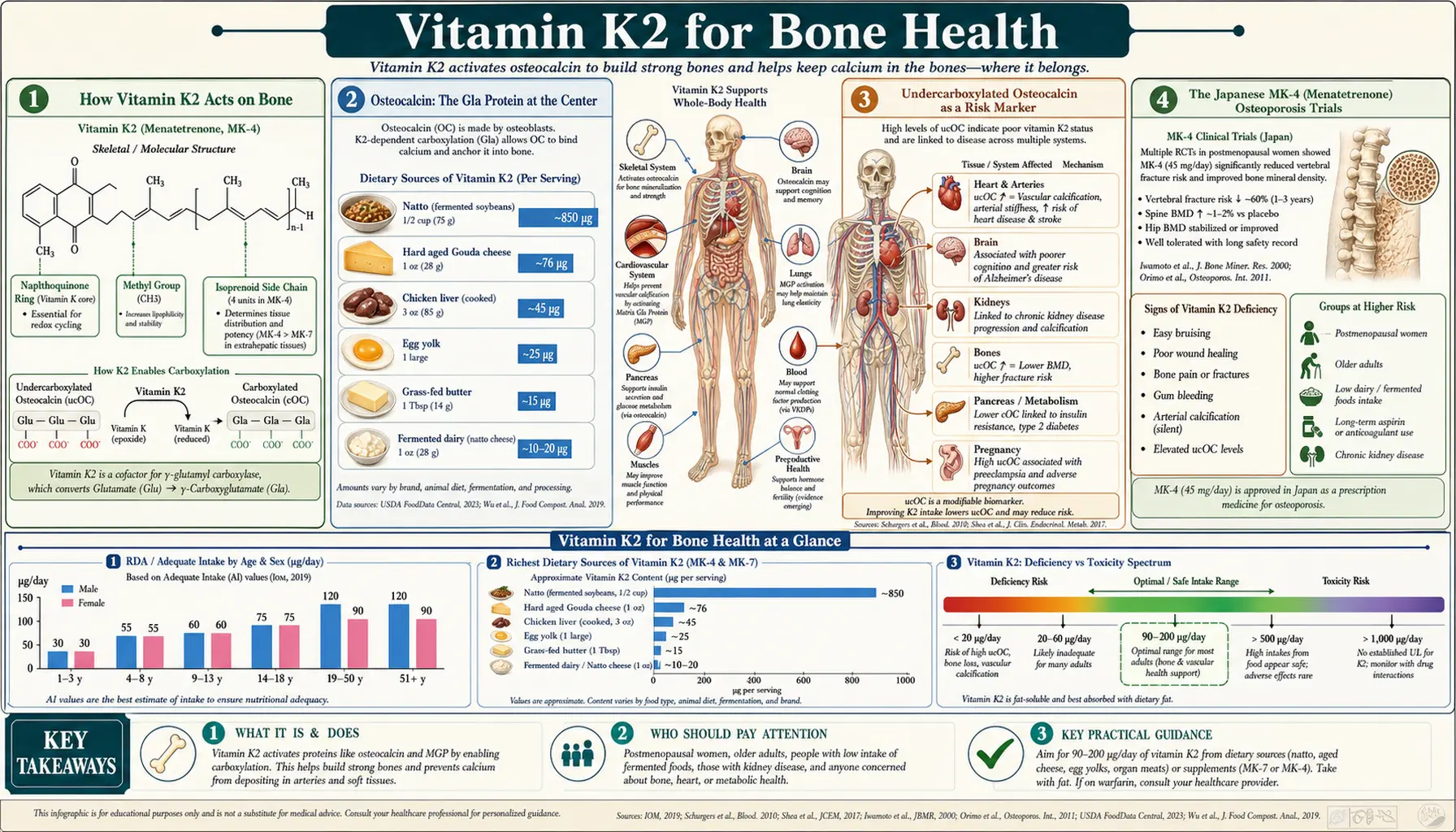
Vitamin K is the cofactor that carboxylates osteocalcin, a protein made by osteoblasts that binds calcium and hydroxyapatite in bone; the carboxylation chemistry is well described, although osteocalcin's exact function in bone has yet to be fully elucidated (Gundberg 2012). The clinical evidence is mixed. In Japan, pharmacological doses of MK-4 (menatetrenone, 45 mg a day in the trials) are used to treat osteoporosis; early Japanese trials reported fewer fractures, but the 4,378-woman OF study found no difference in new vertebral fractures on its primary endpoint (Inoue 2009), and several of the Japanese papers behind the large pooled fracture reductions have since been retracted or flagged. In Western populations, nutritional-dose MK-7 trials (180–375 mcg a day) produced one positive three-year bone-density result (Knapen 2013) and three neutral results (Emaus 2010; Rønn 2016, 2021), and a trial of high-dose K1 (ECKO) did not slow bone-density loss. The 2019 update of the main meta-analysis judged the fracture evidence insufficient to confirm a benefit (Mott 2019). This page sets out the mechanism, the Japanese data and their integrity problems, the Western data, and the negative trials side by side.
Table of Contents
- How Vitamin K2 Acts on Bone
- Osteocalcin: The Gla Protein at the Center
- Undercarboxylated Osteocalcin as a Risk Marker
- The Japanese MK-4 (Menatetrenone) Osteoporosis Trials
- The Western MK-7 Trials (Nutritional Dose)
- The Negative Trials: ECKO, Emaus and Rønn
- What the Evidence Actually Supports
- Working With Vitamin D, Calcium, and Magnesium
- Doses Used in Trials, Forms, and Food Sources
- Cautions and the Warfarin Interaction
- Key Research Papers
- External Resources
- Connections
- Featured Videos
How Vitamin K2 Acts on Bone
Bone is not a static mineral rock; it is a living tissue that is continuously torn down by osteoclasts and rebuilt by osteoblasts. When osteoblasts lay down new bone, they secrete a protein called osteocalcin (also called bone Gla protein). Osteocalcin carries three vitamin K-dependent Gla residues that are critical for its structure, which appears to regulate the maturation of bone mineral (Gundberg 2012).
But freshly made osteocalcin cannot bind calcium. It has to be chemically activated first, and that activation is a vitamin-K-dependent carboxylation. The enzyme gamma-glutamyl carboxylase, using vitamin K as an essential cofactor, converts three specific glutamate residues in osteocalcin into gamma-carboxyglutamate (Gla) residues. Each Gla residue carries an extra negative charge; together they form calcium-binding sites that let osteocalcin dock onto hydroxyapatite. Without enough vitamin K, osteocalcin is produced but remains undercarboxylated — present in the blood, but structurally unable to do its calcium-binding job in bone.
In a comparison in healthy volunteers, the long-chain menaquinone MK-7 had a much longer half-life than vitamin K1, accumulated to 7- to 8-fold higher serum levels during prolonged intake, and produced more complete carboxylation of osteocalcin (Schurgers 2007). That longer circulation is one reason K2 is discussed for bone more than K1, even though both forms can drive the same carboxylation chemistry. The distinction between the forms is covered on the K2 vs K1 page.
Osteocalcin: The Gla Protein at the Center
Osteocalcin sits at the heart of nearly every claim about K2 and bone, so it is worth understanding precisely what it does and does not do. Carboxylated osteocalcin binds calcium ions and hydroxyapatite, and its structure appears to regulate the maturation of bone mineral (Gundberg 2012) — a role that may bear on bone quality (the structural competence of bone) as well as on bone quantity (mineral density measured by DXA). In two MK-4 trials, effects on fractures or on bone-strength indices were reported without a gain in measured bone mineral density: Shiraki 2000 reported fewer clinical fractures while lumbar density in the treated group “failed to increase”, and Knapen 2007 reported higher bone mineral content and femoral-neck width with no change in DXA bone density. That pattern is consistent with, though not proof of, a bone-quality mechanism.
Animal and cell studies suggest that undercarboxylated osteocalcin may act as a hormone in glucose metabolism; a 2012 review found that the limited human data do not support this hypothesis and that osteocalcin's specific function in bone and glucose metabolism has yet to be elucidated (Gundberg 2012). That is a separate research area; for bone health, the calcium-binding, matrix-organizing role is the relevant one. The carboxylation status of osteocalcin — how much of it is fully activated — depends directly on vitamin K availability, which is why osteocalcin serves both as a mechanism and as a measurable marker of vitamin K status (Gundberg 2012).
Undercarboxylated Osteocalcin as a Risk Marker
Because undercarboxylated osteocalcin (ucOC) rises when vitamin K is insufficient, it is measured in blood as a functional marker of vitamin K status — as a percentage of total osteocalcin, because uncorrected ucOC also reflects bone-formation activity (Gundberg 2012). Prospective studies in elderly French women found that higher ucOC predicted hip fracture, first in institutionalized women (Szulc 1993) and then in the EPIDOS cohort of independently living women over 75, where the association held after adjustment for femoral-neck bone density (odds ratio 1.8; Vergnaud 1997). In a dose-finding study in adults aged 19–36, including a randomized two-week substudy of 100 people, vitamin K1 supplements lowered the percentage of ucOC dose-dependently, and the authors concluded that about 1,000 micrograms a day was required for maximal carboxylation (Binkley 2002). The marker chain therefore runs: more vitamin K → more carboxylated osteocalcin → lower ucOC.
The honest caveat is that a biomarker moving in the right direction is not the same as a fracture being prevented. ucOC responds to supplementation dependably; whether normalizing it translates into fewer real-world fractures in well-nourished people is exactly the question the clinical trials below were built to answer — and they do not all agree. A 2012 review concluded that clinical trials do not provide overall support for the suggestion that vitamin K supplementation of the general population will reduce bone loss or fracture risk (Gundberg 2012).
The Japanese MK-4 (Menatetrenone) Osteoporosis Trials
The largest reported fracture reductions for vitamin K2 come from Japan, where pharmacological doses of MK-4 (menatetrenone) are used in the treatment of osteoporosis (Linus Pauling Institute, below). The Shiraki trial below gave 45 mg per day (Shiraki 2000) — a dose measured in milligrams, whereas the MK-7 supplement trials further down used micrograms — a distinction that matters when reading the results.
The open-label randomized trial by Shiraki and colleagues (2000) assigned 241 patients with osteoporosis to 45 mg/day MK-4 or no treatment for two years. At 24 months lumbar bone mineral density had changed by −0.5% in the treated group and −3.3% in the control group, and clinical fractures were less frequent with treatment. The authors noted that the treated group “failed to increase” in lumbar density.
The largest Japanese trial came out differently. The OF study, an open-label trial with blinded evaluation, randomised 4,378 osteoporotic postmenopausal women aged 50 or over to calcium alone or calcium plus menatetrenone. The primary endpoint, new vertebral fractures over 36 months, did not differ significantly between the groups; new clinical fractures over 48 months were lower with menatetrenone, but not significantly. Women with at least five vertebral fractures at baseline had fewer new vertebral fractures with menatetrenone, and adverse events and adverse reactions were more frequent in the menatetrenone group. The authors concluded that menatetrenone “was not effective for preventing vertebral fractures in the full analysis set”, while the results suggested it may prevent them in more advanced osteoporosis (Inoue 2009).
A 2006 review by Iwamoto, Takeda and Sato stated that menatetrenone reduces the incidence of vertebral fractures with only modest effects on bone density, and described bone-quality effects in rats (Iwamoto 2006). In 2020 the journal published an expression of concern, because the review cites publications by Drs. Iwamoto and Sato that have since been retracted or are being investigated for misconduct. Several of this group's vitamin K2 bone papers have been retracted: a 2005 trial in women with Alzheimer's disease, retracted in 2018 at the corresponding author's request because it contains fabricated clinical trial data (Sato 2005); a 2011 hip-fracture trial in Alzheimer's disease, retracted for scientific misconduct (Sato 2011); and a 2004 review of vitamin K2 and osteoporosis, retracted in 2021 because its text, data and some figures came from sources retracted or under investigation for data fabrication and falsification (Iwamoto 2004).
Cockayne and colleagues (2006) pooled the 7 randomized trials that reported fracture data — all of them Japanese and all using menaquinone — and reported substantially lower odds of vertebral, hip and nonvertebral fractures. In 2018 the authors and the journal published a caution to readers: 3 of the included articles came from a single centre whose trial data have since been found to be problematic or retracted, and readers were asked to take into account only a sensitivity analysis that excluded them. Retraction Watch records the notice as an expression of concern, so the original pooled fracture figures are not repeated here. A later meta-analysis of 19 randomised trials of vitamin K2 with 6,759 postmenopausal participants found improved vertebral bone density with K2 in women with osteoporosis but not in women without it; pooling the 7 trials with fracture data showed no significant difference (RR 0.63, p = 0.08), which became significant only after removing the study causing heterogeneity (RR 0.50), and the K2 groups seemed to have a higher adverse-reaction rate (RR 1.22, p = 0.06) (Huang 2015); it was published before the 2018–2025 integrity notices. The Cockayne group's 2019 update, written after the integrity of some of the earlier evidence had been questioned, found lower odds of any clinical fracture with vitamin K (OR 0.72, 95% CI 0.55–0.95), but restricting the analysis to trials at low risk of bias gave an OR of 0.76 (0.58–1.01), and there was no difference in vertebral fractures (OR 0.96). It concluded that for postmenopausal or osteoporotic patients there is no evidence that vitamin K affects bone mineral density or vertebral fractures, and that it may reduce clinical fractures but the evidence is insufficient to confirm this (Mott 2019). A 2020 correction adjusted every estimate in that review that had included the Yamaguchi Osteoporosis Prevention Study, following published concerns about that study's integrity (Avenell 2020). The Yamaguchi study, which compared vitamin K with other osteoporosis treatments, was retracted in 2025: the journal stated that the evidence “strongly argues for scientific misconduct” (Ishida 2004). So the Japanese fracture data were obtained with a high pharmacological dose in a specific population, the largest trial was negative on its primary endpoint, and part of the evidence base has been retracted or flagged.
The Western MK-7 Trials (Nutritional Dose)
Western trials have mostly tested the long-chain menaquinone MK-7 at microgram doses; compared with vitamin K1, MK-7 has a very long half-life and produced more complete osteocalcin carboxylation (Schurgers 2007). The main positive study is the three-year randomized, placebo-controlled trial by Knapen and colleagues (2013): 244 healthy postmenopausal women took 180 mcg/day MK-7 or placebo. MK-7 improved vitamin K status and significantly decreased the age-related decline in bone mineral content and density at the lumbar spine and femoral neck, but not at the total hip; femoral-neck bone-strength indices were favourably affected, and loss of vertebral height in the lower thoracic spine was smaller. An earlier three-year trial by the same group (Knapen 2007) used the pharmacological MK-4 dose (45 mg/day) in 325 postmenopausal women: it did not change DXA bone density, but bone mineral content and femoral-neck width increased relative to placebo, and hip bone strength was maintained while it declined in the placebo group.
The authors concluded that MK-7 supplements may help postmenopausal women prevent bone loss, and that whether the results apply to other populations needs further investigation (Knapen 2013). One positive three-year trial in healthy (not osteoporotic) women, measuring bone density rather than clinical fractures, does not by itself show that K2 prevents fractures across the population — and the trials in the next section came out differently.
The Negative Trials: ECKO, Emaus and Rønn
A responsible account of K2 and bone has to include the trials that did not show benefit, because they are real and they matter.
- ECKO trial (Cheung 2008) — 440 postmenopausal women with osteopenia received 5 mg/day of vitamin K1 or placebo for 2 to 4 years. This used K1 rather than K2, but at a high dose. On the primary outcomes, vitamin K1 did not protect bone mineral density at the lumbar spine or hip over 2 years, and there were no significant differences in BMD at any site over 2 to 4 years. Fewer women in the vitamin K group had clinical fractures (9 versus 20) and cancers (3 versus 12), but these were secondary outcomes; the authors noted that the study was not powered to examine fractures or cancers and called for more studies. On its main bone-density endpoint, ECKO was negative.
- Emaus 2010 — 334 early-menopausal Norwegian women received 360 mcg/day MK-7 (as natto capsules) or placebo for one year. MK-7 lowered ucOC but did not influence bone loss rates at any measured site. This is a direct nutritional-dose MK-7 trial in a Western population that came out neutral.
- Rønn 2016 and 2021 — 148 Danish postmenopausal women with osteopenia, all also given calcium and vitamin D, took 375 mcg/day MK-7 or placebo. After 12 months there was no difference in bone density at any site, although tibial trabecular structure deteriorated in the placebo group and not with MK-7, which the authors suggested means MK-7 preserves trabecular structure at the tibia (Rønn 2016). In the 3-year report (142 women), bone density decreased at all sites with no difference between MK-7 and placebo, and bone turnover markers and microstructure changed similarly in both groups, although ucOC fell with MK-7 (Rønn 2021).
So the trials disagree: the three-year Knapen MK-7 trial was positive for bone density, the one-year Emaus and three-year Rønn MK-7 trials were neutral, and the high-dose K1 ECKO trial was negative for bone density. None of the MK-7 trials on this page reported fewer fractures.
What the Evidence Actually Supports
Putting the pieces together honestly:
- Mechanism. Vitamin K carboxylates osteocalcin, and the percentage of undercarboxylated osteocalcin is used as a biomarker of vitamin K status (Gundberg 2012); every trial on this page that measured it found ucOC fell with supplementation.
- Pharmacological MK-4 (45 mg) for osteoporosis — mostly Japanese, contested. An open-label trial reported fewer clinical fractures (Shiraki 2000); the 4,378-woman OF study was negative on its primary vertebral-fracture endpoint (Inoue 2009); several papers from one research group have been retracted, and the Yamaguchi study was retracted in 2025.
- Nutritional MK-7 for bone — unsettled. One positive 3-year density trial (Knapen 2013); three neutral trials (Emaus 2010; Rønn 2016, 2021); none reported fewer fractures.
- Meta-analyses. Restricted to low-bias trials, the clinical-fracture estimate was no longer statistically significant, and the authors judged the evidence insufficient to confirm a fracture benefit (Mott 2019).
In summary, the research supports vitamin K's role in osteocalcin carboxylation, while fracture prevention by nutritional-dose K2 has not been demonstrated; the fracture data come mainly from pharmacological-dose MK-4 trials in Japan, part of which has been retracted or flagged. The broader treatment landscape is covered on the Osteoporosis page.
Working With Vitamin D, Calcium, and Magnesium
Vitamin K2 is studied alongside other nutrients involved in bone:
- Vitamin D: the synthesis of osteocalcin by osteoblasts is regulated by the active form of vitamin D, 1,25-dihydroxyvitamin D, while its calcium-binding capacity requires vitamin K-dependent carboxylation (Linus Pauling Institute, below). In elderly institutionalized women, ucOC was negatively correlated with vitamin D status and fell during a year of calcium and vitamin D2 treatment (Szulc 1993). In a two-year randomized trial in 172 Japanese postmenopausal women with osteopenia or osteoporosis, vertebral bone density rose 4.92% with combined vitamin K2 and D3 therapy, compared with 0.135% with K2 alone (Ushiroyama 2002). See Vitamin D3 for bone health.
- Calcium is the mineral that carboxylated osteocalcin binds. In the Danish MK-7 trials, both groups also received calcium and vitamin D (Rønn 2021). See Calcium for bone health.
- Magnesium: none of the vitamin K trials on this page tested it. See Magnesium.
Trials of vitamin K have been run against a background of other nutrients; the ECKO participants, for example, were vitamin D replete at baseline (Cheung 2008). How much K2 adds depends on that background, and the trials above do not settle it.
Doses Used in Trials, Forms, and Food Sources
- MK-7 trials: the positive Knapen trial used 180 mcg/day for three years; the neutral trials used 360 mcg/day for one year (Emaus) and 375 mcg/day for up to three years (Rønn).
- MK-4 trials: the Japanese fracture trials and the Dutch MK-4 trial used 45 mg/day (Shiraki 2000; Knapen 2007); the OF study used 15-mg menatetrenone capsules (Inoue 2009).
- Food sources: menaquinones are mainly of microbial origin and are found in fermented foods such as cheese, curds and natto; natto is rich in MK-7 (998 mcg per 100 g), and MK-4 is found in dairy products and some meats (Linus Pauling Institute, below). Details are on the Sources & MK-4 vs MK-7 page.
- Populations studied: the trials above enrolled postmenopausal women (healthy, osteopenic, or osteoporotic) and, in Japan, osteoporosis patients treated with menatetrenone.
Cautions and the Warfarin Interaction
- Warfarin and other vitamin K antagonists — warfarin prevents the recycling of vitamin K by blocking the enzyme VKOR, and large quantities of dietary or supplemental vitamin K can overcome the anticoagulant effect of vitamin K antagonists; the Linus Pauling Institute notes that daily MK-7 doses as low as 10 to 20 micrograms may undermine therapeutic anticoagulant stability. A comparison of K1 and MK-7 supplements found that MK-7 accumulates in blood during daily intake, and its authors noted that preparations supplying 50 micrograms a day or more of MK-7 may interfere with oral anticoagulant treatment in a clinically relevant way (Schurgers 2007). The Linus Pauling Institute describes the newer direct inhibitors of coagulation factors as not interfering with vitamin K-dependent protein activity.
- Osteoporosis treatment — the most recent meta-analysis judged the evidence insufficient to confirm that vitamin K reduces fractures in postmenopausal or osteoporotic patients (Mott 2019).
- Tolerability — no tolerable upper intake level (UL) has been established for vitamin K (Linus Pauling Institute, below). In the trials above, 5 mg/day K1 was well tolerated over 4 years with no significant difference in adverse effects versus placebo (Cheung 2008), and no adverse reactions were observed with K2 plus D3 over 2 years (Ushiroyama 2002). In the OF study, adverse events and adverse reactions were more frequent with menatetrenone than with calcium alone (Inoue 2009).
- Pregnancy and lactation — the bone trials described on this page enrolled postmenopausal women and osteoporosis patients, so they give no information on K2 supplements in pregnancy or breastfeeding.
Key Research Papers
- Gundberg CM, Lian JB, Booth SL (2012). Vitamin K-dependent carboxylation of osteocalcin: friend or foe? Advances in Nutrition — PubMed PMID: 22516722
- Binkley NC et al. (2002). A high phylloquinone intake is required to achieve maximal osteocalcin gamma-carboxylation. Am J Clin Nutr — PubMed PMID: 12399278
- Shiraki M, Shiraki Y, Aoki C, Miura M (2000). Vitamin K2 (menatetrenone) effectively prevents fractures and sustains lumbar bone mineral density in osteoporosis. J Bone Miner Res 15(3):515–521 — PubMed PMID: 10750566
- Iwamoto J, Takeda T, Sato Y (2006). Menatetrenone (vitamin K2) and bone quality in the treatment of postmenopausal osteoporosis. Nutrition Reviews 64(12):509–517 — PubMed PMID: 17274493 — Expression of concern (Nutr Rev 2020: PubMed PMID: 32412060)
- Cockayne S et al. (2006). Vitamin K and the prevention of fractures: systematic review and meta-analysis of RCTs. Arch Intern Med — PubMed PMID: 16801507 — Expression of concern (JAMA Intern Med 2018, “Caution of Conclusions of a Meta-analysis Including Problematic Trials”: PubMed PMID: 29582046)
- Mott A, Bradley T, Wright K, Cockayne ES, Shearer MJ, Adamson J, Lanham-New SA, Torgerson DJ (2019). Effect of vitamin K on bone mineral density and fractures in adults: an updated systematic review and meta-analysis of randomised controlled trials. Osteoporosis International 30(8):1543–1559. — PubMed PMID: 31076817 — correction 2020: PubMed PMID: 32965511
- Knapen MHJ et al. (2013). Three-year low-dose menaquinone-7 supplementation helps decrease bone loss in healthy postmenopausal women. Osteoporosis International — PubMed PMID: 23525894
- Knapen MHJ et al. (2007). Vitamin K2 supplementation improves hip bone geometry and bone strength indices in postmenopausal women. Osteoporosis International — PubMed PMID: 17287908
- Cheung AM et al. (2008). Vitamin K supplementation in postmenopausal women with osteopenia (ECKO trial). PLoS Medicine — PubMed PMID: 18922041
- Emaus N et al. (2010). Vitamin K2 supplementation does not influence bone loss in early menopausal women. Osteoporosis International — PubMed PMID: 19937427
- Booth SL et al. (2000). Dietary vitamin K intakes are associated with hip fracture but not with bone mineral density. Am J Clin Nutr — PubMed PMID: 10799384
- Ushiroyama T et al. (2002). Effect of continuous combined therapy with vitamin K2 and vitamin D3 on bone mineral density. Maturitas — PubMed PMID: 11886767
- Vermeer C (2012). Vitamin K: the effect on health beyond coagulation — an overview. Food & Nutrition Research — PubMed PMID: 22489224
- Schurgers LJ, Teunissen KJ, Hamulyák K, Knapen MH, Vik H, Vermeer C (2007). Vitamin K-containing dietary supplements: comparison of synthetic vitamin K1 and natto-derived menaquinone-7. Blood 109(8):3279–3283 — PubMed PMID: 17158229
- Szulc P, Chapuy MC, Meunier PJ, Delmas PD (1993). Serum undercarboxylated osteocalcin is a marker of the risk of hip fracture in elderly women. J Clin Invest 91(4):1769–1774 — PubMed PMID: 8473517
- Vergnaud P, Garnero P, Meunier PJ, Bréart G, Kamihagi K, Delmas PD (1997). Undercarboxylated osteocalcin measured with a specific immunoassay predicts hip fracture in elderly women: the EPIDOS Study. J Clin Endocrinol Metab 82(3):719–724 — PubMed PMID: 9062471
- Inoue T, Fujita T, Kishimoto H, Makino T, Nakamura T, Nakamura T, Sato T, Yamazaki K (2009). Randomized controlled study on the prevention of osteoporotic fractures (OF study): a phase IV clinical study of 15-mg menatetrenone capsules. J Bone Miner Metab 27(1):66–75. — PubMed PMID: 19082528
- Huang ZB, Wan SL, Lu YJ, Ning L, Liu C, Fan SW (2015). Does vitamin K2 play a role in the prevention and treatment of osteoporosis for postmenopausal women: a meta-analysis of randomized controlled trials. Osteoporos Int 26(3):1175–1186. — PubMed PMID: 25516361
- Rønn SH, Harsløf T, Pedersen SB, Langdahl BL (2016). Vitamin K2 (menaquinone-7) prevents age-related deterioration of trabecular bone microarchitecture at the tibia in postmenopausal women. Eur J Endocrinol 175(6):541–549. — PubMed PMID: 27625301
- Rønn SH, Harsløf T, Oei L, Pedersen SB, Langdahl BL (2021). The effect of vitamin MK-7 on bone mineral density and microarchitecture in postmenopausal women with osteopenia, a 3-year randomized, placebo-controlled clinical trial. Osteoporos Int 32(1):185–191. — PubMed PMID: 33030563
- Ishida Y, Kawai S (2004). Comparative efficacy of hormone replacement therapy, etidronate, calcitonin, alfacalcidol, and vitamin K in postmenopausal women with osteoporosis: the Yamaguchi Osteoporosis Prevention Study. Am J Med 117(8):549–555. — PubMed PMID: 15465502 — Retracted (retraction notice: PubMed PMID: 40222753)
- Avenell A, Grey A, Gamble GD, Bolland MJ (2020). Concerns about the integrity of the Yamaguchi Osteoporosis Prevention Study (YOPS) report, Am J Med. 2004;117:549-555. Am J Med 133(6):e311–e314. — PubMed PMID: 32532372
- Sato Y, Kanoko T, Satoh K, Iwamoto J (2005). Menatetrenone and vitamin D2 with calcium supplements prevent nonvertebral fracture in elderly women with Alzheimer's disease. Bone 36(1):61–68. — PubMed PMID: 15664003 — Retracted (retraction notice: PubMed PMID: 29150013)
- Sato Y, Honda Y, Umeno K, Hayashida N, Iwamoto J, Takeda T, Matsumoto H (2011). The prevention of hip fracture with menatetrenone and risedronate plus calcium supplementation in elderly patients with Alzheimer disease: a randomized controlled trial. Kurume Med J 57(4):117–124. — PubMed PMID: 21778673 — Retracted (retraction notice: PubMed PMID: 28408729)
- Iwamoto J, Takeda T, Sato Y (2004). Effects of vitamin K2 on osteoporosis. Curr Pharm Des 10(21):2557–2576. — PubMed PMID: 15320745 — Retracted (retraction notice: PubMed PMID: 34264184)
PubMed Topic Searches
External Resources
Connections
- All Vitamins
- Vitamin K2 Benefits Hub
- Vitamin K2 (Main Page)
- K2 & Arterial Calcification
- K2 vs K1 & the Calcium Paradox
- Sources & MK-4 vs MK-7
- Vitamin K (Benefits) — Bone Health
- Vitamin D3 for Bone Health
- Calcium for Bone Health
- Magnesium
- Osteoporosis
- Osteoporosis (Orthopedics)
- Natto
- Eggs
- Organ Meats
- Calcium — the mineral that activated osteocalcin binds.