Acrylamide: The Cooking Byproduct and the Research on Cancer and Nerve Damage
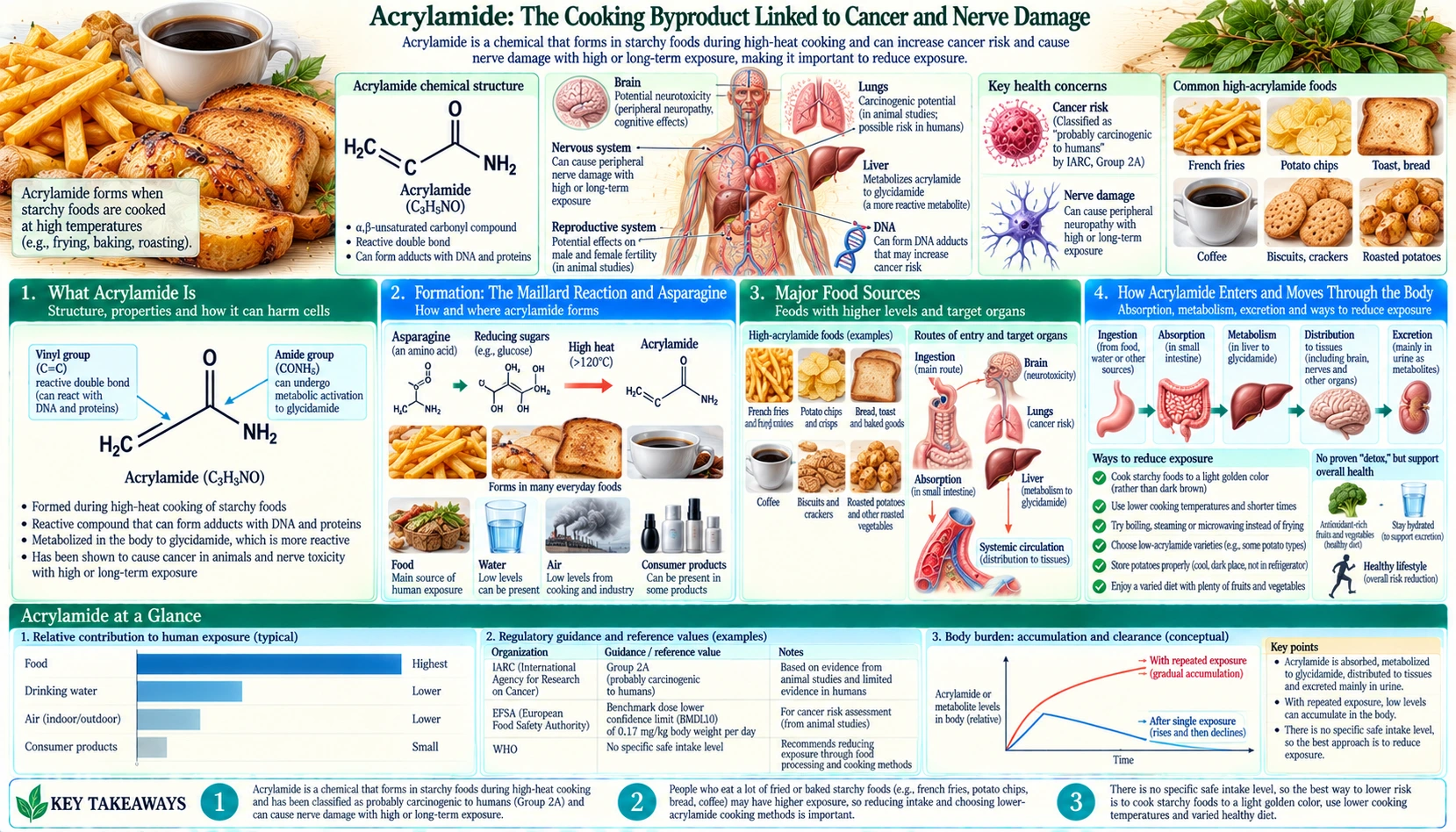
Acrylamide is a small, highly water-soluble chemical that forms in starchy foods cooked at high temperature. The European Food Safety Authority (EFSA) describes it as forming during frying, baking and roasting “at +120 °C and low moisture” from sugars and amino acids, “mainly one called asparagine” (EFSA, 4 June 2015). Two 2002 papers in Nature showed that it arises in the Maillard reaction — the browning reaction between amino acids and reducing sugars that also generates flavour and colour in cooked foods — with asparagine, a major amino acid in potatoes and cereals, as a crucial participant (Mottram 2002; Stadler 2002).
Acrylamide was first reported in foods in 2002 by the Swedish National Food Agency together with scientists from Stockholm University (Tareke 2002). The International Agency for Research on Cancer (IARC) classified it in 1994 as “probably carcinogenic to humans” (Group 2A), a classification based on the evidence of carcinogenicity in animals (Virk-Baker 2014; Obón-Santacana 2015). Most human studies of dietary acrylamide have found no association with cancer. This article covers where acrylamide comes from, what animal, worker and population studies report, and what regulators have done about it.
Table of Contents
- What Acrylamide Is
- Formation: The Maillard Reaction and Asparagine
- Major Food Sources
- How Acrylamide Enters and Moves Through the Body
- Carcinogenic Evidence: IARC Group 2A
- Neurotoxicity: Occupational and Dietary Exposure
- Mechanisms of Harm: Glycidamide and DNA Adducts
- Body Burden and Biomonitoring
- What Agencies Report About Lowering Acrylamide
- Regulatory Status and Policy
- Key Research Papers
- Connections
- Featured Videos
What Acrylamide Is
The EU acrylamide regulation describes acrylamide as “a low molecular weight, highly water soluble, organic compound which forms from the naturally occurring constituents asparagine and sugars in certain foods when prepared at temperatures typically higher than 120 °C and low moisture” (Regulation (EU) 2017/2158, recital 3). Industrially it is produced for plastics, grouts, water-treatment products and cosmetics, and it is also present in cigarette smoke (FDA, Acrylamide Questions and Answers). Chemically it is an α,β-unsaturated carbonyl compound, a “soft electrophile” that preferentially forms covalent bonds with cysteine thiol groups on proteins (LoPachin 2012).
Before acrylamide was found in food, hemoglobin adducts of acrylamide were already being “regularly observed in persons without known exposure”; the search for their origin led to the finding that it forms in heated foods (Tareke 2002). The FDA states that acrylamide “has probably always been present in cooked foods” and was first detected in certain foods in April 2002.
Formation: The Maillard Reaction and Asparagine
Mottram and colleagues showed that acrylamide can be generated from food components during heat treatment through the Maillard reaction between amino acids and reducing sugars, with asparagine as a crucial participant (PubMed PMID: 12368844). Stadler and colleagues reported that acrylamide is released by heating certain amino acids such as asparagine, particularly with reducing sugars, and early Maillard products (PubMed PMID: 12368845).
Factors the sources describe:
- Temperature and time. Laboratory-heated foods showed a temperature dependence of acrylamide formation, and acrylamide could not be detected in unheated or boiled foods (below 5 µg/kg) (Tareke 2002). The FDA states that more acrylamide generally accumulates when cooking is longer or hotter, and that boiling and steaming do not typically form it.
- Degree of browning. In home-style cooking experiments, acrylamide depended on cooking conditions and on the degree of surface browning; colour measurements correlated highly with acrylamide levels (Jackson 2005).
- Reducing sugars in potatoes. The FDA states that storing potatoes in the refrigerator can result in increased acrylamide during cooking. The EU regulation requires food businesses that store potatoes to keep them above 6 °C and to test potatoes for reducing sugars.
- Soaking and blanching. Soaking raw potato slices in water before frying reduced acrylamide in French fries (Jackson 2005); the FDA’s consumer page describes soaking for 15–30 minutes before frying or roasting. The EU regulation requires French-fry producers to blanch potato strips “to remove some of the reducing sugars from the outside of the strips”.
- pH. The EU regulation lists disodium diphosphate (E450), which “lowers the pH level of the washing water and inhibits the browning reaction”, among the measures for French fries.
Major Food Sources
EFSA names fried potato products, coffee, biscuits, crackers, crisp bread and soft bread as the most important food groups contributing to acrylamide exposure, and states that children are the most exposed age group on a body-weight basis (EFSA 2015). On its topic page EFSA adds that fried potato products account for up to half of children’s dietary exposure and that baby food (mainly rusks and biscuits) is the most important source for infants (EFSA topic page). The FDA states that acrylamide is found mainly in plant foods — potato products, grain products and coffee — and does not form, or forms at lower levels, in dairy, meat and fish.
- Fried potato products. French fries fried at 150–190 °C for up to 10 minutes contained 55–2,130 µg/kg, highest in the longest-fried, most browned fries (Jackson 2005).
- Potato chips (crisps) and crispbread. The 2002 Swedish analysis measured 150–4,000 µg/kg in heated carbohydrate-rich foods, including heated potato products and crispbread, against 5–50 µg/kg in heated protein-rich foods (Tareke 2002).
- Coffee. Acrylamide forms when coffee beans are roasted, not when coffee is brewed (FDA). In a Polish survey of 42 commercial samples, mean levels were 179 µg/kg in roasted coffee and 358 µg/kg in instant coffee, with grain-based coffee substitutes highest; arabica and robusta did not differ (Mojska 2013).
- Toast and bread. “Dark” toasted bread slices contained 43.7–610.7 µg/kg, against 8.27–217.5 µg/kg for “light” and 10.9–213.7 µg/kg for “medium” slices (Jackson 2005).
- Breakfast cereals, cookies, biscuits and crackers. Listed by the FDA and EFSA as notable sources, and each given an EU benchmark level (see Regulatory Status below).
- Other foods. California’s Proposition 65 fact sheet also lists roasted asparagus, canned sweet potatoes and pumpkin, canned black olives, roasted nuts, roasted grain-based coffee substitutes, prune juice, bread crusts and toast.
- Baby foods. EFSA identifies rusks and biscuits as the main source for infants, and the EU regulation sets its lowest benchmark levels for baby foods.
How Acrylamide Enters and Moves Through the Body
In male volunteers given labelled acrylamide by mouth, urinary metabolites accounted for 39.9–49.9% of the dose within 24 hours, the estimated urinary elimination half-life was 3.1–3.5 hours, and the authors concluded that oral acrylamide is rapidly absorbed and eliminated; uptake through the skin was slow and limited (Fennell 2006).
Acrylamide is metabolised along two routes:
- Conjugation with glutathione. In the same volunteers about 86% of urinary metabolites came from glutathione conjugation (Fennell 2005).
- Epoxidation to glycidamide. In mice lacking the enzyme CYP2E1, plasma glycidamide was far lower and glycidamide–DNA adducts 52- to 66-fold lower than in normal mice, showing that CYP2E1 is the main enzyme forming glycidamide (Ghanayem 2005). Humans convert acrylamide to glycidamide to a lesser extent than rodents (Fennell 2005).
Placenta. In perfused human placentas, acrylamide and glycidamide crossed from the maternal to the fetal circulation with kinetics similar to antipyrine, and concentrations equilibrated within 2 hours (Annola 2008). Acrylamide and glycidamide hemoglobin adducts measured in cord blood are taken to reflect exposure accumulated over the last months of pregnancy (Pedersen 2012).
Carcinogenic Evidence: IARC Group 2A
IARC classified acrylamide as “probably carcinogenic to humans” (Group 2A) in 1994 (Obón-Santacana 2015). In animals, acrylamide causes tumours at multiple sites in both mice and rats: lung tumours and skin tumours in mice; peritesticular mesotheliomas, thyroid follicular-cell tumours, mammary tumours and brain tumours in rat drinking-water bioassays (Rice 2005). EFSA’s 2015 opinion, based on animal studies, concluded that acrylamide in food “potentially increases the risk of developing cancer for consumers in all age groups”, and states that acrylamide and glycidamide are genotoxic.
The human studies, mostly based on food-frequency questionnaires, are largely null:
- Endometrial cancer. In the Netherlands Cohort Study the highest versus lowest intake quintile gave a hazard ratio of 1.29 (95% CI 0.81–2.07), not significant overall, but 1.99 (1.12–3.52) in never-smokers (Hogervorst 2007, PubMed PMID: 18006919). In the much larger European EPIC cohort no association was found for overall or type-I endometrial cancer (1,382 cases); a positive association with type-I cancer appeared only in women who had never smoked and never used oral contraceptives (HR 1.97, 1.08–3.62; 203 cases) (Obón-Santacana 2014, PubMed PMID: 24937665).
- Ovarian cancer. The Netherlands Cohort Study found a higher risk in the top intake quintile (HR 1.78, 1.10–2.88; never-smokers 2.22, 1.20–4.08) (Hogervorst 2007). EPIC, with 1,191 cases among 325,006 women, found no association and no dose-response (HR for top vs bottom quintile 0.97, 0.76–1.23) (Obón-Santacana 2015, PubMed PMID: 25300475).
- Pooled evidence. A 2015 meta-analysis of 32 publications covering 14 cancer sites found no meaningful associations for most cancers; kidney cancer was of borderline significance (RR 1.20, 1.00–1.45), and among never-smokers borderline associations emerged for endometrial (RR 1.23, 1.00–1.51) and ovarian (RR 1.39, 0.97–2.00) cancer. The authors concluded that dietary acrylamide is not related to the risk of most common cancers, while a modest association for these sites “cannot be excluded” (Pelucchi 2015, PubMed PMID: 25403648). A 2020 dose-response meta-analysis reported a slightly increased risk of ovarian cancer and a positive association for endometrial cancer, especially in never-smokers, and little association with breast cancer except in premenopausal women (Adani 2020).
- Kidney, bladder and prostate. In the Netherlands Cohort Study the top intake quintile had a renal-cell cancer hazard ratio of 1.59 (1.09–2.30), with no positive association for bladder or prostate cancer (Hogervorst 2008). A Swedish case-control re-analysis found no excess risk of bowel, bladder or kidney cancer, and an unexpected inverse trend for large-bowel cancer (Mucci 2003).
- Other sites. Italian and Swiss case-control studies found no consistent association for oral, oesophageal, colorectal, laryngeal, breast, ovarian or prostate cancer (Pelucchi 2006), and the Netherlands Cohort Study found no association with brain cancer (Hogervorst 2009).
- Exposure measurement. A systematic review noted that most studies found no significant association and that exposure assessment has been inadequate, which may misclassify or underestimate exposure (Virk-Baker 2014).
Biomarker studies. Studies that measure acrylamide and glycidamide hemoglobin adducts instead of questionnaires have also been mostly null. In Danish postmenopausal women adduct levels were similar in breast-cancer cases and controls; only after adjustment for smoking was a positive association seen for estrogen-receptor-positive breast cancer (IRR 2.7, 1.1–6.6 per 10-fold higher adduct level) (Olesen 2008, PubMed PMID: 18183576). In non-smoking postmenopausal women from EPIC, adduct levels were not associated with endometrial cancer (PubMed PMID: 26376083), and no clear association was found with ovarian cancer; the authors judged it unlikely that dietary acrylamide increases ovarian cancer risk (PubMed PMID: 26598536).
Neurotoxicity: Occupational and Dietary Exposure
Acrylamide is a well-established cause of peripheral neuropathy, with impairment in the arms and legs, in exposed workers — most thoroughly studied in Swedish tunnel workers exposed to acrylamide grouting (Park 2021). Among 41 heavily exposed Chinese workers, signs and symptoms of peripheral neuropathy were more frequent than in controls, and a neurotoxicity index correlated with acrylamide hemoglobin adducts and urinary mercapturic acids but not with momentary air or plasma levels (Calleman 1994, PubMed PMID: 8209389). A risk assessment based on worker data estimated excess impairment of vibration perception and nerve conduction in 1–2% of workers after three years of inhaling 0.3 mg/m3 (Park 2021).
At dietary levels, EFSA’s panel considered possible effects on the nervous system, pre- and post-natal development and male reproduction and concluded that these “were not considered to be a concern, based on current levels of dietary exposure” (EFSA 2015).
Mechanisms of Harm: Glycidamide and DNA Adducts
- DNA adducts from glycidamide. In mice, acrylamide produced large increases in the glycidamide–DNA adducts N7-GA-Gua and N3-GA-Ade in liver, lung and testes, almost entirely dependent on CYP2E1 (Ghanayem 2005).
- Mutations. In mouse cells carrying the human TP53 gene, glycidamide (but not acrylamide) produced TP53 mutations, mostly at adenines (A>T and A>G), at codons also mutated in human tumours (Hölzl-Armstrong 2020). A glycidamide mutational signature identified experimentally was found in about one-third of roughly 1,600 human tumour genomes across 19 tumour types (Zhivagui 2019, PubMed PMID: 30846532).
- Protein adducts and nerve function. Acrylamide forms covalent adducts with cysteine thiolate groups in the active sites of presynaptic proteins; the resulting protein inactivation disrupts nerve-terminal processes and impairs neurotransmission (LoPachin 2012).
- Reproductive and developmental effects. The U.S. National Toxicology Program found clear evidence of developmental and male reproductive toxicity in laboratory animals, and California lists acrylamide for both (Proposition 65 fact sheet; OEHHA). In the European NewGeneris mother-child study (1,101 births), the highest versus lowest quartile of cord-blood acrylamide adducts was associated with a birth-weight difference of −132 g (95% CI −207 to −56) and 0.33 cm smaller head circumference, also in infants of non-smokers; the authors described the result as needing confirmation (Pedersen 2012, PubMed PMID: 23092936).
Body Burden and Biomonitoring
The standard biomarkers are hemoglobin adducts of acrylamide, N-(2-carbamoylethyl)valine (AAVal), and of glycidamide, N-(2-carbamoyl-2-hydroxyethyl)valine (GAVal); in volunteers both rose linearly with oral dose (Fennell 2005).
- Acrylamide hemoglobin adducts are regularly found in people with no known occupational exposure (Tareke 2002).
- Smokers had adduct levels about 3 times higher than non-smokers in the Danish cohort (Olesen 2008); FDA lists cigarette smoke as a source.
- Urinary metabolites of glutathione conjugation (mercapturic acids) reflect recent intake: in volunteers, acrylamide was eliminated in urine with a half-life of 3.1–3.5 hours (Fennell 2006).
- Questionnaire-based intakes in the cohorts were in the tens of micrograms per day: a median of 21.3 µg/day in EPIC (Obón-Santacana 2015) and quintile means from 8.9 to 40.2 µg/day among Dutch women (Hogervorst 2007).
What Agencies Report About Lowering Acrylamide
The FDA’s consumer page states that it is waiting for new research before considering whether new advice is needed, and passes on the following information for people who want to lower acrylamide intake (FDA, Acrylamide and Diet, Food Storage, and Food Preparation):
- Cooking method. Among potato cooking methods, frying caused the most acrylamide, roasting potato pieces less, and baking whole potatoes less again; boiling potatoes and microwaving whole potatoes with the skin on did not produce acrylamide (FDA studies).
- Colour. Cooking cut potato products to a golden yellow rather than brown colour, and toasting bread to light brown rather than dark brown, lowers acrylamide; brown areas tend to contain more. Jackson’s toast and French-fry measurements show the same pattern (Jackson 2005).
- Soaking. Soaking raw potato slices in water for 15–30 minutes before frying or roasting helps reduce formation.
- Storage. Refrigerated potatoes can produce more acrylamide during cooking; the FDA describes storing potatoes outside the refrigerator in a dark, cool place.
- Coffee. The FDA states that scientists have not found good ways to reduce acrylamide formation in coffee. In one survey, roasting had the largest effect on acrylamide in natural coffee and instant coffee averaged higher than roasted (Mojska 2013).
- Whole grains. The FDA states that it does not recommend reducing intake of whole-grain cereals that are a good source of whole grains and fiber.
EFSA’s topic page lists avoiding excessive browning, varying cooking methods (boiling, steaming and sautéing as well as frying) and a varied diet as options for consumers. Questions about individual diets are for a clinician.
Regulatory Status and Policy
United States. The FDA issued its final Guidance for Industry: Acrylamide in Foods in March 2016. It suggests “a range of possible approaches” for growers, manufacturers and food-service operators, “does not identify any specific maximum recommended level or action level”, and, like all FDA guidance, does not establish legally enforceable responsibilities (FDA guidance page).
European Union. Commission Regulation (EU) 2017/2158, applying from 11 April 2018, requires businesses producing French fries, potato crisps, bread, breakfast cereals, fine bakery wares, coffee, coffee substitutes and baby foods to apply mitigation measures “in view of achieving levels of acrylamide as low as reasonably achievable below the benchmark levels”, to sample and analyse their products, and to review their measures when results are not below the benchmark. The regulation calls benchmark levels “performance indicators” used to verify that mitigation works, and says the setting of maximum levels “should be considered”. Examples from Annex IV (µg/kg): French fries 500; potato crisps 750; wheat-based soft bread 50; biscuits and wafers 350; roast coffee 400; instant coffee 850; baby foods 40; biscuits and rusks for infants and young children 150 (Regulation (EU) 2017/2158).
EFSA’s 2015 scientific opinion, as summarised in the regulation, confirmed that acrylamide in food potentially increases cancer risk for consumers in all age groups and that current dietary exposure indicates a concern with respect to its carcinogenic effects; EFSA headlined its announcement “Acrylamide in food is a public health concern”.
California. Acrylamide has been on the Proposition 65 list as a cause of cancer since 1 January 1990, and as a cause of developmental and male reproductive toxicity since 25 February 2011 (OEHHA). Proposition 65 requires businesses to warn people before exposing them to a significant amount of a listed chemical; the state’s fact sheet adds that “a court has decided that businesses do not have to warn about exposure to acrylamide in food” (Proposition 65 fact sheet). A state regulation operative since 1 October 2019 declares that exposures to listed chemicals created by roasting coffee beans or brewing coffee “do not pose a significant risk of cancer” (27 CCR § 25704).
International. The FDA reports that in 2010 the joint FAO/WHO Expert Committee on Food Additives (JECFA) concluded that acrylamide is a human health concern and suggested further long-term studies.
Key Research Papers
- Tareke E, et al. Analysis of acrylamide, a carcinogen formed in heated foodstuffs. J Agric Food Chem. 2002;50(17):4998–5006. — PubMed PMID: 12166997
- Mucci LA, et al. Dietary acrylamide and cancer of the large bowel, kidney, and bladder: absence of an association in a population-based study in Sweden. Br J Cancer. 2003;88(1):84–89. — PubMed PMID: 12556964
- Olesen PT, et al. Acrylamide exposure and incidence of breast cancer among postmenopausal women in the Danish Diet, Cancer and Health Study. Int J Cancer. 2008;122(9):2094–2100. — PubMed PMID: 18183576
- Hogervorst JG, et al. Dietary acrylamide intake and the risk of renal cell, bladder, and prostate cancer. Am J Clin Nutr. 2008;87(5):1428–1438. — PubMed PMID: 18469268
- Pelucchi C, et al. Dietary acrylamide and human cancer. Int J Cancer. 2006;118(2):467–471. — PubMed PMID: 16003724
- Hogervorst JG, et al. Dietary acrylamide intake and brain cancer risk. Cancer Epidemiol Biomarkers Prev. 2009;18(5):1663–1666. — PubMed PMID: 19383886
- Virk-Baker MK, et al. Dietary acrylamide and human cancer: a systematic review of literature. Nutr Cancer. 2014;66(5):774–790. — PubMed PMID: 24875401
- Fennell TR, et al. Metabolism and hemoglobin adduct formation of acrylamide in humans. Toxicol Sci. 2005;85(1):447–459. — PubMed PMID: 15625188
- Rice JM. The carcinogenicity of acrylamide. Mutat Res. 2005;580(1-2):3–20. — PubMed PMID: 15668103
- Dybing E, et al. Human exposure and internal dose assessments of acrylamide in food. Food Chem Toxicol. 2005;43(3):365–410. — PubMed PMID: 15680675
- Zhivagui M, et al. Experimental and pan-cancer genome analyses reveal widespread contribution of acrylamide exposure to carcinogenesis in humans. Genome Res. 2019;29(4):521–531. — PubMed PMID: 30846532
- Mottram DS, et al. Acrylamide is formed in the Maillard reaction. Nature. 2002;419(6906):448–449. — PubMed PMID: 12368844
- Stadler RH, et al. Acrylamide from Maillard reaction products. Nature. 2002;419(6906):449–450. — PubMed PMID: 12368845
- Jackson LS, et al. Effects of consumer food preparation on acrylamide formation. Adv Exp Med Biol. 2005;561:447–465. — PubMed PMID: 16438318
- Mojska H, et al. Studies of acrylamide level in coffee and coffee substitutes: influence of raw material and manufacturing conditions. Rocz Panstw Zakl Hig. 2013;64(3):173–181. — PubMed PMID: 24325083
- Hogervorst JG, et al. A prospective study of dietary acrylamide intake and the risk of endometrial, ovarian, and breast cancer. Cancer Epidemiol Biomarkers Prev. 2007;16(11):2304–2313. — PubMed PMID: 18006919
- Obón-Santacana M, et al. Dietary intake of acrylamide and endometrial cancer risk in the European Prospective Investigation into Cancer and Nutrition cohort. Br J Cancer. 2014;111(5):987–997. — PubMed PMID: 24937665
- Obón-Santacana M, et al. Dietary intake of acrylamide and epithelial ovarian cancer risk in the european prospective investigation into cancer and nutrition (EPIC) cohort. Cancer Epidemiol Biomarkers Prev. 2015;24(1):291–297. — PubMed PMID: 25300475
- Obón-Santacana M, et al. Acrylamide and glycidamide hemoglobin adduct levels and endometrial cancer risk: A nested case-control study in nonsmoking postmenopausal women from the EPIC cohort. Int J Cancer. 2016;138(5):1129–1138. — PubMed PMID: 26376083
- Obón-Santacana M, et al. Acrylamide and Glycidamide Hemoglobin Adducts and Epithelial Ovarian Cancer: A Nested Case-Control Study in Nonsmoking Postmenopausal Women from the EPIC Cohort. Cancer Epidemiol Biomarkers Prev. 2016;25(1):127–134. — PubMed PMID: 26598536
- Pelucchi C, et al. Dietary acrylamide and cancer risk: an updated meta-analysis. Int J Cancer. 2015;136(12):2912–2922. — PubMed PMID: 25403648
- Adani G, et al. Dietary Intake of Acrylamide and Risk of Breast, Endometrial, and Ovarian Cancers: A Systematic Review and Dose-Response Meta-analysis. Cancer Epidemiol Biomarkers Prev. 2020;29(6):1095–1106. — PubMed PMID: 32169997
- Calleman CJ, et al. Relationships between biomarkers of exposure and neurological effects in a group of workers exposed to acrylamide. Toxicol Appl Pharmacol. 1994;126(2):361–371. — PubMed PMID: 8209389
- Park RM, et al. Preliminary Risk assessment for Acrylamide and Peripheral Neuropathy. Neurotoxicology. 2021;85:10–17. — PubMed PMID: 33892018
- LoPachin RM, et al. Molecular mechanism of acrylamide neurotoxicity: lessons learned from organic chemistry. Environ Health Perspect. 2012;120(12):1650–1657. — PubMed PMID: 23060388
- Ghanayem BI, et al. Role of CYP2E1 in the epoxidation of acrylamide to glycidamide and formation of DNA and hemoglobin adducts. Toxicol Sci. 2005;88(2):311–318. — PubMed PMID: 16141435
- Hölzl-Armstrong L, et al. Mutagenicity of acrylamide and glycidamide in human TP53 knock-in (Hupki) mouse embryo fibroblasts. Arch Toxicol. 2020;94(12):4173–4196. — PubMed PMID: 32886187
- Pedersen M, et al. Birth weight, head circumference, and prenatal exposure to acrylamide from maternal diet: the European prospective mother-child study (NewGeneris). Environ Health Perspect. 2012;120(12):1739–1745. — PubMed PMID: 23092936
- Annola K, et al. Transplacental transfer of acrylamide and glycidamide are comparable to that of antipyrine in perfused human placenta. Toxicol Lett. 2008;182(1-3):50–56. — PubMed PMID: 18790027
- Fennell TR, et al. Kinetics of elimination of urinary metabolites of acrylamide in humans. Toxicol Sci. 2006;93(2):256–267. — PubMed PMID: 16870689