Sauna
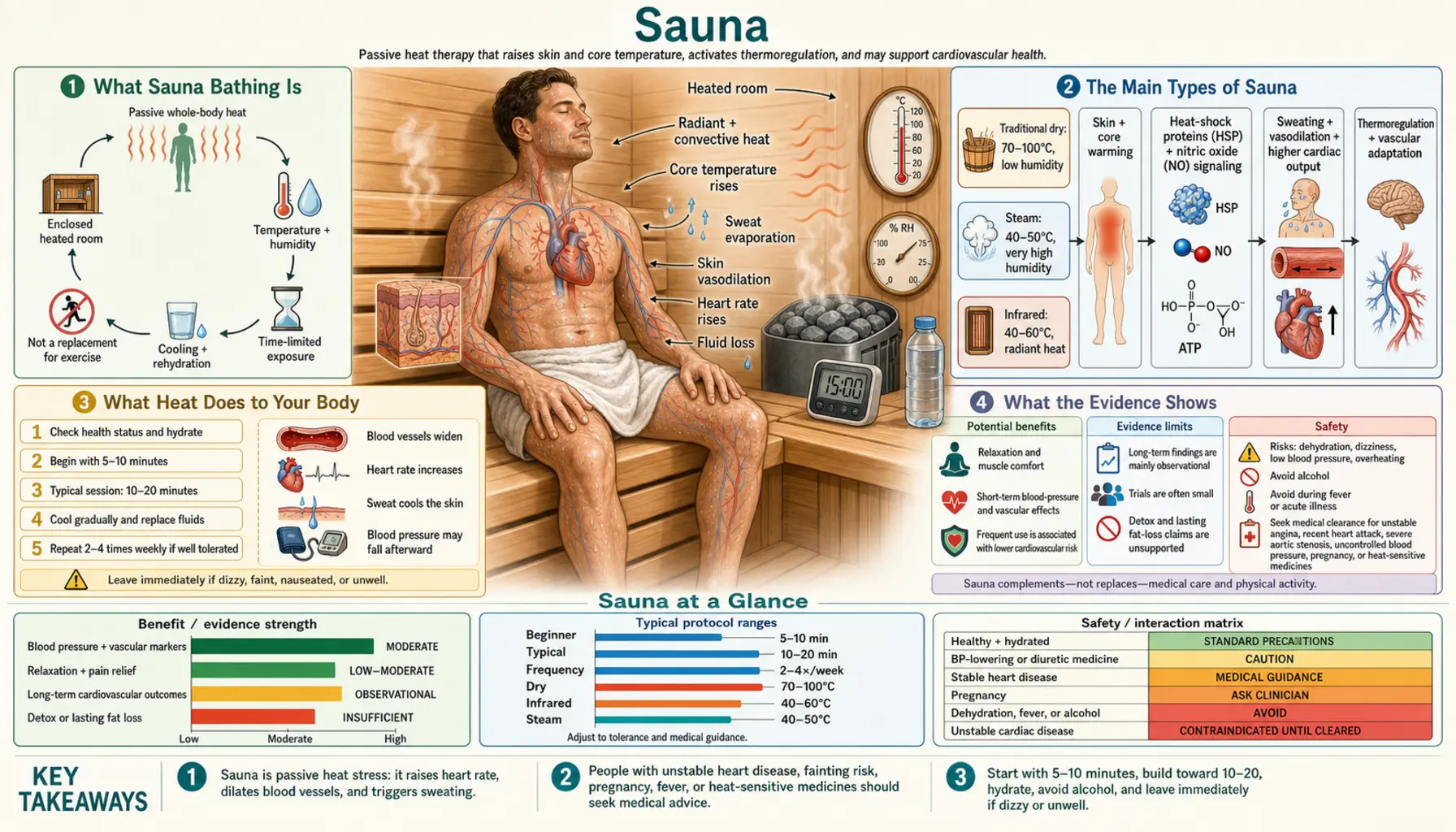
Sitting in a hot room to sweat is one of the oldest wellness practices in the world. In Finland it is not a luxury or a trend but a part of everyday life — there are more saunas than cars, and most people bathe in one every week from childhood on. For a long time the sauna was treated as a pleasant ritual and little more. Over the past decade, though, a series of large Finnish studies has turned it into a genuinely interesting subject for heart and brain research. The headline findings are striking: people who use a sauna often appear to live longer and to have less heart disease and dementia than people who rarely use one. Those findings deserve real attention — but they come from observational studies, which can reveal a strong link without proving that the sauna itself is the cause. This page lays out what sauna bathing actually is, what heat does to your body, what the research honestly supports, how to do it sensibly, and who should be careful.
Table of Contents
- What Sauna Bathing Is
- The Main Types of Sauna
- What Heat Does to Your Body
- What the Evidence Shows
- Finnish, Steam, and Infrared — How the Evidence Compares
- How to Use a Sauna Sensibly
- Safety and Who Should Be Careful
- A Note on Fertility
- Research Papers
- Connections
- Featured Videos
What Sauna Bathing Is
A sauna is simply a room designed to expose your body to heat for a short period, usually followed by a cool-down. The heat makes you sweat, raises your heart rate, and warms your skin and core — and it is this controlled bout of heat stress, repeated regularly, that researchers think may do something useful.
Heat bathing is ancient and nearly universal. The Finnish sauna, the Turkish and Middle Eastern hammam, the Russian banya, Indigenous North American sweat lodges, and Japanese hot-spring bathing are all variations on the same idea. What has changed recently is the science: the modern research base is built almost entirely on the traditional Finnish sauna, because that is where the practice is common enough, and consistent enough, to study large numbers of people over many years.
That single fact shapes everything on this page. When you read that "sauna use is linked to lower mortality," the sauna being studied is nearly always a hot, dry Finnish sauna used several times a week for decades. Other heat practices — steam rooms, and especially the newer infrared cabins — may share some of the same physiology, but they do not share the same weight of evidence. It is important not to quietly transfer the strong Finnish-sauna findings onto every hot box with a bench in it.
The Main Types of Sauna
Three formats are commonly sold as "saunas," and they are meaningfully different in how they heat you and in how much research supports them.
Traditional Finnish (dry) sauna
This is the classic wood-lined room heated by an electric or wood-burning stove topped with stones. The air is hot and relatively dry, typically around 80–100 °C (176–212 °F) at head height, with low humidity. Bathers often ladle water onto the hot stones to release a burst of steam — the Finnish löyly — which briefly spikes the humidity and the sensation of heat. Sessions usually last 5–20 minutes, often repeated with cool-downs in between. This is the type with by far the strongest evidence.
Steam room / hammam
A steam room runs at a much lower air temperature — roughly 40–50 °C (104–122 °F) — but at close to 100% humidity. It feels intensely hot because the saturated air stops your sweat from evaporating, which is your body's main way of shedding heat. Steam bathing has a long cultural history and shares the broad "get hot, then cool down" pattern, but it has been studied far less rigorously than the Finnish sauna.
Infrared sauna
An infrared cabin is a newer, very different device. Instead of heating the air, panels emit infrared radiation that warms your body directly, so the air stays much cooler — often around 45–60 °C (113–140 °F). Many people find the lower air temperature more tolerable. Infrared saunas are heavily marketed with impressive-sounding health claims, but here honesty matters: the research on infrared saunas is much thinner — a handful of small, short studies rather than the large, decades-long Finnish cohorts. Some early results are encouraging, but they are nowhere near strong enough to promise the outcomes seen with traditional saunas. Treat infrared claims with healthy skepticism.
What Heat Does to Your Body
The interesting thing about a sauna is that, from your cardiovascular system's point of view, sitting still in intense heat looks a surprising amount like mild-to-moderate exercise.
When your core temperature starts to climb, your body works hard to shed the heat. The main responses during a single session include:
- A faster heart rate. Heart rate commonly rises into the range of 100–150 beats per minute during a hot session — comparable to a brisk walk or an easy jog — and cardiac output (the amount of blood the heart pumps) increases substantially.
- Widened blood vessels. Blood is redirected toward the skin to release heat, so blood vessels dilate. This tends to lower the resistance the heart pumps against, and blood pressure typically falls during and shortly after a session even though the heart is beating faster.
- Heavy sweating. You can lose a pint or more of fluid in a single session, which is why hydration matters (see How to Use a Sauna).
- A rise in core temperature of roughly 1–2 °C, a mild, deliberate version of a fever-like state.
Those are the immediate effects. The more interesting question is what happens when the exposure is repeated over weeks, months, and years. Researchers have proposed several overlapping mechanisms, though it is important to say these are still being worked out:
- Better blood-vessel function. Repeated heat appears to improve endothelial function — how well the thin lining of your arteries relaxes and dilates — and to reduce arterial stiffness. A controlled study of passive heat therapy in sedentary adults found real improvements in these vascular measures and in blood pressure, which is one of the more convincing pieces of mechanistic evidence (see Research Papers).
- Heat-shock proteins. Heat stress prompts cells to produce protective molecules called heat-shock proteins, which help other proteins fold correctly and cope with stress. This is a plausible and much-discussed pathway, though its exact contribution to long-term human health outcomes is not yet nailed down.
- Lower inflammation and oxidative stress, and a calmer nervous system. Long-term sauna use has been associated with lower levels of some inflammatory markers, and recovery after a session shifts the autonomic nervous system toward its calming "rest-and-digest" branch (see Research Papers).
One honest aside on the popular idea that a sauna "detoxes" the body: sweating is not a meaningful detox pathway. Sweat is mostly water and salt; your liver and kidneys do the real work of clearing toxins, and they are not helped in any important way by sweating more. The plausible benefits of sauna bathing come from the cardiovascular and heat-adaptation effects above — not from "sweating out toxins."
What the Evidence Shows
Most of what we know about the long-term effects of sauna bathing comes from one remarkable Finnish research effort: the Kuopio Ischaemic Heart Disease Risk Factor Study (KIHD), a large group of middle-aged Finnish adults followed for around two decades. Because saunas are woven into everyday Finnish life, this cohort let researchers — led largely by Jari and Tanjaniina Laukkanen — compare people who bathed once a week with people who bathed four to seven times a week, and track what happened over many years.
Before the findings, a crucial caveat that applies to all of them: these are observational associations, not proof of cause and effect. People who use a sauna very frequently may differ from occasional users in ways that also affect health — they may be wealthier, less socially isolated, healthier to begin with (sick people avoid saunas), or more relaxed in general. Good studies try to adjust for such factors, but they can never fully remove them. Keep that firmly in mind as you read the numbers.
Heart disease and overall mortality
This is the strongest and most striking area. In the flagship 2015 analysis, compared with men who used a sauna once a week, those who used one 4–7 times a week had roughly half the risk of dying from cardiovascular causes and about 40% lower all-cause mortality over the follow-up. Longer individual sessions were also associated with lower risk. A later analysis that included women found a similar link between frequent sauna use and lower cardiovascular death. These are large associations — but, again, association is not proof.
Blood pressure
Frequent sauna use has been linked to a lower chance of developing high blood pressure. In the KIHD cohort, men who bathed 4–7 times a week had a markedly lower risk of new-onset hypertension over the years than those who bathed once a week. This fits with the short-term drop in blood pressure seen during and after a session, and with the vascular improvements from repeated heat exposure — a rare instance where the epidemiology and a plausible mechanism point the same way.
Memory and dementia
In the same population, frequent sauna use was associated with a substantially lower risk of later dementia and Alzheimer's disease — men in the most-frequent group had a large reduction in risk compared with once-a-week users. This is a genuinely intriguing signal, and it is biologically plausible if the sauna's cardiovascular benefits also protect the brain's blood supply. But it is a single cohort, it is observational, and reverse causation is a real worry: people in the earliest, undiagnosed stages of dementia may simply stop going to the sauna. It should be read as a promising lead, not a proven prevention.
Other links: lungs, recovery, and wellbeing
Frequent sauna use has also been associated with a lower risk of respiratory conditions such as pneumonia and chronic lung disease in the Finnish cohort. Beyond the epidemiology, most people simply feel better after a sauna — it is relaxing, eases muscle tension, and is often used for post-exercise recovery and sleep. These wellbeing effects are real and valued even where the hard-outcome evidence is thin, and for many people they are the main reason to bathe.
The honest bottom line
The consistency of these findings, across different outcomes and now including women, is more than most single lifestyle habits can claim — and the leading review of the field concludes the associations are strong enough to take seriously. At the same time, we do not yet have large randomized trials showing that starting a sauna habit causes people to live longer. The fair summary: regular sauna bathing is strongly and repeatedly associated with better cardiovascular and brain outcomes, it has plausible mechanisms behind it, and for most healthy people it is a low-risk, enjoyable practice — but it is a complement to the basics (not smoking, moving your body, sleeping, eating well), not a substitute for them or for medical care.
Finnish, Steam, and Infrared — How the Evidence Compares
Because these three practices are often lumped together and sold interchangeably, it is worth being explicit about where the evidence actually sits.
- Traditional Finnish (dry) sauna — strongest evidence. Essentially all of the large mortality, blood-pressure, dementia, and respiratory findings come from hot, dry Finnish saunas. If you want the outcomes the studies describe, this is the format they studied.
- Steam room / hammam — limited direct evidence. Steam bathing shares the general heat-then-cool pattern and likely produces some of the same short-term cardiovascular responses, but it has not been studied in anything like the same depth. Reasonable to enjoy; not something to make strong health promises about.
- Infrared sauna — much less evidence. Infrared cabins are the most aggressively marketed and the least supported. The studies are small, short, and often industry-adjacent. Some show modest improvements in blood pressure or comfort, and the lower air temperature can make heat therapy accessible to people who cannot tolerate a hot sauna — a legitimate advantage. But claims that infrared saunas match the mortality or dementia benefits of Finnish saunas are not supported by the data. Marketing has run well ahead of the science here.
None of this means steam or infrared are useless. It means you should calibrate your expectations to the evidence for the specific format you are using, rather than borrowing the Finnish-sauna headlines to sell a different device.
How to Use a Sauna Sensibly
There is no single "correct" protocol, and the studies simply observed what Finnish bathers naturally did rather than testing an optimized recipe. That said, a reasonable, evidence-informed approach for a healthy adult looks like this:
- Frequency. The strongest associations in the research were seen at 4–7 sessions per week, but even 2–3 times a week was linked to benefit over once a week. Consistency over time seems to matter more than intensity.
- Duration. Sessions of about 5–20 minutes are typical. Longer sessions were associated with more benefit in the studies, but there is no need to tough out discomfort — leave when you feel you have had enough.
- Temperature. A traditional sauna is usually run at roughly 80–90 °C (176–194 °F). Infrared cabins are much cooler by design. Hotter is not automatically better, especially when you are new to it.
- Hydration. You lose a lot of fluid through sweat. Drink water before and after, and do not use the sauna if you are already dehydrated. Rehydrating with water (and replacing some salt through normal food) is enough for typical use.
- Cool down gradually. Step out, let your body settle, and cool off before standing for long or taking a cold plunge. Standing up too fast after intense heat can drop your blood pressure and make you light-headed.
- Ease in. If you are new, start with shorter, cooler sessions and build up. Listen to your body and get out immediately if you feel dizzy, nauseated, faint, or unwell.
If you have any chronic medical condition, or take regular medication, check with your doctor before starting a regular sauna habit — see the safety section next.
Safety and Who Should Be Careful
For most healthy people, sauna bathing is remarkably safe; serious problems are uncommon. But the heat is a real physiological stress, and some situations call for genuine caution. This is where honesty is most important.
General precautions for everyone
- Dehydration. Heavy sweating without replacing fluid can leave you dehydrated and dizzy. Hydrate before and after, and keep sessions moderate.
- Never combine a sauna with alcohol. This is the single most important safety rule. Alcohol impairs your body's ability to regulate temperature and blood pressure, promotes dehydration, and raises the risk of dangerous rhythm disturbances and fainting. A large share of the rare sudden deaths in saunas involve alcohol. Do not drink before or during a sauna.
- Get out if you feel unwell. Dizziness, nausea, a pounding or irregular heartbeat, headache, or feeling faint are all signals to leave, cool down, and rest.
- Don't bathe alone if you are unsure. If you are elderly, unwell, or new to intense heat, it is safer to have someone nearby.
Groups that should be especially careful or avoid it
- Pregnancy. Overheating in early pregnancy is a real concern, as a raised core temperature has been linked to developmental risks. Pregnant women should be cautious — keeping sessions short and cooler at most, and ideally discussing sauna use with their doctor or midwife first. Many are advised to avoid hot saunas, particularly in the first trimester.
- Uncontrolled or unstable heart disease. People with a recent heart attack, unstable angina, severe aortic valve narrowing (aortic stenosis), or poorly controlled heart failure should avoid saunas unless a cardiologist has specifically cleared them. The heat makes the heart work harder and shifts blood flow in ways that can be risky for an unstable heart.
- Blood pressure that is not controlled. Because a sauna lowers blood pressure and dilates vessels, people with very low blood pressure can faint. Those with severe or uncontrolled high blood pressure should get it managed and cleared by a doctor first. People with stable, controlled blood pressure generally tolerate saunas well.
- Children. Young children regulate their body temperature less efficiently than adults and overheat faster. Sauna use for children should be brief, cooler, and closely supervised — and infants should not be taken into a hot sauna.
- Certain other conditions. People who are acutely ill or feverish, those prone to fainting, and anyone with conditions affecting sweating or temperature regulation should be cautious and seek individual advice.
The theme across all of these is the same: a sauna is a controlled stress test for your cardiovascular system. If your system is healthy, it usually handles that stress well and may even adapt favorably. If your system is unstable, the stress can be dangerous — so clear it with your doctor first.
A Note on Fertility
One specific, well-documented effect deserves its own mention because it surprises people: heat temporarily lowers sperm production. The testicles are kept slightly cooler than the rest of the body for a reason, and repeatedly heating them — through frequent hot saunas — can transiently reduce sperm count and impair sperm movement. A controlled study of healthy men who used a sauna twice weekly for three months found measurable reductions in sperm parameters (see Research Papers).
The reassuring part is that this effect is transient and reversible: in the study, sperm measures returned to normal after the men stopped the sauna sessions. For most men this is not a health concern at all. But if you and a partner are actively trying to conceive, or you are being evaluated for fertility, it is sensible to cut back on frequent hot saunas (and other sources of testicular heat) for the time being. There is no evidence that ordinary sauna use causes lasting fertility harm.
Research Papers
- Laukkanen T, Khan H, Zaccardi F, Laukkanen JA. Association between sauna bathing and fatal cardiovascular and all-cause mortality events. JAMA Internal Medicine. 2015;175(4):542–548. doi:10.1001/jamainternmed.2014.8187 — The flagship KIHD analysis: men using a sauna 4–7 times a week had roughly half the cardiovascular mortality and about 40% lower all-cause mortality of once-a-week users. Strong observational evidence, not proof of causation.
- Laukkanen T, Kunutsor SK, Khan H, Willeit P, Zaccardi F, Laukkanen JA. Sauna bathing is associated with reduced cardiovascular mortality and improves risk prediction in men and women: a prospective cohort study. BMC Medicine. 2018;16(1):219. doi:10.1186/s12916-018-1198-0 — Extends the mortality findings to a cohort that includes women, with a similar inverse association between sauna frequency and cardiovascular death.
- Zaccardi F, Laukkanen T, Willeit P, Kunutsor SK, Kauhanen J, Laukkanen JA. Sauna bathing and incident hypertension: a prospective cohort study. American Journal of Hypertension. 2017;30(11):1120–1125. doi:10.1093/ajh/hpx102 — Frequent sauna use was associated with a substantially lower risk of developing high blood pressure over long-term follow-up.
- Laukkanen T, Kunutsor SK, Kauhanen J, Laukkanen JA. Sauna bathing is inversely associated with dementia and Alzheimer's disease in middle-aged Finnish men. Age and Ageing. 2017;46(2):245–249. doi:10.1093/ageing/afw212 — The cohort study behind the dementia headlines; a promising but single-population, observational signal vulnerable to reverse causation.
- Kunutsor SK, Laukkanen T, Laukkanen JA. Sauna bathing reduces the risk of respiratory diseases: a long-term prospective cohort study. European Journal of Epidemiology. 2017;32(12):1107–1111. doi:10.1007/s10654-017-0311-6 — Higher sauna frequency was associated with a lower incidence of respiratory conditions such as pneumonia and chronic lung disease.
- Laukkanen JA, Laukkanen T, Kunutsor SK. Cardiovascular and other health benefits of sauna bathing: a review of the evidence. Mayo Clinic Proceedings. 2018;93(8):1111–1121. doi:10.1016/j.mayocp.2018.04.008 — A balanced narrative review by the KIHD investigators summarizing the cardiovascular, brain, and other associations along with proposed mechanisms.
- Hussain J, Cohen M. Clinical effects of regular dry sauna bathing: a systematic review. Evidence-Based Complementary and Alternative Medicine. 2018;2018:1857413. doi:10.1155/2018/1857413 — An independent systematic review that found generally favorable but often low-to-moderate-quality evidence, underscoring the need for more randomized trials.
- Brunt VE, Howard MJ, Francisco MA, Ely BR, Minson CT. Passive heat therapy improves endothelial function, arterial stiffness and blood pressure in sedentary humans. The Journal of Physiology. 2016;594(18):5329–5342. doi:10.1113/JP272453 — A controlled trial of repeated passive heat exposure showing real improvements in blood-vessel function, arterial stiffness, and blood pressure — among the better mechanistic evidence.
- Kunutsor SK, Laukkanen T, Laukkanen JA. Longitudinal associations of sauna bathing with inflammation and oxidative stress: the KIHD prospective cohort study. Annals of Medicine. 2018;50(5):437–442. doi:10.1080/07853890.2018.1489143 — Links frequent sauna use with lower levels of certain inflammatory markers, one proposed pathway for the observed benefits.
- Laukkanen T, Lipponen J, Kunutsor SK, et al. Recovery from sauna bathing favorably modulates cardiac autonomic nervous system. Complementary Therapies in Medicine. 2019;45:190–197. doi:10.1016/j.ctim.2019.06.011 — Shows that recovery after a session shifts heart-rate variability toward the calming (parasympathetic) branch of the autonomic nervous system.
- Garolla A, Torino M, Sartini B, et al. Seminal and molecular evidence that sauna exposure affects human spermatogenesis. Human Reproduction. 2013;28(4):877–885. doi:10.1093/humrep/det020 — Regular sauna exposure temporarily impaired sperm production and motility in healthy men; the effect reversed after the sessions stopped.
- Kukkonen-Harjula K, Kauppinen K. Health effects and risks of sauna bathing. International Journal of Circumpolar Health. 2006;65(3):195–205. doi:10.3402/ijch.v65i3.18102 — A practical review of the physiological effects and the genuine risks — dehydration, alcohol, pregnancy, and unstable heart disease — that informs the cautions above.
Connections
- All Remedies
- Exercise
- Hypertension
- Heart Failure
- Coronary Artery Disease
- Atherosclerosis
- Stroke
- Alzheimer's Disease
- Meditation
- Breathwork