Rapamycin — Benefits Deep Dive
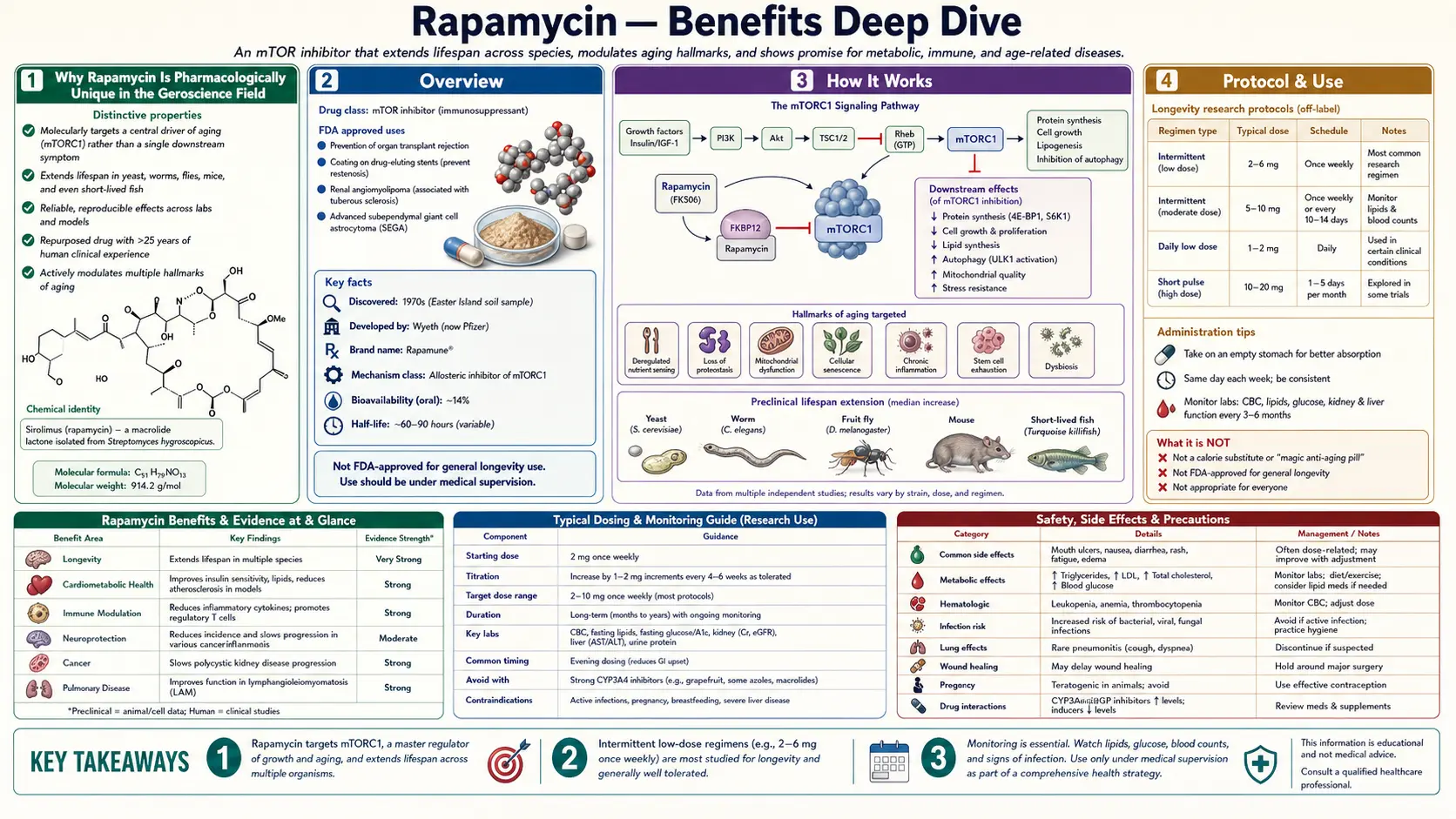
Rapamycin (sirolimus) is the only pharmacologic intervention with reproducible, robust evidence of extending maximum lifespan across a wide range of species — yeast, worms, flies, and most importantly mice across multiple genetic backgrounds and study sites. The Interventions Testing Program (ITP) at the National Institute on Aging has now confirmed lifespan extension in mice with rapamycin started at 9 months, 20 months, and even at 600 days (old age) — a finding without precedent for any other drug. The four deep-dive pages below explore the molecular target (mTORC1 in the PI3K-AKT-mTOR-S6K1-4EBP1 axis), the species-by-species evidence pipeline from yeast through dogs and human off-label cohorts, the intermittent dosing strategies (5-7 mg weekly is the dominant off-label adult protocol) that aim to capture geroprotective effect while sparing the immunosuppression of daily transplant-dose rapamycin, and the side-effect profile and monitoring labs every off-label user should track. None of this constitutes medical advice; rapamycin is an FDA-approved prescription drug for solid-organ transplant rejection and lymphangioleiomyomatosis, with all off-label longevity use happening through specialized longevity clinicians.
Deep-Dive Articles
mTOR Inhibition Mechanism
The molecular pharmacology of rapamycin: FKBP12 binding, allosteric inhibition of mTORC1 (the rapamycin-sensitive complex), preservation of mTORC2 with intermittent dosing, downstream effects on S6K1 and 4E-BP1 protein translation, autophagy induction via ULK1 activation, and the central role of nutrient and growth-factor sensing in the longevity hypothesis. Why the same molecule that prevents organ rejection at daily transplant doses appears to extend lifespan at weekly low-dose intermittent regimens.
Longevity Evidence Animal-to-Human
The pipeline from yeast (Powers et al. 2006) through C. elegans, Drosophila, and the NIA Interventions Testing Program in genetically heterogeneous mice (Harrison et al. 2009 Nature). The Dog Aging Project TRIAD trial. Mannick et al. 2014 Science Translational Medicine RAD001 elderly immune trial. The PEARL randomized human trial. Why max lifespan extension is qualitatively different from delaying disease.
Dosing, Cycling, and Off-Label Use
Transplant dosing (2-5 mg daily, trough 5-15 ng/mL) versus longevity dosing (5-7 mg once weekly, intentionally well below transplant trough). Why intermittent dosing is hypothesized to spare mTORC2-mediated insulin signaling and immune surveillance. Practical considerations: empty-stomach absorption, grapefruit interaction, statin co-administration, the Attia / Blagosklonny / Kaeberlein clinical protocols, and what longevity physicians actually prescribe in 2026.
Side Effects and Monitoring
The real side-effect profile of weekly low-dose rapamycin: mouth ulcers/aphthous stomatitis (most common, dose-dependent), lipid elevation (LDL and triglycerides), insulin resistance with daily dosing (much less with weekly), wound healing impairment, and the theoretical infection risk. Lab monitoring schedule: lipid panel, A1c, CBC, CMP, fasting insulin. Drug interactions, contraindications (active infection, planned surgery, pregnancy), and red-flag symptoms.
Table of Contents
- Deep-Dive Articles
- Why Rapamycin Is Pharmacologically Unique in the Geroscience Field
- Research Papers: mTOR Mechanism & Molecular Pharmacology
- Research Papers: Longevity Evidence (Yeast to Human)
- Research Papers: Dosing, Pharmacokinetics, and Off-Label Use
- Research Papers: Safety, Side Effects, and Monitoring
- Research Papers: Cross-Cutting (Indications, Combinations, Adjacent Compounds)
- External Authoritative Resources
- Connections
- Featured Videos
Why Rapamycin Is Pharmacologically Unique in the Geroscience Field
Hundreds of compounds have shown lifespan-extending effects in one species, one strain, or one laboratory. The list narrows dramatically when the requirement becomes reproducibility across multiple species, multiple laboratories, multiple genetic backgrounds, and both sexes. Rapamycin is the single compound that has passed every one of those tests, and several more besides. The strength of the rapamycin evidence base puts it in a category by itself among candidate geroprotective interventions.
- Conserved molecular target across all eukaryotes. The TOR pathway (Target Of Rapamycin) is one of the oldest signaling pathways in biology, present in yeast, plants, worms, flies, mice, and humans, doing essentially the same job in each — sensing nutrients (especially amino acids), growth factors (insulin/IGF-1), and cellular energy state, then promoting protein synthesis, ribosome biogenesis, and cell growth while suppressing autophagy. When rapamycin slows TOR signaling in any of these species, the cell behaves as though it is mildly nutrient-deprived even when food is plentiful — mimicking the only other reliably reproducible longevity intervention, caloric restriction. See the mTOR Inhibition Mechanism deep-dive for the full molecular picture.
- The NIA Interventions Testing Program (ITP) result. The ITP is a three-site (Jackson Lab, University of Michigan, University of Texas Health Science Center San Antonio), blinded, replicated rodent lifespan-testing program designed specifically to weed out false positives. Rapamycin was tested in genetically heterogeneous UM-HET3 mice and produced lifespan extension at every site, in both sexes, even when treatment was started at 20 months of age (roughly equivalent to age 60 in humans). The 2009 Nature paper by Harrison et al. was the first time any pharmacologic intervention extended mouse lifespan when started in old age. The Longevity Evidence deep-dive walks through the ITP and the follow-on dose-response and intermittent-dosing studies.
- Translation to companion-animal trials. The Dog Aging Project's TRIAD trial is administering rapamycin to middle-aged large-breed dogs at low intermittent doses to test functional and cardiac endpoints, with lifespan follow-up. Earlier pilot work by Kaeberlein and colleagues showed measurable improvement in echocardiographic diastolic function in older dogs after just 10 weeks of rapamycin. Dogs are a particularly important translational species because they share the human environment and have a comparable diversity of spontaneous disease.
- Direct human evidence in non-transplant indications. The Mannick et al. 2014 Science Translational Medicine paper showed that 6 weeks of low-dose RAD001 (everolimus, a rapalog) in healthy elderly subjects produced a 20% improvement in response to influenza vaccine — a functional reversal of one of the most reliable markers of immunosenescence. This is the proof-of-concept for the broader human application. A follow-up paper in Lancet Healthy Longevity 2018 by the same group extended the finding with a different rapalog regimen.
- Mechanism aligns with all the other longevity interventions. Caloric restriction, time-restricted eating, methionine restriction, leucine restriction, the protein restriction work of Longo, and the pharmacologic interventions metformin and acarbose — every one of them either directly or indirectly suppresses mTORC1 signaling. Rapamycin is, in a sense, the pharmacologic "purest" version of the convergent mechanism that all these interventions are partially mimicking.
The therapeutic complication is that the molecule was approved for an entirely different purpose — suppressing T-cell-mediated rejection of transplanted organs — and the dose required for that effect produces real immunosuppression with measurable infection risk, mouth ulcers, dyslipidemia, and insulin resistance. The geroscience hypothesis is that intermittent low-dose regimens (e.g., 5-7 mg once weekly) can capture most of the geroprotective effect while sparing most of the immunosuppression, because mTORC2 (which controls immune function and insulin sensitivity) is not acutely inhibited by short rapamycin exposures, only by chronic exposure. The Dosing & Cycling deep-dive covers the rationale and the practical protocols in detail, and the Side Effects & Monitoring deep-dive covers the lab and symptom monitoring that any off-label adult user should be doing.
Research Papers: mTOR Mechanism & Molecular Pharmacology
- Sabatini DM et al. (1994). RAFT1: a mammalian protein that binds to FKBP12 in a rapamycin-dependent fashion and is homologous to yeast TORs. — PubMed: Sabatini RAFT1 1994
- Brown EJ et al. (1994). A mammalian protein targeted by G1-arresting rapamycin-receptor complex. Nature. — PubMed: Brown mTOR Nature 1994
- Kim DH et al. (2002). mTOR interacts with raptor to form a nutrient-sensitive complex. Cell. — PubMed: Raptor discovery
- Sarbassov DD et al. (2004). Rictor, a novel binding partner of mTOR, defines a rapamycin-insensitive and raptor-independent pathway (mTORC2). — PubMed: mTORC2 discovery
- Sarbassov DD et al. (2006). Prolonged rapamycin treatment inhibits mTORC2 assembly and Akt/PKB. Molecular Cell. — PubMed: Chronic mTORC2 inhibition
- Laplante M, Sabatini DM (2012). mTOR signaling in growth control and disease. Cell. — PubMed: Laplante review
- Saxton RA, Sabatini DM (2017). mTOR Signaling in Growth, Metabolism, and Disease. Cell. — PubMed: Saxton review 2017
- Kim J, Guan KL (2019). mTOR as a central hub of nutrient signalling and cell growth. Nature Cell Biology. — PubMed: Kim Guan 2019
- Jung CH et al. (2009). ULK-Atg13-FIP200 complexes mediate mTOR signaling to the autophagy machinery. Molecular Biology of the Cell. — PubMed: ULK1 autophagy
- Powers RW et al. (2006). Extension of chronological life span in yeast by decreased TOR pathway signaling. Genes & Development. — PubMed: Powers yeast 2006
- Wullschleger S et al. (2006). TOR signaling in growth and metabolism. Cell. — PubMed: Wullschleger 2006
- Wolfson RL et al. (2016). Sestrin2 is a leucine sensor for the mTORC1 pathway. Science. — PubMed: Sestrin2 leucine sensor
Research Papers: Longevity Evidence (Yeast to Human)
- Harrison DE et al. (2009). Rapamycin fed late in life extends lifespan in genetically heterogeneous mice. Nature. — PubMed: Harrison Nature 2009
- Miller RA et al. (2011). Rapamycin, but not resveratrol or simvastatin, extends life span of genetically heterogeneous mice. — PubMed: Miller 2011
- Miller RA et al. (2014). Rapamycin-mediated lifespan increase in mice is dose and sex dependent. — PubMed: Miller dose-response 2014
- Bitto A et al. (2016). Transient rapamycin treatment can increase lifespan and healthspan in middle-aged mice. eLife. — PubMed: Bitto transient dose
- Strong R et al. (2020). Rapamycin and acarbose extend lifespan; canagliflozin extends male lifespan. Aging Cell. — PubMed: ITP 2020 update
- Mannick JB et al. (2014). mTOR inhibition improves immune function in the elderly. Science Translational Medicine. — PubMed: Mannick 2014 STM
- Mannick JB et al. (2018). TORC1 inhibition enhances immune function and reduces infections in the elderly. Science Translational Medicine. — PubMed: Mannick 2018
- Urfer SR et al. (2017). A randomized controlled trial to establish effects of short-term rapamycin treatment in 24 middle-aged companion dogs. GeroScience. — PubMed: Urfer dog trial
- Selvarani R et al. (2021). Effect of rapamycin on aging and age-related diseases — past and future. GeroScience. — PubMed: Selvarani review 2021
- Kaeberlein M (2014). Rapamycin and ageing: when, for how long, and how much? Journal of Genetics and Genomics. — PubMed: Kaeberlein 2014
- Vellai T et al. (2003). Influence of TOR kinase on lifespan in C. elegans. Nature. — PubMed: Vellai C. elegans
- Bjedov I et al. (2010). Mechanisms of life span extension by rapamycin in the fruit fly Drosophila melanogaster. Cell Metabolism. — PubMed: Bjedov Drosophila
Research Papers: Dosing, Pharmacokinetics, and Off-Label Use
- Blagosklonny MV (2019). Rapamycin for longevity: opinion article. Aging. — PubMed: Blagosklonny opinion 2019
- Arriola Apelo SI et al. (2016). Intermittent administration of rapamycin extends the life span of female C57BL/6J mice. — PubMed: Arriola Apelo intermittent
- Kraig E et al. (2018). A randomized control trial to establish the feasibility and safety of rapamycin treatment in an older human cohort. Experimental Gerontology. — PubMed: Kraig safety trial
- Mahmood I (2010). Clinical pharmacology of sirolimus: a review. Clinical Pharmacokinetics. — PubMed: Sirolimus PK review
- Zimmerman JJ et al. (1999). Pharmacokinetic interaction between sirolimus and grapefruit juice in healthy volunteers. — PubMed: Grapefruit interaction
- Sehgal SN (2003). Sirolimus: its discovery, biological properties, and mechanism of action. — PubMed: Sehgal discovery
- Lee DJW et al. (2023). PEARL trial (rapamycin in healthy adults) protocol. medRxiv / GeroScience. — PubMed: PEARL trial protocol
- Konopka AR et al. (2019). Hyperglucagonemia mitigates the effect of metformin on glucose production in prediabetes. Companion paper to longevity-dose rapamycin work. — PubMed: Konopka rapamycin
- Lamming DW et al. (2012). Rapamycin-induced insulin resistance is mediated by mTORC2 loss and uncoupled from longevity. Science. — PubMed: Lamming 2012
- Schreiber KH et al. (2019). A novel rapamycin analog is highly selective for mTORC1 in vivo. Nature Communications. — PubMed: Selective rapalog
Research Papers: Safety, Side Effects, and Monitoring
- Johnston O et al. (2008). Sirolimus is associated with new-onset diabetes in kidney transplant recipients. — PubMed: Sirolimus diabetes risk
- Morath C et al. (2007). Sirolimus in renal transplantation. Nephrology Dialysis Transplantation. — PubMed: Sirolimus in transplant
- Pallet N, Legendre C (2013). Adverse events associated with mTOR inhibitors. Expert Opinion on Drug Safety. — PubMed: mTOR AE review
- Soefje SA et al. (2011). Common toxicities of mammalian target of rapamycin inhibitors. Targeted Oncology. — PubMed: mTOR toxicity
- Sofroniadou S, Goldsmith D (2011). Mammalian target of rapamycin (mTOR) inhibitors: potential uses and a review of haematological adverse effects. — PubMed: Hematologic AE
- Augustine JJ et al. (2007). Use of sirolimus in solid organ transplantation. Drugs. — PubMed: Solid organ sirolimus
- Mancini M et al. (2018). Cutaneous adverse events of mTOR inhibitors: incidence, pathogenesis, and management. — PubMed: Cutaneous AE
- Mahe E et al. (2005). Cutaneous adverse events in renal transplant recipients receiving sirolimus-based therapy. — PubMed: Skin AE in transplant
- Morrisett JD et al. (2002). Sirolimus changes lipid concentrations and lipoprotein metabolism in kidney transplant recipients. — PubMed: Sirolimus dyslipidemia
- Nashan B et al. (2012). Wound healing complications and the use of mammalian target of rapamycin inhibitors in kidney transplantation. — PubMed: Wound healing
Research Papers: Cross-Cutting (Indications, Combinations, Adjacent Compounds)
- FDA prescribing information for Rapamune (sirolimus) for renal transplant rejection prophylaxis. — PubMed: Rapamune prescribing
- McCormack FX et al. (2011). Efficacy and safety of sirolimus in lymphangioleiomyomatosis (LAM) — MILES trial. NEJM. — PubMed: MILES trial
- Krueger DA et al. (2010). Everolimus for subependymal giant-cell astrocytomas in tuberous sclerosis. NEJM. — PubMed: Everolimus TSC
- Mossmann D et al. (2018). mTOR signalling and cellular metabolism are mutual determinants in cancer. Nature Reviews Cancer. — PubMed: mTOR in cancer
- Strong R et al. (2016). Longer lifespan in male mice treated with a weakly estrogenic agonist, an antioxidant, an alpha-glucosidase inhibitor or a Nrf2-inducer. — PubMed: ITP 2016
- Barzilai N et al. (2016). Metformin as a tool to target aging. Cell Metabolism. — PubMed: Metformin and aging
- Anisimov VN et al. (2010). Rapamycin extends maximal lifespan in cancer-prone mice. American Journal of Pathology. — PubMed: Anisimov cancer-prone
- Wilkinson JE et al. (2012). Rapamycin slows aging in mice. Aging Cell. — PubMed: Wilkinson aging
- Lopez-Otin C et al. (2013). The hallmarks of aging. Cell. — PubMed: Hallmarks of aging
- Lopez-Otin C et al. (2023). Hallmarks of aging: an expanding universe. Cell. — PubMed: Hallmarks expanded 2023
External Authoritative Resources
- PubMed — rapamycin/sirolimus longevity research (thousands of papers)
- NIA Interventions Testing Program (ITP) — the blinded multi-site rodent longevity testing program that established the rapamycin lifespan effect
- Dog Aging Project — the TRIAD trial of rapamycin in middle-aged companion dogs
- FDA — Rapamune (sirolimus) prescribing information
- ClinicalTrials.gov — rapamycin aging trials (including PEARL)
- MedlinePlus — Sirolimus consumer drug information
Connections
- All Remedies
- Rapamycin (Main Page)
- mTOR Inhibition Mechanism
- Longevity Evidence Animal-to-Human
- Dosing Cycling and Off-Label Use
- Side Effects and Monitoring
- Metformin
- Berberine
- Resveratrol
- NAD+ / NMN / NR
- Intermittent Fasting
- Caloric Restriction
- Leucine (mTORC1 Activator)
- Methionine
- Fasting Insulin
- Lipid Panel