Morley Robbins — Benefits Deep Dive
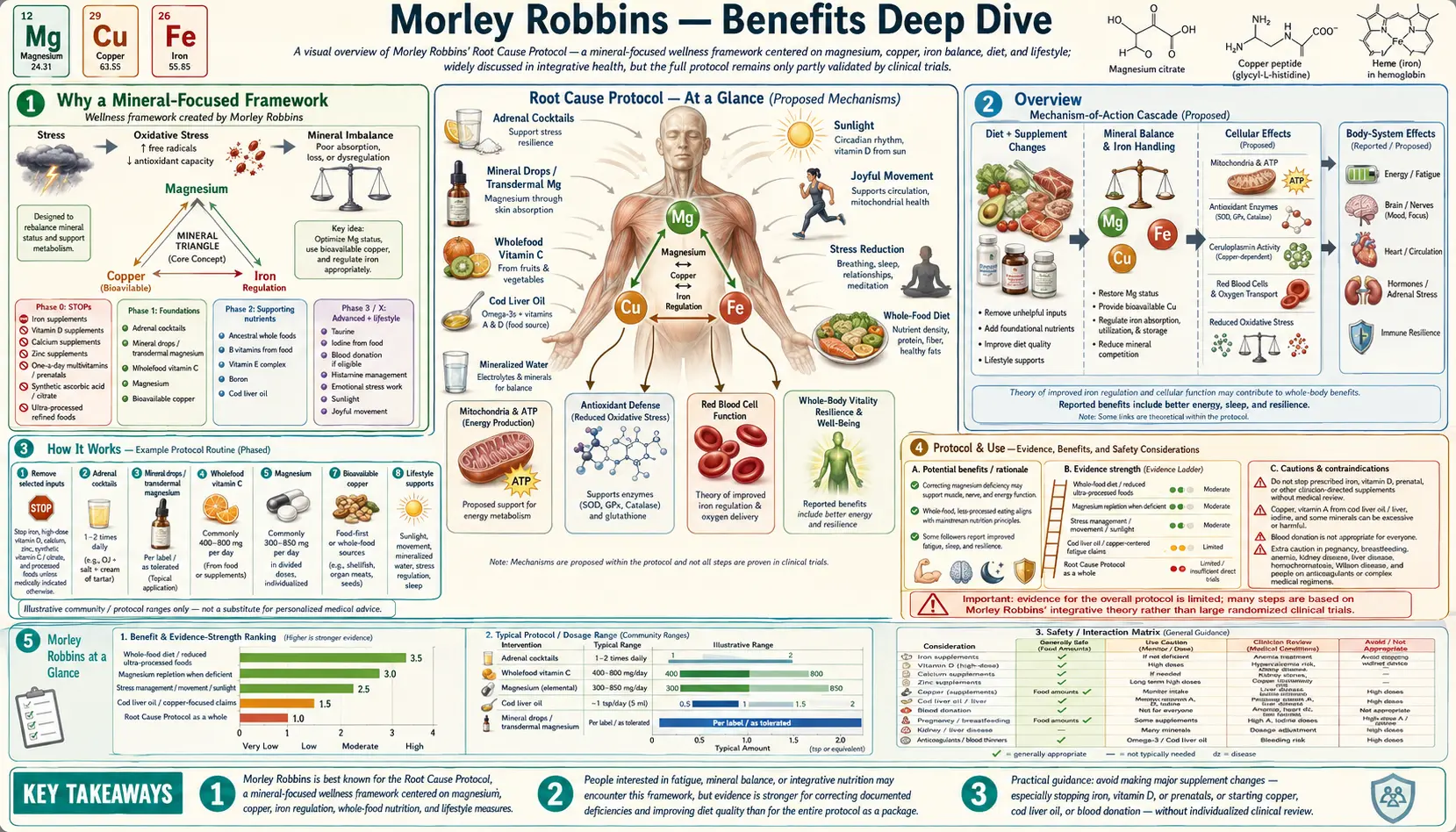
Morley Robbins is the founder of the Root Cause Protocol (RCP) and author of Cure Your Fatigue. His central thesis — rooted in the work of physiologists like Cleland, Wood, Frieden, and the late Hans Selye — is that chronic fatigue, hormonal dysfunction, and most modern degenerative conditions trace back to a triad of mineral dysregulation: bioavailable copper deficiency, iron overload in tissues, and depleted whole-body magnesium. This Benefits Deep Dive walks through the four areas where the RCP framework produces the largest, most measurable changes in patient lab values and symptoms: correcting the copper-iron imbalance that drives ferroptosis and oxidative stress, sourcing copper from whole foods (beef liver, oysters, cacao, bee pollen) rather than synthetic copper sulfate, restoring magnesium as the foundational mineral for over 800 enzyme reactions, and using the full RCP lab panel (HTMA, full iron panel, ceruloplasmin, RBC magnesium) to track the mineral status that ordinary CBC and CMP tests miss entirely.
Deep-Dive Articles
Copper-Iron Imbalance
Why the iron-fortification of the food supply since the 1940s, combined with bioavailable copper deficiency, drives ferroptosis, oxidative stress, and the chronic fatigue epidemic. The ceruloplasmin / hephaestin enzyme system, the role of unbound "free" iron in catalyzing Fenton reactions, why serum ferritin above 70 ng/mL in adults is a red flag rather than a benign marker, and the therapeutic donation protocol Robbins advocates for iron-overloaded patients.
Whole Food Copper Sources
Why Robbins rejects copper sulfate and copper gluconate supplements as bioavailable bound copper, and the whole-food sources he prescribes instead: beef liver (1-2 oz daily), oysters, dark chocolate / raw cacao, bee pollen, organ meats, and shellfish. The matrix-protected copper concept, why food copper arrives with co-factors (amino acids, retinol, magnesium) needed to load ceruloplasmin, and a practical food-rotation framework for non-organ-meat eaters.
Magnesium Foundation
Magnesium as the master mineral cofactor for over 800 enzyme reactions including the entire ATP production cascade. Why serum magnesium is a near-useless marker (RBC magnesium is the minimum, intracellular magnesium is gold), the magnesium glycinate / threonate / malate / taurate forms and what each is best for, the magnesium-copper-iron triangle, and Robbins' "salt + sun + steady-state magnesium" foundational practice.
RCP Lab Panel
The full Root Cause Protocol lab panel: HTMA (hair tissue mineral analysis) for tissue-level mineral status, full iron panel (serum iron, TIBC, transferrin saturation, ferritin), ceruloplasmin and copper, RBC magnesium, vitamin D 25-OH and 1,25-OH, and the often-overlooked ratios (Cu:Zn, Na:K, Ca:Mg, Fe:Cu). Why conventional labs miss the mineral story, how to read the RCP results, and the safety boundaries Robbins enforces.
Table of Contents
- Deep-Dive Articles
- Why a Mineral-Focused Framework
- Research Papers: Copper-Iron Axis
- Research Papers: Whole Food Copper
- Research Papers: Magnesium Foundation
- Research Papers: Lab Markers and Assessment
- Research Papers: Cross-Cutting (Mechanism, Cautions)
- External Authoritative Resources
- Connections
- Featured Videos
Why a Mineral-Focused Framework
Most functional medicine frameworks emphasize a long list of inputs: diet quality, sleep, stress, gut health, hormones, environmental toxins. The Root Cause Protocol narrows the differential dramatically. Robbins argues that almost every chronic symptom seen in functional practice — fatigue, anxiety, insomnia, hair loss, headaches, hypothyroid symptoms, hormonal imbalance, autoimmunity — can be traced back to three interconnected mineral problems and the fat-soluble vitamins (A, D, K2) that regulate them.
- Bioavailable copper deficiency — not total serum copper, but the fraction bound to functional ceruloplasmin, the enzyme that recycles iron, donates electrons to mitochondrial cytochrome c oxidase, and protects against oxidative stress. Many people have normal-to-elevated serum copper but low functional copper because their ceruloplasmin is unloaded or non-enzymatic.
- Iron overload in tissues — the result of decades of iron-fortified grain products, iron-fortified infant formula, and the historical over-prescription of iron supplements for fatigue. Excess iron deposits in the liver, heart, brain, and joints, where it catalyzes Fenton-reaction hydroxyl radical production that drives oxidative damage and ferroptosis.
- Depleted magnesium — the universal cofactor for ATP-dependent reactions, including the enzymes that load copper onto ceruloplasmin and recycle iron back into hemoglobin. Magnesium is the integrator of the whole mineral system; without it, the copper-iron correction does not proceed.
The four deep-dive pages below walk through each lever of the protocol and how they intersect. Copper-Iron Imbalance explains the biochemistry of why these two minerals are inseparable. Whole Food Copper Sources covers the dietary delivery system Robbins endorses (and why he rejects most commercial copper supplements). Magnesium Foundation establishes the substrate for the protocol. RCP Lab Panel describes the markers that confirm what is actually happening in tissue, not just in serum.
Robbins is explicit that the RCP is not a treatment for any specific disease — it is a foundational mineral and fat-soluble vitamin protocol that the body uses to self-correct downstream symptoms. It complements but does not replace conventional care for serious conditions. The Cure Your Fatigue book and the Magnesium Advocacy Group website are the canonical references.
Research Papers: Copper-Iron Axis
- Ceruloplasmin as ferroxidase and the copper-iron interface — PubMed: Ceruloplasmin ferroxidase
- Hephaestin and intestinal iron-copper coupling — PubMed: Hephaestin enterocyte
- Aceruloplasminemia and iron deposition in brain — PubMed: Aceruloplasminemia
- Frieden E, biological role of copper in oxidative reactions — PubMed: Frieden copper biology
- Ferroptosis as iron-dependent regulated cell death — PubMed: Ferroptosis
- Hemochromatosis and tissue iron overload natural history — PubMed: Hemochromatosis
- Iron fortification of food and population iron burden — PubMed: Iron fortification
- Klevay LM, copper deficiency and cardiovascular disease hypothesis — PubMed: Klevay copper
- Therapeutic phlebotomy for hyperferritinemia — PubMed: Therapeutic phlebotomy
- Fenton reaction and iron-catalyzed hydroxyl radical formation — PubMed: Fenton chemistry
Research Papers: Whole Food Copper
- Beef liver nutrient density and copper content — PubMed: Beef liver copper
- Oyster copper bioavailability — PubMed: Oyster copper
- Cacao and dark chocolate copper content — PubMed: Cacao copper
- Bee pollen mineral composition — PubMed: Bee pollen minerals
- Copper sulfate vs food copper bioavailability — PubMed: Copper bioavailability forms
- Zinc supplementation and induced copper deficiency — PubMed: Zinc-induced copper deficiency
- Whole-food matrix and mineral absorption — PubMed: Food matrix absorption
- Retinol-dependent copper transport — PubMed: Retinol and copper
- Copper RDA and dietary intake adequacy in U.S. adults — PubMed: Copper RDA adequacy
- Soil mineral depletion and food copper trends — PubMed: Soil copper depletion
Research Papers: Magnesium Foundation
- Magnesium as cofactor for ATP-dependent reactions — PubMed: Magnesium ATP cofactor
- Subclinical magnesium deficiency and chronic disease — PubMed: Subclinical Mg deficiency
- RBC magnesium vs serum magnesium for status assessment — PubMed: RBC magnesium assessment
- Magnesium glycinate bioavailability — PubMed: Magnesium glycinate
- Magnesium L-threonate and CNS penetration — PubMed: Magnesium threonate brain
- Magnesium and 25-hydroxyvitamin D activation — PubMed: Mg and vitamin D activation
- Magnesium and parathyroid hormone regulation — PubMed: Mg and PTH
- Magnesium and cardiovascular event risk — PubMed: Mg cardiovascular
- Magnesium and insulin sensitivity — PubMed: Mg insulin sensitivity
- Magnesium-copper-iron interplay in mitochondrial function — PubMed: Mg/Cu/Fe mitochondrial
Research Papers: Lab Markers and Assessment
- Hair tissue mineral analysis (HTMA) clinical utility and limitations — PubMed: HTMA clinical
- Ceruloplasmin enzymatic vs immunoreactive assay — PubMed: Ceruloplasmin assay forms
- Serum ferritin as inflammatory marker, not pure iron-store marker — PubMed: Ferritin inflammation
- Full iron panel interpretation: TIBC and transferrin saturation — PubMed: Iron panel interpretation
- Vitamin D 25-OH testing pitfalls and interpretation — PubMed: 25-OH-D testing
- Copper-zinc ratio as functional marker — PubMed: Cu:Zn ratio
- RBC magnesium reference range and chronic disease — PubMed: RBC Mg range
- Hepcidin as iron-regulatory hormone marker — PubMed: Hepcidin
- Retinol-binding protein (RBP4) and vitamin A status — PubMed: RBP4 status
- Soluble transferrin receptor as iron status marker — PubMed: sTfR iron marker
Research Papers: Cross-Cutting (Mechanism, Cautions)
- Copper, iron, and mitochondrial cytochrome c oxidase — PubMed: Cu and cytochrome c oxidase
- Glyphosate and mineral chelation hypothesis — PubMed: Glyphosate chelation
- Wilson's disease and copper toxicity — PubMed: Wilson's disease
- Menkes disease and copper deficiency — PubMed: Menkes disease
- Vitamin A and copper interaction in ceruloplasmin synthesis — PubMed: Vit A and copper
- Vitamin D and mineral absorption (Mg, Ca, P) — PubMed: Vit D mineral absorption
- Synthetic vitamin D supplementation and magnesium depletion — PubMed: Vit D and Mg depletion
- Adrenal cortisol and the mineral cascade (Selye) — PubMed: Selye adrenal mineral
- Iron-induced oxidative stress and chronic fatigue — PubMed: Iron and fatigue
- Magnesium deficiency and anxiety / depression — PubMed: Mg and anxiety
External Authoritative Resources
- The Root Cause Protocol — official Morley Robbins site (protocol stops/starts, lab guidance, RCP-trained consultants)
- Cure Your Fatigue (book by Morley Robbins, 2021)
- Linus Pauling Institute — Copper Micronutrient Information Center
- Linus Pauling Institute — Magnesium Micronutrient Information Center
- Linus Pauling Institute — Iron Micronutrient Information Center
- NIH ODS — Copper Fact Sheet
- NIH ODS — Magnesium Fact Sheet
Connections
- Morley Robbins (Main Page)
- Copper-Iron Imbalance
- Whole Food Copper Sources
- Magnesium Foundation
- RCP Lab Panel
- Root Cause Protocol
- Ceruloplasmin & Bioavailable Copper
- Iron Overload Hidden Toxicity
- Magnesium Replenishment
- Whole Food Copper Sources (Original)
- Adrenal Cortisol Mineral Connection
- Glyphosate Copper Chelation
- Vitamin D Controversy
- Copper
- Magnesium
- Iron