⚠ Evidence warning: Clinical trials or other evidence do not support the claims that correcting B12, magnesium or zinc shortages eliminates tinnitus and that antioxidants protect the ear. This page keeps it as a report of what people, websites or other media say.
Tinnitus — Benefits Deep Dive
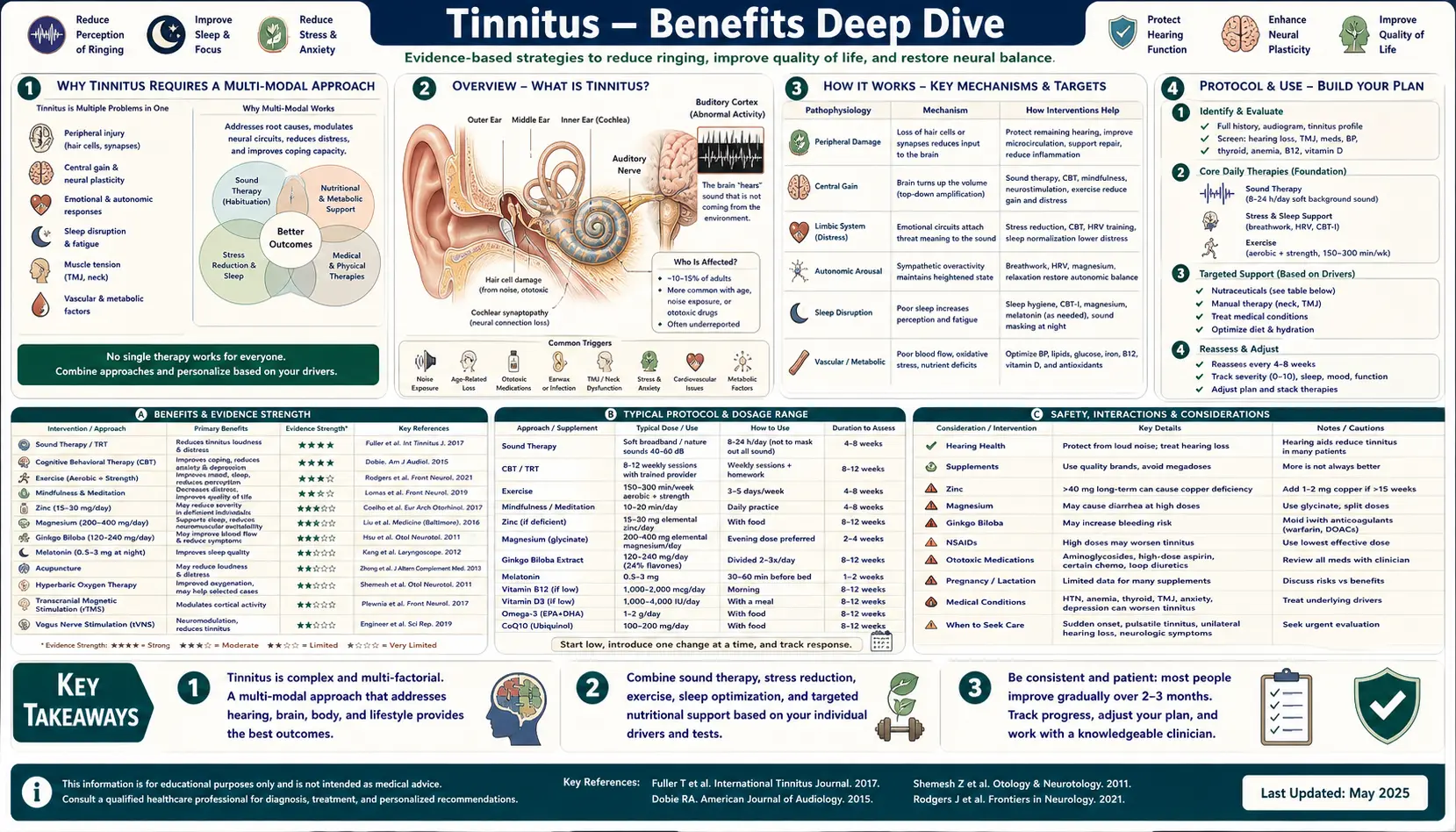
Tinnitus — the phantom perception of ringing, buzzing, hissing, or pulsing sound in the absence of an external acoustic source — affects roughly 10–15% of the global adult population, with severe tinnitus in about 2.3% (2022 pooled figures below). Despite its prevalence, tinnitus is not a disease in itself but a symptom, generated by central auditory-cortex hyperactivity that follows cochlear injury, ototoxic exposure, vascular dysfunction, cervical-spine misalignment, temporomandibular-joint dysfunction, or metabolic deficiency. The four deep-dive pages below cover the conditions and interventions where the evidence base is strongest: identifying the mechanistic cause and modifiable trigger profile, the specific micronutrient deficiencies (B12, magnesium, zinc) that produce reversible tinnitus, the sound-therapy and habituation approach that audiology departments use as a first line of management (in Cochrane reviews, cognitive-behavioral therapy is the option with a pooled benefit), and the role of N-acetylcysteine (NAC) and antioxidants in protecting cochlear hair cells from oxidative injury that initiates and perpetuates the phantom percept.
Deep-Dive Articles
Causes & Triggers
The mechanistic taxonomy of tinnitus — noise-induced cochlear damage, presbycusis, ototoxic medication (salicylates, aminoglycosides, loop diuretics, cisplatin), Meniere's disease, otosclerosis, vestibular schwannoma, temporomandibular joint dysfunction, cervical-spine misalignment, vascular and pulsatile causes, and the central plasticity that converts peripheral cochlear injury into chronic auditory-cortex hyperactivity. Includes the modifiable trigger list: caffeine, sodium, nicotine, alcohol, sleep deprivation, and stress.
Read the deep dive →B12, Magnesium & Zinc Status
The three micronutrient deficiencies most consistently associated with tinnitus in case-control studies. Vitamin B12 deficiency damages the myelin sheath of the cochlear nerve. In a 2016 pilot trial, 17 of 40 people with chronic tinnitus (42.5%) had low B12, and the deficient patients given weekly B12 injections improved on tinnitus severity scores. Magnesium attenuates noise-induced cochlear hair-cell injury through N-methyl-D-aspartate-receptor antagonism. A 2007 review gives zinc deficiency in 2 to 69% of people with tinnitus, and four of the five small studies it covers report benefit from zinc; in a series of 40 patients with severe tinnitus, 6 had low zinc and 7 decreased levels. A 2022 analysis of the US national survey (NHANES) found no significant link between low serum zinc and tinnitus, and a 2016 Cochrane review of 3 trials (209 people) found no evidence that oral zinc improves symptoms.
Read the deep dive →Sound Therapy & Habituation
Tinnitus Retraining Therapy (TRT), masking devices, notched-music therapy, hearing-aid amplification for the most common comorbid condition (sensorineural hearing loss), and cognitive-behavioral therapy. Cochrane reviews found that cognitive-behavioral therapy may lessen the impact of tinnitus on quality of life, and found no evidence that sound therapy beats a waiting list, placebo or education with no device. The Jastreboff neurophysiologic model explains why habituation rather than suppression is the therapeutic target, and why most patients ultimately learn to ignore the phantom signal even when its peripheral driver cannot be cured.
Read the deep dive →N-Acetylcysteine & Antioxidants
N-acetylcysteine as a glutathione precursor that protects cochlear hair cells from the oxidative burst produced by acoustic overexposure, ototoxic chemotherapy, and aminoglycoside antibiotics. Reviews the military trials of pre-exposure N-acetylcysteine for impulse-noise injury, the cisplatin-otoprotection trials, and the role of alpha-lipoic acid, coenzyme Q10, idebenone, and Vitamin E in maintaining cochlear redox balance. Also covers Ginkgo biloba (a standardized leaf extract) and the 2013 Cochrane review, whose limited evidence did not show it to be effective when tinnitus is the main complaint.
Read the deep dive →Table of Contents
- Deep-Dive Articles
- Why Tinnitus Requires a Multi-Modal Approach
- Research Papers: Causes and Mechanism
- Research Papers: Nutritional Status (B12, Mg, Zn)
- Research Papers: Sound Therapy and Habituation
- Research Papers: N-Acetylcysteine and Antioxidants
- Research Papers: Cross-Cutting (Epidemiology, Comorbidities)
- External Authoritative Resources
- Connections
- Featured Videos
Why Tinnitus Requires a Multi-Modal Approach
Tinnitus is unusual in clinical medicine because it is a symptom rather than a disease, the perceived signal originates in the brain rather than the ear, and the most effective management strategies are non-pharmacologic. No U.S. Food and Drug Administration-approved drug specifically treats tinnitus. The combinations of interventions that work best for any given patient depend on identifying which causal pathway is dominant in that individual.
- Peripheral cochlear injury — noise exposure, ototoxic medication, presbycusis, and Meniere's disease all damage the cochlear hair cells, reducing afferent auditory nerve input to the central auditory cortex. The cortex responds with maladaptive plasticity (similar to phantom-limb pain) that generates the phantom signal. Once the central process is established, eliminating the peripheral driver does not always resolve the phantom percept — the cortical reorganization persists. This is why prevention is more effective than treatment, and why otoprotectant antioxidants during predictable noise or ototoxic exposure have the largest mechanistic footprint.
- Central auditory-cortex hyperactivity — once established, the phantom signal can be modulated by training the brain to filter it out of conscious awareness. The Jastreboff neurophysiologic model frames tinnitus as a failure of the limbic system to demote the phantom signal to background noise. Sound therapy, Tinnitus Retraining Therapy, and cognitive-behavioral therapy all work by retraining the limbic-prefrontal filtering loop rather than by suppressing the signal itself.
- Modifiable triggers — even when the underlying cause cannot be reversed, tinnitus loudness fluctuates day-to-day in response to caffeine, sodium, alcohol, nicotine, sleep deprivation, stress, and certain medications. People report that finding and removing their own triggers can reduce symptom burden substantially without addressing the root cause. Practitioners describe the trigger inventory as the first step in conservative management.
- Reversible nutritional deficiencies — vitamin B12 deficiency, magnesium depletion, and zinc deficiency are each documented to cause or worsen tinnitus in repletion-responsive subsets of patients. These blood tests are inexpensive, and practitioners describe correcting a deficiency as one of the few mechanistically-grounded steps with the potential to eliminate tinnitus entirely in a small fraction of cases. The nutrient-status deep-dive covers testing protocols and dosing.
Practitioners describe most patients with chronic tinnitus as benefiting from a stacked approach: trigger elimination plus nutrient repletion plus hearing-aid amplification (when sensorineural hearing loss is present) plus sound therapy plus cognitive-behavioral therapy for the distress component. No single intervention works for everyone, and only part of that list has been tested in combination (see the 2025 trial below).
What Recent Research Reports
How common it is. A 2022 pooled analysis of general-population studies put tinnitus at 14.4% of adults: 9.7% at ages 18–44, 13.7% at 45–64 and 23.6% at 65 and over. Severe tinnitus was 2.3%. The authors estimate that tinnitus affects more than 740 million adults worldwide (Jarach et al., 2022).
One treatment or two. A 2025 randomised trial at five European sites tested this in 461 people with chronic tinnitus, using cognitive-behavioral therapy, hearing aids, app-based counselling or app-based sound therapy, alone or in pairs, for 12 weeks. Scores on a 0–100 handicap scale fell 11.7 points with one treatment and 14.9 with two, a statistically significant difference. The researchers saw no clear synergy: cognitive-behavioral therapy or hearing aids alone had large effects that a second treatment did not raise further. Trigger elimination and nutrient repletion were not part of the trial (Schoisswohl et al., 2025).
Cognitive-behavioral therapy. A 2020 Cochrane review of 28 studies (2,733 people) found scores about 11 points lower on the same 0–100 scale than with no treatment (low certainty) and about 5.65 points lower than with audiological care (moderate certainty). The review took 7 points as the smallest difference that matters to patients. These results cover the end of treatment only, because evidence at 6 and 12 months was absent (Fuller et al., 2020).
Vitamin B12. A 2024 double-blind trial gave vitamin B12 or placebo for a month to 140 people with idiopathic tinnitus and found no significant difference in severity or handicap scores at one or three months (Dadgarnia et al., 2024). In a 2013 study of 100 patients, 63 of them low in B12, replacement brought no significant change in tinnitus severity (Berkiten et al., 2013). The 2016 pilot trial that did report benefit found it in patients who were actually deficient, which fits the “repletion-responsive subsets” wording above (Singh et al., 2016). A 2022 analysis of 9,439 adults in the US national survey found no significant link between low serum B12 or zinc and tinnitus (Narayanan et al., 2022).
N-acetylcysteine and noise. The largest trial located, 566 military personnel given N-acetylcysteine or placebo around weapons training, found no significant difference in its primary measure, the rate of threshold shifts (a sign of hearing damage). A secondary measure, the ear on the trigger-hand side, did differ: 34.98% with placebo and 27.14% with the drug. Adverse events were similar (26.7% and 27.4%). The authors state that the study design failed to confirm a benefit and that further studies are needed (Kopke et al., 2015).
Sound paired with tongue stimulation. Devices that pair sounds with mild electrical stimulation of the tongue are newer than most of the research listed here. In a 2022 randomised, double-blinded trial, both device settings tested reduced symptoms, the effects lasted up to 12 months after treatment ended, there were no treatment-related serious adverse events, and 70.3% of participants indicated benefit (Conlon et al., 2022). The paper’s competing-interest statement lists several authors as employees, consultants or shareholders of the device’s maker.
What Is Not Known
A 2016 Cochrane review found no evidence that oral zinc improves tinnitus symptoms, and a 2013 Cochrane review found that the limited evidence does not show Ginkgo biloba to be effective when tinnitus is the main complaint. The 2018 Cochrane review of sound therapy found little or no use of blinding and no usable data comparing devices with a waiting list, placebo or no device. Its authors point to the strong likelihood of a placebo response in tinnitus, so how much of the improvement seen with a device comes from the device itself is not separated.
Research Papers: Causes and Mechanism
- Eggermont JJ, Roberts LE. The neuroscience of tinnitus (Trends in Neurosciences 2004) — PubMed PMID: 15474168
- Jastreboff PJ. Phantom auditory perception (tinnitus): mechanisms of generation and perception (Neuroscience Research 1990) — PubMed PMID: 2175858
- Henry JA et al. General review of tinnitus: prevalence, mechanisms, effects, and management (2005) — PubMed PMID: 16411806
- Bauer CA. Tinnitus (New England Journal of Medicine 2018) — PubMed PMID: 29601255
- Noreña AJ. An integrative model of tinnitus based on a central gain controlling neural sensitivity (Neuroscience and Biobehavioral Reviews 2011) — PubMed PMID: 21094182
- Roberts LE et al. Ringing ears: the neuroscience of tinnitus (Journal of Neuroscience 2010) — PubMed PMID: 21068300
- Cima RFF et al. A multidisciplinary European guideline for tinnitus: diagnostics, assessment, and treatment (HNO 2019) — PubMed PMID: 30847513
- De Ridder D et al. Phantom percepts: tinnitus and pain as persisting aversive memory networks (PNAS 2011) — PubMed PMID: 21502503
- Schaette R, McAlpine D. Tinnitus with a normal audiogram: physiological evidence for hidden hearing loss and computational model (Journal of Neuroscience 2011) — PubMed PMID: 21940438
- Bhatt JM et al. Prevalence, severity, exposures, and treatment patterns of tinnitus in the US (JAMA Otolaryngol 2016) — PubMed PMID: 27441392
Research Papers: Nutritional Status (B12, Mg, Zn)
- Shemesh Z et al. Vitamin B12 deficiency in patients with chronic-tinnitus and noise-induced hearing loss (American Journal of Otolaryngology 1993) — PubMed PMID: 8484483
- Singh C, Kawatra R, Gupta J, Awasthi V, Dungana H. Therapeutic role of Vitamin B12 in patients of chronic tinnitus: A pilot study (Noise and Health 2016) — PubMed PMID: 26960786
- Cevette MJ et al. Magnesium and hearing (Journal of the American Academy of Audiology 2003) — PubMed PMID: 12940704
- Attias J et al. Oral magnesium intake reduces permanent hearing loss induced by noise exposure (American Journal of Otolaryngology 1994) — PubMed PMID: 8135325
- Coelho CB, Tyler R, Hansen M. Zinc as a possible treatment for tinnitus (Progress in Brain Research 2007) — PubMed PMID: 17956792
- Person OC et al. Zinc supplementation for tinnitus (Cochrane 2016) — PubMed PMID: 27879981
- Berkiten G et al. Vitamin B12 levels in patients with tinnitus and effectiveness of vitamin B12 treatment on hearing threshold and tinnitus (B-ENT 2013) — PubMed PMID: 23909117
- Lasisi AO et al. The role of plasma melatonin and vitamins C and B12 in the development of idiopathic tinnitus in the elderly (Ghana Medical Journal 2012) — PubMed PMID: 23661829
- Yetiser S et al. The role of zinc in management of tinnitus (Auris Nasus Larynx 2002) — PubMed PMID: 12393036
- Joachims Z, Netzer A, Ising H et al. Oral magnesium supplementation as prophylaxis for noise-induced hearing loss: results of a double blind field study (Schriftenreihe des Vereins für Wasser-, Boden- und Lufthygiene 1993) — PubMed PMID: 8460390
- Dadgarnia M et al. The effect of vitamin B12 on idiopathic tinnitus (American Journal of Otolaryngology 2024) — PubMed PMID: 37647778
- Narayanan SS et al. Micronutrients in tinnitus: A National Health and Nutrition Examination Survey analysis (American Journal of Otolaryngology 2022) — PubMed PMID: 35429847
Research Papers: Sound Therapy and Habituation
- Jastreboff PJ, Hazell JW. A neurophysiological approach to tinnitus: clinical implications (British Journal of Audiology 1993) — PubMed PMID: 8339063
- Hoare DJ, Searchfield GD, El Refaie A, Henry JA. Sound therapy for tinnitus management: practicable options (Journal of the American Academy of Audiology 2014) — PubMed PMID: 24622861
- Sereda M et al. Sound therapy (using amplification devices and/or sound generators) for tinnitus (Cochrane 2018) — PubMed PMID: 30589445
- Fuller T et al. Cognitive behavioural therapy for tinnitus (Cochrane 2020) — PubMed PMID: 31912887
- Okamoto H et al. Listening to tailor-made notched music reduces tinnitus loudness and tinnitus-related auditory cortex activity (PNAS 2010) — PubMed PMID: 20080545
- Tunkel DE et al. Clinical practice guideline: tinnitus (AAO-HNS 2014) — PubMed PMID: 25273878
- Hesser H et al. A systematic review and meta-analysis of randomized controlled trials of cognitive-behavioral therapy for tinnitus distress (Clinical Psychology Review 2011) — PubMed PMID: 21237544
- Hobson J et al. Sound therapy (masking) in the management of tinnitus in adults (Cochrane 2012) — PubMed PMID: 23152235
- Searchfield GD, Durai M, Linford T. A State-of-the-Art Review: Personalization of Tinnitus Sound Therapy (Frontiers in Psychology 2017) — PubMed PMID: 28970812
- Conlon B et al. Bimodal neuromodulation combining sound and tongue stimulation reduces tinnitus symptoms (Science Translational Medicine 2020) — PubMed PMID: 33028707
- Conlon B et al. Different bimodal neuromodulation settings reduce tinnitus symptoms in a large randomized trial (Scientific Reports 2022) — PubMed PMID: 35773272
Research Papers: N-Acetylcysteine and Antioxidants
- Kopke RD et al. NAC for noise: from the bench top to the clinic (Hearing Research 2007) — PubMed PMID: 17184943
- Lin CY et al. N-Acetyl-cysteine against noise-induced temporary threshold shift in male workers (Hearing Research 2010) — PubMed PMID: 20638463
- Riga MG et al. Transtympanic injections of N-acetylcysteine for the prevention of cisplatin-induced ototoxicity: a feasible method with promising efficacy (American Journal of Clinical Oncology 2013) — PubMed PMID: 22134515
- Le Prell CG et al. Free radical scavengers vitamins A, C, and E plus magnesium reduce noise trauma (Free Radical Biology and Medicine 2007) — PubMed PMID: 17395018
- Hilton MP, Zimmermann EF, Hunt WT. Ginkgo biloba for tinnitus (Cochrane 2013) — PubMed PMID: 23543524
- Henderson D et al. The role of oxidative stress in noise-induced hearing loss (Ear and Hearing 2006) — PubMed PMID: 16446561
- Choi CH et al. Effectiveness of 4-hydroxy phenyl N-tert-butylnitrone (4-OHPBN) alone and in combination with other antioxidant drugs in the treatment of acute acoustic trauma in chinchilla (Free Radical Biology and Medicine 2008) — PubMed PMID: 18328271
- Doosti A et al. Comparison of the effects of N-acetyl-cysteine and ginseng in prevention of noise induced hearing loss in male textile workers (Noise and Health 2014) — PubMed PMID: 25033789
- Kopke R et al. Efficacy and safety of N-acetylcysteine in prevention of noise induced hearing loss: a randomized clinical trial (Hearing Research 2015) — PubMed PMID: 25620313
Research Papers: Cross-Cutting (Epidemiology, Comorbidities)
- McCormack A et al. A systematic review of the reporting of tinnitus prevalence and severity (Hearing Research 2016) — PubMed PMID: 27246985
- Langguth B et al. Tinnitus: causes and clinical management (Lancet Neurology 2013) — PubMed PMID: 23948178
- Baguley D et al. Tinnitus (Lancet 2013) — PubMed PMID: 23827090
- Folmer RL, Griest SE. Tinnitus and insomnia (American Journal of Otolaryngology 2000) — PubMed PMID: 11032291
- Bhatt JM et al. Relationships between tinnitus and the prevalence of anxiety and depression (Laryngoscope 2017) — PubMed PMID: 27301552
- Bisht M, Bist SS. Ototoxicity: the hidden menace (Indian Journal of Otolaryngology and Head and Neck Surgery 2011) — PubMed PMID: 22754805
- Kreuzer PM et al. Trauma-associated tinnitus (Journal of Head Trauma Rehabilitation 2014) — PubMed PMID: 23982788
- Levine RA. Somatic (craniocervical) tinnitus and the dorsal cochlear nucleus hypothesis (Am J Otolaryngol 1999) — PubMed PMID: 10609479
- Manche SK et al. Association of tinnitus and hearing loss in otological disorders: a decade-long epidemiological study in a South Indian population (Brazilian Journal of Otorhinolaryngology 2016) — PubMed PMID: 26923827
- Jarach CM et al. Global Prevalence and Incidence of Tinnitus: A Systematic Review and Meta-analysis (JAMA Neurology 2022) — PubMed PMID: 35939312
- Schoisswohl S et al. Single versus combination treatment in tinnitus: an international, multicentre, parallel-arm, superiority, randomised controlled trial (Nature Communications 2025) — PubMed PMID: 41271763
External Authoritative Resources
- American Tinnitus Association — the primary US patient-advocacy and research-funding organization, comprehensive evidence-based resources
- NIH/NIDCD — Tinnitus (federal evidence summary and research portfolio)
- AAO-HNS Clinical Practice Guideline: Tinnitus (Tunkel 2014) — the US clinical guideline
- NICE Guideline NG155 — Tinnitus: assessment and management (UK clinical guideline)
- PubMed — All research on tinnitus treatment (50,000+ papers)
Connections
- All Remedies
- Tinnitus Hub (Main Page)
- Causes and Triggers
- B12, Magnesium and Zinc Status
- Sound Therapy and Habituation
- N-Acetylcysteine and Antioxidants
- Ginkgo Biloba for Tinnitus
- Glycine for Tinnitus
- Taurine for Tinnitus
- Vitamin B12
- Magnesium
- Zinc
- N-Acetyl-Cysteine
- Ginkgo Biloba
- Neurology
- Tinnitus — the ENT clinical overview: symptoms, diagnostic workup, and conventional treatment these deep dives build on.