⚠ Evidence warning: Clinical trials or other evidence do not support the claim that pyrroloquinoline quinone reduces fatigue and improves sleep quality. This page keeps it as a report of what people, websites or other media say.
Mitochondrial Health and Oxidative Stress
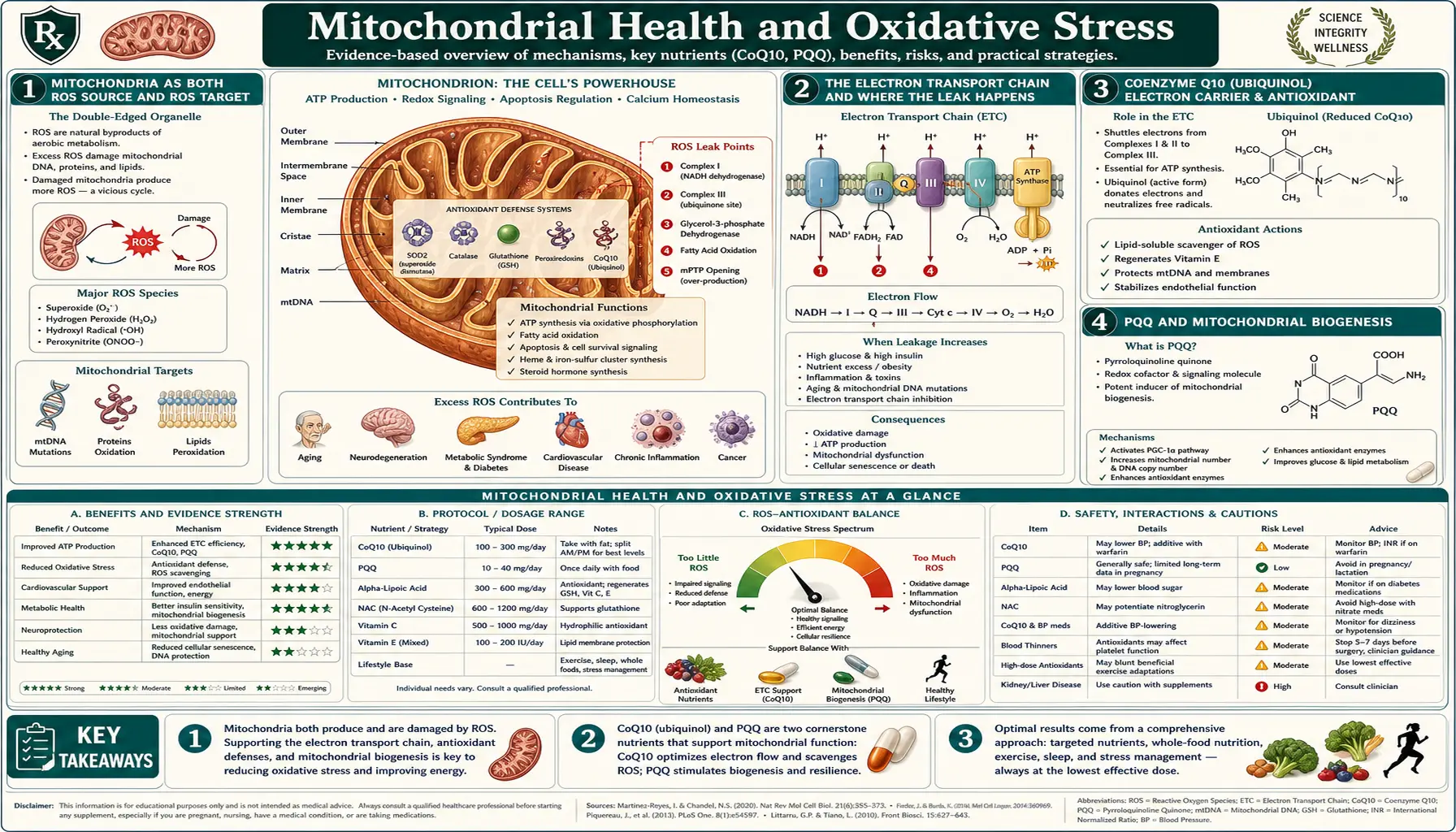
Mitochondria are the dominant source of reactive oxygen species in human cells — approximately 0.2 to 2 percent of the oxygen they consume escapes the electron transport chain as superoxide. They are also the dominant target of oxidative damage, because mitochondrial DNA sits unprotected by histones, just nanometers from the leaky electron transport chain. The result is a feedback loop where mitochondrial dysfunction generates more reactive oxygen species (ROS), which damages more mitochondria. This loop is now recognized as a central feature of nearly every chronic disease and the aging process itself — the Harman free-radical theory of aging, while incomplete, captures something real about mitochondrial decline. Supporting mitochondrial health is therefore not just one antioxidant strategy among many; it is the strategy that targets reactive oxygen species production at its source rather than mopping up afterward. This deep-dive walks through the electron transport chain's role as both reactive oxygen species producer and target, the supplements with the best evidence (coenzyme Q10 (CoQ10), pyrroloquinoline quinone (PQQ), nicotinamide adenine dinucleotide (NAD+) precursors, alpha-lipoic acid), the indispensable role of exercise as the most potent mitochondrial biogenesis stimulus, and how mitochondrial dysfunction unifies the metabolic-neurodegenerative-aging disease cluster.
Table of Contents
- Mitochondria as Both Reactive Oxygen Species Source and Reactive Oxygen Species Target
- The Electron Transport Chain and Where the Leak Happens
- Coenzyme Q10 (Ubiquinol) — Electron Carrier and Antioxidant
- Pyrroloquinoline Quinone and Mitochondrial Biogenesis
- Nicotinamide Adenine Dinucleotide Decline with Aging and Nicotinamide Mononucleotide/Nicotinamide Riboside Supplementation
- Alpha-Lipoic Acid as the Mitochondrial Cofactor
- Exercise — The Most Potent Mitochondrial Biogenesis Stimulus
- Mitophagy: Removing Damaged Mitochondria
- Mitochondrial Dysfunction as Unifying Disease Mechanism
- Cautions and a Commonly Described Stack
- Key Research Papers
- Connections
- Featured Videos
Mitochondria as Both Reactive Oxygen Species Source and Reactive Oxygen Species Target
Every cell in the body except mature red blood cells contains mitochondria — from a handful in lymphocytes to thousands in cardiomyocytes and hepatocytes. They produce the adenosine triphosphate (ATP) that powers virtually all cellular work through oxidative phosphorylation, consuming the oxygen we breathe in the process. They also house the citric acid cycle, beta-oxidation of fatty acids, heme synthesis, steroid hormone biosynthesis, and a major checkpoint of apoptotic cell death (cytochrome c release initiates the intrinsic apoptosis pathway).
The very oxygen that mitochondria require for energy production is also the source of most cellular reactive oxygen species. During electron transport, approximately 0.2 to 2% of consumed oxygen leaks out of the chain at Complexes I and III, forming superoxide anion (O2·-) instead of being fully reduced to water at Complex IV. In a resting cell at low metabolic rate, that fraction may be only 0.2%. Under metabolic stress, hypoxia-reoxygenation, dysfunction, or genetic compromise of the electron transport chain, the leak can rise to several percent. Multiply by the total oxygen consumed per day (the body uses roughly 350-500 liters of oxygen daily), and the reactive oxygen species production at the mitochondrial inner membrane is the dominant source of cellular oxidant load.
The same mitochondria are also a primary target of that reactive oxygen species damage:
- Mitochondrial DNA (mtDNA) sits in the matrix, just nanometers from the electron transport chain leak site, and is not packaged into histones the way nuclear DNA is. It is therefore more vulnerable to reactive oxygen species damage and accumulates mutations approximately 10x faster than nuclear DNA. Each cell has hundreds to thousands of mtDNA copies (versus 2 nuclear copies), and damaged copies can clonally expand within a cell over time.
- Inner mitochondrial membrane lipids — the cardiolipin that is essential for Complex I, III, IV, V, and the ADP/ATP translocator function — are highly enriched in oxidation-prone polyunsaturated fatty acid chains. Cardiolipin peroxidation directly disrupts respiratory chain assembly and triggers release of cytochrome c into the cytoplasm, initiating apoptosis.
- Iron-sulfur cluster enzymes — the Fe-S clusters in Complex I, Complex II, aconitase (citric acid cycle), and others are exquisitely sensitive to oxidative inactivation.
This sets up the central feedback loop of mitochondrial aging: reactive oxygen species damages mitochondria, damaged mitochondria leak more reactive oxygen species, more reactive oxygen species damages more mitochondria. Cells that cannot break this loop (through mitophagy and biogenesis discussed below) accumulate dysfunctional mitochondria, transition to greater glycolytic dependence, and ultimately senesce or die. This is the modern molecular update on Denham Harman's 1956 free-radical theory of aging and the related Harman 1972 mitochondrial theory of aging.
The Electron Transport Chain and Where the Leak Happens
The mitochondrial electron transport chain is composed of four large protein complexes (Complex I through IV) plus adenosine triphosphate synthase (sometimes called Complex V) embedded in the inner mitochondrial membrane, with two mobile electron carriers (ubiquinone and cytochrome c) shuttling electrons between them. The flow:
- Complex I (reduced nicotinamide adenine dinucleotide (NADH) dehydrogenase) — receives electrons from reduced nicotinamide adenine dinucleotide (generated by the citric acid cycle and fatty acid oxidation), pumps 4 protons across the inner membrane, passes electrons to ubiquinone. This is the largest leak site for superoxide production, especially under reverse-electron-transport conditions.
- Complex II (succinate dehydrogenase) — receives electrons from succinate (citric acid cycle intermediate via FADH2), passes them to ubiquinone. Does not pump protons. Also a leak site, particularly relevant in reperfusion injury after ischemia.
- Ubiquinone (Coenzyme Q10) — the mobile lipophilic electron carrier moving between Complex I/II and Complex III. Its reduced form (ubiquinol) is itself an antioxidant.
- Complex III (cytochrome bc1 complex) — transfers electrons from ubiquinol to cytochrome c, pumps 4 protons. The Q cycle at Complex III is the second major superoxide leak site.
- Cytochrome c — small water-soluble carrier in the intermembrane space.
- Complex IV (cytochrome c oxidase) — transfers electrons to O2, forming water; pumps 2 protons. This is the actual oxygen consumption step. Iron and copper cofactors.
- Adenosine triphosphate Synthase (Complex V) — the proton gradient generated by Complexes I, III, IV is harnessed to drive adenosine triphosphate synthesis from ADP and Pi.
The leak is greatest when:
- The proton gradient is high and adenosine triphosphate demand is low (the chain is "backed up" with reduced cofactors that cannot be re-oxidized fast enough). This is the typical state during caloric excess and sedentary metabolism.
- Specific complexes are inhibited (rotenone at Complex I, antimycin A at Complex III) or damaged.
- Coenzyme Q10 is depleted (statin drugs inhibit HMG-CoA reductase, which is also the rate-limiting step for endogenous coenzyme Q10 synthesis).
- The inner membrane lipid composition is compromised (cardiolipin oxidation, deficiency of essential fatty acids).
The leak is reduced by:
- Sufficient adenosine triphosphate demand to maintain electron flow through the chain (exercise).
- Uncoupling proteins (UCP1 in brown adipose, UCP2/3 in other tissues) that allow controlled dissipation of the proton gradient as heat instead of adenosine triphosphate.
- Caloric restriction or intermittent fasting (which transiently reduces substrate flux through the chain).
This last point is mechanistically important. Caloric restriction extends lifespan in nearly every species studied (worms, flies, mice, monkeys), and reduced mitochondrial reactive oxygen species production from a less-saturated electron transport chain is one of the principal proposed mechanisms.
Coenzyme Q10 (Ubiquinol) — Electron Carrier and Antioxidant
Coenzyme Q10 is the electron carrier shuttling reducing equivalents between Complex I/II and Complex III in the electron transport chain. It is a lipophilic quinone (the 10 in coenzyme Q10 refers to its 10-isoprenoid-unit hydrophobic tail). It exists in two forms: oxidized ubiquinone and reduced ubiquinol. The reduced form is the better-absorbed supplement form and is also the form that has direct antioxidant activity in the membrane.
Endogenous coenzyme Q10 synthesis declines with age (myocardial coenzyme Q10 at age 80 is approximately 50% of age 20 levels) and is suppressed by statin drugs (HMG-CoA reductase is the shared rate-limiting step for both cholesterol synthesis and the polyisoprenoid tail of coenzyme Q10). A 2015 pooled analysis of placebo-controlled trials found that statins significantly lower blood coenzyme Q10 levels (Banach 2015, Pharmacological Research). Whether this shortfall contributes to statin-associated muscle symptoms is debated, and the pooled trial results on coenzyme Q10 for those symptoms disagree (see below).
The supplementation evidence:
- Heart failure — the Q-SYMBIO trial (Mortensen 2014) randomized 420 patients with NYHA Class III-IV heart failure to coenzyme Q10 100 mg three times daily (300 mg/day) or placebo, added to standard heart failure therapy. The short-term measures at 16 weeks did not change significantly. After 2 years, major adverse cardiovascular events (death, hospitalization) had occurred in 15% of the coenzyme Q10 group versus 26% of the placebo group (hazard ratio 0.50); heart-related deaths were 9% versus 16% and deaths from any cause 10% versus 18%. This is a substantial effect for an over-the-counter (OTC) supplement.
- Statin-associated myalgia — mixed evidence. A 2015 pooled analysis of 6 randomized trials (302 people on statins) found no significant effect of coenzyme Q10 on muscle pain or on creatine kinase, the blood marker of muscle damage (Banach 2015, Mayo Clinic Proceedings). A larger 2018 pooled analysis of 12 randomized trials (575 people on statins) found that coenzyme Q10 lowered statin muscle pain, weakness, cramps and tiredness compared with placebo, but did not lower creatine kinase (Qu 2018). Some clinicians offer 100-200 mg/day coenzyme Q10 to people with statin-associated muscle symptoms before the statin is stopped.
- Migraine prophylaxis — the 2012 American Academy of Neurology and American Headache Society guideline lists coenzyme Q10 among treatments "considered possibly effective" for migraine prevention (Level C, its lowest positive rating, below butterbur at Level A and magnesium and riboflavin at Level B). The guideline summary gives no dose (Holland 2012).
- Mitochondrial diseases — primary coenzyme Q10 deficiency and other inherited mitochondrial diseases are treated with high-dose coenzyme Q10 (often 1,000-2,400 mg/day).
- Parkinson's disease — the QE3 trial (Beal 2014) of high-dose coenzyme Q10 in early Parkinson's was disappointing for disease modification despite earlier promising pilot data. It enrolled 600 people with early Parkinson's at 67 North American sites and gave 1,200 or 2,400 mg/day of coenzyme Q10 (all participants also took vitamin E) or placebo for up to 16 months. The trial was stopped when it reached a pre-set futility rule: both doses showed slight adverse trends compared with placebo, and the authors reported "no evidence of clinical benefit", although coenzyme Q10 was safe and well tolerated.
- Fertility — a small 2014 trial (Bentov 2014) gave 600 mg/day of coenzyme Q10 or placebo to women aged 35-43 undergoing in vitro fertilization (IVF). It was stopped early, and 24 women completed a treatment cycle. Eggs with an abnormal chromosome count (aneuploidy) made up 46.5% in the coenzyme Q10 group and 62.8% in the placebo group, but the authors found no significant differences in outcome; the study was too small to detect one.
Doses reported in common practice: 100-200 mg of ubiquinol daily for general antioxidant and statin support; 200-300 mg/day for heart failure; 300-600 mg/day for migraine or fertility; higher for primary mitochondrial disease under specialist supervision. The trials above used 300 mg/day (heart failure), 600 mg/day (fertility) and 1,200-2,400 mg/day (Parkinson's). Ubiquinol is better absorbed than ubiquinone, especially in older adults. Coenzyme Q10 is fat-soluble and is usually taken with a meal containing fat for absorption. Ubiquinol products differ in quality between manufacturers.
Pyrroloquinoline Quinone and Mitochondrial Biogenesis
Pyrroloquinoline quinone (PQQ) is a small redox-active cofactor found in trace amounts in many foods (parsley, green tea, kiwi, papaya, tofu, natto, breast milk). It was initially studied for its role in bacterial dehydrogenases, then suggested to be nutritionally important in mammals based on mouse dietary deprivation experiments. Killgore and colleagues (1989) reported that mice fed a diet with no pyrroloquinoline quinone grew poorly, failed to reproduce and developed connective-tissue defects, suggesting a role as a growth factor or vitamin. Stites and colleagues (2006) found that pyrroloquinoline quinone-deficient young mice had 20-30% fewer mitochondria in the liver than supplemented mice.
Pyrroloquinoline quinone's major distinct mechanism is induction of mitochondrial biogenesis — the synthesis of new mitochondria from existing ones. It does this by activating the master transcriptional regulator PGC-1alpha (peroxisome proliferator-activated receptor gamma coactivator 1-alpha), which coordinates the transcription of nuclear and mitochondrial genes for mitochondrial proteins. Activated PGC-1alpha increases mitochondrial number and total mitochondrial mass within target tissues. This mechanism comes mainly from cell and animal studies.
The human clinical evidence is small but interesting. Pyrroloquinoline quinone has been reported to reduce fatigue and improve sleep quality. In a 2013 crossover study of 10 adults (Harris 2013), pyrroloquinoline quinone taken daily (0.3 mg per kilogram of body weight) lowered blood C-reactive protein and interleukin-6, two markers of inflammation, after about 3 days, and shifted urine metabolites in a way the authors read as greater mitochondrial activity; a single dose changed a blood marker of oxidative damage. In a 2020 trial (Hwang 2020), 23 untrained men took 20 mg/day or placebo during 6 weeks of supervised endurance training: aerobic performance and body composition did not differ between the groups, but the pyrroloquinoline quinone group had higher muscle levels of PGC-1alpha, a marker of new mitochondria being made.
What is not known: the human trials are small (10 to 23 people) and short (days to weeks), and they do not show whether pyrroloquinoline quinone improves fatigue, sleep, thinking or long-term health.
Commonly used doses are 10-20 mg/day; the 2020 trial used 20 mg/day. It is often combined with coenzyme Q10, on the reasoning that the two work at complementary stages (coenzyme Q10 supports existing electron transport; pyrroloquinoline quinone stimulates production of new mitochondria).
Nicotinamide Adenine Dinucleotide Decline with Aging and Nicotinamide Mononucleotide/Nicotinamide Riboside Supplementation
Nicotinamide adenine dinucleotide (NAD+) is the central redox cofactor for cellular metabolism. It accepts electrons from glycolysis, the citric acid cycle, and fatty acid oxidation (becoming reduced nicotinamide adenine dinucleotide), then donates them to the electron transport chain (regenerating nicotinamide adenine dinucleotide). The total nicotinamide adenine dinucleotide + reduced nicotinamide adenine dinucleotide pool is therefore continuously recycled, but the size of that total pool also matters for several other functions: nicotinamide adenine dinucleotide is a substrate for the sirtuin family (especially SIRT1 and SIRT3), for PARP enzymes (DNA damage repair), and for cyclic ADP-ribose generation (calcium signaling).
Cellular nicotinamide adenine dinucleotide declines with aging — by approximately 50% from young adulthood to old age in tissues studied. The decline is driven by increased degradation (the CD38 enzyme, induced by chronic inflammation, consumes nicotinamide adenine dinucleotide) and reduced synthesis. Nicotinamide adenine dinucleotide decline limits sirtuin activity, impairs DNA damage repair, reduces oxidative phosphorylation efficiency, and is associated with several age-related changes.
Two major nicotinamide adenine dinucleotide precursors are now available as supplements:
- Nicotinamide riboside (NR) — sold under several trade names. Multiple human trials (Trammell 2016, Martens 2018, Conze 2019) have shown 30-100% increases in blood nicotinamide adenine dinucleotide with 250-1,000 mg/day for several weeks. Clinical endpoints have been more modest — some metabolic improvements, blood pressure reduction in older adults.
- Nicotinamide mononucleotide (NMN) — the other widely sold precursor. Multiple recent human trials (Yoshino 2021, Liao 2021) have shown similar nicotinamide adenine dinucleotide elevation. Direct head-to-head comparisons with nicotinamide riboside are limited; both raise blood nicotinamide adenine dinucleotide in trials.
The remaining open questions: does raising blood nicotinamide adenine dinucleotide actually translate to meaningful clinical benefits in healthy aging? Does it slow age-related disease? Mouse studies, including work from the laboratory of researcher David Sinclair, reported large effects, but human results have been measured rather than dramatic. The human trials above report the supplements as well tolerated; whether their cost buys a meaningful health benefit is not yet known.
Commonly used doses: nicotinamide riboside 300-1,000 mg/day or nicotinamide mononucleotide 250-1,000 mg/day. Many users take them in the morning, and some report sleep disruption from evening doses. They are often combined with resveratrol or pterostilbene, which are described as sirtuin activators.
Alpha-Lipoic Acid as the Mitochondrial Cofactor
Alpha-lipoic acid (ALA, thioctic acid) is both an essential mitochondrial enzyme cofactor and an antioxidant supplement in its own right. As a cofactor it is bound to the lysine residue of three multienzyme complexes: pyruvate dehydrogenase (links glycolysis to citric acid cycle), alpha-ketoglutarate dehydrogenase (citric acid cycle), and branched-chain alpha-keto acid dehydrogenase (branched-chain amino acid catabolism). Without lipoic acid these enzymes cannot function.
As a supplement, alpha-lipoic acid has unique properties: it is both water-soluble and lipid-soluble (it dissolves in both compartments, unlike Vitamin C which is water-only and Vitamin E which is lipid-only); it is reduced inside cells to dihydrolipoic acid, which is itself a potent antioxidant; it regenerates other antioxidants (Vitamins C and E, glutathione); it chelates redox-active metal ions (iron, copper) that catalyze Fenton chemistry; and it crosses the blood-brain barrier.
The strongest clinical evidence is for diabetic peripheral neuropathy (nerve pain, burning and numbness in the feet from diabetes). Two trials give the clearest numbers:
- SYDNEY (Ametov 2003) — 120 patients received 14 intravenous infusions of alpha-lipoic acid 600 mg (5 days a week) or placebo. Their symptom score (burning and stabbing pain, prickling, numbness) improved by an average of 5.7 points on alpha-lipoic acid versus 1.8 points on placebo.
- SYDNEY 2 (Ziegler 2006) — 181 patients took alpha-lipoic acid by mouth at 600, 1,200 or 1,800 mg once daily, or placebo, for 5 weeks. Half or more of their symptoms went away in 62%, 50% and 56% of the three alpha-lipoic acid groups versus 26% on placebo. Nausea, vomiting and dizziness (vertigo) rose with the dose, and the authors concluded that 600 mg once daily "appears to provide the optimum risk-to-benefit ratio".
The earlier ALADIN trials also tested alpha-lipoic acid in diabetic neuropathy. The European Federation of Neurological Societies recommends alpha-lipoic acid as evidence-based therapy for diabetic neuropathy. In practice, oral doses of 600 mg/day are common, and intravenous courses of 600 mg/day for about 3 weeks are used in severe cases.
Other applications with reasonable evidence:
- Insulin sensitivity — modest improvements in homeostatic model assessment of insulin resistance (HOMA-IR) in metabolic syndrome.
- Heavy metal chelation adjunct — supports the body's handling of mercury, lead, cadmium (not a substitute for the chelating drug dimercaptosuccinic acid in true heavy metal toxicity).
- Mitochondrial dysfunction conditions — often included in mitochondrial-support stacks.
- Liver protection — historically used (as intravenous and oral alpha-lipoic acid) for amanita mushroom poisoning and chronic hepatitis.
Commonly used doses are 300-600 mg/day, usually taken on an empty stomach because food reduces how much is absorbed (bioavailability). The R-isomer is the natural and more bioactive form (most supplements are racemic R/S); R-alpha-lipoic acid 300 mg/day is approximately equivalent to racemic 600 mg/day. In people with diabetes on insulin or sulfonylureas, alpha-lipoic acid can lower blood glucose further, adding to the risk of low blood sugar.
Exercise — The Most Potent Mitochondrial Biogenesis Stimulus
No supplement — not coenzyme Q10, pyrroloquinoline quinone, nicotinamide mononucleotide, nicotinamide riboside, or any combination — comes close to exercise as a stimulus for mitochondrial biogenesis. Endurance exercise activates the AMP-activated protein kinase (AMPK) and PGC-1alpha signaling pathways far more potently than any pharmacologic agent. Trained endurance athletes have approximately 2-3x the mitochondrial density in skeletal muscle compared to sedentary adults of the same age. The mitochondrial machinery of an active 70-year-old can match or exceed that of a sedentary 30-year-old.
The relevant mechanisms:
- AMP/ATP ratio rises during exercise — adenosine triphosphate demand exceeds production, ADP and AMP accumulate, activating AMP-activated protein kinase (AMPK). AMP-activated protein kinase in turn activates PGC-1alpha, which drives mitochondrial biogenesis.
- Calcium oscillations — muscle contraction releases calcium from sarcoplasmic reticulum, activating calcium-calmodulin-dependent protein kinases that also signal to PGC-1alpha.
- Transient reactive oxygen species spikes — exercise-induced reactive oxygen species at moderate concentrations is the hormetic signal that triggers adaptive antioxidant responses — including Nrf2 activation, glutathione synthesis upregulation, and antioxidant enzyme induction. This is why supplementing with megadose antioxidants during exercise training can blunt the adaptive benefit (Ristow 2009 PNAS demonstrated that Vitamin C and E supplements abolished the insulin-sensitizing effect of exercise training).
- Substrate cycling — alternating fuel sources during prolonged exercise (glycogen, fatty acids, ketones) trains the metabolic flexibility of mitochondria.
The exercise patterns with the strongest evidence for mitochondrial benefit:
- Aerobic base training — 150-300 minutes per week of moderate-intensity aerobic exercise (walking, cycling, swimming) at a level where you can hold a conversation. This drives the bulk of mitochondrial biogenesis.
- High-intensity interval training (HIIT) — 2-3 sessions per week of short intervals near maximal effort (Tabata protocol, 4x4 protocol). HIIT produces more mitochondrial adaptation per unit of training time than steady-state training, especially relevant when time is limited.
- Resistance training — 2-3 sessions per week to maintain muscle mass (mitochondria-rich tissue) and prevent the sarcopenia that contributes to mitochondrial decline.
- Antioxidant megadoses during the training period — because megadose antioxidants blunted training adaptation in the Ristow 2009 study, some people who train take antioxidant supplements at times of day separated from training, or skip them on training days.
In the research summarized here, exercise is the strongest mitochondrial stimulus on this page; the supplements are studied as additions to it.
Mitophagy: Removing Damaged Mitochondria
Mitochondrial quality control depends not just on producing new mitochondria but on removing damaged ones. The selective autophagy of mitochondria is called mitophagy. The two best-characterized pathways:
- PINK1/Parkin pathway — under normal conditions, the kinase PINK1 is imported into healthy mitochondria and proteolytically degraded. When a mitochondrion loses its membrane potential (a marker of damage), PINK1 import fails, PINK1 accumulates on the outer mitochondrial membrane, phosphorylates ubiquitin, and recruits the E3 ubiquitin ligase Parkin. Parkin then poly-ubiquitinates outer membrane proteins, tagging the damaged mitochondrion for autophagosomal engulfment and lysosomal degradation. Mutations in PINK1 or PARK2/Parkin cause autosomal-recessive early-onset Parkinson's disease — reflecting the importance of mitochondrial quality control specifically in dopaminergic neurons.
- BNIP3 and BNIP3L/Nix pathway — receptor-mediated mitophagy through specific outer membrane receptors that interact directly with the autophagy machinery (LC3-binding motifs).
Mitophagy declines with aging, contributing to the accumulation of dysfunctional mitochondria. Interventions that enhance mitophagy:
- Caloric restriction and intermittent fasting — activate AMP-activated protein kinase and inhibit mechanistic target of rapamycin (mTOR), both of which promote autophagy and mitophagy.
- Exercise — transiently elevates AMP-activated protein kinase, promoting mitophagy alongside biogenesis.
- Urolithin A — the gut-microbiota metabolite of ellagitannins (from pomegranate, walnuts, berries) has been shown in mice and humans to enhance mitophagy. Urolithin A is also sold directly as a supplement, in doses such as 500 mg.
- Spermidine — found in wheat germ, soybeans, mushrooms; enhances autophagy across species. Several pilot human trials suggest cognitive and metabolic benefits.
- Rapamycin — mechanistic target of rapamycin inhibitor; off-label longevity use under specialist supervision.
The Andreux et al. 2019 trial in healthy older adults showed urolithin A 500-1,000 mg/day for 28 days induced mitochondrial gene expression and improved markers of mitochondrial function. Two 4-month trials followed. In 66 adults aged 65 to 90 (Liu 2022), urolithin A 1,000 mg/day improved hand and leg muscle endurance and lowered some blood markers (acylcarnitines, ceramides and C-reactive protein), but it did not significantly improve the 6-minute walk distance or muscle energy (ATP) production, which were the trial's main goals. In middle-aged adults (Singh 2022), urolithin A raised muscle strength by about 12% but did not significantly improve peak power output, that trial's main goal. Employees of the supplement's maker were among the authors of both trials.
Mitochondrial Dysfunction as Unifying Disease Mechanism
Mitochondrial dysfunction is now recognized as a contributing factor in a broad range of chronic diseases — not necessarily the primary cause, but a converging downstream mechanism that amplifies pathology and creates targets for intervention.
- Type 2 diabetes and insulin resistance — mitochondrial overload from chronic caloric excess and the resulting incomplete fatty acid oxidation generates lipid intermediates (diacylglycerol, ceramide) that disrupt insulin signaling. Mitochondrial biogenesis defects (PGC-1alpha downregulation) are characteristic of insulin-resistant skeletal muscle.
- Cardiovascular disease — the heart consumes more energy per gram than any other tissue and is exquisitely mitochondrial-dependent. Heart failure features reduced mitochondrial efficiency. The Q-SYMBIO trial result with coenzyme Q10 reflects this.
- Neurodegeneration — Parkinson's disease has specific Complex I deficits in substantia nigra. Alzheimer's features mitochondrial dysfunction preceding amyloid deposition. Amyotrophic lateral sclerosis (ALS) has mitochondrial calcium handling defects. Huntington's disease has Complex II inhibition.
- Chronic fatigue syndrome / myalgic encephalomyelitis-CFS — the Naviaux 2016 metabolomics work showed a coordinated "dauer-like" hypometabolic state with multiple mitochondrial impairments.
- Fibromyalgia — reduced muscle mitochondrial coenzyme Q10 and Complex I activity.
- Sarcopenia and frailty — loss of muscle mitochondrial density is a major contributor to age-related strength and endurance decline.
- Cancer — the Warburg effect (aerobic glycolysis) reflects mitochondrial reprogramming in cancer cells; mitochondrial dysfunction may be both consequence and contributor.
- Aging itself — the mitochondrial theory of aging proposes that accumulated mitochondrial damage is a central driver of the aging phenotype. The evidence is incomplete — the mtDNA mutator mouse develops accelerated aging, but lifelong antioxidant supplementation in many studies does not extend lifespan as cleanly as predicted.
Researchers therefore study mitochondrial support as a possible addition in many chronic diseases — not as the main treatment for any specific condition, but as support aimed at the cells' energy production. The large trials so far are mixed: a benefit in the Q-SYMBIO heart-failure trial, no benefit in the QE3 Parkinson's trial.
Cautions and a Commonly Described Stack
- Coenzyme Q10 and blood thinners — coenzyme Q10 has mild structural similarity to vitamin K and theoretically can reduce the effect of warfarin, so the international normalized ratio (INR) is commonly checked more closely when coenzyme Q10 is started or stopped. No interaction with direct oral anticoagulants (apixaban, rivaroxaban).
- Alpha-lipoic acid and diabetes drugs — alpha-lipoic acid lowers blood glucose; together with insulin or sulfonylureas it adds to the risk of low blood sugar.
- Nicotinamide mononucleotide/nicotinamide riboside and cancer — theoretical concern that boosting nicotinamide adenine dinucleotide might support cancer cell metabolism. This is a theory rather than a finding in people; it matters most for people with active cancer.
- Resveratrol and bleeding — mild antiplatelet effect; combined with anticoagulants it may add to bleeding risk.
- Antioxidant timing around exercise — per Ristow 2009 PNAS, megadose Vitamin C and E during exercise training blunts insulin-sensitization benefit. Some people therefore separate antioxidant supplements from training by several hours or skip them on training days.
- Methylene blue — emerging mitochondrial-support agent; potent monoamine oxidase inhibitor (MAOI); combined with a selective serotonin reuptake inhibitor (SSRI), serotonin-norepinephrine reuptake inhibitor (SNRI), another monoamine oxidase inhibitor, or tramadol, it carries a risk of serotonin syndrome, a dangerous serotonin overload.
- Mitochondrial poisons — rotenone (pesticide), antimycin A (research chemical), cyanide, carbon monoxide, oligomycin, amobarbital, certain human immunodeficiency virus (HIV) drugs (zidovudine, didanosine, stavudine). Listed for awareness.
- Statin-CoQ10 interaction — when people on statin therapy develop muscle symptoms, some clinicians offer coenzyme Q10 100-200 mg/day for 4-6 weeks before the statin is stopped. Some patients improve dramatically; others do not, and the pooled trial analyses disagree on whether it helps (Banach 2015, Qu 2018).
A mitochondrial-support stack commonly described for healthy adults over 50 focused on healthspan (reported practice; doses as described in the sections above):
- Aerobic exercise 150-300 min/week + 2 HIIT sessions + 2-3 resistance sessions
- Mediterranean-pattern diet, ample polyphenols, time-restricted eating window (12-16 hours)
- Ubiquinol 100-200 mg/day (more if on statin or with heart disease)
- Alpha-lipoic acid 300-600 mg/day on empty stomach
- Nicotinamide mononucleotide or nicotinamide riboside 250-500 mg/day in the morning
- Pyrroloquinoline quinone 10-20 mg/day (optional, paired with coenzyme Q10)
- Urolithin A 500 mg/day or 1 ounce walnuts plus pomegranate seeds daily
- Magnesium 200-400 mg/day (broad mitochondrial enzyme cofactor)
- B-complex with methylated forms
This is one of many variations people describe. In the research above, exercise and diet carry the strongest evidence, and the supplements are studied as additions to them.
Key Research Papers
- Harman D (1972). The biologic clock: the mitochondria? Journal of the American Geriatrics Society. — PubMed PMID: 5016631
- Mortensen SA et al. (2014). The effect of coenzyme Q10 on morbidity and mortality in chronic heart failure: results from Q-SYMBIO. JACC Heart Failure. — PubMed PMID: 25282031
- Banach M et al. (2015). Statin therapy and plasma coenzyme Q10 concentrations — a systematic review and meta-analysis. Pharmacological Research. — PubMed PMID: 26192349
- Trammell SAJ et al. (2016). Nicotinamide riboside is uniquely and orally bioavailable in mice and humans. Nature Communications. — PubMed PMID: 27721479
- Martens CR et al. (2018). Chronic nicotinamide riboside supplementation is well-tolerated and elevates NAD+ in healthy middle-aged and older adults. Nature Communications. — PubMed PMID: 29599478
- Yoshino M et al. (2021). Nicotinamide mononucleotide increases muscle insulin sensitivity in prediabetic women. Science. — PubMed PMID: 33888596
- Andreux PA et al. (2019). The mitophagy activator urolithin A is safe and induces a molecular signature of improved mitochondrial and cellular health in humans. Nature Metabolism. — PubMed PMID: 32694802
- Ristow M et al. (2009). Antioxidants prevent health-promoting effects of physical exercise in humans. PNAS. — PubMed PMID: 19433800
- Ametov AS et al. (2003). The sensory symptoms of diabetic polyneuropathy are improved with alpha-lipoic acid (SYDNEY trial). Diabetes Care. — PubMed PMID: 12610036
- Bentov Y et al. (2014). Coenzyme Q10 supplementation and oocyte aneuploidy in women undergoing IVF-ICSI treatment. Clinical Medicine Insights: Reproductive Health. — PubMed PMID: 24987272
- Wallace DC (2005). A mitochondrial paradigm of metabolic and degenerative diseases, aging, and cancer. Annual Review of Genetics. — PubMed PMID: 16285865
- Naviaux RK et al. (2016). Metabolic features of chronic fatigue syndrome. PNAS. — PubMed PMID: 27573827
- Banach M, Serban C, Sahebkar A, et al. (2015). Effects of coenzyme Q10 on statin-induced myopathy: a meta-analysis of randomized controlled trials. Mayo Clinic Proceedings. — PubMed PMID: 25440725
- Qu H, Guo M, Chai H, Wang WT, Gao ZY, Shi DZ (2018). Effects of Coenzyme Q10 on Statin-Induced Myopathy: An Updated Meta-Analysis of Randomized Controlled Trials. Journal of the American Heart Association. — PubMed PMID: 30371340
- Holland S, Silberstein SD, Freitag F, Dodick DW, Argoff C, Ashman E (2012). Evidence-based guideline update: NSAIDs and other complementary treatments for episodic migraine prevention in adults: report of the Quality Standards Subcommittee of the American Academy of Neurology and the American Headache Society. Neurology. — PubMed PMID: 22529203
- Parkinson Study Group QE3 Investigators; Beal MF, Oakes D, Shoulson I, et al. (2014). A randomized clinical trial of high-dosage coenzyme Q10 in early Parkinson disease: no evidence of benefit. JAMA Neurology. — PubMed PMID: 24664227
- Ziegler D, Ametov A, Barinov A, et al. (2006). Oral treatment with alpha-lipoic acid improves symptomatic diabetic polyneuropathy: the SYDNEY 2 trial. Diabetes Care. — PubMed PMID: 17065669
- Killgore J, Smidt C, Duich L, et al. (1989). Nutritional importance of pyrroloquinoline quinone. Science. — PubMed PMID: 2549636
- Stites T, Storms D, Bauerly K, et al. (2006). Pyrroloquinoline quinone modulates mitochondrial quantity and function in mice. Journal of Nutrition. — PubMed PMID: 16424117
- Harris CB, Chowanadisai W, Mishchuk DO, Satre MA, Slupsky CM, Rucker RB (2013). Dietary pyrroloquinoline quinone (PQQ) alters indicators of inflammation and mitochondrial-related metabolism in human subjects. Journal of Nutritional Biochemistry. — PubMed PMID: 24231099
- Hwang PS, Machek SB, Cardaci TD, Wilburn DT, Kim CS, Suezaki ES, Willoughby DS (2020). Effects of Pyrroloquinoline Quinone (PQQ) Supplementation on Aerobic Exercise Performance and Indices of Mitochondrial Biogenesis in Untrained Men. Journal of the American College of Nutrition. — PubMed PMID: 31860387
- Liu S, D'Amico D, Shankland E, et al. (2022). Effect of Urolithin A Supplementation on Muscle Endurance and Mitochondrial Health in Older Adults: A Randomized Clinical Trial. JAMA Network Open. — PubMed PMID: 35050355
- Singh A, D'Amico D, Andreux PA, et al. (2022). Urolithin A improves muscle strength, exercise performance, and biomarkers of mitochondrial health in a randomized trial in middle-aged adults. Cell Reports Medicine. — PubMed PMID: 35584623
PubMed Topic Searches
Connections
- All Remedies
- Oxidative Stress Hub
- Oxidative Stress Benefits Hub
- Glutathione Master Antioxidant
- N-Acetylcysteine and Precursors
- Polyphenol Foods
- Coenzyme Q10
- Nicotinamide Adenine Dinucleotide (Nicotinamide Mononucleotide/Nicotinamide Riboside)
- Alpha-Lipoic Acid
- Magnesium
- Heart Failure
- Parkinson's Disease
- Type 2 Diabetes
- Exercise
- Intermittent Fasting
- Mediterranean Diet