Immune Boosting: History and Origins
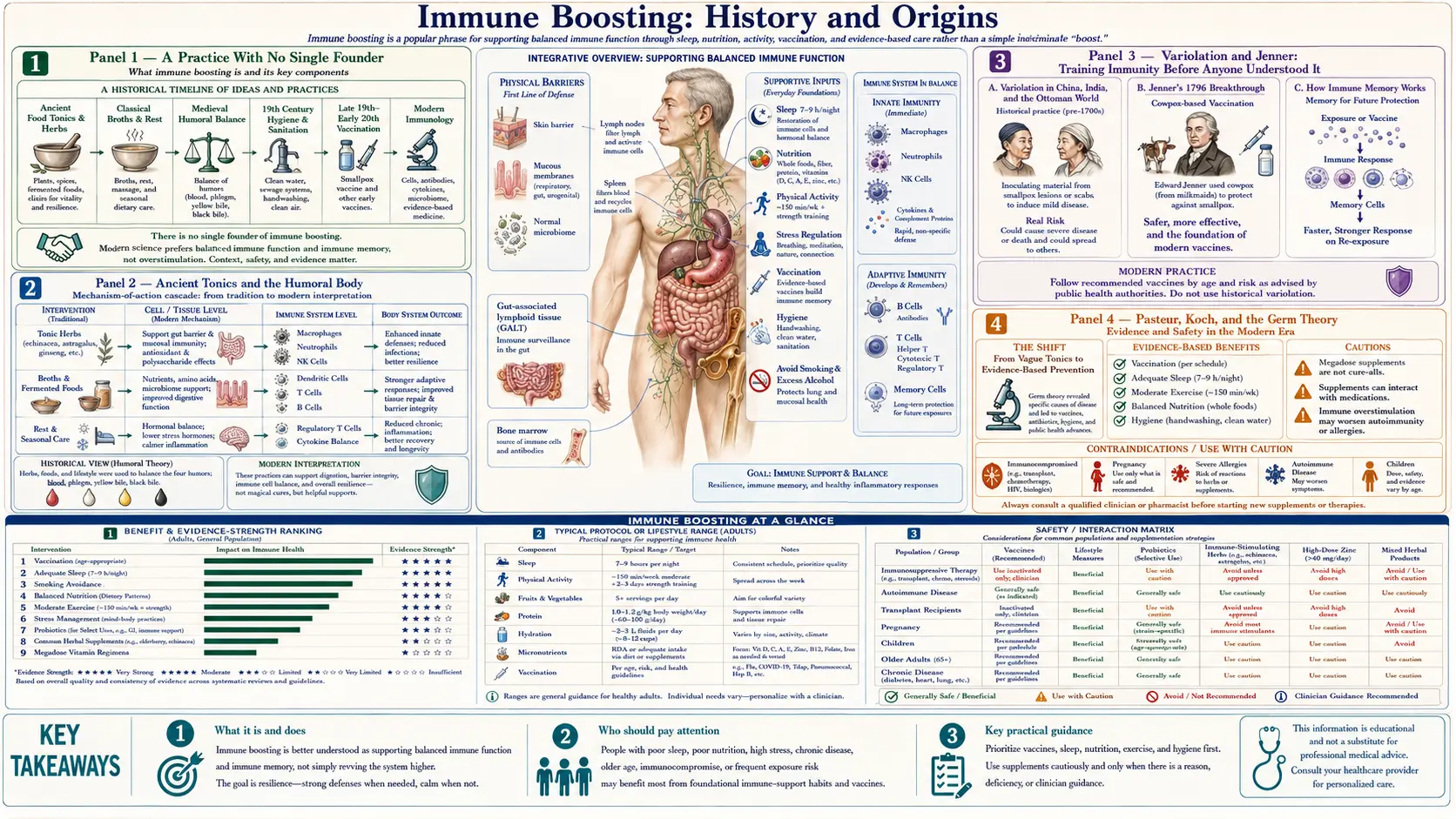
"Immune boosting" is not a single remedy with a single inventor. It is a modern wellness idea built on top of a very old human instinct — the wish to make the body stronger against sickness — and on top of one of the great scientific stories of the last two centuries: the discovery of how immunity actually works. This article traces that real history honestly. It runs from ancient tonic and "humoral" traditions, through the births of vaccination and the germ theory, to the founding of scientific immunology by Metchnikoff and Ehrlich (the 1908 Nobel Prize), and on to the twentieth-century rise of vitamins, adaptogens, and the supplement marketplace that gave us the very phrase "boost your immune system." Because accuracy is the whole point of this site, it also states plainly what mainstream immunology now says: that a healthy immune system works best when it is balanced, not simply "boosted," and that no pill, food, or tea can "supercharge" it in the way advertising often implies. Where a date or name is firm, we say so; where an idea is folklore, marketing, or still debated, we name it as such.
Table of Contents
- A Practice With No Single Founder
- Ancient Tonics and the Humoral Body
- Variolation and Jenner: Training Immunity Before Anyone Understood It
- Pasteur, Koch, and the Germ Theory
- Metchnikoff and Ehrlich: The Birth of Immunology (1908)
- Vitamins, Linus Pauling, and the Megadose Era
- Adaptogens: A Soviet Idea Meets the Tonic Herbs
- From Laboratory to Marketplace: The Rise of "Boost Your Immune System"
- Evidence and Reception: Balance, Not "Boost"
- Research Papers and References
- Connections
- Featured Videos
A Practice With No Single Founder
Some of the remedies described on this site can be traced to one named person — a physician who pioneered a therapy, or a chemist who isolated a molecule on a particular day. Immune boosting is not one of these. There is no Dr. Immune-Boost, no founding patent, no origin moment. What we call "immune boosting" today is a loose, modern bundle of nutrients, herbs, foods, and lifestyle habits assembled from many traditions and many decades of science, held together by a single appealing promise: that you can make your defenses stronger.
That makes its honest history a history of two separate things braided together. The first thread is folk and tonic medicine — the very old, cross-cultural practice of taking strengthening foods and herbs to fortify the body. The second, and far more recent, thread is scientific immunology — the discovery, mostly from the late 1700s onward, of what the immune system actually is and how it can be trained. The modern wellness phrase "boost your immune system" sits on top of both threads, and a fair history has to keep them distinct: a tradition of use is not the same as a body of evidence, and the science that explains immunity is not the same as the marketing that sells products to "boost" it.
The sections that follow walk forward in time, naming real people and real dates where the record supports them, and saving the most important honesty — what the evidence actually shows — for the final two sections.
Ancient Tonics and the Humoral Body
Long before anyone could see a white blood cell, healers across the world reached for foods and herbs believed to fortify a person against illness. In the Indian tradition of Ayurveda, a whole class of rasayana (rejuvenating) herbs — including astragalus-like tonics and ashwagandha — was prized for building strength and resistance. In Traditional Chinese Medicine, tonic herbs such as Astragalus membranaceus (huang qi) and reishi mushroom were used over long periods to support what we would loosely call vitality and defense. Garlic, honey, and various bitter and aromatic herbs appear as protective foods in cultures from the Mediterranean to East Asia. These are genuinely ancient practices, and many of the specific ingredients now sold as "immune boosters" — elderberry, garlic, mushrooms, astragalus — entered the modern marketplace through exactly these older traditions.
The conceptual frame these healers worked within, however, was not immunity as we understand it. From the time of Hippocrates (c. 460–370 BC) through the writings of the Greek physician Galen (c. 129–216 AD) and well into the eighteenth century, Western medicine explained health and sickness through the theory of the four humors — blood, phlegm, yellow bile, and black bile. Illness was thought to be an imbalance among these fluids, and a good diet, the right herbs, and a temperate life were meant to keep them in proportion. It is worth pausing on that word: the oldest Western model of health was already about balance, not about cranking a defense system up. The humoral theory was eventually shown to be wrong about the mechanism, but it shaped how people thought about "strengthening" the body for more than two thousand years.
The honest takeaway is that the impulse behind immune boosting is ancient and near-universal, and that several of its herbs carry real, long traditions of use. But the ancients did not know what the immune system was, and a long history of traditional use tells us a remedy was valued — not that it works by the mechanism modern labels claim.
Variolation and Jenner: Training Immunity Before Anyone Understood It
The first time humans reliably and deliberately strengthened immunity, they did it without any idea of how it worked. The practice was variolation — deliberately exposing a healthy person to material from a mild case of smallpox to provoke a protective response. The technique is genuinely old: it was documented in China, where powdered smallpox scabs were blown into the nose or rubbed into the skin, and variants were practiced across India, the Ottoman Empire, and parts of Africa. It reached Western Europe in the early eighteenth century, famously promoted in England by Lady Mary Wortley Montagu, who had seen it practiced in Constantinople. Variolation was risky — it used live smallpox — but it worked often enough to spread.
The decisive refinement came from the English country physician Edward Jenner (1749–1823). Acting on the rural observation that milkmaids who had caught cowpox seemed protected from smallpox, Jenner tested the idea directly: on 14 May 1796 he inoculated an eight-year-old boy, James Phipps, with material from a cowpox sore, then later exposed him to smallpox — and the boy did not fall ill. Jenner published his findings in 1798 in An Inquiry into the Causes and Effects of the Variolae Vaccinae. Because cowpox is Latin vaccinia, the procedure became known as vaccination, and Jenner is widely credited as its pioneer.
This matters to the history of "immune boosting" for a precise reason. Vaccination is the clearest proof that human immunity can be deliberately and durably trained to be stronger against a specific threat — the original, literal, and scientifically validated form of strengthening the immune response. It is worth being honest about the contrast, though: vaccination teaches the immune system to recognize one particular pathogen with great specificity, which is very different from the modern wellness idea that a supplement can raise overall immune "strength" against everything at once. Jenner trained immunity; he did not "boost" it in the vague, general sense the phrase now usually means.
Pasteur, Koch, and the Germ Theory
For most of human history, no one knew what caused infectious disease, which made "strengthening" the body against it a matter of guesswork. That changed in the second half of the nineteenth century with the germ theory of disease — the demonstration that specific microorganisms cause specific illnesses. The two towering figures are the French chemist Louis Pasteur (1822–1895) and the German physician Robert Koch (1843–1910).
Pasteur showed that fermentation and spoilage were driven by living microbes, helped disprove the old idea of "spontaneous generation," and went on to develop attenuated (weakened) vaccines, extending Jenner's principle to other diseases. Koch supplied the rigor: working in the 1870s and 1880s he identified the specific bacteria behind anthrax (1876), tuberculosis (1882), and cholera (1883), and laid down the criteria — later called Koch's postulates — for proving that a given microbe causes a given disease.
The germ theory transformed what "immune support" could even mean. Once disease had identifiable, external causes, the body's defenses could be studied as a real system that fights real invaders — rather than as a vague balance of humors. This is the intellectual hinge between the old tonic tradition and modern immunology: germ theory did not itself produce any "immune booster," but it created the framework within which the immune system could finally be discovered. That discovery is the next, and central, chapter.
Metchnikoff and Ehrlich: The Birth of Immunology (1908)
If immune boosting has anything resembling founding figures, they are the scientists who first explained what the immune system is — and the clearest pair is the Russian-born zoologist Élie Metchnikoff (1845–1916) and the German physician and chemist Paul Ehrlich (1854–1915), who shared the 1908 Nobel Prize in Physiology or Medicine "in recognition of their work on immunity."
Metchnikoff is often called the father of cellular immunity. Studying starfish larvae, he watched certain wandering cells surround and engulf a foreign splinter, and he proposed that the body is defended by mobile cells that eat invaders — a process he named phagocytosis ("cell-eating"), carried out by cells he called phagocytes. This was the first mechanistic account of the innate immune response: the patrolling cells — today's macrophages, neutrophils, and natural killer cells — that the modern immune-support literature constantly invokes. Ehrlich, working from the other side, developed the theory of humoral immunity: his "side-chain" theory described how cells could produce specific antibodies (antitoxins) that lock onto and neutralize foreign substances, anticipating the modern understanding of the adaptive immune response and its antibodies.
For decades the two camps — cells versus antibodies — argued, sometimes bitterly, over which mattered more. The 1908 Nobel committee, in effect, declared them both right, and modern immunology has confirmed it: innate and adaptive immunity are two arms of one integrated system. This is the bedrock fact under every honest discussion of immune health, including the "innate versus adaptive" framing used on the main Immune Boosting page. It is also the moment that turns "strengthening the body" from folklore into something that can, in principle, be measured. What it does not do is validate any particular supplement — understanding a system is not the same as knowing how to improve it, a gap the rest of this history keeps in view.
Vitamins, Linus Pauling, and the Megadose Era
The popular, consumer version of immune boosting — the one centered on pills and nutrients — grew out of the discovery of the vitamins in the first half of the twentieth century. Once researchers learned that tiny amounts of specific compounds (vitamins A, C, and D among them) were essential to health, and that deficiency of them caused disease, a powerful and partly true idea took hold: correcting a nutritional deficiency can restore a failing immune defense. That much is well supported, and it remains the most defensible core of immune support to this day.
The idea then took a far more controversial turn through one famous figure: the American chemist Linus Pauling (1901–1994), a two-time Nobel laureate. In 1970 Pauling published the bestselling book Vitamin C and the Common Cold, arguing that very large doses of vitamin C could prevent and shorten colds and broadly strengthen resistance to infection. The book triggered a vitamin C craze; American consumption surged so sharply that bulk prices climbed. Pauling's advocacy did more than any single event to plant the modern notion that megadoses of a nutrient can "boost" immunity.
It is essential to be honest about how this was received. Pauling's fellow scientists were sharply critical: reviewers noted that the megadose claims rested largely on anecdote rather than on the rigorous, peer-reviewed trials his own stature demanded, and that when challenged he often took his case to the public rather than into the scientific literature. As the next section explains, decades of careful trials that followed did not bear out the strongest claims. Pauling is therefore a pivotal but cautionary figure in this story: a brilliant scientist whose enthusiasm for vitamin C ran ahead of the evidence and helped launch a multi-billion-dollar "immune-boosting" supplement culture on a shakier foundation than its founder believed.
Adaptogens: A Soviet Idea Meets the Tonic Herbs
A second twentieth-century stream feeding modern immune boosting is the adaptogen concept, and unlike the diffuse folk traditions it actually has a documented origin. The term was coined in 1947 by the Soviet pharmacologist and physician Nikolai Lazarev, who used it for a substance that raises the body's non-specific resistance to a wide range of stressors — physical, chemical, and biological. After the Second World War, Soviet researchers searched for such compounds to improve the stamina and resilience of soldiers, workers, and athletes.
Lazarev's student Israel Brekhman carried the work forward in the 1960s, studying plants such as Eleutherococcus senticosus (often sold as "Siberian ginseng"). In 1969, Brekhman and Igor Dardymov published a formal three-part definition: an adaptogen should be essentially harmless, should produce a non-specific increase in resistance to many kinds of stress, and should have a normalizing effect — bringing an over-active or under-active function back toward normal regardless of the direction of the disturbance.
That last criterion is striking in light of this whole article, because it describes modulation — restoring balance — rather than one-directional "boosting." When the adaptogen idea reached the West and merged with the older tonic herbs of Ayurveda and Chinese medicine (ashwagandha, astragalus, rhodiola, holy basil, reishi), it supplied much of the vocabulary now used to market immune support. It is worth keeping the distinction honest: "adaptogen" is a twentieth-century pharmacological hypothesis, the clinical evidence for individual adaptogens varies widely, and the original Soviet definition pointed toward balance, not toward simply turning immunity up.
From Laboratory to Marketplace: The Rise of "Boost Your Immune System"
By the closing decades of the twentieth century all the ingredients of modern immune boosting were in place: ancient tonic herbs, the discovery of the vitamins, Pauling's megadose enthusiasm, the adaptogen concept, and a growing scientific literature on how nutrients such as vitamin D, zinc, and selenium support immune cells. What turned this into a mass-market category was the dietary-supplement industry, which packaged these elements into convenient products and reached for a simple, compelling sales line: "boost your immune system."
The phrase is a marketing creation more than a scientific one. It is appealing precisely because it is vague and flattering — it suggests that a single product can make an invisible, complex defense system simply stronger, with no downside. Real nutritional science sits underneath some of these products (correcting a genuine vitamin D, zinc, or vitamin C deficiency really can restore immune function that deficiency had impaired), but the slogan typically promises far more than the evidence supports, and it papers over the crucial point that the goal is a well-regulated immune system, not a maximally aggressive one.
This is why national health bodies now push back on the very language. The U.S. National Institutes of Health and others have noted plainly that the immune system cannot be "supercharged" in the way advertisements imply, and that quick fixes such as energy drinks or detox teas are not supported by evidence. The honest history of immune boosting, then, ends not with a triumphant founder but with a caution: a real and valuable science of immune support exists, and a much larger marketplace of overstated promises has grown up around it. Telling the two apart is the entire purpose of the final section.
Evidence and Reception: Balance, Not "Boost"
Because this is a non-profit public-health site, the most important part of the history is the plainest: what does the evidence actually show, and what do mainstream immunologists say?
The central message from immunology is that a healthy immune system works best when it is balanced, not "boosted." Immunologists and bodies such as the NIH stress that the immune system is a finely regulated network, not a muscle you simply make bigger. An immune response that is too weak leaves you open to infection — but one that is too strong or poorly regulated drives allergies, chronic inflammation, and autoimmune disease, in which the system attacks the body's own tissues. "More immune activity" is therefore not automatically better, and for people with autoimmune conditions, indiscriminate stimulation can be actively harmful — a caution covered in detail on the main Immune Boosting page.
The specific claims fare unevenly under testing. The clearest example is vitamin C, the nutrient most associated with the "boost" idea since Pauling. A large Cochrane systematic review (Hemilä and Chalker, 2013) pooling dozens of trials found that regular vitamin C supplementation does not reduce how often people in the general population catch colds; it produced only a modest, consistent reduction in how long colds last, and meaningfully cut cold risk only in people under brief, extreme physical stress, such as marathon runners and soldiers in sub-arctic training. Some interventions hold up better in specific settings — for instance, correcting vitamin D deficiency is genuinely associated with fewer respiratory infections, zinc lozenges taken very early can shorten a cold, and a meta-analysis of black elderberry (Hawkins and colleagues, 2019) reported reduced upper-respiratory symptoms — but these are targeted, evidence-graded effects, not proof of a general power to "boost immunity."
The fair, validating conclusion is this. The impulse behind immune boosting is ancient and reasonable, and parts of it are real: feed the body well, correct true deficiencies, sleep, move, manage stress, and protect the gut, and your immune system will do its job better. But the marketing promise — that a supplement, tea, or megadose can make an otherwise healthy immune system globally "stronger" — is not supported by the science, and chasing maximum immune activity can backfire. The detailed, evidence-graded breakdown of each nutrient and herb lives on the main Immune Boosting page and in the companion Benefits articles; this history exists to show where the idea came from — and to be honest about how much of it the evidence will bear.
Research Papers and References
The list below combines peer-reviewed sources and authoritative public-health references on the history of immunology and the evidence behind immune-support claims, followed by curated PubMed topic-search links. Historical figures and primary events (Hippocrates and Galen's humoral theory, ancient variolation, Jenner's 1796 inoculation, the 1908 Nobel Prize) are named in the article as historical sources. Author names, titles, and journals are given as plain text; only the stable DOI, PMID, or archive link is hyperlinked, and each opens in a new tab.
- Kaufmann SHE. Immunology's foundation: the 100-year anniversary of the Nobel Prize to Paul Ehrlich and Elie Metchnikoff. Nature Immunology. 2008;9(7):705-712. — PMID: 18563076
- Riedel S. Edward Jenner and the history of smallpox and vaccination. Proceedings (Baylor University Medical Center). 2005;18(1):21-25. — PMID: 16200144
- Panossian A, Wikman G. Effects of adaptogens on the central nervous system and the molecular mechanisms associated with their stress-protective activity. Pharmaceuticals (Basel). 2010;3(1):188-224. — doi:10.3390/ph3010188
- Hemilä H, Chalker E. Vitamin C for preventing and treating the common cold. Cochrane Database of Systematic Reviews. 2013;(1):CD000980. — doi:10.1002/14651858.CD000980.pub4
- Hawkins J, Baker C, Cherry L, Dunne E. Black elderberry (Sambucus nigra) supplementation effectively treats upper respiratory symptoms: a meta-analysis of randomized, controlled clinical trials. Complementary Therapies in Medicine. 2019;42:361-365. — doi:10.1016/j.ctim.2018.12.004
- Immune system history and theories of immunity — PubMed: history of immunology (Metchnikoff and Ehrlich)
- Nutrition, supplements, and immune function — PubMed: micronutrients and immune function
External Authoritative Resources
- NCCIH — Elderberry: Usefulness and Safety
- World Health Organization — A Brief History of Vaccination
- NobelPrize.org — The Nobel Prize in Physiology or Medicine 1908 (Metchnikoff & Ehrlich)
Connections
- All Remedies
- Immune Boosting
- Immune Boosting Benefits
- Vitamin C
- Vitamin D3
- Zinc
- Elderberry
- Astragalus
- Cold & Flu Treatments