Wormwood, Clove and Black Walnut
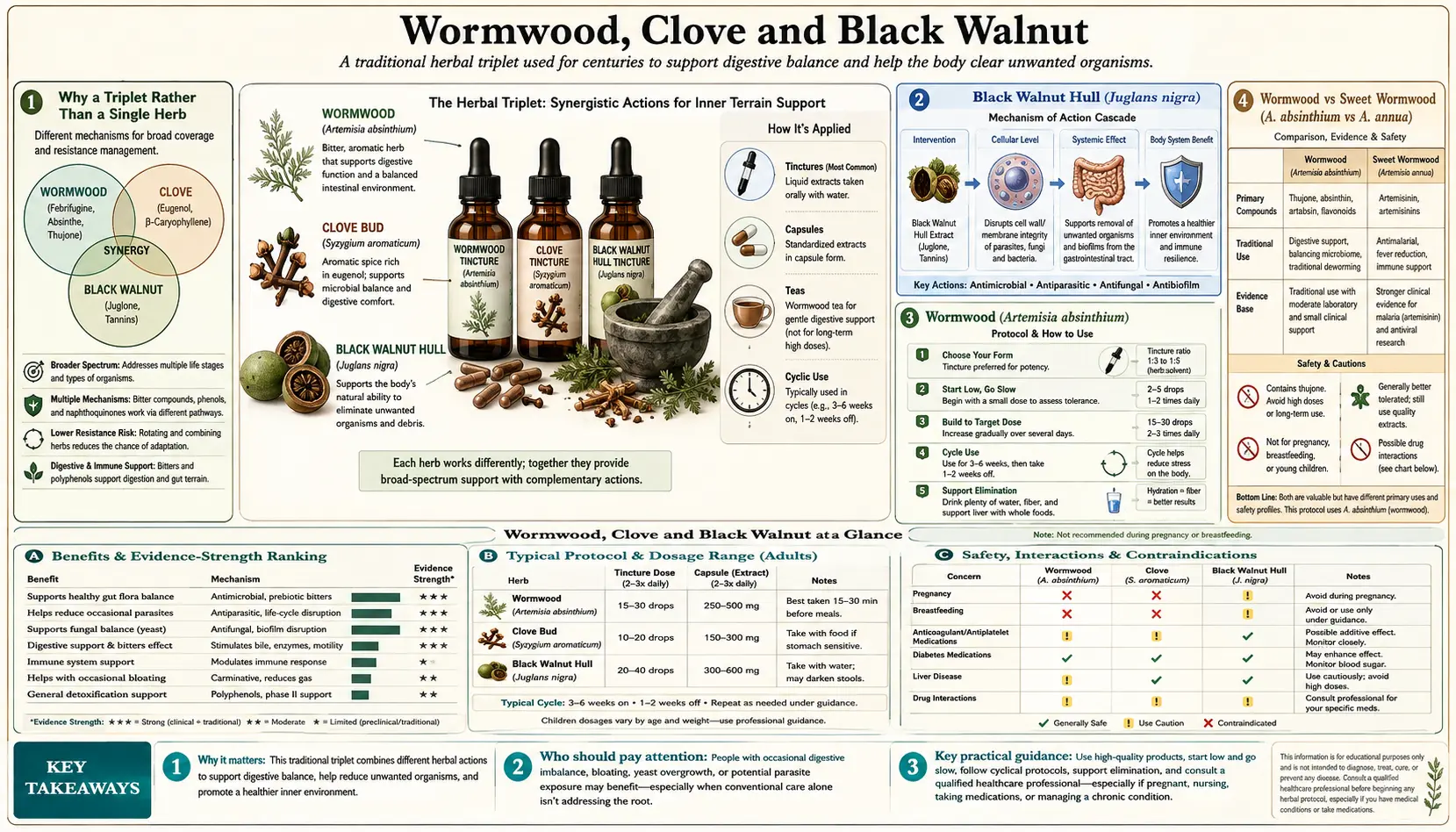
Wormwood, clove and black walnut hull is the herbal “parasite cleanse” combination popularized by Hulda Regehr Clark in her 1990s books, and it is widely sold and discussed in alternative-medicine circles. Proponents describe each herb as acting on a different stage of the parasite life cycle. This page sets out those claims as claims, then reports what the research shows: almost all of it is laboratory (in vitro) or animal work on single herbs or single compounds, no randomized trial of the three-herb combination in people was found, and the safety literature includes thujone’s convulsant action, a case of acute kidney failure after drinking wormwood oil, and serious clove-oil poisonings in young children. Artemisinin, the Nobel Prize–winning antimalarial, comes from a different plant (Artemisia annua) than the wormwood in this combination (Artemisia absinthium).
Table of Contents
- The Life-Cycle Rationale Proponents Describe
- Black Walnut Hull (Juglans nigra)
- Wormwood (Artemisia absinthium)
- Wormwood vs Sweet Wormwood (A. absinthium vs A. annua)
- Clove (Syzygium aromaticum)
- Hulda Clark's Protocol as She Described It
- Forms Sold and What Studies Used
- Safety Findings and Who the Research Raises Concerns For
- State of the Evidence
- Key Research Papers
- Connections
- Featured Videos
The Life-Cycle Rationale Proponents Describe
The central claim made for the combination is that a parasite treatment has to reach every life-cycle stage — adult worms, developing larvae and eggs — and that the three herbs divide that work between them. Proponents, following Clark, commonly describe black walnut hull and wormwood as acting on adult and developing parasites and clove as the herb that acts on eggs. This division of labour is a claim; no study was found that tested it in people.
The underlying observation about eggs is real for conventional drugs. For pinworm, CDC's regimen for pyrantel, mebendazole and albendazole is two doses, the second given two weeks after the first, because, in CDC's words, the medications “kill worms but cannot kill eggs” (see Pinworm Treatment: Pyrantel, Mebendazole, and Albendazole).
What the laboratory and animal research shows for each herb:
- Black walnut hull (juglone and related naphthoquinones) — in laboratory studies, juglone killed Acanthamoeba through increased production of reactive oxygen species, and in a screen of Juglans extracts against Trypanosoma and Leishmania in culture, one constituent was identified as active against Trypanosoma brucei. No human parasite trial was found.
- Wormwood (A. absinthium) — in rats with trichinellosis, a wormwood extract reduced muscle larvae counts; in naturally infected sheep, a wormwood extract reduced faecal egg counts but less than albendazole did. No human parasite trial was found.
- Clove (eugenol) — eugenol and clove oil inhibited Giardia in culture, and eugenol reduced the worm burden in mice with Schistosoma mansoni by 19.2%. No study was found showing that clove or eugenol stops helminth eggs from hatching in the human gut.
Black Walnut Hull (Juglans nigra)
The preparation used in the combination is made from the green outer husk (hull) of the black walnut, traditionally as an alcohol tincture. The hull contains juglone (5-hydroxy-1,4-naphthoquinone), the brown-staining compound that marks the hands of anyone who handles fresh walnuts.
Active compounds:
- Juglone (5-hydroxy-1,4-naphthoquinone) — the best-studied constituent. Naphthoquinones of this kind are active against several protozoa in the laboratory.
- Hydrojuglone glucoside — identified in a 2015 study of 36 extracts from J. regia, J. cinerea and J. nigra as the constituent behind their activity against Trypanosoma brucei in culture, with lower toxicity to mammalian cells than lapachol.
- Tannins and other polyphenols — present in the hull; their contribution to any antiparasitic effect has not been established.
Mechanism (laboratory findings): In a 2015 study, juglone inhibited the growth of Acanthamoeba castellanii at 3–5 μM, increased reactive-oxygen-species production and caused cell death; an antioxidant (N-acetylcysteine) restored the cells' viability. Juglone has a similar oxidative effect on human cells in the laboratory: human red blood cells exposed to it produced more superoxide.
Documented activity: the antiparasitic evidence for Juglans found here is in vitro (cell-culture) work on protozoa such as Trypanosoma and Acanthamoeba. No clinical trial of black walnut hull tincture for intestinal parasites in people was found.
Forms: Products are sold as green-hull tinctures, powders and capsules, and their juglone content is not standardized. The colour of a tincture is described by proponents as a sign of strength; no study was found that measured this.
Wormwood (Artemisia absinthium)
Wormwood is the bitter herb that gives absinthe its flavour. The parts used are the dried leaves and flowering tops. A 2011 review counts about 500 species in the genus Artemisia, with antimalarial, antibacterial, antifungal and other activities reported across the genus. A. absinthium is the classic European medicinal wormwood; A. annua (sweet wormwood, qinghao) is the Chinese plant from which artemisinin was isolated.
Active compounds:
- Sesquiterpene lactones — absinthin and related bitter compounds. They are not artemisinin.
- Thujone (alpha- and beta-thujone) — a monoterpene ketone in the essential oil. A 2000 study established alpha-thujone as a modulator of the GABA-A receptor: poisoning in mice resembled that caused by the classical antagonist picrotoxinin, and thujone suppressed GABA-induced currents in rat nerve cells. A 2013 toxicological review describes thujone as neurotoxic, causing excitation and convulsions in animals in a dose-dependent manner, while noting that the current view “rather downgrades its risk to humans” and that the doses required in humans are uncertain.
- Flavonoids and other phenolics — present, with antioxidant activity reported in the laboratory.
Mechanism against parasites: how A. absinthium extracts act on parasites has not been established. Artemisinin's mechanism cannot be assumed to apply, because artemisinin comes from A. annua.
Documented activity: In rats infected with Trichinella spiralis, a methanol extract of A. absinthium at 300 mg/kg during the intestinal (adult) phase reduced the muscle larva rate by 37.7% to 63.5% depending on the muscle; the related A. vulgaris did better in the same study. In a 2026 study of 18 sheep naturally infected with gastrointestinal nematodes, a wormwood extract gave therapeutic success in 76.77% of the treated group by the faecal egg count reduction test, against 100% for albendazole. No clinical trial of wormwood for intestinal parasites in people was found in PubMed.
Thujone limits: EU Regulation (EC) No 1334/2008 sets maximum thujone levels of 35 mg/kg in alcoholic beverages produced from Artemisia species, 10 mg/kg in other alcoholic beverages, and 0.5 mg/kg in non-alcoholic beverages produced from Artemisia species. The 2013 toxicological review gives its best estimates of allowable daily thujone intake from herbal preparations and diet as being of the order of 3–7 mg/day. Thujone content varies between wormwood products, and essential oil is the most concentrated form.
Wormwood vs Sweet Wormwood (A. absinthium vs A. annua)
This distinction is a common point of confusion in parasite-cleanse literature. The two are different species:
- Artemisia absinthium (common wormwood) — the herb in the Clark combination. Its bitter compounds include absinthin; thujone is the principal toxicity concern. The antiparasitic evidence is animal and laboratory work (see above).
- Artemisia annua (sweet wormwood, qinghao) — the source of artemisinin, whose discovery Tu Youyou described in 2011 and for which she shared the 2015 Nobel Prize in Physiology or Medicine. Artemisinin derivatives are part of the artemisinin-based combination therapies (ACTs) used to treat malaria (see Antimalarial Drugs and Artemisinin Combination Therapy). The derivative artemether has also been tested in randomized controlled trials for preventing schistosome infections, reviewed in 2001.
The drug and the plant are not the same thing. Two large trials reporting that A. annua and A. afra tea infusions treated malaria and schistosomiasis were retracted by the journal Phytomedicine in 2020. Schistosomiasis treatment with praziquantel is covered on the Praziquantel page.
Products labelled “wormwood” may contain either species; “sweet wormwood”, “qinghao” and “Artemisia annua” refer to A. annua.
Clove (Syzygium aromaticum)
Clove is the dried flower bud of an evergreen tree native to the Maluku Islands of Indonesia. Its essential oil is dominated by eugenol (4-allyl-2-methoxyphenol), the compound used in dentistry as a local anaesthetic.
Active compounds:
- Eugenol — the major compound of clove oil, with antimicrobial and local anaesthetic activity.
- Beta-caryophyllene — a sesquiterpene.
- Eugenyl acetate — a minor component related to eugenol.
The egg claim: Clark's writings and later proponents present clove as the member of the combination that acts on parasite eggs, on the grounds that eugenol is small and fat-soluble enough to cross the eggshell. No study was found showing that clove or eugenol taken by mouth prevents helminth eggs from hatching in people. Eugenol and its derivatives have been tested in the laboratory against nematodes of livestock (Haemonchus contortus) and of plants (root-knot nematodes).
Documented activity:
- Giardia (in vitro): in a 2011 study, clove essential oil (IC50 134 μg/mL) and eugenol (IC50 101 μg/mL) inhibited the growth of Giardia lamblia trophozoites in culture, and the oil killed almost 50% of the parasites in a time-dependent manner.
- Schistosoma mansoni (mice): in a 2019 study, eugenol by mouth reduced total worm burden by 19.2%. The authors concluded that eugenol “could not totally eradicate adults” but reduced liver enzymes and liver fibrosis.
Forms: Products include ground whole clove in capsules and clove essential oil. Eugenol is volatile, so the eugenol content of stored ground clove varies; clove essential oil is far more concentrated, and it is the form involved in the poisoning cases described below.
Hulda Clark's Protocol as She Described It
Hulda Clark set out her parasite program in The Cure for All Diseases (1995) and related books. As she described it, the three herbs are started together at small amounts that are increased day by day over roughly the first one to two weeks, followed by a maintenance phase of weekly doses that she presented as continuing long-term. The amounts and the schedule are Clark's own; no clinical trial has tested them, and they are not reproduced here.
Clark presented the gradual increase as a way to limit uncomfortable reactions, which she and later practitioners attribute to parasites dying off. That explanation has not been studied in trials.
Combination capsules containing all three herbs are now widely sold, with schedules that differ from product to product and from Clark's original.
Forms Sold and What Studies Used
Black walnut hull: sold as green-hull tinctures, hull powder and capsules. Juglone content is not standardized between products, and no human dosing study for parasites was found.
Wormwood (A. absinthium): sold as dried-herb capsules, extracts and alcohol tinctures. The animal studies used extracts dosed by body weight (300–600 mg/kg in the rat trichinellosis study; 1.0 g/kg in the sheep study). The thujone content of a product depends on the plant material and the extraction; the essential oil is the most concentrated form and is the form involved in the 1997 kidney-failure case below.
Clove (S. aromaticum): sold as ground whole clove in capsules and as essential oil. No human dosing study for parasites was found. The pediatric poisoning cases involved clove oil.
Combination products: many products combine all three herbs, and they differ in the amount of each herb and in the Artemisia species used.
Safety Findings and Who the Research Raises Concerns For
- Wormwood oil and the kidneys — a 1997 case report in the New England Journal of Medicine described acute kidney failure caused by oil of wormwood bought over the internet.
- Thujone and seizures — thujone blocks the GABA-A receptor and causes convulsions in animals in a dose-dependent manner. The research raises a concern for people with a seizure disorder and for anyone taking wormwood essential oil, the most concentrated source.
- Clove oil in young children — case reports describe a 7-month-old infant with central nervous system depression, urinary abnormalities and a large anion-gap acidosis after clove oil was given by mouth by accident (1991), a 2-year-old with disseminated intravascular coagulation and liver-cell necrosis after swallowing clove oil (1992), and a near-fatal case with coma, fits, a clotting disorder and acute liver damage (1993), which the authors compared to late-stage paracetamol poisoning. A 2018 report described N-acetylcysteine given early after a clove-oil ingestion.
- Pregnancy, breastfeeding and young children — no clinical safety data were found for any of the three herbs as a parasite treatment in these groups. For pinworm in children, CDC lists pyrantel, mebendazole and albendazole doses for adults and children (see the pinworm treatment page).
- Black walnut and juglone — juglone is a reactive naphthoquinone that raised superoxide production in human red blood cells in the laboratory. Black walnut is a tree nut, which matters for people with tree-nut allergy. In horses, bedding made from black walnut heartwood (not hull) commonly caused laminitis, and an extract of the heartwood is used as an experimental laminitis model.
- Bleeding and anticoagulants — eugenol inhibited platelet activation in human platelets in the laboratory. The research raises a concern for people taking warfarin, other anticoagulants or antiplatelet drugs; no clinical interaction study was found.
- Drug metabolism — in human liver microsomes, eugenol inhibited the drug-metabolizing enzymes CYP1A2, CYP2C9, CYP2D6 and CYP3A4; the authors flagged a potential for herb–drug interactions. Thujone is metabolized mainly by CYP2A6, followed by CYP3A4 and CYP2B6.
- Reactions attributed to die-off — proponents describe symptoms during a cleanse as parasite “die-off” or detox reactions; the claim is covered on the Cycle & Detox Symptoms page.
Decisions about medicines and supplements belong with a clinician.
State of the Evidence
No randomized controlled trial of the wormwood-clove-black walnut combination in people was found in PubMed. The evidence that exists is:
- In vitro studies of single herbs or single compounds — juglone and Juglans extracts against protozoa, clove oil and eugenol against Giardia, and eugenol derivatives against nematodes.
- Animal studies of single herbs — wormwood extract in rats with trichinellosis and in sheep with gastrointestinal nematodes (where it reduced egg counts less than albendazole), and eugenol in mice with schistosomiasis (a 19.2% reduction in worm burden).
- Human trials of the individual herbs for intestinal parasites — none were found.
- Traditional use — the plants have a history of folk use against worms; a 2005 review discusses plant compounds as a source of new antiparasitic drugs.
- Practitioner reports — accounts from Clark and later practitioners, which are not controlled studies.
The best-documented anti-parasitic drugs come from controlled trials and public-health guidelines: albendazole and mebendazole for roundworm (Anthelmintic Treatment of Ascariasis), pyrantel, mebendazole and albendazole for pinworm, praziquantel for schistosomiasis, ivermectin for Strongyloides (Ivermectin Treatment for Strongyloides), and artemisinin combination therapy for malaria. The full list of parasites and their treatments is in the Parasites section.
Key Research Papers
- Tu Y (2011). The discovery of artemisinin (qinghaosu) and gifts from Chinese medicine. Nature Medicine 17:1217-20. — PubMed PMID: 21989013
- Bora KS, Sharma A (2011). The genus Artemisia: a comprehensive review. Pharmaceutical Biology 49:101-9. — PubMed PMID: 20681755
- Caner A, Döşkaya M, Değirmenci A, et al. (2008). Comparison of the effects of Artemisia vulgaris and Artemisia absinthium growing in western Anatolia against trichinellosis (Trichinella spiralis) in rats. Experimental Parasitology 119:173-9. — PubMed PMID: 18325496
- Wright CW, ed. (2002). Artemisia. Medicinal and Aromatic Plants — Industrial Profiles, vol. 18. London: Taylor & Francis. (Book; not indexed in PubMed.) — PubMed
- Pelkonen O, Abass K, Wiesner J (2013). Thujone and thujone-containing herbal medicinal and botanical products: toxicological assessment. Regulatory Toxicology and Pharmacology 65:100-7. — PubMed PMID: 23201408
- Mahesh B, Satish S (2008). Antimicrobial activity of some important medicinal plants against plant and human pathogens. — PubMed
- Anthony JP, Fyfe L, Smith H (2005). Plant active components — a resource for antiparasitic agents? Trends in Parasitology 21:462-8. — PubMed PMID: 16099722
- Weisbord SD, Soule JB, Kimmel PL (1997). Poison on line — acute renal failure caused by oil of wormwood purchased through the Internet. New England Journal of Medicine 337:825-7. — PubMed PMID: 9297113
- Höld KM, Sirisoma NS, Ikeda T, Narahashi T, Casida JE (2000). Alpha-thujone (the active component of absinthe): gamma-aminobutyric acid type A receptor modulation and metabolic detoxification. Proceedings of the National Academy of Sciences USA 97:3826-31. — PubMed PMID: 10725394
- Lane BW, Ellenhorn MJ, Hulbert TV, McCarron M (1991). Clove oil ingestion in an infant. Human & Experimental Toxicology 10:291-4. — PubMed PMID: 1679654
- Brown SA, Biggerstaff J, Savidge GF (1992). Disseminated intravascular coagulation and hepatocellular necrosis due to clove oil. Blood Coagulation & Fibrinolysis 3:665-8. — PubMed PMID: 1450336
- Hartnoll G, Moore D, Douek D (1993). Near fatal ingestion of oil of cloves. Archives of Disease in Childhood 69:392-3. — PubMed PMID: 8215554
- Kim A, Farkas AN, Dewar SB, Abesamis MG (2018). Early administration of N-acetylcysteine in the treatment of clove oil ingestion. Journal of Pediatric Gastroenterology and Nutrition 67:e38-e39. — PubMed PMID: 29601442
- Machado M, Dinis AM, Salgueiro L, et al. (2011). Anti-Giardia activity of Syzygium aromaticum essential oil and eugenol: effects on growth, viability, adherence and ultrastructure. Experimental Parasitology 127:732-9. — PubMed PMID: 21272580
- El-Kady AM, Ahmad AA, Hassan TM, et al. (2019). Eugenol, a potential schistosomicidal agent with anti-inflammatory and antifibrotic effects against Schistosoma mansoni, induced liver pathology. Infection and Drug Resistance 12:709-719. — PubMed PMID: 30992676
- Ellendorff T, Brun R, Kaiser M, Sendker J, Schmidt TJ (2015). PLS-prediction and confirmation of hydrojuglone glucoside as the antitrypanosomal constituent of Juglans spp. Molecules 20:10082-94. — PubMed PMID: 26035104
- Jha BK, Jung HJ, Seo I, Suh SI, Suh MH, Baek WK (2015). Juglone induces cell death of Acanthamoeba through increased production of reactive oxygen species. Experimental Parasitology 159:100-6. — PubMed PMID: 26358271
- Valério GN, Gutiérrez-Merino C, Nogueira F, et al. (2020). Human erythrocytes exposure to juglone leads to an increase of superoxide anion production associated with cytochrome b5 reductase uncoupling. Biochimica et Biophysica Acta — Bioenergetics 1861:148134. — PubMed PMID: 31825806
- Irehan B, Temamogullari F, Sayin Ipek DN, Icen H, Altas Atig M (2026). Comparison of in vivo anthelmintic efficacy of Artemisia absinthium extract and albendazole in Awassi breed sheep with natural gastrointestinal nematode infection. Journal of Helminthology 100:e85. — PubMed PMID: 42572844
- Utzinger J, Xiao S, N'Goran EK, Bergquist R, Tanner M (2001). The potential of artemether for the control of schistosomiasis. International Journal for Parasitology 31:1549-62. — PubMed PMID: 11730781
- Munyangi J, Cornet-Vernet L, Idumbo M, et al. (2020). Retraction notice to “Effect of Artemisia annua and Artemisia afra tea infusions on schistosomiasis in a large clinical trial”. Phytomedicine 78:153303. — PubMed PMID: 32972796
- Munyangi J, Cornet-Vernet L, Idumbo M, et al. (2020). Retraction notice to “Artemisia annua and Artemisia afra tea infusions vs. artesunate-amodiaquine (ASAQ) in treating Plasmodium falciparum malaria in a large scale, double blind, randomized clinical trial”. Phytomedicine 78:153304. — PubMed PMID: 32972797
- Belknap JK (2010). Black walnut extract: an inflammatory model. Veterinary Clinics of North America: Equine Practice 26:95-101. — PubMed PMID: 20381738
- Chang Y, Hsia CW, Chiou KR, et al. (2024). Eugenol: a potential modulator of human platelet activation and mouse mesenteric vascular thrombosis via an innovative cPLA2-NF-κB signaling axis. Biomedicines 12:1689. — PubMed PMID: 39200154
- Alharbi NFM, Ahad A, Bin Jardan YA, Al-Jenoobi FI (2024). Effect of eugenol on cytochrome P450 1A2, 2C9, 2D6, and 3A4 activity in human liver microsomes. Saudi Pharmaceutical Journal 32:102118. — PubMed PMID: 38841106
- Oliveira RF, Braga AP, Barbosa MLF, et al. (2026). Synthesis, cytotoxicity and in vitro and in silico anthelmintic activity of eugenol and derivatives against Haemonchus contortus. Veterinary Parasitology 345:110717. — PubMed PMID: 41760478
- Nasiou E, Giannakou IO (2020). The potential of eugenol as a nematicidal agent against Meloidogyne javanica (Treub) Chitwood. Journal of Nematology 52. — PubMed PMID: 33829203
- European Parliament and Council of the European Union (2008). Regulation (EC) No 1334/2008 on flavourings and certain food ingredients with flavouring properties, Annex III Part B (maximum levels of thujone). Official Journal of the European Union. — EUR-Lex: 32008R1334