Parasite Cleanse Cycle and Detox Symptoms
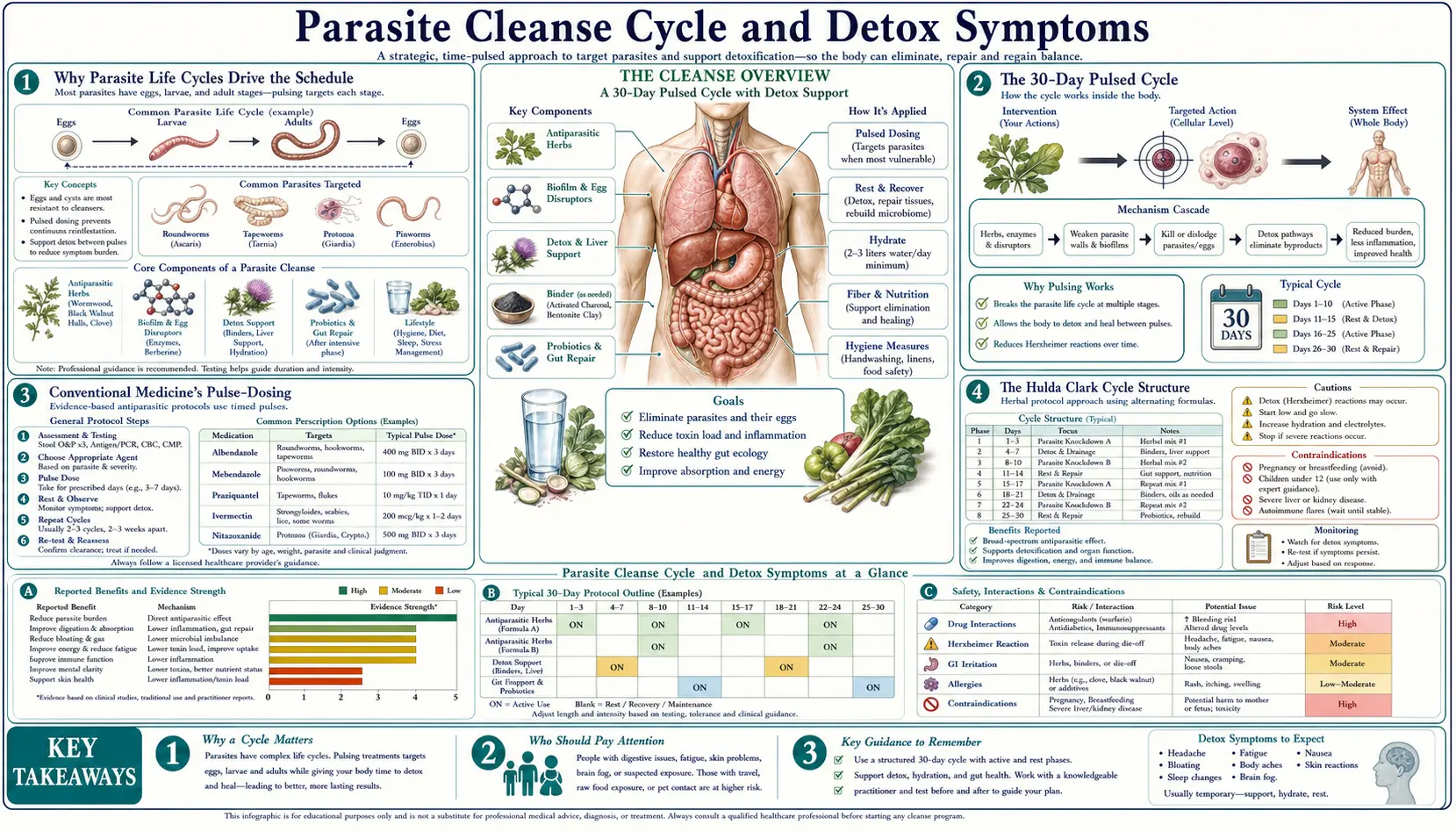
Herbal “parasite cleanse” programs are often described by their proponents as a 30-day pulsed cycle meant to reach the parasite at each life-cycle stage, and the symptoms people report during them are often called “die-off” or a Herxheimer reaction. This page sets out what the medical sources actually say: where repeat dosing is part of standard treatment (pinworm, lice, scabies) and why, what the drug labels and the CDC list for the common antiparasitic medicines, how the Hulda Clark protocol is described by its author, what the Jarisch-Herxheimer reaction is in the research literature, and what is — and is not — known about binders, hydration and “liver-support” nutrients during a cleanse. No published study testing a 30-day herbal cleanse schedule, or testing die-off symptoms after a herbal cleanse, was found in PubMed.
Table of Contents
- Why Parasite Life Cycles Drive the Schedule
- The 30-Day Pulsed Cycle as Proponents Describe It
- Repeat Dosing in Conventional Treatment
- The Hulda Clark Cycle Structure
- The Jarisch-Herxheimer Reaction
- “Detox” Symptoms vs Adverse Effects
- Binders: Claims and Evidence
- Hydration and Electrolytes
- “Liver-Support” Nutrients: Claims and Evidence
- Warning Signs Described in Medical Sources
- Key Research Papers
- Connections
- Featured Videos
Why Parasite Life Cycles Drive the Schedule
Helminths pass through distinct stages — egg, larva and adult — and some also have tissue-migrating or encysted stages. Different stages respond differently to the same medicine. The CDC's pinworm guidance states the point directly: the medicines “kill worms but cannot kill eggs,” so a second dose is given two weeks after the first to reach the worms that were still eggs at the time of the first dose.
How much this matters depends on the parasite. Pinworm eggs laid on the skin around the anus become infective in 4 to 6 hours under optimal conditions (CDC DPDx), so re-swallowed eggs can restart the infection; the CDC's parasite reference (DPDx) gives about one month from swallowing an egg to an adult female laying eggs, and an adult life span of about two months. The common soil-transmitted helminths behave differently. The World Health Organization notes that roundworm, whipworm and hookworm eggs passed in faeces need about three weeks to mature in soil before they become infective, that these worms do not multiply inside the human host, and that re-infection comes only from contact with infective stages in the environment. Strongyloides is the exception: it can reproduce inside the host (autoinfection).
For these reasons, the WHO's control strategy for soil-transmitted helminths is periodic deworming of at-risk groups in endemic areas, together with health education and sanitation, rather than a repeat dose timed to egg hatching inside the gut.
The 30-Day Pulsed Cycle as Proponents Describe It
Herbal cleanse programs commonly describe a cycle of about 30 days, alternating active and rest phases. A typical description runs:
- First week — “intensive” phase: daily use of the chosen herbs, with amounts increased gradually; proponents describe this phase as targeting adult worms.
- Second week — “rest” phase: no herbs or a reduced amount; proponents describe this as the time when eggs hatch and the body “clears die-off.”
- Third week — second “intensive” phase: a repeat of the first phase, described as reaching the newly hatched generation.
- Final days — “maintenance”: reduced or weekly use, often alongside binders and “liver-support” products, with some programs describing weekly maintenance continued for months and repeat cleanses once or twice a year.
The schedule borrows the logic of the conventional pinworm repeat dose (below). No published study was found that tested this schedule, compared it with continuous dosing, or measured whether it clears any parasite. The timing of the “rest” week is not tied to the life cycle of any specific parasite, and, as the WHO notes, most intestinal worm eggs do not hatch inside the gut at all.
Repeat Dosing in Conventional Treatment
Repeat dosing does appear in standard treatment for a few parasites — but the regimens are short, fixed and specific to the parasite. What the CDC, the WHO and the U.S. drug labels list:
- Pinworm (Enterobius): the CDC lists mebendazole 100 mg, pyrantel pamoate 11 mg/kg (maximum 1 g) or albendazole 400 mg, each taken once and repeated in two weeks, and treatment of the whole household at the same time. The U.S. over-the-counter monograph for pyrantel (21 CFR 357.150) sets the label directions as a single dose of 11 mg/kg, not exceeding 1 g, with the label wording “do not repeat treatment unless directed by a doctor.” So the OTC package describes one dose; the CDC's two-dose schedule is clinical guidance.
- Soil-transmitted helminths (roundworm, whipworm, hookworm): the WHO's mass-deworming medicines are single-dose albendazole 400 mg or mebendazole 500 mg, given periodically. For individual treatment the CDC lists courses of one to three days — for example albendazole 400 mg once for roundworm or hookworm, and three-day courses for whipworm.
- Strongyloides: the U.S. ivermectin label gives a single oral dose of about 200 mcg/kg and states that “in general, additional doses are not necessary,” with follow-up stool tests to confirm clearance. The CDC lists ivermectin 200 µg/kg for one to two days, and retreatment only if larvae reappear. A 2016 Cochrane review found that a second 200 µg/kg dose was not associated with a higher cure rate (two trials, 94 participants).
- Scabies: the CDC describes permethrin 5% cream applied from the neck down and washed off after 8–14 hours; a single application is described as effective, though two or more applications about a week apart may be needed.
- Head lice: the CDC states that pyrethrin products kill live lice but not eggs, and describes a second treatment 9–10 days after the first; for permethrin 1% lotion, it notes a second treatment on day nine may be needed.
- Schistosomiasis: the U.S. praziquantel label gives 20 mg/kg three times in one day, 4–6 hours apart. The CDC lists 40 mg/kg per day in two divided doses for one day (S. mansoni, S. haematobium) or 60 mg/kg per day in three divided doses (S. japonicum, S. mekongi), notes that lightly infected patients may need a repeat after 2–4 weeks, and that travelers are treated at least 6–8 weeks after their last freshwater exposure because the drug acts mainly on adult worms.
- Neurocysticercosis: the U.S. albendazole label gives 400 mg twice daily (60 kg or more) or 15 mg/kg/day in two divided doses (maximum 800 mg/day) for 8 to 30 days, with corticosteroids to be considered in the first week. The CDC notes that killing the cysts can acutely worsen symptoms through inflammation, and that the choice of treatment depends on the number, size, location and stage of the cysts (see the 2017 IDSA/ASTMH guideline).
Where a repeat interval exists, the sources tie it to a stated reason — eggs that survive the first dose (pinworm, lice, scabies), or the drug acting only on adult worms (schistosomiasis). None of these regimens is a 30-day cycle, and none involves weekly maintenance for months.
The Hulda Clark Cycle Structure
Hulda Clark's book The Cure for All Diseases (1995) describes a herbal parasite program built on three agents — black walnut hull tincture, wormwood and clove. As she describes it, the amounts of each are increased step by step over roughly the first one to two weeks, after which the full amount is taken once a week as long-term maintenance; she presents clove as the agent aimed at eggs. Practitioners who follow her approach describe many variations, such as two 14-day courses separated by a break, followed by weekly use.
No clinical trial of the Clark protocol was found in PubMed, and its claims about which herb acts on which life stage have not been tested in people. The safety literature on the three herbs — thujone in wormwood, and liver and clotting injury reported after clove-oil ingestion — is covered on the Wormwood, Clove and Black Walnut page in this section.
The Jarisch-Herxheimer Reaction
The Jarisch-Herxheimer reaction is named after the dermatologists Adolf Jarisch (1895) and Karl Herxheimer (1902), who described it in patients treated for syphilis. In the research literature it is a reaction to antimicrobial treatment of spirochetal infections — syphilis, Lyme disease, leptospirosis and relapsing fever. A 2017 review describes shaking chills, a rise in temperature and intensified skin rashes within 24 hours of antibiotic treatment, with symptoms resolving a few hours later. Case reports also describe serious forms: uterine contractions in pregnancy, worsening liver and kidney function, respiratory distress, low blood pressure, seizures and strokes. It is rarely fatal, though the review reports deaths in newborns and high perinatal mortality in some pregnancies.
Mechanism: the 2017 review attributes the reaction to spirochetal lipoproteins and a non-endotoxin pyrogen, with the cytokines TNF-alpha, IL-6 and IL-8 as mediators. In a 1992 study of 17 patients treated with penicillin for louse-borne relapsing fever in Ethiopia, 14 developed the reaction, with temperature peaking at about two hours and transient sharp rises in TNF, IL-6 and IL-8; the three without the reaction showed no such rise. In a 1996 randomized trial in 49 such patients, antibodies against TNF-alpha given before penicillin reduced reactions with rigors (10 of 20 vs 26 of 29 controls).
Parasites: the closest parallels in parasitology are different reactions with their own names and mechanisms. Killing microfilariae in filarial infections can trigger systemic reactions (fever, headache, joint pain, low blood pressure; called Mazzotti reactions in onchocerciasis), linked mainly to eosinophil degranulation and related to the intensity of infection. Killing brain cysts in neurocysticercosis can acutely worsen symptoms through inflammation, which is why corticosteroids are used. Case reports describe “Jarisch-Herxheimer-like” paradoxical reactions after praziquantel in acute schistosomiasis. All of these occur in diagnosed infections treated with effective drugs. No study was found documenting a Herxheimer-type reaction after a herbal parasite cleanse, or showing that symptoms during such a cleanse come from dying parasites.
“Detox” Symptoms vs Adverse Effects
Cleanse proponents commonly describe a flu-like feeling, headache, fatigue, more digestive upset, skin rashes and “brain fog” during a cleanse as die-off — a sign it is working — and say these symptoms ease with each pulse. No validated way of telling such “detox” symptoms apart from adverse effects was found in the literature, and there is no evidence that the symptoms reflect parasite death.
What is documented is that the products themselves can cause the same kinds of symptoms:
- The required warnings on over-the-counter pyrantel list abdominal cramps, nausea, vomiting, diarrhea, headache and dizziness as effects that sometimes occur after taking it.
- Alpha-thujone, the active compound in wormwood, acts on GABA-A receptors in laboratory studies, the mechanism behind its convulsant effect; a 1997 case report describes acute kidney failure after a man drank wormwood oil bought online.
- A 2026 case report describes cyanide poisoning after a “parasite cleanse” that combined amygdalin with coffee.
- Rash, hives, swelling of the lips or throat, yellowing of the skin, dark urine and bleeding are described in medical sources as signs of drug or herb reactions.
Because the label wording, the case reports and the medical sources all treat these symptoms as possible adverse effects, the research gives no basis for reading worsening symptoms during a cleanse as proof that it is working. Decisions about medicines and supplements belong with a clinician.
Binders: Claims and Evidence
Binders are oral substances said to hold toxins, endotoxin and bile-borne metabolites in the gut so they leave in stool rather than being reabsorbed. Cleanse programs describe them as easing die-off symptoms. No study was found testing any binder against Herxheimer reactions or cleanse symptoms. What is known about each:
- Activated charcoal — used in medicine for gut decontamination after certain acute oral overdoses (reviewed systematically in 2021). Because it adsorbs a wide range of substances, it also reduces absorption of medicines taken with it (a 1971 study showed this for propantheline), and it darkens stool.
- Bentonite / montmorillonite clay — in a crossover trial in Ghana, a refined calcium montmorillonite clay lowered a urinary aflatoxin biomarker by 55% compared with placebo. That is evidence about a dietary mycotoxin, not about parasites or cleanse symptoms.
- Zeolite (clinoptilolite), chlorella and pectin / modified citrus pectin — promoted as binding heavy metals and biotoxins; no study of their use during a parasite cleanse was found.
- Cholestyramine — a prescription bile-acid sequestrant; its U.S. label states that it may delay or reduce the absorption of other oral medicines taken with it, including warfarin, thyroid hormone and digitalis. Its use for “biotoxins” is a claim of some practitioners, not a labeled use.
Programs that include binders usually space them away from meals, supplements and medicines, because of the same binding effect.
Hydration and Electrolytes
Some cleanse protocols include a deliberate purge (for example castor oil in some pumpkin-seed protocols), and wormwood, black walnut and other agents can cause diarrhoea. Diarrhoea from any cause depletes water and electrolytes (sodium and potassium), and dehydration can itself cause headache, fatigue and dizziness — symptoms that may then be read as die-off.
Cleanse programs commonly add coconut water, bone broth or food sources of potassium and magnesium. No study was found testing a specific fluid or electrolyte schedule during a parasite cleanse.
“Liver-Support” Nutrients: Claims and Evidence
The liver clears drug and herb metabolites through Phase I (cytochrome P450) and Phase II (conjugation) reactions. Cleanse programs commonly add nutrients said to support these pathways and to ease detox symptoms. No study was found testing any of them for symptoms during a parasite cleanse. What the research says about each:
- N-acetylcysteine (NAC) — a precursor of cysteine and glutathione; a 2007 review describes it as a safe antidote for cysteine/glutathione deficiency.
- Glutathione — the main cellular antioxidant and a Phase II conjugation substrate; sold in several oral forms.
- Milk thistle (silymarin) — a 2001 systematic review found that trials in toxic and viral liver disease were mostly outdated and underpowered and allowed no valid conclusion, while trials in alcoholic liver disease and cirrhosis suggested a possible adjuvant role (lower liver-related mortality in pooled cirrhosis trials), with a good safety record. See the milk thistle page.
- Alpha-lipoic acid — an antioxidant cofactor promoted for regenerating glutathione.
- B-complex vitamins — B vitamins are cofactors for many metabolic enzymes, including detoxification pathways.
- Cruciferous vegetables (broccoli, kale, Brussels sprouts, cabbage) — sources of sulforaphane and indole-3-carbinol, which induce Phase II enzymes.
- Sulfur-containing foods (garlic, onion, eggs) — supply sulfur used in sulfation and glutathione reactions.
- Taurine and glycine — the two amino acids the liver conjugates bile acids with; bone broth is a dietary source of glycine.
Warning Signs Described in Medical Sources
The labels, CDC pages and case reports above describe the following as reasons for medical evaluation rather than features of a cleanse:
- High or persistent fever, especially with a stiff neck, severe headache or confusion
- Severe or localized abdominal pain — which can come from appendicitis, gallbladder or liver disease, or parasite-related complications
- Jaundice (yellow skin or eyes), dark urine or pale stools — possible drug- or herb-induced liver injury
- Persistent vomiting that prevents drinking fluids
- Blood in the stool or black stool (unrelated to charcoal use)
- Rash, hives, swelling of the lips, tongue or throat, or difficulty breathing — signs of an allergic reaction
- New neurological symptoms such as seizures, weakness or severe confusion — thujone in wormwood is a convulsant, and treatment of undiagnosed neurocysticercosis can provoke inflammation around brain cysts
- Unexplained bruising or bleeding — disseminated intravascular coagulation has been reported after clove-oil ingestion
- Reduced urine output — possible kidney injury, as in the wormwood-oil case
- Symptoms that worsen with each dose
The drug sources list groups for whom the medicines carry particular cautions: the OTC pyrantel label warns people who are pregnant or have liver disease; the CDC lists pregnancy, breastfeeding, body weight under 15 kg and possible Loa loa co-infection as relative contraindications for ivermectin, and notes limited data on albendazole in pregnancy. There is no published safety data on herbal cleanse programs in pregnancy, breastfeeding, immune suppression, liver or kidney disease, inflammatory bowel disease or seizure disorders.
Key Research Papers
- Belum GR, Belum VR, Chaitanya Arudra SK, Reddy BS (2013). The Jarisch-Herxheimer reaction: revisited. Travel Medicine and Infectious Disease 11(4):231-7. — PubMed PMID: 23632012
- Butler T (2017). The Jarisch-Herxheimer reaction after antibiotic treatment of spirochetal infections: a review of recent cases and our understanding of pathogenesis. American Journal of Tropical Medicine and Hygiene 96(1):46-52. — PubMed PMID: 28077740
- Negussie Y, Remick DG, DeForge LE, Kunkel SL, Eynon A, Griffin GE (1992). Detection of plasma tumor necrosis factor, interleukins 6, and 8 during the Jarisch-Herxheimer reaction of relapsing fever. Journal of Experimental Medicine 175(5):1207-12. — PubMed PMID: 1569394
- Maloy AL, Black RD, Segurola RJ Jr (1998). Lyme disease complicated by the Jarisch-Herxheimer reaction. Journal of Emergency Medicine 16(3):437-8. — PubMed PMID: 9610974
- Vannier EG, Diuk-Wasser MA, Ben Mamoun C, Krause PJ (2015). Babesiosis. Infectious Disease Clinics of North America 29(2):357-70. (Review of babesiosis, a tick-borne protozoan infection; its abstract does not address the Herxheimer reaction.) — PubMed PMID: 25999229
- Centers for Disease Control and Prevention (2024). Clinical Overview of Pinworm Infection (two doses, the second two weeks after the first). — CDC
- World Health Organization (2017). Guideline: Preventive Chemotherapy to Control Soil-Transmitted Helminth Infections in At-Risk Population Groups. Geneva: WHO. — PubMed PMID: 29578660
- Atkuri KR, Mantovani JJ, Herzenberg LA, Herzenberg LA (2007). N-Acetylcysteine — a safe antidote for cysteine/glutathione deficiency. Current Opinion in Pharmacology 7(4):355-9. — PubMed PMID: 17602868
- Saller R, Meier R, Brignoli R (2001). The use of silymarin in the treatment of liver diseases. Drugs 61(14):2035-63. — PubMed PMID: 11735632
- U.S. Code of Federal Regulations, Title 21, §357.150. Labeling of anthelmintic drug products (over-the-counter pyrantel pamoate). — eCFR 21 CFR 357.150
- Henriquez-Camacho C, Gotuzzo E, Echevarria J, et al. (2016). Ivermectin versus albendazole or thiabendazole for Strongyloides stercoralis infection. Cochrane Database of Systematic Reviews 2016(1):CD007745. — PubMed PMID: 26778150
- Centers for Disease Control and Prevention (2024). Clinical Care of Strongyloides. — CDC
- Centers for Disease Control and Prevention. Clinical Care of Soil-Transmitted Helminths. — CDC
- Centers for Disease Control and Prevention (2024). Clinical Care of Schistosomiasis. — CDC
- Centers for Disease Control and Prevention. Clinical Care of Cysticercosis. — CDC
- Centers for Disease Control and Prevention. Clinical Care of Scabies. — CDC
- Centers for Disease Control and Prevention. Clinical Care of Head Lice. — CDC
- White AC Jr, Coyle CM, Rajshekhar V, Singh G, Hauser WA, Mohanty A, Garcia HH, Nash TE (2018). Diagnosis and treatment of neurocysticercosis: 2017 clinical practice guidelines by the Infectious Diseases Society of America (IDSA) and the American Society of Tropical Medicine and Hygiene (ASTMH). Clinical Infectious Diseases 66(8):e49-e75. — PubMed PMID: 29481580
- Fekade D, Knox K, Hussein K, Melka A, Lalloo DG, Coxon RE, Warrell DA (1996). Prevention of Jarisch-Herxheimer reactions by treatment with antibodies against tumor necrosis factor alpha. New England Journal of Medicine 335(5):311-5. — PubMed PMID: 8663853
- Ottesen EA (1987). Description, mechanisms and control of reactions to treatment in the human filariases. Ciba Foundation Symposium 127:265-83. — PubMed PMID: 3297558
- Neumayr AL, Tschirky B, Warren A, Hatz CF, Blum JA (2012). Acute febrile respiratory reaction after praziquantel treatment during asymptomatic late form of acute schistosomiasis. Journal of Travel Medicine 19(4):264-7. — PubMed PMID: 22776392
- Höld KM, Sirisoma NS, Ikeda T, Narahashi T, Casida JE (2000). Alpha-thujone (the active component of absinthe): gamma-aminobutyric acid type A receptor modulation and metabolic detoxification. Proceedings of the National Academy of Sciences USA 97(8):3826-31. — PubMed PMID: 10725394
- Weisbord SD, Soule JB, Kimmel PL (1997). Poison on line — acute renal failure caused by oil of wormwood purchased through the Internet. New England Journal of Medicine 337(12):825-7. — PubMed PMID: 9297113
- Khushbakht M, Cowdery C, Temple C (2026). Cyanide toxicity following an amygdalin and coffee “parasite cleanse”. Clinical Toxicology (online ahead of print). — PubMed PMID: 42657541
- Chaput de Saintonge DM, Herxheimer A (1971). Activated charcoal impairs propantheline absorption. European Journal of Clinical Pharmacology 4(1):52-3. — PubMed PMID: 5151392
- Mitchell NJ, Kumi J, Johnson NM, et al. (2013). Reduction in the urinary aflatoxin M1 biomarker as an early indicator of the efficacy of dietary interventions to reduce exposure to aflatoxins. Biomarkers 18(5):391-8. — PubMed PMID: 23697800
- Hoegberg LCG, Shepherd G, Wood DM, et al. (2021). Systematic review on the use of activated charcoal for gastrointestinal decontamination following acute oral overdose. Clinical Toxicology 59(12):1196-1227. — PubMed PMID: 34424785
- Brown SA, Biggerstaff J, Savidge GF (1992). Disseminated intravascular coagulation and hepatocellular necrosis due to clove oil. Blood Coagulation & Fibrinolysis 3:665-8. — PubMed PMID: 1450336