Gerson Therapy — Benefits Deep Dive
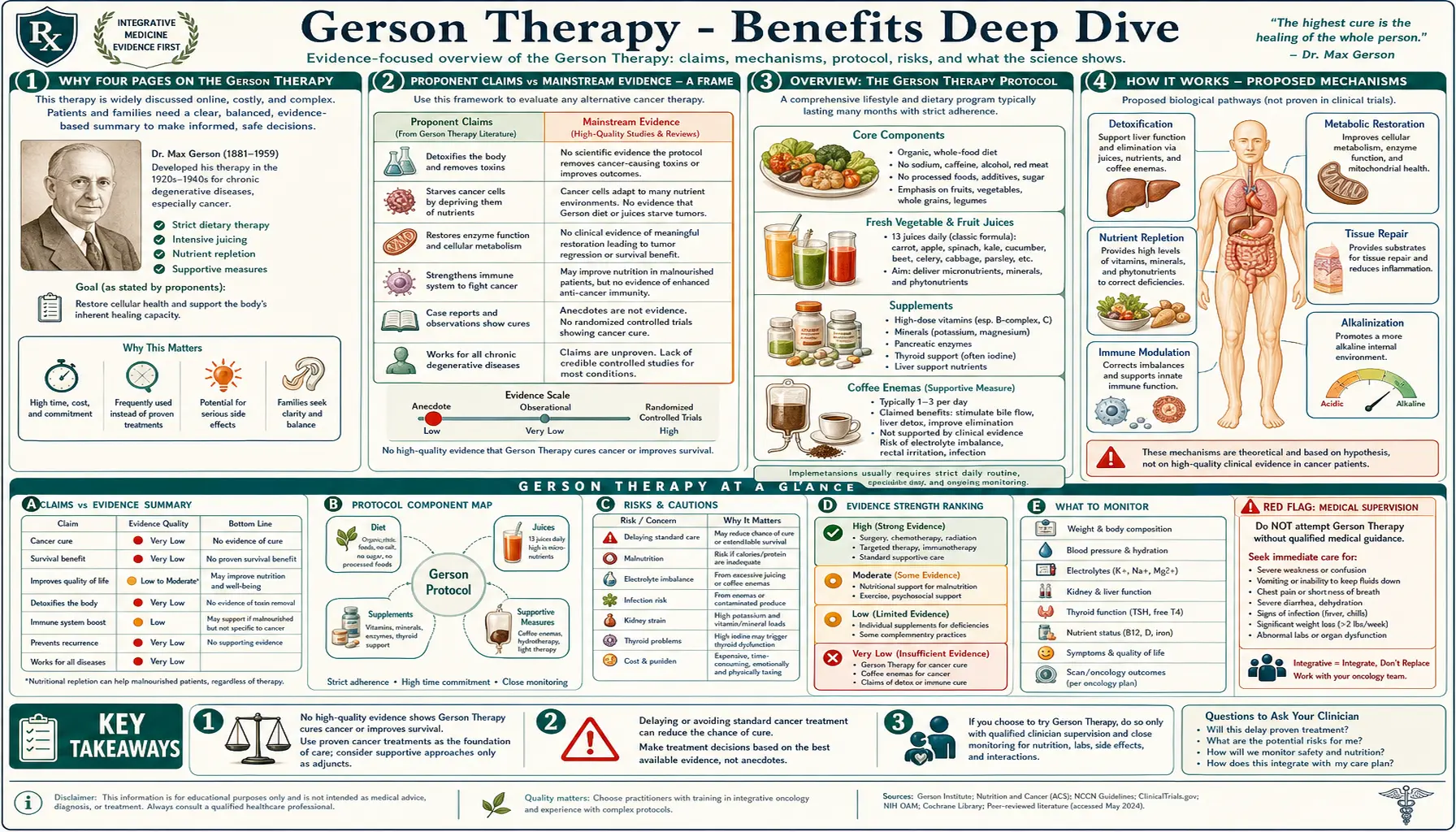
The Gerson Therapy is a 1930s nutritional and detoxification protocol developed by the German-American physician Max Gerson (1881–1959) to treat chronic disease through diet, fresh vegetable juice, and coffee enemas. Originally applied to tuberculosis, migraine, and lupus, it became best known and most contested for its application to advanced cancer. This Benefits Deep Dive examines the protocol's four most-discussed claimed mechanisms — the high-volume juicing regimen, the coffee-enema detoxification component, the high-potassium / low-sodium mineral balance, and the documentary and case-series evidence base — alongside the mainstream oncology critique. Pages below present proponent claims, the published primary literature (where it exists), and the substantial limitations recognized by independent reviewers including the American Cancer Society, the National Cancer Institute, and Cancer Research UK.
Deep-Dive Articles
Juicing Protocol
The 13-glass-per-day fresh juice regimen as the caloric and micronutrient backbone of the Gerson diet — carrot, apple, green leaf, and the signature "green juice" mix. Why Gerson insisted on a Norwalk-style press juicer rather than a centrifugal juicer (oxidation kinetics, polyphenol preservation), the bioavailability arguments, and the practical realities of preparing 13 glasses every day. Also covers the published research on carrot beta-carotene, leafy-green nitrate, and apple polyphenols that the protocol concentrates.
Coffee Enema Component
The most controversial element of the protocol — up to five coffee enemas per day, claimed to stimulate hepatic glutathione-S-transferase activity and bile flow. Reviews the mechanistic case (Wattenberg's 1980s lab work on caffeine and palmitates as Phase II inducers), the safety case-series (electrolyte deaths, colitis, septicemia, rectal burns), the historical Kellogg-era origins, and why mainstream gastroenterology rejects the protocol while a minority of integrative practitioners continue to use it.
Mineral Density and Sodium-Potassium
Gerson's "sodium-potassium hypothesis" of chronic disease — the claim that modern processed diets invert the evolutionary high-K/low-Na ratio and that restoring it reverses cellular dysfunction. Reviews the actual potassium content of the Gerson juicing regimen (8–10 g/day), the DASH-trial parallels, the contraindication in renal failure, and the substantial overlap with the modern evidence base on potassium intake, blood pressure, and stroke risk.
Documentary Evidence and Critique
The documentary record from Max Gerson's 1958 book "A Cancer Therapy: Results of Fifty Cases" through the 1990 Hildenbrand retrospective melanoma series in Alternative Therapies in Health and Medicine, to modern reviews by the National Cancer Institute, American Cancer Society, Cancer Research UK, and Memorial Sloan Kettering. Also covers the Senate Pepper-Neely hearings of 1946, Steve McQueen's 1980 treatment, and why the published evidence has been judged insufficient by every major mainstream oncology body.
Table of Contents
- Deep-Dive Articles
- Why Four Pages on the Gerson Therapy
- Proponent Claims vs Mainstream Evidence — A Frame
- Research Papers: Juicing, Micronutrients, and Plant Polyphenols
- Research Papers: Coffee Enemas and Hepatic Detoxification
- Research Papers: Potassium, Sodium, and Mineral Density
- Research Papers: Gerson Clinical Series and Mainstream Reviews
- External Authoritative Resources
- Connections
- Featured Videos
Why Four Pages on the Gerson Therapy
The Gerson Therapy is a unitary protocol — juicing, coffee enemas, raw food diet, supplements, and thyroid extract all together — but the public conversation around it has fragmented into four largely separate debates. Each debate has its own literature, its own mainstream-versus-heterodox split, and its own legitimate answer. Lumping them into a single page obscures more than it reveals.
- The juicing case has the broadest mainstream overlap. Heavy intake of fresh vegetable and fruit juice clearly delivers carotenoids, polyphenols, potassium, and folate at concentrations difficult to reach with whole-food chewing. The argument is about whether 13 glasses per day exceeds the dose that whole-food intake would deliver in a way that produces clinically meaningful effects in cancer or autoimmune disease — the Gerson position — or whether the same micronutrient profile could be achieved with a normal high-vegetable diet without the dental, glycemic, and time costs of juicing.
- The coffee-enema case is where mainstream gastroenterology is most directly opposed. The mechanistic claim (Phase II liver-enzyme induction via caffeine palmitates) rests on Wattenberg-era lab work and a small number of clinical observation studies. The harm case includes published deaths from electrolyte disturbance and septicemia. The American Cancer Society explicitly recommends against coffee enemas; some integrative practitioners use them anyway. This page presents both sides candidly.
- The mineral-density case — the high-potassium / low-sodium hypothesis — has actually become more mainstream over time, not less. The DASH trial, the INTERSALT epidemiology, the WHO 2012 potassium guideline (90 mmol / 3,500 mg per day for adults), and the modern stroke-prevention literature all support the directional claim that higher potassium and lower sodium intake reduces cardiovascular risk. Gerson's specific extrapolation to cancer reversal remains unproven, but the dietary direction overlaps substantially with modern cardiology.
- The clinical-evidence case — whether the Gerson Therapy actually treats cancer — is where mainstream oncology is most uniformly negative. The published primary literature consists of Gerson's own 1958 case series (50 patients, no controls), the 1990 Hildenbrand melanoma retrospective (54 patients, no randomized control), and a handful of case reports. The National Cancer Institute, American Cancer Society, Memorial Sloan Kettering, and Cancer Research UK all describe the evidence as insufficient. We present that consensus honestly.
The four-page structure lets readers weigh each claim on its own merits without the easy rhetorical move of accepting or rejecting the entire protocol because one piece of it is strong or weak.
Proponent Claims vs Mainstream Evidence — A Frame
Throughout these four pages we use a consistent rhetorical frame: this is what proponents claim, this is what the published primary literature shows, and this is where the mainstream consensus differs. The frame is deliberate. It is the same frame applied to any heterodox medical claim — whether Ignaz Semmelweis on puerperal fever in 1847, Barry Marshall on H. pylori in 1982, or Linus Pauling on intravenous vitamin C in the 1970s — some of which were eventually vindicated and some of which were not.
In the case of the Gerson Therapy, the historical record is genuinely mixed. The juicing and mineral-density components have moved closer to the mainstream over time. The coffee-enema component has not. The cancer-cure claim has not. Patients evaluating the protocol deserve to see all four pieces separately, with citations to the actual literature on each, rather than a binary recommendation from any direction.
One additional note on tone. The Gerson Therapy attracts strong feelings on both sides — advocates who credit it with personal remission and critics who view any positive coverage as endangering cancer patients. Both groups have legitimate concerns. We address the safety concerns candidly (coffee enemas have killed people; cancer patients abandoning effective treatment for the Gerson Therapy have died from disease progression). We also address the suppression concerns candidly (the Pepper-Neely hearings, the Bobst Memorial restrictions, the FDA actions against Gerson clinics). Neither narrative is the whole story, and readers are presumed capable of holding both.
Research Papers: Juicing, Micronutrients, and Plant Polyphenols
- Norwalk-style press juicing and polyphenol preservation versus centrifugal extraction — PubMed: Press vs centrifugal juicing
- Carrot beta-carotene bioavailability and matrix disruption by juicing — PubMed: Carrot juice bioavailability
- Leafy green nitrate, dietary nitric oxide, and endothelial function — PubMed: Leafy-green nitrate and NO
- Apple polyphenols (quercetin, chlorogenic acid) and antioxidant capacity — PubMed: Apple polyphenols
- Sulforaphane and isothiocyanates from cruciferous juice (cabbage, kale) — PubMed: Cruciferous sulforaphane
- Vegetable and fruit intake and cancer incidence: EPIC cohort — PubMed: EPIC vegetable/fruit cohort
- Juice fasting and short-term metabolic effects (gut microbiome shifts) — PubMed: Juice fast microbiome
- Concentrated fruit juice and dental enamel erosion risk — PubMed: Juice and dental erosion
- Plant-based diet and chronic disease risk — meta-analyses — PubMed: Plant-based diet meta-analyses
- Vegetable juice and glycemic load compared to whole vegetables — PubMed: Juice vs whole glycemic
Research Papers: Coffee Enemas and Hepatic Detoxification
- Wattenberg LW and colleagues on coffee palmitates and Phase II enzyme induction — PubMed: Wattenberg palmitate Phase II
- Caffeine and bile flow / cholecystokinin release — PubMed: Caffeine and bile flow
- Coffee enema fatalities and electrolyte deaths — case reports — PubMed: Coffee enema fatalities
- Proctocolitis and rectal burns from coffee enema use — PubMed: Coffee enema proctocolitis
- Septicemia from contaminated enema equipment — PubMed: Enema septicemia
- Coffee enema and serum cortisol / liver enzyme markers — clinical observation — PubMed: Coffee enema enzyme markers
- Glutathione-S-transferase induction by dietary coffee compounds (cafestol, kahweol) — PubMed: Cafestol Phase II induction
- American Cancer Society position statement against coffee enemas — PubMed: ACS coffee enema position
- Colonic irrigation safety review — Acosta & Cash — PubMed: Colonic irrigation review
- Hepatic glutathione biology and dietary modulation — PubMed: Hepatic glutathione
Research Papers: Potassium, Sodium, and Mineral Density
- WHO 2012 guideline on potassium intake (90 mmol / 3,500 mg per day) — PubMed: WHO potassium guideline
- DASH trial — dietary approaches to stop hypertension — PubMed: DASH trial
- INTERSALT study on cross-national sodium and blood pressure — PubMed: INTERSALT study
- Potassium intake and stroke incidence meta-analysis — PubMed: Potassium and stroke
- Sodium-potassium ratio as cardiovascular risk marker — PubMed: Na/K ratio mortality
- Hyperkalemia risk in chronic kidney disease and potassium-rich diets — PubMed: CKD hyperkalemia
- Magnesium intake and cardiovascular mortality — PubMed: Magnesium and CVD
- Paleolithic dietary potassium and ancestral Na/K ratio estimates — PubMed: Paleolithic Na/K
- Intracellular potassium and membrane potential biology — PubMed: Intracellular potassium
- Salt sensitivity of blood pressure and individual variation — PubMed: Salt sensitivity
Research Papers: Gerson Clinical Series and Mainstream Reviews
- Gerson M, A Cancer Therapy: Results of Fifty Cases (1958 monograph, frequently cited) — PubMed: Gerson 1958 monograph
- Hildenbrand GL et al., Five-year survival rates of melanoma patients treated by diet therapy (Alternative Therapies in Health and Medicine 1995) — PubMed: Hildenbrand melanoma
- Molassiotis A et al., A retrospective analysis of Gerson Therapy patients — PubMed: Molassiotis retrospective
- National Cancer Institute PDQ summary: Gerson Therapy — PubMed: NCI PDQ Gerson
- Memorial Sloan Kettering integrative medicine review of Gerson Therapy — PubMed: MSK Gerson review
- Cassileth BR, alternative cancer therapy review including Gerson — PubMed: Cassileth review
- Risberg T et al., use of alternative therapies by Norwegian cancer patients — PubMed: Risberg Norwegian survey
- American Cancer Society review of metabolic therapies (Gerson, Issels, Kelley) — PubMed: ACS metabolic therapy review
- Cope FW, on the mineral-deficiency hypothesis of cancer (1978, cited by Gerson advocates) — PubMed: Cope mineral hypothesis
- Ernst E, complementary and alternative cancer therapy systematic review — PubMed: Ernst systematic review
External Authoritative Resources
- National Cancer Institute — Gerson Therapy (PDQ Patient Version)
- Cancer Research UK — Gerson Therapy Overview
- Memorial Sloan Kettering — Gerson Regimen (Integrative Medicine)
- Gerson Institute — Official Proponent Organization (read alongside the mainstream reviews above)
- PubMed — All indexed research on Gerson Therapy
Connections
- All Remedies
- Gerson Therapy (Main Hub)
- Juicing Protocol
- Coffee Enema Component
- Mineral Density and Sodium-Potassium
- Documentary Evidence and Critique
- Gerson Diet Protocol
- Gerson Juicing
- Coffee Enemas
- Gerson and Cancer
- Research Evidence Summary
- History of Max Gerson
- Practical Guide
- Detox Protocols
- Liver Cleansing
- Anti-Inflammatory Diet
- Potassium